

 |
市場調查報告書
商品編碼
2125710
桌上型製冰機:市場佔有率分析、產業趨勢與統計、成長預測(2026-2031)Countertop Ice Makers - Market Share Analysis, Industry Trends & Statistics, Growth Forecasts (2026 - 2031) |
||||||

※ 本網頁內容可能與最新版本有所差異。詳細情況請與我們聯繫。
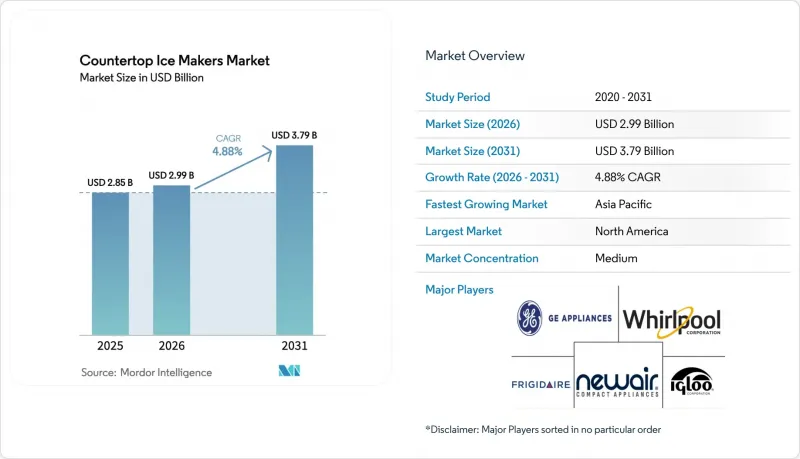
據 Mordor Intelligence 稱,2025 年台式製冰機市值為 28.5 億美元,預計到 2031 年將達到 37.9 億美元,而 2026 年為 29.9 億美元,預測期(2026-2031 年)的複合年成長率為 4.8%。
本報告按產品類型(子彈型製冰機、顆粒型製冰機及其他)、產能(日產低於26英鎊、26-40英鎊、40英鎊以上)、終端用戶(住宅和商用)、配銷通路(線上和線下)以及地區(北美、歐洲及其他)對市場進行細分。市場預測以美元計價。
全球檯式製冰機市場趨勢與洞察
緊湊型生活空間的增加推高了對可攜式家用電器的需求。
隨著都市區密度不斷增加,消費者越來越傾向於選擇面積較小的廚房,而這類廚房往往無法安裝嵌入式製冰機。千禧世代和Z世代的居住者喜歡輕巧的桌上型製冰機,這類製冰機可直接插入標準插座,並且在更換租約時可以輕鬆移動。美國能源局(DOE)2029年的能源標準保證了產品的能源效率達到基準水平,這鼓勵各品牌採用變速壓縮機和更厚的隔熱材料。這些因素正推動桌上型製冰機市場從奢侈品轉變為必需品,尤其是在都市區,每占地面積的年平均成本超過50美元。
消費者對便利性的偏好以及在家飲用飲料的文化
消費者對家庭調酒術、專門食品咖啡和氣泡水的需求不斷成長,也提高了他們對冰塊品質的期望。顆粒狀製冰機滿足了人們對有嚼勁冰塊的需求,這種冰塊非常適合冷萃咖啡和精釀雞尾酒。通用電氣家電的「Opal」系列體現了消費者對高級產品的購買意願,其零售價接近700美元的型號位列該品牌暢銷產品之列。消費者對精品飲品的持續關注,推動了桌上製冰機市場高階機型的兩位數成長。
由於現代冷藏庫整合了製冰機,需求下降。
目前,高階冷藏庫配備了球形冰塊和雙製冰系統,蠶食了富裕家庭對獨立製冰機的市場需求。 LG 的「Craft Ice」冷藏庫透過直接從冷凍室門供應緩融球形冰塊,對高階桌上型製冰機構成了挑戰。然而,桌上型製冰機則被定位為輔助產品,非常適合派對、露台和房車等場所,其優勢在於便攜性、製冰週期短以及獨特的顆粒狀冰塊。
細分市場分析
到2025年,子彈型製冰機將佔據桌上型製冰機市場45.03%的最大佔有率,這主要得益於其成熟的製造技術、8分鐘的快速初始冷凍週期以及低於150美元的價格。這個細分市場的目標客戶是公寓、學生宿舍和休息室等場所,這些場所通常偏好簡單的冰塊。顆粒型製冰機雖然產量較小,但其複合年成長率(CAGR)也達到了9.22%,吸引了那些願意為這種口感支付兩到三倍價格的消費者,這也促使了諸如GE的Opal 2.0等創新產品的開發,該產品配備了Wi-Fi定時功能和防燙過濾器。
專業級高階製冰機的目標客戶是調酒師,他們需要晶瑩剔透、厚度達 2 英寸的冰塊,以最大程度地減少陳年威士忌的稀釋。這些產品採用雙層冷凍室設計,有效消除氣泡,售價在 500 至 900 美元之間。雖然市場定位小眾,但這一品類正受益於精釀雞尾酒的蓬勃發展和 Instagram 的視覺文化。總體而言,產品多樣化推動了桌上型製冰機市場平均售價的上漲。
到2025年,日產量不超過26英鎊的桌上型製冰機將佔據38.12%的市場佔有率,滿足一般家庭的日常需求。日產量在26至40英鎊之間的機型專為小規模咖啡館設計,製冰週期為6分鐘,並配有可拆卸的儲冰盒,方便放置在檯面下方。
日產量超過 40 英鎊的型號是成長最快的群體,複合年成長率達 8.33%,吸引了那些優先考慮減少補貨頻率和持續服務的辦公室和餐車用戶。變速箱式冷凝器和 R290 冷媒降低了能耗,符合加州和歐盟的環保法規。對更大容量儲冰盒的需求表明小規模商業用途和住宅娛樂需求正在融合,這提高了人們對桌上型製冰機市場整體產能的預期。
區域分析
北美地區佔全球銷售額的36.62%,是全球需求的基礎。在美國,適合冷萃咖啡的顆粒狀冰塊較受歡迎,日產40磅的製冰機被辦公室用作自動販賣機冰袋的替代品。加拿大也出現了類似的趨勢,隨著墨西哥都市區公寓廚房面積的縮小,可攜式製冰機也開始被採用。明確的監管要求,例如美國食品藥物管理局(FDA)的食品級法規和美國能源部(DOE)的能源目標,正促使各品牌採用更安靜的壓縮機和食品安全的內部結構。
亞太地區是成長的主要驅動力。在中國,中產階級公寓的蓬勃發展帶動了首次購屋者的需求,而旗艦級桌上型製冰機也在「雙十一」購物節期間亮相各大商場。在印度,一些旅館業新創公司正在共同工作咖啡館安裝太陽能製冰機,以減少對地方政府不穩定的冰塊供應的依賴。在日本,人們對小型化電子產品的興趣日益濃厚,一款能在10分鐘內製出晶瑩剔透冰塊的產品正透過群眾集資資金籌措。在東協,可攜式製冰機在電力供應不穩定的海濱度假勝地需求旺盛。
歐洲市場銷售穩定且利潤豐厚。能源標章的修訂促使各大品牌著重宣傳其降低的千瓦時能耗,這引起了斯堪的納維亞地區環保意識強的消費者的共鳴。疫情後封鎖措施推動了英國家庭酒吧的蓬勃發展,也帶動了顆粒冰機的銷售;與此同時,西班牙沿海地區的酒吧為了應對遊客激增,紛紛安裝高功率製冰機。進口商面臨遵守新的水質標準的挑戰,這推高了認證成本,但合規性能夠增強品牌信心,並支撐桌上型製冰機市場的長期發展前景。
其他好處
- Excel格式的市場預測(ME)表
- 3個月的分析師支持
目錄
第1章:引言
- 研究假設和市場定義
- 調查範圍
第2章:調查方法
第3章執行摘要
第4章 市場狀況
- 市場概覽
- 市場促進因素
- 緊湊型生活空間的增加推高了對可攜式家用電器的需求。
- 消費者對便利性的偏好以及在家飲用飲料的文化
- 已在辦公室、休息室和小規模餐飲店等場所廣泛採用。
- 透過拓展電子商務管道,可得性。
- 房車生活和露營車社區對離網冰的需求
- 提高效率,從而實現太陽能桌上型單元
- 市場限制因素
- 由於現代冷藏庫整合了製冰機,對製冰機的需求減少了。
- 對運作噪音和可靠性的擔憂會影響消費者滿意度
- 新的水質法規導致合規成本增加
- 大量不符合標準的進口產品湧入,損害了品牌聲譽。
- 價值供應鏈分析
- 技術展望
- 監理情勢
- 波特五力模型
第5章 市場規模與成長預測
- 依產品類型
- 子彈形製冰機
- 金塊製冰機
- 高級透明製冰機
- 以產能計算
- 每天不到 26 英鎊
- 每天 26-40 英鎊
- 每天超過 40 英鎊
- 最終用戶
- 住宅
- 商用
- 小規模咖啡館和酒吧
- 辦公室和共享辦公空間
- 休閒車輛和船隻
- 透過分銷管道
- 離線
- 家用電器商店
- 大型零售商店
- 經銷商和經銷商網路
- 線上
- 電子商務市場
- 品牌官方網店
- 離線
- 按地區
- 北美洲
- 加拿大
- 美國
- 墨西哥
- 南美洲
- 巴西
- 秘魯
- 智利
- 阿根廷
- 其他南美國家
- 亞太地區
- 印度
- 中國
- 日本
- 澳洲
- 韓國
- 東南亞(新加坡、馬來西亞、泰國、印尼、越南、菲律賓)
- 其他亞太國家
- 歐洲
- 英國
- 德國
- 法國
- 西班牙
- 義大利
- 比荷盧經濟聯盟(比利時、荷蘭、盧森堡)
- 北歐國家(丹麥、芬蘭、冰島、挪威、瑞典)
- 其他歐洲國家
- 中東和非洲
- 阿拉伯聯合大公國
- 沙烏地阿拉伯
- 南非
- 奈及利亞
- 其他中東和非洲國家
- 北美洲
第6章 競爭情勢
- 市場集中度
- 策略趨勢
- 市佔率分析
- 公司簡介
- Whirlpool Corporation
- NewAir Appliances
- Frigidaire(Electrolux AB)
- Igloo(Nostalgia Products LLC)
- hOmeLabs(Aterian Inc.)
- GE Appliances(Haier)
- Scotsman(Ali Group)
- Manitowoc Ice(Welbilt Inc.)
- Vremi(Aterian Inc.)
- Magic Chef(Midea Group)
- EdgeStar(Living Direct)
- Della(SPT)
- Costway
- Dometic Group
- Luma Comfort(NewAir)
- Maxx Ice(Chef's Deal)
- SPT(Sunpentown)
- Sunpentown International
- Whynter
- Euhomy
- AGLUCKY
- Antarctic Star*
第7章 市場機會與未來展望
According to Mordor Intelligence, the countertop ice makers market size was valued at USD 2.85 billion in 2025 and estimated to grow from USD 2.99 billion in 2026 to reach USD 3.79 billion by 2031, at a CAGR of 4.88% during the forecast period (2026-2031).
This report Segments by Product Type (Bullet Ice Makers, Nugget Ice Makers and More), by Capacity (Up To 26 Lbs/Day, 26 - 40 Lbs/Day, and More), by End User (Residential, and Commercial), by Distribution Channel (Online, and Offline), and by Geography (North America, Europe, and More). The Market Forecasts are Provided in Terms of Value (USD).
Global Countertop Ice Makers Market Trends and Insights
Growth in Compact Living Spaces Pushing Demand for Portable Appliances
Urban densification drives consumers toward smaller kitchens where built-in dispensers do not fit. Millennials and Gen Z renters choose appliances they can move between leases, favoring lightweight countertop designs that plug into standard outlets. DOE's 2029 energy standards assure baseline efficiency, nudging brands to adopt variable-speed compressors and thicker insulation. These forces position the countertop ice maker market as a staple rather than a discretionary category, particularly in cities where floor-space costs top USD 50 per square foot annually.
Consumer Convenience Preference and At-Home Beverage Culture
Permanent shifts toward home mixology, specialty coffee, and sparkling water elevate ice quality expectations. Nugget machines meet demands for chewable texture ideal for cold brew and craft cocktails. GE Appliances' Opal line exemplifies premium willingness to pay, with models retailing near USD 700 and ranking among the brand's bestsellers. Continuing interest in gourmet beverages sustains double-digit growth for higher-spec units across the countertop ice maker market.
Integration of Ice Dispensers in Modern Refrigerators Reducing Need
High-end fridges now include craft-ice spheres and dual makers, eroding standalone demand in affluent households. LG's Craft Ice refrigerator supplies slow-melting spheres directly from the freezer door, challenging premium countertop units. However, countertop models counter with portability, faster cycle times, and specialty nugget formats, positioning themselves as complementary for parties, patios, and RVs.
Other drivers and restraints analyzed in the detailed report include:
- Rising Adoption in Offices, Breakrooms, and Small HoReCa Outlets
- E-commerce Channel Proliferation Improving Product Accessibility
- Operational Noise and Reliability Concerns Affecting Consumer Satisfaction
For complete list of drivers and restraints, kindly check the Table Of Contents.
Segment Analysis
Bullet units delivered the largest 45.03% countertop ice maker market share in 2025 on the back of mature manufacturing, 8-minute first-freeze cycles, and price points under USD 150. The segment serves apartments, dorms, and breakrooms that value straightforward cubes. Nugget machines, though smaller in volume, expand at 9.22% CAGR on the allure of chewable pellets that retain soda carbonation. Consumers pay 2- 3 times more for these textures, fueling innovation such as GE's Opal 2.0 with WiFi scheduling and scale-inhibiting filtration.
Specialized gourmet models aim at mixologists who require crystal-clear, 2-inch slabs that minimize dilution in aged whisky. Their double-wall freezing chambers force air bubbles out, selling at USD 500-900. Although niche, the category benefits from the craft-cocktail boom and Instagram visual culture. Collectively, product diversification sustains a climb in average selling price across the countertop ice maker market.
The Up to 26 lbs/day tier owned the largest slice of the countertop ice maker market size in 2025 at 38.12%, matching the daily needs of typical households. Units rated 26-40 lb/day bridge into small cafes, providing 6-minute cycles and removable bins that fit under counters.
Above-40 lb/day models, the fastest-growing group at 8.33% CAGR, entice offices and food trucks that prioritize fewer refills and continuous service. Variable-speed condensers and R290 refrigerant cut power draw, satisfying environmental codes in California and the EU. Demand for bigger bins indicates convergence between light commercial and residential entertaining trends and advances overall output expectations in the countertop ice maker market.
Complete Report Scope:
- By Product Type
- Bullet Ice Makers
- Nugget / Pea Ice Makers
- Gourmet / Clear Ice Makers
- By Capacity
- Up to 26 lbs / day
- 26 - 40 lbs / day
- Above 40 lbs / day
- By End User
- Residential
- Commercial
- Small Cafes and Bars
- Offices and Co-working Spaces
- Recreational Vehicles and Marine
- By Distribution Channel
- Offline
- Specialty Appliance Stores
- Big-Box Retailers
- Dealer and Distributor Networks
- Online
- E-commerce Marketplaces
- Brand-owned Webstores
- Offline
- By Geography
- North America
- Canada
- United States
- Mexico
- South America
- Brazil
- Peru
- Chile
- Argentina
- Rest of South America
- Asia-Pacific
- India
- China
- Japan
- Australia
- South Korea
- South East Asia (Singapore, Malaysia, Thailand, Indonesia, Vietnam, and Philippines)
- Rest of Asia Pacific
- Europe
- United Kingdom
- Germany
- France
- Spain
- Italy
- BENELUX (Belgium, Netherlands, and Luxembourg)
- NORDICS (Denmark, Finland, Iceland, Norway, and Sweden)
- Rest of Europe
- Middle East And Africa
- United Arab Emirates
- Saudi Arabia
- South Africa
- Nigeria
- Rest of Middle East And Africa
- North America
Geography Analysis
North America anchors global demand with a 36.62% slice of revenue. U.S. households value nugget textures for cold brew, while offices use 40 lb/day units to replace vending bags. Canada mirrors these patterns, and Mexico's urban condos adopt portable makers as kitchens shrink. FDA food-grade rules and DOE energy targets provide a clear regulatory landscape, nudging brands toward quieter compressors and food-safe interiors.
Asia-Pacific is the growth engine. China's middle-class apartment boom fuels first-time purchases, and malls showcase countertop ice maker market flagships during 11-11 shopping festivals. India's hospitality startups outfit co-working cafes with solar-ready makers, cutting reliance on erratic municipal ice deliveries. Japan's fascination with gadget miniaturization yields crowd-funded upgrades featuring 10-minute crystal-clear cycles. ASEAN economies add volume through beach resorts where portable machines offset unreliable grid power.
Europe contributes stable, margin-rich sales. Energy-label revisions push brands to advertise kilowatt-hour drops, resonating with eco-conscious Nordic consumers. The UK home-bar hobby, rising after pandemic lockdowns, sustains nugget sales, while Spain's coastal bars adopt high-output units to meet tourist surges. Importers must navigate emerging water-quality standards that raise certification costs, yet compliance enhances brand trust, sustaining long-run prospects across the countertop ice maker market.
- Whirlpool Corporation
- NewAir Appliances
- Frigidaire (Electrolux AB)
- Igloo (Nostalgia Products LLC)
- hOmeLabs (Aterian Inc.)
- GE Appliances (Haier)
- Scotsman (Ali Group)
- Manitowoc Ice (Welbilt Inc.)
- Vremi (Aterian Inc.)
- Magic Chef (Midea Group)
- EdgeStar (Living Direct)
- Della (SPT)
- Costway
- Dometic Group
- Luma Comfort (NewAir)
- Maxx Ice (Chef's Deal)
- SPT (Sunpentown)
- Sunpentown International
- Whynter
- Euhomy
- AGLUCKY
- Antarctic Star*
Additional Benefits:
- The market estimate (ME) sheet in Excel format
- 3 months of analyst support
TABLE OF CONTENTS
1 Introduction
- 1.1 Study Assumptions and Market Definition
- 1.2 Scope of the Study
2 Research Methodology
3 Executive Summary
4 Market Landscape
- 4.1 Market Overview
- 4.2 Market Drivers
- 4.2.1 Growth in compact living spaces pushing demand for portable appliances
- 4.2.2 Consumer convenience preference and at-home beverage culture
- 4.2.3 Rising adoption in offices, breakrooms, and small HoReCa outlets
- 4.2.4 E-commerce channel proliferation improving product accessibility
- 4.2.5 Van-life and RV community demand for off-grid ice (under-the-radar)
- 4.2.6 Efficiency gains enabling solar-powered countertop units (under-the-radar)
- 4.3 Market Restraints
- 4.3.1 Integration of ice dispensers in modern refrigerators reducing need
- 4.3.2 Operational noise and reliability concerns affecting consumer satisfaction
- 4.3.3 Emerging water-quality regulations increasing compliance costs (under-the-radar)
- 4.3.4 Influx of sub-standard imports eroding brand trust (under-the-radar)
- 4.4 Value / Supply-Chain Analysis
- 4.5 Technological Outlook
- 4.6 Regulatory Landscape
- 4.7 Porter's Five Forces
- 4.7.1 Threat of New Entrants
- 4.7.2 Bargaining Power of Suppliers
- 4.7.3 Bargaining Power of Buyers
- 4.7.4 Threat of Substitute Products
- 4.7.5 Competitive Rivalry
5 Market Size and Growth Forecasts
- 5.1 By Product Type
- 5.1.1 Bullet Ice Makers
- 5.1.2 Nugget / Pea Ice Makers
- 5.1.3 Gourmet / Clear Ice Makers
- 5.2 By Capacity
- 5.2.1 Up to 26 lbs / day
- 5.2.2 26 - 40 lbs / day
- 5.2.3 Above 40 lbs / day
- 5.3 By End User
- 5.3.1 Residential
- 5.3.2 Commercial
- 5.3.2.1 Small Cafes and Bars
- 5.3.2.2 Offices and Co-working Spaces
- 5.3.2.3 Recreational Vehicles and Marine
- 5.4 By Distribution Channel
- 5.4.1 Offline
- 5.4.1.1 Specialty Appliance Stores
- 5.4.1.2 Big-Box Retailers
- 5.4.1.3 Dealer and Distributor Networks
- 5.4.2 Online
- 5.4.2.1 E-commerce Marketplaces
- 5.4.2.2 Brand-owned Webstores
- 5.4.1 Offline
- 5.5 By Geography
- 5.5.1 North America
- 5.5.1.1 Canada
- 5.5.1.2 United States
- 5.5.1.3 Mexico
- 5.5.2 South America
- 5.5.2.1 Brazil
- 5.5.2.2 Peru
- 5.5.2.3 Chile
- 5.5.2.4 Argentina
- 5.5.2.5 Rest of South America
- 5.5.3 Asia-Pacific
- 5.5.3.1 India
- 5.5.3.2 China
- 5.5.3.3 Japan
- 5.5.3.4 Australia
- 5.5.3.5 South Korea
- 5.5.3.6 South East Asia (Singapore, Malaysia, Thailand, Indonesia, Vietnam, and Philippines)
- 5.5.3.7 Rest of Asia Pacific
- 5.5.4 Europe
- 5.5.4.1 United Kingdom
- 5.5.4.2 Germany
- 5.5.4.3 France
- 5.5.4.4 Spain
- 5.5.4.5 Italy
- 5.5.4.6 BENELUX (Belgium, Netherlands, and Luxembourg)
- 5.5.4.7 NORDICS (Denmark, Finland, Iceland, Norway, and Sweden)
- 5.5.4.8 Rest of Europe
- 5.5.5 Middle East And Africa
- 5.5.5.1 United Arab Emirates
- 5.5.5.2 Saudi Arabia
- 5.5.5.3 South Africa
- 5.5.5.4 Nigeria
- 5.5.5.5 Rest of Middle East And Africa
- 5.5.1 North America
6 Competitive Landscape
- 6.1 Market Concentration
- 6.2 Strategic Moves
- 6.3 Market Share Analysis
- 6.4 Company Profiles (includes Global level Overview, Market level overview, Core Segments, Financials as available, Strategic Information, Market Rank/Share for key companies, Products and Services, and Recent Developments)
- 6.4.1 Whirlpool Corporation
- 6.4.2 NewAir Appliances
- 6.4.3 Frigidaire (Electrolux AB)
- 6.4.4 Igloo (Nostalgia Products LLC)
- 6.4.5 hOmeLabs (Aterian Inc.)
- 6.4.6 GE Appliances (Haier)
- 6.4.7 Scotsman (Ali Group)
- 6.4.8 Manitowoc Ice (Welbilt Inc.)
- 6.4.9 Vremi (Aterian Inc.)
- 6.4.10 Magic Chef (Midea Group)
- 6.4.11 EdgeStar (Living Direct)
- 6.4.12 Della (SPT)
- 6.4.13 Costway
- 6.4.14 Dometic Group
- 6.4.15 Luma Comfort (NewAir)
- 6.4.16 Maxx Ice (Chef's Deal)
- 6.4.17 SPT (Sunpentown)
- 6.4.18 Sunpentown International
- 6.4.19 Whynter
- 6.4.20 Euhomy
- 6.4.21 AGLUCKY
- 6.4.22 Antarctic Star*
7 Market Opportunities & Future Outlook
- 7.1 White-space & unmet-need assessment

 2026年全球製冰機市場報告
 可攜式包裝機市場機會、成長促進因素、產業趨勢分析及2026-2035年預測
 可重複使用冰塊市場 - 全球產業規模、佔有率、趨勢、機會、預測:按應用、材料、分銷管道、地區和競爭格局分類,2021-2031年
 製冰冷藏庫市場報告:趨勢、預測與競爭分析(至2035年)
 製冰機市場規模、佔有率、趨勢和預測:按產品類型、最終用途和地區分類,2026-2034 年
 商用製冰機市場:2026-2032年全球市場預測(按型號、冷凝器類型、製冰能力、冰的類型、最終用戶和銷售管道)製冰機市場:2026-2032年全球市場預測(依產品、技術、製冰方法、運作狀態、產能、應用及通路分類)管式製冰機市場:依產品類型、產能、應用、終端用戶及通路分類-2026-2032年全球預測
 全球管式製冰機市場規模、佔有率、趨勢及成長分析報告(2026-2034年)桌上型製冰機市場-全球產業規模、佔有率、趨勢、機會和預測:按類型、應用、分銷管道、地區和競爭格局分類,2021-2031年