


 |
市場調查報告書
商品編碼
2125695
燈具照明:市場佔有率分析、產業趨勢與統計、成長預測(2026-2031)Lamps And Lighting - Market Share Analysis, Industry Trends & Statistics, Growth Forecasts (2026 - 2031) |
||||||

※ 本網頁內容可能與最新版本有所差異。詳細情況請與我們聯繫。
根據 Mordor Intelligence 估計,2026 年燈具和照明市場規模將達到 1,395.7 億美元,高於 2025 年的 1,341.4 億美元,預計到 2031 年將達到 1,702.5 億美元。
預計從 2026 年到 2031 年,其複合年成長率將達到 4.05%。
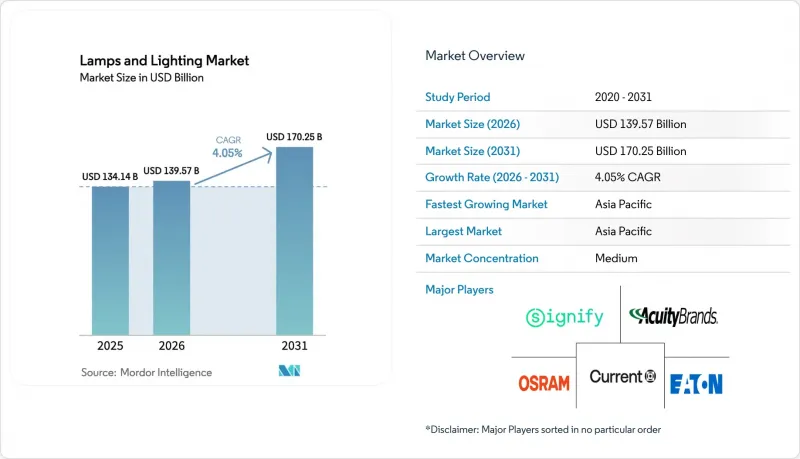
本報告按產品類型(檯燈/落地燈、吸頂燈/水晶燈、壁燈及其他)、光源類型(LED、螢光、白熾燈及其他)、應用類型(住宅、商業、工業/倉儲及其他)、地區(北美、南美及其他)和其他細分市場對行業進行分類。市場預測以美元計價。
全球燈具照明市場趨勢及洞察
LED燈替換需求激增
產業預測,到2024年,二次更換需求將達到58億件,隨著照明燈具接近其25,000至40,000小時的運作,更換需求預計將在2025年至2028年間達到高峰。消費者的偏好不再局限於簡單地更換為LED燈,而是越來越重視高顯色指數(CRI)、無線調光和語音控制等進階功能。儘管標準燈具的平均售價(ASP)持續下降,但消費者對高階功能的日益重視有助於價格穩定。此外,這一趨勢正在推動服務合約的普及,設施管理人員擴大選擇基於訂閱的模式,以確保現場設備的持續運作。這些趨勢凸顯了整個產業向更高附加價值解決方案和長期服務可靠性發展的趨勢。
政府正逐步淘汰螢光和鹵素燈。
加州將於2025年1月1日停止銷售螢光,歐盟的RoHS指令也將於2025年2月24日禁止販售含汞螢光。加拿大根據《水俁公約》的規定,將於2026年逐步淘汰螢光燈,這對照明市場而言是一項至關重要的監管措施。這些同步實施的禁令將迫使經銷商加快處理過時庫存,並加速向LED解決方案的過渡。該框架提供的監管確定性將使製造商能夠策略性地擴大其固體照明產品的產能,以滿足預期需求。這種跨區域的協調方法將確保低效照明技術的持續高效淘汰,並促進市場的長期可預測性。預計到2030年,這些措施將帶來顯著的節能效果,歐盟預計每年可節省34太瓦時(TWh)的電力,這將進一步加速市場向高效照明產品的轉型。
原物料價格上漲給LED利潤率帶來了壓力。
中國可能對鎵和鍺實施出口限制,預計將對半導體市場的成本結構產生重大影響。美國地質調查局(USGS)估計,這將導致GDP下降34億美元。美國計畫對稀土元素磁鐵徵收25%的關稅,進一步加劇了人們的擔憂,對供應鏈和價格走勢造成更大壓力。為了應對這些挑戰,LED製造商正在採取策略措施來降低風險,例如尋找替代來源、改進磷光體配方以及與回收公司合作。規模經濟效益有限的中小型市場參與企業可能面臨更大的財務壓力,這可能導致他們退出市場或進行產業結構調整。這些事態發展可能會加劇市場集中度,尤其是在中型企業領域,並改變產業的競爭格局。
細分市場分析
預計到2025年,LED燈具將佔總銷售額的63.45%,鞏固其在燈具和照明市場的主導地位。效率的持續提升、平均售價的下降以及日益成熟的智慧控制生態系統,都為其主導地位提供了支撐。其他光源(HID、OLED、雷射)的總合年成長率最高,達6.05%,主要針對LED尚未完全覆蓋的高功率、顯示器和專業細分市場。監管期限的臨近加速了螢光的衰落,而白熾燈和鹵素燈則僅用於裝飾或高發熱應用。隨著微型LED原型從展示實驗室走向通用照明的試生產線,技術融合的趨勢日益明顯。量子點顏色轉換和高顯色指數(CRI)磷光體混合物的出現,使得LED產品的色彩品質能夠達到甚至超越鹵素燈,從而消除了全面普及的最後障礙。日亞化學工業株式會社的H6系列LED實現了高效率和Ra 90或更高的顯色指數,為設計師提供了高級產品選擇。鑑於這些技術進步,LED燈具和照明市場預計將穩定成長。此外,供應商正在提供整合藍牙和Matter晶片的產品,從而降低了智慧家庭生態系統的整合成本。隨著全光譜和可調光白光照明選擇的增多,LED有望逐步蠶食專業光源的市場佔有率,並鞏固其作為標準平台的地位。
到2025年,吸頂燈和水晶燈將佔全球銷售額的31.30%,它們作為基礎照明設備,在建築能源戰略中仍將佔據核心地位。照明設備製造商正將感測器和無線通訊功能直接整合到筒燈和下照燈中,而天花板網格正逐漸成為用於人員檢測和自然光利用的數位神經系統。檯燈和落地燈雖然規模較小,但隨著遠距辦公的普及和消費者對個人化工作照明的需求,預計將以5.05%的複合年成長率實現最高成長。在容易停電的季節,配備備用電池和無線充電插槽的可攜式設計將成為高級產品的差異化優勢。壁掛式和軌道式照明系統在飯店和零售業蓬勃發展,重點照明能夠塑造品牌形象。雖然燈泡插座仍符合維修安裝的需求,但燈具的外型正轉向配備標準可調色溫LED的燈具。燈具和照明市場正持續轉型,從替換普通燈泡轉向能夠與語音助理無縫整合的智慧照明設備。該產品的模組化設計,例如可更換的驅動器和可升級的通訊晶片,延長了其使用壽命,並符合歐盟關於「維修權」的新興法規。
區域分析
預計到2025年,亞太地區將引領全球燈具和照明市場,佔全球總銷售額的35.60%,並將在2031年之前以5.45%的複合年成長率推動市場成長。中國在供需兩端都發揮重要作用,其九江工廠擁有192條LED燈俱生產線。該地區受益於智慧城市的大力發展和政府支持的LED採購,但其對稀土元素的依賴也帶來了地緣政治風險。日本透過推動高顯色性(CRI)雷射和微型LED構裝的發展,保持其在光電領域的創新地位。繼印度的「UJALA」計畫之後,一系列補貼計畫以及東南亞的都市化也促進了基礎銷售的成長。
在北美,受監管合規性驅動的強勁勢頭仍在持續。加州禁止使用螢光以及美國能源局提高流明/瓦特基準值,導致市場對固體光源的需求集中。紐約市第88號地方法律強制要求房東今年升級照明設備,造成PoE(電力傳輸)和智慧感測器照明設備的訂單積壓。儘管存在政治阻力(參議院經常出現放寬白熾燈使用限制的提案),但州級政策仍發揮決定性作用。
在歐洲,永續性正透過2024/1781號生態設計法規推廣,該法規強制要求產品的可維修性和可回收性。 2025年汞燈禁令已全面生效,迫使繼續使用螢光的企業進行更換。 CEN-CENELEC標準現在強調數位介面,使新型照明設備能夠從一開始就與建築管理軟體整合。在新興的東歐市場,LED照明的普及率正在不斷提高,這得益於歐盟為支持市政LED路燈計畫提供的資金。
其他好處
- Excel格式的市場預測(ME)表
- 3個月的分析師支持
目錄
第1章:引言
- 研究假設和市場定義
- 調查範圍
第2章:調查方法
第3章執行摘要
第4章 市場狀況
- 市場概覽
- 市場促進因素
- LED燈替換需求激增
- 主要經濟體政府主導的螢光和鹵素燈逐步淘汰計劃
- 商業地產快速維修計畫(後新冠疫情時代的ESG要求)
- 透過整合乙太網路供電 (PoE) 和智慧建築技術,加速照明設備的更換。
- 受控環境農業(CEA)的發展正在推動園藝照明市場的發展。
- 利用微型LED和人性化的照明技術,開發高價利基市場。
- 市場限制因素
- 原物料價格上漲給LED利潤率帶來了壓力。
- 與重要稀土元素磷光體相關的供應鏈風險
- 由於維修標準不一致而導致的互通性問題
- 美國部分地區立法機構反對禁止使用白熾燈泡
- 產業價值鏈分析
- 波特五力分析
- 洞察最新市場趨勢與創新
- 洞察近期市場趨勢(新產品發布、策略性舉措、投資、合作、合資、業務擴張、併購等)
第5章 市場規模與成長預測
- 按產品(安裝位置和形式)
- 檯燈和落地燈
- 吸頂燈和水晶燈
- 壁掛式照明燈具
- 燈泡和照明燈具
- 其他產品(現貨型、車載型、可攜式等)
- 透過光源
- LED
- 螢光
- 白熾燈
- 鹵素燈
- 其他光源(HID、OLED、雷射等)
- 透過使用
- 住宅
- 商業設施(辦公大樓、零售店、飯店)
- 工業和倉儲
- 戶外和公共基礎設施
- 園藝和農業
- 內科/外科
- 其他
- 透過分銷管道
- B2C/零售通路
- 大賣場和超級市場
- 家居建材商店
- 燈具專賣店
- 線上
- 其他
- B2B/直銷和項目
- B2C/零售通路
- 按地區
- 北美洲
- 加拿大
- 美國
- 墨西哥
- 南美洲
- 巴西
- 秘魯
- 智利
- 阿根廷
- 其他南美國家
- 歐洲
- 英國
- 德國
- 法國
- 西班牙
- 義大利
- 比荷盧經濟聯盟
- 北歐的
- 其他歐洲國家
- 亞太地區
- 印度
- 中國
- 日本
- 澳洲
- 韓國
- 東南亞
- 其他亞太國家
- 中東和非洲
- 阿拉伯聯合大公國
- 沙烏地阿拉伯
- 南非
- 奈及利亞
- 其他中東和非洲國家
- 北美洲
第6章 競爭情勢
- 市場集中度
- 策略性措施與併購分析
- 市佔率分析
- 公司簡介
- Signify(Philips Lighting)
- Acuity Brands
- Osram Licht AG
- GE Current(Daintree)
- Eaton(Copper Lighting)
- Cree Lighting
- Hubbell Lighting
- Zumtobel Group
- Nichia Corporation
- Samsung Electronics(LED)
- Panasonic Lighting
- Legrand SA
- Wipro Lighting
- Havells India
- Bajaj Electricals
- Thorn Lighting
- Fagerhult Group
- Delta Electronics
- Syska LED
- Luxxbox
- LumiGrow(Horticulture)
- Heliospectra
第7章 市場機會與未來展望
According to Mordor Intelligence, lamps and lighting market size in 2026 is estimated at USD 139.57 billion, growing from 2025 value of USD 134.14 billion with 2031 projections showing USD 170.25 billion, growing at 4.05% CAGR over 2026-2031.
This report Segments the Industry Into by Product (Table & Floor Lamps, Ceiling Lights & Chandeliers, Wall-Mounted Fixtures, and More), by Light Source (LED, Fluorescent, Incandescent, and More), by Application (Residential, Commercial, Industrial & Warehouse, and More), by Geography (North America, South America, and More), and More Segments. The Market Forecasts are Provided in Terms of Value (USD).
Global Lamps And Lighting Market Trends and Insights
Surging secondary-replacement demand for LED lamps
The industry forecasts a secondary-replacement demand of 5.8 billion units in 2024, with peak replacement activity anticipated between 2025 and 2028 as fixtures approach their operational lifespans of 25,000-40,000 hours . Consumer preferences have shifted beyond basic LED replacements, with increasing demand for advanced features such as higher color rendering index (CRI), wireless dimming capabilities, and voice-activated controls. This growing emphasis on premium functionalities has contributed to price stabilization, even as the average selling prices (ASPs) for standard lamps continue to decline. Additionally, the trend has driven the adoption of service contracts, as facility managers increasingly opt for subscription-based models that ensure consistent on-site operational uptime. These developments highlight a broader industry movement toward value-added solutions and long-term service reliability.
Government-mandated fluorescent & halogen phase-outs
California halted fluorescent sales on 1 January 2025, while the EU's RoHS directive banned mercury-containing fluorescents on 24 February 2025 . Canada's implementation of its Minamata Convention-aligned phase-out in 2026 represents a pivotal regulatory development for the lighting market. These synchronized bans will necessitate that channel partners accelerate the clearance of outdated inventory and fully transition to LED-based solutions. The regulatory certainty provided by this policy framework allows manufacturers to strategically scale their solid-state production capacities to meet anticipated demand. This harmonized approach across regions ensures a consistent and efficient phase-out of less efficient lighting technologies, fostering long-term market predictability. By 2030, these measures are projected to deliver significant energy savings, with the European Union expected to conserve 34 TWh of electricity annually, reinforcing the market's shift toward high-efficiency lighting products.
Commodity-price pressure eroding LED margins
China's potential export restrictions on gallium and germanium are expected to significantly impact the cost structures within the semiconductor market, with the USGS estimating a potential GDP loss of USD 3.4 billion. The planned 25% tariffs by the United States on rare-earth magnets further exacerbate concerns, creating additional pressure on supply chains and pricing dynamics. In response to these challenges, LED manufacturers are adopting strategic measures such as securing alternative supply sources, modifying phosphor formulations, and forming partnerships with recycling firms to mitigate risks. Smaller market participants, constrained by limited economies of scale, may face heightened financial pressures, leading to potential market exits or consolidation activities. Such developments could result in increased market concentration, particularly within mid-tier segments, altering competitive dynamics in the industry.
Other drivers and restraints analyzed in the detailed report include:
- Rapid retrofit programs in commercial real estate
- PoE and smart-building integration
- Supply-chain risks for rare-earth phosphors
For complete list of drivers and restraints, kindly check the Table Of Contents.
Segment Analysis
The LED segment accounted for 63.45% of 2025 revenue, underscoring its status as the mainstream engine of the lamps and lighting market. Continuous efficiency gains, declining ASPs, and maturing smart-control ecosystems sustain its leadership. Other Light Sources-HID, OLED, and laser-collectively deliver the swiftest 6.05% CAGR by serving high-power, display, and specialty niches that LEDs do not yet fully cover. Regulatory deadlines hasten fluorescent decline, while incandescent and halogen lights persist only in decorative or high-heat applications. Technology convergence is evident as micro-LED prototypes transition from display labs to general illumination pilot lines.Quantum-dot color-conversion and high-CRI phosphor blends now enable LED products to match or surpass halogen color quality, eroding remaining barriers to full adoption. Nichia's H6 series delivers Ra >= 90 at high efficacy, widening the premium range available to designers. The lamps and lighting market size for LEDs is projected to expand at a steady pace, given these technical advances. Suppliers also bundle embedded Bluetooth or Matter chips, lowering integration costs for smart-home ecosystems. As full-spectrum and tunable white options proliferate, LEDs are set to capture incremental share from specialized sources, reinforcing their position as the reference platform.
Ceiling Lights & Chandeliers contributed 31.30% of worldwide revenue in 2025 and remain central to building energy strategies because they provide baseline illumination. Fixture OEMs integrate sensors and radios directly into troffers and downlights, making the ceiling grid the digital nervous system for occupancy and daylight harvesting. Table & Floor Lamps, though smaller, are on track for the quickest 5.05% CAGR as remote work normalizes and consumers seek personalized task lighting. Portable designs with battery backup and wireless charging slots differentiate premium offerings during blackout-prone weather seasons.Wall-mounted and track systems flourish in hospitality and retail where accent lighting shapes brand ambience. Light-bulb sockets still support retrofit demand, but form factors shift toward lamps that natively host color-tunable LEDs. The lamps and lighting market continues to pivot from commodity bulb replacement to connected luminaires that integrate seamlessly with voice assistants. Product modularity-such as replaceable drivers and upgradable communication chips-extends life cycles and aligns with emerging right-to-repair statutes in the EU.
Complete Report Scope:
- By Product (Placement & Form-factor)
- Table & Floor Lamps
- Ceiling Lights & Chandeliers
- Wall-Mounted Fixtures
- Light Bulbs & Fittings
- Other Products (Spot, Track, Portable etc.)
- By Light Source
- LED
- Fluorescent
- Incandescent
- Halogen
- Other Light Sources (HID, OLED, laser, etc.)
- By Application
- Residential
- Commercial (Offices, Retail, Hospitality)
- Industrial & Warehouse
- Outdoor & Public Infrastructure
- Horticulture & Agriculture
- Healthcare & Surgical
- Other Applications
- By Distribution Channel
- B2C/Retail Channels
- Hypermarkets and Supermarkets
- Home Centers
- Specialty Lighting Stores
- Online
- Other Distribution Channels
- B2B/Direct Sales & Projects
- B2C/Retail Channels
- By Geography
- North America
- Canada
- United States
- Mexico
- South America
- Brazil
- Peru
- Chile
- Argentina
- Rest of South America
- Europe
- United Kingdom
- Germany
- France
- Spain
- Italy
- BENELUX
- NORDICS
- Rest of Europe
- Asia-Pacific
- India
- China
- Japan
- Australia
- South Korea
- South East Asia
- Rest of Asia-Pacific
- Middle East and Africa
- United Arab Emirates
- Saudi Arabia
- South Africa
- Nigeria
- Rest of Middle East and Africa
- North America
Geography Analysis
Asia-Pacific led with 35.60% of global revenue in 2025 and will pace the lamps and lighting market at a 5.45% CAGR through 2031. China anchors both supply and demand, with the Jiujiang factory featuring 192 lines dedicated to LED lamps. The region benefits from aggressive smart-city deployments and governmental LED procurement, although rare-earth dependence introduces geopolitical risk. Japan advances high-CRI lasers and micro-LED packages, sustaining its reputation as a photonics innovator. India's UJALA-successor subsidy programs and Southeast Asian urbanization also expand baseline volumes.
North America maintains strong compliance-driven momentum. California's fluorescent ban and the US Department of Energy's increasing lumen-per-watt thresholds funnel demand into solid-state options. Local Law 88 in New York City obliges landlords to finalize upgrades this year, driving a project backlog for PoE and smart-sensor fixtures. Although political pushback exists-Senate proposals to restore incandescent freedom emerge periodically-state-level policies remain decisive.
Europe champions sustainability through 2024/1781 Eco-design rules that enforce reparability and recyclability. The 2025 mercury-lamp ban is fully in force, compelling late-stage fluorescent holdouts to convert. CEN-CENELEC standards now emphasize digital interfaces, ensuring new luminaires can integrate with building management software from day one. Emerging Eastern markets benefit from EU funding that supports municipal LED streetlights, widening regional adoption.
- Signify (Philips Lighting)
- Acuity Brands
- Osram Licht AG
- GE Current (Daintree)
- Eaton (Copper Lighting)
- Cree Lighting
- Hubbell Lighting
- Zumtobel Group
- Nichia Corporation
- Samsung Electronics (LED)
- Panasonic Lighting
- Legrand SA
- Wipro Lighting
- Havells India
- Bajaj Electricals
- Thorn Lighting
- Fagerhult Group
- Delta Electronics
- Syska LED
- Luxxbox
- LumiGrow (Horticulture)
- Heliospectra
Additional Benefits:
- The market estimate (ME) sheet in Excel format
- 3 months of analyst support
TABLE OF CONTENTS
1 Introduction
- 1.1 Study Assumptions & Market Definition
- 1.2 Scope of the Study
2 Research Methodology
3 Executive Summary
4 Market Landscape
- 4.1 Market Overview
- 4.2 Market Drivers
- 4.2.1 Surging secondary-replacement demand for LED lamps
- 4.2.2 Government-mandated fluorescent & halogen phase-outs in major economies
- 4.2.3 Rapid retrofit programs in commercial real estate (post-COVID ESG mandates)
- 4.2.4 Power Over Ethernet (PoE) and smart-building integration accelerating fixture upgrades
- 4.2.5 Growth of controlled-environment agriculture (CEA) driving horticultural lighting
- 4.2.6 Micro-LED & human-centric lighting unlocking premium pricing niches
- 4.3 Market Restraints
- 4.3.1 Commodity-price pressure eroding LED margins
- 4.3.2 Supply-chain risks for critical rare-earth phosphors
- 4.3.3 Fragmented retrofit standards causing interoperability issues
- 4.3.4 Legislative pushback on incandescent bans in parts of the U.S.
- 4.4 Industry Value Chain Analysis
- 4.5 Porter's Five Forces Analysis
- 4.5.1 Threat of New Entrants
- 4.5.2 Bargaining Power of Suppliers
- 4.5.3 Bargaining Power of Buyers
- 4.5.4 Threat of Substitutes
- 4.5.5 Competitive Rivalry
- 4.6 Insights into the Latest Trends and Innovations in the Market
- 4.7 Insights on Recent Developments (New Product Launches, Strategic Initiatives, Investments, Partnerships, JVs, Expansion, M&As, etc.) in the Market
5 Market Size & Growth Forecasts
- 5.1 By Product (Placement & Form-factor)
- 5.1.1 Table & Floor Lamps
- 5.1.2 Ceiling Lights & Chandeliers
- 5.1.3 Wall-Mounted Fixtures
- 5.1.4 Light Bulbs & Fittings
- 5.1.5 Other Products (Spot, Track, Portable etc.)
- 5.2 By Light Source
- 5.2.1 LED
- 5.2.2 Fluorescent
- 5.2.3 Incandescent
- 5.2.4 Halogen
- 5.2.5 Other Light Sources (HID, OLED, laser, etc.)
- 5.3 By Application
- 5.3.1 Residential
- 5.3.2 Commercial (Offices, Retail, Hospitality)
- 5.3.3 Industrial & Warehouse
- 5.3.4 Outdoor & Public Infrastructure
- 5.3.5 Horticulture & Agriculture
- 5.3.6 Healthcare & Surgical
- 5.3.7 Other Applications
- 5.4 By Distribution Channel
- 5.4.1 B2C/Retail Channels
- 5.4.1.1 Hypermarkets and Supermarkets
- 5.4.1.2 Home Centers
- 5.4.1.3 Specialty Lighting Stores
- 5.4.1.4 Online
- 5.4.1.5 Other Distribution Channels
- 5.4.2 B2B/Direct Sales & Projects
- 5.4.1 B2C/Retail Channels
- 5.5 By Geography
- 5.5.1 North America
- 5.5.1.1 Canada
- 5.5.1.2 United States
- 5.5.1.3 Mexico
- 5.5.2 South America
- 5.5.2.1 Brazil
- 5.5.2.2 Peru
- 5.5.2.3 Chile
- 5.5.2.4 Argentina
- 5.5.2.5 Rest of South America
- 5.5.3 Europe
- 5.5.3.1 United Kingdom
- 5.5.3.2 Germany
- 5.5.3.3 France
- 5.5.3.4 Spain
- 5.5.3.5 Italy
- 5.5.3.6 BENELUX
- 5.5.3.7 NORDICS
- 5.5.3.8 Rest of Europe
- 5.5.4 Asia-Pacific
- 5.5.4.1 India
- 5.5.4.2 China
- 5.5.4.3 Japan
- 5.5.4.4 Australia
- 5.5.4.5 South Korea
- 5.5.4.6 South East Asia
- 5.5.4.7 Rest of Asia-Pacific
- 5.5.5 Middle East and Africa
- 5.5.5.1 United Arab Emirates
- 5.5.5.2 Saudi Arabia
- 5.5.5.3 South Africa
- 5.5.5.4 Nigeria
- 5.5.5.5 Rest of Middle East and Africa
- 5.5.1 North America
6 Competitive Landscape
- 6.1 Market Concentration
- 6.2 Strategic Moves & M&A Analysis
- 6.3 Market Share Analysis
- 6.4 Company Profiles (includes Global level Overview, Market level overview, Core Segments, Financials as available, Strategic Information, Market Rank/Share for key companies, Products & Services, Recent Developments)
- 6.4.1 Signify (Philips Lighting)
- 6.4.2 Acuity Brands
- 6.4.3 Osram Licht AG
- 6.4.4 GE Current (Daintree)
- 6.4.5 Eaton (Copper Lighting)
- 6.4.6 Cree Lighting
- 6.4.7 Hubbell Lighting
- 6.4.8 Zumtobel Group
- 6.4.9 Nichia Corporation
- 6.4.10 Samsung Electronics (LED)
- 6.4.11 Panasonic Lighting
- 6.4.12 Legrand SA
- 6.4.13 Wipro Lighting
- 6.4.14 Havells India
- 6.4.15 Bajaj Electricals
- 6.4.16 Thorn Lighting
- 6.4.17 Fagerhult Group
- 6.4.18 Delta Electronics
- 6.4.19 Syska LED
- 6.4.20 Luxxbox
- 6.4.21 LumiGrow (Horticulture)
- 6.4.22 Heliospectra
7 Market Opportunities & Future Outlook
- 7.1 Accelerating transition to energy-efficient lighting
- 7.2 Modular, personalized, and flexible lighting is becoming mainstream
- 7.3 New models such as "Lighting as a Service (LAAS)" gaining traction

 天花板照明及水晶燈:市場佔有率分析、產業趨勢及統計數據、成長預測(2026-2031)
 障礙指示燈市場:全球市場預測,2026-2032年
 全球燈具照明市場規模、佔有率、趨勢及成長分析報告(2026-2034)
 垂直農業照明系統市場:預測至2034年-按光源、頻譜、安裝、應用和區域分類的全球分析
 2026-2030年全球照明市場印度照明市場:市場佔有率分析、產業趨勢與統計、成長預測(2026-2031)全球通用照明市場規模、佔有率、趨勢和成長分析報告(2026-2034年)
 燈具照明市場機會、成長要素、產業趨勢分析及2026-2035年預測。
 垂直農業照明市場規模、佔有率和趨勢分析報告:按組件、照明類型、農場類型、安裝類型、作物類型、最終用途、地區和細分市場預測(2026-2033 年)
 基礎設施照明市場-全球產業規模、佔有率、趨勢、機會和預測:按技術、產品、應用、地區和競爭格局分類,2021-2031年