


 |
市場調查報告書
商品編碼
2125667
工業爐:市場佔有率分析、產業趨勢與統計、成長預測(2026-2031)Industrial Furnace - Market Share Analysis, Industry Trends & Statistics, Growth Forecasts (2026 - 2031) |
||||||

※ 本網頁內容可能與最新版本有所差異。詳細情況請與我們聯繫。
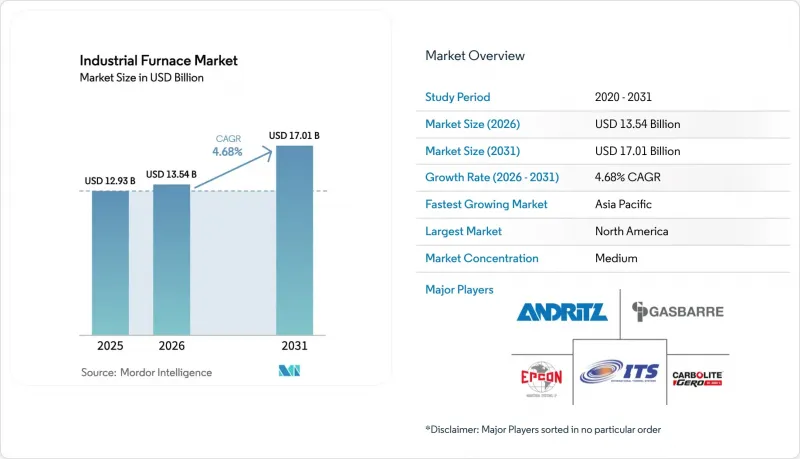
預計工業爐市場將從 2025 年的 129.3 億美元成長到 2026 年的 135.4 億美元,然後從 2026 年到 2031 年以 4.68% 的複合年成長率成長,到 2031 年達到 170.1 億美元。
本報告按爐型(燃氣/燃料輥底爐、電輥底爐等)、結構/形式(箱式/腔式/高溫爐、管式/翻蓋式等)、加熱方式(燃燒、電阻加熱等)、溫度範圍(低於1000 度C等)、終端用戶行業(化工、金屬和採礦等)以及地區進行細分。市場預測以美元(USD)計價。
全球工業爐市場趨勢與洞察
汽車製造業對熱處理的需求激增
向電動車 (EV) 生產轉型正在重塑全球組裝廠的熱處理要求。電池外殼、牽引馬達鐵芯和輕量化車身結構需要採用能夠最大限度減少變形並滿足更嚴格公差的熱處理過程。因此,汽車製造商正在指定使用具備快速冷卻能力、惰性氣氛和封閉回路型控制功能的爐子,這些爐子能夠記錄每個循環,以符合 ISO 26262 標準。整合預測性維護分析的供應商正在提高運轉率、降低整體擁有成本,並增強其在長期採購合約中的競爭競標。
加大對金屬和採礦業產能擴張的投資
中國、印度和海灣合作理事會(GCC)的鋼鐵和非鐵金屬製造商正在建造和維修現有設施,以滿足基礎設施建設和能源轉型支出需求。鼓勵使用電弧爐(EAF)取代傳統高爐的政策正在推動替代需求,同時,低品位礦石的加工也增加了對配備先進耐火材料襯裡和富氧氣氛的高爐的需求,這些高爐能夠在保持加工能力的同時降低能耗。模組化工廠使營運商能夠分階段進行資本投資,並適應未來的產品週期。
運作溫度超過 1500 度C的設施需要高昂的資本和營運成本。
安裝超高溫爐的成本超過1000萬美元,佔工廠營運預算的15%至20%。先進的耐火材料、客製化合金和增強型安全系統推高了初始投資成本,而全球專精於超高溫操作的工程師短缺又推高了人事費用。保險費和嚴格的授權程序進一步增加了間接成本,延長了投資回收期,並阻礙了中小企業採用這項技術。
細分市場分析
隨著歐洲和日本的政策框架強制推行碳中和製程熱,預計到2031年,氫能燃燒設計將以6.59%的複合年成長率成長,成為成長最快的細分市場。然而,燃氣/燃料輥底爐因其可靠性和現有基礎設施的優勢,即使到2025年仍保持著44.10%的工業爐市場佔有率。混合燃燒器能夠分階段取代氫氣,拓寬使用者選擇,並確保現有設備在過渡期內保持高效運作。
在可再生能源豐富的地區,電輥底爐的日益普及促使原始設備製造商(OEM)合作開發高功率變壓器和先進的磁場控制系統,以減少能量損耗。感應加熱系統仍然是需要快速加熱和精確溫度梯度的特殊冶金應用的最佳選擇。同時,在利用聚光型太陽熱能發電生產特殊陶瓷的高輻照度地區,太陽能爐佔據了一個前景廣闊但仍在發展中的細分市場。
至2025年,箱型/腔室式/高溫爐爐將佔工業爐市場規模的37.45%,主要應用於金屬、機械和陶瓷業的批量加工。隨著連續流佈局的普及,物料停留時間和能耗顯著降低,管式/翻蓋式爐的複合年成長率將達到6.51%。在重型機械製造領域,由於超大型鑄件需要可靠的物料輸送解決方案,底裝式和底部裝料式爐仍然十分重要。
真空和可控氣氛系統在航太和半導體後端製程中市場佔有率不斷擴大,這反映了對無污染表面監管鏈的要求。在工業爐產業,無需長期現場維護即可擴大生產規模的即插即用型撬裝設備如今備受青睞,這符合精益生產的原則,也契合了中型供應商日益成長的資本風險規避趨勢。
區域分析
預計到2025年,北美將佔工業爐市場佔有率的35.10%。這主要得益於美國汽車和航太產業強勁的熱處理訂單,以及對美國能源部最新標準的遵守。諸如紐柯公司投資30億美元的電弧爐(EAF)項目和加拿大礦業投資等擴張項目,正在推動高容量設備的潛在需求。熟練的技術人員為售後服務業務收益提供了支持,但天然氣和電力價格的波動仍然是企業關注的重點。
亞太地區以6.24%的複合年成長率領跑,主要得益於中國鋼鐵業的現代化改造,中國正以電弧爐(EAF)取代老舊的高爐;以及印度的生產連結獎勵計畫(PLI)計劃,該計劃加速了對機械和電子設備生產能力的資本投資。作為氫能冶金技術的先驅,日本已撥款3,294億日圓用於升級其高爐,以符合其2035年的氣候目標。韓國、新加坡和澳洲正透過擴大半導體後端製程和礦物加工生產線來推動該地區的成長。
歐洲憑藉對氣候政策的堅持,維持中等個位數的成長。德國正投入公共研究津貼研發氫氣燃燒器,而義大利則在對特種鋼和汽車供應鏈的熱處理設施進行現代化改造。碳邊境調節機制(CBAM)正在推動爐窯維修,以減少範圍1的排放,而工業排放指令則強制要求在耐火材料、控制系統和余熱回收方面採用「最佳可行技術(BAT)」。東歐市場,尤其是波蘭和捷克共和國,正在吸引待開發區投資建造配備低碳爐的電池組件工廠。
其他好處:
- Excel格式的市場預測(ME)表
- 3個月的分析師支持
目錄
第1章:引言
- 研究假設和市場定義
- 調查範圍
第2章:調查方法
第3章執行摘要
第4章 市場狀況
- 市場概覽
- 市場促進因素
- 汽車製造業對熱處理的需求激增
- 加大對金屬和採礦業產能擴張的投資
- 隨著農業脫碳的強制性要求,電爐的推廣應用正在加速。
- 嚴格的能源效率標準正在推動反應器維修。
- 歐洲和日本向氫兼容反應器設計過渡
- 微型模組化爐實現分散式製造
- 市場限制因素
- 運作溫度超過 1500 度C。
- 天然氣和電力價格波動
- 複雜熱處理流程領域熟練工人短缺
- 未來碳定價體系的監理不確定性
- 產業價值鏈分析
- 監理情勢
- 技術展望
- 宏觀經濟因素的影響
- 波特五力分析
第5章 市場規模與成長預測
- 按爐子類型分類
- 瓦斯/燃料動力滾筒爐
- 電輥底爐
- 感應爐
- 氫氣兼容反應器
- 太陽能爐
- 透過配置/格式
- 箱式高溫爐爐
- 管式/蛤殼式爐
- 底部裝載式/車載底部裝載式爐子
- 頂部裝料爐
- 真空/氣氛/熱處理爐
- 透過加熱法
- 燃燒類型
- 電阻電
- 感應式/電感應式
- 混合動力(汽油+電力)
- 按溫度範圍
- 低於 1000 度C
- 1 000~1 500°C
- 1500 度C或更高
- 按最終用戶行業分類
- 化學品
- 金屬和採礦
- 汽車製造
- 施工機械
- 航太
- 電子和半導體
- 其他終端用戶產業
- 按地區
- 北美洲
- 美國
- 加拿大
- 墨西哥
- 南美洲
- 巴西
- 阿根廷
- 其他南美國家
- 歐洲
- 德國
- 英國
- 法國
- 義大利
- 西班牙
- 其他歐洲國家
- 亞太地區
- 中國
- 日本
- 韓國
- 印度
- 新加坡
- 澳洲
- 其他亞太國家
- 中東和非洲
- 中東
- 沙烏地阿拉伯
- 阿拉伯聯合大公國
- 土耳其
- 其他中東國家
- 非洲
- 南非
- 奈及利亞
- 埃及
- 其他非洲國家
- 中東
- 北美洲
第6章 競爭情勢
- 市場集中度
- 策略趨勢
- 市佔率分析
- 公司簡介
- Andritz AG
- Carbolite Gero Limited
- Epcon Industrial Systems LP
- Gasbarre Products Inc.
- International Thermal Systems LLC
- Ipsen International GmbH
- Nutec Industries SA de CV(Nutec Bickley)
- Seco/Warwick SA
- Thermcraft Inc.
- Nabertherm GmbH
- Elino Industrie-Ofenbau GmbH
- CAN-ENG Furnaces International Ltd.
- Inductotherm Corp.
- Despatch Industries LLC
- Surface Combustion Inc.
- Lenton Furnaces and Ovens Ltd.
- Keith Company Inc.
- Dowa Thermotech Co., Ltd.
- CM Furnaces Inc.
- SOLO Swiss Group SA
- Tenova SpA
第7章 市場機會與未來展望
According to Mordor Intelligence, the industrial furnace market size is expected to grow from USD 12.93 billion in 2025 to USD 13.54 billion in 2026 and is forecast to reach USD 17.01 billion by 2031 at 4.68% CAGR over 2026-2031.
This report is Segmented by Furnace Type (Gas/Fuel Roller Hearth, Electric Roller Hearth, and More), Arrangement/Format (Box/Chamber/Muffle, Tube/Clamshell, and More), Heating Method (Combustion-Fired, Resistance Electric, and More), Temperature Range (Below 1000°C, and More), End-User Industry (Chemicals, Metal and Mining, and More), and Geography. The Market Forecasts are Provided in Terms of Value (USD).
Global Industrial Furnace Market Trends and Insights
Surging Demand for Heat-Treatment in Automotive Manufacturing
The pivot to electric vehicle production is reshaping thermal-processing requirements across global assembly plants. Battery housings, traction-motor cores, and lightweight body structures need heat-treatment profiles that minimize distortion and support tighter tolerances. Automakers therefore specify furnaces with rapid quench rates, inert atmospheres, and closed-loop controls that document every cycle for ISO 26262 compliance. Suppliers integrating predictive-maintenance analytics achieve higher uptime, reducing total cost of ownership and strengthening competitive bids for long-term sourcing contracts.
Rising Investments in Metal and Mining Capacity Expansion
Steel and non-ferrous producers in China, India, and the Gulf Cooperation Council are building or revamping assets to meet infrastructure and energy-transition spending. Policies encouraging electric-arc furnaces (EAFs) over legacy blast furnaces drive replacement demand, while lower-grade ore processing boosts the need for furnaces with advanced refractory linings and oxygen-rich atmospheres that preserve throughput yet cut energy use. Modular plants allow operators to stagger capital outlays and match future commodity cycles.
High Capital and Running Costs for> 1,500 °C Installations
Extreme-temperature furnaces cost upward of USD 10 million to install and consume 15-20% of plant operating budgets. Advanced refractories, custom alloys, and enhanced safety systems inflate upfront investment, while a global shortage of technicians specialized in ultra-high-temperature operations raises labor costs. Insurance premiums and stringent permitting add further overhead, extending payback periods and deterring adoption in smaller firms.
Other drivers and restraints analyzed in the detailed report include:
- Accelerated Adoption of Electric Furnaces for Decarbonization Mandates
- Stringent Energy-Efficiency Norms Driving Furnace Retrofits
- Volatility in Natural Gas and Electricity Prices
For complete list of drivers and restraints, kindly check the Table Of Contents.
Segment Analysis
Hydrogen-ready designs form the fastest-moving segment with a 6.59% CAGR to 2031 as policy frameworks in Europe and Japan stipulate carbon-neutral process heat. Gas/fuel roller hearth equipment nonetheless retained 44.10% of the industrial furnace market share in 2025, favored for reliability and existing infrastructure. Hybrid burners allowing incremental hydrogen substitution widen user options, ensuring legacy assets remain productive throughout the transition.
Wider adoption of electric roller hearth furnaces in renewable-rich regions encourages OEMs to co-develop high-power transformers and sophisticated magnetic-field controls that reduce energy loss. Induction units remain the tool of choice for niche metallurgical applications requiring rapid heating and fine temperature gradients, whereas solar furnaces occupy a nascent but promising niche in high-irradiance zones willing to leverage concentrated solar power for specialty ceramics.
Box/chamber/muffle configurations delivered 37.45% of the industrial furnace market size in 2025 by serving batch processes across metals, machinery, and ceramics. Tube/clamshell systems are recording a 6.51% CAGR as producers switch to continuous-flow layouts that minimize dwell time and energy consumption. Car-bottom and bottom-loading designs retain importance in heavy-equipment production where oversized castings demand robust material-handling solutions.
Vacuum and controlled-atmosphere units capture rising share in aerospace and semiconductor back-end processing, reflecting chain-of-custody requirements for contamination-free surfaces. The industrial furnace industry now emphasizes plug-and-play skids that scale production without lengthy site work, aligning with lean manufacturing philosophies and reduced capital-risk appetites among mid-tier suppliers.
Complete Report Scope:
- By Furnace Type
- Gas/Fuel Roller Hearth Furnace
- Electric Roller Hearth Furnace
- Induction Furnace
- Hydrogen-ready Furnace
- Solar Furnace
- By Arrangement / Format
- Box/Chamber/Muffle Furnace
- Tube/Clamshell Furnace
- Bottom Loading/Car Bottom Loading Furnace
- Top Loading Furnace
- Vacuum/Atmosphere/Heat-Treatment Furnace
- By Heating Method
- Combustion-Fired
- Resistance Electric
- Induction Electric
- Hybrid (Gas plus Electric)
- By Temperature Range
- Below 1 000 °C
- 1 000 - 1 500 °C
- Above 1 500 °C
- By End-user Industry
- Chemicals
- Metal and Mining
- Automotive Manufacturing
- Construction Machinery
- Aerospace
- Electronics and Semiconductors
- Other End-user Industries
- By Geography
- North America
- United States
- Canada
- Mexico
- South America
- Brazil
- Argentina
- Rest of South America
- Europe
- Germany
- United Kingdom
- France
- Italy
- Spain
- Rest of Europe
- Asia-Pacific
- China
- Japan
- South Korea
- India
- Singapore
- Australia
- Rest of Asia-Pacific
- Middle East and Africa
- Middle East
- Saudi Arabia
- United Arab Emirates
- Turkey
- Rest of Middle East
- Africa
- South Africa
- Nigeria
- Egypt
- Rest of Africa
- Middle East
- North America
Geography Analysis
North America contributed 35.10% of the industrial furnace market size in 2025, driven by strong heat-treatment orders from U.S. automotive and aerospace hubs and compliance with updated Department of Energy standards. Expansion projects such as Nucor's USD 3.0 billion EAF program and Canadian mining investments elevate baseline demand for high-capacity units. Skilled technical labor supports after-sales service revenue, though price volatility in natural gas and electricity remains a management priority.
Asia-Pacific records the quickest 6.24% CAGR, thanks to China's steel sector modernization that replaces outdated blast furnaces with EAFs and India's Production-Linked Incentive scheme that pulls forward capital spending on machinery and electronics capacity. Japan pioneers hydrogen-ready metallurgy, allocating JPY 329.4 billion to furnace upgrades that align with 2035 climate goals. South Korea, Singapore, and Australia round out regional growth by boosting semiconductor back-end and mineral-processing lines.
Europe sustains mid-single-digit growth anchored in climate policy compliance. Germany funnels public research grants toward hydrogen burners, while Italy modernizes heat-treatment fleets for specialty steel and automotive supply chains. The Carbon Border Adjustment Mechanism incentivizes furnace retrofits that cut Scope-1 emissions, and the Industrial Emissions Directive mandates best-available-technology upgrades in refractory, control systems, and waste-heat recovery. Eastern European markets, particularly Poland and Czechia, attract green-field investments in battery-component plants equipped with low-carbon furnaces.
- Andritz AG
- Carbolite Gero Limited
- Epcon Industrial Systems LP
- Gasbarre Products Inc.
- International Thermal Systems LLC
- Ipsen International GmbH
- Nutec Industries S.A. de C.V. (Nutec Bickley)
- Seco/Warwick S.A.
- Thermcraft Inc.
- Nabertherm GmbH
- Elino Industrie-Ofenbau GmbH
- CAN-ENG Furnaces International Ltd.
- Inductotherm Corp.
- Despatch Industries LLC
- Surface Combustion Inc.
- Lenton Furnaces and Ovens Ltd.
- Keith Company Inc.
- Dowa Thermotech Co., Ltd.
- CM Furnaces Inc.
- SOLO Swiss Group SA
- Tenova S.p.A.
Additional Benefits:
- The market estimate (ME) sheet in Excel format
- 3 months of analyst support
TABLE OF CONTENTS
1 INTRODUCTION
- 1.1 Study Assumptions and Market Definition
- 1.2 Scope of the Study
2 RESEARCH METHODOLOGY
3 EXECUTIVE SUMMARY
4 MARKET LANDSCAPE
- 4.1 Market Overview
- 4.2 Market Drivers
- 4.2.1 Surging demand for heat-treatment in automotive manufacturing
- 4.2.2 Rising investments in metal and mining capacity expansion
- 4.2.3 Accelerated adoption of electric furnaces for decarbonisation mandates
- 4.2.4 Stringent energy-efficiency norms driving furnace retrofits
- 4.2.5 Shift towards hydrogen-ready furnace designs in Europe and Japan
- 4.2.6 Micro-scale modular furnaces enabling distributed manufacturing
- 4.3 Market Restraints
- 4.3.1 High capital and running costs for >1500 °C installations
- 4.3.2 Volatility in natural gas and electricity prices
- 4.3.3 Skilled-operator shortage for complex heat-treat processes
- 4.3.4 Regulatory uncertainty on future carbon-pricing schemes
- 4.4 Industry Value Chain Analysis
- 4.5 Regulatory Landscape
- 4.6 Technological Outlook
- 4.7 Impact of Macroeconomic Factors
- 4.8 Porter's Five Forces Analysis
- 4.8.1 Bargaining Power of Suppliers
- 4.8.2 Bargaining Power of Buyers
- 4.8.3 Threat of New Entrants
- 4.8.4 Threat of Substitutes
- 4.8.5 Intensity of Competitive Rivalry
5 MARKET SIZE AND GROWTH FORECASTS (VALUES)
- 5.1 By Furnace Type
- 5.1.1 Gas/Fuel Roller Hearth Furnace
- 5.1.2 Electric Roller Hearth Furnace
- 5.1.3 Induction Furnace
- 5.1.4 Hydrogen-ready Furnace
- 5.1.5 Solar Furnace
- 5.2 By Arrangement / Format
- 5.2.1 Box/Chamber/Muffle Furnace
- 5.2.2 Tube/Clamshell Furnace
- 5.2.3 Bottom Loading/Car Bottom Loading Furnace
- 5.2.4 Top Loading Furnace
- 5.2.5 Vacuum/Atmosphere/Heat-Treatment Furnace
- 5.3 By Heating Method
- 5.3.1 Combustion-Fired
- 5.3.2 Resistance Electric
- 5.3.3 Induction Electric
- 5.3.4 Hybrid (Gas plus Electric)
- 5.4 By Temperature Range
- 5.4.1 Below 1 000 °C
- 5.4.2 1 000 - 1 500 °C
- 5.4.3 Above 1 500 °C
- 5.5 By End-user Industry
- 5.5.1 Chemicals
- 5.5.2 Metal and Mining
- 5.5.3 Automotive Manufacturing
- 5.5.4 Construction Machinery
- 5.5.5 Aerospace
- 5.5.6 Electronics and Semiconductors
- 5.5.7 Other End-user Industries
- 5.6 By Geography
- 5.6.1 North America
- 5.6.1.1 United States
- 5.6.1.2 Canada
- 5.6.1.3 Mexico
- 5.6.2 South America
- 5.6.2.1 Brazil
- 5.6.2.2 Argentina
- 5.6.2.3 Rest of South America
- 5.6.3 Europe
- 5.6.3.1 Germany
- 5.6.3.2 United Kingdom
- 5.6.3.3 France
- 5.6.3.4 Italy
- 5.6.3.5 Spain
- 5.6.3.6 Rest of Europe
- 5.6.4 Asia-Pacific
- 5.6.4.1 China
- 5.6.4.2 Japan
- 5.6.4.3 South Korea
- 5.6.4.4 India
- 5.6.4.5 Singapore
- 5.6.4.6 Australia
- 5.6.4.7 Rest of Asia-Pacific
- 5.6.5 Middle East and Africa
- 5.6.5.1 Middle East
- 5.6.5.1.1 Saudi Arabia
- 5.6.5.1.2 United Arab Emirates
- 5.6.5.1.3 Turkey
- 5.6.5.1.4 Rest of Middle East
- 5.6.5.2 Africa
- 5.6.5.2.1 South Africa
- 5.6.5.2.2 Nigeria
- 5.6.5.2.3 Egypt
- 5.6.5.2.4 Rest of Africa
- 5.6.5.1 Middle East
- 5.6.1 North America
6 COMPETITIVE LANDSCAPE
- 6.1 Market Concentration
- 6.2 Strategic Moves
- 6.3 Market Share Analysis
- 6.4 Company Profiles (includes Global level Overview, Market level overview, Core Segments, Financials as available, Strategic Information, Market Rank/Share for key companies, Products and Services, and Recent Developments)
- 6.4.1 Andritz AG
- 6.4.2 Carbolite Gero Limited
- 6.4.3 Epcon Industrial Systems LP
- 6.4.4 Gasbarre Products Inc.
- 6.4.5 International Thermal Systems LLC
- 6.4.6 Ipsen International GmbH
- 6.4.7 Nutec Industries S.A. de C.V. (Nutec Bickley)
- 6.4.8 Seco/Warwick S.A.
- 6.4.9 Thermcraft Inc.
- 6.4.10 Nabertherm GmbH
- 6.4.11 Elino Industrie-Ofenbau GmbH
- 6.4.12 CAN-ENG Furnaces International Ltd.
- 6.4.13 Inductotherm Corp.
- 6.4.14 Despatch Industries LLC
- 6.4.15 Surface Combustion Inc.
- 6.4.16 Lenton Furnaces and Ovens Ltd.
- 6.4.17 Keith Company Inc.
- 6.4.18 Dowa Thermotech Co., Ltd.
- 6.4.19 CM Furnaces Inc.
- 6.4.20 SOLO Swiss Group SA
- 6.4.21 Tenova S.p.A.
7 MARKET OPPORTUNITIES AND FUTURE OUTLOOK
- 7.1 White-space and Unmet-need Assessment

 全球工業爐市場研究報告,2026年
 工業爐市場報告:按爐型、配置、最終用途和地區分類(2026-2034 年)
 工業爐窯市場:依爐型、加熱方式、燃料類型、溫度範圍、安裝配置、控制系統、應用和最終用戶產業分類,全球預測,2026-2032年日本工業烤箱和爐窯市場規模、佔有率、趨勢和預測(按產品類型、電源類型、應用和地區分類,2026-2034年)
 全球工業爐市場:市場規模、佔有率、成長率、產業分析、依類型、應用和地區劃分的分析、未來預測(2026-2034)
 工業爐市場規模、佔有率和成長分析(按佈局、操作方法、應用、結構、最終用戶和地區分類)-2026-2033年產業預測
 工業爐市場機會、成長動力、產業趨勢分析及 2025 - 2034 年預測
 工業爐市場:成長、未來展望、競爭分析,2025-2033 年