


 |
市場調查報告書
商品編碼
2125645
氣候變遷諮詢:市場佔有率分析、產業趨勢與統計、成長預測(2026-2031)Climate Change Consulting - Market Share Analysis, Industry Trends & Statistics, Growth Forecasts (2026 - 2031) |
||||||

※ 本網頁內容可能與最新版本有所差異。詳細情況請與我們聯繫。
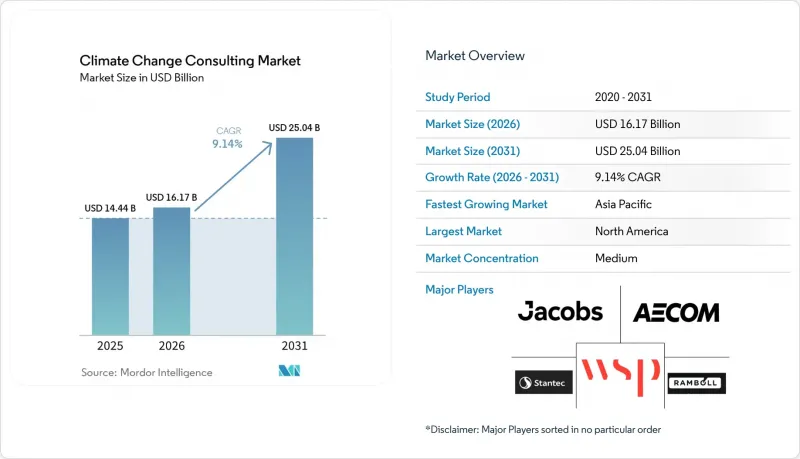
氣候變遷諮詢市場預計將從 2025 年的 60.7 億美元成長到 2026 年的 67.6 億美元,到 2031 年達到 109.9 億美元,2026 年至 2031 年的複合年成長率為 10.21%。
本報告按服務類型(風險評估和情境分析等)、最終用戶產業(能源電力等)、組織規模(大型企業、中小企業)、諮詢類型(多學科工程公司等)、交付方式(現場諮詢等)和地區進行細分。市場預測以美元計價。
全球氣候變遷諮詢市場趨勢與洞察
在全球範圍內,ESG資訊揭露義務正變得越來越嚴格。
2024年,美國證券交易委員會(SEC)的監管變更以及同年歐盟的永續發展報告指令引發了一波加強基準排放評估和內部控制的浪潮。國際永續發展標準理事會(ISSB)透過國際財務報告準則S1和S2統一了報告標準,消除了跨司法管轄區的套利,並提高了標準的嚴謹性。諮詢顧問目前正在設計資料架構、進行雙重重要性分析,並建立符合2025年至2028年分階段截止日期的審計就緒檔案。由於資訊揭露需要第三方保證,諮詢需求在首次提交後仍將持續,這為氣候變遷諮詢市場創造了多年的收入前景。
投資者對企業的碳排放影子審計需求強勁。
在「淨零資產管理公司」舉措下,管理130兆美元資產的資產管理公司開始要求其投資組合公司從2024年起揭露與其投資相關的減排路徑。 「碳核算財務夥伴夥伴關係」規範了範圍3的計算方法,並強制要求銀行和保險公司對其資產持有情況進行審計,並對落後的公司採取糾正措施。私募股權投資機構目前正將與氣候變遷相關的合約條款納入管理協議,以便調整獲利能力支付。顧問公司正在提供雙重服務:既為投資者進行投資組合篩檢,也為投資組合公司提供詳細的脫碳藍圖,這正在增強氣候變遷諮詢市場的持續收入來源。
缺乏檢驗的範圍 3 排放數據
由於範圍 3 通常占公司碳足跡的 70% 到 90%,供應商提供的數據仍然分散,迫使企業依賴基於支出的替代指標,而這些指標的準確度可能存在 50% 甚至更高的誤差。國際永續發展標準委員會 (ISSB) 才剛開始討論更合適的調查方法,預計至少要到 2027 年才能實現標準化。汽車和電子產品供應鏈尤其受到這個問題的影響,因為跨國公司從 50 多個國家採購零件。這種持續的數據匱乏導致客戶不滿,延緩了多年期計畫的啟動,並減緩了氣候變遷諮詢市場的成長。
細分市場分析
預計到2025年,溫室氣體(GHG)計算和報告的氣候變遷諮詢市場規模將達到19億美元,佔總收入的31.28%。企業正優先考慮建立基準清單以符合新的揭露法規,這使得這項服務成為大多數交易的切入點。隨著物理風險成為重要的財務因素,氣候變遷調適和韌性規劃預計將以11.40%的複合年成長率(CAGR)在所有服務類型中成長最快。這種轉變正促使支出重新分配到洪水建模、熱應力測繪和韌性投資藍圖。揭露、風險量化和資金籌措之間的相互作用正在催生出整合情境分析和適應性資本支出規劃的打包服務,從而增強了氣候變遷諮詢市場的交叉銷售機會。
脫碳策略服務正超越邊際減量成本曲線,轉而評估氫能、碳捕獲和電氣化等方案。顧問們正日益將永續金融結構融入服務,將投資藍圖與綠色債券和永續發展掛鉤貸款連結起來。儘管許多森林碳權額度因一致性審查而被取消,碳抵消和排放權交易方面的諮詢工作仍然小規模,但對高品質、基於自然的碳移除項目的需求依然旺盛,尤其是在客戶追求淨零排放目標並需要剩餘碳抵消額度的情況下。生物多樣性和循環經濟諮詢目前仍是一個小眾領域,但隨著即將訂定的歐洲實質審查法規擴大了環境影響的定義,該領域正在發展壯大,預計將為氣候變遷諮詢市場的專家帶來額外收入。
預計到2025年,能源電力產業將創造17.3億美元的收入,佔氣候變遷諮詢市場總收入的28.53%。公共產業面臨迫在眉睫的資訊揭露期限和總量管制與交易義務,導致其在基準審計和藍圖制定方面投入大量資金。採礦和金屬產業雖然規模較小,但預計到2031年將以10.61%的複合年成長率成長,因為投資者要求提供可靠的範圍1和範圍2藍圖,以符合該行業的淨零排放承諾。諮詢顧問正在就電動運輸卡車、利用綠氫直接還原鐵以及可再生能源併網等議題提供諮詢,這推動了對技術經濟分析的強勁需求。
由於資金撥付前需要進行可行性研究,公部門對多邊氣候融資管道的需求日益成長。從汽車到化工等製造業正在將脫碳納入其資本規劃週期,由此產生了對融合程式工程和氣候融資指導的多學科服務需求。金融機構需要進行投資組合層面的風險分析,以符合央行的壓力測試要求。資訊通訊技術和電信營運商正在聘請顧問,以最佳化資料中心能源消耗並減少供應鏈碳足跡。農業、食品、交通運輸和物流等行業正在擴大氣候變遷諮詢市場的基礎,每個行業都有其獨特的服務需求,涵蓋從土壤碳測量到車輛電氣化方案等各個方面。
區域分析
到2025年,北美將佔全球整體收入的37.33%。這主要得益於美國證券交易委員會(SEC)涵蓋數千家發行人和工業企業的揭露規則,以及加州的總量管制與交易體系。加拿大將碳價格上限提高至每噸80加幣(59美元),到2025年,這刺激了能源、採礦和製造業的諮詢需求。墨西哥的排放交易試點計畫雖然規模有限,但正在為未來的措施奠定基礎。美國的監管訴訟帶來了實施風險,一些公司正在逐步減少支出,直到法律明確為止,但資本市場本身的深度支撐著與資金籌措相關的排放分析的潛在需求,從而推動了氣候變遷諮詢市場的發展。
歐洲在銷售額方面位居第二,主要得益於《企業永續性報告指令》(CSRD)、《歐盟分類條例》和《碳邊境調節機制》(CBAM)。這三項法規共同構成了全球最嚴格的資訊揭露和定價框架。德國300億歐元(340億美元)的綠色氫能和電氣化補貼計畫正在推動可行性研究,而英國的轉型規劃法規則要求進行前瞻性情境報告。法國的第29條義務正在推動投資組合分析,北歐企業則致力於開展基於自然的減排項目,以實現淨零排放目標。這些相互交織的監管要求催生了高價值的跨司法管轄區諮詢服務,從而增強了該地區在氣候變遷諮詢市場的影響力。
亞太地區是成長最快的地區,年複合成長率達11.07%。中國計劃在2025年將國家碳排放交易體系擴展至八個行業,並將雙重碳目標(既包括碳減排目標,也包括經濟發展目標)納入省級行動計劃,這在城市層面催生了大量的諮詢合約。印度最終確定了綠色分類標準並加強了能源效率標準,迫使那些難以減排的行業不得不尋求諮詢服務。日本綠色轉型聯盟正在投資1,500億美元用於低碳項目,而韓國的碳中和框架則要求各產業制定具體的藍圖。東南亞各國正在競相爭取與氣候變遷相關的資金,但當地的諮詢能力仍然有限,這為希望拓展氣候變遷諮詢業務的全球公司創造了機會。
儘管南美洲、中東和非洲的市場規模較小,但其成長速度正在加速。巴西計劃於2027年推出的受監管碳市場已經催生了對合規前審計的需求。中東的主權財富基金正在將資金配置到可再生能源領域,而國有石油公司也需要製定與阿拉伯聯合大公國淨零排放承諾相符的轉型策略。這些趨勢正在全部區域日益多元化的氣候變遷諮詢市場奠定基礎。
其他好處:
- Excel格式的市場預測(ME)表
- 3個月的分析師支持
目錄
第1章:引言
- 研究假設和市場定義
- 調查範圍
第2章:調查方法
第3章執行摘要
第4章 市場狀況
- 市場概覽
- 市場促進因素
- 在全球範圍內,ESG資訊揭露要求正變得越來越嚴格。
- 投資者對企業的碳排放影子審計需求強勁。
- 與永續發展掛鉤的金融產品的快速擴張
- 來自原始設備製造商的壓力,要求供應鏈脫碳
- 人工智慧驅動的氣候風險分析取得突破性進展
- 對基於自然的碳去除諮詢服務的需求日益成長。
- 市場限制因素
- 缺乏檢驗的範圍 3 排放數據
- 各地區碳定價機制不一致
- 氣候科學與金融交叉領域的人才短缺
- 與「綠色清洗」相關的訴訟風險阻礙了諮詢服務的使用。
- 產業價值鏈分析
- 宏觀經濟因素對市場的影響
- 監理情勢
- 技術展望
- 波特五力分析
- 服務趨勢分析
第5章 市場規模與成長預測
- 按服務類型
- 風險評估與情境分析
- 溫室氣體排放量的計算與報告
- 脫碳策略和藍圖
- 氣候變遷調適與韌性規劃
- 關於碳抵銷和排放權交易的諮詢
- 永續金融與ESG的融合
- 其他服務類型
- 按最終用戶行業分類
- 能源與電力
- 採礦和金屬
- 公部門
- 製造業
- 金融服務
- 資訊通訊技術與通訊
- 農業和食品
- 運輸/物流
- 其他終端用戶產業
- 按組織規模
- 大公司
- 小型企業
- 按諮詢類型分類
- 一家多元化工程公司
- 專注於永續發展的專業顧問公司。
- 四大會計師事務所
- 管理顧問公司
- 智庫和非政府組織
- 透過串流媒體模式
- 現場諮詢
- 遠端/虛擬諮詢
- 混合式參與
- 按地區
- 北美洲
- 美國
- 加拿大
- 墨西哥
- 歐洲
- 德國
- 英國
- 法國
- 西班牙
- 義大利
- 其他歐洲國家
- 亞太地區
- 中國
- 日本
- 印度
- 韓國
- 其他亞太國家
- 南美洲
- 巴西
- 阿根廷
- 其他南美國家
- 中東和非洲
- 中東
- 以色列
- 沙烏地阿拉伯
- 阿拉伯聯合大公國
- 土耳其
- 其他中東國家
- 非洲
- 南非
- 埃及
- 其他非洲國家
- 中東
- 北美洲
第6章 競爭情勢
- 市場集中度
- 策略趨勢
- 市佔率分析
- 公司簡介
- Jacobs Solutions Inc.
- AECOM
- WSP Global Inc.
- Stantec Inc.
- Ramboll Group A/S
- Tetra Tech Inc.
- ERM International Group Ltd.
- Arup Group Ltd.
- GHD Group Pty Ltd.
- Sweco AB
- Deloitte Touche Tohmatsu Ltd.
- PricewaterhouseCoopers International Ltd.
- KPMG International Ltd.
- Ernst and Young Global Ltd.
- McKinsey and Company
- Boston Consulting Group Inc.
- ICF International Inc.
- South Pole Holding AG
- Carbon Trust Advisory Ltd.
- Sustainalytics
第7章 市場機會與未來展望
According to Mordor Intelligence, the climate change consulting market size is expected to increase from USD 6.07 billion in 2025 to USD 6.76 billion in 2026 and reach USD 10.99 billion by 2031, growing at a CAGR of 10.21% over 2026-2031.
This report is Segmented by Service Type (Risk Assessment and Scenario Analysis, and More), End-User Industry (Energy and Power, and More), Organization Size (Large Enterprises, and Small and Medium Enterprises), Consultancy Type (Multidisciplinary Engineering Firms, and More), Delivery Mode (On-Site Advisory, and More), and Geography. The Market Forecasts are Provided in Terms of Value (USD).
Global Climate Change Consulting Market Trends and Insights
Mandatory ESG Disclosures Tightening Worldwide
Rulemaking by the U.S. Securities and Exchange Commission in 2024 and the European Union's Corporate Sustainability Reporting Directive in the same year triggered a wave of baseline emission assessments and internal-control upgrades. The International Sustainability Standards Board harmonized reporting through IFRS S1 and S2, removing jurisdictional arbitrage and raising the rigor bar. Consultants now design data architectures, run double-materiality analyses, and prepare audit-ready files that satisfy phased deadlines rolling from 2025 to 2028. Because disclosures require third-party assurance, advisory demand persists beyond first filings, creating multi-year revenue visibility for the climate change consulting market.
Corporate Carbon-Shadow Audits Demanded by Investors
Asset managers overseeing USD 130 trillion under the Net Zero Asset Managers initiative began ordering portfolio companies to publish financed-emission pathways in 2024. The Partnership for Carbon Accounting Financials standardized Scope 3 calculations, compelling banks and insurers to audit holdings and remediate laggards. Private-equity sponsors now embed climate covenants into management agreements that can adjust earn-outs. Consultants secure dual mandates, serving investors with portfolio screens and investees with deep dive decarbonization road maps, reinforcing recurring revenue for the climate change consulting market.
Scarcity of Verifiable Scope 3 Emissions Data
Scope 3 often represents 70%-90% of a company's footprint, yet supplier data remain fragmented, forcing reliance on spend-based proxies that can deviate by more than 50%. The International Sustainability Standards Board has only started consultations on better methodologies, delaying standardization until at least 2027. Automotive and electronics supply chains are particularly exposed, where multinationals source from over 50 countries. Persistent data gaps frustrate clients and postpone multi-year commitments, tempering expansion within the climate change consulting market.
Other drivers and restraints analyzed in the detailed report include:
- Rapid Scaling of Sustainability-Linked Finance Instruments
- Supply-Chain Decarbonization Pressures from OEMs
- Inconsistent Regional Carbon-Pricing Mechanisms
For complete list of drivers and restraints, kindly check the Table Of Contents.
Segment Analysis
The climate change consulting market size for GHG accounting and reporting reached USD 1.90 billion in 2025, equal to 31.28% of total revenue. Companies prioritized baseline inventories to satisfy new disclosure laws, positioning this service as the entry point for most engagements. As physical risk becomes financially material, climate adaptation and resilience planning is projected to grow at an 11.40% CAGR, the fastest among service types. This shift reallocates spend toward flood modelling, heat stress mapping, and resilience investment road maps. The interplay of disclosure, risk quantification, and financing has created bundled offerings that integrate scenario analysis with adaptation capex planning, reinforcing cross-selling opportunities in the climate change consulting market.
Decarbonization strategy services have moved beyond marginal-abatement cost curves to evaluate hydrogen, carbon capture, and electrification options. Advisors increasingly integrate sustainable finance structuring, tying investment road maps to green bonds or sustainability-linked loans. Carbon offset and trading advisory remains modest because integrity reviews invalidated many forestry credits, but demand persists for high-quality nature-based removal projects, especially where clients pursue net-zero claims that require residual offsetting. Biodiversity and circular-economy consulting, presently niche, is expanding as forthcoming European due-diligence rules widen the definition of environmental impact, promising incremental revenue for specialized firms within the climate change consulting market.
Energy and power generated USD 1.73 billion in 2025, representing 28.53% of climate change consulting market revenue. Utilities faced immediate disclosure deadlines and cap-and-trade obligations, driving heavy spend on baseline audits and road maps. Mining and metals, while smaller, will expand at a 10.61% CAGR to 2031 as investors push for credible Scope 1 and 2 pathways that align with sector net-zero commitments. Consultants advise on electrified haul trucks, green hydrogen direct-reduced iron, and renewable power integration, fostering robust demand for techno-economic analysis.
Public-sector demand is rising because multilateral climate-finance channels require feasibility studies before disbursing funds. Manufacturing, spanning automotive to chemicals, is embedding decarbonization into capital-planning cycles, generating multi-disciplinary mandates that blend process engineering with climate finance guidance. Financial-services institutions need portfolio-level risk analytics to comply with central-bank stress tests. ICT and telecom operators hire advisers for data-center energy optimization and supply-chain footprint reductions. Agriculture, food, transportation, and logistics are broadening the base of the climate change consulting market, each with distinct service requirements from soil-carbon measurement to fleet electrification scenarios.
Complete Report Scope:
- By Service Type
- Risk Assessment and Scenario Analysis
- GHG Accounting and Reporting
- Decarbonisation Strategy and Road-Mapping
- Climate Adaptation and Resilience Planning
- Carbon Offset and Trading Advisory
- Sustainable Finance and ESG Integration
- Other Service Types
- By End-User Industry
- Energy and Power
- Mining and Metals
- Public Sector
- Manufacturing
- Financial Services
- ICT and Telecom
- Agriculture and Food
- Transportation and Logistics
- Other End-User Industry
- By Organisation Size
- Large Enterprises
- Small and Medium Enterprises
- By Consultancy Type
- Multidisciplinary Engineering Firms
- Pure-Play Sustainability Boutiques
- Big Four Accounting Firms
- Management Consulting Firms
- Think Tanks and NGOs
- By Delivery Mode
- On-Site Advisory
- Remote / Virtual Advisory
- Hybrid Engagements
- By Geography
- North America
- United States
- Canada
- Mexico
- Europe
- Germany
- United Kingdom
- France
- Spain
- Italy
- Rest of Europe
- Asia-Pacific
- China
- Japan
- India
- South Korea
- Rest of Asia-Pacific
- South America
- Brazil
- Argentina
- Rest of South America
- Middle East and Africa
- Middle East
- Israel
- Saudi Arabia
- United Arab Emirates
- Turkey
- Rest of Middle East
- Africa
- South Africa
- Egypt
- Rest of Africa
- Middle East
- North America
Geography Analysis
North America produced 37.33% of global revenue in 2025, anchored by the SEC disclosure rule and California's cap-and-trade program that cover thousands of issuers and industrial plants. Canada's carbon-pricing backstop, which rose to CAD 80 per metric ton (USD 59) in 2025, stimulated advisory demand in energy, mining, and manufacturing. Mexico's pilot emissions-trading system, although narrow, sets the stage for future engagements. Regulatory litigation in the United States introduces execution risk, leading some firms to phase spending until legal clarity emerges, but the sheer depth of capital markets sustains baseline demand for financed-emission analytics, bolstering the climate change consulting market.
Europe ranks second in revenue, propelled by the Corporate Sustainability Reporting Directive, EU Taxonomy Regulation, and Carbon Border Adjustment Mechanism that jointly constitute the world's strictest disclosure and pricing framework. Germany's EUR 30 billion (USD 34 billion) subsidy program for green hydrogen and electrification fuels feasibility studies, while the United Kingdom's transition-plan rules require forward-looking scenario reports. France's Article 29 obligations drive portfolio analytics, and Nordic corporates pursue nature-based removal projects for net-zero claims. These overlapping mandates generate high-value, multi-jurisdictional advisory work that reinforces the region's influence on the climate change consulting market.
Asia-Pacific is the fastest-growing region at an 11.07% CAGR. China expanded its national emissions trading system to eight sectors in 2025 and linked dual-carbon goals to provincial action plans, spawning city-level consulting contracts. India finalized its green taxonomy and tightened energy-efficiency standards, compelling hard-to-abate industries to seek advisory. Japan's Green Transformation League is channelling USD 150 billion into low-carbon projects, while South Korea's carbon-neutrality framework mandates sectoral road maps. Southeast Asian countries vie for climate-finance inflows, but local consulting capacity remains thin, creating entry opportunities for global players eager to enlarge their footprint in the climate change consulting market.
South America and Middle East and Africa are smaller but quickening. Brazil's regulated carbon market, expected in 2027, already motivates pre-compliance audits. Sovereign wealth funds in the Middle East are allocating capital to renewables, and national oil companies need transition strategies aligned with UAE's net-zero pledge. These developments are laying the groundwork for an increasingly diversified climate change consulting market across emerging regions.
- Jacobs Solutions Inc.
- AECOM
- WSP Global Inc.
- Stantec Inc.
- Ramboll Group A/S
- Tetra Tech Inc.
- ERM International Group Ltd.
- Arup Group Ltd.
- GHD Group Pty Ltd.
- Sweco AB
- Deloitte Touche Tohmatsu Ltd.
- PricewaterhouseCoopers International Ltd.
- KPMG International Ltd.
- Ernst and Young Global Ltd.
- McKinsey and Company
- Boston Consulting Group Inc.
- ICF International Inc.
- South Pole Holding AG
- Carbon Trust Advisory Ltd.
- Sustainalytics
Additional Benefits:
- The market estimate (ME) sheet in Excel format
- 3 months of analyst support
TABLE OF CONTENTS
1 INTRODUCTION
- 1.1 Study Assumptions and Market Definition
- 1.2 Scope of the Study
2 RESEARCH METHODOLOGY
3 EXECUTIVE SUMMARY
4 MARKET LANDSCAPE
- 4.1 Market Overview
- 4.2 Market Drivers
- 4.2.1 Mandatory ESG Disclosures Tightening Worldwide
- 4.2.2 Corporate Carbon-Shadow Audits Demanded by Investors
- 4.2.3 Rapid Scaling of Sustainability-Linked Finance Instruments
- 4.2.4 Supply-Chain Decarbonisation Pressures from OEMs
- 4.2.5 Breakthroughs in AI-Driven Climate-Risk Analytics
- 4.2.6 Growing Demand for Nature-Based Carbon Removal Advisory
- 4.3 Market Restraints
- 4.3.1 Scarcity of Verifiable Scope 3 Emissions Data
- 4.3.2 Inconsistent Regional Carbon-Pricing Mechanisms
- 4.3.3 Talent Shortage at the Climate Science-Finance Interface
- 4.3.4 Green-Washing Litigation Risk Discouraging Advisory Uptake
- 4.4 Industry Value-Chain Analysis
- 4.5 Impact of Macroeconomic Factors on the Market
- 4.6 Regulatory Landscape
- 4.7 Technological Outlook
- 4.8 Porter's Five Forces Analysis
- 4.8.1 Bargaining Power of Suppliers
- 4.8.2 Bargaining Power of Buyers
- 4.8.3 Threat of New Entrants
- 4.8.4 Threat of Substitutes
- 4.8.5 Competitive Rivalry
- 4.9 Service Trend Analysis
5 MARKET SIZE AND GROWTH FORECASTS (VALUE)
- 5.1 By Service Type
- 5.1.1 Risk Assessment and Scenario Analysis
- 5.1.2 GHG Accounting and Reporting
- 5.1.3 Decarbonisation Strategy and Road-Mapping
- 5.1.4 Climate Adaptation and Resilience Planning
- 5.1.5 Carbon Offset and Trading Advisory
- 5.1.6 Sustainable Finance and ESG Integration
- 5.1.7 Other Service Types
- 5.2 By End-User Industry
- 5.2.1 Energy and Power
- 5.2.2 Mining and Metals
- 5.2.3 Public Sector
- 5.2.4 Manufacturing
- 5.2.5 Financial Services
- 5.2.6 ICT and Telecom
- 5.2.7 Agriculture and Food
- 5.2.8 Transportation and Logistics
- 5.2.9 Other End-User Industry
- 5.3 By Organisation Size
- 5.3.1 Large Enterprises
- 5.3.2 Small and Medium Enterprises
- 5.4 By Consultancy Type
- 5.4.1 Multidisciplinary Engineering Firms
- 5.4.2 Pure-Play Sustainability Boutiques
- 5.4.3 Big Four Accounting Firms
- 5.4.4 Management Consulting Firms
- 5.4.5 Think Tanks and NGOs
- 5.5 By Delivery Mode
- 5.5.1 On-Site Advisory
- 5.5.2 Remote / Virtual Advisory
- 5.5.3 Hybrid Engagements
- 5.6 By Geography
- 5.6.1 North America
- 5.6.1.1 United States
- 5.6.1.2 Canada
- 5.6.1.3 Mexico
- 5.6.2 Europe
- 5.6.2.1 Germany
- 5.6.2.2 United Kingdom
- 5.6.2.3 France
- 5.6.2.4 Spain
- 5.6.2.5 Italy
- 5.6.2.6 Rest of Europe
- 5.6.3 Asia-Pacific
- 5.6.3.1 China
- 5.6.3.2 Japan
- 5.6.3.3 India
- 5.6.3.4 South Korea
- 5.6.3.5 Rest of Asia-Pacific
- 5.6.4 South America
- 5.6.4.1 Brazil
- 5.6.4.2 Argentina
- 5.6.4.3 Rest of South America
- 5.6.5 Middle East and Africa
- 5.6.5.1 Middle East
- 5.6.5.1.1 Israel
- 5.6.5.1.2 Saudi Arabia
- 5.6.5.1.3 United Arab Emirates
- 5.6.5.1.4 Turkey
- 5.6.5.1.5 Rest of Middle East
- 5.6.5.2 Africa
- 5.6.5.2.1 South Africa
- 5.6.5.2.2 Egypt
- 5.6.5.2.3 Rest of Africa
- 5.6.5.1 Middle East
- 5.6.1 North America
6 COMPETITIVE LANDSCAPE
- 6.1 Market Concentration
- 6.2 Strategic Moves
- 6.3 Market Share Analysis
- 6.4 Company Profiles (includes Global Level Overview, Market Level Overview, Core Segments, Financials as available, Strategic Information, Market Rank/Share, Products and Services, Recent Developments)
- 6.4.1 Jacobs Solutions Inc.
- 6.4.2 AECOM
- 6.4.3 WSP Global Inc.
- 6.4.4 Stantec Inc.
- 6.4.5 Ramboll Group A/S
- 6.4.6 Tetra Tech Inc.
- 6.4.7 ERM International Group Ltd.
- 6.4.8 Arup Group Ltd.
- 6.4.9 GHD Group Pty Ltd.
- 6.4.10 Sweco AB
- 6.4.11 Deloitte Touche Tohmatsu Ltd.
- 6.4.12 PricewaterhouseCoopers International Ltd.
- 6.4.13 KPMG International Ltd.
- 6.4.14 Ernst and Young Global Ltd.
- 6.4.15 McKinsey and Company
- 6.4.16 Boston Consulting Group Inc.
- 6.4.17 ICF International Inc.
- 6.4.18 South Pole Holding AG
- 6.4.19 Carbon Trust Advisory Ltd.
- 6.4.20 Sustainalytics
7 MARKET OPPORTUNITIES AND FUTURE OUTLOOK
- 7.1 White-Space and Unmet-Need Assessment

 氣候風險管理市場機會、成長要素、產業趨勢分析及2026-2035年預測
 氣候變遷諮詢市場:規模、佔有率、成長、全球產業分析、區域趨勢及2026年至2034年預測氣候風險分析市場規模、佔有率、成長、全球產業分析、區域趨勢及2026-2034年預測
 氣候風險融資平台市場預測至2034年:按風險類型、金融用例、分析能力、部署模式和最終用戶分類的全球分析
 全球氣候風險管理市場(至2031年):依軟體及交付方式分類
 巨量資料、物聯網和氣候變遷市場:按組件、連接方式、應用和產業分類-2026年至2032年全球市場預測
 2026年全球天基氣候工程市場報告2026年全球氣候變遷諮詢市場報告城市噪音映射市場預測至2034年-按組件、部署模式、噪音類型、應用、最終用戶和地區分類的全球分析
 氣候風險市場:依服務類型、產業和地區分類