


 |
市場調查報告書
商品編碼
2125641
東南亞壓縮天然氣(CNG)加氣機:市場佔有率分析、產業趨勢與統計及成長預測(2026-2031)Southeast Asia Compressed Natural Gas (CNG) Dispenser - Market Share Analysis, Industry Trends & Statistics, Growth Forecasts (2026 - 2031) |
||||||

※ 本網頁內容可能與最新版本有所差異。詳細情況請與我們聯繫。
據 Mordor Intelligence 稱,東南亞壓縮天然氣 (CNG) 加氣機市場在 2025 年的價值為 3,239 萬美元,預計到 2031 年將達到 6,033 萬美元,而 2026 年為 3,611 萬美元,預測期(2026-2031 年)的複合年成長率為 10.1%。
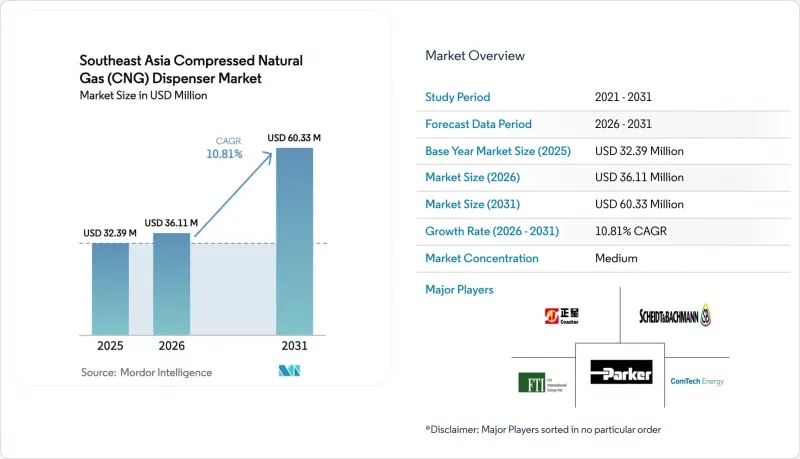
本報告按加油機配置(單管、雙管、多管)、加油站類型(快速加註、定時加註、移動/可攜式)、最終用戶(公共零售加油站、私家車停車場、公共交通和公共汽車、工業和礦業設施)以及地區(泰國、新加坡、印尼、馬來西亞、菲律賓、越南和東南亞其他地區)進行分類。
東南亞壓縮天然氣(CNG)加氣機市場趨勢與洞察。
與柴油相比,它的總擁有成本(TCO)更低。
印尼和越南的汽車營運商已簽署5至7年的壓縮天然氣(CNG)供應契約,以對沖2024年柴油價格峰值至谷值超過25%的波動風險。這些合約將維修設施的投資回收期縮短至3.2年,每日處理量超過150輛汽車。隨著印尼國家石油公司(Pertamina)管線的擴建,爪哇島和蘇門答臘島的CNG交付成本下降了18%,即使在液化天然氣(LNG)價格高企時期,CNG與柴油的營運成本差異已達30%至40%。越南製造商也順應了這個趨勢,預計2025年私人CNG加氣站數量將年增22%。營運商指出,CNG在維護和引擎壽命方面具有優勢,只有當運轉率低於60%時,這些優勢才會消失。因此,東南亞CNG加氣站市場主要由大型車隊而非都市區乘用車驅動,並且由於直接的天然氣供應契約,其受零售價格波動的影響較小。
擴大該地區的液化天然氣進口能力
2023年至2025年間,越南蓋梅及菲律賓新建的液化天然氣接收站每年新增810萬噸液化天然氣再氣化量。這將使接收站運營商能夠在亞太地區液化天然氣價格跌破12美元/百萬英熱單位時購買現貨液化天然氣。印尼國營管道營運商正大力推進通往中爪哇和南蘇門答臘的干線管道建設,從而以「虛擬管道」的形式降低卡車運輸成本。在泰國東部經濟走廊,小規模衛星液化天然氣接收站正在試驗建設中。如果每個接收站的投資額低於200萬美元,則可能顛覆傳統的管道配送系統。然而,新加坡的第二個接收站預計在未來十年內無法達到運作,這將迫使該國營運商依賴從馬來西亞的管道進口,並限制了管網的擴張。
提高電池電動車的競爭力
曼谷於2025年訂購了500輛純電動公車,胡志明市也於2025年12月將58輛CNG公車改裝為電動公車,這些舉措導致都市區CNG需求量較前一年下降約15%。馬來西亞於2025年7月強制淘汰44,383輛天然氣汽車(NGV),顯示政策可以迅速縮小目標市場。隨著公共運輸業者致力於實現零排放目標,城市地區的加氣站運轉率低於損益平衡點,迫使一些地區轉向使用氫氣或液化石油氣(LPG)。因此,區域供應商正在將銷售團隊重新部署到受電氣化影響較小的工業和礦業客戶。
細分市場分析
雅加達、曼谷和胡志明市的營運商已對老舊的雙管加氣站進行了維修,使其能夠同時為三到四輛車加氣,從而提升了多管設備在東南亞CNG加氣市場的佔有率。預計到2025年,雙管設備仍將佔總銷售量的39.8%,而多管設備的複合年成長率預計將達到12.8%。這反映了土地資源有限,對平方公尺氣能力的迫切需求。單管設備仍在農村地區和交通流量較小的加氣站使用,這些地方更注重設備的簡易性而非速度,但隨著省會城市服務標準監管的日益嚴格,其市場佔有率正在下降。
製造商現在提供模組化機櫃,允許每12個月添加軟管,使資本投資與實際需求相匹配,並防止資產閒置。符合ISO 19880標準意味著未來只需進行少量維修即可相容氫燃料,這對於風險規避型燃料零售商而言,無疑是一項日益重要的安全保障。 Parker Hanifin和Gilberto Wieder Root透過將全天候零件支援與軟體訂閱模式相結合,擴大了市場佔有率,該模式將初始成本分攤到五年服務合約中。中國的新參與企業在價格上競爭,但在高檔都市區加油站面臨形像差距,使得競爭壓力保持在適中水平,並未造成市場動盪。
其他好處:
- Excel格式的市場預測(ME)表
- 3個月的分析師支持
目錄
第1章:引言
- 研究假設和市場定義
- 調查範圍
第2章:調查方法
第3章執行摘要
第4章 市場狀況
- 市場概覽
- 市場促進因素
- 政府對天然氣汽車(NGV)的激勵和補貼計劃
- 與汽油和柴油相比,總擁有成本更低。
- 城市公車向天然氣動力車輛的改造正在推進中。
- 擴大各地區的管道和液化天然氣進口能力
- 沼氣制壓縮天然氣轉化計畫的快速發展
- 引入物聯網賦能的分配器進行預測性維護
- 市場限制因素
- 電池式電動車領域的競爭日益激烈
- 基地台建設和土地租賃相關的障礙物需要較高的初始資本支出(CAPEX)。
- 液化天然氣現貨價格波動對壓縮天然氣零售價格的影響
- 都市計畫對高壓燃料設施的限制
- 供應鏈分析
- 監理情勢
- 技術展望
- 波特五力模型
第5章 市場規模與成長預測
- 分配器配置
- 單管
- 雙管
- 多管
- 依站點類型
- 快速填充
- 時間填充
- 行動/可攜式
- 最終用戶
- 公共零售站
- 私家車停車場
- 公共交通和公共汽車
- 工業和採礦設施
- 按地區
- 泰國
- 新加坡
- 印尼
- 馬來西亞
- 菲律賓
- 越南
- 東南亞其他地區
第6章 競爭情勢
- 市場集中度
- 策略趨勢(併購、聯盟、購電協議)
- 市場佔有率分析(主要公司的市場排名和佔有率)
- 公司簡介
- Parker Hannifin Corp
- Gilbarco Veeder-Root
- Censtar Science & Technology
- Tatsuno Corporation
- Scheidt & Bachmann
- Greka Engineering
- FTI International Group
- ComTech Energy
- Sanki Industry Group
- TGT Fuel Technologies India
- Compac Industries
- Tokheim Corporation
- ANGI Energy Systems
- WEH GmbH
- Linde Hydrogen & Gas Equipment
- Bosch Rexroth
- Chart Industries
- KwangShin Machine
- Armstrong Equipment
- Clean Energy Compression
第7章 市場機會與未來展望
According to Mordor Intelligence, the Southeast Asia compressed natural gas dispenser market size was valued at USD 32.39 million in 2025 and is estimated to grow from USD 36.11 million in 2026 to reach USD 60.33 million by 2031, at a CAGR of 10.81% during the forecast period (2026-2031).
This report is Segmented by Dispenser Configuration (Single-Hose, Dual-Hose, and Multi-Hose), Station Type (Fast-Fill, Time-Fill, and Mobile/Portable), End-User (Public Retail Stations, Private Fleet Depots, Transit and Bus Fleets, and Industrial and Mining Sites), and Geography (Thailand, Singapore, Indonesia, Malaysia, Philippines, Vietnam, and Rest of Southeast Asia).
Southeast Asia Compressed Natural Gas (CNG) Dispenser Market Trends and Insights
Lower Total Cost of Ownership vs Diesel
Fleet operators in Indonesia and Vietnam have locked in five-to-seven-year CNG supply contracts that hedge against diesel swings exceeding 25% peak-to-trough in 2024, reducing depot payback periods to 3.2 years at throughputs above 150 vehicles daily. Delivered CNG costs in Java and Sumatra fell 18% after Pertamina's pipeline extensions, cementing a 30-40% operating-cost gap versus diesel that persists even during LNG price spikes. Vietnamese manufacturers mirrored the shift as private depots grew 22% year-on-year in 2025, with operators citing maintenance and engine-life advantages that close only when utilization drops below 60%. The Southeast Asia CNG dispenser market, therefore, draws its core growth from heavy-duty fleets, not urban consumer vehicles, and is increasingly insulated from retail-price politics through direct gas-supply agreements.
Regional LNG Import Capacity Build-Out
Between 2023 and 2025, Vietnam's Cai Mep and the Philippines' new terminals added 8.1 million t p.a. of regasification, enabling station operators to source spot LNG cargoes when Asia-Pacific prices dip below USD 12/MMBtu. Indonesia's state pipeline operator is pushing trunk lines into Central Java and South Sumatra, cutting virtual-pipeline truck costs. Thailand's Eastern Economic Corridor pilots small-scale satellite LNG stations that could disrupt legacy pipeline distribution if capex falls beneath USD 2 million per site. Yet Singapore's second terminal will not reach full output this decade, leaving operators there exposed to Malaysian pipeline imports and limiting network expansion.
Rising Competitiveness of Battery-Electric Mobility
Bangkok's 2025 order for 500 battery-electric buses and Ho Chi Minh City's December 2025 conversion of 58 CNG buses to electric cut urban CNG demand by roughly 15% year-on-year. Malaysia's July 2025 mandate eliminating 44,383 NGVs showed that policy can abruptly shrink the addressable base. With public-transport operators chasing zero-emission targets, dispenser utilization in city cores has dipped below break-even, forcing some sites to pivot to hydrogen or LPG. Regional suppliers are therefore redirecting sales teams toward industrial and mining clients less vulnerable to electrification.
Other drivers and restraints analyzed in the detailed report include:
- Government NGV Incentives & Subsidies
- Adoption of IoT-Enabled Dispensers
- High Upfront Station CAPEX & Land-Leasing Hurdles
For complete list of drivers and restraints, kindly check the Table Of Contents.
Segment Analysis
Multi-hose installations captured a rising share of the Southeast Asia CNG dispenser market as operators in Jakarta, Bangkok, and Ho Chi Minh City retrofit older dual-hose forecourts to serve three or four vehicles simultaneously. Dual-hose units still held 39.8% revenue in 2025, but multi-hose variants are projected to log a 12.8% CAGR, reflecting land constraints that make throughput per square meter critical. Single-hose equipment lingers in rural or low-traffic depots where simplicity trumps speed, although its share is ebbing as secondary cities tighten service-level rules.
Manufacturers now offer modular cabinets that add hoses in 12-month intervals, matching capex to realized demand and guarding against stranded assets. Integrating ISO 19880 compatibility prepares sites for future hydrogen blends with minimal retrofit, an insurance policy increasingly specified by risk-averse fuel retailers. Parker Hannifin and Gilbarco Veeder-Root have gained ground by bundling 24-hour parts support with software-subscription models that spread upfront costs across five-year service contracts. Chinese challengers compete on price but face perception gaps in premium urban stations, keeping competitive pressure moderate rather than destabilizing.
Complete Report Scope:
- By Dispenser Configuration
- Single-Hose
- Dual-Hose
- Multi-Hose
- By Station Type
- Fast-Fill
- Time-Fill
- Mobile/Portable
- By End-User
- Public Retail Stations
- Private Fleet Depots
- Transit and Bus Fleets
- Industrial and Mining Sites
- By Geography
- Thailand
- Singapore
- Indonesia
- Malaysia
- Philippines
- Vietnam
- Rest of Southeast Asia
List of Companies Covered in this Report:
- Parker Hannifin Corp
- Gilbarco Veeder-Root
- Censtar Science & Technology
- Tatsuno Corporation
- Scheidt & Bachmann
- Greka Engineering
- FTI International Group
- ComTech Energy
- Sanki Industry Group
- TGT Fuel Technologies India
- Compac Industries
- Tokheim Corporation
- ANGI Energy Systems
- WEH GmbH
- Linde Hydrogen & Gas Equipment
- Bosch Rexroth
- Chart Industries
- KwangShin Machine
- Armstrong Equipment
- Clean Energy Compression
Additional Benefits:
- The market estimate (ME) sheet in Excel format
- 3 months of analyst support
TABLE OF CONTENTS
1 Introduction
- 1.1 Study Assumptions & Market Definition
- 1.2 Scope of the Study
2 Research Methodology
3 Executive Summary
4 Market Landscape
- 4.1 Market Overview
- 4.2 Market Drivers
- 4.2.1 Government NGV incentives & subsidy programs
- 4.2.2 Lower total cost of ownership vs gasoline & diesel
- 4.2.3 Growing city-bus fleet conversions to CNG
- 4.2.4 Regional pipeline & LNG import capacity build-out
- 4.2.5 Rapid biogas-to-CNG project roll-outs
- 4.2.6 Adoption of IoT-enabled dispensers for predictive maintenance
- 4.3 Market Restraints
- 4.3.1 Rising competitiveness of battery-electric mobility
- 4.3.2 High upfront station CAPEX & land-leasing hurdles
- 4.3.3 Volatility of LNG spot prices impacting CNG retail price
- 4.3.4 Urban zoning limits on high-pressure fueling facilities
- 4.4 Supply-Chain Analysis
- 4.5 Regulatory Landscape
- 4.6 Technological Outlook
- 4.7 Porter's Five Forces
- 4.7.1 Bargaining Power of Suppliers
- 4.7.2 Bargaining Power of Consumers
- 4.7.3 Threat of New Entrants
- 4.7.4 Threat of Substitute Products & Services
- 4.7.5 Intensity of Competitive Rivalry
5 Market Size & Growth Forecasts
- 5.1 By Dispenser Configuration
- 5.1.1 Single-Hose
- 5.1.2 Dual-Hose
- 5.1.3 Multi-Hose
- 5.2 By Station Type
- 5.2.1 Fast-Fill
- 5.2.2 Time-Fill
- 5.2.3 Mobile/Portable
- 5.3 By End-User
- 5.3.1 Public Retail Stations
- 5.3.2 Private Fleet Depots
- 5.3.3 Transit and Bus Fleets
- 5.3.4 Industrial and Mining Sites
- 5.4 By Geography
- 5.4.1 Thailand
- 5.4.2 Singapore
- 5.4.3 Indonesia
- 5.4.4 Malaysia
- 5.4.5 Philippines
- 5.4.6 Vietnam
- 5.4.7 Rest of Southeast Asia
6 Competitive Landscape
- 6.1 Market Concentration
- 6.2 Strategic Moves (M&A, Partnerships, PPAs)
- 6.3 Market Share Analysis (Market Rank/Share for key companies)
- 6.4 Company Profiles (includes Global level Overview, Market level overview, Core Segments, Financials as available, Strategic Information, Products & Services, and Recent Developments)
- 6.4.1 Parker Hannifin Corp
- 6.4.2 Gilbarco Veeder-Root
- 6.4.3 Censtar Science & Technology
- 6.4.4 Tatsuno Corporation
- 6.4.5 Scheidt & Bachmann
- 6.4.6 Greka Engineering
- 6.4.7 FTI International Group
- 6.4.8 ComTech Energy
- 6.4.9 Sanki Industry Group
- 6.4.10 TGT Fuel Technologies India
- 6.4.11 Compac Industries
- 6.4.12 Tokheim Corporation
- 6.4.13 ANGI Energy Systems
- 6.4.14 WEH GmbH
- 6.4.15 Linde Hydrogen & Gas Equipment
- 6.4.16 Bosch Rexroth
- 6.4.17 Chart Industries
- 6.4.18 KwangShin Machine
- 6.4.19 Armstrong Equipment
- 6.4.20 Clean Energy Compression
7 Market Opportunities & Future Outlook
- 7.1 White-space & Unmet-Need Assessment

 壓縮天然氣(CNG)加氣機:市場佔有率分析、產業趨勢與統計、成長預測(2026-2031)
 CNG加氣機市場:按加氣方式、技術、流量、壓力、安裝方式、運作模式和最終用戶分類-全球市場預測(2026-2032年)
 CNG灌裝機全球市場規模、佔有率、趨勢及成長分析報告(2026-2034年)
 CNG加氣機市場 - 全球產業規模、佔有率、趨勢、機會及預測(按類型、銷售、分銷、地區和競爭格局分類,2021-2031年)
 CNG加氣機市場規模、佔有率和成長分析(按類型、分銷、銷售和地區分類)-產業預測(2026-2033年)壓縮天然氣分配器市場-全球產業規模、佔有率、趨勢、機會與預測(細分、按類型、按分佈、按地區、按競爭,2020-2030 年)全球 CNG 加氣機市場規模(依加氣機類型、流量、分佈、區域範圍、預測)中東和非洲壓縮天然氣加氣機:市場佔有率分析、產業趨勢和成長預測(2025-2030)歐洲壓縮天然氣加氣機:市場佔有率分析、產業趨勢、成長預測(2025-2030)