


 |
市場調查報告書
商品編碼
2125628
蒸氣渦輪維護、修理和大修 (MRO):市場佔有率分析、行業趨勢與統計數據、成長預測 (2026-2031)Steam Turbine MRO - Market Share Analysis, Industry Trends & Statistics, Growth Forecasts (2026 - 2031) |
||||||

※ 本網頁內容可能與最新版本有所差異。詳細情況請與我們聯繫。
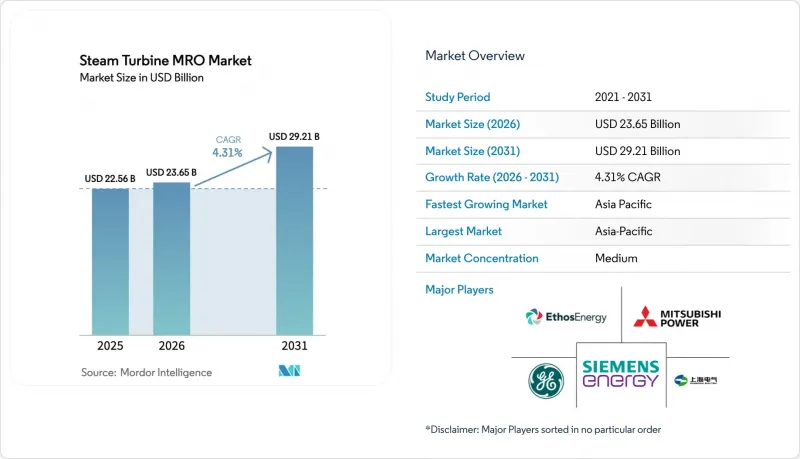
根據 Mordor Intelligence 預測,蒸氣渦輪的 MRO(維護、修理和大修)市場規模將從 2025 年的 225.6 億美元成長到 2026 年的 236.5 億美元,然後在 2031 年達到 292.1 億美元,2026 年至 2031 年至 2031 年的複合年成長率。
本報告按輸出功率(小於 300 兆瓦、300-600 兆瓦和大於 600 兆瓦)、發電廠使用的燃料(煤炭、天然氣、核能、生質能/垃圾焚化發電)、服務類型(維護、修理、大修)、最終用戶行業(發電、石油和天然氣、工業和其他)以及地區(北美、歐洲、亞太地區、南美以及非洲和非洲)進行分類。
全球蒸氣渦輪MRO市場趨勢與洞察
全球火力發電設施老化及使用壽命延長
2024年,美國燃煤電廠機組的平均運作達44年,屋主選擇延長使用壽命至50至60年。這包括轉子鏜孔、蠕變評估和3D空氣動力學葉片改造,成本通常只有新建設改造,延長了印度15台機組(總裝機容量3.8吉瓦)的運作,維修包括冶金技術升級和安裝先進的密封設備。中國也呈現類似的趨勢,對2010年以前建造的亞臨界電廠維修,包括密封升級和低壓級更換,以推遲退役時間,同時達到2030年的碳排放強度目標。
聯合循環發電廠和先進超臨界發電廠的擴建
在這些發電機組中,蒸氣溫度超過 600 度C,加速了蠕變,因此需要比傳統亞臨界發電設備高出一倍的檢查頻率。日本 J-POWER 公司於 2024 年推出了額定溫度為 650 度C的鎳基葉片,但這些葉片需要特殊的焊接維修,大多數獨立承包商無法勝任。中國在 2025 年新增了 28 吉瓦的超臨界發電裝置容量,並強制規定每 12,000 小時進行一次檢查,從而提高了檢修頻率。西門子能源在沙烏地阿拉伯與 Kreya 機組簽訂的為期 15 年的長期服務協議 (LTSA) 表明,高效資產能夠從投入運作之日起,長期保障維護、維修和大修 (MRO) 的現金流。
經合組織國家儘早逐步淘汰煤炭資產
根據美國能源資訊署(EIA)的數據,2024年美國將關閉23吉瓦的燃煤發電廠,另有14吉瓦計畫在2029年前關閉,將導致維修、修理和大修(MRO)需求大幅下降。英國將於2024年關閉其最後燃煤發電廠,而德國正在討論是否將原定於2038年到2030年逐步淘汰燃煤發電的計劃提前,這將對歐洲的服務需求帶來壓力。國際能源總署(IEA)預測,到2035年,經合組織(OECD)國家的燃煤發電裝置容量將減少40%,這一降幅對無法轉向天然氣或核能的獨立營運商來說將是毀滅性的打擊。
細分市場分析
到2025年,由於上世紀90年代建造的大量亞臨界燃煤電廠,300-600兆瓦機組將佔據蒸氣渦輪MRO市場佔有率的50.5%。預計到2031年,600兆瓦以上汽輪機的複合年成長率將達到5.1%,其中中國、印度和日本將推動該細分市場蒸氣渦輪MRO市場規模的成長,因為這些國家採用的超臨界設計需要鎳合金修復和相位陣列超音波檢測。
中功率機組絕非過時之物。 2025年,J-POWER公司透過將低壓級葉片更換為3D葉片,使四台600兆瓦亞臨界機組的效率提高了2.3個百分點。這顯示維修比除役更經濟。 300兆瓦以下的機組面臨零件短缺和提前除役的問題,儘管它們占美國裝置容量的22%,但僅佔維護、修理和大修(MRO)收入的14%。
到2025年,燃煤發電廠將佔全球支出的60.1%,儘管經合組織國家仍在進行除役,但仍將支援蒸氣渦輪、修理和大修(MRO)市場。這主要得益於亞洲1900吉瓦的燃煤發電運作。核能產業的業務正以5.5%的複合年成長率成長,成長超過所有燃料類型。這主要得益於美國美國核能管理委員會(NRC)和法國核能(ASN)批准美國和法國核子反應爐的運作壽命延長至80年。這將擴大蒸汽產生器更換和轉子鏜孔的範圍,從而提升核能發電廠蒸氣渦輪MRO市場的規模。
天然氣聯合循環發電廠佔總支出的25%,預計將以4.8%的複合年成長率成長,主要得益於中東地區大型企劃簽訂的長期服務協議(LTSA)。生質能和廢棄物發電廠目前仍屬於小眾領域,但對耐腐蝕塗層的需求旺盛,為專業維修提供了機會。
區域分析
亞太地區預計到2025年將佔總收入的49.6%,並預計到2031年將以5.8%的複合年成長率成長,這主要得益於中國、印度和東南亞超臨界和聯合循環發電設施的擴張。中國國家電網公司承包的78吉瓦超臨界電力容量正由國內維修公司負責,這些公司已具備鎳合金焊接和相位陣列超音波檢測(UT)能力,這給外國OEM製造商的市場佔有率帶來了壓力。印度國家電力公司(NTPC)授予巴拉特重型電氣公司(Bharat Heavy Electricals)的3.8吉瓦維修契約,清楚地表明未來十年將有大規模延壽項目。
在北美,由於燃煤發電廠的關閉抵消了核能發電廠使用壽命延長帶來的成長,市場成長正在放緩。然而,250吉瓦的聯合循環發電裝置容量支撐著穩健的長期維護協議(LTSA)基礎。歐洲市場的成長主要得益於法國核能發電廠的維修以及德國聯合循環燃氣渦輪機(CCGT)的擴建,旨在確保可再生能源的穩定供應。中東和非洲市場的成長則得益於Clayya、Al Dhafra和New Capital等公司簽訂的巨額契約,這些合約將長期維護協議與數位孿生分析相結合。南美洲6%的市佔率則受惠於巴西水力發電和火力發電混合發電廠的維修以及阿根廷與Vaca Muerta頁岩氣相關的汽電共生計畫。
其他好處:
- Excel格式的市場預測(ME)表
- 3個月的分析師支持
目錄
第1章:引言
- 市場分析與定義的前提條件
- 分析範圍
第2章 分析方法
第3章執行摘要
第4章 市場狀況
- 市場概覽
- 市場促進因素
- 全球火力發電設施的老化導致其使用壽命延長。
- 聯合循環發電廠和先進超臨界發電廠的擴建
- OEM長期服務協議(LTSA)的蓬勃發展
- 在預測性維護中引入數位孿生技術
- 脫碳維修,包括氫氣(H2)/氨氣(NH3)混燒
- 新興市場工業微型熱電聯產的興起
- 市場限制因素
- 經合組織國家儘早逐步淘汰煤炭資產
- 大規模改造需要高額的資本投入和較長的運作。
- OEM軟體鎖定限制了獨立製造商的發展。
- 老款車型零件供不應求
- 供應鏈分析
- 監理情勢
- 技術展望
- 波特五力分析
- 長期服務協議(LTSA)趨勢分析
第5章:預測市場規模與成長率
- 按產能
- 小於300兆瓦
- 300~600 MW
- 600兆瓦或以上
- 發電廠燃料類型
- 煤炭
- 天然氣
- 核能
- 生質能/垃圾焚化發電
- 按服務類型
- 維護
- 維修
- 大修
- 按最終用戶行業分類
- 發電
- 石油和天然氣(上游/中游/下游)
- 工業及其他
- 按地區
- 北美洲
- 美國
- 加拿大
- 墨西哥
- 歐洲
- 德國
- 英國
- 法國
- 義大利
- 北歐國家
- 俄羅斯
- 其他歐洲國家
- 亞太地區
- 中國
- 印度
- 日本
- 韓國
- 東南亞國協
- 其他亞太國家
- 南美洲
- 巴西
- 阿根廷
- 其他南美國家
- 中東和非洲
- 沙烏地阿拉伯
- 阿拉伯聯合大公國
- 南非
- 埃及
- 其他中東和非洲國家
- 北美洲
第6章 競爭情勢
- 市場集中度
- 策略趨勢(併購、聯盟、購電協議)
- 市場佔有率分析(主要公司的市場排名和市場佔有率)
- 公司簡介
- GE Vernova
- Siemens Energy
- Mitsubishi Power
- Shanghai Electric
- Harbin Electric
- Dongfang Turbine
- Bharat Heavy Electricals
- Baker Hughes
- Sulzer
- EthosEnergy
- Elliott Group
- Triveni Turbine
- Doosan Enerbility
- MAN Energy Solutions
- Toshiba Energy Systems
- Ansaldo Energia
- Fuji Electric
- Voith Turbo
- Kessels Steam Turbines
- TMS Turbomaschinenservice
第7章 市場機會與未來展望
According to Mordor Intelligence, the steam turbine MRO market size is expected to grow from USD 22.56 billion in 2025 to USD 23.65 billion in 2026 and is forecast to reach USD 29.21 billion by 2031 at 4.31% CAGR over 2026-2031.
This report is Segmented by Capacity (Below 300 MW, 300 To 600 MW, and Above 600 MW), Plant Fuel (Coal, Natural Gas, Nuclear, and Biomass/Waste-to-Energy), Service Type (Maintenance, Repair, and Overhaul), End-User Industry (Power Generation, Oil and Gas, and Industrial and Other), and Geography (North America, Europe, Asia-Pacific, South America, and Middle East and Africa).
Global Steam Turbine MRO Market Trends and Insights
Aging Global Thermal-Power Fleet Lifecycle Extension
The median U.S. coal unit age reached 44 years in 2024, and owners are choosing 50-60 year life extensions that call for rotor re-boring, creep assessments, and 3D aerodynamic blade retrofits, typically restoring 80-90% original efficiency at one-third of new-build capital. NTPC extended fifteen Indian units totaling 3.8 GW in 2025 under a Bharat Heavy Electricals contract covering metallurgy upgrades and advanced seals. China mirrors the pattern, retrofitting pre-2010 subcritical plants with upgraded seals and low-pressure stage replacements to meet 2030 carbon-intensity targets while deferring decommissioning.
Expansion of Combined-Cycle & Advanced Ultra-Supercritical Plants
Steam temperatures above 600 °C in these units accelerate creep, doubling inspection frequency versus legacy subcritical fleets. Japan's J-POWER introduced nickel-based 650 °C blades in 2024, requiring specialist weld repair unserved by most independents. China added 28 GW of ultra-supercritical capacity in 2025, and mandated 12,000-hour inspections, raising overhaul incidence. Siemens Energy's 15-year Qurayyah LTSA in Saudi Arabia demonstrates how high-efficiency assets lock in long-duration MRO cash flows immediately after commissioning.
Accelerated Retirement of Coal Assets in OECD
EIA data show 23 GW of U.S. coal shut in 2024, with another 14 GW slated by 2029, eliminating large swaths of addressable MRO volume. The U.K. closed its last coal station in 2024, and Germany debates pulling its 2038 exit forward to 2030, squeezing European service demand. IEA forecasts a 40% decline in OECD coal capacity by 2035, a contraction that disproportionately hurts independents unable to pivot to gas or nuclear.
Other drivers and restraints analyzed in the detailed report include:
- OEM Long-Term Service Agreement Boom
- Predictive-Maintenance Digital Twins Adoption
- High Outage CAPEX & Downtime for Major Overhauls
For complete list of drivers and restraints, kindly check the Table Of Contents.
Segment Analysis
In 2025, 300-600 MW units accounted for 50.5% of the steam turbine MRO market share thanks to the vast 1990s subcritical coal fleet. Above-600 MW turbines will post a 5.1% CAGR to 2031, lifting the steam turbine MRO market size for this bracket as China, India, and Japan deploy ultra-supercritical designs that demand nickel-alloy repairs and phased-array ultrasonic inspections.
Mid-range units are far from obsolete; J-POWER lifted four 600 MW subcritical units' efficiency 2.3 points by swapping low-pressure stages for 3D blades in 2025, underscoring retrofit economics over retirement. Below-300 MW machines face parts shortages and early retirement, producing only 14% of MRO revenue on 22% of capacity in the United States.
Coal plants generated 60.1% of global spend in 2025 and underpin the steam turbine MRO market despite OECD retirements, because Asia runs 1,900 GW of coal capacity. Nuclear work will outpace all fuels at 5.5% CAGR after NRC and ASN approvals push U.S. and French reactors to 80-year lives, swelling steam-generator swaps and rotor re-boring scopes that expand the steam turbine MRO market size for nuclear sites.
Natural-gas combined-cycle fleets carry 25% of spending and will grow 4.8% CAGR, buoyed by Middle-East megaproject LTSAs. Biomass and WtE plants remain niche yet require corrosion-resistant coatings, a specialized repair opportunity.
Complete Report Scope:
- By Capacity
- Below 300 MW
- 300 to 600 MW
- Above 600 MW
- By Plant Fuel
- Coal
- Natural Gas
- Nuclear
- Biomass/Waste-to-Energy
- By Service Type
- Maintenance
- Repair
- Overhaul
- By End-user Industry
- Power Generation
- Oil and Gas (Up-/Mid-/Down-stream)
- Industrial and Other
- By Geography
- North America
- United States
- Canada
- Mexico
- Europe
- Germany
- United Kingdom
- France
- Italy
- NORDIC Countries
- Russia
- Rest of Europe
- Asia-Pacific
- China
- India
- Japan
- South Korea
- ASEAN Countries
- Rest of Asia-Pacific
- South America
- Brazil
- Argentina
- Rest of South America
- Middle East and Africa
- Saudi Arabia
- United Arab Emirates
- South Africa
- Egypt
- Rest of Middle East and Africa
- North America
Geography Analysis
Asia-Pacific controlled 49.6% of 2025 revenue and is projected to deliver a 5.8% CAGR to 2031 as China, India, and Southeast Asia expand ultra-supercritical and combined-cycle fleets. State Grid contracts for 78 GW of Chinese ultra-supercritical capacity already rely on domestic repair houses that possess nickel-alloy weld and phased-array UT capabilities, compressing foreign OEM share. India's 3.8 GW NTPC refurbishment award to Bharat Heavy Electricals showcases the large-scale lifecycle-extension pipeline through the next decade.
North America's growth is slowing down as coal closures offset nuclear life-extension gains; however, 250 GW of combined-cycle capacity anchors a robust LTSA base. Europe's market is propelled by French nuclear upgrades and German CCGT build-outs to firm renewables. The Middle East and Africa market growth is fueled by Qurayyah, Al Dhafra, and New Capital mega-contracts linking LTSAs with digital-twin analytics. South America's 6% slice benefits from Brazilian hydro-thermal hybrid upgrades and Argentine cogeneration tied to Vaca Muerta shale gas.
- GE Vernova
- Siemens Energy
- Mitsubishi Power
- Shanghai Electric
- Harbin Electric
- Dongfang Turbine
- Bharat Heavy Electricals
- Baker Hughes
- Sulzer
- EthosEnergy
- Elliott Group
- Triveni Turbine
- Doosan Enerbility
- MAN Energy Solutions
- Toshiba Energy Systems
- Ansaldo Energia
- Fuji Electric
- Voith Turbo
- Kessels Steam Turbines
- TMS Turbomaschinenservice
Additional Benefits:
- The market estimate (ME) sheet in Excel format
- 3 months of analyst support
TABLE OF CONTENTS
1 Introduction
- 1.1 Study Assumptions & Market Definition
- 1.2 Scope of the Study
2 Research Methodology
3 Executive Summary
4 Market Landscape
- 4.1 Market Overview
- 4.2 Market Drivers
- 4.2.1 Aging global thermal-power fleet lifecycle extension
- 4.2.2 Expansion of combined-cycle & advanced ultra-supercritical plants
- 4.2.3 OEM long-term service agreement (LTSA) boom
- 4.2.4 Predictive-maintenance digital twins adoption
- 4.2.5 Decarbonization retrofits incl. H2 / NH3 co-firing
- 4.2.6 Rise of industrial micro-CHP in emerging markets
- 4.3 Market Restraints
- 4.3.1 Accelerated retirement of coal assets in OECD
- 4.3.2 High outage CAPEX & downtime for major overhauls
- 4.3.3 OEM software lock-in limiting independents
- 4.3.4 Scarcity of legacy spare parts <300 MW units
- 4.4 Supply-Chain Analysis
- 4.5 Regulatory Landscape
- 4.6 Technological Outlook
- 4.7 Porter's Five Forces
- 4.7.1 Threat of New Entrants
- 4.7.2 Bargaining Power of Suppliers
- 4.7.3 Bargaining Power of Buyers
- 4.7.4 Threat of Substitutes
- 4.7.5 Competitive Rivalry
- 4.8 Long-Term Service Agreement (LTSA) Trend Analysis
5 Market Size & Growth Forecasts
- 5.1 By Capacity
- 5.1.1 Below 300 MW
- 5.1.2 300 to 600 MW
- 5.1.3 Above 600 MW
- 5.2 By Plant Fuel
- 5.2.1 Coal
- 5.2.2 Natural Gas
- 5.2.3 Nuclear
- 5.2.4 Biomass/Waste-to-Energy
- 5.3 By Service Type
- 5.3.1 Maintenance
- 5.3.2 Repair
- 5.3.3 Overhaul
- 5.4 By End-user Industry
- 5.4.1 Power Generation
- 5.4.2 Oil and Gas (Up-/Mid-/Down-stream)
- 5.4.3 Industrial and Other
- 5.5 By Geography
- 5.5.1 North America
- 5.5.1.1 United States
- 5.5.1.2 Canada
- 5.5.1.3 Mexico
- 5.5.2 Europe
- 5.5.2.1 Germany
- 5.5.2.2 United Kingdom
- 5.5.2.3 France
- 5.5.2.4 Italy
- 5.5.2.5 NORDIC Countries
- 5.5.2.6 Russia
- 5.5.2.7 Rest of Europe
- 5.5.3 Asia-Pacific
- 5.5.3.1 China
- 5.5.3.2 India
- 5.5.3.3 Japan
- 5.5.3.4 South Korea
- 5.5.3.5 ASEAN Countries
- 5.5.3.6 Rest of Asia-Pacific
- 5.5.4 South America
- 5.5.4.1 Brazil
- 5.5.4.2 Argentina
- 5.5.4.3 Rest of South America
- 5.5.5 Middle East and Africa
- 5.5.5.1 Saudi Arabia
- 5.5.5.2 United Arab Emirates
- 5.5.5.3 South Africa
- 5.5.5.4 Egypt
- 5.5.5.5 Rest of Middle East and Africa
- 5.5.1 North America
6 Competitive Landscape
- 6.1 Market Concentration
- 6.2 Strategic Moves (M&A, Partnerships, PPAs)
- 6.3 Market Share Analysis (Market Rank/Share for key companies)
- 6.4 Company Profiles (includes Global level Overview, Market level overview, Core Segments, Financials as available, Strategic Information, Products & Services, and Recent Developments)
- 6.4.1 GE Vernova
- 6.4.2 Siemens Energy
- 6.4.3 Mitsubishi Power
- 6.4.4 Shanghai Electric
- 6.4.5 Harbin Electric
- 6.4.6 Dongfang Turbine
- 6.4.7 Bharat Heavy Electricals
- 6.4.8 Baker Hughes
- 6.4.9 Sulzer
- 6.4.10 EthosEnergy
- 6.4.11 Elliott Group
- 6.4.12 Triveni Turbine
- 6.4.13 Doosan Enerbility
- 6.4.14 MAN Energy Solutions
- 6.4.15 Toshiba Energy Systems
- 6.4.16 Ansaldo Energia
- 6.4.17 Fuji Electric
- 6.4.18 Voith Turbo
- 6.4.19 Kessels Steam Turbines
- 6.4.20 TMS Turbomaschinenservice
7 Market Opportunities & Future Outlook
- 7.1 White-Space & Unmet-Need Assessment

 蒸汽輪機
蒸汽輪機 工業蒸氣渦輪市場:2026-2032年全球市場預測(蒸氣源、配置、運轉模式、輸出、結構、軸系、應用及安裝類型分類)
 全球蒸氣渦輪市場
 蒸氣渦輪:市場佔有率分析、產業趨勢與統計、成長預測(2026-2031)
 蒸氣渦輪服務市場-全球產業規模、佔有率、趨勢、機會、預測:依產能、設計、服務、最終用戶、地區和競爭格局分類,2021-2031年
 蒸氣渦輪市場報告:按排氣方式、容量、技術、應用和地區分類(2026-2034 年)
 蒸氣渦輪市場:按容量、應用和地區分類
 多級蒸氣渦輪(高達 5000kW)市場規模、佔有率、成長和全球產業分析:按類型、應用和地區分類的見解,以及 2026-2034 年的預測。蒸氣渦輪市場:按類型、級數和應用分類-2026-2032年全球預測
 2026年全球蒸氣渦輪售後市場報告