


 |
市場調查報告書
商品編碼
2125626
商用車高階駕駛輔助系統:市佔率分析、產業趨勢與統計、成長預測(2026-2031)Commercial Vehicle ADAS - Market Share Analysis, Industry Trends & Statistics, Growth Forecasts (2026 - 2031) |
||||||

※ 本網頁內容可能與最新版本有所差異。詳細情況請與我們聯繫。
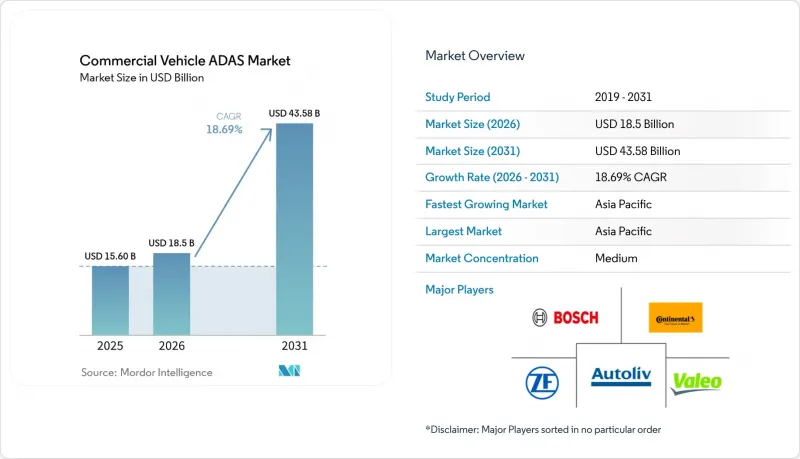
據 Mordor Intelligence 稱,2025 年商用車先進駕駛輔助系統(ADAS) 的市場規模為 156 億美元,預計將從 2026 年的 185 億美元成長到 2031 年的 435.8 億美元,2026 年至 2031 年的複合年成長率為 18.69%。
本報告按系統(自適應巡航控制、盲點偵測等)、感測器(雷達、雷射雷達等)、車輛類型(輕型商用車、中型和重型商用車)、分銷管道(原廠配套、售後市場)和地區(北美、南美等)進行分類。市場預測以美元計價。
全球商用車ADAS市場趨勢及洞察
加強道路安全法規
歐盟通用安全法規2022/1426強制要求歐盟境內所有新商用車輛必須配備駕駛員疲勞預警、自動緊急煞車和盲點監測系統。該法規統一了歐盟27個成員國的相關規範。印度也將效仿,強制要求採用AIS-162、AIS-186和AIS-188標準。這些標準將於2026年4月對新車型生效,並於2026年10月對現有平台生效。這些強制措施將促進這些功能的標準化,即使在成本控制較嚴格的細分市場也是如此。中國的GB 39901-2025標準也將從2028年1月起對N1類廂型車強制要求配備自動緊急煞車系統。此外,中國的自動駕駛法規將於2027年7月起允許L3級自動駕駛,從而有效地建立了分級性能標準。在美國,NHTSA 針對重型車輛煞車提案的法規草案目前正處於最終審查階段,此前該草案於 2023 年進行了公開通知和公眾評議。 UNECE 法規 R131、R152、R171 和 R157 為簽署國之間提供了協調一致的技術標準,減少了合規性差異,並促進了跨境車輛部署。
自動駕駛/ADAS技術堆疊的技術進步
感測器融合正朝著雷達、攝影機和LiDAR相結合的混合模式發展,從而在成本績效方面取得良好的平衡。 PlusAI 的「SuperDrive 6.0」將一個包含 100 億個參數的基礎模型壓縮成一個包含 5,000 萬個參數的邊緣版本,實現了無雲延遲的即時物體分類。法雷奧已獲得訂單,該雷達能夠支援時速 130 公里的 L3 級高速公路自動駕駛。這表明,在結構化的應用場景中,4D 雷達可以取代LiDAR,從而顯著降低組件成本。到 2028 年,MicroVision 的「Movia S LiDAR」計畫透過採用 905 奈米 MEMS 掃描模組來實現具有競爭力的價格。此舉將使該產品的應用範圍擴展到豪華卡車之外。早期融合方法結合了來自雷達、LiDAR和攝影機的原始數據以提高識別能力,但需要更多的運算能力。相較之下,後期融合可以降低延遲,但存在各模態之間位置錯位的風險。原始設備製造商正在嘗試這兩種方法,以找到性能和成本之間的最佳平衡。
ADAS組件初始成本高
在印度和巴西,標準的77GHz雷達和單攝影機配置會推高輕型卡車的價格,但這只佔出廠價的一小部分。機械旋轉式LiDAR仍然價格昂貴,但MicroVision的固態技術藍圖旨在未來三年內大幅降低成本。 Valeo的成像雷達聲稱,在維護良好的高速公路上,它可以取代雷射雷達,從而大幅降低系統成本。然而,車主們正努力平衡ADAS的成本與電氣化和駕駛員訓練的成本。為了減輕經濟負擔,他們正透過租賃和保險相關的融資方式,將資本支出轉化為營運費用。這項策略使得商用車ADAS市場即使在經濟普遍波動的情況下也能維持成長動能。
細分市場分析
在商用車高級駕駛輔助系統(ADAS)市場中,受歐盟和印度強制法規的推動,駕駛員監控系統細分市場預計到2031年將以20.05%的複合年成長率成長。同時,主動式車距維持定速系統(ACC)預計到2025年將佔據商用車ADAS市場佔有率的26.15%,儘管隨著該技術的普及,其單價利潤率呈下降趨勢。自動緊急煞車系統在許多聯合國歐洲經濟委員會(UNECE)成員國被強制要求,這使得低誤報率的感知演算法備受關注。盲點偵測技術正透過售後市場套件獲得越來越多的應用,尤其是在亞太地區的公共交通車輛中。另一方面,諸如泊車輔助和夜視等功能仍處於小眾領域,由於熱成像攝影機的單價仍然較高,其應用主要局限於高階旅遊巴士市場。
整合式網域控制器將多個ADAS功能整合到單一攝影機中,從而降低單車成本並簡化空中下載(OTA)升級。這種整合正在將商用車ADAS市場從基於硬體的收入模式轉向軟體主導的價值創造模式。原始設備製造商(OEM)正在將駕駛員監控系統與車道維持輔助和前向碰撞警報捆綁銷售,從而顯著減少額外的硬體投資。
雷達仍然是車輛感知系統的基礎,預計到2025年將佔據商用車ADAS市場49.05%的佔有率。然而,LiDAR預計將以19.72%的複合年成長率成長,這反映出其強勁的成長潛力,尤其是在單價降至200美元以下的情況下。成像雷達提供點雲深度數據,模糊了傳統感測器分類的界限,使得在結構化高速公路上無需旋轉雷射雷達即可實現L3級自動駕駛。攝影機仍然是最具成本效益的模式,對於駕駛員監控、交通標誌識別和物體分類至關重要。多模態資料的早期融合可以提高系統在霧天和低光源條件下的穩健性,但會增加計算成本,這為引入矽基最佳化推理引擎創造了機會。
LiDAR價格的下降預計將推動從豪華長途客車到量產中型卡車等各類車輛更多地採用LiDAR,從而擴大商用車高級駕駛輔助系統(ADAS)市場。然而,2030年後,歐洲主要大都會圈的雷達頻譜擁塞可能會催生對140 GHz高頻率雷達的需求。
區域分析
亞太地區在商用車ADAS市場佔最大佔有率,達39.26%,並以每年18.97%的速度成長。印度2025年12月的商用車銷量年增24.6%,達到83,666輛。自2026年4月起,所有新購買重型卡車和客車都必須配備ADAS系統。中國的GB 39901-2025標準規定,N1級廂型車到2028年必須安裝自動緊急煞車系統;L3級自動駕駛框架將於2027年7月起合法化部分自動駕駛。這種整體規模的擴大正在推動供應商的本地化發展,安徽省、馬哈拉斯特拉邦和名古屋等地的攝影機、雷達和LiDAR工廠正在擴建。
在歐洲,嚴格的時間表正在加速推進軟體定義架構的採用。至2028年,TRATON的「ONE OS」計畫整合MAN、斯堪尼亞和國際卡車的軟體棧。同時,依維柯在馬德里和薩拉戈薩之間開展的L4級自動駕駛試點計畫表明,該地區可能直接跳過L3級的大規模部署。東歐的老舊車輛仍然高度依賴改裝,而監管力道不足也阻礙了市場滲透。
在北美,美國國家公路交通安全管理局 (NHTSA) 正在等待公佈關於重型車輛煞車系統的最終規則。儘管如此,L4 級自動駕駛試點計畫已經開始商業化。博世和 Kodiak 計劃在 2026 年底前在二疊紀盆地部署 100 輛無人駕駛卡車,在全面部署之前展示路線控制自動駕駛的潛力。在加拿大,長途運輸路線反映了美國的經濟模式,維護造成的運作顯著提高了高級駕駛輔助系統 (ADAS) 的投資回報率 (ROI)。南美洲、中東和非洲仍處於早期階段,但巴西雄心勃勃的基礎設施發展計畫和阿拉伯聯合大公國打造物流樞紐的努力正在為早期試驗鋪平道路。此外,保險公司的遠端資訊處理計劃在 ADAS運作期間提供基於里程的折扣,從而降低了這些系統的實施成本。
其他好處:
- Excel格式的市場預測(ME)表
- 3個月的分析師支持
目錄
第1章:引言
- 市場分析與定義的前提條件
- 分析範圍
第2章 分析方法
第3章執行摘要
第4章 市場狀況
- 市場概覽
- 市場促進因素
- 加強交通安全法規
- 自動駕駛/ADAS技術堆疊的技術進步
- 強制最佳化總擁有成本 (TCO)
- 與保險和遠端資訊處理相關的ADAS獎勵
- 歐盟自2026年起強制實施駕駛員監控
- 舊款車輛標準化維修套件
- 市場限制因素
- ADAS組件初始成本高
- 改裝不支援 CAN 總線的車輛的複雜性。
- 都市區雷達和頻段堵塞
- 促進要素流動率和技能缺口
- 價值鍊和供應鏈分析
- 供應商趨勢
- 監理情勢
- 技術展望
- 波特五力分析
第5章:預測市場規模與成長率
- 系統特定
- 主動式車距維持定速系統(ACC)
- 盲點偵測
- 車道偏離預警系統(LDWS)
- 自動緊急制動
- 前方碰撞警報
- 夜視系統
- 駕駛員監控
- 輪胎壓力監測系統(TPMS)
- 抬頭顯示器(HUD)
- 停車輔助系統
- 其他
- 感測器類型
- 雷達
- LiDAR
- 超音波
- 影像
- 其他
- 按車輛類型
- 輕型商用車
- 中型和大型商用車輛
- 透過分銷管道
- 原廠適配
- 售後市場
- 按地區
- 北美洲
- 美國
- 加拿大
- 其他北美國家
- 南美洲
- 巴西
- 阿根廷
- 其他南美國家
- 歐洲
- 德國
- 英國
- 法國
- 義大利
- 西班牙
- 其他歐洲國家
- 亞太地區
- 中國
- 日本
- 印度
- 韓國
- 澳洲
- 其他亞太國家
- 中東和非洲
- 阿拉伯聯合大公國
- 沙烏地阿拉伯
- 南非
- 其他中東和非洲國家
- 北美洲
第6章 競爭情勢
- 市場集中度
- 策略趨勢
- 市佔率分析
- 公司簡介
- Robert Bosch GmbH
- Continental AG
- ZF Friedrichshafen AG
- Autoliv Inc.
- Valeo SA
- Daimler Truck AG
- Volvo Group
- MAN Truck & Bus SE
- HL Mando Corporation
- Harman International
- Applied Intuition
- Imagination Technologies
- Vignal Group
- Gauzy Ltd.
第7章 市場機會與未來展望
According to Mordor Intelligence, the commercial vehicle ADAS market size was valued at USD 15.60 billion in 2025, and is projected to grow from USD 18.50 billion in 2026 to USD 43.58 billion by 2031, growing at a CAGR of 18.69% from 2026 to 2031.
This report is Segmented by System (Adaptive Cruise Control, Blind Spot Detection, and More), Sensor (Radar, Lidar, and More), Vehicle Type (Light Commercial Vehicles, Medium and Heavy Commercial Vehicles), Distribution Channel (OEM-Fitment, Aftermarket), and Geography (North America, South America, and More). Market Forecasts are Provided in Terms of Value (USD).
Global Commercial Vehicle ADAS Market Trends and Insights
Increasing Road-Safety Regulations
The General Safety Regulation 2022/1426 mandates that all new commercial vehicles in the EU must feature driver-drowsiness alerts, automated braking, and blind-spot detection. This regulation aligns specifications across all 27 EU member states. India follows with AIS-162, AIS-186, and AIS-188 mandates, which took effect in April 2026 for new models and will take effect in October 2026 for existing platforms. These mandates will drive baseline inclusion, even in cost-sensitive segments. China's GB 39901-2025 will extend automatic emergency braking requirements to N1 vans from January 2028. In addition, its autonomous driving code will permit Level 3 operations from July 2027, effectively establishing a progressive performance ladder.. In the United States, NHTSA's proposed heavy-vehicle braking rule is under final review after the 2023 notice-and-comment period. UNECE regulations R131, R152, R171, and R157 provide harmonized technical criteria among signatories, reducing compliance fragmentation and facilitating cross-border fleet deployment.
Technological Advances in Autonomous/ADAS Stacks
Sensor fusion is converging on hybrid radar-camera-LiDAR formats that strike a cost-performance balance. PlusAI's SuperDrive 6.0 compresses a 10-billion-parameter foundation model into a 0.5-billion-parameter edge variant, enabling real-time object classification without cloud latency. Valeo won orders for imaging radar capable of supporting Level 3 highway pilot at 130 km/h, proving that 4D radar can substitute for LiDAR in structured use cases and significantly trim the bill of materials . By 2028, MicroVision's Movia S LiDAR aims to achieve competitive pricing, utilizing 905-nm MEMS scanning modules. This move expands its reach beyond just premium trucks. Early-fusion methods combine raw data from radar, LiDAR, and cameras, enhancing perception but requiring more computing power. In contrast, late fusion reduces latency but risks misalignment between modalities. OEMs are experimenting with both methods to find the right balance between performance and cost.
High Initial ADAS Component Cost
In India and Brazil, a baseline 77-GHz radar and mono-camera suite adds to the price of light trucks, accounting for a small percentage of their ex-factory price. While mechanical spinning LiDAR remains expensive, MicroVision's solid-state roadmap targets significant cost reductions over the next three years. Valeo's imaging radar claims to offer substantial savings in system costs by substituting LiDAR on structured highways. However, fleets are balancing the costs of ADAS with those of electrification and driver training. To ease the financial burden, leasing and insurance-linked financing are converting capital expenditures into operational expenditures. This strategy is helping to maintain momentum in the commercial vehicle ADAS market, even amidst broader economic fluctuations.
Other drivers and restraints analyzed in the detailed report include:
- Fleet TCO Optimization Mandates
- Insurance-Telematics-Linked ADAS Incentives
- Retrofit Complexity for Pre-CAN Vehicles
For complete list of drivers and restraints, kindly check the Table Of Contents.
Segment Analysis
The commercial vehicle ADAS market segment for driver-monitoring systems is projected to expand at a CAGR of 20.05% through 2031, driven by regulatory mandates in the European Union and India. By comparison, adaptive cruise control is expected to account for 26.15% of the commercial vehicle ADAS market share in 2025, although unit margins are declining as the technology becomes commoditized. Automatic emergency braking is mandatory in many UNECE territories, shifting the focus toward perception algorithms with low false-positive rates. Blind-spot detection is gaining traction through retrofit kits, particularly among public transport fleets in the Asia-Pacific. Functions such as park assist and night vision remain niche, as thermal cameras continue to add high cost per truck, limiting adoption beyond premium tour bus segments.
Integrated domain controllers consolidate multiple ADAS functions into a single camera, reducing per-vehicle costs and simplifying over-the-air upgrades. This integration supports the Commercial Vehicle ADAS Market's shift from hardware-based revenue toward software-driven value capture. OEMs are bundling driver monitoring systems with lane-keeping assistance and forward-collision warning, significantly reducing incremental hardware spending.
Radar continues to anchor vehicle perception systems, accounting for 49.05% of the commercial vehicle ADAS market share in 2025. However, LiDAR is expected to register a 19.72% CAGR, reflecting strong growth potential as unit prices fall below USD 200. Imaging radar, which delivers point-cloud depth data, is blurring traditional sensor categories and enabling Level 3 autonomy on structured highways without the need for spinning LiDAR. Cameras remain the most cost-effective modality and are essential for driver monitoring, traffic sign recognition, and object classification. Early fusion of multimodal data improves system robustness in fog and low-light conditions but increases computing costs, creating opportunities for silicon-optimized inference engines.
Declining LiDAR prices will drive adoption of LiDAR from luxury motorcoaches to high-volume medium-duty trucks, expanding the commercial vehicle ADAS market. However, radar spectrum congestion in European metropolitan areas could create opportunities for higher-frequency 140 GHz radar after 2030.
Complete Report Scope:
- By System
- Adaptive Cruise Control
- Blind Spot Detection
- Lane Departure Warning System
- Automatic Emergency Braking
- Forward Collision Warning
- Night Vision System
- Driver Monitoring
- Tire-Pressure Monitoring System
- Head-Up Display
- Park Assist System
- Others
- By Sensor
- Radar
- LiDAR
- Ultrasonic
- Image
- Others
- By Vehicle Type
- Light Commercial Vehicles
- Medium and Heavy Commercial Vehicles
- By Distribution Channel
- Original Equipment Manufacturer (OEM)-Fitment
- Aftermarket
- By Geography
- North America
- United States
- Canada
- Rest of North America
- South America
- Brazil
- Argentina
- Rest of South America
- Europe
- Germany
- United Kingdom
- France
- Italy
- Spain
- Rest of Europe
- Asia-Pacific
- China
- Japan
- India
- South Korea
- Australia
- Rest of Asia-Pacific
- Middle East and Africa
- United Arab Emirates
- Saudi Arabia
- South Africa
- Rest of Middle East and Africa
- North America
Geography Analysis
Asia-Pacific holds the largest Commercial vehicle ADAS market share at 39.26% and is expanding 18.97% annually. India's December 2025 commercial-vehicle sales rose 24.6% year-on-year to 83,666 units, and April 2026 mandates that ADAS be fitted to every new heavy truck and bus . China's GB 39901-2025 makes automatic braking compulsory on N1 vans by 2028, while its Level 3 framework legalizes partial autonomy from July 2027. The combined scale drives supplier localization, with camera, radar, and LiDAR plants expanding in Anhui, Maharashtra, and Nagoya.
Europe is enforcing tight timelines, driving the adoption of software-defined architectures. By 2028, TRATON's ONE OS aims to unify the truck stacks of MAN, Scania, and International. Meanwhile, IVECO's pilot in Madrid-Zaragoza, operating at Level 4, suggests the region may bypass widespread Level 3 adoption. Eastern Europe's older fleets remain heavily reliant on retrofitting, but weaker enforcement continues to hinder market penetration.
North America awaits NHTSA's final heavy-vehicle braking rule. Still, it is already commercializing Level 4 pilots. Bosch and Kodiak are deploying 100 driverless trucks in the Permian Basin by the end of 2026, demonstrating the potential of controlled-route autonomy ahead of broader deployment. In Canada, long-haul corridors reflect U.S. economic patterns, where maintenance-related downtimes significantly boost the ROI for ADAS. While South America and the Middle East-Africa regions are still in their infancy, Brazil's ambitious infrastructure initiatives and the UAE's aspirations as a logistics hub are paving the way for early experiments. Furthermore, insurance-telematics initiatives offer pay-per-kilometer discounts during active ADAS use, making these systems more affordable.
- Robert Bosch GmbH
- Continental AG
- ZF Friedrichshafen AG
- Autoliv Inc.
- Valeo SA
- Daimler Truck AG
- Volvo Group
- MAN Truck & Bus SE
- HL Mando Corporation
- Harman International
- Applied Intuition
- Imagination Technologies
- Vignal Group
- Gauzy Ltd.
Additional Benefits:
- The market estimate (ME) sheet in Excel format
- 3 months of analyst support
TABLE OF CONTENTS
1 Introduction
- 1.1 Study Assumptions & Market Definition
- 1.2 Scope of the Study
2 Research Methodology
3 Executive Summary
4 Market Landscape
- 4.1 Market Overview
- 4.2 Market Drivers
- 4.2.1 Increasing Road-Safety Regulations
- 4.2.2 Technological Advances in Autonomous/ADAS Stacks
- 4.2.3 Fleet TCO Optimization Mandates
- 4.2.4 Insurance-Telematics-Linked ADAS Incentives
- 4.2.5 EU Driver-Monitoring Mandate Post-2026
- 4.2.6 Standardized Retrofit Kits for Legacy Fleets
- 4.3 Market Restraints
- 4.3.1 High Initial ADAS Component Cost
- 4.3.2 Retrofit Complexity for Pre-CAN Vehicles
- 4.3.3 Urban Radar-Spectrum Congestion
- 4.3.4 Driver Disengagement and Skills Gap
- 4.4 Value / Supply-Chain Analysis
- 4.5 Supplier Landscape
- 4.6 Regulatory Landscape
- 4.7 Technological Outlook
- 4.8 Porter's Five Forces
- 4.8.1 Threat of New Entrants
- 4.8.2 Bargaining Power of Suppliers
- 4.8.3 Bargaining Power of Buyers
- 4.8.4 Threat of Substitutes
- 4.8.5 Competitive Rivalry
5 Market Size & Growth Forecasts (Value (USD))
- 5.1 By System
- 5.1.1 Adaptive Cruise Control
- 5.1.2 Blind Spot Detection
- 5.1.3 Lane Departure Warning System
- 5.1.4 Automatic Emergency Braking
- 5.1.5 Forward Collision Warning
- 5.1.6 Night Vision System
- 5.1.7 Driver Monitoring
- 5.1.8 Tire-Pressure Monitoring System
- 5.1.9 Head-Up Display
- 5.1.10 Park Assist System
- 5.1.11 Others
- 5.2 By Sensor
- 5.2.1 Radar
- 5.2.2 LiDAR
- 5.2.3 Ultrasonic
- 5.2.4 Image
- 5.2.5 Others
- 5.3 By Vehicle Type
- 5.3.1 Light Commercial Vehicles
- 5.3.2 Medium and Heavy Commercial Vehicles
- 5.4 By Distribution Channel
- 5.4.1 Original Equipment Manufacturer (OEM)-Fitment
- 5.4.2 Aftermarket
- 5.5 By Geography
- 5.5.1 North America
- 5.5.1.1 United States
- 5.5.1.2 Canada
- 5.5.1.3 Rest of North America
- 5.5.2 South America
- 5.5.2.1 Brazil
- 5.5.2.2 Argentina
- 5.5.2.3 Rest of South America
- 5.5.3 Europe
- 5.5.3.1 Germany
- 5.5.3.2 United Kingdom
- 5.5.3.3 France
- 5.5.3.4 Italy
- 5.5.3.5 Spain
- 5.5.3.6 Rest of Europe
- 5.5.4 Asia-Pacific
- 5.5.4.1 China
- 5.5.4.2 Japan
- 5.5.4.3 India
- 5.5.4.4 South Korea
- 5.5.4.5 Australia
- 5.5.4.6 Rest of Asia-Pacific
- 5.5.5 Middle East and Africa
- 5.5.5.1 United Arab Emirates
- 5.5.5.2 Saudi Arabia
- 5.5.5.3 South Africa
- 5.5.5.4 Rest of Middle East and Africa
- 5.5.1 North America
6 Competitive Landscape
- 6.1 Market Concentration
- 6.2 Strategic Moves
- 6.3 Market Share Analysis
- 6.4 Company Profiles (Includes Global Level Overview, Market Level Overview, Core Segments, Financials as Available, Strategic Information, Market Rank/Share for Key Companies, Products and Services, SWOT Analysis, and Recent Developments)
- 6.4.1 Robert Bosch GmbH
- 6.4.2 Continental AG
- 6.4.3 ZF Friedrichshafen AG
- 6.4.4 Autoliv Inc.
- 6.4.5 Valeo SA
- 6.4.6 Daimler Truck AG
- 6.4.7 Volvo Group
- 6.4.8 MAN Truck & Bus SE
- 6.4.9 HL Mando Corporation
- 6.4.10 Harman International
- 6.4.11 Applied Intuition
- 6.4.12 Imagination Technologies
- 6.4.13 Vignal Group
- 6.4.14 Gauzy Ltd.
7 Market Opportunities & Future Outlook
- 7.1 White-Space & Unmet-Need Assessment

 商用車ADAS市場-2026-2032年全球市場預測
 2026年商用車高級駕駛輔助系統(ADAS)全球市場報告
 商用車ADAS市場機會、成長要素、產業趨勢分析及2026年至2035年預測
 全球商用車ADAS市場
 商用車 ADAS 市場,全球 2025-2029