


 |
市場調查報告書
商品編碼
1913474
商用車ADAS市場機會、成長要素、產業趨勢分析及2026年至2035年預測Commercial Vehicle ADAS Market Opportunity, Growth Drivers, Industry Trend Analysis, and Forecast 2026 - 2035 |
||||||

全球商用車ADAS市場預計2025年將達154億美元,到2035年將達763億美元,年複合成長率為17.7%。
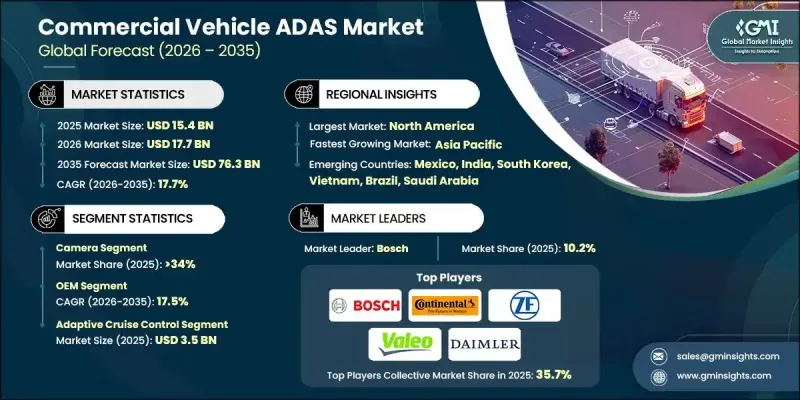
這一強勁的成長勢頭源於監管機構對道路安全的日益重視,以及商用車輛車隊對降低事故相關成本的日益關注。車隊所有者和營運商越來越認知到,高級駕駛輔助系統 (ADAS) 是提高營運安全性和效率的關鍵工具。這些系統透過增強駕駛員的感知能力、改善車輛控制以及減少對人工干預的依賴來輔助駕駛員。隨著運輸公司將風險緩解和遵守安全要求放在首位,ADAS 的應用正在加速。技術進步進一步推動了需求,人工智慧和機器學習能夠實現更快的數據處理和更準確的即時決策。這些創新提高了車輛的反應速度,並提升了系統的整體可靠性。隨著全球商務傳輸活動的日益成長,ADAS 的整合正不斷成為現代車輛設計和車隊管理策略的關鍵要素。
| 市場覆蓋範圍 | |
|---|---|
| 開始年份 | 2025 |
| 預測年份 | 2026-2035 |
| 起始值 | 154億美元 |
| 預測金額 | 763億美元 |
| 複合年成長率 | 17.7% |
預計2026年至2035年間,OEM通路細分市場將以17.5%的複合年成長率成長。汽車製造商在生產過程中直接整合ADAS系統,從而能夠將先進的安全功能作為標準配置或客製化選項提供。這種方法提高了系統的兼容性和性能,同時確保了品質標準的一致性,這也解釋了OEM在流通結構中佔據的強勢地位。
2025年,主動式車距維持定速系統(ACC)細分市場價值將達到35億美元。該細分市場將繼續保持主導地位,因為它能夠根據交通流量自動調節速度,從而提高駕駛員的舒適度,即使在長時間駕駛條件下也能保持車輛穩定運行。
預計到2025年,美國商用車ADAS市場規模將達39億美元。隨著車隊營運商尋求先進的安全技術來應對事故風險和不斷上漲的營運成本,市場需求持續成長。減少人為駕駛失誤的趨勢也進一步凸顯了在全國商用車車隊中推廣ADAS的重要性。
目錄
第1章調查方法
第2章執行摘要
第3章業界考察
- 生態系分析
- 供應商情況
- 利潤率
- 成本結構
- 每個階段的附加價值
- 影響價值鏈的因素
- 中斷
- 產業影響因素
- 促進要素
- 政府對商用車輛制定了嚴格的安全法規。
- 涉及大型和商用車輛的道路交通事故增加。
- 車隊安全和遠端資訊處理解決方案的廣泛應用
- 電子商務和最後一公里配送車輛的快速成長
- 產業潛在風險與挑戰
- 極端天氣和路況下的可靠性挑戰
- 為現有車輛加裝ADAS系統的複雜性
- 市場機遇
- 電動商用車對ADAS的需求日益成長
- 新興市場和發展中經濟體的成長潛力
- ADAS和V2X通訊系統的整合
- 為老舊車隊擴展ADAS改造解決方案
- 促進要素
- 成長潛力分析
- 監管環境
- 北美洲
- 聯邦機動車輛安全標準(FMVSS)
- IIHS商用車輛安全評級計劃
- SAE國際高級駕駛輔助系統(ADAS)與自動駕駛標準
- 加拿大運輸部機動車輛安全法規
- 歐洲
- 歐盟一般安全規則(EU)
- 聯合國歐洲經濟委員會(UNECE)車輛法規
- 歐洲新車安全評鑑協會商用車安全評估通訊協定
- 歐盟道路安全政策框架
- 亞太地區
- 日本國土交通省ADAS安全法規
- 中國GB標準:智慧連網車輛
- 中國新車安全評鑑協會(C-NCAP)ADAS評估指南
- 印度商用車輛安全標準(AIS)
- 拉丁美洲
- 拉丁美洲 NCAP 安全評估通訊協定
- 巴西國家公路運輸管理局(CONTRAN)車輛安全決議
- 阿根廷國家道路安全法規
- 墨西哥NOM車輛安全標準
- 中東和非洲
- 阿拉伯聯合大公國聯邦道路安全法規
- 南非共和國道路交通法車輛標準
- 北美洲
- 波特五力分析
- PESTEL 分析
- 科技與創新趨勢
- 當前技術趨勢
- 新興技術
- 價格趨勢
- 按地區
- 依產品
- 成本細分分析
- 永續性和環境影響
- 環境影響評估
- 社會影響力和社區服務
- 公司管治與企業社會責任
- 永續金融與投資趨勢
- 風險評估
- 市場風險
- 技術風險
- 監理與合規風險
- 網路安全與資料隱私風險
- 風險緩解策略
- 案例研究
- 未來前景與機遇
第4章 競爭情勢
- 介紹
- 公司市佔率分析
- 北美洲
- 歐洲
- 亞太地區
- 拉丁美洲
- 中東和非洲
- 主要市場公司的競爭分析
- 競爭定位矩陣
- 戰略展望矩陣
- 重大進展
- 併購
- 夥伴關係與合作
- 新產品發布
- 企業擴張計畫和資金籌措
第5章 2022-2035年各系統市場估算與預測
- 主動式車距維持定速系統
- 盲點偵測系統
- 車道偏離預警系統
- 自動緊急煞車(AEM)
- 前方碰撞警報
- 夜視系統
- 駕駛員監控
- 輪胎壓力監測系統
- 抬頭顯示器
- 停車輔助系統
- 其他
第6章 按感測器分類的市場估算與預測,2022-2035年
- 雷達
- 騎士
- 超音波
- 相機
- 其他
第7章 依車輛類型分類的市場估計與預測,2022-2035年
- LCV
- MCV
- 重型商用車(HCV)
第8章 2022-2035年各層級市場估算與預測
- 一級
- 二級
- 3級
- 4級
第9章 依推進方式分類的市場估計與預測,2022-2035年
- 內燃機(ICE)
- 電動車(EV)
- 混合
第10章 按分銷管道分類的市場估算與預測,2022-2035年
- OEM
- 售後市場
第11章 2022-2035年各地區市場估計與預測
- 北美洲
- 美國
- 加拿大
- 歐洲
- 德國
- 英國
- 法國
- 義大利
- 西班牙
- 俄羅斯
- 北歐國家
- 比荷盧經濟聯盟
- 亞太地區
- 中國
- 印度
- 日本
- 韓國
- ANZ
- 新加坡
- 馬來西亞
- 印尼
- 越南
- 泰國
- 拉丁美洲
- 巴西
- 墨西哥
- 阿根廷
- 哥倫比亞
- 中東和非洲(MEA)
- 南非
- 沙烏地阿拉伯
- 阿拉伯聯合大公國
第12章:公司簡介
- 世界公司
- Bosch
- Continental
- ZF Friedrichshafen
- Valeo
- Denso
- Mobileye
- Magna
- Autoliv
- Hyundai Mobis
- Aptiv
- Knorr-Bremse
- Forvia(Hella)
- Daimler
- Volvo
- Ford
- 本地公司
- Stoneridge
- Brigade Electronics
- Seeing Machines
- MAN Truck &Bus
- Iveco
- Gauzy
- Renault
- 新興企業
- Huawei
- Horizon Robotics
- Black Sesame
- Applied Intuition
The Global Commercial Vehicle ADAS Market was valued at USD 15.4 billion in 2025 and is estimated to grow at a CAGR of 17.7% to reach USD 76.3 billion by 2035.
Strong momentum is driven by increasing regulatory focus on road safety and the growing emphasis on reducing accident-related costs within commercial fleets. Fleet owners and operators increasingly view advanced driver assistance technologies as essential tools for improving operational safety and efficiency. These systems support drivers by enhancing awareness, improving vehicle control, and reducing dependence on manual intervention. Adoption has accelerated as transportation companies prioritize risk mitigation and compliance with safety requirements. Technological progress has further strengthened demand, with artificial intelligence and machine learning enabling faster data processing and more accurate real-time decision-making. These innovations enhance vehicle responsiveness and improve overall system reliability. As commercial transport activity increases worldwide, the integration of ADAS continues to gain traction as a critical component of modern vehicle design and fleet management strategies.
| Market Scope | |
|---|---|
| Start Year | 2025 |
| Forecast Year | 2026-2035 |
| Start Value | $15.4 Billion |
| Forecast Value | $76.3 Billion |
| CAGR | 17.7% |
The OEM channel segment will grow at a CAGR of 17.5% from 2026 to 2035. Vehicle manufacturers integrate ADAS directly during production, allowing advanced safety features to be offered as built-in or configurable options. This approach improves system compatibility and performance while ensuring consistent quality standards, which explains the strong position of OEMs within the distribution landscape.
The adaptive cruise control segment reached USD 3.5 billion in 2025. This segment maintained its leadership due to its ability to support driver comfort and maintain consistent vehicle operation during extended driving conditions by automatically regulating speed based on traffic flow.
U.S. Commercial Vehicle ADAS Market reached USD 3.9 billion in 2025. Demand increased as fleet operators sought advanced safety technologies to address accident risks and rising operational expenses. The focus on reducing human-related driving errors continued to reinforce the importance of ADAS adoption across commercial fleets in the country.
Key companies operating in the Global Commercial Vehicle ADAS Market include Continental, Bosch, Magna, Mobileye, ZF Friedrichshafen, Denso, Volvo, Valeo, Ford, and Daimler. Companies active in the Global Commercial Vehicle ADAS Market strengthen their market position through continuous innovation, strategic partnerships, and large-scale production capabilities. Manufacturers invest heavily in research and development to enhance system accuracy, reliability, and real-time processing capabilities. Collaboration with vehicle manufacturers enables seamless integration of ADAS at the production stage. Firms also focus on expanding product portfolios to address diverse vehicle categories and fleet requirements. Cost optimization and scalable manufacturing help companies remain competitive while meeting growing demand.
Table of Contents
Chapter 1 Methodology
- 1.1 Market scope and definition
- 1.2 Research design
- 1.2.1 Research approach
- 1.2.2 Data collection methods
- 1.3 Data mining sources
- 1.3.1 Global
- 1.3.2 Regional/Country
- 1.4 Base estimates and calculations
- 1.4.1 Base year calculation
- 1.4.2 Key trends for market estimation
- 1.5 Primary research and validation
- 1.5.1 Primary sources
- 1.6 Forecast
- 1.7 Research assumptions and limitations
Chapter 2 Executive Summary
- 2.1 Industry 360° synopsis
- 2.2 Key market trends
- 2.2.1 Regional
- 2.2.2 System
- 2.2.3 Sensor
- 2.2.4 Vehicle Category
- 2.2.5 Level
- 2.2.6 Propulsion
- 2.2.7 Distribution Channel
- 2.3 TAM analysis, 2026-2035
- 2.4 CXO perspectives: Strategic imperatives
- 2.4.1 Executive decision points
- 2.4.2 Critical success factors
- 2.5 Future outlook and recommendations
Chapter 3 Industry Insights
- 3.1 Industry ecosystem analysis
- 3.1.1 Supplier landscape
- 3.1.2 Profit margin
- 3.1.3 Cost structure
- 3.1.4 Value addition at each stage
- 3.1.5 Factor affecting the value chain
- 3.1.6 Disruptions
- 3.2 Industry impact forces
- 3.2.1 Growth drivers
- 3.2.1.1 Stringent government safety regulations for commercial vehicles
- 3.2.1.2 Rising road accidents involving heavy and commercial vehicles
- 3.2.1.3 Growing adoption of fleet safety and telematics solutions
- 3.2.1.4 Rapid growth of e-commerce and last-mile delivery fleets
- 3.2.2 Industry pitfalls and challenges
- 3.2.2.1 Reliability issues in harsh weather and road conditions
- 3.2.2.2 Complexity in retrofitting ADAS in existing vehicles
- 3.2.3 Market opportunities
- 3.2.3.1 Increasing demand for ADAS in electric commercial vehicles
- 3.2.3.2 Growth potential in emerging markets and developing economies
- 3.2.3.3 Integration of ADAS with V2X communication systems
- 3.2.3.4 Expansion of ADAS retrofitting solutions for aging fleets
- 3.2.1 Growth drivers
- 3.3 Growth potential analysis
- 3.4 Regulatory landscape
- 3.4.1 North America
- 3.4.1.1 Federal Motor Vehicle Safety Standards (FMVSS)
- 3.4.1.2 IIHS Commercial Vehicle Safety Evaluation Programs
- 3.4.1.3 SAE International ADAS and Automated Driving Standards
- 3.4.1.4 Transport Canada Motor Vehicle Safety Regulations
- 3.4.2 Europe
- 3.4.2.1 EU General Safety Regulation (EU)
- 3.4.2.2 UNECE Vehicle Regulations
- 3.4.2.3 Euro NCAP Commercial Vehicle Safety Rating Protocols
- 3.4.2.4 EU Road Safety Policy Framework
- 3.4.3 Asia Pacific
- 3.4.3.1 Japan MLIT Safety Regulations for ADAS
- 3.4.3.2 China GB Standards for Intelligent and Connected Vehicles
- 3.4.3.3 China NCAP (C-NCAP) ADAS Evaluation Guidelines
- 3.4.3.4 India AIS Standards for Commercial Vehicle Safety
- 3.4.4 Latin America
- 3.4.4.1 Latin NCAP Safety Assessment Protocols
- 3.4.4.2 Brazil CONTRAN Vehicle Safety Resolutions
- 3.4.4.3 Argentina National Traffic Safety Regulations
- 3.4.4.4 Mexico NOM Vehicle Safety Standards
- 3.4.5 Middle East & Africa
- 3.4.5.1 UAE Federal Traffic Safety Regulations
- 3.4.5.2 South Africa National Road Traffic Act Vehicle Standards
- 3.4.1 North America
- 3.5 Porter's analysis
- 3.6 PESTEL analysis
- 3.7 Technology and innovation landscape
- 3.7.1 Current technological trends
- 3.7.2 Emerging technologies
- 3.8 Price trends
- 3.8.1 By region
- 3.8.2 By product
- 3.9 Cost breakdown analysis
- 3.10 Sustainability and environmental impact
- 3.10.1 Environmental impact assessment
- 3.10.2 Social impact & community benefits
- 3.10.3 Governance & corporate responsibility
- 3.10.4 Sustainable finance & investment trends
- 3.11 Risk Assessment
- 3.11.1 Market risks
- 3.11.2 Technological risks
- 3.11.3 Regulatory and compliance risks
- 3.11.4 Cybersecurity and data privacy risks
- 3.11.5 Risk mitigation strategies
- 3.12 Case studies
- 3.13 Future outlook & opportunities
Chapter 4 Competitive Landscape, 2025
- 4.1 Introduction
- 4.2 Company market share analysis
- 4.2.1 North America
- 4.2.2 Europe
- 4.2.3 Asia Pacific
- 4.2.4 LATAM
- 4.2.5 MEA
- 4.3 Competitive analysis of major market players
- 4.4 Competitive positioning matrix
- 4.5 Strategic outlook matrix
- 4.6 Key developments
- 4.6.1 Mergers & acquisitions
- 4.6.2 Partnerships & collaborations
- 4.6.3 New product launches
- 4.6.4 Expansion plans and funding
Chapter 5 Market Estimates & Forecast, By System, 2022 - 2035 ($Bn, units)
- 5.1 Key trends
- 5.2 Adaptive cruise control
- 5.3 Blind spot detection
- 5.4 Lane departure warning system
- 5.5 Automatic emergency braking (AEM)
- 5.6 Forward collision warning
- 5.7 Night vision system
- 5.8 Driver monitoring
- 5.9 Tire pressure monitoring system
- 5.10 Head-up display
- 5.11 Park assist system
- 5.12 Others
Chapter 6 Market Estimates & Forecast, By Sensor, 2022 - 2035 ($Bn, units)
- 6.1 Key trends
- 6.2 Radar
- 6.3 Lidar
- 6.4 Ultrasonic
- 6.5 Camera
- 6.6 Others
Chapter 7 Market Estimates & Forecast, By Vehicle Category, 2022 - 2035 ($Bn, units)
- 7.1 Key trends
- 7.2 LCV
- 7.3 MCV
- 7.4 HCV
Chapter 8 Market Estimates & Forecast, By Level, 2022 - 2035 ($Bn, units)
- 8.1 Key trends
- 8.2 Level-1
- 8.3 Level-2
- 8.4 Level-3
- 8.5 Level-4
Chapter 9 Market Estimates & Forecast, By Propulsion, 2022 - 2035 ($Bn, units)
- 9.1 Key trends
- 9.2 ICE
- 9.3 EV
- 9.4 Hybrid
Chapter 10 Market Estimates & Forecast, By Distribution Channel, 2022 - 2035 ($Bn, units)
- 10.1 Key trends
- 10.2 OEM
- 10.3 Aftermarket
Chapter 11 Market Estimates & Forecast, By Region, 2022 - 2035 ($Bn, units)
- 11.1 Key trends
- 11.2 North America
- 11.2.1 US
- 11.2.2 Canada
- 11.3 Europe
- 11.3.1 Germany
- 11.3.2 UK
- 11.3.3 France
- 11.3.4 Italy
- 11.3.5 Spain
- 11.3.6 Russia
- 11.3.7 Nordics
- 11.3.8 Benelux
- 11.4 Asia Pacific
- 11.4.1 China
- 11.4.2 India
- 11.4.3 Japan
- 11.4.4 South Korea
- 11.4.5 ANZ
- 11.4.6 Singapore
- 11.4.7 Malaysia
- 11.4.8 Indonesia
- 11.4.9 Vietnam
- 11.4.10 Thailand
- 11.5 Latin America
- 11.5.1 Brazil
- 11.5.2 Mexico
- 11.5.3 Argentina
- 11.5.4 Colombia
- 11.6 MEA
- 11.6.1 South Africa
- 11.6.2 Saudi Arabia
- 11.6.3 UAE
Chapter 12 Company Profiles
- 12.1 Global companies
- 12.1.1 Bosch
- 12.1.2 Continental
- 12.1.3 ZF Friedrichshafen
- 12.1.4 Valeo
- 12.1.5 Denso
- 12.1.6 Mobileye
- 12.1.7 Magna
- 12.1.8 Autoliv
- 12.1.9 Hyundai Mobis
- 12.1.10 Aptiv
- 12.1.11 Knorr-Bremse
- 12.1.12 Forvia (Hella)
- 12.1.13 Daimler
- 12.1.14 Volvo
- 12.1.15 Ford
- 12.2 Regional companies
- 12.2.1 Stoneridge
- 12.2.2 Brigade Electronics
- 12.2.3 Seeing Machines
- 12.2.4 MAN Truck & Bus
- 12.2.5 Iveco
- 12.2.6 Gauzy
- 12.2.7 Renault
- 12.3 Emerging companies
- 12.3.1 Huawei
- 12.3.2 Horizon Robotics
- 12.3.3 Black Sesame
- 12.3.4 Applied Intuition

 商用車ADAS市場-2026-2032年全球市場預測
 2026年商用車高級駕駛輔助系統(ADAS)全球市場報告
 商用車ADAS:市場佔有率分析、產業趨勢與統計、成長預測(2025-2030年)
 全球商用車ADAS市場
 商用車 ADAS 市場,全球 2025-2029