


 |
市場調查報告書
商品編碼
2125586
餐車:市佔率分析、產業趨勢及統計、成長預測(2026-2031)Food Truck - Market Share Analysis, Industry Trends & Statistics, Growth Forecasts (2026 - 2031) |
||||||

※ 本網頁內容可能與最新版本有所差異。詳細情況請與我們聯繫。
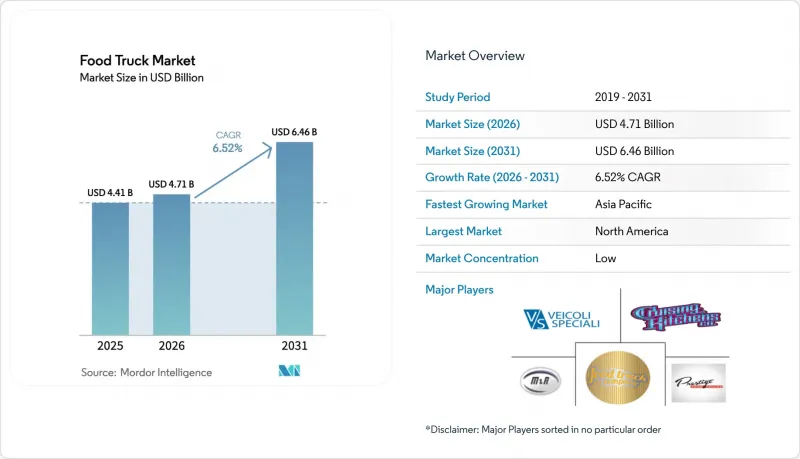
根據 Mordor Intelligence 預測,食品卡車市場規模將從 2025 年的 44.1 億美元成長到 2026 年的 47.1 億美元,到 2031 年達到 64.6 億美元。這意味著在預測期(2026-2031 年)內,複合年成長率將達到 6.52%。
本報告按車輛類型(廂型車、拖車等)、總長度(14 英尺以下、14-22 英尺、其他)、菜系/菜單(快餐等)、所有權類型(獨立運營商等)、動力傳動系統(內燃機等)、服務模式(移動/活動型、半永久性艙式停車場)和地區進行細分。市場預測以貨幣價值(美元)和銷售(輛)兩種形式呈現。
全球餐車市場趨勢與洞察
引入零排放/電動餐車將降低營運成本(OPEX)。
法規和燃油經濟性的雙重推動了電池式電動車)的普及。歐盟的《清潔車輛指令》規定,公共採購中只能包含零排放的小型車輛。美國國家可再生能源實驗室(NREL)指出,考慮到充電計畫和運作週期,與柴油車相比,電動重型汽車平臺可以降低總擁有成本。馬裡蘭州蒙哥馬利縣的一個試點計畫採用了焦耳箱系統,該計畫報告稱,在不使用發電機的情況下,運作時間延長,燃料成本顯著降低。在倫敦和加州,更嚴格的排放氣體法規及其帶來的罰款正在迅速抵消內燃機最初的成本優勢。隨著地方政府在活動場所安裝充電站,預計餐車市場將比預期更快採用電動驅動系統。
人們對初始資本支出(CAPEX)較低的特許經營模式越來越感興趣。
特許經營體係正透過降低准入門檻而蓬勃發展。 Kona Ice 利用包含設備和支援的打包方案,顯著拓展了其在美國的業務。 King of Pops 提供低廉的加盟費,以及獨家配方和供應商網路,大幅縮短了開業時間。 Carvel 在其特許經營資訊揭露中明確指出,其啟動成本遠低於傳統實體店,其中央廚房有助於營運商應對食品價格波動。不斷上漲的人事費用和食品成本正促使獨立業者透過特許經營實現規模經濟。這些發現凸顯了餐車產業對承包模式日益成長的需求。
與第三方線上配送平台的競爭
在美國,DoorDash 和 Uber Eats 等聚合平台主導外送市場,佔了很大一部分銷售額。這些平台改變了消費者獲取食物的方式,將曾經僅限於攤販小販的便利應用程式服務推向了大眾視野。原本就因高額佣金而苦苦掙扎的商家,如今面臨著更加狹窄的利潤空間。然而,隨著外送需求的激增,人們對這些平台廣泛覆蓋的依賴也日益加深。外送應用程式不斷增加廣告支出,為餐車獲取客戶的預算帶來了壓力。此外,平台演算法優先推廣自家虛擬品牌而非註冊商家,這為餐車產業帶來了更大的挑戰。
細分市場分析
預計到2025年,廂型車將佔餐車市場佔有率的46.20%,這表明它們非常適合人口密集的都市區路線和停車規定相對寬鬆的地區。電動廂型車預計將進一步擴大餐車市場,到2031年將以12.25%的複合年成長率成長,因為公共部門的採購限制往往優先考慮零排放的小型車輛。經營者欣賞廂型車在烹飪空間和移動性之間的平衡,而拖車則非常適合允許現場拆卸牽引車輛的節日路線。全尺寸卡車為複雜的廚房設備提供了充足的空間,但燃油和停車成本也更高。手推車和嘟嘟車則以較低的初始投資滿足了咖啡、甜點和單品銷售等細分市場的需求。
美國國家再生能源實驗室 (NREL) 的 T3CO 建模工具可協助車主最佳化電池容量和充電時間,從而支援部署決策。在馬裡蘭州進行的實地測試表明,配備 Joule Cases 的貨車在無需使用發電機的情況下,全天運行可降低 60-70% 的燃油消耗。這項證據表明,餐車市場即將迎來轉折點,電動貨車正開始從柴油車手中奪取市場佔有率。
到2025年,車長在14至22英尺之間的車輛將佔據餐車市場佔有率的53.75%。這反映了市政當局對車輛長度的限制,這些限制優先考慮與標準停車位的兼容性。預計到2031年,車長22英尺及以上的車輛市場將以10.45%的複合年成長率成長,其目標客戶是需要大規模生產線的企業園區和多日節慶活動。
中型車輛受益於類似華盛頓州帕斯科市2024年訂定的法規,該法規專門為餐車劃定停車位,允許它們全年運營而無需重複申請。蒙大拿州博茲曼市的一項計劃,每月定價800至1050美元不等,結果表明,包含公用設施的停車位可以提高每日盈利並縮短盈虧平衡點。
區域分析
到2025年,北美將佔據全球餐車市場佔有率的40.80%。美國透過城市層級的改革,以基於績效的許可製度取代了基於抽籤的街頭攤販數量上限,從而獲得了大部分區域收入。夏洛特、辛辛那提和卡加利等二線大都會圈正在為公共烹飪設施提供津貼,以鼓勵餐飲創業,並將業務範圍擴展到洛杉磯和紐約等傳統中心城市之外。在加拿大多元文化的都市區,多樣化的餐飲選擇持續受到歡迎,而較冷的氣候則導致5月至9月出現季節性銷售高峰。
亞太地區是成長最快的地區,預計到2031年將以10.50%的複合年成長率成長,這主要得益於不斷成長的城市人口和根深蒂固的街頭小吃傳統。在中國,「流動小吃街」試點計畫正在使先前不受監管的攤販合法化,並將QR碼支付的廣泛應用與現代衛生規範相結合。印度的「智慧城市計畫」透過資助配備共用廢棄物、水和電力設施的模組化銷售區,提高了基本的營運標準。印尼、泰國和越南也呈現出類似的成長勢頭,這得益於旅遊業的復甦和中產階級日益成長的需求。監管方面的不一致性仍然是一個障礙,但低廉的人事費用和本土底盤製造有助於降低創業成本。
歐洲的永續性法規正在改變格局。歐盟的《清潔車輛指令》強製成員國採購零排放車輛,引導企業採用電池式電動車。在葡萄牙,供應商註冊程序已簡化,企業家現在可以免費在線註冊。同時,在英國,環境衛生官員的減少導致許可證核准延誤。
在南美洲,巴西和阿根廷已推出新的聯邦法規,正式承認街頭攤販的存在。這些法規旨在簡化進口程序,減少重複檢查,並凸顯該地區作為快速成長市場的潛力。中東和非洲仍處於發展初期,但已引起廣泛關注,尤其是在杜拜和約翰尼斯堡等旅遊目的地。
其他好處:
- Excel格式的市場預測(ME)表
- 3個月的分析師支持
目錄
第1章:引言
- 市場分析與定義的前提條件
- 分析範圍
第2章 分析方法
第3章執行摘要
第4章 市場狀況
- 市場概覽
- 市場促進因素
- 快餐消費的擴張和街頭食品文化的傳播
- 人們對低資本支出(CAPEX)的特許經營模式越來越感興趣
- 透過社群媒體發現店鋪並進行衝動購買
- 透過展示美食佳餚和精湛工藝的菜單實現差異化。
- 市政府的社區廚房計畫正在加快許可證發放流程。
- 透過引入零排放/電動餐車降低營運成本 (OPEX)。
- 市場限制因素
- 來自第三方線上配送平台的競爭
- 嚴格的食品安全法規和多個機構的遵守
- 持證流動食品安全檢查員短缺
- 由於通貨膨脹,二手卡車底盤的價格正在飆升。
- 技術展望
- 波特五力分析
第5章:預測市場規模與成長率
- 按車輛類型
- 範
- 拖車
- 追蹤
- 嘟嘟車
- 按總長度
- 不足14英尺
- 14-22英尺
- 超過 22 英尺
- 按菜色/菜單
- 速食
- 純素/植物來源
- 烘焙食品和甜點
- 民族融合
- 僅限飲料
- 依所有權類型
- 獨立企業
- 特許經營連鎖店
- 企業/機構用車
- 按動力傳動系統
- 內燃機
- 全電動
- 混合
- 按服務模式
- 旅行/活動
- 半永久性艙身公園
- 按地區
- 北美洲
- 美國
- 加拿大
- 其他北美國家
- 南美洲
- 巴西
- 阿根廷
- 其他南美國家
- 歐洲
- 德國
- 英國
- 法國
- 義大利
- 西班牙
- 俄羅斯
- 其他歐洲國家
- 亞太地區
- 中國
- 印度
- 日本
- 韓國
- 澳洲和紐西蘭
- 其他亞太國家
- 中東和非洲
- 阿拉伯聯合大公國
- 沙烏地阿拉伯
- 土耳其
- 南非
- 其他中東和非洲國家
- 北美洲
第6章 競爭情勢
- 市場集中度
- 策略趨勢
- 市佔率分析
- 公司簡介
- Prestige Food Trucks
- Cruising Kitchens, LLC
- VS Veicoli Speciali
- M&R Specialty Trailers and Trucks
- Food Truck Company BV
- United Food Trucks United LLC
- MSM Catering Manufacturing Inc.
- Shanghai Mobile Kitchen Solutions
- Karpatia Trucks
- Custom Concessions
- Futuristo Trailers
- Legion Food Trucks
第7章 市場機會與未來展望
According to Mordor Intelligence, the food truck market size is expected to grow from USD 4.41 billion in 2025 to USD 4.71 billion in 2026 and is forecast to reach USD 6.46 billion by 2031, reflecting a 6.52% CAGR during the forecast period (2026-2031).
This report is Segmented by Vehicle Type (Vans, Trailers, and More), Length (Up To 14 Ft, 14 To 22 Ft, and More), Cuisine/Menu (Fast Food and More), Ownership Model (Independent Operators and More), Powertrain (Internal-Combustion and More), Service Model (Roaming/Event-Based and Semi-Permanent Pods and Parks), and Geography. The Market Forecasts are Provided in Terms of Value (USD) and Volume (Units).
Global Food Truck Market Trends and Insights
Adoption of Zero-Emission / Electric Food Trucks Cuts OPEX
Battery-electric fleets are gaining traction, driven by a combination of regulations and fuel economics. The EU Clean Vehicles Directive mandates that only zero-emission light-duty vehicles will qualify for public procurement. The National Renewable Energy Laboratory highlights that electric heavy-duty platforms, when considering charging schedules and duty cycles, can provide a lower total cost of ownership compared to diesel alternatives. Pilots in Montgomery County, Maryland, using Joule Case systems, report extended generator-free operation and significant fuel savings. In both London and California, increasing emission penalties quickly offset any initial cost advantages of internal-combustion engines. As municipalities continue to install charging stations in event spaces, the food truck market is expected to adopt electric drivetrains at a faster pace than previously anticipated.
Growing Preference for Low-CAPEX Franchising Models
Franchise systems are making headway by easing entry barriers. Kona Ice, leveraging a bundled equipment and support package, has expanded significantly nationwide. King of Pops offers a low franchise fee, along with proprietary recipes and supplier networks, which substantially reduces the time to launch. Carvel outlines a startup range in its Franchise Disclosure Document that is notably lower than traditional brick-and-mortar costs, and its central commissaries help operators manage fluctuations in ingredient prices. Rising labor and food costs have driven independent owners to seek economies of scale through franchising. These insights highlight the growing adoption of turnkey models in the food truck sector.
Competition from Third-Party Online Delivery Platforms
In the United States, aggregators such as DoorDash and Uber Eats dominate the delivery landscape, accounting for a significant share of sales. These platforms have transformed the way consumers access food, bringing app-based convenience to the forefront, a service once exclusive to street vendors. Operators, grappling with high commission rates, find their already-narrow profit margins further squeezed. Yet, as off-premises demand surges, so does their reliance on the expansive reach of these platforms. Delivery apps have increased their advertising expenditure, straining the customer acquisition budgets of food trucks. The challenge deepens as platform algorithms prioritize proprietary virtual brands, sidelining listed vendors and amplifying headwinds for the food truck sector.
Other drivers and restraints analyzed in the detailed report include:
- Social-Media-Driven Location Discovery and Impulse Buying
- Rising Consumption of Fast-Food and Street-Food Culture
- Stringent Food-Safety Regulations and Multi-Agency Compliance
For complete list of drivers and restraints, kindly check the Table Of Contents.
Segment Analysis
Vans accounted for 46.20% of the food truck market share in 2025, confirming their suitability for dense urban routes and easier parking regulations. Larger food truck market size prospects now lie in electric vans, forecasted to grow at a 12.25% CAGR through 2031, as public-sector procurement limits favor zero-emission light-duty vehicles. Operators appreciate the balance of galley capacity and maneuverability in vans, while trailers are more suitable for festival routes that permit the on-site detachment of prime movers. Full-size trucks offer ample space for complex kitchens, but they also incur higher fuel and parking costs. Carts and tuk-tuks fill coffee, dessert, and single-item niches at substantially lower capital outlays.
NREL's T3CO modeling tool helps owners optimize battery sizing and charging windows, supporting adoption decisions. In Maryland field trials, Joule Case-equipped vans logged full-service days without generators, resulting in a 60-70% reduction in fuel consumption. Such evidence suggests a tipping point at which electric vans will begin to shift market share away from diesel platforms in the food truck market.
Units between 14 and 22 feet captured 53.75% of the food truck market share in 2025, reflecting municipal length caps that favor standard parking bay compatibility. The 22-plus-foot cohort, projected to grow at a 10.45% CAGR through 2031, targets corporate campuses and multi-day festivals where throughput demands larger production lines.
Mid-size units benefit from ordinances such as Pasco, Washington's 2024 rule, which designates dedicated food-truck parks, allowing year-round trade without the need for repeated applications. Bozeman, Montana's program, priced at USD 800-1,050 per month, confirms that utilities-inclusive pads can improve daily economics and shorten breakeven timelines.
Complete Report Scope:
- By Vehicle Type
- Vans
- Trailers
- Trucks
- Carts and Tuk-tuks
- By Length
- Up to 14 ft
- 14 to 22 ft
- Above 22 ft
- By Cuisine/Menu
- Fast Food
- Vegan/Plant-based
- Bakery and Desserts
- Ethnic/Fusion
- Beverage-only
- By Ownership Model
- Independent Operators
- Franchise Chains
- Corporate / Institutional Fleets
- By Powertrain
- Internal-Combustion
- All-Electric
- Hybrid
- By Service Model
- Roaming/Event-based
- Semi-Permanent Pods and Parks
- By Geography
- North America
- United States
- Canada
- Rest of North America
- South America
- Brazil
- Argentina
- Rest of South America
- Europe
- Germany
- United Kingdom
- France
- Italy
- Spain
- Russia
- Rest of Europe
- Asia-Pacific
- China
- India
- Japan
- South Korea
- Australia and New Zealand
- Rest of Asia-Pacific
- Middle East and Africa
- United Arab Emirates
- Saudi Arabia
- Turkey
- South Africa
- Rest of Middle East and Africa
- North America
Geography Analysis
North America accounted for 40.80% of the food truck market share in 2025; the United States accounted for the majority of regional revenue, owing to city-level reforms that replaced lottery-based street-vending caps with merit-based licensing. Secondary metropolitan areas, such as Charlotte, Cincinnati, and Calgary, are offering commissary grants to promote culinary entrepreneurship, expanding their geographical reach beyond traditional hubs like Los Angeles and New York. Canada's multicultural urban centers continue to embrace diverse cuisine options, while its colder climate creates seasonal revenue peaks from May to September.
The Asia-Pacific region is the fastest-growing region, with a 10.50% CAGR through 2031, as urban population growth meets an ingrained street-food heritage. China's pilot "mobile snack streets" legalize previously informal vendors, pairing the ubiquity of QR-code payments with modern hygiene oversight. India's Smart City Mission funds modular vending zones outfitted with shared waste, water, and electricity, elevating baseline operating standards. Indonesia, Thailand, and Vietnam display similar momentum, buoyed by tourism rebounds and middle-class dietary experimentation. Fragmented regulations remain a hurdle; however, lower labor expenses and domestic chassis manufacturing help temper start-up costs.
Europe's sustainability mandates are reshaping its landscape. The EU's Clean Vehicles Directive requires member states to adopt zero-emission procurement quotas, steering operators towards battery-electric fleets. Portugal has simplified vendor notification processes, allowing entrepreneurs to register online for free. Meanwhile, the United Kingdom is experiencing permit delays due to a decline in staffing in environmental health.
In South America, Brazil and Argentina are introducing new federal regulations to formalize street vending. These rules aim to streamline import procedures and reduce redundant inspections, signaling the region's potential as a burgeoning growth corridor. While the Middle East and Africa are still in their infancy, they are drawing attention, particularly around tourism hotspots such as Dubai and Johannesburg.
- Prestige Food Trucks
- Cruising Kitchens, LLC
- VS Veicoli Speciali
- M&R Specialty Trailers and Trucks
- Food Truck Company BV
- United Food Trucks United LLC
- MSM Catering Manufacturing Inc.
- Shanghai Mobile Kitchen Solutions
- Karpatia Trucks
- Custom Concessions
- Futuristo Trailers
- Legion Food Trucks
Additional Benefits:
- The market estimate (ME) sheet in Excel format
- 3 months of analyst support
TABLE OF CONTENTS
1 Introduction
- 1.1 Study Assumptions and Market Definition
- 1.2 Scope of the Study
2 Research Methodology
3 Executive Summary
4 Market Landscape
- 4.1 Market Overview
- 4.2 Market Drivers
- 4.2.1 Rising Consumption of Fast-Food and Street-Food Culture
- 4.2.2 Growing Preference for Low-CAPEX Franchising Models
- 4.2.3 Social-Media-Driven Location Discovery and Impulse Buying
- 4.2.4 Gourmet and Artisanal Menu Differentiation
- 4.2.5 Municipal Shared-Commissary Programs Accelerating Permitting""
- 4.2.6 Adoption of Zero-Emission / Electric Food Trucks Cuts OPEX
- 4.3 Market Restraints
- 4.3.1 Competition From Third-Party Online Delivery Platforms
- 4.3.2 Stringent Food-Safety Regulations and Multi-Agency Compliance
- 4.3.3 Shortage of Certified Mobile Food-Safety Inspectors
- 4.3.4 Inflation-Driven Spike in Used Truck Chassis Prices
- 4.4 Technological Outlook
- 4.5 Porter's Five Forces Analysis
- 4.5.1 Bargaining Power of Suppliers
- 4.5.2 Bargaining Power of Buyers
- 4.5.3 Threat of New Entrants
- 4.5.4 Threat of Substitutes
- 4.5.5 Intensity of Competitive Rivalry
5 Market Size & Growth Forecasts (Value (USD) and Volume (Units))
- 5.1 By Vehicle Type
- 5.1.1 Vans
- 5.1.2 Trailers
- 5.1.3 Trucks
- 5.1.4 Carts and Tuk-tuks
- 5.2 By Length
- 5.2.1 Up to 14 ft
- 5.2.2 14 to 22 ft
- 5.2.3 Above 22 ft
- 5.3 By Cuisine/Menu
- 5.3.1 Fast Food
- 5.3.2 Vegan/Plant-based
- 5.3.3 Bakery and Desserts
- 5.3.4 Ethnic/Fusion
- 5.3.5 Beverage-only
- 5.4 By Ownership Model
- 5.4.1 Independent Operators
- 5.4.2 Franchise Chains
- 5.4.3 Corporate / Institutional Fleets
- 5.5 By Powertrain
- 5.5.1 Internal-Combustion
- 5.5.2 All-Electric
- 5.5.3 Hybrid
- 5.6 By Service Model
- 5.6.1 Roaming/Event-based
- 5.6.2 Semi-Permanent Pods and Parks
- 5.7 By Geography
- 5.7.1 North America
- 5.7.1.1 United States
- 5.7.1.2 Canada
- 5.7.1.3 Rest of North America
- 5.7.2 South America
- 5.7.2.1 Brazil
- 5.7.2.2 Argentina
- 5.7.2.3 Rest of South America
- 5.7.3 Europe
- 5.7.3.1 Germany
- 5.7.3.2 United Kingdom
- 5.7.3.3 France
- 5.7.3.4 Italy
- 5.7.3.5 Spain
- 5.7.3.6 Russia
- 5.7.3.7 Rest of Europe
- 5.7.4 Asia-Pacific
- 5.7.4.1 China
- 5.7.4.2 India
- 5.7.4.3 Japan
- 5.7.4.4 South Korea
- 5.7.4.5 Australia and New Zealand
- 5.7.4.6 Rest of Asia-Pacific
- 5.7.5 Middle East and Africa
- 5.7.5.1 United Arab Emirates
- 5.7.5.2 Saudi Arabia
- 5.7.5.3 Turkey
- 5.7.5.4 South Africa
- 5.7.5.5 Rest of Middle East and Africa
- 5.7.1 North America
6 Competitive Landscape
- 6.1 Market Concentration
- 6.2 Strategic Moves
- 6.3 Market Share Analysis
- 6.4 Company Profiles (Includes Global Level Overview, Market Level Overview, Core Segments, Financials, Strategic Information, Market Rank/Share, Products and Services, Recent Developments)
- 6.4.1 Prestige Food Trucks
- 6.4.2 Cruising Kitchens, LLC
- 6.4.3 VS Veicoli Speciali
- 6.4.4 M&R Specialty Trailers and Trucks
- 6.4.5 Food Truck Company BV
- 6.4.6 United Food Trucks United LLC
- 6.4.7 MSM Catering Manufacturing Inc.
- 6.4.8 Shanghai Mobile Kitchen Solutions
- 6.4.9 Karpatia Trucks
- 6.4.10 Custom Concessions
- 6.4.11 Futuristo Trailers
- 6.4.12 Legion Food Trucks
7 Market Opportunities & Future Outlook

 餐車市場:2026-2032年全球市場預測(依菜系類型、用餐場合、營運模式、銷售管道和應用程式分類)
 2035年餐車市場分析與預測:類型、產品類型、服務、技術、組件、應用、流程、最終用戶、設備
 全球餐車市場規模、佔有率、趨勢和成長分析報告(2026-2034)
 美國餐車服務市場規模、佔有率和趨勢分析報告:按服務、平台、菜系類型和細分市場預測(2026-2033 年)
 餐車市場規模、佔有率和成長分析:按類型、規模、菜系和地區分類-2026-2033年產業預測
 2026-2030年全球餐車市場
 2026年全球餐車市場報告2026年全球移動餐車市場報告
 機場餐飲車市場規模、佔有率、成長分析(按卡車類型、燃料類型、容量、設備、最終用戶和地區分類)-2026-2033年產業預測
 餐車市場機會、成長促進因素、產業趨勢分析及預測(2025-2034年)