


 |
市場調查報告書
商品編碼
2125571
歐洲太陽能板回收:市場佔有率分析、行業趨勢和統計數據以及成長預測(2026-2031 年)Europe Solar Panel Recycling - Market Share Analysis, Industry Trends & Statistics, Growth Forecasts (2026 - 2031) |
||||||

※ 本網頁內容可能與最新版本有所差異。詳細情況請與我們聯繫。
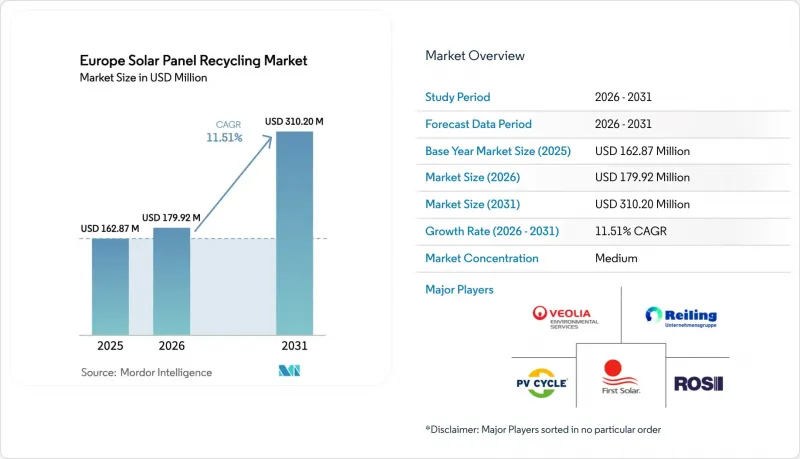
根據 Mordor Intelligence 預測,歐洲太陽能板回收市場規模將從 2025 年的 1.6287 億美元成長到 2026 年的 1.7992 億美元,然後在 2031 年達到 3.102 億美元,2026 年至 2031 年的複合成長率為 11.51%。
本報告按加工方法(熱處理、機械、雷射)、面板類型(晶體矽、薄膜)、使用壽命(正常劣化、過早劣化)、回收材料(玻璃、矽晶圓、銀、鋁、其他金屬)和地區(英國、法國、義大利、西班牙、荷蘭、比利時、波蘭、瑞典、挪威、俄羅斯和其他歐洲國家)進行分類。
歐洲太陽能板回收市場的趨勢與洞察
歐盟的太陽能發電能力正在迅速擴張,每年已超過70吉瓦。
預計到2024年,太陽能發電裝置容量將超過70吉瓦,並有望維持類似的年成長率,這將加速先前延遲的廢棄物激增,預計到2031年,廢棄物總量將達到250萬噸。處理能力的提升為回收商提供了長期前景,足以支援工廠運作超過10年。預計到2024年,德國和西班牙的裝置容量將分別超過14吉瓦,這將加速對回收夥伴關係關係的需求,以便提前安排設備的移除。隨著環境部門開始根據安裝登記冊追蹤組件的流動情況,這一成長也促使掩埋的監管更加嚴格。這些因素共同造就了一個可預測且大規模的原料來源,從而鼓勵債權人為大規模回收能力提供融資。
基於WEEE/EPR的製造商強制性回收
2012 年的《廢棄電子電氣設備指令》(WEEE) 修正案以及各國將生產者責任延伸制度 (EPR) 納入國家法律,強制要求製造商承擔所有收集和處理成本。這消除了回收商的量級風險,但如果處理設施距離超過 400 公里,則會壓縮其收費利潤。在法國的太陽能回收計畫 (SOREN) 中,2024 年收集了 6,200 噸太陽能廢棄物,比 2023 年增加了 40%。這顯示監理措施行之有效。德國的 EAR 基金會已對未註冊進口產品處以罰款,顯示被動合規已不再可行。這些處罰促使製造商重新設計組件,使其更易於拆卸,間接提高了回收率。
跨越歐盟的大型模組物流成本很高。
當模組運輸距離超過300公里時,運輸成本佔總成本的很大一部分,在某些從波蘭到法國的路線上,每公斤運輸成本高達0.12歐元。根據《巴塞爾公約》,文件核准程序和鉛/鎘檢測可能會導致長達一週的延誤,從而加劇回收商的現金流壓力。雖然區域性破碎設施可以減重高達70%,但在10到15個衛星設施安裝類似設備會對小規模企業的財務狀況造成沉重負擔。
細分市場分析
預計到2025年,機械破碎將佔銷售額的65.8%。這是因為傳統生產線已折舊免稅額完畢,操作簡單。然而,雷射系統正以16.9%的複合年成長率快速擴張,是所有製程中成長最快的。這是因為雷射系統能夠獲得玻璃純度高達95%且無殘留物的晶圓,從而實現更高的售價。以美元計算,配備雷射系統的工廠每噸晶圓可創造25-30美元的附加價值,如果年處理量超過5000噸,這一差額足以攤提300萬歐元的資本投資。 ROSI Solar的混合製程將低成本的鋁去除破碎與高等級的雷射精加工相結合,展現了一種切實可行的過渡策略,符合不斷發展的WEEE(廢棄電子電氣設備)空氣排放標準。在整個預測期內,薄膜組件和小規模供應商將繼續使用機械加工方法,但雷射設備預計將在高品質分類方面主導,並為歐洲太陽能板回收市場的環境合規性樹立新標準。
決定是否採用該技術的關鍵因素仍是作業規模。對於年處理量低於2500噸的物料,簡易切碎機在資本投資和運轉率方面更具優勢,並在東歐和地中海地區的小規模市場佔據了穩固的地位。然而,回收率正日益成為各國競標的關鍵評估標準,採購趨勢也逐漸轉向雷射和熱化學生產線。歐盟創新基金的公共資金優先考慮回收率超過85%的項目,這將有效地引導未來的加工能力朝向更先進的配置發展,從而降低基礎機械設備在歐洲太陽能板回收市場中的長期佔有率。
到2025年,晶體矽組件將佔回收廢棄物的81.6%,與其安裝佔有率相符。晶體矽組件的材料成分多樣,包括玻璃、鋁、矽和銀,仍是歐洲太陽能板回收市場的經濟支柱。同時,薄膜CIGS組件正以19.1%的複合年成長率成長,因為許多電力公司的第一代CIGS陣列的故障率高於預期。 CIGS組件不含銀,但含有銦和鎵,這兩種元素已被《關鍵原料法》指定為戰略原料,推動了德國和義大利的專業回收業務。像First Solar這樣的早期採用者正在透過回收再利用90%的碲化鎘材料,證明閉合迴路回收的可行性。
監管成本的差異進一步影響各個細分市場的經濟效益。薄膜太陽能板回收商需要辦理危險廢棄物處理許可證,這會增加每噸50至100歐元的成本。晶體太陽能板回收商可以避免這些額外成本,但新型組件中金屬化程度的降低可能會導致銀回收率下降。面板原始設備製造商(OEM)正在透過與其自身回收示範專案相關的回收計劃來解決這個問題,例如天合光能(Trina Solar)在2024年生產的全回收組件。這表明,製造商的控制可以縮短材料循環週期,並重塑歐洲太陽能板回收市場中不同類別組件之間的競爭格局。
其他好處:
- Excel格式的市場預測(ME)表
- 3個月的分析師支持
目錄
第1章:引言
- 研究假設和市場定義
- 調查範圍
第2章:調查方法
第3章執行摘要
第4章 市場狀況
- 市場概覽
- 市場促進因素
- 歐盟的太陽能發電能力正在迅速成長,每年超過70吉瓦。
- 根據 WEEE 和 EPR 規定,強制製造商承擔回收費用。
- 高附加價值矽和銀回收技術的商業化
- 歐盟的《基本原料法》將太陽能廢棄物。
- 汽車製造商(OEM)對用於電動車電池的回收太陽能級矽的需求
- 市場限制因素
- 跨越歐盟的大型模組物流成本很高。
- 逐步擴建專用回收生產線(年處理量:不到3萬噸)
- 白銀價格波動會降低迴收商的投資報酬率 (ROI)。
- 供應鏈分析
- 監管狀態(WEEE、生態設計、EPR)
- 技術趨勢(機械、熱力、化學、雷射、熱機械)
- 波特五力模型
第5章 市場規模與成長預測
- 透過流程
- 熱處理
- 機器
- 雷射
- 按面板類型
- 晶體矽
- 薄膜
- 按服役年限
- 正常劣化(超過25年)
- 過早劣化(少於10年)
- 按回收材料類型
- 玻璃
- 矽晶片
- 銀
- 鋁
- 其他金屬(銅、銦等)
- 按地區
- 英國
- 法國
- 義大利
- 西班牙
- 荷蘭
- 比利時
- 波蘭
- 瑞典
- 挪威
- 俄羅斯
- 其他歐洲國家
第6章 競爭情勢
- 市場集中度
- 策略趨勢(併購、聯盟、購電協議)
- 市場佔有率分析(主要公司的市場排名和佔有率)
- 公司簡介
- Veolia Environnement SA
- Reiling PV-Recycling GmbH
- ROSI Solar
- PV Cycle
- First Solar Inc.
- SunPower Corporation
- JA Solar Holdings Co. Ltd.
- Trina Solar Co. Ltd.
- Canadian Solar Inc.
- Renesola Ltd.
- Suez SA
- 9-Tech Srl
- Soren(PV Cycle France)
- Envaris GmbH
- Iberia Solar Recycling(Endesa)
- REC Solar EMEA GmbH
- SMA Solar Technology AG
- Enel Green Power(3Sun recycling)
- Greenmet Solar
- Solarglass Recycling BV
- Norsk Solar Recycling AS
- Apellix Laser Ablation
第7章 市場機會與未來展望
According to Mordor Intelligence, the Europe solar panel recycling market size is expected to grow from USD 162.87 million in 2025 to USD 179.92 million in 2026 and is forecast to reach USD 310.20 million by 2031 at 11.51% CAGR over 2026-2031.
This report is Segmented by Process (Thermal, Mechanical, and Laser), Panel Type (Crystalline Silicon and Thin Film), Shelf Life (Normal Loss and Early Loss), Material Recovered (Glass, Silicon Wafers, Silver, Aluminium, and Other Metals), and Geography (United Kingdom, France, Italy, Spain, Netherlands, Belgium, Poland, Sweden, Norway, Russia, and Rest of Europe).
Europe Solar Panel Recycling Market Trends and Insights
Rapid Growth of EU PV Installations Reaching >70 GW Annually
Photovoltaic build-outs exceeded 70 GW in 2024 and remain on pace for similar yearly additions, front-loading a deferred waste surge estimated at 2.5 million tonnes by 2031. Rising volumes give recyclers long-term visibility that supports 10-plus-year plant lifetimes. Germany and Spain contributed over 14 GW each in 2024, accelerating the need for collection partnerships that pre-book fleet decommissioning. The growth also tightens landfill restrictions because environmental agencies now track module flows against installation registries. Collectively, these forces create a predictable, sizable feedstock that encourages creditors to underwrite large-scale capacity.
Mandatory Producer-Financed Recycling Under WEEE & EPR
The 2012 WEEE amendment, and its country-specific EPR transpositions, compel manufacturers to absorb all collection and processing costs, eliminating volume risk for recyclers but compressing fee margins when the distance to the plant exceeds 400 km. France's SOREN scheme gathered 6,200 tonnes of PV waste in 2024, a 40% increase over 2023, proving regulatory teeth are now fully in place. Germany's Stiftung EAR issued fines for non-registered imports, signaling that passive compliance is no longer tolerated. These penalties encourage module redesign for easier disassembly, indirectly improving recycling yields.
High Logistics Cost for Bulky Modules Across EU Borders
Transport dominates cost structures when modules travel beyond 300 km, reaching EUR 0.12 per kilogram on some Poland-to-France routes. Basel Convention paperwork and lead-cadmium testing add week-long delays, eroding recycler cash flow. Regional shredding hubs cut weight by up to 70%, but replicating equipment across 10-15 satellite sites strains balance sheets for small operators.
Other drivers and restraints analyzed in the detailed report include:
- Commercialization of High-Value Silicon & Silver Recovery Technologies
- EU Critical Raw Materials Act Prioritizing PV Waste Streams
- Slow Scale-Up of Purpose-Built Recycling Lines (< 30 kt/yr)
For complete list of drivers and restraints, kindly check the Table Of Contents.
Segment Analysis
Mechanical shredding controlled 65.8% of 2025 revenue because legacy lines are fully depreciated and remain easy to operate. However, laser systems are expanding at a 16.9% CAGR, the sharpest among all processes, thanks to 95% glass purity and residue-free wafer output that garners higher sale prices. In USD terms, laser-enabled plants add USD 25-30 per tonne in incremental value, a differential sufficient to amortize EUR 3 million equipment packages when annual volumes exceed 5,000 tonnes. ROSI Solar's hybrid flow pairs low-cost shredding for aluminum removal with laser finishing for high-grade fractions, demonstrating a pragmatic bridging strategy that aligns with evolving WEEE air-emission norms. Over the forecast horizon, mechanical methods will still serve thin-film modules and small-scale feeders, but laser units are poised to command premium fractions and set new benchmarks for environmental compliance within the European solar panel recycling market.
Operational scale remains the decisive adoption filter. Below 2,500 tonnes per year, simple shredders outcompete in capex and uptime, giving them an embedded base in smaller Eastern European and Mediterranean markets. Yet national tenders increasingly score bids on recovery rates, gradually shifting procurement in favor of laser or thermo-chemical lines. Public funding under the EU Innovation Fund specifically prioritizes > 85% recovery thresholds, effectively nudging future capacity toward advanced configurations and trimming the long-term share of basic mechanical plants within the European solar panel recycling market landscape.
Crystalline silicon modules represented 81.6% of inbound waste in 2025, mirroring their installation share. Their diversified material mix, glass, aluminum, silicon, and silver, keeps them the economic backbone of the European solar panel recycling market. Thin-film CIGS, however, is growing at a 19.1% CAGR because many first-wave utility arrays are failing earlier than projected. Although CIGS panels lack silver, they contain indium and gallium, which the Critical Raw Materials Act now ranks as strategic, propelling specialized recovery ventures in Germany and Italy. Early adopters such as First Solar illustrate closed-loop viability, recovering 90% of cadmium-telluride material for re-use.
Variations in regulatory costs further shape segment economics. Thin-film recyclers must manage hazardous-waste permits, adding EUR 50-100 per tonne. Crystalline processors steer clear of these surcharges, but they may face diminishing silver returns as modern modules adopt lower metallization loadings. Panel OEMs are responding with take-back programs that interlock with their own recycling pilots, a trend exemplified by Trina Solar's 2024 fully recycled module, which showcases how manufacturer control can shorten material loops and reshape competition across panel categories within the European solar panel recycling market.
Complete Report Scope:
- By Process
- Thermal
- Mechanical
- Laser
- By Panel Type
- Crystalline Silicon
- Thin Film
- By Shelf Life
- Normal Loss (Above 25 yr)
- Early Loss (Below 10 yr)
- By Material Recovered
- Glass
- Silicon Wafers
- Silver
- Aluminium
- Other Metals (Cu, Indium, etc.)
- By Geography
- United Kingdom
- France
- Italy
- Spain
- Netherlands
- Belgium
- Poland
- Sweden
- Norway
- Russia
- Rest of Europe
List of Companies Covered in this Report:
- Veolia Environnement S.A.
- Reiling PV-Recycling GmbH
- ROSI Solar
- PV Cycle
- First Solar Inc.
- SunPower Corporation
- JA Solar Holdings Co. Ltd.
- Trina Solar Co. Ltd.
- Canadian Solar Inc.
- Renesola Ltd.
- Suez SA
- 9-Tech Srl
- Soren (PV Cycle France)
- Envaris GmbH
- Iberia Solar Recycling (Endesa)
- REC Solar EMEA GmbH
- SMA Solar Technology AG
- Enel Green Power (3Sun recycling)
- Greenmet Solar
- Solarglass Recycling BV
- Norsk Solar Recycling AS
- Apellix Laser Ablation
Additional Benefits:
- The market estimate (ME) sheet in Excel format
- 3 months of analyst support
TABLE OF CONTENTS
1 Introduction
- 1.1 Study Assumptions & Market Definition
- 1.2 Scope of the Study
2 Research Methodology
3 Executive Summary
4 Market Landscape
- 4.1 Market Overview
- 4.2 Market Drivers
- 4.2.1 Rapid growth of EU PV installations reaching >70 GW p.a.
- 4.2.2 Mandatory producer-financed recycling under WEEE & EPR
- 4.2.3 Commercialisation of high-value silicon & silver recovery technologies
- 4.2.4 EU Critical Raw Materials Act prioritising PV waste streams
- 4.2.5 Automotive OEM demand for recycled solar-grade silicon for EV batteries
- 4.3 Market Restraints
- 4.3.1 High logistics cost for bulky modules across EU borders
- 4.3.2 Slow scale-up of purpose-built recycling lines (<30 kt/yr capacity)
- 4.3.3 Silver price volatility undermining recycler ROI
- 4.4 Supply-Chain Analysis
- 4.5 Regulatory Landscape (WEEE, Ecodesign, EPR)
- 4.6 Technological Outlook (Mechanical, Thermal, Chemical, Laser, and Thermo-mechanical)
- 4.7 Porter's Five Forces
- 4.7.1 Bargaining Power of Suppliers
- 4.7.2 Bargaining Power of Buyers
- 4.7.3 Threat of New Entrants
- 4.7.4 Threat of Substitutes
- 4.7.5 Intensity of Rivalry
5 Market Size & Growth Forecasts
- 5.1 By Process
- 5.1.1 Thermal
- 5.1.2 Mechanical
- 5.1.3 Laser
- 5.2 By Panel Type
- 5.2.1 Crystalline Silicon
- 5.2.2 Thin Film
- 5.3 By Shelf Life
- 5.3.1 Normal Loss (Above 25 yr)
- 5.3.2 Early Loss (Below 10 yr)
- 5.4 By Material Recovered
- 5.4.1 Glass
- 5.4.2 Silicon Wafers
- 5.4.3 Silver
- 5.4.4 Aluminium
- 5.4.5 Other Metals (Cu, Indium, etc.)
- 5.5 By Geography
- 5.5.1 United Kingdom
- 5.5.2 France
- 5.5.3 Italy
- 5.5.4 Spain
- 5.5.5 Netherlands
- 5.5.6 Belgium
- 5.5.7 Poland
- 5.5.8 Sweden
- 5.5.9 Norway
- 5.5.10 Russia
- 5.5.11 Rest of Europe
6 Competitive Landscape
- 6.1 Market Concentration
- 6.2 Strategic Moves (M&A, Partnerships, PPAs)
- 6.3 Market Share Analysis (Market Rank/Share for key companies)
- 6.4 Company Profiles (includes Global level Overview, Market level overview, Core Segments, Financials as available, Strategic Information, Products & Services, and Recent Developments)
- 6.4.1 Veolia Environnement S.A.
- 6.4.2 Reiling PV-Recycling GmbH
- 6.4.3 ROSI Solar
- 6.4.4 PV Cycle
- 6.4.5 First Solar Inc.
- 6.4.6 SunPower Corporation
- 6.4.7 JA Solar Holdings Co. Ltd.
- 6.4.8 Trina Solar Co. Ltd.
- 6.4.9 Canadian Solar Inc.
- 6.4.10 Renesola Ltd.
- 6.4.11 Suez SA
- 6.4.12 9-Tech Srl
- 6.4.13 Soren (PV Cycle France)
- 6.4.14 Envaris GmbH
- 6.4.15 Iberia Solar Recycling (Endesa)
- 6.4.16 REC Solar EMEA GmbH
- 6.4.17 SMA Solar Technology AG
- 6.4.18 Enel Green Power (3Sun recycling)
- 6.4.19 Greenmet Solar
- 6.4.20 Solarglass Recycling BV
- 6.4.21 Norsk Solar Recycling AS
- 6.4.22 Apellix Laser Ablation
7 Market Opportunities & Future Outlook
- 7.1 White-space & Unmet-need Assessment

 太陽能板回收技術市場預測至2034年-全球分析(按回收技術、太陽能板類型、回收材料、加工階段、最終用戶和地區分類)
 太陽能板回收:市場佔有率分析、行業趨勢和統計數據以及成長預測(2026-2031 年)
 太陽能板回收市場:2026-2032年全球市場預測(依處理方法、面板類型、回收材料、廢棄物來源、最終用途、客戶類型和收集管道分類)
 太陽能板回收市場報告:按製程、類型、材料、使用壽命和地區分類(2026-2034 年)
 太陽能板回收市場規模、佔有率和趨勢分析報告:按類型、技術、壽命、地區和細分市場預測(2026-2033 年)日本太陽能板回收市場規模、佔有率、趨勢及預測(按製程、類型、材質、使用壽命及地區分類,2026-2034年)
 太陽能板回收市場-全球產業規模、佔有率、趨勢、機會、預測:按製程、類型、地區和競爭格局分類,2021-2031年
 太陽能板回收市場規模、佔有率和成長分析(按製程、材料、儲存期限、類型和地區分類)-2026-2033年產業預測
 可回收光學模組:全球市場佔有率和排名、總收入和需求預測(2025-2031 年)2032 年太陽能板回收市場預測:按類型、保存期限、技術、材料、最終用戶和地區進行的全球分析