


 |
市場調查報告書
商品編碼
2114151
太陽能板回收:市場佔有率分析、行業趨勢和統計數據以及成長預測(2026-2031 年)Solar Panel Recycling - Market Share Analysis, Industry Trends & Statistics, Growth Forecasts (2026 - 2031) |
||||||

※ 本網頁內容可能與最新版本有所差異。詳細情況請與我們聯繫。
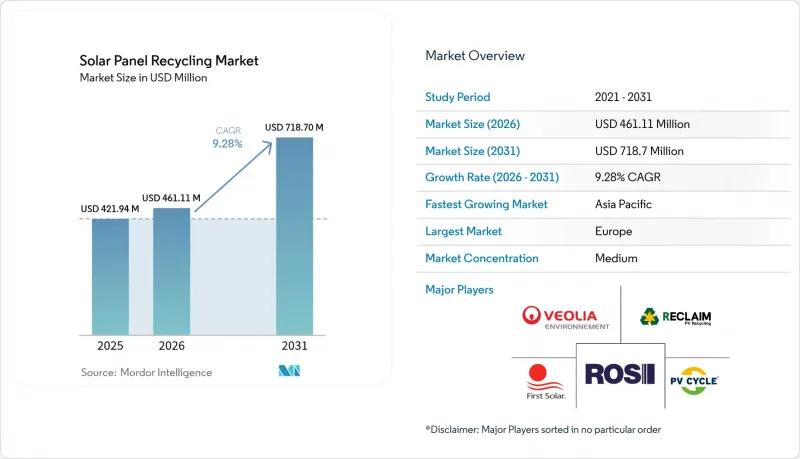
根據 Mordor Intelligence 預測,太陽能板回收市場規模將從 2025 年的 4.2194 億美元成長到 2026 年的 4.6111 億美元,到 2031 年將達到 7.187 億美元,2026 年至 2031 年的複合成長率為 9.28%。
本報告按製程(熱處理、機械處理、雷射處理)、面板類型(晶體矽、薄膜)、使用壽命(正常劣化、過早劣化)、回收材料(玻璃、矽晶圓、銀、鋁、其他金屬)以及地區(北美、歐洲、亞太、南美、中東和非洲)進行細分。市場規模和預測均以美元計價。
全球太陽能板回收市場趨勢及洞察
2025 年至 2030 年間,將有一批太陽能發電組件達到使用壽命終點。
在最初的上網電價補貼(FIT)熱潮過去四分之一世紀後,廢棄太陽能板的處置量正在激增。在義大利,預計2050年將產生452萬噸太陽能廢棄物,並在2036年左右達到峰值,屆時最初的屋頂安裝獎勵將到期。在中國,截至2022年,裝置容量已達393吉瓦,預計到2030年將產生18吉瓦的廢棄組件,為此已成立專門的回收工作小組來處理這些廢棄物。隨著集中處理降低了單位物流成本,並使加工商能夠對高精度設備進行折舊,太陽能電池板回收市場正在從單純的廢棄物處置轉向價值創造。
歐盟式的 WEEE(廢棄電子電氣設備)合規義務正在全球擴大。
歐盟設定的85%回收率和80%材料回收率目標已成為全球標準。華盛頓州的《製造商回收法案》於2025年7月生效。南卡羅來納州隨後於2024年效仿,引入了面積超過13英畝的太陽能發電陣列註冊制度。美國聯邦政府提出的「一般廢棄物管理條例」計畫於2025年中期生效,該條例將統一各州之間的相關要求。對於投資者而言,可預測的合規成本為回收工廠的多年投資回報奠定了基礎;而對於太陽能板回收市場而言,這些法規則確保了原料的持續供應。
回收成本仍然超過了回收玻璃碎片的價值。
玻璃佔太陽能板品質的三分之二,但其轉售價值卻微乎其微。回收單一組件的成本在 15 美元到 45 美元之間,而掩埋處理的成本僅為 2 美元。然而,歐洲的先導計畫正在生產符合光伏標準的平板玻璃,這表明高品質、低碳玻璃有望彌合這一差距。在可預見的未來,補貼和生態設計法規對於太陽能板回收市場的玻璃產業仍然至關重要。
細分市場分析
預計到2025年,機械破碎將在太陽能板回收市場佔據63.72%的市場佔有率,這得益於其較低的資本投入和成熟的加工能力。同時,雷射剝離技術正以14.88%的複合年成長率成長,該技術利用飛秒脈衝在不熔化焊料的情況下剝離電池,從而保持銀的純度。隨著美國國家可再生能源實驗室(NREL)的研究成果從試點階段邁向實用化階段,採用雷射加工生產線的太陽能板回收市場規模預計將增加三倍。以去除框架為起點,以雷射或熱剝離為終點的混合流程,目前已實現接近95%的回收率,縮小了與原料進口的成本差距。第二代回收設施擴大將機器視覺分類機與機器人夾具結合,從而減少了一半的人工勞動,並提高了工人的安全。機械平台繼續有效率地處理玻璃和鋁的拆卸,尤其是在處理大規模庫存時。高產量和高精度加工流程的並存表明,太陽能電池板回收市場正在從單一技術服務轉向針對混合各種原料而最佳化的多元化製程組合。
預計到2025年,晶體矽組件將佔太陽能板廢棄物的88.34%,推動該類別太陽能板回收市場規模的成長。雖然薄膜組件的處理量仍然小規模,但預計將以17.46%的複合年成長率成長,尤其是在公用事業領域CIGS和CdTe組件應用日益廣泛的情況下。 First Solar的全球網路迄今已回收了約40萬噸CdTe組件,材料回收率高達95%,為其他薄膜組件公司樹立了標竿。
經濟效益差異顯著。在晶體矽系統中,重點在於回收銀和晶片;而在薄膜系統中,主要關注點在於回收碲、鎘和銦。目前,透過採用特殊的浸出和電解提煉方法,可以在48小時內回收超過52%的銦,從而降低下一代異質結生產線的原料供應風險。隨著組件多樣化的發展,專業設施的數量也會增加,而太陽能板回收市場雖然會變得更加複雜,但利潤範圍也會擴大。
區域分析
2025年,歐洲將佔據全球太陽能板回收市場38.15%的佔有率。這主要歸功於WEEE指令中強制規定的85%和80%的回收率。預計到2030年,德國將產生40萬至100萬噸太陽能廢棄物,推動了處理能力的擴張,以滿足生態設計指令更嚴格的可回收性標準。跨國合作,例如AGC Glass Europe與ROSI合作開發超低碳玻璃,正是循環經濟政策與產業合作的典範。
亞太地區預計將以15.92%的複合年成長率成長,其中中國393吉瓦的裝置容量構成了全球最大的廢棄太陽能板廢棄物庫。一個由中國人民銀行資助的工作小組正在起草國家標準,江蘇和山西兩省的先導工廠正在將機熱混合系統推廣至工業規模。印度的法規草案提案向回收企業提供可行性缺口資金,並強制要求進行廢棄物報告,如果這些措施得以實施,預計將刺激投資。日本的儲備基金政策為回收和土地修復提供了資金保障,為該地區樹立了榜樣。
在北美,回收金屬被視為國產零件,可享有《通膨控制法案》規定的稅額扣抵。華盛頓州的《2025年復甦法案》和南卡羅來納州的《2024年位置條例》正在提升地方層級的確定性。聯邦政府計劃於2025年將回收金屬指定為“一般用途廢棄物”,這將簡化州際物流。 SOLARCYCLE公司投資3.44億美元在錫達頓建設的工廠象徵私營部門的信心,該工廠每年可處理1000萬個組件,並供應5-6吉瓦的再生玻璃。
其他好處:
- Excel格式的市場預測(ME)表
- 3個月的分析師支持
目錄
第1章:引言
- 研究假設和市場定義
- 調查範圍
第2章:調查方法
第3章執行摘要
第4章 市場狀況
- 市場概覽
- 市場促進因素
- 2025 年至 2030 年間,預計將有大量報廢太陽能發電組件進入市場。
- 歐盟式的WEEE合規義務正在全球擴大。
- 白銀、銦和其他重要礦產的商品價值正在上漲。
- 商業規模的機械和熱力混合製程可顯著降低迴收成本。
- 將次要重要礦產的供應鏈遷回國內的必要性
- 與保險相關的退役基金要求進行回收審計
- 市場限制因素
- 回收成本仍然超過了回收的散裝玻璃的價值。
- 非統一的收集物流與逆向供應鏈網路
- 屋頂太陽能發電資產所有權多角化
- 關於危險物質(鉛、鎘)跨境運輸的規定
- 供應鏈分析
- 監理情勢
- 技術展望
- 波特五力模型
第5章 市場規模與成長預測
- 透過流程
- 熱處理
- 機械的
- 雷射
- 按面板類型
- 晶體矽
- 薄膜
- 按服役年限
- 正常劣化(超過25年)
- 過早劣化(少於10年)
- 按回收材料類型
- 玻璃
- 矽晶片
- 銀
- 鋁
- 其他金屬(銅、銦等)
- 按地區
- 北美洲
- 美國
- 加拿大
- 墨西哥
- 歐洲
- 德國
- 英國
- 法國
- 義大利
- 北歐國家
- 俄羅斯
- 其他歐洲國家
- 亞太地區
- 中國
- 印度
- 日本
- 韓國
- 東南亞國協
- 其他亞太國家
- 南美洲
- 巴西
- 阿根廷
- 其他南美國家
- 中東和非洲
- 沙烏地阿拉伯
- 阿拉伯聯合大公國
- 南非
- 土耳其
- 其他中東和非洲國家
- 北美洲
第6章 競爭情勢
- 市場集中度
- 策略趨勢(併購、聯盟、購電協議)
- 市場佔有率分析(主要公司的市場排名和佔有率)
- 公司簡介
- Veolia Environnement SA
- First Solar Inc.
- PV Cycle
- Reclaim PV Recycling Pty Ltd
- ROSI Solar
- Canadian Solar Inc.
- Hanwha Q Cells
- Trina Solar Co. Ltd
- Jinko Solar Holding Co. Ltd
- SunPower Corporation
- Sharp Corporation
- Yingli Energy Co. Ltd
- Reiling Group
- We Recycle Solar Inc.
- Green Clean Solar LLC
- Envaris GmbH
- Cleanlites Recycling Inc.
- TotalEnergies Renewables(Nextcycle JV)
- Soren EP
- Solarcycle Inc.
第7章 市場機會與未來展望
According to Mordor Intelligence, the solar panel recycling market size is expected to grow from USD 421.94 million in 2025 to USD 461.11 million in 2026 and is forecast to reach USD 718.7 million by 2031 at 9.28% CAGR over 2026-2031.
This report is Segmented by Process (Thermal, Mechanical, and Laser), Panel Type (Crystalline Silicon and Thin Film), Shelf Life (Normal Loss and Early Loss), Material Recovered (Glass, Silicon Wafers, Silver, Aluminum, and Other Metals), and Geography (North America, Europe, Asia-Pacific, South America, and Middle East and Africa). The Market Sizes and Forecasts are Provided in Terms of Value (USD).
Global Solar Panel Recycling Market Trends and Insights
Wave of End-of-Life PV Modules Hitting in 2025-2030
A quarter-century after the first feed-in-tariff boom, a surge of legacy arrays is approaching retirement. Italy expects 4.52 million t of PV waste by 2050, peaking near 2036 when early rooftop incentives reach obsolescence. China, with 393 GW installed by 2022, anticipates 18 GW of discarded modules by 2030 and has established dedicated recycling working groups to address this stream. Volume clustering reduces unit logistics costs and enables processors to amortize high-precision equipment, shifting the solar panel recycling market from waste disposal to value extraction.
EU-Style WEEE Compliance Mandates Expanding Worldwide
The European Union's 85% collection and 80% material-recovery targets have become the default global template. Washington State's producer-take-back law took effect in July 2025. South Carolina followed in 2024 with a registration regime for arrays bigger than 13 acres. Proposed U.S. federal universal-waste rules, slated for mid-2025, would harmonize interstate requirements. For investors, predictable compliance costs underpin multiyear recycling-plant paybacks, and for the solar panel recycling market, the mandates lock in recurring feedstock.
Recycling Cost Still Exceeds Value of Recovered Bulk Glass
Glass accounts for two-thirds of a panel's mass, yet it offers minimal resale value. The cost to recycle a module can range from USD 15 to USD 45, compared to USD 2 for landfill dumping. Pilot projects in Europe, however, have produced flat glass that meets PV-grade specifications, hinting that premium, low-carbon glass could close the gap. In the near term, subsidies and ecodesign rules remain essential for the glass fraction of the solar panel recycling market.
Other drivers and restraints analyzed in the detailed report include:
- Rising Commodity Value of Silver, Indium & Other Critical Materials
- Commercial-Scale Mechanical + Thermal Hybrid Processes Slash Recycling Costs
- Patchy Collection Logistics & Reverse-Supply Networks
For complete list of drivers and restraints, kindly check the Table Of Contents.
Segment Analysis
Mechanical shredding held a 63.72% market share in the solar panel recycling market in 2025, favoured for its low capital expenditure and proven throughput. Yet laser-enabled delamination is growing at 14.88% CAGR, leveraging femtosecond pulses to detach cells without melting solder, thereby preserving silver purity. The solar panel recycling market size for laser lines is expected to triple as NREL results move from pilot to commercial adoption. Hybrid flowsheets that begin with frame removal and conclude with laser or thermal delamination now exhibit recovery rates approaching 95%, shrinking the cost gap with raw-material imports.Second-generation facilities increasingly couple machine-vision sorters with robotic grippers, reducing hands-on labor by half and enhancing operator safety. Mechanical platforms continue to handle glass and aluminum disassembly efficiently, particularly for utility-scale inventories. The coexistence of bulk-volume and precision-value streams illustrates the solar panel recycling market's transition from a single-technology service to a diversified process portfolio optimized for a mix of feedstocks.
Crystalline silicon modules accounted for 88.34% of 2025 waste inflows, thereby anchoring the solar panel recycling market size for that category. Thin-film volumes remain modest but are forecast to grow at an 17.46% CAGR as CIGS and CdTe deployments rise, especially in utility segments. First Solar's global network, which has recycled nearly 400,000 tons of CdTe modules, showcases a 95% material recovery rate and sets a benchmark that other thin-film firms aim to match.
The economics diverge sharply: crystalline paths emphasise silver and wafer reclamation, whereas thin-film streams target tellurium, cadmium, and indium. Specialized leaching and electro-winning can now retrieve 52% or more indium within 48 hours, thereby limiting raw-material supply risk for next-generation heterojunction lines. As module diversity grows, so will tailored facilities, adding complexity but also revenue depth to the solar panel recycling market.
Complete Report Scope:
- By Process
- Thermal
- Mechanical
- Laser
- By Panel Type
- Crystalline Silicon
- Thin Film
- By Shelf Life
- Normal Loss (Above 25 yr)
- Early Loss (Below 10 yr)
- By Material Recovered
- Glass
- Silicon Wafers
- Silver
- Aluminium
- Other Metals (Cu, Indium, etc.)
- By Geography
- North America
- United States
- Canada
- Mexico
- Europe
- Germany
- United Kingdom
- France
- Italy
- NORDIC Countries
- Russia
- Rest of Europe
- Asia-Pacific
- China
- India
- Japan
- South Korea
- ASEAN Countries
- Rest of Asia-Pacific
- South America
- Brazil
- Argentina
- Rest of South America
- Middle East and Africa
- Saudi Arabia
- United Arab Emirates
- South Africa
- Turkey
- Rest of Middle East and Africa
- North America
Geography Analysis
Europe controlled 38.15% of the solar panel recycling market in 2025, primarily due to the implementation of mandatory 85% collection and 80% recovery thresholds under the WEEE Directive. Germany forecasts 400,000-1 million t of PV waste by 2030, catalysing capacity expansions aligned with the Ecodesign Directive's stricter recyclability criteria. Cross-border collaborations, such as AGC Glass Europe partnering with ROSI on ultra-low-carbon glass, exemplify industrial alignment with circular-economy policy.
Asia-Pacific is set for a 15.92% CAGR as China's 393 GW installed base translates into the world's largest end-of-life pool. CP-funded working groups are drafting national standards, and pilot plants in Jiangsu and Shanxi are scaling mechanical-thermal hybrids to industrial levels. India's draft rules propose viability-gap funding for recyclers and mandatory waste reporting, measures expected to unlock investment once adopted. Japan's reserve-fund policy secures financing for recycling and land restoration, providing a replicable model for the region.
North America benefits from the Inflation Reduction Act's tax credits, which treat recycled metals as domestic content. Washington State's 2025 take-back law and South Carolina's 2024 siting rules add sub-national certainty. Federal universal-waste designation, anticipated in 2025, would streamline interstate flows. SOLARCYCLE's USD 344 million Cedartown plant is emblematic of private-sector confidence, capable of processing 10 million modules per year and supplying 5-6 GW of recycled glass
- Veolia Environnement SA
- First Solar Inc.
- PV Cycle
- Reclaim PV Recycling Pty Ltd
- ROSI Solar
- Canadian Solar Inc.
- Hanwha Q Cells
- Trina Solar Co. Ltd
- Jinko Solar Holding Co. Ltd
- SunPower Corporation
- Sharp Corporation
- Yingli Energy Co. Ltd
- Reiling Group
- We Recycle Solar Inc.
- Green Clean Solar LLC
- Envaris GmbH
- Cleanlites Recycling Inc.
- TotalEnergies Renewables (Nextcycle JV)
- Soren EP
- Solarcycle Inc.
Additional Benefits:
- The market estimate (ME) sheet in Excel format
- 3 months of analyst support
TABLE OF CONTENTS
1 Introduction
- 1.1 Study Assumptions & Market Definition
- 1.2 Scope of the Study
2 Research Methodology
3 Executive Summary
4 Market Landscape
- 4.1 Market Overview
- 4.2 Market Drivers
- 4.2.1 Wave of end-of-life (EoL) PV modules hitting in 2025-2030
- 4.2.2 EU-style WEEE compliance mandates expanding worldwide
- 4.2.3 Rising commodity value of silver, indium & other critical minerals
- 4.2.4 Commercial?scale mechanical + thermal hybrid processes slash recycling costs
- 4.2.5 Supply-chain reshoring need for secondary critical minerals
- 4.2.6 Insurance-linked decommissioning funds demanding recycling audits
- 4.3 Market Restraints
- 4.3.1 Recycling cost still > value of recovered bulk glass
- 4.3.2 Patchy collection logistics & reverse-supply network
- 4.3.3 Fragmented ownership of rooftop PV assets
- 4.3.4 Trans-boundary haz-mat transport regulations (Pb, Cd)
- 4.4 Supply-Chain Analysis
- 4.5 Regulatory Landscape
- 4.6 Technological Outlook
- 4.7 Porter's Five Forces
- 4.7.1 Threat of New Entrants
- 4.7.2 Bargaining Power of Suppliers
- 4.7.3 Bargaining Power of Buyers
- 4.7.4 Threat of Substitutes
- 4.7.5 Competitive Rivalry
5 Market Size & Growth Forecasts
- 5.1 By Process
- 5.1.1 Thermal
- 5.1.2 Mechanical
- 5.1.3 Laser
- 5.2 By Panel Type
- 5.2.1 Crystalline Silicon
- 5.2.2 Thin Film
- 5.3 By Shelf Life
- 5.3.1 Normal Loss (Above 25 yr)
- 5.3.2 Early Loss (Below 10 yr)
- 5.4 By Material Recovered
- 5.4.1 Glass
- 5.4.2 Silicon Wafers
- 5.4.3 Silver
- 5.4.4 Aluminium
- 5.4.5 Other Metals (Cu, Indium, etc.)
- 5.5 By Geography
- 5.5.1 North America
- 5.5.1.1 United States
- 5.5.1.2 Canada
- 5.5.1.3 Mexico
- 5.5.2 Europe
- 5.5.2.1 Germany
- 5.5.2.2 United Kingdom
- 5.5.2.3 France
- 5.5.2.4 Italy
- 5.5.2.5 NORDIC Countries
- 5.5.2.6 Russia
- 5.5.2.7 Rest of Europe
- 5.5.3 Asia-Pacific
- 5.5.3.1 China
- 5.5.3.2 India
- 5.5.3.3 Japan
- 5.5.3.4 South Korea
- 5.5.3.5 ASEAN Countries
- 5.5.3.6 Rest of Asia-Pacific
- 5.5.4 South America
- 5.5.4.1 Brazil
- 5.5.4.2 Argentina
- 5.5.4.3 Rest of South America
- 5.5.5 Middle East and Africa
- 5.5.5.1 Saudi Arabia
- 5.5.5.2 United Arab Emirates
- 5.5.5.3 South Africa
- 5.5.5.4 Turkey
- 5.5.5.5 Rest of Middle East and Africa
- 5.5.1 North America
6 Competitive Landscape
- 6.1 Market Concentration
- 6.2 Strategic Moves (M&A, Partnerships, PPAs)
- 6.3 Market Share Analysis (Market Rank/Share for key companies)
- 6.4 Company Profiles (includes Global level Overview, Market level overview, Core Segments, Financials as available, Strategic Information, Products & Services, and Recent Developments)
- 6.4.1 Veolia Environnement SA
- 6.4.2 First Solar Inc.
- 6.4.3 PV Cycle
- 6.4.4 Reclaim PV Recycling Pty Ltd
- 6.4.5 ROSI Solar
- 6.4.6 Canadian Solar Inc.
- 6.4.7 Hanwha Q Cells
- 6.4.8 Trina Solar Co. Ltd
- 6.4.9 Jinko Solar Holding Co. Ltd
- 6.4.10 SunPower Corporation
- 6.4.11 Sharp Corporation
- 6.4.12 Yingli Energy Co. Ltd
- 6.4.13 Reiling Group
- 6.4.14 We Recycle Solar Inc.
- 6.4.15 Green Clean Solar LLC
- 6.4.16 Envaris GmbH
- 6.4.17 Cleanlites Recycling Inc.
- 6.4.18 TotalEnergies Renewables (Nextcycle JV)
- 6.4.19 Soren EP
- 6.4.20 Solarcycle Inc.
7 Market Opportunities & Future Outlook
- 7.1 White-space & unmet-need assessment

 歐洲太陽能板回收:市場佔有率分析、行業趨勢和統計數據以及成長預測(2026-2031 年)
 太陽能板回收技術市場預測至2034年-全球分析(按回收技術、太陽能板類型、回收材料、加工階段、最終用戶和地區分類)
 太陽能板回收市場:2026-2032年全球市場預測(依處理方法、面板類型、回收材料、廢棄物來源、最終用途、客戶類型和收集管道分類)
 太陽能板回收市場報告:按製程、類型、材料、使用壽命和地區分類(2026-2034 年)
 太陽能板回收市場規模、佔有率和趨勢分析報告:按類型、技術、壽命、地區和細分市場預測(2026-2033 年)日本太陽能板回收市場規模、佔有率、趨勢及預測(按製程、類型、材質、使用壽命及地區分類,2026-2034年)
 太陽能板回收市場-全球產業規模、佔有率、趨勢、機會、預測:按製程、類型、地區和競爭格局分類,2021-2031年
 太陽能板回收市場規模、佔有率和成長分析(按製程、材料、儲存期限、類型和地區分類)-2026-2033年產業預測
 可回收光學模組:全球市場佔有率和排名、總收入和需求預測(2025-2031 年)2032 年太陽能板回收市場預測:按類型、保存期限、技術、材料、最終用戶和地區進行的全球分析