

 |
市場調查報告書
商品編碼
2125570
北美預拌混凝土市場:市場佔有率分析、產業趨勢與統計及成長預測(2026-2031 年)North America Ready-Mix Concrete - Market Share Analysis, Industry Trends & Statistics, Growth Forecasts (2026 - 2031) |
||||||

※ 本網頁內容可能與最新版本有所差異。詳細情況請與我們聯繫。
據 Mordor Intelligence 稱,2025 年北美預拌混凝土市場價值為 726.3 億美元,預計到 2031 年將達到 989.9 億美元,而 2026 年為 764.7 億美元,預測期(2026-2031 年)的複合年成長率為 5.29%。
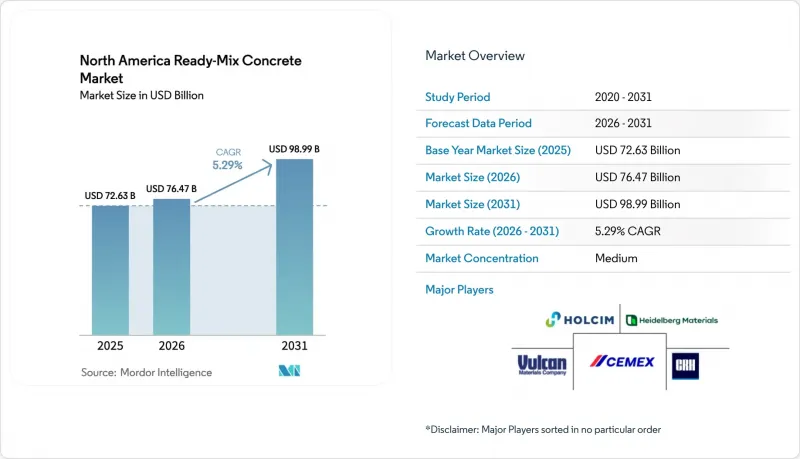
本報告按混合類型(公共交通混合、中心城區混合、生活配套混合)、最終用戶產業(住宅、商業、工業/機構、基礎設施)和地區(美國、加拿大、墨西哥)進行細分。市場預測以美元計價。
北美預拌混凝土市場趨勢及洞察
聯邦政府的基礎設施獎勵策略正在推動對混凝土的持續需求。
《基礎設施投資與就業法案》(IIJA)每年為公路和橋樑建設撥款620億美元,為北美預拌混凝土市場的生產商提供了穩定的訂單來源。例如,一家負責密西根州I-69州際公路重組的建築商已搭建了一個臨時攪拌站,以滿足加快的工期要求並最佳化混凝土性能。由於資金已落實到2030年,生產商目前擁有前所未有的需求前景,並正在降低新建攪拌站和車輛等資本支出所帶來的風險。
住宅市場的復甦正在加速住宅用混凝土的消耗。
住宅板塊錄得最高的複合年成長率(CAGR),達到5.98%,這主要得益於被抑制的需求釋放、有利的房屋抵押貸款支持以及由於人口向陽光地帶大都會圈遷移而導致的住宅開工量增加。隨著人口湧入德克薩斯州、佛羅裡達州和卡羅來納州,對快速地基和樓板施工的需求日益成長,而預拌混凝土的速度和穩定性使其優於現場攪拌的替代方案。芝加哥和費城等歷史名城的維修工程也推動了對特種裝飾混凝土和纖維增強混凝土的需求。
水泥和骨材價格的波動給利潤率帶來了壓力。
2024年和2025年,水泥價格隨能源價格飆升,進口水泥熟料關稅加劇了供應短缺,對生產商的利潤率帶來壓力。此外,柴油價格波動導致骨材運輸成本增加,有報告顯示,在加拿大西部採石場,運費佔交貨成本的40%。由於合約結構往往延遲成本轉嫁,當價格波動達到高峰時,生產商要麼被迫對沖投入成本,要麼自行承擔由此造成的利潤率下降。
細分市場分析
運輸攪拌混凝土佔據北美預拌混凝土市場46.60%的佔有率。由於移動式攪拌筒允許在施工現場進行最後的加水量調整,承包商非常重視柔軟性,能夠在到達現場後微調坍落度,因此這種混凝土形式對於橋面和中高層建築框架至關重要。在整個預測期內,預計該細分市場將繼續利用成熟的物流網路和卡車遠端資訊處理技術來最佳化引擎怠速時間,並滿足華盛頓州規定的排放氣體目標。集中攪拌混凝土佔據北美預拌混凝土市場第二大佔有率,由於集中攪拌能夠確保品質穩定,因此是水壩基礎等超大批量澆築工程的首選。收縮攪拌混凝土目前規模較小,但預計將以5.59%的複合年成長率在所有攪拌混凝土類型中成長最快,這得益於外加劑技術的進步提高了小規模都市區運輸的可操作性,從而減少了現場堵塞和存儲空間。
越來越多的城市收緊噪音和粉塵管制,導致建築公司避免在施工現場使用攪拌機,這也推動了對收縮混合混凝土產品的需求。為此,製造商推出了配備液壓驅動系統和碳纖維滾筒的小型攪拌機,顯著降低了重量並提高了負載容量。同時,中央攪拌站營運商正在其工廠中引入高剪切雙軸攪拌機,用於生產高速鐵路專案預製梁所需的超高強度混凝土(UHPC)。
其他好處:
- Excel格式的市場預測(ME)表
- 3個月的分析師支持
目錄
第1章:引言
- 研究假設和市場定義
- 調查範圍
第2章:調查方法
第3章執行摘要
第4章 市場狀況
- 市場概覽
- 市場促進因素
- 聯邦政府基礎設施獎勵策略
- 住宅開工及住宅維修的復甦
- 與現場攪拌混凝土相比,具有更優異的均勻性和施工速度。
- 國家強制脫碳正在推動低碳能源結構轉型。
- AI最佳化調度和批次處理平台
- 市場限制因素
- 水泥和骨材價格波動
- 透過預製模組化系統展開競爭
- 卡車駕駛人運輸能力和駕駛時間限制
- 價值鏈分析
- 波特五力模型
第5章 市場規模與成長預測
- 混合類型
- 交通組合
- 中央混合
- 收縮混合物
- 按最終用戶部門
- 住宅
- 商業
- 工業/公共部門
- 基礎設施
- 按地區
- 美國
- 加拿大
- 墨西哥
第6章 競爭情勢
- 市場集中度
- 策略趨勢
- 市佔率和排名分析
- 公司簡介
- Argos USA LLC
- Buzzi SpA
- CEMEX SAB de CV
- Colas
- CRH
- GCC
- Heidelberg Materials
- HOLCIM
- Martin Marietta Materials
- RW Sidley Inc.
- Sika AG
- SRM Concrete
- Thomas Concrete Group
- Titan Cement
- Vicat SA
- Vulcan Materials Company
第7章 市場機會與未來展望
According to Mordor Intelligence, the North America ready-Mix concrete market size was valued at USD 72.63 billion in 2025 and estimated to grow from USD 76.47 billion in 2026 to reach USD 98.99 billion by 2031, at a CAGR of 5.29% during the forecast period (2026-2031).
This report is Segmented by Mix Type (Transit Mixed, Central Mixed, and Shrink Mixed), End-User Sector (Residential, Commercial, Industrial and Institutional, and Infrastructure), and Geography (United States, Canada, and Mexico). The Market Forecasts are Provided in Terms of Value (USD).
North America Ready-Mix Concrete Market Trends and Insights
Federal Infrastructure Stimulus Drives Sustained Concrete Demand
Annual IIJA allocations of USD 62 billion for highways and bridges are channeling a reliable order pipeline to producers across the North America Ready-Mix Concrete market. Contractors on Michigan's I-69 rebuild, for example, established temporary batch plants to meet accelerated delivery schedules and optimize mix performance. With disbursements fixed through 2030, producers now operate with unprecedented demand visibility, de-risking capital outlays for new plants and fleets.
Housing Market Recovery Accelerates Residential Concrete Consumption
The residential segment posted the highest 5.98% CAGR as pent-up demand, favorable mortgage support, and migration to Sun Belt metros lifted housing starts. Population inflows into Texas, Florida, and the Carolinas require rapid foundation and slab work-applications where ready-mix's speed and strength consistency eclipse site-mixed alternatives. Parallel retrofit activity in legacy cities such as Chicago and Philadelphia is boosting demand for specialty decorative and fiber-reinforced mixes.
Cement and Aggregate Price Volatility Pressures Margins
Energy-linked cement price spikes in 2024 and 2025 strained producer margins as tariffs on imported clinker compounded supply tightness. Aggregate haulage costs also rose amid diesel price volatility, with western Canadian quarries citing freight as 40% of delivered cost. Contract structures often delay pass-through, forcing producers to hedge input costs or absorb margin compression during peak volatility.
Other drivers and restraints analyzed in the detailed report include:
- Technology Integration Transforms Operational Efficiency
- State Decarbonization Mandates Reshape Product Specifications
- Precast and Modular Construction Systems Gain Market Share
For complete list of drivers and restraints, kindly check the Table Of Contents.
Segment Analysis
Transit-Mixed concrete accounted for a 46.60% North America Ready-Mix Concrete market share. As mobile drums enable last-minute water adjustments, contractors value the flexibility to fine-tune slump on arrival, making the format indispensable for bridge decks and mid-rise frames. Over the forecast horizon, the segment continues to leverage established logistics networks and truck telematics that optimize engine idle time and Washington-mandated emissions targets. Central-Mixed concrete holds the second-largest portion of the North America Ready-Mix Concrete market, favored for mega-volume pours such as dam footings, where central batching ensures homogeneous quality. Shrink-Mixed concrete, though currently smaller, is projected to expand at 5.59% CAGR-the highest among mix types-thanks to admixture advancements that prolong workability for small urban deliveries, cutting site congestion and storage footprints.
Demand for Shrink-Mixed products is also being fueled by cities tightening noise and dust ordinances, prompting contractors to avoid on-site mixers. Producers are responding with mini-fleet agitator trucks that feature hydraulic drive systems and carbon-fiber drums, slashing tare weight and boosting payload. Central-Mixed operators, meanwhile, are retrofitting plants with high-shear twin-shaft mixers capable of ultra-high-performance concrete (UHPC) for precast girders on high-speed rail projects.
Complete Report Scope:
- By Mix Type
- Transit Mixed
- Central Mixed
- Shrink Mixed
- By End-user Sector
- Residential
- Commercial
- Industrial and Institutional
- Infrastructure
- By Geography
- United States
- Canada
- Mexico
List of Companies Covered in this Report:
- Argos USA LLC
- Buzzi SpA
- CEMEX SAB de CV
- Colas
- CRH
- GCC
- Heidelberg Materials
- HOLCIM
- Martin Marietta Materials
- R.W. Sidley Inc.
- Sika AG
- SRM Concrete
- Thomas Concrete Group
- Titan Cement
- Vicat SA
- Vulcan Materials Company
Additional Benefits:
- The market estimate (ME) sheet in Excel format
- 3 months of analyst support
TABLE OF CONTENTS
1 Introduction
- 1.1 Study Assumptions and Market Definition
- 1.2 Scope of the Study
2 Research Methodology
3 Executive Summary
4 Market Landscape
- 4.1 Market Overview
- 4.2 Market Drivers
- 4.2.1 Federal-level infrastructure stimulus packages
- 4.2.2 Housing starts rebound and residential retrofits
- 4.2.3 Superior consistency and speed versus site-mixed concrete
- 4.2.4 State decarbonisation mandates driving low-carbon mixes
- 4.2.5 AI-optimised dispatch and batching platforms
- 4.3 Market Restraints
- 4.3.1 Cement and aggregate price volatility
- 4.3.2 Competition from precast and modular systems
- 4.3.3 Truck-driver capacity and Hours-of-Service limits
- 4.4 Value Chain Analysis
- 4.5 Porter's Five Forces
- 4.5.1 Bargaining Power of Suppliers
- 4.5.2 Bargaining Power of Buyers
- 4.5.3 Threat of New Entrants
- 4.5.4 Threat of Substitutes
- 4.5.5 Degree of Competition
5 Market Size and Growth Forecasts (Value)
- 5.1 By Mix Type
- 5.1.1 Transit Mixed
- 5.1.2 Central Mixed
- 5.1.3 Shrink Mixed
- 5.2 By End-user Sector
- 5.2.1 Residential
- 5.2.2 Commercial
- 5.2.3 Industrial and Institutional
- 5.2.4 Infrastructure
- 5.3 By Geography
- 5.3.1 United States
- 5.3.2 Canada
- 5.3.3 Mexico
6 Competitive Landscape
- 6.1 Market Concentration
- 6.2 Strategic Moves
- 6.3 Market Share (%)/Ranking Analysis
- 6.4 Company Profiles (includes Global Level Overview, Market Level Overview, Core Segments, Financials as available, Strategic Information, Market Rank/Share, Products and Services, Recent Developments)
- 6.4.1 Argos USA LLC
- 6.4.2 Buzzi SpA
- 6.4.3 CEMEX SAB de CV
- 6.4.4 Colas
- 6.4.5 CRH
- 6.4.6 GCC
- 6.4.7 Heidelberg Materials
- 6.4.8 HOLCIM
- 6.4.9 Martin Marietta Materials
- 6.4.10 R.W. Sidley Inc.
- 6.4.11 Sika AG
- 6.4.12 SRM Concrete
- 6.4.13 Thomas Concrete Group
- 6.4.14 Titan Cement
- 6.4.15 Vicat SA
- 6.4.16 Vulcan Materials Company
7 Market Opportunities and Future Outlook
- 7.1 White-Space and Unmet-Need Assessment

 歐洲預拌混凝土:市場佔有率分析、產業趨勢與統計及成長預測(2026-2031 年)
 2026-2030年全球攪拌站用預拌混凝土市場
 預拌混凝土市場預測至2034年:依產品、產量、應用及地區分類的全球分析
 預拌混凝土市場規模、佔有率和趨勢分析報告:按應用、地區和細分市場預測(2026-2033 年)
 2026年全球混凝土攪拌站市場報告2026年全球混凝土攪拌站攪拌機市場報告2026年全球預拌混凝土市場報告
 預拌混凝土市場:依混凝土類型、製造方法、強度等級、應用、最終用途及通路分類-2026-2032年全球預測
 混凝土攪拌站市場分析及預測(至2035年):依類型、產品類型、服務、技術、組件、應用、材料類型、製程、最終用戶、功能分類預拌混凝土市場分析及預測(至2035年):類型、產品類型、應用、技術、組成成分、最終用戶、製程、安裝類型、設備、解決方案