

 |
市場調查報告書
商品編碼
2117207
歐洲預拌混凝土:市場佔有率分析、產業趨勢與統計及成長預測(2026-2031 年)Europe Ready-Mix Concrete - Market Share Analysis, Industry Trends & Statistics, Growth Forecasts (2026 - 2031) |
||||||

※ 本網頁內容可能與最新版本有所差異。詳細情況請與我們聯繫。
根據 Mordor Intelligence 預測,歐洲預拌混凝土市場規模將從 2025 年的 642.7 億美元成長到 2026 年的 663.3 億美元,到 2031 年將達到 776.8 億美元,2026 年至 2031 年的複合年成長率為 3.21%。
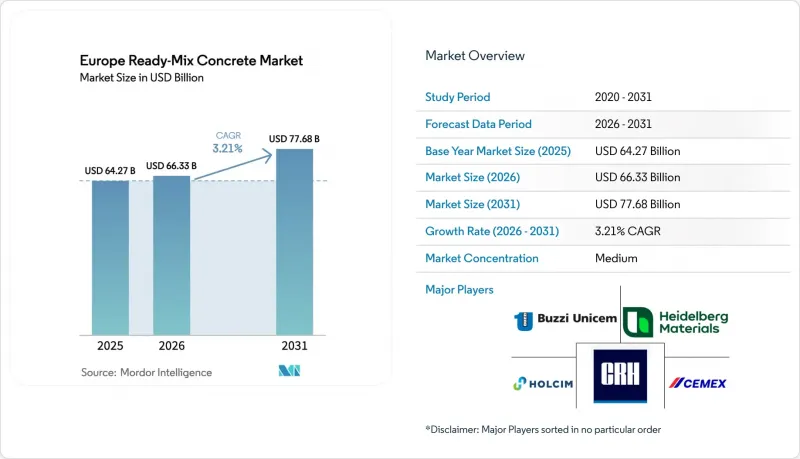
本報告按最終用戶產業(住宅、商業、工業/公共、基礎設施)、產品類型(軌道/軌道混合、集中/批量混合、收縮混合)和地區(德國、英國、法國、義大利、西班牙、波蘭、荷蘭、比利時、北歐國家和其他歐洲國家)進行細分。市場預測以美元計價。
歐洲預拌混凝土市場趨勢與洞察
住宅和都市區再開發建設。
儘管城市現代化政策導致整體住宅量放緩,但每戶住宅的混凝土用量卻在增加。德國建築規範中更嚴格的隔熱性能標準要求建造更厚、更堅固的牆體,導致住宅預拌混凝土的使用量增加。荷蘭350億歐元的氣候基金為將原工業區改造成中層住宅提供津貼,為擅長在狹小空間進行物流的供應商創造了持續的商機。在法國,維修工程目前佔建築許可的很大一部分,推動了對用於結構加固和節能維修的特殊混凝土的需求。北歐各市政府持續為能夠承受凍融循環的混凝土住宅津貼。在這些市場中,將技術諮詢服務與準時交貨(JIT)結合的製造商正在獲得競爭優勢。
歐盟綠色交易/透過泛歐交通運輸網路(TEN-T)走廊獎勵策略基礎建設
2024年,歐盟為94個泛歐交通網路(TEN-T)計畫撥款28億歐元,刺激了對橋面、高架橋和鐵路路基的持續需求。波蘭在波羅的海-亞得里亞海走廊計畫中的作用支撐了5.63%的複合年成長率,而德國在2025年聯邦預算中為交通部門撥款382.6億歐元,其中25億歐元將用於高速公路橋樑的維修。法國的「大巴黎快線」和都靈-里昂鐵路計畫正在擴大2026年之前的土木工程訂單前景。義大利正利用重建資金購買混凝土用於防洪和抗震加固,從而維持了專業供應商的訂單儲備。這些多年期計畫正在保護歐洲預拌混凝土市場免受住宅市場低迷的影響。
水泥和能源價格的波動給利潤率帶來了壓力。
在愛爾蘭,水泥價格在2021年至2024年間上漲。這與西歐各地水泥價格飆升的趨勢相呼應,西歐價格飆升的原因是天然氣市場波動以及窯爐營運商將不斷上漲的能源成本轉嫁給消費者。德國建築商報告稱,2025年初投入成本通膨達到16個月以來的最高水平,導致競標延遲和混凝土訂單放緩。由於多年期供應合約通常會限制價格上漲,燃油額外費用只能部分抵銷成本的急劇上升。來自東歐的進口進一步擠壓了成熟市場的利潤空間。生產商正在採取動態定價條款和最佳化車輛路線以減少柴油使用等措施來應對,但預計在替代燃料的佔比超過目前的53%之前,盈利仍將對天然氣價格波動保持敏感。
細分市場分析
在歐盟復甦基金和強制性氣候變遷適應能力建設的推動下,基礎設施產業實現了5.65%的複合年成長率,顯著高於住宅產業。光是德國交通部門就已撥款1,660億歐元用於公路橋樑和鐵路的維修,目標是在2029年前完成。這些項目將穩定訂單週期,使混凝土攪拌站能夠接近滿載運作。受電子商務驅動的倉儲建設的推動,商業領域仍保持強勁成長,而工業回流也提振了對混凝土地板材料的需求。學校和醫院等公共設施的維修項目強調低碳標準,這使得經認證的混凝土供應商更具優勢。總體而言,隨著公共預算中資產韌性建設優先於新建住宅,基礎設施產業在歐洲預拌混凝土市場的佔有率預計將會擴大。
基礎設施領域的強勁表現也導致規範的複雜性日益增加。橋面需要高初始強度和抗氯離子侵蝕性能,而纖維增強混凝土和微矽粉增強混凝土對於隧道段至關重要。製造商投資建造中央研究實驗室和行動測試設施,贏得供應合約並非競標最低報價,而是憑藉其性能優勢。先進的物流系統,例如夜間混凝土澆築、鐵路車輛運輸和現場筒倉,對於大型企劃至關重要,使垂直整合的大型企業能夠實現規模經濟。
其他好處:
- Excel格式的市場預測(ME)表
- 3個月的分析師支持
目錄
第1章:引言
- 研究假設和市場定義
- 調查範圍
第2章:調查方法
第3章執行摘要
第4章 市場狀況
- 市場概覽
- 市場促進因素
- 住宅建設和都市區改造帶來的需求成長
- 透過歐盟綠色交易/泛歐交通運輸走廊獎勵策略基礎建設
- 透過預製和數位化叫車平台提高時間和成本效率
- 促進低碳混凝土混合料的脫碳
- 3D混凝土列印技術的普及,需要特殊的配方。
- 市場限制因素
- 水泥和能源價格的波動給利潤率帶來了壓力。
- 由於燃煤發電廠關閉,導致供應鏈管理(SCM)人才短缺
- 歐盟排放交易體系(EU ETS)的更嚴格規定正在增加營運成本。
- 價值鏈分析
- 波特五力模型
第5章 市場規模與成長預測
- 按最終用戶行業分類
- 住宅
- 商業的
- 工業和公共部門
- 基礎建設(公路、鐵路、能源、供水)
- 依產品類型
- Transit/Track Mix
- 集中式/批量混合
- 收縮混合物
- 按地區
- 德國
- 英國
- 法國
- 義大利
- 西班牙
- 波蘭
- 荷蘭
- 比利時
- 北歐國家
- 其他歐洲國家
第6章 競爭情勢
- 市場集中度
- 策略趨勢
- 市佔率** / 排名分析
- 公司簡介
- Breedon Group plc
- Buzzi Unicem SpA
- CEMEX SAB de CV
- Consolis
- CRH
- Hanson UK
- HeidelbergCement
- HOLCIM
- Mapei SpA
- Sika AG
- Sweco AB
- Thomas Concrete Group
- Titan Cement
- Vicat SA
- Votorantim Cimentos
第7章 市場機會與未來展望
According to Mordor Intelligence, the Europe ready-Mix concrete market size is expected to grow from USD 64.27 billion in 2025 to USD 66.33 billion in 2026 and is forecast to reach USD 77.68 billion by 2031 at 3.21% CAGR over 2026-2031.
This report is Segmented by End-User Industry (Residential, Commercial, Industrial and Institutional, Infrastructure), Product Type (Transit/Truck-Mix, Central/Batch-Mix, Shrink-Mix), and Geography (Germany, United Kingdom, France, Italy, Spain, Poland, Netherlands, Belgium, Nordic Countries, Rest of Europe). The Market Forecasts are Provided in Terms of Value (USD).
Europe Ready-Mix Concrete Market Trends and Insights
Growing Demand from Residential and Urban-Infill Construction
Urban densification policies are increasing the concrete intensity per dwelling, even as overall housing starts soften. German building codes that tighten thermal-performance thresholds require thicker, higher-strength walls, increasing ready-mix volumes per unit. The Netherlands' EUR 35 billion Climate Fund channels grants to convert former industrial zones into mid-rise residential districts, creating repeat business for suppliers that excel at narrow-site logistics. In France, renovation approvals now dominate permits, favoring specialized mixes formulated for structural reinforcement and energy upgrades. Nordic municipalities continue to subsidize concrete-frame housing that withstands freeze-thaw cycles. Across these markets, producers that couple technical advisory services with just-in-time delivery gain a competitive edge.
Infrastructure Stimulus via EU Green Deal / TEN-T Corridors
The EU has earmarked EUR 2.8 billion for 94 Trans-European Transport Network (TEN-T) projects in 2024, catalyzing sustained demand for bridge decks, viaducts, and rail sub-bases. Poland's role on the Baltic-Adriatic corridor underpins a 5.63% CAGR, while Germany allocates EUR 38.26 billion to transport in the 2025 federal budget, with EUR 2.5 billion ring-fenced for autobahn bridge rehabilitation. France's Grand Paris Express and Turin-Lyon links widen the civil-work pipeline through 2026. Italy channels recovery funds toward flood control and seismic retrofit concrete, sustaining order books for specialized suppliers. These multi-year programs buffer the Europe ready-mix concrete market against housing downturns.
Volatility in Cement and Energy Prices Squeezing Margins
Cement prices climbed in Ireland between 2021 and 2024, mirroring surges across Western Europe as gas markets swung and kiln operators passed on higher energy costs. German contractors report input-cost inflation at 16-month highs in early 2025, prompting tender delays that dampen concrete call-offs. Fuel surcharges only partially offset cost spikes because multi-year supply contracts often cap escalation. Eastern European imports further compress margins in mature markets. Producers respond with dynamic pricing clauses and fleet route optimization to shave diesel use, yet profitability remains sensitive to gas-benchmark volatility until alternative-fuel substitution rises above today's 53% share.
Other drivers and restraints analyzed in the detailed report include:
- Prefabrication and Digital Dispatch Platforms Enhancing Time-Cost Efficiency
- Uptake of 3-D Concrete Printing Requiring Specialized Mixes
- Shortage of SCMs After Coal-Plant Closures
For complete list of drivers and restraints, kindly check the Table Of Contents.
Segment Analysis
Infrastructure applications captured a 5.65% CAGR, well ahead of residential, underpinned by EU recovery funds and climate-resilience mandates. Transport authorities in Germany alone earmarked EUR 166 billion through 2029 for highway bridges and rail upgrades. This pipeline stabilizes ordering cycles, allowing plants to run near rated capacity. The commercial segment remains steady as e-commerce drives warehouse construction, while industrial reshoring fuels demand for concrete flooring. Institutional refurbishments across schools and hospitals pivot on low-carbon specifications that favor suppliers with certified mixes. Overall, infrastructure's share of the Europe ready-mix concrete market size is set to expand as public budgets prioritize asset resilience over new dwellings.
Infrastructure's outperformance also elevates specification complexity. Bridge decks require high early strength and chloride resistance; tunnel sections need fiber-reinforced, micro-silica-enhanced mixes. Producers investing in central labs and mobile testing win supply contracts on performance rather than lowest-price bids. Logistics sophistication-night pours, rail-car feeding and on-site silos-becomes critical on mega-projects, giving vertically integrated majors a scale advantage.
Complete Report Scope:
- By End-user Industry
- Residential
- Commercial
- Industrial and Institutional
- Infrastructure (Road, Rail, Energy, Water)
- By Product Type
- Transit/Truck-Mix
- Central/Batch-Mix
- Shrink-Mix
- By Geography
- Germany
- United Kingdom
- France
- Italy
- Spain
- Poland
- Netherlands
- Belgium
- Nordic Countries
- Rest of Europe
List of Companies Covered in this Report:
- Breedon Group plc
- Buzzi Unicem SpA
- CEMEX S.A.B. de C.V.
- Consolis
- CRH
- Hanson UK
- HeidelbergCement
- HOLCIM
- Mapei SpA
- Sika AG
- Sweco AB
- Thomas Concrete Group
- Titan Cement
- Vicat SA
- Votorantim Cimentos
Additional Benefits:
- The market estimate (ME) sheet in Excel format
- 3 months of analyst support
TABLE OF CONTENTS
1 Introduction
- 1.1 Study Assumptions and Market Definition
- 1.2 Scope of the Study
2 Research Methodology
3 Executive Summary
4 Market Landscape
- 4.1 Market Overview
- 4.2 Market Drivers
- 4.2.1 Growing demand from residential and urban-infill construction
- 4.2.2 Infrastructure stimulus via EU Green Deal / TEN-T corridors
- 4.2.3 Prefabrication and digital dispatch platforms enhancing time-cost efficiency
- 4.2.4 Decarbonisation push for low-carbon concrete formulations
- 4.2.5 Uptake of 3-D concrete printing requiring specialised mixes
- 4.3 Market Restraints
- 4.3.1 Volatility in cement and energy prices squeezing margins
- 4.3.2 Shortage of SCMs after coal-plant closures
- 4.3.3 Stricter EU ETS costs inflating operating expenses
- 4.4 Value Chain Analysis
- 4.5 Porter's Five Forces
- 4.5.1 Bargaining Power of Suppliers
- 4.5.2 Bargaining Power of Buyers
- 4.5.3 Threat of New Entrants
- 4.5.4 Threat of Substitute Products and Services
- 4.5.5 Degree of Competition
5 Market Size and Growth Forecasts (Value)
- 5.1 By End-user Industry
- 5.1.1 Residential
- 5.1.2 Commercial
- 5.1.3 Industrial and Institutional
- 5.1.4 Infrastructure (Road, Rail, Energy, Water)
- 5.2 By Product Type
- 5.2.1 Transit/Truck-Mix
- 5.2.2 Central/Batch-Mix
- 5.2.3 Shrink-Mix
- 5.3 By Geography
- 5.3.1 Germany
- 5.3.2 United Kingdom
- 5.3.3 France
- 5.3.4 Italy
- 5.3.5 Spain
- 5.3.6 Poland
- 5.3.7 Netherlands
- 5.3.8 Belgium
- 5.3.9 Nordic Countries
- 5.3.10 Rest of Europe
6 Competitive Landscape
- 6.1 Market Concentration
- 6.2 Strategic Moves
- 6.3 Market Share**/Ranking Analysis
- 6.4 Company Profiles (includes Global level Overview, Market level overview, Core Segments, Financials as available, Strategic Information, Market Rank/Share for key companies, Products and Services, and Recent Developments)
- 6.4.1 Breedon Group plc
- 6.4.2 Buzzi Unicem SpA
- 6.4.3 CEMEX S.A.B. de C.V.
- 6.4.4 Consolis
- 6.4.5 CRH
- 6.4.6 Hanson UK
- 6.4.7 HeidelbergCement
- 6.4.8 HOLCIM
- 6.4.9 Mapei SpA
- 6.4.10 Sika AG
- 6.4.11 Sweco AB
- 6.4.12 Thomas Concrete Group
- 6.4.13 Titan Cement
- 6.4.14 Vicat SA
- 6.4.15 Votorantim Cimentos
7 Market Opportunities and Future Outlook
- 7.1 White-space and Unmet-Need Assessment

 2026-2030年全球攪拌站用預拌混凝土市場
 預拌混凝土市場預測至2034年:依產品、產量、應用及地區分類的全球分析
 預拌混凝土市場規模、佔有率和趨勢分析報告:按應用、地區和細分市場預測(2026-2033 年)
 2026年全球混凝土攪拌站市場報告2026年全球混凝土攪拌站攪拌機市場報告2026年全球預拌混凝土市場報告
 預拌混凝土市場:依混凝土類型、製造方法、強度等級、應用、最終用途及通路分類-2026-2032年全球預測
 混凝土攪拌站市場分析及預測(至2035年):依類型、產品類型、服務、技術、組件、應用、材料類型、製程、最終用戶、功能分類預拌混凝土市場分析及預測(至2035年):類型、產品類型、應用、技術、組成成分、最終用戶、製程、安裝類型、設備、解決方案
 全球預拌混凝土市場規模、佔有率、趨勢和成長分析報告(2026-2034)