


 |
市場調查報告書
商品編碼
2125530
歐洲油氣儲存槽:市場佔有率分析、產業趨勢與統計及成長預測(2026-2031 年)Europe Oil And Gas Storage Tank - Market Share Analysis, Industry Trends & Statistics, Growth Forecasts (2026 - 2031) |
||||||

※ 本網頁內容可能與最新版本有所差異。詳細情況請與我們聯繫。
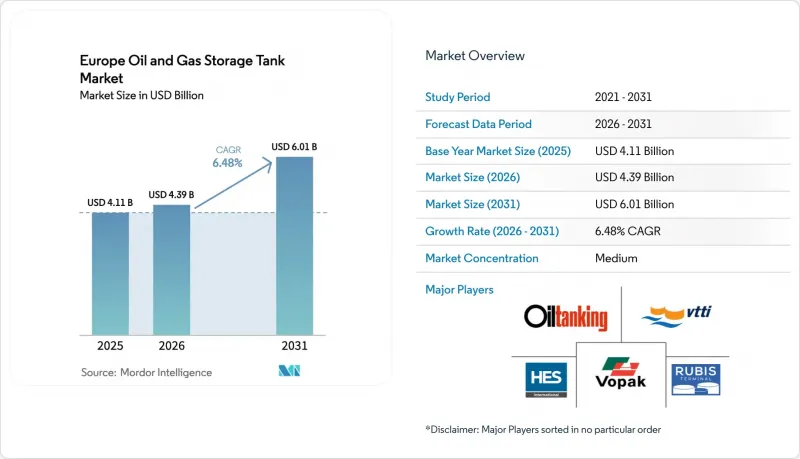
根據 Mordor Intelligence 預測,歐洲石油和天然氣儲存槽市場規模預計將在 2025 年達到 41.1 億美元,2026 年達到 43.9 億美元,到 2031 年達到 60.1 億美元,2026 年至 2031 年的複合年成長率為 6.48%。
本報告涵蓋儲槽設計(浮動頂儲槽、球形儲槽等)、儲槽類型(地上儲存槽、地下儲槽、移動/模組化儲存槽)、材料(碳鋼、FRP 等)、容量範圍(5,000 立方米以下、50,000 至 150,000 立方米等)、俄羅斯地區(這些市場等)、英國地區(原油用戶化)、俄羅斯地區等元素公司。
歐洲油氣儲存槽市場趨勢與洞察
戰略石油儲備的需求不斷成長
截至2025年12月,歐盟成員國的石油儲備總合滿足90天的淨進口量需求,但現在一些國家的政府正力爭在2028年達到120天的儲備量。德國在2025年新增了320萬立方公尺的儲槽容量,主要位於威廉港-下薩克森州,該地區運作的儲槽容量在5萬至15萬立方公尺的最佳範圍內。西班牙簽署了一份價值1.8億歐元(1.95億美元)的契約,用於在卡塔赫納-塔拉戈納附近建造地上儲罐,並指定使用一種耐腐蝕塗層,可將檢驗週期延長至15年。法國SAGESS公司在2024年競標建造了180萬立方公尺的儲罐,這顯示儘管汽油消費量保持平穩,但對大直徑碳鋼儲罐的需求仍然穩定。儘管精煉產品加工量成長緩慢,但這穩定了區域鋼鐵製造商的生產流程,並提高了單位盈利。
液化天然氣進口終端和低溫儲槽擴建
在德國,四座浮體式儲存再氣化裝置(FSRU)於2023年至2025年間投入運作。這四座裝置運作總合萬立方米陸上-162 度C儲存槽。 2025年5月,一座符合EN 14620標準的9%鎳鋼材質的18萬立方米儲罐(3號罐)在鹿特丹蓋特碼頭竣工。芬蘭因庫設施於2025年9月新增一座5萬立方公尺的子彈型儲罐,這反映了北歐國家傾向採用模組化、分階段擴容的方式。這些低溫設施的建設成本為每立方米1200至1800美元,約為原油成本的三倍,但考慮到替代俄羅斯管道天然氣的戰略需求,其建設成本是合理的。液化天然氣需求的激增支撐了液化天然氣儲槽需求預計年複合成長率為 8.2%。
歐洲石油需求下降
2025年,全部區域需求下降1,240萬桶/日,較上年下降2.1%。這主要歸因於電動車滲透率達到新車註冊量的22%。德國汽油和柴油消費量分別下降3.8%和2.9%,導致煉油廠運轉率低於80%。 Gamvoor公司於2025年初關閉了其位於鹿特丹的40萬立方米中間餾分油產能,理由是期貨溢價走弱以及由此導致的倉儲套利利潤下降。除非原油儲槽改造利用,否則到2030年,法國預計將有120萬立方公尺的原油儲存空間面臨閒置風險。
細分市場分析
2025年,浮動頂儲槽佔歐洲油氣儲存槽市場營收的35.9%,預計到2031年將以7.5%的複合年成長率成長。 2024年歐洲經濟區指令規定,到2027年12月,對於里德蒸氣超過10千帕的液體,必須使用內浮頂或外浮動頂儲罐,這意味著大約需要改造或更換1800個固定頂儲罐。 2025年,皇家孚寶公司在鹿特丹改造了14個儲罐,每年減少1,450噸揮發性有機化合物(VOC)排放,從而避免了排放交易體系(ETS)的罰款。雖然固定頂儲槽仍然用於儲存低揮發性燃料,但穹頂儲槽已針對芬蘭的大量降雪進行了改造,而子彈型儲槽則為西班牙的模組化液化天然氣衛星站提供支援。
穹頂形屋頂能夠承受 5 kPa 的雪荷載,Neste 公司容量為 60,000 立方米的 Porvoo 生物柴油儲罐便證明了這一點,該儲罐的設計運行溫度為 -20 度C。通常容量為 200 立方公尺的子彈形儲槽可滿足分散式液化天然氣 (LNG) 的需求。 Enagas 公司計劃在 2025 年前在西班牙農村地區安裝 18 個此類儲罐。由於浮動頂式儲槽既符合排放法規,又能提高庫存效率,預計到 2031 年,它將成為易揮發液體儲存的標準選擇。
到2025年,地上儲槽將佔據70.2%的市場佔有率,並成為主流類型,這主要得益於其較低的建造成本和易於檢查的特點。由於地下水保護條例的實施,新建地下儲槽的數量正在下降。在荷蘭,2024年起,禁止在飲用水井100公尺範圍內安裝地下儲槽。移動式和模組化儲槽的年複合成長率(CAGR)為8.9%,因為災害應變機構和液化天然氣尖峰用電調節業者更傾向於選擇50至1000立方公尺的拖車式儲槽。德國聯邦技術救濟辦公室於2025年採購了24套此類儲罐,用於煉油廠的檢修(定期檢查和維修)。芬蘭天然氣網於2025年初從HOYER租賃了6個500立方米的液化天然氣儲罐,在確保供應的同時推遲了資本支出。
地上儲槽適用於沿海碼頭常用的 5 萬至 15 萬立方公尺容量範圍,而地下儲槽則需要合適的地質條件,且挖掘成本更高。移動式儲槽具有更高的柔軟性,資產負擔更輕,營運商可以在 48 小時內將容量重新分配到季節性需求高峰出現的地區。
其他好處:
- Excel格式的市場預測(ME)表
- 3個月的分析師支持
目錄
第1章:引言
- 研究假設和市場定義
- 調查範圍
第2章:調查方法
第3章執行摘要
第4章 市場狀況
- 市場概覽
- 市場促進因素
- 對戰略石油儲備的需求日益成長
- 液化天然氣進口終端和低溫儲槽擴建
- 對更新老舊儲存基礎設備的需求
- 生質燃料和氫氣儲存槽的成長
- 將廢舊儲槽改造成碳捕集與封存(CCS)儲存設施
- 利用數位孿生維修預測性維護
- 市場限制因素
- 歐洲石油需求下降
- 嚴格的環境法規和合規成本
- 當地居民的反對和授權程序的延誤。
- 供應鏈分析
- 監理情勢
- 技術展望
- 波特五力模型
第5章 市場規模與成長預測
- 有意為之
- 固定頂水箱
- 浮動頂罐
- 圓頂形水箱
- 球形儲罐
- 子彈形坦克和其他
- 坦克型
- 地面儲存槽(AST)
- 地下儲存槽(UST)
- 移動式/模組化坦克
- 材料
- 碳鋼
- 不銹鋼
- 玻璃纖維增強塑膠(FRP)
- 具體的
- 其他
- 按容量範圍
- 5000立方米或以下
- 5,000~50,000m3
- 50,000~150,000m3
- 超過150,000立方米
- 依產品
- 原油
- 石油精煉產品
- 液化天然氣(例如,LPG、LNG)
- 航空燃料和中間餾分油
- 特種烴類/石油化學產品
- 最終用戶
- 石油和天然氣生產商
- 煉油廠和石化廠
- 貿易業者/經銷商
- 戰略石油儲備(SPR)
- 物流/運輸公司
- 按地區
- 德國
- 英國
- 法國
- 義大利
- 西班牙
- 北歐國家
- 俄羅斯
- 其他歐洲國家
第6章 競爭情勢
- 市場集中度
- 策略趨勢(併購、聯盟、購電協議)
- 市場佔有率分析(主要公司的市場排名和佔有率)
- 公司簡介
- Royal Vopak NV
- Oiltanking GmbH
- HOYER GmbH
- Vitol Tank Terminals International BV(VTTI)
- Eisenbau Heilbronn GmbH
- Lapesa Grupo Empresarial SL
- GLS Tanks International GmbH
- ROSEN Group
- Dyer Gas GmbH
- Virtor Oy
- HES International BV
- Odfjell SE(Terminals)
- Rubis Terminal
- Navigator Terminals
- Gunvor Petroleum Rotterdam BV
- LBC Tank Terminals
- PetroIneos
- Alkion Terminals
- Decal Spain
- TotalEnergies Raffinerie Mitteldeutschland GmbH
第7章 市場機會與未來展望
According to Mordor Intelligence, the Europe oil and gas storage tank market size is projected to be USD 4.11 billion in 2025, USD 4.39 billion in 2026, and reach USD 6.01 billion by 2031, growing at a CAGR of 6.48% from 2026 to 2031.
This report is Segmented by Design (Floating-Roof Tanks, Spherical Tanks, and More), Tank Type (ASTs, Usts, and Mobile/Modular Tanks), Material (Carbon Steel, FRP, and More), Capacity Range (Up To 5k M3, 50 To 150k M3, and More), Product (Crude Oil, Natural Gas Liquids, and More), End-User (Refineries and Petrochemical Plants, and More), and Geography (Germany, United Kingdom, Russia, and More)
Europe Oil And Gas Storage Tank Market Trends and Insights
Rising Need for Strategic Petroleum Reserves
European Union members collectively held 90 days of net import cover in December 2025, yet several governments now target 120 days by 2028. Germany added 3.2 million m3 of new capacity in 2025, commissioning tanks in Wilhelmshaven and Lower Saxony that primarily fall in the 50,000-150,000 m3 sweet spot. Spain awarded EUR 180 million (USD 195 million) in above-ground tank contracts near Cartagena and Tarragona, specifying corrosion-resistant coatings that extend inspection intervals to 15 years. France's SAGESS tendered for 1.8 million m3 during 2024, reinforcing consistent demand for large-diameter carbon-steel tanks even as gasoline consumption plateaus. The resulting offtake stabilizes fabrication pipelines for regional steel shops and lifts per-unit profitability despite muted refined-product throughput.
Expansion of LNG Import Terminals & Cryogenic Tanks
Germany commissioned four floating storage and regasification units (FSRUs) between 2023 and 2025, which together required 480,000 m3 of onshore minus-162 °C storage. In May 2025, the Gate terminal in Rotterdam finished a third 180,000 m3 tank built from 9-percent-nickel steel that meets EN 14620. Finland's Inkoo facility added a 50,000 m3 bullet tank in September 2025, illustrating Nordic preference for modular, incremental capacity. Cryogenic construction costs of USD 1,200-1,800 per m3, roughly triple crude-oil equivalents, are nevertheless justified by the strategic imperative to displace Russian pipeline gas. This LNG surge underpins the 8.2% CAGR forecast for natural-gas-liquid tank demand.
Declining Petroleum Demand in Europe
Regional demand fell to 12.4 million b/d in 2025, shaving 2.1% year-on-year as electric-vehicle uptake hit 22% of new car registrations. Germany's gasoline and diesel consumption slipped 3.8% and 2.9%, respectively, depressing refinery utilization below 80%. Gunvor idled 400,000 m3 of middle-distillate capacity in Rotterdam early 2025, citing weak contango that no longer funds storage arbitrage. Unless crude tanks are repurposed, an estimated 1.2 million m3 will risk stranding in France by 2030.
Other drivers and restraints analyzed in the detailed report include:
- Aging Storage Infrastructure Replacement Demand
- Growth in Biofuels & Hydrogen Storage Tanks
- Stringent Environmental Regulations & Compliance Cost
For complete list of drivers and restraints, kindly check the Table Of Contents.
Segment Analysis
Floating-roof vessels accounted for 35.9% of Europe's oil & gas storage tank market revenue in 2025 and are on track for a 7.5% CAGR through 2031. The 2024 EEA directive compels internal or external floating roofs for liquids above 10 kPa Reid vapor pressure by December 2027, forcing the retrofit or replacement of roughly 1,800 fixed-roof tanks. Royal Vopak converted 14 tanks at Rotterdam in 2025, cutting VOC releases by 1,450 t/yr and avoiding ETS penalties. Fixed-roof vessels still serve low-volatility fuels, while dome-roof designs handle high snow-load sites in Finland, and bullet tanks support modular LNG satellite stations in Spain.
Dome roofs resist 5 kPa snow loads, demonstrated by Neste's 60,000 m3 Porvoo biodiesel tank engineered for -20 °C operations. Bullet tanks, typically 200 m3 each, support distributed LNG demand; Enagas deployed 18 in rural Spain during 2025. The convergence of emission compliance and inventory efficiency cements floating roofs as the default for volatile liquids through 2031.
Above-ground tanks dominated with a 70.2% market share in 2025, reflecting lower construction costs and inspection ease. Underground newbuilds decline due to groundwater-protection rules; the Netherlands banned such tanks within 100 m of drinking-water wells in 2024. Mobile and modular tanks grow at an 8.9% CAGR as disaster-response agencies and LNG peak-shaving operators favor 50-1,000 m3 trailer-mounted units. Germany's Federal Agency for Technical Relief bought 24 in 2025 for refinery turnarounds. Finland's Gasgrid leased six 500 m3 LNG tanks from HOYER in early 2025, deferring capital while securing supply.
Above-ground vessels fit the 50,000-150,000 m3 capacity band favored at coastal terminals, whereas underground options require favorable geology and face costlier excavation. Mobility offers asset-light flexibility, enabling operators to redeploy capacity within 48 hours to seasonal hotspots.
Complete Report Scope:
- By Design
- Fixed-Roof Tanks
- Floating-Roof Tanks
- Dome-Roof Tanks
- Spherical Tanks
- Bullet Tanks and Others
- By Tank Type
- Aboveground Storage Tanks (ASTs)
- Underground Storage Tanks (USTs)
- Mobile/Modular Tanks
- By Material
- Carbon Steel
- Stainless Steel
- Fiberglass-Reinforced Plastic (FRP)
- Concrete
- Others
- By Capacity Range
- Up to 5k m3
- 5 to 50k m3
- 50 to 150k m3
- Above 150k m3
- By Product
- Crude Oil
- Refined Petroleum Products
- Natural Gas Liquids (e.g., LPG, LNG)
- Aviation Fuel and Middle Distillates
- Specialty Hydrocarbons/Petrochemicals
- By End-User
- Oil and Gas Producers
- Refineries and Petrochemical Plants
- Traders and Distributors
- Strategic Petroleum Reserve Agencies (SPRs)
- Logistics/Transportation companies
- By Geography
- Germany
- United Kingdom
- France
- Italy
- Spain
- NORDIC Countries
- Russia
- Rest of Europe
List of Companies Covered in this Report:
- Royal Vopak NV
- Oiltanking GmbH
- HOYER GmbH
- Vitol Tank Terminals International BV (VTTI)
- Eisenbau Heilbronn GmbH
- Lapesa Grupo Empresarial SL
- GLS Tanks International GmbH
- ROSEN Group
- Dyer Gas GmbH
- Virtor Oy
- HES International BV
- Odfjell SE (Terminals)
- Rubis Terminal
- Navigator Terminals
- Gunvor Petroleum Rotterdam BV
- LBC Tank Terminals
- PetroIneos
- Alkion Terminals
- Decal Spain
- TotalEnergies Raffinerie Mitteldeutschland GmbH
Additional Benefits:
- The market estimate (ME) sheet in Excel format
- 3 months of analyst support
TABLE OF CONTENTS
1 Introduction
- 1.1 Study Assumptions & Market Definition
- 1.2 Scope of the Study
2 Research Methodology
3 Executive Summary
4 Market Landscape
- 4.1 Market Overview
- 4.2 Market Drivers
- 4.2.1 Rising need for strategic petroleum reserves
- 4.2.2 Expansion of LNG import terminals & cryogenic tanks
- 4.2.3 Aging storage infrastructure replacement demand
- 4.2.4 Growth in biofuels & hydrogen storage tanks
- 4.2.5 Repurposing decommissioned tanks for CCS storage
- 4.2.6 Digital-twin-driven predictive maintenance retrofits
- 4.3 Market Restraints
- 4.3.1 Declining petroleum demand in Europe
- 4.3.2 Stringent environmental regulations & compliance cost
- 4.3.3 Community opposition & permitting delays
- 4.4 Supply-Chain Analysis
- 4.5 Regulatory Landscape
- 4.6 Technological Outlook
- 4.7 Porter's Five Forces
- 4.7.1 Bargaining Power of Suppliers
- 4.7.2 Bargaining Power of Buyers
- 4.7.3 Threat of New Entrants
- 4.7.4 Threat of Substitutes
- 4.7.5 Intensity of Competitive Rivalry
5 Market Size & Growth Forecasts
- 5.1 By Design
- 5.1.1 Fixed-Roof Tanks
- 5.1.2 Floating-Roof Tanks
- 5.1.3 Dome-Roof Tanks
- 5.1.4 Spherical Tanks
- 5.1.5 Bullet Tanks and Others
- 5.2 By Tank Type
- 5.2.1 Aboveground Storage Tanks (ASTs)
- 5.2.2 Underground Storage Tanks (USTs)
- 5.2.3 Mobile/Modular Tanks
- 5.3 By Material
- 5.3.1 Carbon Steel
- 5.3.2 Stainless Steel
- 5.3.3 Fiberglass-Reinforced Plastic (FRP)
- 5.3.4 Concrete
- 5.3.5 Others
- 5.4 By Capacity Range
- 5.4.1 Up to 5k m3
- 5.4.2 5 to 50k m3
- 5.4.3 50 to 150k m3
- 5.4.4 Above 150k m3
- 5.5 By Product
- 5.5.1 Crude Oil
- 5.5.2 Refined Petroleum Products
- 5.5.3 Natural Gas Liquids (e.g., LPG, LNG)
- 5.5.4 Aviation Fuel and Middle Distillates
- 5.5.5 Specialty Hydrocarbons/Petrochemicals
- 5.6 By End-User
- 5.6.1 Oil and Gas Producers
- 5.6.2 Refineries and Petrochemical Plants
- 5.6.3 Traders and Distributors
- 5.6.4 Strategic Petroleum Reserve Agencies (SPRs)
- 5.6.5 Logistics/Transportation companies
- 5.7 By Geography
- 5.7.1 Germany
- 5.7.2 United Kingdom
- 5.7.3 France
- 5.7.4 Italy
- 5.7.5 Spain
- 5.7.6 NORDIC Countries
- 5.7.7 Russia
- 5.7.8 Rest of Europe
6 Competitive Landscape
- 6.1 Market Concentration
- 6.2 Strategic Moves (M&A, Partnerships, PPAs)
- 6.3 Market Share Analysis (Market Rank/Share for key companies)
- 6.4 Company Profiles (includes Global level Overview, Market level overview, Core Segments, Financials as available, Strategic Information, Products & Services, and Recent Developments)
- 6.4.1 Royal Vopak NV
- 6.4.2 Oiltanking GmbH
- 6.4.3 HOYER GmbH
- 6.4.4 Vitol Tank Terminals International BV (VTTI)
- 6.4.5 Eisenbau Heilbronn GmbH
- 6.4.6 Lapesa Grupo Empresarial SL
- 6.4.7 GLS Tanks International GmbH
- 6.4.8 ROSEN Group
- 6.4.9 Dyer Gas GmbH
- 6.4.10 Virtor Oy
- 6.4.11 HES International BV
- 6.4.12 Odfjell SE (Terminals)
- 6.4.13 Rubis Terminal
- 6.4.14 Navigator Terminals
- 6.4.15 Gunvor Petroleum Rotterdam BV
- 6.4.16 LBC Tank Terminals
- 6.4.17 PetroIneos
- 6.4.18 Alkion Terminals
- 6.4.19 Decal Spain
- 6.4.20 TotalEnergies Raffinerie Mitteldeutschland GmbH
7 Market Opportunities & Future Outlook
- 7.1 White-space & Unmet-Need Assessment

 地下天然氣儲存:市場佔有率分析、產業趨勢與統計、成長預測(2026-2031)
 2026-2030年全球地下天然氣儲存市場
 商業天然氣儲存市場-全球產業規模、佔有率、趨勢、機會與預測:按類型、地區和競爭格局分類,2021-2031年
 液化石油氣(LPG)儲存市場:商業機會、成長要素、產業趨勢分析及2026-2035年預測
 地下天然氣儲存市場:儲存類型、服務、合約期限、應用、最終用途-2026-2032年全球市場預測液化石油氣儲存市場-全球產業規模、佔有率、趨勢、機會和預測:按應用、儲存類型、終端用戶產業、地區和競爭格局分類,2021-2031年石油和天然氣儲存服務市場-全球產業規模、佔有率、趨勢、機會及預測(按服務、產品類型、最終用戶、地區和競爭格局分類,2021-2031年)
 全球地下儲氣庫市場全球液化石油氣儲存市場
 亞太多元素氣瓶市場(按應用、類型和國家分類)分析與預測(2024 年至 2034 年)