

 |
市場調查報告書
商品編碼
2125526
先進生質燃料:市場佔有率分析、產業趨勢與統計、成長預測(2026-2031)Advanced Biofuel - Market Share Analysis, Industry Trends & Statistics, Growth Forecasts (2026 - 2031) |
||||||

※ 本網頁內容可能與最新版本有所差異。詳細情況請與我們聯繫。
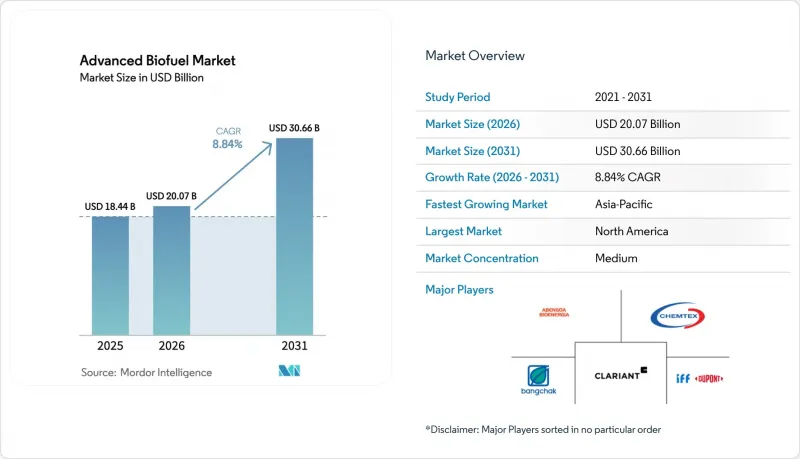
據 Mordor Intelligence 稱,2025 年先進生質燃料市場價值為 184.4 億美元,預計到 2031 年將達到 306.6 億美元,而 2026 年為 200.7 億美元,預測期(2026-2031 年)的複合年成長率為 8.84%。
本報告按原料(木質纖維素殘渣、能源作物、藻類等)、生質燃料類型(可再生柴油、沼氣/生物甲烷等)、技術(生物化學轉化、熱化學轉化、混合和新興技術)、最終用途(道路運輸燃料、航空燃料、船舶燃料、工業熱能和電力)以及地區(北美、歐洲、亞太地區及其他地區)進行分類。
全球先進生質燃料市場趨勢與洞察
加強全球混合義務
國家和超國家層面的監管正從自願性措施轉向具有約束力的配額制度,從而為生產商提供更清晰的需求預測。英國永續航空燃料的強制性配額比例將從2025年的2%提高到2040年的22%,並輔以收入保障機制,預計可為英國經濟帶來50億英鎊的收入,並維持多達1.5萬個就業機會。巴西計畫推出的E30汽油混合燃料預計每年可減少170萬噸溫室氣體排放,同時吸引90億雷亞爾的外國投資。加拿大的《無污染燃料條例》和歐盟的《ReFuelEU航空條例》也同樣確保了長期承諾,並為長期專案融資提供了支持。這些強制性措施將使資本密集煉油廠能夠保障加工能力,降低風險溢價,並加速先進生質燃料市場的整體擴張。
對永續航空燃料(SAF)的需求迅速成長
航空公司為實現淨零排放目標而簽署的直接採購協議,繞過了傳統的噴射機燃料經銷商。 DHL快遞公司從Neste公司購買了7,400噸永續航空燃料(SAF),用於新加坡樟宜機場。同時,國泰航空正在中國聯合開發四座電轉液(P2L)工廠,每座工廠的年產能為5萬至10萬噸。美國永續航空燃油的產量在2024年12月至2025年2月期間加倍,達到每日約3萬桶,但這仍只能滿足國內噴射機燃料需求的不到2%,凸顯了巨大的供應缺口。因此,航空業相關人員正在加快簽訂長期契約,以支持產能的提升和技術多元化,從而推動先進生質燃料市場遠遠超越傳統道路燃料的範疇。
原料價格和糧食作物價格波動
由於原料成本佔營運成本的60%至80%,廢棄食用油、大豆以及玉米秸稈和葉片的價格波動會擠壓利潤空間,並阻礙新的資本投資。氫化植物油(HVO)生產商和食品加工商需求的成長推高了食用油價格,引發了開發中國家糧食安全的討論。為了對沖商品價格波動,生產商正將業務多元化,轉向農業殘餘物、城市固態廢棄物和藻類。藻類培養成本目前仍高達每公升0.43美元至8.75美元,污染和營養管理風險推高了成本。由此導致的價格波動迫使投資者要求增加緊急預算,從而抑制了先進生質燃料市場的短期成長。
細分市場分析
利用豐富的農作物廢棄物、鋸末和林業殘餘物,同時最大限度地減少土地佔用負擔,木質纖維素殘渣預計到2025年將佔先進生質燃料市場佔有率的28.62%。能源作物的種植面積正在低產農田上不斷擴大,芒草和柳枝稷能夠提供穩定的生質能產量並改善土壤。雖然廢棄食用油和其他油脂的收集網路已與連鎖餐廳和市政回收計劃合作,但目前需求已超過供應,導致價格溢價。因此,先進生質燃料市場正在擴大其原料基礎,將城市固態廢棄物納入其中。 Enerchem位於埃德蒙頓的工廠就是一個零掩埋法規如何提供穩定原料供應的例證。合成生物學的突破使得封閉式電氣管槽池中微藻類的日產量超過每平方公尺60 克,降低了生產成本,並推動藻類市場在 2026 年至 2031 年間以 14.92% 的複合年成長率成長。生產商正在將智慧收穫、絮凝和下游脂質萃取相結合,以實現與陸地油籽相當的產量,而無需佔用耕地。
原料策略正變得日益多元化。煉油廠正在將農業殘渣與燃料混合,用於基本負載供應;在生產高價值氫化植物油(HVO)時添加廢棄油脂;並試點利用藻類和城市廢棄物,以確保未來的擴充性。這種對沖策略有助於減輕大宗商品價格週期波動的影響,並更容易滿足有利於非食品原料的政策獎勵要求。隨著企業買家對可追溯性和生命週期評估的要求日益嚴格,基於殘渣的生產路線正在先進生質燃料市場中佔據越來越重要的地位。
可再生柴油因其與現有引擎和物流網路的直接相容性,預計到2025年將佔銷量的45.38%。這將使車輛無需更換資產即可實現脫碳。由於廢棄食用油和動物脂肪易於獲取,HEFA工廠的試運行週期較短,因此保持了較高的正常運作運轉率。在零甲烷排放法規的推動下,沼氣和生物甲烷的複合年成長率達到12.11%,主要得益於掩埋和大規模酪農廠附近厭氧消化叢集的興起。纖維素乙醇仍然受到酵素成本的限制,但透過連續發酵和整合生物製程,成本差距正在縮小。生物丁醇具有更高的能量密度和辛烷值,預計在資本成本降低之前,其應用將僅限於航空燃料的特定混合燃料。
市場需求決定了每種燃料在其最終用途上的細分市場地位。 HVO 用於重型運輸車輛和寒冷氣候地區,SAF 混合燃料用於長途航空運輸,而管道級生物甲烷則用於工業熱源。能夠靈活切換產品線的生產商能夠在法規或原料變更時獲取價值。這種多樣化的選擇正在推動大型石油公司進行垂直整合,進而提高了先進生質燃料市場的進入門檻。
區域分析
預計到2025年,北美將佔全球銷售額的38.42%,這得益於數十年來政策的支持,這些支持催生了成熟的低碳燃料信用市場。 2023年,美國可再生柴油產能成長了44%,使國內生質燃料總產量達到每年240億加侖,並推動了中西部地區新的原料收集中心的形成。加拿大的「無污染燃料法規」將省級指令與聯邦碳定價機制結合,即使在與美國進行跨境貿易仲裁的情況下,也能確保需求的穩定性。
隨著中國、印度和東協成員國降低進口依賴並建構國內供應鏈,預計2031年,亞太地區的年複合成長率將達到12.23%。印度的「2025年生質燃料計畫」為生物壓縮天然氣(bio-CNG)和乙醇計畫提供土地使用和稅收優惠,目標是在2026年前僅在比哈爾邦就建成9座乙醇工廠,預計將創造5萬個就業機會。中國航空監管機構將於2024年批准首批永續航空燃料(SAF)商業航班,目前各地區航空公司正在簽署承購協議,以確保在預期配額生效前獲得供應。澳洲政策環境的滯後導致英國石油公司(BP)奎納納油田升級計畫延期,凸顯了監管在確保先進生質燃料市場投資方面發揮的關鍵作用。
在可再生能源指令的指導下,歐洲保持穩定成長,但間接土地利用變更的政策不確定性導致審核流程漫長。德國和法國已升級生物柴油反應器以處理廢棄油脂,而北歐各國政府正在將長期採購承諾納入其體系,以保護生產商免受現貨價格波動的影響。隨著強制性的ReFuelEU航空燃料計畫和各國碳排放稅的實施,預計到2030年,永續航空燃料(SAF)的需求量將超過500萬噸。複雜的生命週期會計規則推高了合規成本,為擁有完善可追溯系統的生產者創造了一個高價值的利基市場。
其他好處:
- Excel格式的市場預測(ME)表
- 3個月的分析師支持
目錄
第1章:引言
- 研究假設和市場定義
- 調查範圍
第2章:調查方法
第3章執行摘要
第4章 市場狀況
- 市場概覽
- 市場促進因素
- 加強全球混合義務
- 對永續航空燃料的需求正在激增。
- 企業淨零排放採購目標
- 一種碳負排放的 BECCS(建築能源效率消耗和停止系統)路徑正在形成。
- 在《掩埋掩埋法》的支持下,都市固態廢棄物(MSW)轉向生物原油的轉變。
- 合成生物學成本降低的突破
- 市場限制因素
- 原料價格和糧食作物價格的波動
- 纖維素生物煉製需要高資本投資
- 擴大藻類養殖規模及其污染風險
- 重點區域內土地利用變化政策的不確定性
- 供應鏈分析
- 監理情勢
- 現有及未來主要項目
- 技術展望
- 波特五力模型
第5章 市場規模與成長預測
- 按成分
- 木質纖維素殘渣
- 能源作物(如芒草)
- 廢棄食用油/油霧
- 藻類
- 都市固態廢棄物
- 依生質燃料類型
- 纖維素基乙醇
- 氫化酯脂肪酸(HEFA)
- 可再生柴油(HVO)
- 沼氣/生物甲烷
- 生物丁醇
- 透過技術
- 生物化學轉化
- 熱化學轉化
- 混合和新興技術
- 按最終用途行業分類
- 道路運輸燃料
- 航空燃料(SAF)
- 船用燃料
- 工業熱能和電力
- 按地區
- 北美洲
- 美國
- 加拿大
- 墨西哥
- 歐洲
- 德國
- 英國
- 法國
- 義大利
- 北歐國家
- 俄羅斯
- 其他歐洲國家
- 亞太地區
- 中國
- 印度
- 日本
- 韓國
- 東南亞國協
- 其他亞太國家
- 南美洲
- 巴西
- 阿根廷
- 其他南美國家
- 中東和非洲
- 沙烏地阿拉伯
- 阿拉伯聯合大公國
- 南非
- 埃及
- 其他中東和非洲國家
- 北美洲
第6章 競爭情勢
- 市場集中度
- 策略趨勢(併購、聯盟、購電協議)
- 市場佔有率分析(主要公司的市場排名和佔有率)
- 公司簡介
- Neste Oyj
- Chevron(Renewable Energy Group)
- TotalEnergies(SAFE)
- Gevo Inc.
- POET LLC
- Aemetis Inc.
- Verbio AG
- UPM Biofuels
- LanzaJet Inc.
- Fulcrum BioEnergy
- Shell plc(Biofuels)
- BP(bp Bunge Bioenergia)
- Clariant AG
- Abengoa Bioenergy
- Green Plains Inc.
- Sekab Biofuels & Chemicals
- Enerkem Inc.
- Algenol Biotech
- GranBio
- Sundrop Fuels Inc.
第7章 市場機會與未來展望
According to Mordor Intelligence, the advanced biofuel market size was valued at USD 18.44 billion in 2025 and estimated to grow from USD 20.07 billion in 2026 to reach USD 30.66 billion by 2031, at a CAGR of 8.84% during the forecast period (2026-2031).
This report is Segmented by Raw Material (Lignocellulosic Residues, Energy Crops, Algae, and More), Biofuel Type (Renewable Diesel, Biogas/Biomethane, and More), Technology (Biochemical Conversion, Thermochemical Conversion, and Hybrid and Emerging Pathways), End-Use (Road Transport Fuel, Aviation Fuel, Marine Fuel, and Industrial Heat and Power), and Geography (North America, Europe, Asia-Pacific, and More).
Global Advanced Biofuel Market Trends and Insights
Tightening Global Blending Mandates
National and supranational legislation is shifting from voluntary schemes to binding quotas that hard-wire demand visibility for producers. The United Kingdom's sustainable aviation-fuel obligation rises from 2% in 2025 to 22% by 2040, supported by a revenue-certainty mechanism that could add GBP 5 billion to the economy and sustain up to 15,000 jobs. Brazil's planned E30 gasoline blend is projected to cut greenhouse-gas emissions by 1.7 million t per year while mobilising BRL 9 billion in inbound investment. Canada's Clean Fuel Regulation and the EU's ReFuelEU Aviation rule likewise embed long-range offtake certainty, enabling long tenor project financing. These mandates allow capital-intensive refineries to lock in throughput volumes, lowering risk premiums and accelerating scale-up across the advanced biofuel market.
Surging Sustainable Aviation-Fuel Demand
Airline net-zero pledges translate into direct offtake agreements that bypass traditional jet-fuel distributors. DHL Express procured 7,400 t of SAF from Neste for Singapore's Changi Airport, while Cathay Pacific is co-developing four power-to-liquids plants in China capable of 50,000-100,000 t per year each. United States SAF production doubled between December 2024 and February 2025 to about 30,000 bpd, yet still covers less than 2% of national jet-fuel demand, underscoring a sizeable supply gap. Aviation stakeholders are therefore accelerating long-term contracts that underwrite capacity expansions and technology diversification, lifting the advanced biofuel market well beyond conventional road-fuel confines.
Feedstock-Price Volatility vs. Food Crops
Feedstock accounts for 60%-80% of operating expenditure, so price swings in used cooking, soybean, or corn stover can erode margins and discourage new builds. Rising demand from HVO producers and food processors pushes edible oil prices higher, sparking food security debates in developing economies. Producers diversify toward agricultural residues, municipal solid waste, and algae to buffer against commodity cycles. Algal cultivation still ranges between USD 0.43 and USD 8.75 per l, with contamination and nutrient management risks inflating costs. The resulting volatility obliges investors to demand larger contingency budgets, tempering near-term growth in the advanced biofuel market.
Other drivers and restraints analyzed in the detailed report include:
- Corporate Net-Zero Procurement Targets
- Carbon-Negative BECCS Pathways Emerge
- High Capex for Cellulosic Biorefineries
For complete list of drivers and restraints, kindly check the Table Of Contents.
Segment Analysis
Lignocellulosic residues provided 28.62% of the advanced biofuel market share in 2025 by exploiting plentiful crop waste, sawdust, and forestry slash with minimal land-use penalty. Energy-crop acreage is expanding in lower-yield farmland where miscanthus and switchgrass offer reliable biomass tonnage and soil-health benefits. Collection networks for used cooking oil and other fats, oils, and grease tapped into restaurant chains and municipal recycling programs, but demand is now outstripping supply, driving price premiums. Therefore, the advanced biofuel market is broadening its raw-material base to municipal solid waste streams; Enerkem's Edmonton facility illustrates how zero-landfill rules can provide steady feedstock volumes. Synthetic-biology breakthroughs have pushed microalgae productivity beyond 60 g per m2 per day in closed raceways, compressing production costs and fuelling a 14.92% CAGR for algae between 2026 and 2031. Producers are layering smart harvesting, flocculation, and downstream lipid extraction to achieve yields that rival terrestrial oilseeds without competing for arable land.
Feedstock strategy is increasingly multipronged: refineries blend agricultural residues for base-load supply, add waste lipids for high-value HVO batches, and trial algae or municipal waste to secure future scalability. This hedge lowers exposure to commodity cycles and enhances eligibility for policy incentives favoring non-food inputs. As corporate buyers request life-cycle assessments with rigorous traceability, residue-based pathways strengthen their status inside the advanced biofuel market.
Renewable diesel captured 45.38% revenue in 2025 thanks to drop-in compatibility with existing engines and logistics networks, allowing fleets to decarbonise without asset swaps. HEFA plants operated at high utilisation because readily available used cooking oil and tallow shorten commissioning lead time. Biogas and biomethane ride a 12.11% CAGR as anaerobic-digestion clusters spring up near landfills and large dairy operations under zero-methane-emission rules. Cellulosic ethanol remains restrained by enzyme costs, although continuous fermentation and consolidated bioprocessing are closing the cost gap. Despite its superior energy density and octane performance, biobutanol is held to niche aviation blends until capital costs fall.
Market demand aligns each fuel with end-use niches: HVO for heavy-duty transport and winter climates, SAF blends for long-haul aviation, and pipeline-quality biomethane for industrial heat. Producers that can flex between outputs are better positioned to capture value when regulation or feedstock shifts. Such optionality reinforces vertical-integration moves by oil majors, thereby deepening competitive barriers inside the advanced biofuel market.
Complete Report Scope:
- By Raw Material
- Lignocellulosic Residues
- Energy Crops (e.g., Miscanthus)
- Used Cooking Oil and FOG
- Algae
- Municipal Solid Waste
- By Biofuel Type
- Cellulosic Ethanol
- Hydroprocessed Esters and Fatty Acids (HEFA)
- Renewable Diesel (HVO)
- Biogas/Biomethane
- Biobutanol
- By Technology
- Biochemical Conversion
- Thermochemical Conversion
- Hybrid & Emerging Pathways
- By End-Use Sector
- Road Transport Fuel
- Aviation Fuel (SAF)
- Marine Fuel
- Industrial Heat and Power
- By Geography
- North America
- United States
- Canada
- Mexico
- Europe
- Germany
- United Kingdom
- France
- Italy
- NORDIC Countries
- Russia
- Rest of Europe
- Asia-Pacific
- China
- India
- Japan
- South Korea
- ASEAN Countries
- Rest of Asia-Pacific
- South America
- Brazil
- Argentina
- Rest of South America
- Middle East and Africa
- Saudi Arabia
- United Arab Emirates
- South Africa
- Egypt
- Rest of Middle East and Africa
- North America
Geography Analysis
North America delivered 38.42% of 2025 revenue after decades of policy support that created a mature credit market for low-carbon fuelsRenewable diesel capacity in the United States climbed 44% in 2023, lifting total national biofuel output to 24 billion gal per year and stimulating fresh feedstock collection hubs in the Midwest. Canada's Clean Fuel Regulation layers a federal carbon-price signal onto provincial mandates, ensuring demand certainty even as cross-border trade arbitration with the United States persists.
Asia-Pacific is on track for a 12.23% CAGR through 2031 as China, India, and ASEAN members tighten import dependency and build domestic supply lines. India's "Biofuel Scheme-2025" offers land-use concessions and tax breaks for Bio-CNG and ethanol projects, and Bihar alone targets nine ethanol plants by 2026 that will employ 50,000 people. China's civil-aviation regulator cleared the first commercial SAF flight in 2024, and regional airlines are now entering offtake contracts to secure supply ahead of anticipated quotas. Australia's lagging policy environment delayed BP's Kwinana upgrade, emphasising the decisive role of regulation in securing investment across the advanced biofuel market.
Europe sustains steady growth under the Renewable Energy Directive but faces indirect land-use-change policy uncertainty that lengthens permitting cycles. Germany and France upgraded biodiesel reactors to process waste lipids, while Nordic governments embed long-term purchase commitments to shield producers from spot-price swings. The ReFuelEU Aviation mandate and national carbon taxes are expected to pull SAF demand past 5 million t by 2030. Complex life-cycle accounting rules elevate compliance costs and create a premium niche for producers with robust traceability frameworks.
- Neste Oyj
- Chevron (Renewable Energy Group)
- TotalEnergies (SAFE)
- Gevo Inc.
- POET LLC
- Aemetis Inc.
- Verbio AG
- UPM Biofuels
- LanzaJet Inc.
- Fulcrum BioEnergy
- Shell plc (Biofuels)
- BP (bp Bunge Bioenergia)
- Clariant AG
- Abengoa Bioenergy
- Green Plains Inc.
- Sekab Biofuels & Chemicals
- Enerkem Inc.
- Algenol Biotech
- GranBio
- Sundrop Fuels Inc.
Additional Benefits:
- The market estimate (ME) sheet in Excel format
- 3 months of analyst support
TABLE OF CONTENTS
1 Introduction
- 1.1 Study Assumptions & Market Definition
- 1.2 Scope of the Study
2 Research Methodology
3 Executive Summary
4 Market Landscape
- 4.1 Market Overview
- 4.2 Market Drivers
- 4.2.1 Tightening global blending mandates
- 4.2.2 Surging sustainable aviation-fuel demand
- 4.2.3 Corporate net-zero procurement targets
- 4.2.4 Carbon-negative BECCS pathways emerge
- 4.2.5 MSW-to-bio-crude backed by zero-landfill laws
- 4.2.6 Synthetic-biology cost breakthroughs
- 4.3 Market Restraints
- 4.3.1 Feedstock-price volatility vs. food crops
- 4.3.2 High capex for cellulosic biorefineries
- 4.3.3 Algal-culture scaling & contamination risks
- 4.3.4 ILUC policy uncertainty in key regions
- 4.4 Supply-Chain Analysis
- 4.5 Regulatory Landscape
- 4.6 Key Existing & Upcoming Projects
- 4.7 Technological Outlook
- 4.8 Porter's Five Forces
- 4.8.1 Bargaining Power of Suppliers
- 4.8.2 Bargaining Power of Consumers
- 4.8.3 Threat of New Entrants
- 4.8.4 Threat of Substitutes
- 4.8.5 Intensity of Competitive Rivalry
5 Market Size & Growth Forecasts
- 5.1 By Raw Material
- 5.1.1 Lignocellulosic Residues
- 5.1.2 Energy Crops (e.g., Miscanthus)
- 5.1.3 Used Cooking Oil and FOG
- 5.1.4 Algae
- 5.1.5 Municipal Solid Waste
- 5.2 By Biofuel Type
- 5.2.1 Cellulosic Ethanol
- 5.2.2 Hydroprocessed Esters and Fatty Acids (HEFA)
- 5.2.3 Renewable Diesel (HVO)
- 5.2.4 Biogas/Biomethane
- 5.2.5 Biobutanol
- 5.3 By Technology
- 5.3.1 Biochemical Conversion
- 5.3.2 Thermochemical Conversion
- 5.3.3 Hybrid & Emerging Pathways
- 5.4 By End-Use Sector
- 5.4.1 Road Transport Fuel
- 5.4.2 Aviation Fuel (SAF)
- 5.4.3 Marine Fuel
- 5.4.4 Industrial Heat and Power
- 5.5 By Geography
- 5.5.1 North America
- 5.5.1.1 United States
- 5.5.1.2 Canada
- 5.5.1.3 Mexico
- 5.5.2 Europe
- 5.5.2.1 Germany
- 5.5.2.2 United Kingdom
- 5.5.2.3 France
- 5.5.2.4 Italy
- 5.5.2.5 NORDIC Countries
- 5.5.2.6 Russia
- 5.5.2.7 Rest of Europe
- 5.5.3 Asia-Pacific
- 5.5.3.1 China
- 5.5.3.2 India
- 5.5.3.3 Japan
- 5.5.3.4 South Korea
- 5.5.3.5 ASEAN Countries
- 5.5.3.6 Rest of Asia-Pacific
- 5.5.4 South America
- 5.5.4.1 Brazil
- 5.5.4.2 Argentina
- 5.5.4.3 Rest of South America
- 5.5.5 Middle East and Africa
- 5.5.5.1 Saudi Arabia
- 5.5.5.2 United Arab Emirates
- 5.5.5.3 South Africa
- 5.5.5.4 Egypt
- 5.5.5.5 Rest of Middle East and Africa
- 5.5.1 North America
6 Competitive Landscape
- 6.1 Market Concentration
- 6.2 Strategic Moves (M&A, Partnerships, PPAs)
- 6.3 Market Share Analysis (Market Rank/Share for key companies)
- 6.4 Company Profiles (includes Global level Overview, Market level overview, Core Segments, Financials as available, Strategic Information, Products & Services, and Recent Developments)
- 6.4.1 Neste Oyj
- 6.4.2 Chevron (Renewable Energy Group)
- 6.4.3 TotalEnergies (SAFE)
- 6.4.4 Gevo Inc.
- 6.4.5 POET LLC
- 6.4.6 Aemetis Inc.
- 6.4.7 Verbio AG
- 6.4.8 UPM Biofuels
- 6.4.9 LanzaJet Inc.
- 6.4.10 Fulcrum BioEnergy
- 6.4.11 Shell plc (Biofuels)
- 6.4.12 BP (bp Bunge Bioenergia)
- 6.4.13 Clariant AG
- 6.4.14 Abengoa Bioenergy
- 6.4.15 Green Plains Inc.
- 6.4.16 Sekab Biofuels & Chemicals
- 6.4.17 Enerkem Inc.
- 6.4.18 Algenol Biotech
- 6.4.19 GranBio
- 6.4.20 Sundrop Fuels Inc.
7 Market Opportunities & Future Outlook
- 7.1 White-space & Unmet-need Assessment

 先進生質燃料市場:依燃料種類、原料、製程類型及地區分類
 先進生質燃料市場:2026-2032年全球市場預測(按類型、生產技術、原料種類及先進生質燃料應用分類)
 先進生質燃料市場機會、成長要素、產業趨勢分析及2026年至2035年預測
 2026年全球先進生質燃料市場報告
 先進生質燃料市場-全球產業規模、佔有率、趨勢、機會及預測,依燃料類型、原料類型、加工技術、地區及競爭情況細分,2020-2030 年預測
 全球先進生質燃料市場
 先進生質燃料市場規模、佔有率和成長分析(按發電、製程、燃料類型、原料、最終用途和地區)- 產業預測 2025-2032
 歐洲先進生質燃料:市場佔有率分析、產業趨勢/統計、成長預測(2025-2030)