


 |
市場調查報告書
商品編碼
2125507
無線連接晶片組:市場佔有率分析、產業趨勢與統計及成長預測(2026-2031 年)Wireless Connectivity Chipset - Market Share Analysis, Industry Trends & Statistics, Growth Forecasts (2026 - 2031) |
||||||

※ 本網頁內容可能與最新版本有所差異。詳細情況請與我們聯繫。
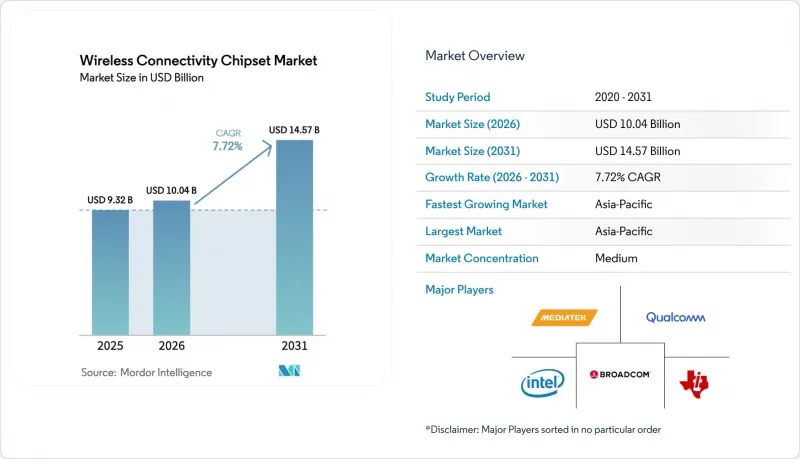
根據 Mordor Intelligence 預測,無線連接晶片組的市場規模預計將從 2025 年的 93.2 億美元成長到 2026 年的 100.4 億美元,然後從 2026 年到 2031 年以 7.72% 的複合年成長率成長,到 20317 億美元。
本報告按類型(Wi-Fi 獨立模式、藍牙獨立模式及其他)、技術標準(Wi-Fi 4、Wi-Fi 5 及其他)、最終用戶應用(消費電子產品、企業基礎設施及其他)、設備類別(智慧型手機和平板電腦、PC 和筆記型電腦及其他)以及地區進行分類。市場預測以美元計價。
全球無線連接晶片組市場趨勢與洞察
消費領域和工業領域的物聯網設備數量正在迅速成長。
如今,工廠自動化要求將確定性無線技術與傳統的 Wi-Fi/藍牙整合在同一晶片上,從而實現先前依賴有線連接的關鍵任務感測器迴路。智慧家庭設備的出貨量預計將在 2024 年超過 14 億台。每台設備都至少整合一個無線晶片組,從而加速規模經濟。因此,供應商正在尋求支援消費級和工業級韌體堆疊的整合參考設計,以降低開發成本並擴大目標市場。
Wi-Fi 6/6E/7 和藍牙 5.x/LE 音訊的推廣正在加速。
Wi-Fi 7 的多鏈路操作可同時覆蓋 2.4GHz、5GHz 和 6GHz 頻段,為吞吐量和延遲樹立了新的標桿,並將先進的射頻前端引入主流客戶端設備。企業正在將其網路基地台叢集升級到 Wi-Fi 6E,並利用 6GHz 頻段實現暢通無阻的高密度園區網路環境。同時,用於藍牙低功耗音訊的 LC3轉碼器正促使汽車主機進行重新設計,以提供多串流播放和助聽器相容性,從而提高了連接 SoC 中的 DSP 要求。
2.4GHz ISM頻段射頻頻譜壅塞加劇。
在高密度多用戶住宅中,藍牙和Wi-Fi訊號會相互干擾,迫使供應商實現能夠靈活切換頻道並實現共存的韌體。每層樓配備數百個感測器的工業設施報告稱,由於重複重傳,電池壽命顯著縮短,導致用戶轉向5GHz和6GHz頻段,同時也增加了三頻前端的物料清單成本。
細分市場分析
至2025年,Wi-Fi+藍牙複合晶片將佔據無線連接晶片組市場的79.62%。低功耗無線IC目前市場規模較小,但隨著電池供電的物聯網節點不斷擴展,預計其複合年成長率將達到9.02%。組合設計可減少PCB面積並簡化認證流程,使消費性電子和穿戴式裝置供應商能夠以統一的射頻特性面向全球市場推出產品。
智慧家庭生態系統中Matter標準的普及也推動了對整合式SoC的需求。 Matter要求在初始設定和控制過程中同時使用Wi-Fi和Thread/BLE。將這兩種無線功能整合到單一SoC中,無需額外的晶體振盪器和電源軌,從而降低了智慧插座的成本,使其價格低於5美元。
由於平均售價較低且認證體系完善,傳統的Wi-Fi 5仍佔62.35%的市佔率。但受多Gigabit網路和雲端遊戲需求的推動,Wi-Fi 7晶片組的年複合成長率預計將達到9.18%。在車載資訊娛樂領域,支援6GHz頻段的Wi-Fi 6E已被廣泛採用,跳過了Wi-Fi 6,從而實現了後排乘客的無干擾串流媒體播放。
藍牙低功耗音訊(Bluetooth LE Audio)在真無線耳機和車載資訊娛樂系統領域逐漸普及,取代傳統的A2DP耳機。廠商透過多點連接和Auracast廣播功能來凸顯自身優勢,並將新型基頻邏輯和記憶體整合到產品中,從而提高了單晶片的晶片含量。
區域分析
亞太地區受惠於中國的物聯網製造群和日本在聯網汽車研發領域的領先地位,預計到2025年將佔全球收入的56.65%。去年,政府主導的智慧城市試點計畫啟動了超過5億台設備。韓國的5G超可靠低延遲通訊(URLLC)試點計畫正在為工業專用網路奠定基礎,這些網路傾向於使用Wi-Fi 7作為備份。印度農村地區的寬頻計畫雖然受到嚴格的價格限制,但低成本用戶端設備(CPE)正在採用複合晶片組。
北美位居第二,企業級 Wi-Fi 6E 和 Wi-Fi 7 的早期普及加速了晶片組的更新換代。美國聯邦通訊委員會 (FCC) 全面開放 1.2GHz 至 6GHz頻寬,也帶動了三頻網路基地台的訂單成長。加拿大關鍵基礎設施項目需要符合 FIPS 標準的晶片,而墨西哥的近岸外包熱潮正迫使汽車行業的一級供應商將其連接模組生產線本地化。
在有關永續性和網路韌性的法規推動下,歐洲市場正穩步成長。歐盟的《網路韌性法案》強制要求連接晶片具備硬體信任根和SBOM功能,並為擁有安全智慧財產權組合的供應商提供優先待遇。德國工業4.0實驗室正在試行Wi-Fi 7的確定性調度,而英國則在脫歐後時代推行津貼計畫。
其他好處
- Excel格式的市場預測(ME)表
- 3個月的分析師支持
目錄
第1章:引言
- 研究假設和市場定義
- 調查範圍
第2章:調查方法
第3章執行摘要
第4章 市場狀況
- 市場概覽
- 市場促進因素
- 消費領域和工業領域的物聯網設備數量正在迅速成長。
- Wi-Fi 6/6E/7 和藍牙 5.x/LE 音訊的推廣正在加速。
- 擴大汽車5G/C-V2X車聯網應用案例
- 邊緣人工智慧對整合神經加速器的組合式SoC的需求
- 智慧家庭補貼計畫和綠建築法規
- 供應商整合可以透過規模經濟降低成本。
- 市場限制因素
- 2.4GHz ISM頻段射頻頻譜壅塞加劇。
- 供應鏈領先節點的交貨前置作業時間持續波動。
- 網路安全合規成本不斷上升(WPA3、ISO 21434、Matter)
- 由於協定棧之間的互通性差距,導致多重通訊協定採用延遲。
- 宏觀經濟因素的影響
- 工業供應鏈分析
- 監理情勢
- 技術展望
- 波特五力分析
第5章 市場規模與成長預測
- 按類型
- Wi-Fi 獨立版
- 藍牙研究基地
- Wi-Fi 與藍牙組合
- 低功耗無線積體電路(BLE、Zigbee、UWB)
- 依技術標準
- Wi-Fi 4(802.11n)
- Wi-Fi 5(802.11ac)
- Wi-Fi 6/6E(802.11ax)
- Wi-Fi 7(802.11be)
- Bluetooth Classic
- Bluetooth Low-Energy 5.x
- 透過最終用戶應用程式
- 家用電器
- 企業基礎設施
- 行動電話
- 汽車(車載資訊系統、車聯網、資訊娛樂系統)
- 工業物聯網
- 其他(醫療保健、穿戴式裝置、智慧城市)
- 按設備類別
- 智慧型手機和平板電腦
- 個人電腦和筆記型電腦
- 智慧家庭物聯網節點
- 網路基礎設施(路由器、存取點)
- 穿戴式和可聽見的
- 汽車控制單元
- 按地區
- 北美洲
- 美國
- 加拿大
- 墨西哥
- 南美洲
- 巴西
- 阿根廷
- 其他南美國家
- 歐洲
- 德國
- 英國
- 法國
- 義大利
- 西班牙
- 俄羅斯
- 其他歐洲國家
- 亞太地區
- 中國
- 日本
- 印度
- 韓國
- 其他亞太國家
- 中東和非洲
- 中東
- 沙烏地阿拉伯
- 阿拉伯聯合大公國
- 土耳其
- 其他中東國家
- 非洲
- 南非
- 奈及利亞
- 其他非洲地區
- 中東
- 北美洲
第6章 競爭情勢
- 市場集中度
- 策略趨勢
- 市佔率分析
- 公司簡介
- Broadcom Inc.
- Qualcomm Technologies Inc.
- MediaTek Inc.
- Intel Corporation
- Texas Instruments Incorporated
- STMicroelectronics NV
- NXP Semiconductors NV
- ON Semiconductor Corporation
- Infineon Technologies AG
- Microchip Technology Inc.
- Qorvo Inc.
- Skyworks Solutions Inc.
- HiSilicon Technologies Co., Ltd.
- UNISOC(Shanghai)Technologies Co., Ltd.
- Nordic Semiconductor ASA
- Silicon Laboratories Inc.
- Realtek Semiconductor Corp.
- Espressif Systems(Shanghai)Co., Ltd.
- Marvell Technology, Inc.
- Cypress Semiconductor
第7章 市場機會與未來展望
According to Mordor Intelligence, the wireless connectivity chipset market size is expected to grow from USD 9.32 billion in 2025 to USD 10.04 billion in 2026 and is forecast to reach USD 14.57 billion by 2031 at 7.72% CAGR over 2026-2031.
This report is Segmented by Type (Wi-Fi Standalone, Bluetooth Standalone, and More), Technology Standard (Wi-Fi 4, Wi-Fi 5, and More), End-User Application (Consumer Electronics, Enterprise Infrastructure, and More), Device Category (Smartphones and Tablets, Pcs and Laptops, and More), and Geography. The Market Forecasts are Provided in Terms of Value (USD).
Global Wireless Connectivity Chipset Market Trends and Insights
Surging IoT-device volumes across consumer and industrial sectors
Factory automation now specifies deterministic wireless plus traditional Wi-Fi/Bluetooth in the same die, enabling mission-critical sensor loops that previously relied on wired links. Smart-home shipments topped 1.4 billion units in 2024; each gadget embeds at least one wireless chipset, accelerating scale economies. Vendors therefore pursue unified reference designs that cater to both consumer and industrial firmware stacks, compressing development expense while widening addressable markets.
Accelerated roll-out of Wi-Fi 6/6E/7 and Bluetooth 5.x/LE Audio
Wi-Fi 7's multi-link operation simultaneously spans 2.4, 5, and 6 GHz, creating new throughput and latency benchmarks that pull advanced RF front-ends into mainstream client devices. Enterprises are refreshing access-point fleets to Wi-Fi 6E, monetizing 6 GHz spectrum for congestion-free high-density campuses. Bluetooth LE Audio's LC3 codec, meanwhile, prompts head-unit redesigns in vehicles to offer multi-stream playback and hearing-aid compatibility, raising DSP requirements inside connectivity SoCs.
Intensifying RF-spectrum congestion in the 2.4 GHz ISM band
Bluetooth and Wi-Fi signals collide in dense apartment blocks, pushing vendors to implement agile channel hopping and coexistence firmware. Industrial sites deploying hundreds of sensors per floor report retries that sap battery life, nudging migration toward 5 GHz and 6 GHz but adding BOM cost for tri-band front-ends.
Other drivers and restraints analyzed in the detailed report include:
- Growth of automotive 5G / C-V2X telematics design-wins
- Edge-AI demand for combo SoCs with integrated neural accelerators
- Persistent supply-chain lead-time volatility for advanced nodes
For complete list of drivers and restraints, kindly check the Table Of Contents.
Segment Analysis
Wi-Fi + Bluetooth combo silicon captured 79.62% wireless connectivity chipset market share in 2025. Low-power wireless ICs, although smaller today, are expected to post a 9.02% CAGR as battery-operated IoT nodes scale. Combo designs shrink PCB area and streamline certifications, letting appliance and wearables vendors ship global SKUs with uniform RF behavior.
The appetite for combo SoCs also stems from smart-home ecosystems adopting Matter, which prescribes concurrent Wi-Fi and Thread/BLE for commissioning and control. Integrating both radios into one SoC eliminates extra crystal oscillators and power rails, lowering USD cost targets for sub-USD 5 smart plugs.
Legacy Wi-Fi 5 still accounts for 62.35% of revenue, given its low ASPs and broad certification base, but Wi-Fi 7 chipsets will experience a 9.18% CAGR as multi-gigabit mesh and cloud gaming drive demand. Automotive infotainment is already skipping Wi-Fi 6 in favor of Wi-Fi 6E, which is 6 GHz-enabled, for interference-free back-seat streaming.
Bluetooth LE Audio is ramping up on true-wireless earbuds and infotainment, replacing classic A2DP headsets. Vendors differentiating on multipoint or Auracast broadcast features bundle new baseband logic and memory, lifting silicon content per unit.
Complete Report Scope:
- By Type
- Wi-Fi Standalone
- Bluetooth Standalone
- Wi-Fi and Bluetooth Combo
- Low-power Wireless IC (BLE, Zigbee, UWB)
- By Technology Standard
- Wi-Fi 4 (802.11n)
- Wi-Fi 5 (802.11ac)
- Wi-Fi 6 / 6E (802.11ax)
- Wi-Fi 7 (802.11be)
- Bluetooth Classic
- Bluetooth Low-Energy 5.x
- By End-user Application
- Consumer Electronics
- Enterprise Infrastructure
- Mobile Handsets
- Automotive (Telematics, V2X, Infotainment)
- Industrial and IIoT
- Others (Healthcare, Wearables, Smart-City)
- By Device Category
- Smartphones and Tablets
- PCs and Laptops
- Smart-Home / IoT Nodes
- Networking Infrastructure (Routers, APs)
- Wearables and Hearables
- Automotive Control Units
- By Geography
- North America
- United States
- Canada
- Mexico
- South America
- Brazil
- Argentina
- Rest of South America
- Europe
- Germany
- United Kingdom
- France
- Italy
- Spain
- Russia
- Rest of Europe
- Asia-Pacific
- China
- Japan
- India
- South Korea
- Rest of Asia-Pacific
- Middle East and Africa
- Middle East
- Saudi Arabia
- United Arab Emirates
- Turkey
- Rest of Middle East
- Africa
- South Africa
- Nigeria
- Rest of Africa
- Middle East
- North America
Geography Analysis
Asia-Pacific delivered 56.65% of 2025 revenue, benefitting from China's IoT manufacturing clusters and Japan's connected-car R&D leadership. Government smart-city pilots drove over 500 million device activations last year. South Korea's 5G URLLC trials underpin industrial private networks that prefer Wi-Fi 7 back-ups. India's rural broadband schemes adopt combo chipsets in low-cost CPE, albeit with strict price caps.
North America ranks second as early Wi-Fi 6E and Wi-Fi 7 enterprise roll-outs amplify chipset refresh cycles. The FCC's release of the full 1.2 GHz to 6 GHz band accelerated orders for tri-band access points. Canada's critical-infrastructure projects demand FIPS-certified silicon, while Mexico's near-shoring boom pushes automotive tier-1s to localize connectivity module lines.
Europe's market grows steadily under sustainability and cyber-resilience mandates. The EU Cyber Resilience Act compels hardware-root-of-trust and SBOM features inside connectivity silicon, rewarding suppliers with security IP portfolios. Germany's Industrie 4.0 labs are piloting Wi-Fi 7 deterministic scheduling, whereas the U.K. is pursuing sovereign chip design grants post-Brexit.
- Broadcom Inc.
- Qualcomm Technologies Inc.
- MediaTek Inc.
- Intel Corporation
- Texas Instruments Incorporated
- STMicroelectronics N.V.
- NXP Semiconductors N.V.
- ON Semiconductor Corporation
- Infineon Technologies AG
- Microchip Technology Inc.
- Qorvo Inc.
- Skyworks Solutions Inc.
- HiSilicon Technologies Co., Ltd.
- UNISOC (Shanghai) Technologies Co., Ltd.
- Nordic Semiconductor ASA
- Silicon Laboratories Inc.
- Realtek Semiconductor Corp.
- Espressif Systems (Shanghai) Co., Ltd.
- Marvell Technology, Inc.
- Cypress Semiconductor
Additional Benefits:
- The market estimate (ME) sheet in Excel format
- 3 months of analyst support
TABLE OF CONTENTS
1 INTRODUCTION
- 1.1 Study Assumptions and Market Definition
- 1.2 Scope of the Study
2 RESEARCH METHODOLOGY
3 EXECUTIVE SUMMARY
4 MARKET LANDSCAPE
- 4.1 Market Overview
- 4.2 Market Drivers
- 4.2.1 Surging IoT-device volumes across consumer and industrial sectors
- 4.2.2 Accelerated roll-out of Wi-Fi 6/6E/7 and Bluetooth 5.x/LE Audio
- 4.2.3 Growth of automotive 5G/ C-V2X telematics design-wins
- 4.2.4 Edge-AI demand for combo SoCs with integrated neural accelerators
- 4.2.5 Subsidised smart-home programs and green-building regulations
- 4.2.6 Vendor consolidation unlocking scale-driven cost declines
- 4.3 Market Restraints
- 4.3.1 Intensifying RF-spectrum congestion in 2.4 GHz ISM band
- 4.3.2 Persistent supply-chain lead-time volatility for advanced nodes
- 4.3.3 Rising cybersecurity-compliance costs (WPA3, ISO 21434, Matter)
- 4.3.4 Inter-stack interoperability gaps slowing multi-protocol adoption
- 4.4 Impact of Macroeconomic Factors
- 4.5 Industry Supply Chain Analysis
- 4.6 Regulatory Landscape
- 4.7 Technological Outlook
- 4.8 Porter's Five Forces Analysis
- 4.8.1 Bargaining Power of Suppliers
- 4.8.2 Bargaining Power of Buyers
- 4.8.3 Threat of New Entrants
- 4.8.4 Threat of Substitutes
- 4.8.5 Degree of Competition
5 MARKET SIZE AND GROWTH FORECASTS (VALUE)
- 5.1 By Type
- 5.1.1 Wi-Fi Standalone
- 5.1.2 Bluetooth Standalone
- 5.1.3 Wi-Fi and Bluetooth Combo
- 5.1.4 Low-power Wireless IC (BLE, Zigbee, UWB)
- 5.2 By Technology Standard
- 5.2.1 Wi-Fi 4 (802.11n)
- 5.2.2 Wi-Fi 5 (802.11ac)
- 5.2.3 Wi-Fi 6 / 6E (802.11ax)
- 5.2.4 Wi-Fi 7 (802.11be)
- 5.2.5 Bluetooth Classic
- 5.2.6 Bluetooth Low-Energy 5.x
- 5.3 By End-user Application
- 5.3.1 Consumer Electronics
- 5.3.2 Enterprise Infrastructure
- 5.3.3 Mobile Handsets
- 5.3.4 Automotive (Telematics, V2X, Infotainment)
- 5.3.5 Industrial and IIoT
- 5.3.6 Others (Healthcare, Wearables, Smart-City)
- 5.4 By Device Category
- 5.4.1 Smartphones and Tablets
- 5.4.2 PCs and Laptops
- 5.4.3 Smart-Home / IoT Nodes
- 5.4.4 Networking Infrastructure (Routers, APs)
- 5.4.5 Wearables and Hearables
- 5.4.6 Automotive Control Units
- 5.5 By Geography
- 5.5.1 North America
- 5.5.1.1 United States
- 5.5.1.2 Canada
- 5.5.1.3 Mexico
- 5.5.2 South America
- 5.5.2.1 Brazil
- 5.5.2.2 Argentina
- 5.5.2.3 Rest of South America
- 5.5.3 Europe
- 5.5.3.1 Germany
- 5.5.3.2 United Kingdom
- 5.5.3.3 France
- 5.5.3.4 Italy
- 5.5.3.5 Spain
- 5.5.3.6 Russia
- 5.5.3.7 Rest of Europe
- 5.5.4 Asia-Pacific
- 5.5.4.1 China
- 5.5.4.2 Japan
- 5.5.4.3 India
- 5.5.4.4 South Korea
- 5.5.4.5 Rest of Asia-Pacific
- 5.5.5 Middle East and Africa
- 5.5.5.1 Middle East
- 5.5.5.1.1 Saudi Arabia
- 5.5.5.1.2 United Arab Emirates
- 5.5.5.1.3 Turkey
- 5.5.5.1.4 Rest of Middle East
- 5.5.5.2 Africa
- 5.5.5.2.1 South Africa
- 5.5.5.2.2 Nigeria
- 5.5.5.2.3 Rest of Africa
- 5.5.5.1 Middle East
- 5.5.1 North America
6 COMPETITIVE LANDSCAPE
- 6.1 Market Concentration
- 6.2 Strategic Moves
- 6.3 Market Share Analysis
- 6.4 Company Profiles (includes Global level Overview, Market level overview, Core Segments, Financials as available, Strategic Information, Market Rank/Share, Products and Services, Recent Developments)
- 6.4.1 Broadcom Inc.
- 6.4.2 Qualcomm Technologies Inc.
- 6.4.3 MediaTek Inc.
- 6.4.4 Intel Corporation
- 6.4.5 Texas Instruments Incorporated
- 6.4.6 STMicroelectronics N.V.
- 6.4.7 NXP Semiconductors N.V.
- 6.4.8 ON Semiconductor Corporation
- 6.4.9 Infineon Technologies AG
- 6.4.10 Microchip Technology Inc.
- 6.4.11 Qorvo Inc.
- 6.4.12 Skyworks Solutions Inc.
- 6.4.13 HiSilicon Technologies Co., Ltd.
- 6.4.14 UNISOC (Shanghai) Technologies Co., Ltd.
- 6.4.15 Nordic Semiconductor ASA
- 6.4.16 Silicon Laboratories Inc.
- 6.4.17 Realtek Semiconductor Corp.
- 6.4.18 Espressif Systems (Shanghai) Co., Ltd.
- 6.4.19 Marvell Technology, Inc.
- 6.4.20 Cypress Semiconductor
7 MARKET OPPORTUNITIES AND FUTURE OUTLOOK
- 7.1 White-space and Unmet-need Assessment

 無線連接市場規模、佔有率和趨勢分析報告:按技術、網路類型、應用、地區和細分市場分類(2026-2033 年)
 無線連接:市場佔有率分析、行業趨勢和統計數據、成長預測(2026-2031 年)
 Wi-Fi、藍牙和無線連線調查服務
 無線連接市場-2026-2032年全球市場預測
 2026年全球數據連結市場報告
 汽車無線連接模組市場機會、成長要素、產業趨勢分析及2026-2035年預測2026年全球連結服務市場報告無線連接技術市場的細分分析與目標市場無線連線:市場數據概覽(2026 年第二季)連接模組市場規模、佔有率和趨勢分析報告:按連接技術、產品、最終用途、地區和細分市場預測(2026-2033 年)