


 |
市場調查報告書
商品編碼
2124039
無線連接:市場佔有率分析、行業趨勢和統計數據、成長預測(2026-2031 年)Wireless Connectivity - Market Share Analysis, Industry Trends & Statistics, Growth Forecasts (2026 - 2031) |
||||||

※ 本網頁內容可能與最新版本有所差異。詳細情況請與我們聯繫。
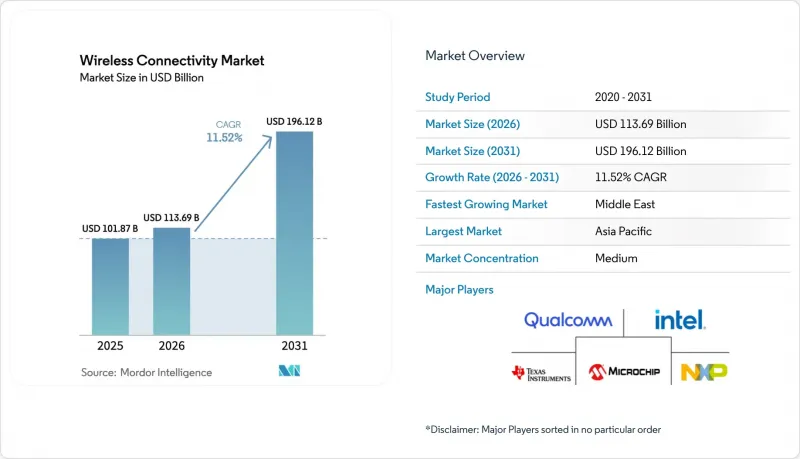
根據 Mordor Intelligence 預測,無線連接市場規模預計將在 2025 年達到 1,018.7 億美元,2026 年達到 1,136.9 億美元,2031 年達到 1,961.2 億美元,2026 年至 2031 年的複合年成長率為 11.52%。
本報告按科技(Wi-Fi、藍牙等)、終端用戶產業(消費性電子、汽車等)、頻段(1 GHz 以下、2.4 GHz、6 GHz)、裝置類型(智慧型手機和平板電腦、智慧家居設備等)以及地區(北美、歐洲、亞太、南美、中東和非洲)進行細分。市場預測以美元計價。
全球無線連接市場趨勢與洞察
消費性和工業IoT。
2025年第一季,企業級Wi-Fi 7網路基地台的出貨量佔所有新WLAN設備的12%。然而,目前46 Gbps的最大吞吐量仍屬理想值,因為大多數客戶端設備仍不支援320 MHz頻段。多鏈路操作允許工廠感測器在6 GHz頻段上傳輸時限敏感的資料包,同時將大量資料分配給5 GHz頻段,即使在擁擠的房間內也能將抖動保持在5毫秒以下。博通公司在2025年出貨了1,800萬顆Wi-Fi 7複合晶片,其中一半用於工業閘道器。從星型拓撲結構向網狀+閘道型拓撲結構的轉變迫使傳統PLC製造商重新設計其背板,導致更新周期延長至24個月,並預計到2027年晶片組將保持兩位數的成長。將基於人工智慧的干擾緩解技術整合到韌體的模組供應商已獲得長期供貨契約,即使在節點短缺導致半導體價格波動的情況下,也能保持利潤率穩定。因此,在無線連接市場,許多工廠自動化升級都需要採用 Wi-Fi 7。
擴展用於智慧電錶部署的低功耗廣域網路 (LPWAN) 模組
在監管機構強制要求每15分鐘採集一次數據後,歐洲公共產業加快了2025年電錶數位化進程。塞文特倫特公司在英格蘭中部地區部署了100萬個LoRaWAN電錶,將現場回應成本降低了40%。約克郡水務公司採用了NB-IoT技術,透過改造現有行動電話基地台部署了130萬個設備,無需閘道器資本投資。由此,出現了兩極化的局面:遍遠地區採用免許可的LoRa技術,而人口密集的都市區則採用運營商級的NB-IoT技術,形成了並行的生態系統。這導致人們認為依賴單一協議的策略風險很高。 Semtech公司的「LoRa Edge」技術結合了sub-GHz頻段、GNSS和Wi-Fi嗅探技術,將使德國和法國的建設公司能夠在2025年前為20萬個高價值資產貼上標籤,這表明該技術具有跨行業復用的潛力。公共產業和租賃車輛產業同樣專注於超低功耗無線技術,這推高了模組的平均售價,即使出貨量也在成長。在無線連接市場,LPWAN 的部署進一步強化了該產業「長尾效應和大規模生產」的特性。
全球頻段政策的分散化正在減緩 Wi-Fi 7 的普及。
美國和加拿大已開放6GHz頻寬的1200MHz,但歐洲將室內使用限制在500MHz,而中國則完全停用該頻寬,迫使供應商準備針對特定地區的SKU,導致庫存增加18%。博通的BCM6726由於工程師需要重新調整功率放大器以適應不同的EIRP上限,因此延遲了九個月上市,這表明產品上市時間有隱性延遲。這種市場碎片化導致上海和深圳的企業推遲了WLAN升級計劃,優先升級到較舊的5GHz頻段,減緩了短期硬體需求。在歐洲,自動頻率調節要求增加了認證成本,給中小系統整合商帶來了壓力。因此,無線連接市場面臨的是區域部署不平衡的局面,而不是全球同步擴張。
細分市場分析
超寬頻 (UWB) 的銷售額正以 12.46% 的複合年成長率成長,超越所有競爭技術。 BMW和大眾在其旗艦車型中整合了數位鑰匙,而工業營運商則需要厘米級定位來進行資產追蹤。 Wi-Fi 在企業網路基地台(AP) 升級週期的支援下,預計到 2025 年將佔到 43.43% 的銷售額,但由於北美以外地區 6 GHz 頻段的頻道上限導致升級停滯,其市場佔有率正在萎縮。藍牙設備的年出貨量高達 28 億台,但由於 SoC 供應商現在免費捆綁無線模組,其利潤率正在下降。 Zigbee 和 Thread 現已整合到 Matter 協議中,正在智慧家居領域開闢一個新的相鄰市場,預計到 2025 年將有 340 款認證產品出貨。 LoRa 和 NB-IoT 等低功耗廣域網路 (LPWAN) 技術正在遠端、低資料量感測器領域開闢一片天地,鞏固了無線連接市場的「啞鈴」結構。其中一方面是尖端的多千兆位元擴展技術,另一方面是超低功耗測量技術。
混合整合是目前產品藍圖的特徵。例如,樂鑫科技的ESP32-C6晶片整合了Wi-Fi 6、藍牙5.3、Zigbee和Thread協議,使韌體能夠根據裝置狀態變化切換協議,支援高速Wi-Fi韌體更新,並透過Zigbee實現低速感測器突發通訊。 IEEE 802.15.4z的安全測距是數位鑰匙3.0的強制性要求,確保了OEM廠商之間的互通性。功耗與精度之間的權衡仍然十分重要。超寬頻(UWB)技術將在六個月內耗盡紐帶電池的電量,因此其應用主要集中在市電供電的門鎖和車載資訊娛樂系統上。另一方面,Wi-Fi 7 2W的功耗限制了其應用範圍,使其僅適用於散熱能力充足的設備。這種性能矩陣確保了半導體需求的多樣性,即使單一協議出現下滑,無線連接市場仍保持韌性。
隨著監管機構強制推行蜂窩V2X(車聯網)技術,以及保險公司為能夠抵禦繼電器攻擊的超寬頻數位金鑰提供折扣,汽車互聯市場正以11.72%的複合年成長率超越其他產業。通用汽車計劃為其所有2027款車型配備高通驍龍Ride平台,該平台整合了超寬頻功能,並建立了多頻段無線電基準。家用電子電器在2025年佔總銷售額的37.23%,但隨著智慧型手機更換週期延長至3.2年,其銷售成長潛力有所收窄。在工業自動化領域,專用5G和Wi-Fi 6E正被用於整合自主機器人和機器視覺系統,但資本投資的速度與五年一次的PLC(可程式邏輯控制器)更換週期密切相關。在醫療保健領域,專有無線技術正向藍牙低功耗5.4(Bluetooth Low Energy 5.4)轉變,但由於法規核准問題,商業化進程被推遲了18至36個月。在公共產業計量領域,NB-IoT和LoRa技術正蓬勃發展,無線連接市場呈現出由非同步需求曲線交織而成的複雜格局。
汽車產業的價值創造正從獨立的車載資訊系統盒轉向整合蜂窩網路、Wi-Fi、藍牙和超寬頻通訊的網域控制器,從而使物料清單 (BOM) 減少 20%。家用電子電器分為兩大類:高階設備配備 Wi-Fi 7 和超寬頻通訊,而入門級設備仍停留在 Wi-Fi 5。工業 OEM 廠商要求產品具備寬廣的動作溫度範圍和 IP67 防護等級,而主流企業級 WLAN 供應商目前在這方面的服務不足。醫療保健相關企業將在 FDA 網路安全法規明確認證範本後立即採用藍牙 5.4,這將提高 2027-2028 年的市場可見度。這些跨行業的趨勢正在分散風險和機遇,從而支撐無線連接市場的穩定成長。
區域分析
亞太地區將在2025年佔據全球5G支出的34.51%,這主要得益於中國5G的部署、印度的智慧城市計畫以及日本的「社會5.0」舉措。中國將從2024年起強制要求所有新安裝的公用事業收費計量表採用NB-IoT技術,這將創造一個潛在市場,規模達4億台。印度已撥款4,800億印度盧比(約58億美元)用於數位基礎建設,為覆蓋整個城市的Wi-Fi和物聯網感測器網路奠定基礎。豐田計劃於2025年在其12家工廠部署愛立信的私人5G網路,用於引導自動駕駛汽車,這將提振其工廠的5G需求。在東南亞,LoRaWAN網路正被部署用於農業技術(AgTech),預計2025年將有240萬個土壤濕度探頭連接到網路。
中東地區以12.02%的複合年成長率呈現最快成長動能。沙烏地阿拉伯公共投資基金(PIF)已投資200億美元用於NEOM的整合光纖無線網路建設,該網路融合了5G、Wi-Fi 6E和毫米波回程傳輸。阿拉伯聯合大公國已於2025年拍賣了6GHz頻段的頻譜牌照,這將使du和Etisalat能夠在杜拜部署Wi-Fi 7固定無線存取。土耳其已批准在室內使用6GHz頻段,將加速伊斯坦堡企業級Wi-Fi 6E的部署。 NB-IoT正在非洲成為主流,MTN集團計畫在2025年在南非安裝120萬個智慧電錶。
在北美和歐洲,由於基礎設施成熟,新的部署受到限制,導致複合年成長率僅 8-9%。然而,美國提前開放 6 GHz 頻段正在推動 WLAN 的持續升級,思科 6 GHz網路基地台(AP) 的滲透率已超過 20%。墨西哥於 2025 年批准的法規統一了北美地區的規則,從而減少了產品種類 (SKU)。在歐洲,由於監管環境複雜,發展勢頭較為緩慢。 6 GHz 頻段僅限於室內使用、各國對超寬頻 (UWB) 功率的限制以及各國特定的 NB-IoT 頻率都阻礙了合規性。在德國,到 2025 年將發放 450 張 5G 私人執照,其中大部分用於汽車和化學企業。英國於 2024 年開放了整個室內 6 GHz 頻段,加速了倫敦 Wi-Fi 7 的普及。巴西的頻段談判仍未達成一致,導致該國6GHz無線區域網路的部署被推遲。總體而言,區域政策正在塑造一個多速無線連接市場,而能夠靈活應對監管差異的供應商將從中受益。
其他好處:
- Excel格式的市場預測(ME)表
- 3個月的分析師支持
目錄
第1章:引言
- 研究假設和市場定義
- 調查範圍
第2章:調查方法
第3章執行摘要
第4章 市場狀況
- 市場概覽
- 市場促進因素
- 消費性和工業IoT。
- 隨著智慧電錶部署的擴展,低功耗廣域網路(LPWAN)模組也得到了廣泛應用。
- 私有 5G 和 Wi-Fi 的共存正在推動多無線電閘道器的普及。
- 政府資助的開放式漫遊城市網路
- 工廠中人工智慧驅動的自最佳化無線網路
- 遍遠地區固定無線存取計畫中的毫米波回程傳輸
- 市場限制因素
- 全球各地不同的頻率政策正在減緩 Wi-Fi 7 的普及。
- 持續利用藍牙安全漏洞攻擊醫療穿戴設備
- 由於先進製程節點供不應求,矽成本不斷上漲。
- 汽車座艙內超寬頻電磁相容性面臨的挑戰
- 產業價值鏈分析
- 監理情勢
- 技術展望
- 波特五力分析
- 宏觀經濟因素對市場的影響
- 投資分析
第5章 市場規模與成長預測
- 透過技術
- Wi-Fi
- Bluetooth
- Zigbee
- NFC
- 蜂窩網路(4G/5G)
- LPWAN(LoRa、NB-IoT、Sigfox)
- UWB
- 其他技術
- 按最終用戶行業分類
- 家用電子產品
- 車
- 工業和製造業
- 醫療保健和醫療設備
- 能源公用事業
- 智慧基礎設施與智慧建築
- 其他終端用戶產業
- 按頻段
- 小於 1 GHz
- 2.4 GHz(傳統 Wi-Fi/BLE 裝置)
- 6 GHz(Wi-Fi 6E/Wi-Fi 7)
- 依設備類型
- 智慧型手機和平板電腦
- 工業IoT感測器
- 穿戴式裝置
- 智慧家庭設備
- 汽車系統
- 醫療設備
- 按地區
- 北美洲
- 美國
- 加拿大
- 墨西哥
- 歐洲
- 德國
- 英國
- 法國
- 義大利
- 西班牙
- 俄羅斯
- 其他歐洲國家
- 亞太地區
- 中國
- 日本
- 印度
- 韓國
- ASEAN
- 澳洲和紐西蘭
- 其他亞太國家
- 南美洲
- 巴西
- 阿根廷
- 其他南美國家
- 中東
- 沙烏地阿拉伯
- 阿拉伯聯合大公國
- 土耳其
- 其他中東國家
- 非洲
- 南非
- 奈及利亞
- 肯亞
- 其他非洲國家
- 北美洲
第6章 競爭情勢
- 市場集中度
- 策略趨勢
- 市佔率分析
- 公司簡介
- Qualcomm Incorporated
- Broadcom Inc.
- MediaTek Inc.
- Intel Corporation
- Texas Instruments Inc.
- NXP Semiconductors NV
- STMicroelectronics
- Nordic Semiconductor
- Microchip Technology Inc.
- Renesas Electronics Corp.
- Samsung Electronics Co.
- Infineon Technologies AG
- Silicon Laboratories Inc.
- Murata Manufacturing Co.
- Skyworks Solutions Inc.
- Marvell Technology Group Ltd.
- Huawei Technologies Co.
- Qorvo Inc.
- u-blox AG
- Semtech Corporation
- Espressif Systems
第7章 市場機會與未來展望
According to Mordor Intelligence, the wireless connectivity market size is projected to be USD 101.87 billion in 2025, USD 113.69 billion in 2026, and reach USD 196.12 billion by 2031, growing at a CAGR of 11.52% from 2026 to 2031.
This report is Segmented by Technology (Wi-Fi, Bluetooth, and More), End-User Industry (Consumer Electronics, Automotive, and More), Frequency Band (Sub-1 GHz, 2. 4 GHz, and 6 GHz), Device Type (Smartphones and Tablets, Smart Home Devices, and More), and Geography (North America, Europe, Asia Pacific, South America, Middle East, Africa). The Market Forecasts are Provided in Terms of Value in USD.
Global Wireless Connectivity Market Trends and Insights
Surge of Wi-Fi 6/6E/7 Chipsets in Consumer and Industrial IoT
Enterprise shipments of Wi-Fi 7 access points reached 12% of new WLAN units in Q1 2025, although headline 46 Gbps throughput remains aspirational because most client devices still lack 320 MHz support. Multi-link operation lets a factory sensor send time-critical packets over 6 GHz while placing bulk data on 5 GHz, holding jitter below 5 ms in congested rooms. Broadcom shipped 18 million Wi-Fi 7 combo chips during 2025, with industrial gateways driving half of that volume. The shift from star to mesh-plus-gateway topologies forces legacy PLC makers to redesign backplanes, creating a 24-month refresh cycle that sustains double-digit chipset growth into 2027. Module suppliers that layer AI-based interference mitigation into firmware are securing long-term supply agreements, insulating margins even as silicon prices wobble due to node scarcity. Consequently, the wireless connectivity market finds Wi-Fi 7 adoption gating many factory-automation upgrades.
Expansion of LPWAN Modules for Smart-Meter Roll-Outs
European utilities accelerated meter digitization in 2025 after regulators mandated 15-minute interval data. Severn Trent deployed 1 million LoRaWAN meters across the Midlands and slashed truck-roll costs by 40%. Yorkshire Water opted for NB-IoT, rolling out 1.3 million units that piggy-back on existing cellular towers, eliminating gateway capex. The resulting bifurcation unlicensed LoRa for rural districts versus carrier-grade NB-IoT in dense metros creates parallel ecosystems where single-protocol strategies now look risky. Semtech's LoRa Edge, which combines sub-GHz, GNSS, and Wi-Fi sniffing, allowed German and French construction firms to tag 200 000 high-value assets during 2025, hinting at cross-vertical reuse. Utilities and rental fleets alike converge on ultra-low-power radios, boosting module ASPs even as volumes scale. For the wireless connectivity market, LPWAN roll-outs reinforce the sector's long-tail, high-volume profile.
Fragmented Global Spectrum Policy Slowing Wi-Fi 7 Adoption
The United States and Canada opened 1200 MHz of 6 GHz spectrum, yet Europe caps indoor use at 500 MHz and China bars the band entirely, obliging vendors to field regional SKUs that inflate inventory by 18%. Broadcom's BCM6726 slipped nine months while engineers retuned power amps to meet disparate EIRP ceilings, illustrating hidden time-to-market penalties. Such fragmentation causes enterprises in Shanghai and Shenzhen to delay WLAN refresh plans in favor of legacy 5 GHz upgrades, muting near-term hardware demand. In Europe, automated frequency coordination requirements add certification fees that squeeze small integrators. Consequently, the wireless connectivity market faces a patchwork adoption curve rather than a synchronized global ramp.
Other drivers and restraints analyzed in the detailed report include:
- Private 5G and Wi-Fi Co-Existence Driving Multi-Radio Gateways
- Government-Funded Open-Roaming City Networks
- Persistent Bluetooth Security Exploits in Medical Wearables
For complete list of drivers and restraints, kindly check the Table Of Contents.
Segment Analysis
Ultra-wideband revenue is rising at a 12.46% CAGR, outpacing all rival technologies as BMW and Volkswagen embed digital keys in mainstream models, while industrial operators demand centimeter-grade positioning for asset tracking. Wi-Fi still anchored 43.43% of 2025 receipts, buoyed by enterprise AP refresh cycles, yet its share erodes as 6 GHz channel caps outside North America stall upgrades. Bluetooth rides 2.8 billion annual device shipments, but its margin pool narrows as SoC vendors bundle radios without extra cost. Zigbee and Thread, now converged under the Matter protocol, shipped 340 certified products in 2025, opening fresh smart-home adjacencies. LPWAN variants such as LoRa and NB-IoT carve out long-range, low-data sensor niches, solidifying the wireless connectivity market's barbell pattern, bleeding-edge multi-gig extensions at one end and ultra-low-power metering on the other.
Hybrid integration defines current roadmaps. Espressif's ESP32-C6, for instance, hosts Wi-Fi 6, Bluetooth 5.3, Zigbee, and Thread on one die, letting firmware switch protocols as device states shift, support high-rate Wi-Fi firmware updates, and enable low-rate sensor bursts on Zigbee. IEEE 802.15.4z secure ranging is now mandatory for Digital Key 3.0, ensuring interoperability across OEMs. Power-accuracy trade-offs remain stark: ultra-wideband drains a coin cell in six months, so adoption clusters around mains-powered door locks and infotainment hubs. Meanwhile, Wi-Fi 7's 2 W draw confines it to devices with robust thermal budgets. This performance matrix guarantees diverse silicon demand profiles, keeping the wireless connectivity market resilient to single-protocol downturns.
Automotive connectivity outstrips all peers at an 11.72% CAGR as regulators mandate cellular vehicle-to-everything and insurers discount ultra-wideband digital keys that defeat relay attacks. General Motors will embed Qualcomm Snapdragon Ride with integrated ultra-wideband in all 2027 models, locking in multi-radio baselines. Consumer electronics still contributed 37.23% of 2025 revenue, yet smartphone refresh cycles expanded to 3.2 years, trimming unit upside. Industrial automation leans on private 5G and Wi-Fi 6E to orchestrate autonomous robots and machine-vision systems, but the capex cadence aligns with five-year PLC refreshes. Healthcare transitions from proprietary radios to Bluetooth Low Energy 5.4, but regulatory approval extends commercialization by 18-36 months. Utility metering continues its pivot to NB-IoT and LoRa, making the wireless connectivity market a tapestry of asynchronic demand curves.
Value creation in automotive is shifting from discrete telematics boxes to integrated domain controllers that aggregate cellular, Wi-Fi, Bluetooth, and ultra-wideband, chopping BOMs by 20%. Consumer electronics splits into premium devices sporting Wi-Fi 7 and ultra-wideband, and value tiers staying on Wi-Fi 5. Industrial OEMs demand extended temperature and IP67 ratings, an area mainstream enterprise WLAN vendors currently under-serve. Healthcare firms adopt Bluetooth 5.4 once FDA cybersecurity rules clarify certification templates, bolstering pipeline visibility for 2027-2028. These cross-sector rhythms distribute risk and opportunity, underpinning steady expansion in the wireless connectivity market.
Complete Report Scope:
- By Technology
- Wi-Fi
- Bluetooth
- Zigbee
- NFC
- Cellular (4G/5G)
- LPWAN (LoRa, NB-IoT, Sigfox)
- UWB
- Other Technologies
- By End-User Industry
- Consumer Electronics
- Automotive
- Industrial and Manufacturing
- Healthcare and Medical Devices
- Energy and Utilities
- Smart Infrastructure and Buildings
- Other End-User Industries
- By Frequency Band
- Sub-1 GHz
- 2.4 GHz (Legacy Wi-Fi/BLE Devices)
- 6 GHz (Wi-Fi 6E / Wi-Fi 7)
- By Device Type
- Smartphones and Tablets
- Industrial IoT Sensors
- Wearables
- Smart Home Devices
- Automotive Systems
- Healthcare Devices
- By Geography
- North America
- United States
- Canada
- Mexico
- Europe
- Germany
- United Kingdom
- France
- Italy
- Spain
- Russia
- Rest of Europe
- Asia Pacific
- China
- Japan
- India
- South Korea
- ASEAN
- Australia and New Zealand
- Rest of Asia Pacific
- South America
- Brazil
- Argentina
- Rest of South America
- Middle East
- Saudi Arabia
- Saudi Arabia
- United Arab Emirates
- UAE
- Turkey
- Turkey
- Rest of Middle East
- Rest of Middle East
- Africa
- South Africa
- South Africa
- Nigeria
- Nigeria
- Kenya
- Rest of Africa
- Rest of Africa
- North America
Geography Analysis
Asia Pacific retained 34.51% of 2025 spending, propelled by China's 5G roll-out, India's smart-city program, and Japan's Society 5.0 initiative. China mandated NB-IoT in all new utility meters starting 2024, seeding a 400 million-unit addressable base. India allocated INR 480 billion (USD 5.8 billion) for digital infrastructure, underpinning city-wide Wi-Fi and IoT sensor nets. Toyota equipped 12 plants with Ericsson private 5G in 2025 to guide autonomous vehicles, reinforcing factory demand. Southeast Asia adds LoRaWAN networks for ag-tech, connecting 2.4 million soil-moisture probes by 2025.
The Middle East shows the fastest trajectory at 12.02% CAGR, as Saudi Arabia's Public Investment Fund committed USD 20 billion to NEOM's converged fiber-wireless grid, blending 5G, Wi-Fi 6E, and millimeter-wave backhaul. The UAE auctioned 6 GHz licenses in 2025, allowing du and Etisalat to deploy Wi-Fi 7 fixed-wireless access in Dubai. Turkey approved indoor 6 GHz use, catalyzing enterprise Wi-Fi 6E in Istanbul. Africa clusters around NB-IoT, with MTN Group installing 1.2 million smart meters in South Africa during 2025.
North America and Europe log 8-9% CAGR as mature fleets limit new installs. Yet U.S. early 6 GHz liberalization spurs continual WLAN refresh; Cisco's 6 GHz AP penetration already tops 20%. Mexico's 2025 approval harmonized North American rules, easing SKU counts. Europe's patchwork slows momentum, indoor-only 6 GHz, varying ultra-wideband power caps, and country-specific NB-IoT frequencies pose compliance drag. Germany issued 450 private 5G licenses by 2025, largely to automotive and chemical sites. The UK opened the whole 6 GHz indoor band in 2024, accelerating Wi-Fi 7 uptake in London. Brazil's spectrum consultation remains unresolved, delaying 6 GHz WLAN there. Overall, geography-specific policy shapes a multi-speed wireless connectivity market that rewards vendors agile enough to handle regulatory heterogeneity.
- Qualcomm Incorporated
- Broadcom Inc.
- MediaTek Inc.
- Intel Corporation
- Texas Instruments Inc.
- NXP Semiconductors N.V.
- STMicroelectronics
- Nordic Semiconductor
- Microchip Technology Inc.
- Renesas Electronics Corp.
- Samsung Electronics Co.
- Infineon Technologies AG
- Silicon Laboratories Inc.
- Murata Manufacturing Co.
- Skyworks Solutions Inc.
- Marvell Technology Group Ltd.
- Huawei Technologies Co.
- Qorvo Inc.
- u-blox AG
- Semtech Corporation
- Espressif Systems
Additional Benefits:
- The market estimate (ME) sheet in Excel format
- 3 months of analyst support
TABLE OF CONTENTS
1 INTRODUCTION
- 1.1 Study Assumptions and Market Definition
- 1.2 Scope of the Study
2 RESEARCH METHODOLOGY
3 EXECUTIVE SUMMARY
4 MARKET LANDSCAPE
- 4.1 Market Overview
- 4.2 Market Drivers
- 4.2.1 Surge of Wi-Fi 6/6E/7 Chipsets in Consumer and Industrial IoT
- 4.2.2 Expansion of LPWAN Modules for Smart-Meter Roll-Outs
- 4.2.3 Private 5G and Wi-Fi Co-Existence Driving Multi-Radio Gateways
- 4.2.4 Government-Funded Open-Roaming City Networks
- 4.2.5 AI-Driven Self-Optimising Wireless Networks in Factories
- 4.2.6 Millimetre-Wave Backhaul for Rural FWA Programs
- 4.3 Market Restraints
- 4.3.1 Fragmented Global Spectrum Policy Slowing Wi-Fi 7 Adoption
- 4.3.2 Persistent Bluetooth Security Exploits in Medical Wearables
- 4.3.3 Rising Silicon Costs Due to Advanced Node Scarcity
- 4.3.4 EMC Compliance Hurdles for UWB in Automotive Cabins
- 4.4 Industry Value Chain Analysis
- 4.5 Regulatory Landscape
- 4.6 Technological Outlook
- 4.7 Porter's Five Forces Analysis
- 4.7.1 Bargaining Power of Suppliers
- 4.7.2 Bargaining Power of Buyers
- 4.7.3 Threat of New Entrants
- 4.7.4 Threat of Substitutes
- 4.7.5 Intensity of Competitive Rivalry
- 4.8 Impact of Macroeconomic Factors on the Market
- 4.9 Investment Analysis
5 MARKET SIZE AND GROWTH FORECASTS (VALUE)
- 5.1 By Technology
- 5.1.1 Wi-Fi
- 5.1.2 Bluetooth
- 5.1.3 Zigbee
- 5.1.4 NFC
- 5.1.5 Cellular (4G/5G)
- 5.1.6 LPWAN (LoRa, NB-IoT, Sigfox)
- 5.1.7 UWB
- 5.1.8 Other Technologies
- 5.2 By End-User Industry
- 5.2.1 Consumer Electronics
- 5.2.2 Automotive
- 5.2.3 Industrial and Manufacturing
- 5.2.4 Healthcare and Medical Devices
- 5.2.5 Energy and Utilities
- 5.2.6 Smart Infrastructure and Buildings
- 5.2.7 Other End-User Industries
- 5.3 By Frequency Band
- 5.3.1 Sub-1 GHz
- 5.3.2 2.4 GHz (Legacy Wi-Fi/BLE Devices)
- 5.3.3 6 GHz (Wi-Fi 6E / Wi-Fi 7)
- 5.4 By Device Type
- 5.4.1 Smartphones and Tablets
- 5.4.2 Industrial IoT Sensors
- 5.4.3 Wearables
- 5.4.4 Smart Home Devices
- 5.4.5 Automotive Systems
- 5.4.6 Healthcare Devices
- 5.5 By Geography
- 5.5.1 North America
- 5.5.1.1 United States
- 5.5.1.2 Canada
- 5.5.1.3 Mexico
- 5.5.2 Europe
- 5.5.2.1 Germany
- 5.5.2.2 United Kingdom
- 5.5.2.3 France
- 5.5.2.4 Italy
- 5.5.2.5 Spain
- 5.5.2.6 Russia
- 5.5.2.7 Rest of Europe
- 5.5.3 Asia Pacific
- 5.5.3.1 China
- 5.5.3.2 Japan
- 5.5.3.3 India
- 5.5.3.4 South Korea
- 5.5.3.5 ASEAN
- 5.5.3.6 Australia and New Zealand
- 5.5.3.7 Rest of Asia Pacific
- 5.5.4 South America
- 5.5.4.1 Brazil
- 5.5.4.2 Argentina
- 5.5.4.3 Rest of South America
- 5.5.5 Middle East
- 5.5.5.1 Saudi Arabia
- 5.5.5.2 United Arab Emirates
- 5.5.5.3 Turkey
- 5.5.5.4 Rest of Middle East
- 5.5.6 Africa
- 5.5.6.1 South Africa
- 5.5.6.2 Nigeria
- 5.5.6.3 Kenya
- 5.5.6.4 Rest of Africa
- 5.5.1 North America
6 COMPETITIVE LANDSCAPE
- 6.1 Market Concentration
- 6.2 Strategic Moves
- 6.3 Market Share Analysis
- 6.4 Company Profiles (includes Global Level Overview, Market Level Overview, Core Segments, Financials as Available, Strategic Information, Market Rank/Share for Key Companies, Products and Services, and Recent Developments)
- 6.4.1 Qualcomm Incorporated
- 6.4.2 Broadcom Inc.
- 6.4.3 MediaTek Inc.
- 6.4.4 Intel Corporation
- 6.4.5 Texas Instruments Inc.
- 6.4.6 NXP Semiconductors N.V.
- 6.4.7 STMicroelectronics
- 6.4.8 Nordic Semiconductor
- 6.4.9 Microchip Technology Inc.
- 6.4.10 Renesas Electronics Corp.
- 6.4.11 Samsung Electronics Co.
- 6.4.12 Infineon Technologies AG
- 6.4.13 Silicon Laboratories Inc.
- 6.4.14 Murata Manufacturing Co.
- 6.4.15 Skyworks Solutions Inc.
- 6.4.16 Marvell Technology Group Ltd.
- 6.4.17 Huawei Technologies Co.
- 6.4.18 Qorvo Inc.
- 6.4.19 u-blox AG
- 6.4.20 Semtech Corporation
- 6.4.21 Espressif Systems
7 MARKET OPPORTUNITIES AND FUTURE OUTLOOK
- 7.1 White-Space and Unmet-Need Assessment

 無線連接市場規模、佔有率和趨勢分析報告:按技術、網路類型、應用、地區和細分市場分類(2026-2033 年)
 無線連接晶片組:市場佔有率分析、產業趨勢與統計及成長預測(2026-2031 年)
 Wi-Fi、藍牙和無線連線調查服務
 無線連接市場-2026-2032年全球市場預測
 2026年全球數據連結市場報告
 汽車無線連接模組市場機會、成長要素、產業趨勢分析及2026-2035年預測2026年全球連結服務市場報告無線連接技術市場的細分分析與目標市場無線連線:市場數據概覽(2026 年第二季)連接模組市場規模、佔有率和趨勢分析報告:按連接技術、產品、最終用途、地區和細分市場預測(2026-2033 年)