


 |
市場調查報告書
商品編碼
2125461
美國熱泵:市場佔有率分析、行業趨勢和統計數據以及成長預測(2026-2031 年)United States Heat Pump - Market Share Analysis, Industry Trends & Statistics, Growth Forecasts (2026 - 2031) |
||||||

※ 本網頁內容可能與最新版本有所差異。詳細情況請與我們聯繫。
根據 Mordor Intelligence 預測,美國熱泵市場規模預計在 2026 年達到 148.1 億美元,到 2031 年達到 226.8 億美元,預測期內複合年成長率為 8.89%。
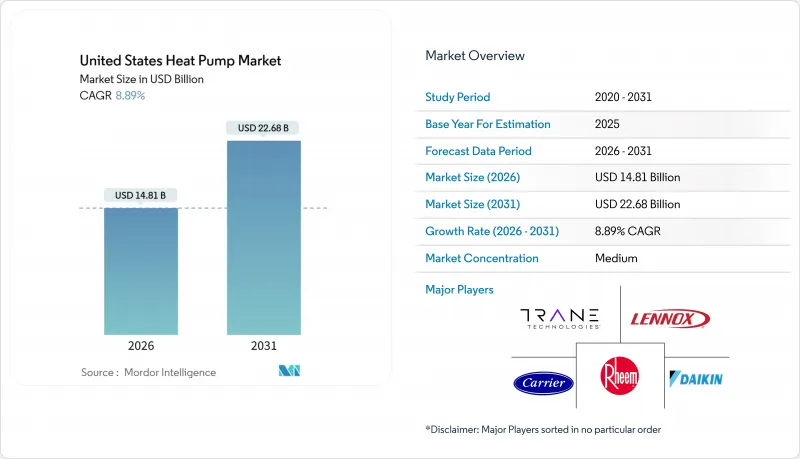
本報告按類型(空氣源、水源等)、額定輸出功率(10 kW 以下、10-20 kW 及其他)、系統設計(分離式、一體式、混合式熱泵)、最終用戶(住宅、商業、工業、公共)和應用(空間供暖和製冷、熱水等)進行分類。市場預測以美元計價。
美國熱泵市場趨勢與洞察
《通貨膨脹控制法案》下的聯邦稅收優惠政策正在提升其受歡迎程度。
根據第25C和25D條規定提供的稅額扣抵,空氣源熱泵最高可抵免2000美元,地源熱泵安裝成本可抵免30%,有效減輕了先前限制其普及的初始成本負擔。在財報電話會議上,原始設備製造商(OEM)一再強調,銷售點稅額扣抵能夠減輕中等收入家庭的現金流負擔,這是預計2025年出貨量將實現兩位數成長的關鍵因素。在供暖成本佔公用事業帳單很大比例的寒冷地區,這些激勵措施將投資回收期縮短至不到七年,即使現有供暖系統仍在運作,也鼓勵用戶維修。承包商報告稱,由於現在報價中明確列出了補貼,而不是等到報稅季才發放,因此轉換率有所提高。此外,電力公司透過提供基於績效的補貼進一步擴大了需求,在馬薩諸塞州和奧勒岡州地形成了複雜的激勵機制,補貼金額可達安裝成本的40%至50%。
快速淘汰高全球暖化潛勢冷媒正在加速設備更換週期。
美國環保署 (EPA) 的《AIM 法案》產量上限降低了 R-410A 的產量,並推高了現貨價格。這迫使經銷商鼓勵用戶儘早更換冷媒,以免服務冷媒短缺問題進一步惡化。擁有經認證的 R-32 或 R-454B 產品線的製造商展現了前瞻性的合規意識,這使他們在承包商通路中獲得了更高的轉售價格。早期採用者受益於更高的季節性能效,因為低密度冷媒與變速壓縮機結合使用,可以減少部分負載下的損耗。分階段減產計畫也促使美國暖氣、冷氣與空調工程師學會 (ASHRAE) 加快了安全等級評定,解決了與微燃性冷媒相關的監管瓶頸。雖然短期供應緊張擠壓了依賴回收 R-410A 的服務承包商的利潤空間,但擁有多種冷媒產品線的原始設備製造商 (OEM) 正在擴大市場佔有率,並獲得更高的平均售價 (ASP)。
熟練安裝技術人員人手不足導致安裝成本上升。
儘管過去十年來暖通空調行業的就業人數預計成長了8%,但仍未能跟上專業熱泵技能需求激增的步伐。預計到2024年,安裝人員的平均薪資將達到59,810美元,其中人事費用佔住宅安裝成本的45%以上。在農村地區,由於承包商需要長途跋涉,前置作業時間更長,管理費用也更高。原始設備製造商(OEM)正致力於人才培養,例如開利公司的TechVantage計劃到2028年培訓10萬名安裝人員。同時,經銷商正努力推廣預製管道套件,以減少現場施工時間。儘管如此,薪資上漲的壓力依然強勁,限制了短期銷售量的成長。
細分市場分析
空氣源熱泵在2025年佔了74.83%的銷售額,使其成為美國熱泵市場入門成本最低的選擇。許多住宅正在維修現有管道,安裝可在兩週內交貨的變速分離式空調系統;而無管道迷你分離式空調系統則無需對多戶住宅進行結構改造即可實現區域控制。儘管在零下環境下運作效率會降低,但變頻壓縮機和先進的除霜循環技術使得即使在0°F(-18°C)的低溫下,能源效率比(COP)也能達到1.8或更高。同時,地熱解決方案可享有30%的聯邦稅額扣抵,預計其複合年成長率(CAGR)將達到9.31%。雖然鑽井成本較高,但生命週期成本的差異正在縮小。 WaterFurnace的封閉回路型垂直系統已實現了5.2的能源效率比,在高負荷地區,投資可在不到七年的時間內收回成本。由於該技術獲得了 LEED 認證且使用壽命長,學區和企業園區正在採用該技術,這表明美國熱泵市場正進一步轉移到地熱領域。
除了全生命週期經濟效益外,地熱性能的穩定性還能幫助用戶抵禦尖峰時段用電時段的價格波動。這使其成為一種極具吸引力的對沖工具,因為可再生能源會導致白天的價格波動。設備供應商正在將環路現場設計、鑽井和試運行整合到一份合約中,以縮短承包商的學習曲線。這種承包模式透過縮短部署時間和解決安裝人員短缺的問題,使地熱成為美國熱泵產業中最有效的選擇。
到2025年,10千瓦以下的系統將占美國熱泵市場規模的45.26%,反映了單戶住宅2-5噸的冷凍需求。經銷商更青睞這些產品,因為它們存貨周轉高且安裝標準化。目前,30千瓦以上的容量範圍仍處於小規模,但隨著超級市場、輕工業工廠和物流中心將其暖通空調負載電氣化以減少範圍1排放,該市場正以9.78%的複合年成長率成長。模組化屋頂平台整合了多個變頻壓縮機,可捕捉倉庫內波動的熱量,並顯著降低部分負載下的效率損失。電力公司為這些設施提供需量反應獎勵,與燃氣鍋爐維修相比,它們具有更高的淨經濟效益。
工業企業若需超過160°F(71°C)的製程溫度,正在試用配備節熱器和蒸氣噴射功能的兩級壓縮系統。在乳製品殺菌和紡織品乾燥領域的初步項目表明,與天然氣燃氣鍋爐相比,燃料成本降低了60%,這表明到本世紀末,高容量熱泵系統預計將在美國熱泵市場佔據更大的佔有率。
其他好處:
- Excel格式的市場預測(ME)表
- 3個月的分析師支持
目錄
第1章:引言
- 研究假設和市場定義
- 調查範圍
第2章:調查方法
第3章執行摘要
第4章 市場狀況
- 市場概覽
- 市場促進因素
- 《通貨膨脹控制法案》下的聯邦稅收優惠政策正在提升其受歡迎程度。
- 快速淘汰高全球暖化潛勢冷媒正在加速設備更換週期。
- 各州的電氣化強制令不再侷限於沿海州。
- 熱泵在寒冷氣候下的性能取得了突破性進展,這將刺激北方地區的需求。
- 針對熱泵熱水器的補貼計畫正在開闢新的銷售管道。
- OEM廠商將壓縮機生產轉移到國內可以降低成本並前置作業時間。
- 市場限制因素
- 由於短期冷媒轉換,供應出現瓶頸
- 由於熟練安裝工人短缺,安裝成本飆升。
- 傳統住宅配電配電盤的容量限制限制了目標市場。
- 利率上升減緩了人們更換暖通空調系統的決策速度。
- 產業供應鏈分析
- 監理情勢
- 技術展望
- 宏觀經濟因素對市場的影響
- 波特五力分析
第5章 市場規模與成長預測
- 按資訊來源類型分類
- 空氣熱源
- 空氣對空氣
- 水氣型
- 水熱源
- 地表水
- 開放型
- 地下/地熱源
- 封閉回路型垂直
- 封閉回路型水平
- 直接膨脹
- 空氣熱源
- 按額定容量
- 10千瓦或以下
- 10~20 kW
- 20~30 kW
- 30千瓦或以上
- 系統設計
- 分離式系統
- 單體塊
- 混合熱泵
- 最終用戶
- 住宅
- 商業的
- 產業
- 對機構而言
- 透過使用
- 暖氣和冷
- 熱水供應
- 區域供熱
- 製程和工業加熱
第6章 競爭情勢
- 市場集中度
- 策略趨勢
- 市佔率分析
- 公司簡介
- Carrier Global Corporation
- DAIKIN INDUSTRIES, Ltd.,
- Trane Technologies plc
- Johnson Controls International plc
- Rheem Manufacturing Company
- Lennox International Inc.
- Mitsubishi Electric US, Inc.
- Bosch Thermotechnology Corp.
- Emerson Electric Co.
- GE Appliances, Inc.(a Haier company)
- Nortek Air Management
- Fujitsu General America, Inc.
- LG Electronics USA, Inc.
- WaterFurnace International, Inc.
- ClimateMaster, Inc.
- Goodman Manufacturing Co., LP
- Stiebel Eltron GmbH and Co. KG
- Samsung HVAC America, LLC
第7章 市場機會與未來展望
According to Mordor Intelligence, the United States heat pump market size stood at USD 14.81 billion in 2026 and is projected to reach USD 22.68 billion by 2031, translating into an 8.89% CAGR across the forecast period.
This report is Segmented by Type (Air-Source, Water-Source, and More), Rated Capacity (Up To 10 Kilowatts, 10 To 20 Kilowatts, and More), System Design (Split System, Monobloc, and Hybrid Heat Pump), End-User (Residential, Commercial, Industrial and Institutional), and Application (Space Heating and Cooling, Water Heating and More). The Market Forecasts are Provided in Terms of Value (USD).
United States Heat Pump Market Trends and Insights
Federal Tax Incentives Under Inflation Reduction Act Boost Adoption
Section 25C and 25D credits covering up to USD 2,000 for air-source units and 30% of ground-source installed cost are eliminating the historical first-cost penalty that limited mainstream adoption. OEM earnings calls consistently attribute double-digit shipment growth in 2025 to point-of-sale credits that remove cash-flow friction for middle-income households. In cold-weather states where heat loads dominate utility bills, the incentive shortens payback to under seven years, stimulating retrofits even when legacy furnaces remain operational. Contractors report higher close rates because rebates are visible on proposals rather than deferred to tax season. Utilities further amplify demand by layering performance-based rebates, creating stacked incentives that reach 40% to 50% of installed cost in Massachusetts and Oregon.
Rapid Phasedown of High-GWP Refrigerants Accelerates Equipment Refresh Cycles
EPA's AIM Act caps are cutting R-410A production, raising spot prices and driving distributors to encourage accelerated replacement before service refrigerant scarcity becomes acute. Manufacturers with certified R-32 or R-454B product lines advertise future-proof compliance, giving them a resale premium in contractor channels. Early adopters benefit from improved seasonal efficiency because lower-density refrigerants pair with variable-speed compressors that reduce part-load losses. The phasedown timeline has also catalyzed ASHRAE to fast-track safety classifications, removing a regulatory bottleneck for mildly flammable refrigerants. While near-term supply tightness curbs margins for service contractors reliant on reclaimed R-410A, OEMs positioned with multi-refrigerant portfolios capture share and command higher ASPs.
Skilled-Installer Labor Shortage Inflates Installation Costs
HVAC employment is projected to grow 8% this decade but still lags accelerated demand for heat-pump-specific competencies. Median installer wages touched USD 59,810 in 2024, causing labor to exceed 45% of residential installed cost. Rural territories face extended lead times as contractors travel long distances, inflating soft costs. OEMs have pivoted into workforce development, Carrier's TechVantage aims to train 100,000 installers by 2028 while distributors experiment with prefabricated line-set kits that cut job-site hours. Despite these moves, wage inflation remains embedded, constraining near-term volume growth.
Other drivers and restraints analyzed in the detailed report include:
- State-Level Electrification Mandates Expand Beyond Coastal States
- Cold-Climate Heat Pump Performance Breakthroughs Unlock Northern Demand
- Legacy-Home Electrical-Panel Limits Curb Addressable Market
For complete list of drivers and restraints, kindly check the Table Of Contents.
Segment Analysis
Air-source units accounted for 74.83% of 2025 revenue as the lowest-cost entry point into the United States heat pump market. Most homeowners retrofit existing ducts with variable-speed split systems that ship in under two weeks, while ductless mini-splits give multifamily owners zone control without structural work. Operating efficiency dips in sub-freezing conditions, yet inverter-driven compressors and advanced defrost cycles now keep COP above 1.8 at 0 °F. On the other hand, ground-source solutions, supported by 30% federal credits, achieved a 9.31% CAGR outlook, eroding the lifecycle cost gap despite higher drilling expense. WaterFurnace's closed-loop vertical systems post COP 5.2, yielding sub-seven-year paybacks in high-load zones. School districts and corporate campuses embrace the technology for LEED certification and long service life, signaling further share migration toward geothermal in the United States heat pump market.
Beyond lifecycle economics, geothermal performance stability shields users from grid-peak price volatility, an attractive hedge as renewables drive intraday rate swings. Equipment suppliers are bundling loop-field design, drilling, and commissioning under single contracts to offset contractor learning curves. This turnkey model accelerates timelines and addresses installer scarcity, positioning geothermal as the premium efficiency choice within the United States heat pump industry.
Sub-10 kW systems furnished 45.26% of the United States heat pump market size in 2025, reflecting 2- to 5-ton demand in detached housing. Dealers favor these SKUs for inventory turns and standardized installation. Capacity bands above 30 kW, though smaller today, are scaling at 9.78% CAGR as supermarkets, light-manufacturing plants, and distribution centers electrify HVAC loads for Scope 1 reductions. Modular rooftop platforms integrate multiple inverter compressors to track variable internal gains in warehouses, slashing part-load inefficiency. Utilities reward these sites with demand-response incentives, improving net economics relative to gas boiler retrofits.
Industrial adopters pursuing process heat above 160 °F are piloting two-stage compression systems with economized vapor injection. Early projects in dairy pasteurization and textile drying demonstrate 60% fuel-cost cuts versus natural-gas boilers, hinting that high-capacity segments could command a larger slice of the United States heat pump market share by decade-end.
Complete Report Scope:
- By Source Type
- Air-Source
- Air-to-Air
- Air-to-Water
- Water-Source
- Surface Water
- Open Loop
- Ground / Geothermal Source
- Closed Loop Vertical
- Closed Loop Horizontal
- Direct Expansion
- Air-Source
- By Rated Capacity
- Up to 10 kW
- 10-20 kW
- 20-30 kW
- Above 30 kW
- By System Design
- Split System
- Monobloc
- Hybrid Heat Pump
- By End-User
- Residential
- Commercial
- Industrial
- Institutional
- By Application
- Space Heating and Cooling
- Water Heating
- District Heating
- Process and Industrial Heating
List of Companies Covered in this Report:
- Carrier Global Corporation
- DAIKIN INDUSTRIES, Ltd.,
- Trane Technologies plc
- Johnson Controls International plc
- Rheem Manufacturing Company
- Lennox International Inc.
- Mitsubishi Electric US, Inc.
- Bosch Thermotechnology Corp.
- Emerson Electric Co.
- GE Appliances, Inc. (a Haier company)
- Nortek Air Management
- Fujitsu General America, Inc.
- LG Electronics USA, Inc.
- WaterFurnace International, Inc.
- ClimateMaster, Inc.
- Goodman Manufacturing Co., L.P.
- Stiebel Eltron GmbH and Co. KG
- Samsung HVAC America, LLC
Additional Benefits:
- The market estimate (ME) sheet in Excel format
- 3 months of analyst support
TABLE OF CONTENTS
1 INTRODUCTION
- 1.1 Study Assumptions and Market Definition
- 1.2 Scope of the Study
2 RESEARCH METHODOLOGY
3 EXECUTIVE SUMMARY
4 MARKET LANDSCAPE
- 4.1 Market Overview
- 4.2 Market Drivers
- 4.2.1 Federal Tax Incentives Under Inflation Reduction Act Boost Adoption
- 4.2.2 Rapid Phasedown of High-GWP Refrigerants Accelerates Equipment Refresh Cycles
- 4.2.3 State-Level Electrification Mandates Expand Beyond Coastal States
- 4.2.4 Cold-Climate Heat Pump Performance Breakthroughs Unlock Northern Demand
- 4.2.5 Heat-Pump Water-Heater Rebates Open Parallel Sales Channel
- 4.2.6 OEM On-Shoring of Compressor Production Lowers Cost and Lead-Times
- 4.3 Market Restraints
- 4.3.1 Short-Term Refrigerant-Transition Supply Bottlenecks
- 4.3.2 Skilled-Installer Labor Shortage Inflates Installation Costs
- 4.3.3 Legacy-Home Electrical-Panel Limits Curb Addressable Market
- 4.3.4 Rising Interest Rates Dampen HVAC Replacement Decisions
- 4.4 Industry Supply- Chain Analysis
- 4.5 Regulatory Landscape
- 4.6 Technological Outlook
- 4.7 Impact of Macroeconomic Factors on the Market
- 4.8 Porter's Five Forces Analysis
- 4.8.1 Bargaining Power of Suppliers
- 4.8.2 Bargaining Power of Consumers
- 4.8.3 Threat of New Entrants
- 4.8.4 Intensity of Competitive Rivalry
- 4.8.5 Threat of Substitutes
5 MARKET SIZE AND GROWTH FORECASTS (VALUE)
- 5.1 By Source Type
- 5.1.1 Air-Source
- 5.1.1.1 Air-to-Air
- 5.1.1.2 Air-to-Water
- 5.1.2 Water-Source
- 5.1.2.1 Surface Water
- 5.1.2.2 Open Loop
- 5.1.3 Ground / Geothermal Source
- 5.1.3.1 Closed Loop Vertical
- 5.1.3.2 Closed Loop Horizontal
- 5.1.3.3 Direct Expansion
- 5.1.1 Air-Source
- 5.2 By Rated Capacity
- 5.2.1 Up to 10 kW
- 5.2.2 10-20 kW
- 5.2.3 20-30 kW
- 5.2.4 Above 30 kW
- 5.3 By System Design
- 5.3.1 Split System
- 5.3.2 Monobloc
- 5.3.3 Hybrid Heat Pump
- 5.4 By End-User
- 5.4.1 Residential
- 5.4.2 Commercial
- 5.4.3 Industrial
- 5.4.4 Institutional
- 5.5 By Application
- 5.5.1 Space Heating and Cooling
- 5.5.2 Water Heating
- 5.5.3 District Heating
- 5.5.4 Process and Industrial Heating
6 COMPETITIVE LANDSCAPE
- 6.1 Market Concentration
- 6.2 Strategic Moves
- 6.3 Market Share Analysis
- 6.4 Company Profiles (includes Global level Overview, Market level overview, Core Segments, Financials as available, Strategic Information, Market Rank/Share, Products and Services, Recent Developments)
- 6.4.1 Carrier Global Corporation
- 6.4.2 DAIKIN INDUSTRIES, Ltd.,
- 6.4.3 Trane Technologies plc
- 6.4.4 Johnson Controls International plc
- 6.4.5 Rheem Manufacturing Company
- 6.4.6 Lennox International Inc.
- 6.4.7 Mitsubishi Electric US, Inc.
- 6.4.8 Bosch Thermotechnology Corp.
- 6.4.9 Emerson Electric Co.
- 6.4.10 GE Appliances, Inc. (a Haier company)
- 6.4.11 Nortek Air Management
- 6.4.12 Fujitsu General America, Inc.
- 6.4.13 LG Electronics USA, Inc.
- 6.4.14 WaterFurnace International, Inc.
- 6.4.15 ClimateMaster, Inc.
- 6.4.16 Goodman Manufacturing Co., L.P.
- 6.4.17 Stiebel Eltron GmbH and Co. KG
- 6.4.18 Samsung HVAC America, LLC
7 MARKET OPPORTUNITIES AND FUTURE OUTLOOK
- 7.1 White-Space and Unmet-Need Assessment

 全球熱泵市場(至2031年):按技術、冷媒、類型、額定容量、最終用戶、應用和地區分類
 英國熱泵市場:市場佔有率分析、產業趨勢與統計及成長預測(2026-2031)
 全球工業熱泵市場:按類型、冷媒、溫度範圍、容量、終端用戶產業和地區分類-市場規模、產業動態、機會分析和預測(2026-2035 年)
 農產品乾燥熱泵市場規模、佔有率和成長分析:按產品類型、農產品類型、乾燥能力、最終用戶、安裝類型、銷售管道和地區分類-2026-2033年產業預測
 熱泵市場:按類型、技術、容量、安裝方式、應用領域、最終用戶和分銷管道分類-2026-2032年全球市場預測
 熱泵市場機會、成長促進因素、產業趨勢分析及2026-2035年預測。熱泵式乾衣機:市場佔有率分析、行業趨勢和統計數據、成長預測(2026-2031 年)
 2026年全球農作物乾燥熱泵市場報告
 熱泵市場規模及預測(2021-2034),全球及區域佔有率、趨勢和成長機會分析報告:按最終用戶和技術分類工業熱泵市場:商業機會、成長要素、產業趨勢分析及2026-2035年預測