


 |
市場調查報告書
商品編碼
2119576
英國熱泵市場:市場佔有率分析、產業趨勢與統計及成長預測(2026-2031)United Kingdom Heat Pumps - Market Share Analysis, Industry Trends & Statistics, Growth Forecasts (2026 - 2031) |
||||||

※ 本網頁內容可能與最新版本有所差異。詳細情況請與我們聯繫。
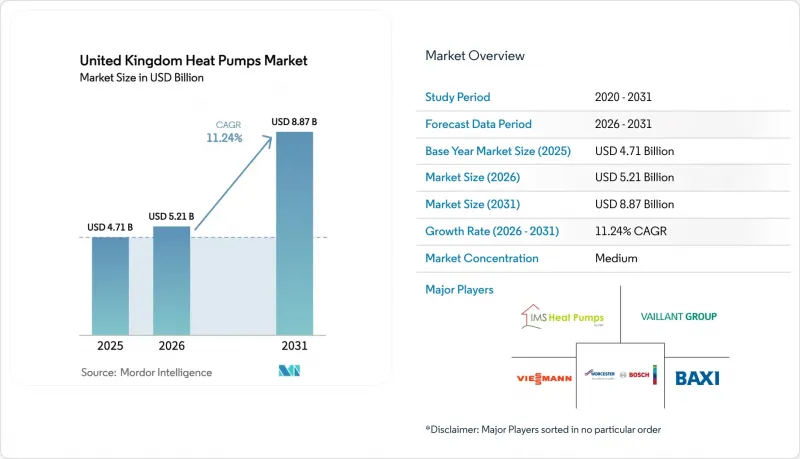
根據 Mordor Intelligence 預測,英國熱泵市場預計將從 2025 年的 47.1 億美元成長到 2026 年的 52.1 億美元,到 2031 年達到 88.7 億美元,2026 年至 2031 年的複合年成長率預計為 11.24%。
本報告按熱源類型(空氣源、水源、地下/地熱源)、額定輸出功率(低於 10 kW、高於 10 kW)、系統設計(分離式、其他)、最終用戶(住宅、商業、其他)和應用(空間供暖和製冷、熱水、區域供熱、製程和工業供熱)進行細分。市場預測以美元 (USD) 為單位。
英國熱泵市場趨勢與洞察
政府法規和淨零排放目標
隨著具有法律約束力的《2050年淨零排放法案》的實施,暖氣和熱水排放佔英國家庭碳排放量的37%,使得暖氣脫碳成為英國氣候策略的核心。 2024年推出的清潔暖氣市場機制強制要求鍋爐製造商確保其年銷售額中至少有8%為熱泵產品,並對僅使用燃氣的產品線徵收合規成本。將於2025年生效的《未來住宅標準》要求新建住宅的碳排放量將比2013年的基準值降低高達80%,這實際上強制要求未來的住宅安裝熱泵。加之政府設定的到2028年每年安裝60萬台熱泵的目標,這些政策措施正迫使製造商將其研發重點從冷凝鍋爐轉向先進的熱泵平台。因此,種種跡象表明,英國熱泵市場存在持續的長期需求。
鍋爐更換補貼和其他財政獎勵
根據鍋爐升級計劃,空氣源熱泵的津貼於2024年10月提高至7500英鎊(9500美元),將普通住宅中燃氣鍋爐和空氣源熱泵的初始成本差距縮小至3000至5000英鎊。截至2025年3月,每月申請量年增88%,但累積總量仍不足60萬台年度目標的7%,顯示仍有龐大的成長空間。區域性獎勵,例如為蘇格蘭農村地區提供的補貼(最高可達9000英鎊),造成了南北地區熱泵普及率的差異,而熱力培訓補助金則有助於支付安裝人員的認證費用。儘管資金投入有所增加,但人們對補貼的認知度以及安裝人員的能力仍然是限制因素,這表明中期內財政激勵措施仍將繼續刺激熱泵的安裝。
以價格低廉的替代產品取代燃氣鍋爐是主流做法。
更換燃氣鍋爐的費用在2000英鎊到3500英鎊之間,而更換空氣源熱泵即使扣除補貼也需要10000英鎊到14000英鎊。初始成本的巨大差異仍然是融資有限的家庭的一大障礙。此外,許多業主往往只有在冬季設備發生故障後才會考慮更換鍋爐,導致他們習慣性地更換同類型的鍋爐。混合式熱泵的價格在6000英鎊到9000英鎊之間,但無法享受津貼,其分階段的過渡方式進一步加劇了向純電氣化轉型的複雜性。由於「清潔熱能市場機制」僅適用於製造商,安裝商仍可專注於鍋爐更換而不會受到處罰,這導致英國熱泵市場短期內的變化有限。
細分市場分析
2025年,空氣源熱泵系統佔了73.83%的銷售佔有率,遙遙領先。同時,預計到2031年,地源熱泵機組將實現顯著成長,年複合成長率(CAGR)將達到12.31%。空氣源熱泵機組在2025年佔據銷售主導地位的原因在於,它們適用於英國常見的維修項目,並且能夠享受最多的補貼。住宅用戶優先考慮分離式系統的緊湊外形,而小規模商業設施的買家則更青睞能夠根據部分負載調節輸出功率的變頻壓縮機。然而,對於運作20年或以上的學校、辦公室和物流中心,從生命週期成本的角度來看,地源熱泵系統正變得越來越有優勢。當季節能源效率係數(SPF)超過4.0時,營業成本最多可降低30%。封閉回路型垂直鑽孔系統克服了都市區空間的限制,而政府指南簡化了規劃核准程序,導致200千瓦以上項目的競標增加。隨著熱網路開發商將共用地下陣列納入重建開發項目,預計到 2031 年,英國熱泵市場對地熱能的採用率將穩步上升。
空氣源熱泵技術目前仍處於灰色地帶,預計到2025年初將安裝約22.5萬台,但該技術被排除在清潔供熱市場機制之外。如果取消這項限制,其成長速度可能會加快,尤其是在熱水維修不切實際的多用戶住宅。同時,新制定的深層地熱藍圖將Cornwall和英格蘭中部地區列為長期優先發展區域,預計這些地區將在2030年後繼續為區域供熱網路提供基本負載熱源。投資者將密切關注試點計畫的成果,因為成功的示範計畫可能會為英國熱泵市場開闢新的天地。
到2025年,10千瓦以下的機組佔總需求的44.26%,但預計到2031年,30千瓦以上的系統將以12.78%的複合年成長率成長。住宅規模的設備,尤其是10千瓦以下的設備,凸顯了獨棟住宅和小規模聯排住宅分階段脫碳的趨勢。在郊區填充式開發案中,目前多用戶住宅正在安裝10-20千瓦的系統,因此無需中央機房。這得歸功於使用符合許可開發項目規定的噪音限制的低矮型室外機。 20-30千瓦的功率範圍非常適合小學、養老院和便利商店。在這些場所,空間加熱和熱水的同步需求需要緩衝機制來防止頻繁啟動和停止。
成長動能正轉向功率超過30千瓦的系統,特別是用於區域供熱變電站和工業製程迴路的機組。大金在曼徹斯特地區簽訂的五年框架合約涵蓋64,000套系統,就是一個大規模採購與地方政府氣候計畫相契合的例證。在食品製造和造紙廠,能夠提供80-100度C熱水的高溫平台正在取代燃氣鍋爐,而工業熱回收支持計劃正在共同資助可行性研究,以降低企業資本預算中的風險。因此,預計到2031年,英國熱泵市場的大容量細分市場將跑贏整體市場成長率,從而推動供應鏈向模組化和貨櫃式設計轉型。
其他好處:
- Excel格式的市場預測(ME)表
- 3個月的分析師支持
目錄
第1章:引言
- 研究假設和市場定義
- 調查範圍
第2章:調查方法
第3章執行摘要
第4章 市場狀況
- 市場概覽
- 市場促進因素
- 政府法規和淨零排放目標
- 鍋爐更換支持補貼和其他財政獎勵
- 辦公空間需求復甦與空調系統維修
- 電力和天然氣價格差距的擴大對熱泵來說是一個利好因素。
- 靈活的收費系統和需求面響應的整合
- 透過採取措施促進對熱泵的投資,擴大國內製造業規模
- 市場限制因素
- 用更便宜的燃氣鍋爐替換老舊鍋爐的做法越來越普遍。
- 合格的熱泵安裝人員短缺
- 區域配電網路的容量限制
- 半導體和稀土元素磁鐵的供應風險
- 產業供應鏈分析
- 監理情勢
- 技術展望
- 宏觀經濟因素對市場的影響
- 波特五力分析
第5章 市場規模與成長預測
- 按熱源類型
- 空氣熱源
- 空氣對空氣
- 水氣型
- 水熱源
- 地表水
- 開放型
- 地下/地熱源
- 封閉回路型垂直
- 封閉回路型水平
- 直接膨脹型
- 空氣熱源
- 按類型分類的額定輸出
- 10千瓦或以下
- 10~20 kW
- 20~30 kW
- 30千瓦或以上
- 系統設計
- 分離式系統
- 單體塊
- 混合熱泵
- 最終用戶
- 住宅
- 商業
- 產業
- 機構
- 透過使用
- 暖氣和冷
- 熱水供應
- 區域供熱
- 製程和工業加熱
第6章 競爭情勢
- 市場集中度
- 策略趨勢
- 市佔率分析
- 公司簡介
- IMS Heat Pumps
- Vaillant Group
- Baxi Heating UK
- Viessmann Group
- Worcestor Bosch Group
- Ideal Heating
- Zehnder Group
- Daikin Airconditioning UK
- Danfoss
- Kensa Heat Pumps
- Mitsubishi Electric UK
- NIBE Energy Systems
- Panasonic Climate Solutions UK
- LG Electronics UK
- Samsung Climate Solutions UK
- Grant Engineering UK
- Glen Dimplex Heating and Ventilation
- Octopus Energy(Home Energy Tech)
- Midea UK
- Stiebel Eltron UK
第7章 市場機會與未來展望
According to Mordor Intelligence, the United Kingdom heat pumps market size is expected to increase from USD 4.71 billion in 2025 to USD 5.21 billion in 2026 and reach USD 8.87 billion by 2031, growing at a CAGR of 11.24% over 2026-2031.
This report is Segmented by Source Type (Air-Source, Water-Source, and Ground/Geothermal Source), Rated Capacity (Up To 10 KW, and More), System Design (Split System, and More), End-User (Residential, Commercial, and More), Application (Space Heating and Cooling, Water Heating, District Heating, and Process and Industrial Heating). The Market Forecasts are Provided in Terms of Value (USD).
United Kingdom Heat Pumps Market Trends and Insights
Government Regulations and Net-Zero Targets
Legally binding 2050 net-zero legislation places heat decarbonization at the center of the United Kingdom's climate strategy, as space and water heating account for 37% of national emissions. The Clean Heat Market Mechanism, introduced in 2024, obliges boiler brands to ensure heat pumps represent at least 8% of annual sales, embedding a compliance cost on gas-only portfolios. The Future Homes Standard, implemented in 2025, requires new houses to cut carbon emissions by up to 80% relative to 2013 baselines, effectively locking heat pumps into all future residential constructions. Combined with the government's 600,000-unit annual installation target for 2028, these policy levers push manufacturers to redirect R&D away from condensing boilers toward advanced heat-pump platforms. The result is a durable, long-horizon demand signal that anchors the United Kingdom heat pumps market.
Boiler Upgrade Scheme Grants and Other Financial Incentives
The Boiler Upgrade Scheme lifted its air-source grant to GBP 7,500 (USD 9,500) in October 2024, slashing the upfront premium over a gas boiler to GBP 3,000-5,000 for a typical home. Monthly applications rose 88% year-on-year by March 2025, yet the cumulative total still covers less than 7% of the 600,000-unit annual target, underscoring the runway for growth. Additional regional incentives, such as Scotland's rural grant of up to GBP 9,000, create a north-south uptake gradient, while the Heat Training Grant helps defray installer accreditation costs. Although funding pools have been expanded, grant awareness and installer throughput remain gating factors, suggesting financial sweeteners should continue to stimulate volume in the medium term.
Prevalence of Cheaper Gas-Boiler Replacements
Replacing a gas boiler costs GBP 2,000-3,500 versus GBP 10,000-14,000 for an air-source heat pump, even after subsidies, keeping a sizeable upfront premium that deters cash-constrained households. Behavioural inertia reinforces like-for-like boiler swaps, as many owners act only when a unit fails in winter. Hybrid heat pumps, priced between GBP 6,000-9,000 yet ineligible for grants, further complicate pure electrification by offering an incremental pathway. Because the Clean Heat Market Mechanism targets only manufacturers, installer businesses can still focus on boiler replacements without penalty, limiting near-term conversion in the United Kingdom heat pump market.
Other drivers and restraints analyzed in the detailed report include:
- Rising Electricity-Gas Price Differential Favouring Heat Pumps
- Domestic Manufacturing Scale-up via Heat Pump Investment Accelerator
- Shortage of Qualified Heat-Pump Installers
For complete list of drivers and restraints, kindly check the Table Of Contents.
Segment Analysis
In 2025, air-source systems commanded a dominant 73.83% share of the revenue. Meanwhile, ground-source units are on track to achieve a notable 12.31% CAGR through 2031. Air-source units captured the lion's share of 2025's revenue, because they fit typical U.K. retrofits and qualify for the largest subsidy. Residential customers prize the compact split-system form factor, while light-commercial buyers value inverter compressors that modulate to partial loads. Nevertheless, lifecycle economics increasingly favor ground-source designs in schools, offices, and logistics centers that operate for 20-plus years. Seasonal performance factors above 4.0 shave operating costs by up to 30%. Closed-loop vertical borehole systems overcome urban space limits, and government guidance has simplified planning approval, boosting tender volumes for projects above 200 kW. As heat-network developers bundle shared ground arrays into regeneration sites, the United Kingdom heat pumps market is expected to see ground-source penetration rise steadily through 2031.
Air-to-air technology remains a gray-area niche, with roughly 225,000 units installed by early 2025 but excluded from the Clean Heat Market Mechanism. Removal of that exclusion could accelerate growth, especially in flats where hydronic retrofits are impractical. Meanwhile, the emerging deep-geothermal roadmap identifies Cornwall and the Midlands as long-term hot spots, offering baseload heat for district grids beyond 2030. Investors will watch pilot outcomes closely, as successful demonstrators could open a new vertical within the United Kingdom heat pumps market.
In 2025, units up to 10 kW made up 44.26% of the demand, while systems exceeding 30 kW are projected to expand at a CAGR of 12.78% through 2031. Equipment in the residential scale, particularly those up to 10 kW, underscores the gradual decarbonization trend in detached houses and small terrace homes. In suburban infill projects, 10-20 kW systems are now catering to multi-family blocks, eliminating the need for central plant rooms. This is made possible by using low-profile outdoor units that adhere to noise limits set by permitted developments. The 20-30 kW range is ideal for primary schools, care homes, and convenience retail outlets. Here, the simultaneous demands for space heating and domestic hot water necessitate buffers to prevent short cycling.
Growth is shifting toward systems above 30 kW, especially arrays for district-heating substations and industrial process loops. Daikin's five-year Greater Manchester framework, covering 64,000 systems, exemplifies volume procurement aligned with local-authority climate plans. High-temperature platforms that deliver 80-100 °C water are displacing gas boilers in food manufacture and paper mills, and the Industrial Heat Recovery Support program co-funds feasibility studies that derisk corporate capital budgets. As a result, the large-capacity slice of the United Kingdom heat pumps market is forecast to outpace the aggregate growth rate through 2031, reinforcing supply-chain moves toward modular, containerized designs.
Complete Report Scope:
- By Source Type
- Air-Source
- Air-to-Air
- Air-to-Water
- Water-Source
- Surface Water
- Open Loop
- Ground / Geothermal Source
- Closed Loop Vertical
- Closed Loop Horizontal
- Direct Expansion
- Air-Source
- By Rated Capacity
- Up to 10 kW
- 10-20 kW
- 20-30 kW
- Above 30 kW
- By System Design
- Split System
- Monobloc
- Hybrid Heat Pump
- By End-User
- Residential
- Commercial
- Industrial
- Institutional
- By Application
- Space Heating and Cooling
- Water Heating
- District Heating
- Process and Industrial Heating
List of Companies Covered in this Report:
- IMS Heat Pumps
- Vaillant Group
- Baxi Heating UK
- Viessmann Group
- Worcestor Bosch Group
- Ideal Heating
- Zehnder Group
- Daikin Airconditioning UK
- Danfoss
- Kensa Heat Pumps
- Mitsubishi Electric UK
- NIBE Energy Systems
- Panasonic Climate Solutions UK
- LG Electronics UK
- Samsung Climate Solutions UK
- Grant Engineering UK
- Glen Dimplex Heating and Ventilation
- Octopus Energy (Home Energy Tech)
- Midea UK
- Stiebel Eltron UK
Additional Benefits:
- The market estimate (ME) sheet in Excel format
- 3 months of analyst support
TABLE OF CONTENTS
1 INTRODUCTION
- 1.1 Study Assumptions and Market Definition
- 1.2 Scope of the Study
2 RESEARCH METHODOLOGY
3 EXECUTIVE SUMMARY
4 MARKET LANDSCAPE
- 4.1 Market Overview
- 4.2 Market Drivers
- 4.2.1 Government Regulations and Net-Zero Targets
- 4.2.2 Boiler Upgrade Scheme Grants and Other Financial Incentives
- 4.2.3 Recovering Office-Space Demand and HVAC Retrofits
- 4.2.4 Rising Electricity-Gas Price Differential Favouring Heat Pumps
- 4.2.5 Flexible Tariff and Demand-Side Response Integration
- 4.2.6 Domestic Manufacturing Scale-up via Heat Pump Investment Accelerator
- 4.3 Market Restraints
- 4.3.1 Prevalence of Cheaper Gas-Boiler Replacements
- 4.3.2 Shortage of Qualified Heat-Pump Installers
- 4.3.3 Local Distribution-Grid Capacity Constraints
- 4.3.4 Semiconductor and Rare-Earth Magnet Supply Risks
- 4.4 Industry Supply- Chain Analysis
- 4.5 Regulatory Landscape
- 4.6 Technological Outlook
- 4.7 Impact of Macroeconomic Factors on the Market
- 4.8 Porter's Five Forces Analysis
- 4.8.1 Bargaining Power of Suppliers
- 4.8.2 Bargaining Power of Consumers
- 4.8.3 Threat of New Entrants
- 4.8.4 Intensity of Competitive Rivalry
- 4.8.5 Threat of Substitutes
5 MARKET SIZE AND GROWTH FORECASTS (VALUE)
- 5.1 By Source Type
- 5.1.1 Air-Source
- 5.1.1.1 Air-to-Air
- 5.1.1.2 Air-to-Water
- 5.1.2 Water-Source
- 5.1.2.1 Surface Water
- 5.1.2.2 Open Loop
- 5.1.3 Ground / Geothermal Source
- 5.1.3.1 Closed Loop Vertical
- 5.1.3.2 Closed Loop Horizontal
- 5.1.3.3 Direct Expansion
- 5.1.1 Air-Source
- 5.2 By Rated Capacity
- 5.2.1 Up to 10 kW
- 5.2.2 10-20 kW
- 5.2.3 20-30 kW
- 5.2.4 Above 30 kW
- 5.3 By System Design
- 5.3.1 Split System
- 5.3.2 Monobloc
- 5.3.3 Hybrid Heat Pump
- 5.4 By End-User
- 5.4.1 Residential
- 5.4.2 Commercial
- 5.4.3 Industrial
- 5.4.4 Institutional
- 5.5 By Application
- 5.5.1 Space Heating and Cooling
- 5.5.2 Water Heating
- 5.5.3 District Heating
- 5.5.4 Process and Industrial Heating
6 COMPETITIVE LANDSCAPE
- 6.1 Market Concentration
- 6.2 Strategic Moves
- 6.3 Market Share Analysis
- 6.4 Company Profiles (Includes Global Level Overview, Market Level Overview, Core Segments, Financials as Available, Strategic Information, Market Rank/Share, Products and Services, and Recent Developments)
- 6.4.1 IMS Heat Pumps
- 6.4.2 Vaillant Group
- 6.4.3 Baxi Heating UK
- 6.4.4 Viessmann Group
- 6.4.5 Worcestor Bosch Group
- 6.4.6 Ideal Heating
- 6.4.7 Zehnder Group
- 6.4.8 Daikin Airconditioning UK
- 6.4.9 Danfoss
- 6.4.10 Kensa Heat Pumps
- 6.4.11 Mitsubishi Electric UK
- 6.4.12 NIBE Energy Systems
- 6.4.13 Panasonic Climate Solutions UK
- 6.4.14 LG Electronics UK
- 6.4.15 Samsung Climate Solutions UK
- 6.4.16 Grant Engineering UK
- 6.4.17 Glen Dimplex Heating and Ventilation
- 6.4.18 Octopus Energy (Home Energy Tech)
- 6.4.19 Midea UK
- 6.4.20 Stiebel Eltron UK
7 MARKET OPPORTUNITIES AND FUTURE OUTLOOK
- 7.1 White-Space and Unmet-Need Assessment

 全球熱泵市場(至2031年):按技術、冷媒、類型、額定容量、最終用戶、應用和地區分類
 美國熱泵:市場佔有率分析、行業趨勢和統計數據以及成長預測(2026-2031 年)
 全球工業熱泵市場:按類型、冷媒、溫度範圍、容量、終端用戶產業和地區分類-市場規模、產業動態、機會分析和預測(2026-2035 年)
 農產品乾燥熱泵市場規模、佔有率和成長分析:按產品類型、農產品類型、乾燥能力、最終用戶、安裝類型、銷售管道和地區分類-2026-2033年產業預測
 熱泵市場:按類型、技術、容量、安裝方式、應用領域、最終用戶和分銷管道分類-2026-2032年全球市場預測
 熱泵市場機會、成長促進因素、產業趨勢分析及2026-2035年預測。熱泵式乾衣機:市場佔有率分析、行業趨勢和統計數據、成長預測(2026-2031 年)
 2026年全球農作物乾燥熱泵市場報告
 熱泵市場規模及預測(2021-2034),全球及區域佔有率、趨勢和成長機會分析報告:按最終用戶和技術分類工業熱泵市場:商業機會、成長要素、產業趨勢分析及2026-2035年預測