


 |
市場調查報告書
商品編碼
2125443
印尼網路安全:市場佔有率分析、產業趨勢與統計及成長預測(2026-2031)Indonesia Cybersecurity - Market Share Analysis, Industry Trends & Statistics, Growth Forecasts (2026 - 2031) |
||||||

※ 本網頁內容可能與最新版本有所差異。詳細情況請與我們聯繫。
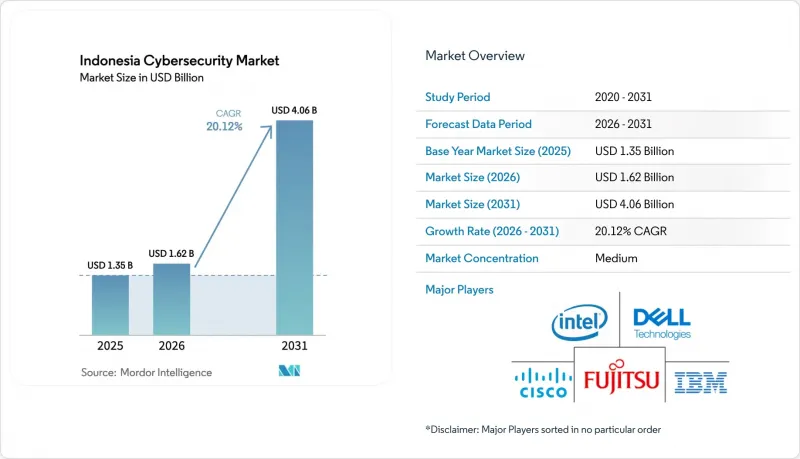
據 Mordor Intelligence 稱,2025 年印尼網路安全市場價值 13.5 億美元,預計到 2031 年將從 2026 年的 16.2 億美元成長至 40.6 億美元,預測期(2026-2031 年)複合年成長率為 20.12%。
本報告將產業分為「產品(解決方案和服務)」、「部署模式(本地部署和雲端部署)」、「組織規模(中小企業和大型企業)」以及「最終用戶產業(銀行、金融服務和保險、醫療保健等)」。市場預測以美元計價。
印尼網路安全市場趨勢與洞察
數位支付交易的激增是由 BI-FAST 和 QRIS 的強制實施所推動的。
2024年4月,QRIS交易量激增194.06%,8月更是飆升217.33%,隨著開始接受即時程式碼的中小型企業(SME)數量達到1478萬家,攻擊面也隨之擴大。預計到2025年,交易量將達到1,153.4億美元,迫使發卡銀行和收購方部署複雜的詐欺分析系統。 Neo Commerce銀行已就人工智慧驅動的深度造假詐騙發出警告,凸顯了在支付管道中實施基於生物識別和行為分析的管理的緊迫性。 BI的「國家支付系統藍圖」正在推動支付方式從批量支付向即時支付的轉變,進一步提高了對檢測速度的需求。因此,基於網路的入侵防禦工具和API安全工具正在從可選項變為整個零售支付生態系統的必備工具。
政府的PDN(國家資料中心)計畫正在加快網路安全方面的支出。
光是芝卡朗資料中心就擁有 25,000 個核心、200 TB 記憶體和 40 PB 儲存空間,整合了 629 個遺留的政府資料孤島。 2024 年 6 月的一次勒索軟體攻擊導致 282 個政府機構的營運中斷,證實了先前存在的安全漏洞問題,並促使政府緊急採購零信任閘道和備份編配。在巴淡島和努沙登加拉群島的平行建設將構成自主雲端戰略的基礎,該戰略需要微隔離網路、不可篡改的備份和自動化事件回應。過去幾年,提供「資料中心一體化」解決方案、AI-SOC 平台和合規性儀錶板的供應商在公共部門的支出週期中佔據了有利地位。
具備印尼語能力的認證網路安全專業人員短缺
印尼到2025年需要10萬名安全專業人員,但儘管有「數位人才獎學金」計畫旨在2018年至2024年間培訓50萬人,實際培養的人才卻寥寥無幾。高薪促使高階主管流向金融科技和電信公司,導致關鍵基礎設施團隊人員短缺。平均起薪高達每年1.2億至1.8億印尼幣,使得中小企業不願聘用內部分析師。因此,對託管安全服務提供者 (MSSP) 合約和自動化安全營運中心 (SOC) 工具的需求不斷成長,但實施這些工具所需的時間仍然會延誤事件回應準備。
細分市場分析
到2025年,解決方案板塊將佔總收入的62.86%,這主要得益於網路防火牆、安全Web閘道器和終端代理等產品對應對印尼勒索軟體激增的需求。印尼網路安全市場解決方案板塊預計到2025年將達到8.5億美元,並保持兩位數的成長勢頭,這主要得益於PDN(個人資料保護網路)的發展和BI-FAST合規性對平台全面升級的推動。資料遺失防護和身分管治領域受到《個人資料保護法》相關處罰的影響,罰款金額可能高達收入的2%,這促使企業董事會投資於加密和特權存取管理解決方案。同時,採用微服務的原生數位銀行對容器工作負載保護的需求也不斷增加。
預計託管服務將實現 17.14% 的複合年成長率,成長速度將超過產品細分市場,因為首席資訊安全長 (CISO) 正因工作量繁重而轉向基於結果的合約。託管偵測與回應 (MDR)、安全營運中心即服務 (SOCaaS) 和漏洞管理的訂閱服務正成為缺乏全天候分析師支援的中小型企業的理想選擇。在諮詢領域,零信任參考設計和監管差距評估正被打包出售,以簡化實施流程。印尼網路安全市場持續依賴混合交付模式,供應商將硬體升級、軟體授權和託管偵測服務打包成統一的按用戶定價模式,以降低資本投資門檻。
預計到2025年,本地部署環境將佔總支出的53.33%,這主要得益於印尼央行、金融服務監理局(OJK)和國家網路安全局(BSSN)持續將資料居住放在首位。金融機構要求本地密鑰管理,而國營企業則繼續維護與公共雲端控制能力整合度較低的大型主機。因此,儘管更新周期較長,但印尼本地部署的硬體安全模組、網路分段設備和SIEM設備的市場佔有率仍然很高。
同時,隨著微軟Azure印尼區域、AWS雅加達以及印尼電信巴淡島超大規模資料中心的運作,基於雲端的安全解決方案正以19.92%的複合年成長率快速成長。 SaaS模式下的SWG、CASB和SASE解決方案正受到需要應對交易量激增的原生數位銀行和零售應用的青睞。在「統一資料政策」強制推行的「模型到資料」架構的推動下,印尼雲端安全市場預計到2031年將超過18.5億美元。結合本地資料平面和雲端控制平面的混合網狀架構正逐漸成為主流,因為它既滿足了合規性要求,也兼顧了敏捷性。
其他好處:
- Excel格式的市場預測(ME)表
- 3個月的分析師支持
目錄
第1章:引言
- 研究假設和市場定義
- 調查範圍
第2章:調查方法
第3章執行摘要
第4章 市場狀況
- 市場概覽
- 市場促進因素
- 數位支付交易的激增是由 BI-FAST 和 QRIS 的強制實施所推動的。
- 政府的PDN(國家資料中心)計畫正在加快網路安全方面的支出。
- 印尼國營企業遭受勒索軟體攻擊的事件增多
- 在貝卡西卡拉旺製造業帶引進5G和工業4.0
- 伊斯蘭數位銀行的擴張需要符合伊斯蘭教法的安全管理。
- 《個人資訊保護法》(UU PDP)將於2022年實施
- 市場限制因素
- 具備印尼語能力的認證網路安全專業人員短缺
- 二級企業的傳統本地部署技術棧
- 網路保險的普及率較低。
- 監管機構(BSSN、Kominfo、OJK)的分散化造成了合規的模糊性。
- 重要法規結構的評估
- 價值鏈分析
- 技術展望
- 波特五力分析
- 對關鍵相關人員的影響評估
- 主要用例和案例研究
- 宏觀經濟因素對市場的影響
- 投資分析
第5章 市場規模與成長預測
- 報價
- 解決方案
- 應用程式安全
- 雲端安全
- 資料安全
- 身分和存取管理
- 基礎設施保護
- 綜合風險管理
- 網路安全設備
- 端點安全
- 其他解決方案
- 服務
- 專業服務
- 託管服務
- 解決方案
- 部署模式
- 現場
- 雲
- 按組織規模
- 小型企業
- 大公司
- 按行業分類的最終用戶
- BFSI
- 衛生保健
- IT/通訊
- 工業與國防
- 零售
- 能源公用事業
- 製造業
- 其他
第6章 競爭情勢
- 市場集中度
- 策略趨勢
- 市佔率分析
- 公司簡介
- IBM Corporation
- Cisco Systems Inc.
- Fortinet Inc.
- Palo Alto Networks Inc.
- Trend Micro Incorporated
- Check Point Software Technologies Ltd.
- PT Xynexis International
- PT Telkomsigma(Telkom Indonesia)
- PT Daya Cipta Mandiri Solusi(Noosc)
- PT Sakti Solusi Data
- PT Mitra Integrasi Komputindo
- Dell Technologies Inc.
- Huawei Technologies Co. Ltd.
- Microsoft Corporation
- Amazon Web Services Inc.
- Google Cloud
- CyberArk Software Ltd.
- CrowdStrike Holdings Inc.
- Kaspersky Lab
- Sophos Ltd.
- PT Xapiens Teknologi Indonesia
- Zscaler Inc.
- Darktrace plc
- PT Sigma Cipta Caraka
第7章 市場機會與未來展望
According to Mordor Intelligence, the Indonesia cybersecurity market size was valued at USD 1.35 billion in 2025 and estimated to grow from USD 1.62 billion in 2026 to reach USD 4.06 billion by 2031, at a CAGR of 20.12% during the forecast period (2026-2031).
This report Segments the Industry Into Offering (Solutions and Services), Deployment Mode (On-Premise and Cloud), Organization Size (SMEs and Large Enterprises), and End-User Vertical (BFSI, Healthcare, and More). The Market Forecasts are Provided in Terms of Value (USD).
Indonesia Cybersecurity Market Trends and Insights
Surge in Digital Payment Transactions Fueled by BI-FAST and QRIS Mandates
QRIS volumes surged by 194.06% in April 2024 and 217.33% in August 2024, broadening the attack surface to 14.78 million SMEs now accepting real-time codes. Transaction values are forecast to hit USD 115.34 billion in 2025, compelling issuers and acquirers to deploy advanced fraud analytics. Bank Neo Commerce has already flagged AI-driven deep-fake scams, underscoring the urgency for biometric and behavioral controls across payment rails. The BI National Payment System Blueprint pushes a shift from batch clearing to instant settlement, further elevating detection speed requirements. Consequently, network-based intrusion prevention and API-security tools are moving from optional to mandatory across retail payments ecosystems.
Government PDN (National Data Center) Program Accelerating Cybersecurity Spend
The Cikarang site alone houses 25,000 cores, 200 TB of memory, and 40 PB of storage, consolidating 629 legacy government data silos. A ransomware outage in June 2024 that disrupted 282 agencies validated vulnerability concerns and led to emergency procurement of zero-trust gateways and backup orchestration. Parallel builds in Batam and Nusantara will underpin sovereign-cloud strategies that demand micro-segmented networks, immutable backups, and automated incident response. Vendors offering data-center-in-a-box, AI-SOC platforms, and compliance dashboards are well positioned for this multiyear public-sector spend cycle.
Shortage of Certified Bahasa-Speaking Cybersecurity Talent
Indonesia needs 100,000 security specialists by 2025 yet produces only a fraction of that number despite the Digital Talent Scholarship training 500,000 individuals from 2018-2024. Salary premiums divert senior staff to fintechs and telecoms, leaving critical infrastructure teams understaffed. Entry-level packages averaging IDR 120-180 million per year deter SMEs from hiring in-house analysts. Consequently, demand for MSSP contracts and automated SOC tools is growing, but lengthy onboarding times still delay incident-response readiness.
Other drivers and restraints analyzed in the detailed report include:
- Rising Ransomware Incidents Across Indonesian SOEs
- 5G and Industry 4.0 Roll-outs in Bekasi-Karawang Manufacturing Belt
- Fragmented Oversight Creating Compliance Ambiguity
For complete list of drivers and restraints, kindly check the Table Of Contents.
Segment Analysis
Solutions generated 62.86% of 2025 revenue, led by network firewalls, secure web gateways, and endpoint agents that address Indonesia's ransomware surge. The Indonesia cybersecurity market size for solutions amounted to USD 0.85 billion in 2025 and is tracking a double-digit growth arc as PDN build-outs and BI-FAST compliance drive holistic platform upgrades. Data-loss prevention and identity governance lines are benefiting from the Personal Data Protection Act's penalties of up to 2% of turnover, pushing boards to fund encryption and privileged-access vaults. Meanwhile, demand for container workload protection is rising among digital-native banks deploying microservices.
Managed Services is projected to log a 17.14% CAGR, outpacing products as over-extended CISOs pivot toward outcome-based contracting. MDR, SOC-as-a-Service, and vulnerability management subscriptions are proving attractive to SMEs that lack round-the-clock analysts. Consulting arms are bundling zero-trust reference designs and regulatory-gap assessments to simplify onboarding. The Indonesia cybersecurity market continues to lean on hybrid delivery, with vendors packaging hardware refresh, software licensing, and managed detection in unified per-user pricing to ease capex barriers.
On-Premises estates captured 53.33% of 2025 spending because Bank Indonesia, OJK, and BSSN still prioritize data residency. Financial institutions demand local key management, and SOEs retain mainframes that integrate poorly with public cloud controls. As a result, the Indonesia cybersecurity market share for on-prem hardware security modules, network segmentation appliances, and SIEM boxes remained high despite their lengthy refresh cycles.
Cloud-Delivered security, however, is expanding at 19.92% CAGR as Microsoft Azure Indonesia Regions, AWS Jakarta, and Telkom's Batam hyperscale sites go live. SaaS-delivered SWG, CASB, and SASE offerings resonate with digital-native banks and retail apps that scale transaction bursts. The Indonesia cybersecurity market size for cloud security is expected to exceed USD 1.85 billion by 2031, driven by "model-to-data" architectures mandated under the One Data Policy. Hybrid mesh approaches-local data plane, cloud control plane-are emerging as the design of choice to meet both compliance and agility needs.
Complete Report Scope:
- By Offering
- Solutions
- Application Security
- Cloud Security
- Data Security
- Identity and Access Management
- Infrastructure Protection
- Integrated Risk Management
- Network Security Equipment
- Endpoint Security
- Other Solutions
- Services
- Professional Services
- Managed Services
- Solutions
- By Deployment Mode
- On-Premise
- Cloud
- By Organization Size
- SMEs
- Large Enterprises
- By End-User Vertical
- BFSI
- Healthcare
- IT and Telecom
- Industrial and Defense
- Retail
- Energy and Utilities
- Manufacturing
- Others
List of Companies Covered in this Report:
- IBM Corporation
- Cisco Systems Inc.
- Fortinet Inc.
- Palo Alto Networks Inc.
- Trend Micro Incorporated
- Check Point Software Technologies Ltd.
- PT Xynexis International
- PT Telkomsigma (Telkom Indonesia)
- PT Daya Cipta Mandiri Solusi (Noosc)
- PT Sakti Solusi Data
- PT Mitra Integrasi Komputindo
- Dell Technologies Inc.
- Huawei Technologies Co. Ltd.
- Microsoft Corporation
- Amazon Web Services Inc.
- Google Cloud
- CyberArk Software Ltd.
- CrowdStrike Holdings Inc.
- Kaspersky Lab
- Sophos Ltd.
- PT Xapiens Teknologi Indonesia
- Zscaler Inc.
- Darktrace plc
- PT Sigma Cipta Caraka
Additional Benefits:
- The market estimate (ME) sheet in Excel format
- 3 months of analyst support
TABLE OF CONTENTS
1 INTRODUCTION
- 1.1 Study Assumptions and Market Definition
- 1.2 Scope of the Study
2 RESEARCH METHODOLOGY
3 EXECUTIVE SUMMARY
4 MARKET LANDSCAPE
- 4.1 Market Overview
- 4.2 Market Drivers
- 4.2.1 Surge in Digital Payment Transactions Fueled by BI-FAST and QRIS Mandates
- 4.2.2 Government PDN (National Data Center) Program Accelerating Cybersecurity Spend
- 4.2.3 Rising Ransomware Incidents Across Indonesian SOEs
- 4.2.4 5G and Industry 4.0 Roll-outs in Bekasi-Karawang Manufacturing Belt
- 4.2.5 Expansion of Islamic Digital Banking Requiring Sharia-Compliant Security Controls
- 4.2.6 Enforcement of Personal Data Protection Act 2022 (UU PDP)
- 4.3 Market Restraints
- 4.3.1 Shortage of Certified Bahasa-Speaking Cybersecurity Talent
- 4.3.2 Legacy On-Prem Tech Stacks in Tier-2 Enterprises
- 4.3.3 Low Cyber-Insurance Penetration
- 4.3.4 Fragmented Oversight (BSSN, Kominfo, OJK) Creating Compliance Ambiguity
- 4.4 Evaluation of Critical Regulatory Framework
- 4.5 Value Chain Analysis
- 4.6 Technological Outlook
- 4.7 Porter's Five Forces Analysis
- 4.7.1 Bargaining Power of Suppliers
- 4.7.2 Bargaining Power of Buyers
- 4.7.3 Threat of New Entrants
- 4.7.4 Threat of Substitutes
- 4.7.5 Competitive Rivalry
- 4.8 Impact Assessment of Key Stakeholders
- 4.9 Key Use Cases and Case Studies
- 4.10 Impact on Macroeconomic Factors of the Market
- 4.11 Investment Analysis
5 MARKET SIZE AND GROWTH FORECASTS (VALUE)
- 5.1 By Offering
- 5.1.1 Solutions
- 5.1.1.1 Application Security
- 5.1.1.2 Cloud Security
- 5.1.1.3 Data Security
- 5.1.1.4 Identity and Access Management
- 5.1.1.5 Infrastructure Protection
- 5.1.1.6 Integrated Risk Management
- 5.1.1.7 Network Security Equipment
- 5.1.1.8 Endpoint Security
- 5.1.1.9 Other Solutions
- 5.1.2 Services
- 5.1.2.1 Professional Services
- 5.1.2.2 Managed Services
- 5.1.1 Solutions
- 5.2 By Deployment Mode
- 5.2.1 On-Premise
- 5.2.2 Cloud
- 5.3 By Organization Size
- 5.3.1 SMEs
- 5.3.2 Large Enterprises
- 5.4 By End-User Vertical
- 5.4.1 BFSI
- 5.4.2 Healthcare
- 5.4.3 IT and Telecom
- 5.4.4 Industrial and Defense
- 5.4.5 Retail
- 5.4.6 Energy and Utilities
- 5.4.7 Manufacturing
- 5.4.8 Others
6 COMPETITIVE LANDSCAPE
- 6.1 Market Concentration
- 6.2 Strategic Moves
- 6.3 Market Share Analysis
- 6.4 Company Profiles {(includes Global level Overview, Market level overview, Core Segments, Financials as available, Strategic Information, Market Rank/Share for key companies, Products and Services, and Recent Developments)}
- 6.4.1 IBM Corporation
- 6.4.2 Cisco Systems Inc.
- 6.4.3 Fortinet Inc.
- 6.4.4 Palo Alto Networks Inc.
- 6.4.5 Trend Micro Incorporated
- 6.4.6 Check Point Software Technologies Ltd.
- 6.4.7 PT Xynexis International
- 6.4.8 PT Telkomsigma (Telkom Indonesia)
- 6.4.9 PT Daya Cipta Mandiri Solusi (Noosc)
- 6.4.10 PT Sakti Solusi Data
- 6.4.11 PT Mitra Integrasi Komputindo
- 6.4.12 Dell Technologies Inc.
- 6.4.13 Huawei Technologies Co. Ltd.
- 6.4.14 Microsoft Corporation
- 6.4.15 Amazon Web Services Inc.
- 6.4.16 Google Cloud
- 6.4.17 CyberArk Software Ltd.
- 6.4.18 CrowdStrike Holdings Inc.
- 6.4.19 Kaspersky Lab
- 6.4.20 Sophos Ltd.
- 6.4.21 PT Xapiens Teknologi Indonesia
- 6.4.22 Zscaler Inc.
- 6.4.23 Darktrace plc
- 6.4.24 PT Sigma Cipta Caraka
7 MARKET OPPORTUNITIES AND FUTURE OUTLOOK
- 7.1 White-space and Unmet-Need Assessment

 中東網路安全:市場佔有率分析、產業趨勢與統計及成長預測(2026-2031 年)
 全球網路安全代理人工智慧市場規模、佔有率、趨勢和成長分析報告(2026-2034)印度網路安全:市場佔有率分析、產業趨勢與統計及成長預測(2026-2031)菲律賓網路安全:市場佔有率分析、產業趨勢與統計及成長預測(2026-2031 年)馬來西亞網路安全:市場佔有率分析、產業趨勢與統計及成長預測(2026-2031)義大利網路安全:市場佔有率分析、產業趨勢與統計、成長預測(2026-2031)英國網路安全:市場佔有率分析、產業趨勢與統計資料、成長預測(2026-2031 年)越南網路安全:市場佔有率分析、產業趨勢與統計及成長預測(2026-2031)
 2026-2030年全球安全態勢管理(SPM)市場
 2026-2030年全球網路安全市場