


 |
市場調查報告書
商品編碼
2125389
軸流泵和混流泵:市場佔有率分析、行業趨勢和統計數據以及成長預測(2026-2031 年)Axial And Mixed Flow Pumps - Market Share Analysis, Industry Trends & Statistics, Growth Forecasts (2026 - 2031) |
||||||

※ 本網頁內容可能與最新版本有所差異。詳細情況請與我們聯繫。
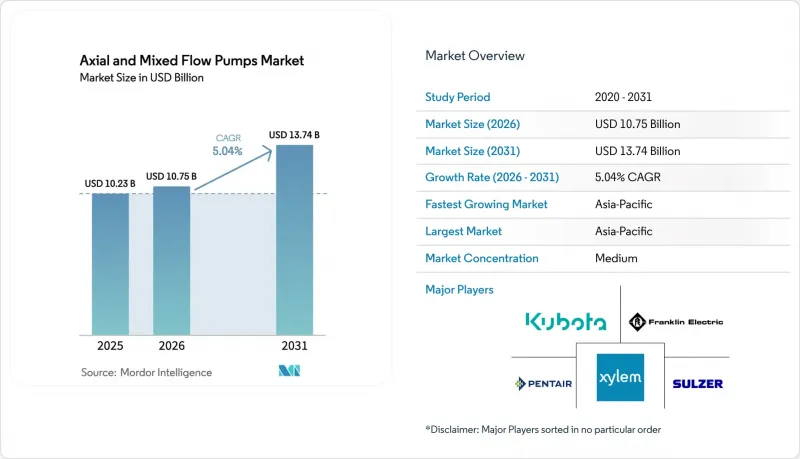
據 Mordor Intelligence 稱,軸流泵和混流泵的市場規模預計在 2026 年達到 107.5 億美元,高於 2025 年的 102.3 億美元,預計到 2031 年將達到 137.4 億美元。
預計 2026 年至 2031 年的複合年成長率為 5.04%。
本報告按流體類型(軸流、徑流和混流)、級數(單級和多級)、安裝方向(垂直和水平)、建築材料(鑄鐵、不銹鋼等)、終端用戶行業(石油天然氣、用水和污水處理、發電、化工等)以及地區進行細分。市場預測以美元計價。
全球軸流泵和混流泵市場趨勢及洞察
城市供水和污水基礎設施的擴建
隨著老化的管道和水處理設施達到使用壽命終點,以及新興經濟體為滿足不斷成長的城市人口需求而擴大水處理能力,供水和水處理維修的支出正在增加。例如,新加坡的新生水擴建計畫就採用了大直徑軸流泵來有效處理大量海水。變速驅動裝置可降低15%至25%的能耗,這對於面臨減碳義務的公共產業至關重要。亞太地區政府在2024年實施的超過2,000億美元的獎勵策略,直接推動了對大容量設備的競標成長。隨著公共產業採用全生命週期服務契約,能夠提供泵浦、馬達和數位監控平台等一體化解決方案的製造商,在獲得重複訂單方面佔據了有利地位。
擴大中游油氣計畫的投資
2024年,北美業者投資150億美元用於管線維修,其中最引人注目的是耗資340億美元的跨山輸油管擴建工程。此專案指定使用額定功率為軸流式的泵站,以應對山區地形的挑戰。符合API 610標準的抽水站鼓勵採購方選擇性能可靠的設計,確保平均故障間隔時間(MTBF)超過6萬小時。類似的泵浦系統也應用於拉丁美洲頁岩油氣開發項目,例如阿根廷的瓦卡穆埃爾塔油田,該專案日輸送量達50萬桶。由於處理能力強且對正常運轉率要求嚴格,在這些中游環節,軸流泵浦仍然優於離心泵浦。
高黏度流體的性能局限性
當黏度超過 100 cP 時,軸流泵和混流泵的效率會損失高達 30%,這促使化學企業選擇磁力驅動離心式幫浦,因為這類泵能夠在更廣泛的流體特性範圍內保持輸出功率。此外,由於衛生管理的複雜性,符合 FDA Part 11 清潔標準的製藥廠也對採用軸流幫浦持謹慎態度。在新的葉輪形狀和驅動技術能夠解決效率損失問題之前,高黏度流體領域的應用將落後於水和能源等主要市場。
細分市場分析
在軸流泵浦和混流泵浦市場中,隨著使用者對寬揚程範圍內效率的需求不斷成長,混流泵浦的市場規模正在迅速擴大。預計到2031年,混流泵產品的複合年成長率將達到6.78%,儘管到2025年,軸流泵仍將佔據44.55%的市場佔有率。混流泵能夠在5米至15米的揚程範圍內保持動態穩定性,因此擴大應用於燃氣和核能發電廠的冷卻水迴路。根據使用者回饋,在負載波動頻繁的情況下,混流泵比純軸流泵節能高達8%。目前,針對可調螺距葉輪和複合材料泵殼的研發工作仍在繼續,旨在進一步縮小成本差距,並鞏固混流泵的成長動能。
該技術在都市區防洪措施中的廣泛應用,清楚地展現了其轉型潛力。在東京新建的地下蓄水池中,混流泵被應用於應對雨水水位波動,即使吸水揚程發生劇烈變化,也能維持穩定的出水量。基於ISO 9906測試程序的標準化檢驗了其在更廣泛運行條件下的性能,增強了客戶的信心。這正在加速混流泵在新建設和維修專案中的應用。
單級泵浦組件在軸流泵浦和混流泵浦市場佔據主導地位,預計到2025年將達到60.74%。這主要歸功於其在低揚程水處理和灌溉應用中的簡易性。然而,多級泵浦產品線正以6.9%的複合年成長率快速成長,這主要得益於核能發電廠不斷提高的揚程要求,其目標排放壓力已達到50-100公尺。多級泵浦設計在管道增壓站中也至關重要,因為高差對單級泵浦設計提出了更高的要求。製造商正透過泵殼模組化設計降低高昂的初始投資成本,使用戶能夠根據需求成長增加泵級,而無需重新安裝整個裝置。
在跨山輸油管專案中,中游站引入了多級軸流泵,以補償山區地形的高差,即使在重油高負荷運作條件下,也展現出其全生命週期成本優勢。運轉率目標。
區域分析
預計到2025年,亞太地區將佔全球支出的43.52%,並繼續以5.78%的複合年成長率成長。這主要得益於大都會圈加強防洪措施、農村地區擴大飲用水管網以及工業走廊為能源相關大型企劃配備配套設施。中國已撥款500億美元用於排水隧道建設,這些隧道將配備大容量軸流泵組;印度的「飲用水生命線計畫」(Jal Jeevan Mission)已為2,000多家當地承包商獲得了水泵訂單。以越南和菲律賓為首的東南亞國家已獲得多邊資金籌措,將變速驅動和智慧遙測技術結合,以實現節能目標。
在北美,我們透過維修石油管線以應對老化的基礎設施和市政基礎設施改造項目,保持強大的市場佔有率。該地區軸流泵和混流泵的市場佔有率得益於符合API標準的泵體結構,這是上市管道運營商的硬性要求,他們無法承擔環境處罰的風險。未來20年,美國供水事業將面臨6,250億美元的升級改造,即使聯邦資金籌措週期出現波動,也能確保訂單的持續成長。在歐洲,能源效率和碳排放預算是重中之重。公共產業正在採用IE5電機,並實施數位孿生技術,在硬體安裝前模擬浸沒場景,這項舉措得到了歐盟分類法規的支持。從西班牙到丹麥,沿海城市正在試驗海水熱泵,每台熱泵都需要耐腐蝕的軸流泵機組。同時,在中東和非洲,由於海水淡化和石化行業的擴張,需求激增,這體現了高品質雙相不銹鋼材料在NEOM等大型企劃中的應用。儘管規模較小,但南美洲正透過採礦和陸上液化天然氣開發實現穩步成長,這些項目利用軸流增壓泵將製程用水輸送到地形複雜的地區。
其他好處:
- Excel格式的市場預測(ME)表
- 3個月的分析師支持
目錄
第1章:引言
- 研究假設和市場定義
- 調查範圍
第2章:調查方法
第3章執行摘要
第4章 市場狀況
- 市場概覽
- 市場促進因素
- 地方政府用水和污水基礎設施擴建
- 中游油氣業務的投資增加
- 加速亞太地區城市防洪和灌溉工程建設。
- 在波浪發電設備中採用變速軸流泵
- 沿海城市對海水熱泵系統的需求正在激增。
- 資料中心液冷迴路模組化抽水站的興起
- 市場限制因素
- 高黏度流體的性能局限性
- 替代性直列式旋葉泵的設計正變得越來越普遍。
- 高合金不銹鋼零件供應鏈中斷
- 更嚴格的能源效率法規增加了合規成本。
- 產業價值鏈分析
- 監理情勢
- 技術展望
- 波特五力分析
- 宏觀經濟因素的影響
第5章 市場規模與成長預測
- 按流體類型
- 軸流式
- 徑向
- 混合物
- 按層數
- 單級
- 多階段
- 按安裝方向
- 垂直
- 橫版
- 透過建築材料
- 鑄鐵
- 不銹鋼
- 雙工或超級雙工
- 其他建築材料
- 按最終用戶行業分類
- 石油和天然氣
- 水和污水處理
- 發電
- 化學品
- 食品/飲料
- 製藥
- 金屬和採礦
- 建造
- 其他終端用戶產業
- 按地區
- 北美洲
- 美國
- 加拿大
- 墨西哥
- 歐洲
- 德國
- 英國
- 法國
- 俄羅斯
- 其他歐洲國家
- 亞太地區
- 中國
- 日本
- 印度
- 韓國
- 澳洲
- 其他亞太國家
- 中東和非洲
- 中東
- 沙烏地阿拉伯
- 阿拉伯聯合大公國
- 其他中東國家
- 非洲
- 南非
- 埃及
- 其他非洲國家
- 中東
- 南美洲
- 巴西
- 阿根廷
- 其他南美國家
- 北美洲
第6章 競爭情勢
- 市場集中度
- 策略趨勢
- 市佔率分析
- 公司簡介
- Xylem Inc.
- Franklin Electric Co., Inc.
- Sulzer Ltd
- Kubota Corporation
- Pentair plc
- Torishima Pump Manufacturing Co., Ltd.
- Ebara Corporation
- The Weir Group PLC
- Hayward Tyler Limited
- Peerless Pump Company
- Grundfos Holding A/S
- Flowserve Corporation
- KSB SE and Co. KGaA
- ITT Inc.
- SPX FLOW, Inc.
- Tsurumi Manufacturing Co., Ltd.
- Ruhrpumpen, SA de CV
- Kirloskar Brothers Limited
- WILO SE
- Patterson Pump Company
- Zhejiang Dayuan Pumps Industrial Co., Ltd.
- Shanghai Kaiquan Pump(Group)Co., Ltd.
第7章 市場機會與未來展望
According to Mordor Intelligence, the axial and mixed flow pumps market size in 2026 is estimated at USD 10.75 billion, growing from 2025 value of USD 10.23 billion with 2031 projections showing USD 13.74 billion, growing at 5.04% CAGR over 2026-2031.
This report is Segmented by Flow Type (Axial, Radial, Mixed), Number of Stages (Single Stage, and Multi Stage), Installation Orientation (Vertical, and Horizontal), Material of Construction (Cast Iron, Stainless Steel, and More), End-User Industry (Oil and Gas, Water and Wastewater, Power Generation, Chemicals, and More), and Geography. The Market Forecasts are Provided in Terms of Value (USD).
Global Axial And Mixed Flow Pumps Market Trends and Insights
Expansion of Municipal Water and Wastewater Infrastructure
Spending on water supply and treatment upgrades is increasing as aging pipes and treatment facilities reach the end of their lifespan, while emerging nations scale up their capacity to support growing urban populations. Projects such as Singapore's NEWater expansion rely on large-bore axial flow pumps to manage high-volume seawater intakes efficiently. Variable-speed drives trim energy consumption by 15-25%, a decisive benefit for utilities facing carbon-reduction mandates. The government stimulus exceeding USD 200 billion in the Asia-Pacific region during 2024 is translating directly into tender pipelines for high-capacity units. Manufacturers that can bundle pumps, motors, and digital monitoring platforms are best positioned to capture repeat orders as utilities adopt lifecycle-service contracts.
Increasing Investments in Oil and Gas Midstream Projects
North American operators invested USD 15 billion in 2024 pipeline upgrades, culminating in the USD 34 billion Trans Mountain expansion, which specified axial flow pump stations rated for use in mountainous terrain. Compliance with API 610 encourages buyers to opt for robust designs that maintain a mean-time-between-failure of over 60,000 hours. Latin American shale programs, typified by Argentina's Vaca Muerta, require similar pumping systems to move 500,000 barrels per day. High throughput and tight uptime targets continue to favor axial configurations over centrifugal alternatives in these midstream links.
Performance Limitations with High-Viscosity Fluids
When viscosity exceeds 100 cP, axial and mixed flow pumps lose up to 30% of their efficiency, prompting chemical producers to opt for magnetic-drive centrifugal models that maintain output across a broader range of fluid properties. Pharmaceutical plants tied to FDA Part 11 cleaning codes further retreat from axial designs due to sanitization complexities. Until new impeller geometries or drive technologies reverse efficiency penalties, penetration in viscous-fluid verticals will lag core water and energy markets.
Other drivers and restraints analyzed in the detailed report include:
- Accelerated Urban Flood Control and Irrigation Schemes in Asia-Pacific
- Adoption of Variable Speed Drive Axial Pumps for Wave Energy Converters
- Rising Prevalence of Alternative Inline Propeller Pump Designs
For complete list of drivers and restraints, kindly check the Table Of Contents.
Segment Analysis
The axial and mixed flow pumps market size for mixed flow configurations is growing rapidly as users seek efficiency across a range of heads. Mixed flow products recorded a 6.78% CAGR through 2031, although axial designs still controlled 44.55% of 2025 revenues. Cooling-water circuits in gas and nuclear plants are increasingly opting for mixed-flow units that maintain hydraulic stability over a range of 5 m to 15 m heads. Operators report energy savings of up to 8% against pure axial alternatives when load swings are frequent. Continued R&D into variable-pitch impellers and composite casings aims to further narrow cost gaps, reinforcing the mixed flow growth arc.
Robust municipal flood-control deployments also illustrate the migration of technology. Tokyo's new underground reservoirs utilized mixed-flow pumps to accommodate fluctuating stormwater levels, demonstrating steady throughput even as suction heads changed dramatically. Standardization under ISO 9906 test procedures builds buyer confidence by validating performance across broader duty points, thereby accelerating the adoption of mixed flow in both greenfield and retrofit packages.
Single-stage assemblies dominated the axial and mixed flow pumps market share, accounting for 60.74% in 2025, which is favored for simplicity in low-head water treatment and irrigation applications. Yet multi-stage lines expanded at a 6.9% CAGR, propelled by rising head requirements at nuclear stations that now target 50-100 m discharge pressures. Multi-stage designs also anchor pipeline booster stations, where elevation changes strain the limits of single-stage designs. Manufacturers mitigate higher capital costs by modularizing casings, allowing operators to add stages as demand grows without the need to reinstall entire units.
The Trans Mountain project integrated multi-stage axial pumps in its mid-line stations to offset mountain passes, demonstrating favorable lifecycle economics under heavy-oil duty cycles. Predictive analytics, combined with pressure sensors, alerts technicians to stage-imbalance drift before vibration escalates, supporting higher availability targets within critical energy corridors.
Complete Report Scope:
- By Flow Type
- Axial
- Radial
- Mixed
- By Number of Stages
- Single Stage
- Multi Stage
- By Installation Orientation
- Vertical
- Horizontal
- By Material of Construction
- Cast Iron
- Stainless Steel
- Duplex or Super Duplex
- Other Material of Construction
- By End-User Industry
- Oil and Gas
- Water and Wastewater
- Power Generation
- Chemicals
- Food and Beverage
- Pharmaceuticals
- Metals and Mining
- Construction
- Other End-User Industries
- By Geography
- North America
- United States
- Canada
- Mexico
- Europe
- Germany
- United Kingdom
- France
- Russia
- Rest of Europe
- Asia-Pacific
- China
- Japan
- India
- South Korea
- Australia
- Rest of Asia-Pacific
- Middle East and Africa
- Middle East
- Saudi Arabia
- United Arab Emirates
- Rest of Middle East
- Africa
- South Africa
- Egypt
- Rest of Africa
- Middle East
- South America
- Brazil
- Argentina
- Rest of South America
- North America
Geography Analysis
The Asia-Pacific region retained 43.52% of 2025 expenditures and is pacing forward at a 5.78% CAGR as megacities strengthen flood protection, rural districts expand potable water networks, and industrial corridors equip energy megaprojects. China has earmarked USD 50 billion for drainage tunnels that integrate high-capacity axial sets, while India's Jal Jeevan Mission channels pump orders to over 2,000 regional contractors. Southeast Asian nations, led by Vietnam and the Philippines, secured multilateral funding that bundles variable-speed drives with smart telemetry to meet efficiency targets.
North America holds an entrenched share through oil-pipeline refurbishments and municipal rehabilitations that address aging infrastructure. The axial and mixed flow pumps market share in this region benefits from API-compliant builds, which are demanded by publicly traded pipeline operators that cannot risk environmental penalties. U.S. water utilities face USD 625 billion of capital replacements over two decades, ensuring a recurring order funnel even as federal funding cycles fluctuate. Europe prioritizes energy efficiency and carbon budgets. Utilities are adopting IE5 motors, paired with digital twins that simulate flooding scenarios before hardware installation, a practice reinforced by EU taxonomy rules. Coastal cities from Spain to Denmark trial seawater-source heat pumps, each requiring corrosion-resistant axial units. Meanwhile, demand in the Middle East and Africa escalates through desalination and petrochemical expansions, with megaprojects such as NEOM validating premium stainless duplex materials. South America, although smaller, is experiencing steady growth from mining and onshore LNG developments that rely on axial booster pumps to transport process water over challenging terrain.
- Xylem Inc.
- Franklin Electric Co., Inc.
- Sulzer Ltd
- Kubota Corporation
- Pentair plc
- Torishima Pump Manufacturing Co., Ltd.
- Ebara Corporation
- The Weir Group PLC
- Hayward Tyler Limited
- Peerless Pump Company
- Grundfos Holding A/S
- Flowserve Corporation
- KSB SE and Co. KGaA
- ITT Inc.
- SPX FLOW, Inc.
- Tsurumi Manufacturing Co., Ltd.
- Ruhrpumpen, S.A. de C.V.
- Kirloskar Brothers Limited
- WILO SE
- Patterson Pump Company
- Zhejiang Dayuan Pumps Industrial Co., Ltd.
- Shanghai Kaiquan Pump (Group) Co., Ltd.
Additional Benefits:
- The market estimate (ME) sheet in Excel format
- 3 months of analyst support
TABLE OF CONTENTS
1 INTRODUCTION
- 1.1 Study Assumptions and Market Definition
- 1.2 Scope of the Study
2 RESEARCH METHODOLOGY
3 EXECUTIVE SUMMARY
4 MARKET LANDSCAPE
- 4.1 Market Overview
- 4.2 Market Drivers
- 4.2.1 Expansion of Municipal Water and Wastewater Infrastructure
- 4.2.2 Increasing Investments in Oil and Gas Midstream Projects
- 4.2.3 Accelerated Urban Flood Control and Irrigation Schemes in Asia Pacific
- 4.2.4 Adoption of Variable Speed Drive Axial Pumps for Wave Energy Converters
- 4.2.5 Surging Demand for Seawater Source Heat Pump Systems in Coastal Cities
- 4.2.6 Rise of Modular Pump Stations for Data Center Liquid Cooling Loops
- 4.3 Market Restraints
- 4.3.1 Performance Limitations with High-Viscosity Fluids
- 4.3.2 Rising Prevalence of Alternative Inline Propeller Pump Designs
- 4.3.3 Supply Chain Disruptions for High-Alloy Stainless Steel Components
- 4.3.4 Escalating Energy Efficiency Regulations Increasing Compliance Costs
- 4.4 Industry Value Chain Analysis
- 4.5 Regulatory Landscape
- 4.6 Technological Outlook
- 4.7 Porter's Five Forces Analysis
- 4.7.1 Bargaining Power of Suppliers
- 4.7.2 Bargaining Power of Buyers
- 4.7.3 Threat of New Entrants
- 4.7.4 Threat of Substitutes
- 4.7.5 Intensity of Competitive Rivalry
- 4.8 Impact of Macroeconomic Factors
5 MARKET SIZE AND GROWTH FORECASTS (VALUE)
- 5.1 By Flow Type
- 5.1.1 Axial
- 5.1.2 Radial
- 5.1.3 Mixed
- 5.2 By Number of Stages
- 5.2.1 Single Stage
- 5.2.2 Multi Stage
- 5.3 By Installation Orientation
- 5.3.1 Vertical
- 5.3.2 Horizontal
- 5.4 By Material of Construction
- 5.4.1 Cast Iron
- 5.4.2 Stainless Steel
- 5.4.3 Duplex or Super Duplex
- 5.4.4 Other Material of Construction
- 5.5 By End-User Industry
- 5.5.1 Oil and Gas
- 5.5.2 Water and Wastewater
- 5.5.3 Power Generation
- 5.5.4 Chemicals
- 5.5.5 Food and Beverage
- 5.5.6 Pharmaceuticals
- 5.5.7 Metals and Mining
- 5.5.8 Construction
- 5.5.9 Other End-User Industries
- 5.6 By Geography
- 5.6.1 North America
- 5.6.1.1 United States
- 5.6.1.2 Canada
- 5.6.1.3 Mexico
- 5.6.2 Europe
- 5.6.2.1 Germany
- 5.6.2.2 United Kingdom
- 5.6.2.3 France
- 5.6.2.4 Russia
- 5.6.2.5 Rest of Europe
- 5.6.3 Asia-Pacific
- 5.6.3.1 China
- 5.6.3.2 Japan
- 5.6.3.3 India
- 5.6.3.4 South Korea
- 5.6.3.5 Australia
- 5.6.3.6 Rest of Asia-Pacific
- 5.6.4 Middle East and Africa
- 5.6.4.1 Middle East
- 5.6.4.1.1 Saudi Arabia
- 5.6.4.1.2 United Arab Emirates
- 5.6.4.1.3 Rest of Middle East
- 5.6.4.2 Africa
- 5.6.4.2.1 South Africa
- 5.6.4.2.2 Egypt
- 5.6.4.2.3 Rest of Africa
- 5.6.4.1 Middle East
- 5.6.5 South America
- 5.6.5.1 Brazil
- 5.6.5.2 Argentina
- 5.6.5.3 Rest of South America
- 5.6.1 North America
6 COMPETITIVE LANDSCAPE
- 6.1 Market Concentration
- 6.2 Strategic Moves
- 6.3 Market Share Analysis
- 6.4 Company Profiles (includes Global level Overview, Market level overview, Core Segments, Financials as available, Strategic Information, Market Rank or Share for key companies, Products and Services, and Recent Developments)
- 6.4.1 Xylem Inc.
- 6.4.2 Franklin Electric Co., Inc.
- 6.4.3 Sulzer Ltd
- 6.4.4 Kubota Corporation
- 6.4.5 Pentair plc
- 6.4.6 Torishima Pump Manufacturing Co., Ltd.
- 6.4.7 Ebara Corporation
- 6.4.8 The Weir Group PLC
- 6.4.9 Hayward Tyler Limited
- 6.4.10 Peerless Pump Company
- 6.4.11 Grundfos Holding A/S
- 6.4.12 Flowserve Corporation
- 6.4.13 KSB SE and Co. KGaA
- 6.4.14 ITT Inc.
- 6.4.15 SPX FLOW, Inc.
- 6.4.16 Tsurumi Manufacturing Co., Ltd.
- 6.4.17 Ruhrpumpen, S.A. de C.V.
- 6.4.18 Kirloskar Brothers Limited
- 6.4.19 WILO SE
- 6.4.20 Patterson Pump Company
- 6.4.21 Zhejiang Dayuan Pumps Industrial Co., Ltd.
- 6.4.22 Shanghai Kaiquan Pump (Group) Co., Ltd.
7 MARKET OPPORTUNITIES AND FUTURE OUTLOOK
- 7.1 White-space and Unmet-Need Assessment

 水泵:市場佔有率分析、行業趨勢和統計數據、成長預測(2026-2031 年)
 農業泵浦市場-2026-2032年全球市場預測
 2026年全球電動幫浦市場報告2026年全球泵浦市場報告泵浦市場:2026-2032年全球市場預測(按泵浦類型、技術、動力來源、最終用戶、應用、分銷管道和額定功率分類)
 ATEX幫浦市場 - 全球產業規模、佔有率、趨勢、機會、預測:按類型、最終用戶產業、地區和競爭格局分類,2021-2031年
 泵浦市場機會、成長要素、產業趨勢分析及2026-2035年預測。
 固態廢棄物處理用防堵塞幫浦市場預測至2034年-按類型、材質、最終用戶和地區分類的全球分析工業氣動幫浦市場預測至2034年-按產品、類型、材質、應用、最終用戶和地區分類的全球分析地熱流體幫浦市場:2026年至2032年全球市場預測(按泵浦類型、能源來源、部署模式、輸出、材質、應用和最終用戶分類)