


 |
市場調查報告書
商品編碼
2122543
水泵:市場佔有率分析、行業趨勢和統計數據、成長預測(2026-2031 年)Pumps - Market Share Analysis, Industry Trends & Statistics, Growth Forecasts (2026 - 2031) |
||||||

※ 本網頁內容可能與最新版本有所差異。詳細情況請與我們聯繫。
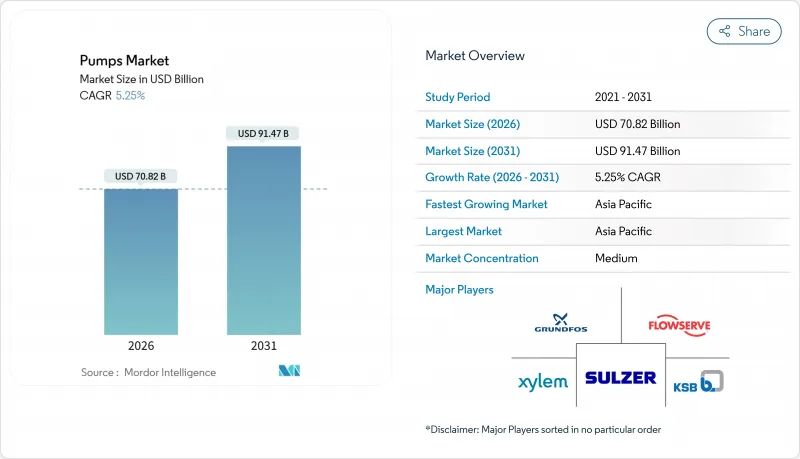
根據 Mordor Intelligence 估計,2026 年泵浦市值為 708.2 億美元,預計在預測期(2026-2031 年)內將以 5.25% 的複合年成長率成長,到 2031 年達到 914.7 億美元。
本報告按泵類型(離心泵和容積泵)、驅動技術(電動馬達、柴油/燃氣引擎、太陽能/可再生能源、磁力驅動/無密封)、安裝類型(地上、水下、垂直直列式)、應用(供水/污水、發電、採礦/冶金、其他)和地區(北美、歐洲、亞太地區、南美、中東和非洲)進行南美、中東和非洲)進行分類。
全球泵浦市場趨勢與洞察
擴大中東和北非 (MENA) 以及亞太 (APAC) 地區海水淡化項目的資本支出 (CAPEX)。
沙烏地阿拉伯國家水資源策略概述了一項計劃,擬在2030年前投資130億美元,以擴大其逆滲透(RO)處理能力,這將加速對採用耐氯化物應力開裂雙相不銹鋼內件的高壓離心式幫浦的需求。 2025年3月,阿拉伯聯合大公國阿布達比水電局簽署了一份價值11億美元的契約,用於建造塔維拉RO-3工廠。該合約規定安裝12台多段離心式幫浦,每台泵的額定流量為1200立方米/小時。印度的「飲用水生命線計畫」(Jal Jeevan Mission)已累計6萬印度盧比(約72億美元)用於2025-2026年的沿海海水淡化試點項目,並強制要求採用能源回收系統,該系統可在泵浦的整個生命週期內降低高達30%的成本。中國「十四五」規劃提出到2027年新增海水淡化產能290萬立方公尺/日,公共產業正根據ISO 9001和API 610標準對泵浦OEM製造商進行預認證。由於每10萬立方公尺/日的海水淡化模組需要8至12台供水幫浦及配套的鹽水循環裝置,離心式幫浦產品的短期訂單正在成長。
歐洲和北美對污水再利用有嚴格的規定
歐盟修訂後的《都市廢水處理指令》規定,到2030年12月,人口超過1萬的城市必須進行三級處理,這意味著6200個污水處理廠需要維修,每個廠需額外安裝4至6台變頻泵。加州2023年「水資源韌性計畫」設定了2030年再生水使用率達到30%的目標,並撥款28億美元用於維修污水處理廠,加裝增壓泵以彌補膜處理造成的壓力損失。美國正在審議的PFAS法規將要求12,000個公共供水系統安裝連接到顆粒活性碳處理管線的新型泵浦級。供水事業傾向於選擇能夠提供耐腐蝕合金和IE3或更高馬達效率的原始設備製造商(OEM),預計短期內訂單將加速成長。
鎳和不銹鋼價格的波動推高了物料清單 (BOM) 的成本。
2025年第一季鎳現貨價格上漲18%,隨後在年底下跌9%,但這導致歐洲鋼廠雙相不鏽鋼溢價上漲7%至11%。鎳價10%的波動將使葉輪和殼體的成本增加4%至6%,從而擠壓中型OEM製造商的設備利潤率150至200個基點。儘管Flowserve在長期訂單中累計價格上漲條款,但由於原物料價格飆升,該公司在2024年仍面臨4,200萬美元的虧損。由於高氯化物和酸性氣體環境下可用的替代材料有限,沒有避險計畫的亞洲中小型製造商面臨更嚴重的利潤率下滑。競標週期正在縮短,一些承包商要求客戶提供材料以降低風險。
細分市場分析
在泵浦市場,預計到2025年,離心泵浦將佔56.97%的銷售額,年複合成長率達6.00%,主要得益於海水淡化模組、城市基礎設施升級和暖通空調維修等需求。光是在沙烏地阿拉伯的拉斯蓋爾工廠,就有18台額定流量為1800立方公尺/小時的多級離心式幫浦投入運作,凸顯了離心式幫浦在高流量、中等揚程應用中的規模經濟優勢。其成熟的供應鏈、符合ANSI B73.1和ISO 2858標準的標準化面積以及完善的售後服務網路,使其生命週期成本比容積式泵降低20-30%。單軸螺旋泵浦、隔膜泵和齒輪泵共同佔據了剩餘的市場佔有率,在粘度較高的流體和計量進料應用中呈現出穩定但小眾的成長,在這些應用中,自吸和處理剪切敏感流體至關重要。
容積式泵浦在製藥、乳製品和重油輸送領域仍佔據主導地位。根據美國FDA 2024年關於生技藥品連續生產的指導意見,各生產設施正轉向使用一次性隔膜泵,以消除交叉污染的風險。在加拿大阿薩巴斯卡地區,能夠提升黏度達10,000 cP原油的螺旋泵正在取代在高黏度下容易發生故障的離心式幫浦。然而,由於離心式幫浦具有模組化設計、低資本投入和易於現場維護等優勢,因此它們在水處理、污水處理和暖通空調泵市場仍可能佔據主導地位。
到2025年,74.90%的裝置將採用電動馬達驅動,由於IE3和IE4能源效率標準的實施,歐洲和北美地區的維修正在加速,預計這一佔有率的下降幅度將非常有限。與感應電動機整合的變頻驅動器可透過根據即時需求調節泵速,從而降低20%至30%的能耗。目前,柴油和燃氣引擎主要用於偏遠地區和緊急情況,因為對於功率超過56千瓦的引擎而言,符合Tier 4 Final和Stage V排放法規將增加8000至15000美元的後處理成本。
同時,太陽能發電預計到2025年僅佔總出貨量的6.50%,但其成長最快,年複合成長率高達9.30%。印度的PM-KUSUM補貼計畫已部署了180萬套系統,將農民的投資回收期縮短至四年。在肯亞、衣索比亞和奈及利亞,利用行動支付的「按需隨收隨付」模式將資本成本分攤到24至36個月,消除了小規模農戶的初始成本障礙。在高階機型中,磁力驅動無密封幫浦正被生命科學和精細化工企業廣泛採用,其零洩漏的優勢足以彌補40-50%的溢價。福斯公司報告稱,2024年此類設備的訂單將增加12%。因此,驅動技術正呈現出明顯的分化趨勢。在都市區工業領域,併網電動馬達已確立了穩固的地位,太陽能正在擴大離網裝置的面積,而磁力驅動系統正在高附加價值無菌運輸領域保護其利基市場。
區域分析
到2025年,亞太地區將佔全球泵浦銷售額的53.27%,預計到2031年將以5.90%的複合年成長率成長。光是印度的「飲用水生命線計畫」(Jal Jeevan Mission)就需要250萬至300萬台潛水泵,此外還需要80萬台增壓泵用於高海拔蓄水。同時,「總理庫蘇姆計畫」(PM-KUSUM)正在支持350萬小規模農戶安裝太陽能發電系統。在中國,到2027年,天津、青島和大連將新增約300萬立方公尺/日的海水淡化產能。東南亞製造業正以8.3%的成長率擴張,帶動了越南和泰國對工業流程的需求。
到2025年,歐洲將佔全球銷售額的21.40%,並以4.70%的複合年成長率持續成長。根據“都市污水處理指令”,三級處理設施的維修將影響6200座污水處理廠;與此同時,瑞典和丹麥區域供熱的脫碳進程正在加速變速泵的更換。儘管燃煤發電廠的逐步淘汰將部分降低對鍋爐給水泵的需求,但泰晤士水務公司耗資55億美元的「泰晤士河隧道」計畫到2027年仍將需要36台大型泵浦。
預計到2025年,北美地區的銷售額將佔全球總銷售額的14.60%,年增4.90%。深海開發,特別是殼牌的「鯨魚」項目和BP的「泥狗2號」項目,預計將為潛水泵帶來大量訂單;同時,加州強制使用再生水的政策正在加速三級處理設施的維修。在加拿大重質燃油產業,螺桿幫浦正被用來彌補再生煤用於熱能生產而導致的需求下降。
到2025年,南美洲將佔總銷售額的6.30%,年複合成長率達5.60%,主要得益於巴西鹽層下計畫和智利銅礦的擴張。中東和非洲地區預計到2025年將佔總銷售額的4.43%,年複合成長率將達到6.10%,遠超其他地區,主要得益於肯亞、衣索比亞和奈及利亞對海水淡化和太陽能水泵的投資和推廣。
其他福利:
- Excel格式的市場預測(ME)表
- 3個月的分析師支持
目錄
第1章:引言
- 研究假設和市場定義
- 調查範圍
第2章:調查方法
第3章執行摘要
第4章 市場狀況
- 市場概覽
- 市場促進因素
- 擴大中東和北非 (MENA) 以及亞太 (APAC) 地區海水淡化項目的資本支出 (CAPEX)。
- 歐洲和北美嚴格的污水再利用規定
- 美國墨西哥灣和巴西的頁岩油氣和深海油氣計畫迅速擴張。
- 北歐和中東地區的區域供暖和製冷裝置數量正在迅速增加。
- 印度和非洲農業灌溉電氣化(太陽能水泵)
- 市場限制因素
- 鎳和不銹鋼價格的波動推高了成本。
- 中國低成本製造商的增加給利潤率帶來了壓力。
- 經合組織國家發電工程的減少抑制了對循環泵的需求。
- 由於地方政府的設備更換週期較長(15-20年),因此每年銷售的設備數量有限。
- 供應鏈分析
- 監理展望
- 技術展望
- 波特五力模型
第5章 市場規模與成長預測
- 泵浦類型
- 離心式幫浦
- 正位移
- 透過驅動技術
- 電動機
- 柴油/燃氣引擎
- 太陽能發電/可再生能源
- 磁力驅動/無密封
- 按安裝類型
- 地面安裝
- 水下安裝類型
- 垂直內聯字體
- 透過使用
- 水和污水處理
- 化工/石油化工
- 暖通空調及建築設施
- 石油和天然氣(上游、中游、下游)
- 食品/飲料
- 採礦和金屬
- 發電(火力發電、核能、可再生能源發電)
- 製藥和生物技術
- 其他
- 按地區
- 北美洲
- 美國
- 加拿大
- 墨西哥
- 歐洲
- 英國
- 德國
- 法國
- 西班牙
- 北歐國家
- 俄羅斯
- 土耳其
- 其他歐洲國家
- 亞太地區
- 中國
- 印度
- 日本
- 韓國
- 馬來西亞
- 泰國
- 印尼
- 越南
- 澳洲
- 其他亞太國家
- 南美洲
- 巴西
- 阿根廷
- 哥倫比亞
- 其他南美國家
- 中東和非洲
- 沙烏地阿拉伯
- 阿拉伯聯合大公國
- 南非
- 埃及
- 奈及利亞
- 卡達
- 其他中東和非洲國家
- 北美洲
第6章 競爭情勢
- 市場集中度
- 策略趨勢(併購、聯盟、購電協議)
- 市場佔有率分析(主要公司的市場排名和佔有率)
- 公司簡介
- Flowserve Corporation
- Grundfos Holding A/S
- KSB SE & Co. KGaA
- ITT Inc.
- Sulzer Ltd.
- Ebara Corporation
- Weir Group plc
- Xylem Inc.
- Wilo SE
- Pentair plc
- Tsurumi Manufacturing Co. Ltd.
- Torishima Pump Mfg. Co. Ltd.
- Baker Hughes Company
- Schlumberger Limited
- Celeros Flow Technology LLC
- Atlas Copco AB
- Kirloskar Brothers Ltd.
- Ruhrpumpen Group
- Desmi A/S
- Zoeller Pump Co.
第7章 市場機會與未來展望
According to Mordor Intelligence, the pumps market size is estimated at USD 70.82 billion in 2026, and is expected to reach USD 91.47 billion by 2031, at a CAGR of 5.25% during the forecast period (2026-2031).
This report is Segmented by Pump Type (Centrifugal and Positive-Displacement), Drive Technology (Electric Motor, Diesel/Gas Engine, Solar/Renewable, and Magnetically-Driven/Sealless), Position (Surface, Submersible, and Vertical In-Line), Application (Water and Wastewater, Power Generation, Mining and Metals, and More), and Geography (North America, Europe, Asia-Pacific, South America, and Middle East and Africa).
Global Pumps Market Trends and Insights
Escalating CAPEX in Desalination Projects across MENA & APAC
Saudi Arabia's National Water Strategy directs USD 13 billion to reverse-osmosis capacity through 2030, pulling forward demand for high-pressure centrifugal units with duplex stainless-steel internals that resist chloride stress cracking. The UAE's Abu Dhabi Water and Electricity Authority awarded a USD 1.1 billion contract in March 2025 for the Taweelah RO-3 plant, which specifies 12 multistage centrifugal pumps rated at 1,200 m3/h each. India's Jal Jeevan Mission earmarked INR 60,000 crore (USD 7.2 billion) in 2025-26 for coastal desalination pilots, mandating energy-recovery devices that cut lifecycle pumping costs by up to 30%. China's 14th Five-Year Plan adds 2.9 million m3/day of desalination by 2027, with utilities pre-qualifying pump OEMs under ISO 9001 and API 610 standards. Each 100,000 m3/day module demands 8-12 feed pumps plus matching brine-circulation units, advancing near-term bookings for centrifugal lines.
Stringent Wastewater Reuse Mandates in Europe & North America
The EU's updated Urban Wastewater Treatment Directive obliges tertiary treatment for towns above 10,000 population equivalents by December 2030, prompting 6,200 facilities to retrofit 4-6 additional variable-frequency-drive pumps per site. In California, the 2023 Water Resilience Portfolio targets 30% recycled-water use by 2030, releasing USD 2.8 billion for treatment-plant upgrades that incorporate booster pumps to compensate for membrane pressure drops. Pending U.S. PFAS limits will force 12,000 public systems to install new pumping stages linked to granular activated carbon trains. Utilities favor OEMs offering corrosion-resistant alloys and IE3-plus motor efficiencies, accelerating order flow in the short term.
Volatility in Nickel & Stainless-Steel Prices Inflating BoM
Nickel spot prices rose 18% in Q1 2025 before easing 9% by year-end, pushing duplex stainless-steel surcharges up 7-11% at European mills. A 10% nickel move raises impeller and casing costs 4-6%, squeezing equipment margins 150-200 bp among mid-tier OEMs. Flowserve recorded a USD 42 million material-inflation headwind in 2024 despite escalation clauses on long-cycle orders. Smaller Asian fabricators lacking hedging programs face deeper margin erosion because material substitution is limited in chloride-rich or sour-gas services. Bid validity periods have shortened, and some contractors insist on owner-supplied materials to mitigate exposure.
Other drivers and restraints analyzed in the detailed report include:
- Rapid Expansion of Shale & Deep-water O&G Projects in US Gulf & Brazil
- Surging District Cooling & Heating Installations in Nordics & Middle East
- Proliferation of Low-cost Chinese Manufacturers Compressing Margins
For complete list of drivers and restraints, kindly check the Table Of Contents.
Segment Analysis
Centrifugal designs accounted for 56.97% of 2025 revenue in the pump market and will register a 6.00% forecast CAGR on the back of desalination modules, municipal upgrades, and HVAC retrofits. The Ras Al Khair facility in Saudi Arabia alone operates 18 multistage centrifugal pumps rated at 1,800 m3/h, highlighting the scale advantage centrifugal frames command in high-flow, moderate-head duty. Their mature supply chain, standardized footprints under ANSI B73.1 and ISO 2858, and broad aftermarket network cut lifecycle costs 20-30% relative to positive-displacement alternatives. Progressive-cavity, diaphragm, and gear pumps together form the remainder of the market, finding steady but niche growth in viscous-fluid and metering applications where self-priming or shear-sensitive handling is non-negotiable.
Positive-displacement models retain firm footholds in pharmaceuticals, dairy, and heavy-oil transfer. The US FDA's 2024 guidance on continuous biologics manufacturing is pivoting facilities toward single-use diaphragm pumps that eliminate cross-contamination risk. In Canada's Athabasca region, screw pumps able to lift 10,000 cP crude are replacing centrifugal units that stall under high viscosity. However, centrifugal units will continue to dominate the pump market size for water, wastewater, and HVAC thanks to modular designs, lower capital intensity, and easier field maintenance.
Electric motors powered 74.90% of installations in 2025, a share expected to erode only modestly as IE3 and IE4 efficiency mandates accelerate retrofits across Europe and North America. Variable-frequency drives integrated with induction motors can slash energy draw 20-30% by matching pump speed to real-time demand. Diesel and gas engines now mainly serve remote or emergency settings because compliance with Tier 4 Final and Stage V exhaust limits adds USD 8,000-15,000 in after-treatment costs above 56 kW.
Meanwhile, solar-driven configurations, a slender 6.50% of 2025 volume, are scaling fastest at a 9.30% CAGR. India's PM-KUSUM subsidy has already deployed 1.8 million systems, shrinking farmer payback periods to four years. Pay-as-you-go models leveraging mobile money in Kenya, Ethiopia, and Nigeria distribute capital costs over 24-36 months, removing the upfront barrier for smallholders. At the premium end, magnetically driven sealless pumps serve life-science and fine-chemical plants where zero leakage outweighs 40-50% higher list prices; Flowserve logged a 12% jump in 2024 orders for such units. The drive-technology split consequently bifurcates: grid-tied electric motors hold entrenched positions in urban industry, solar expands off-grid acreage, and mag-drive variants protect high-value sterile-transfer niches.
Complete Report Scope:
- By Pump Type
- Centrifugal
- Positive-Displacement
- By Drive Technology
- Electric Motor
- Diesel/Gas Engine
- Solar/Renewable
- Magnetically-Driven/Sealless
- By Position
- Surface
- Submersible
- Vertical In-Line
- By Application
- Water and Wastewater
- Chemical and Petrochemical
- HVAC and Building Services
- Oil and Gas (Upstream, Midstream, Downstream)
- Food and Beverage
- Mining and Metals
- Power Generation (Thermal, Nuclear, Renewables)
- Pharmaceuticals and Biotech
- Others
- By Geography
- North America
- United States
- Canada
- Mexico
- Europe
- United Kingdom
- Germany
- France
- Spain
- NORDIC Countries
- Russia
- Turkey
- Rest of Europe
- Asia-Pacific
- China
- India
- Japan
- South Korea
- Malaysia
- Thailand
- Indonesia
- Vietnam
- Australia
- Rest of Asia-Pacific
- South America
- Brazil
- Argentina
- Colombia
- Rest of South America
- Middle East and Africa
- Saudi Arabia
- United Arab Emirates
- South Africa
- Egypt
- Nigeria
- Qatar
- Rest of Middle East and Africa
- North America
Geography Analysis
Asia-Pacific commanded 53.27% of the 2025 global revenue in the pump market and is projected to grow at a 5.90% CAGR to 2031. India's Jal Jeevan Mission alone needs 2.5-3 million submersible borehole pumps plus 800,000 boosters for elevated storage, while PM-KUSUM underwrites solar sets for 3.5 million smallholders. China adds nearly 3 million m3/day of desalination by 2027 in Tianjin, Qingdao, and Dalian. Southeast Asian manufacturing growth at 8.3% is spurring industrial-process demand in Vietnam and Thailand.
Europe accounted for 21.40% of 2025 revenue and advances at a 4.70% CAGR. Tertiary-treatment retrofits under the Urban Wastewater Directive affect 6,200 plants, while decarbonizing district heating across Sweden and Denmark stimulates variable-speed pump upgrades. Coal retirements eliminate some boiler-feed replacements, yet Thames Water's USD 5.5 billion Tideway Tunnel requires 36 large units by 2027.
North America held 14.60% of 2025 turnover, forecast to expand at 4.90%. Deepwater development, notably Shell's Whale project and BP's Mad Dog 2, locks in submersible orders, while California's recycled-water mandate drives tertiary-treatment retrofits. Canada's heavy-oil segment relies on progressive-cavity pumps, balancing lost thermal-coal circulation demand.
South America delivered 6.30% of 2025 sales and grew at 5.60% on Brazil's pre-salt projects and Chilean copper mine expansions. Middle East and Africa, 4.43% of 2025 value, outpace at 6.10% CAGR thanks to desalination CAPEX and solar-pump rollouts in Kenya, Ethiopia, and Nigeria.
- Flowserve Corporation
- Grundfos Holding A/S
- KSB SE & Co. KGaA
- ITT Inc.
- Sulzer Ltd.
- Ebara Corporation
- Weir Group plc
- Xylem Inc.
- Wilo SE
- Pentair plc
- Tsurumi Manufacturing Co. Ltd.
- Torishima Pump Mfg. Co. Ltd.
- Baker Hughes Company
- Schlumberger Limited
- Celeros Flow Technology LLC
- Atlas Copco AB
- Kirloskar Brothers Ltd.
- Ruhrpumpen Group
- Desmi A/S
- Zoeller Pump Co.
Additional Benefits:
- The market estimate (ME) sheet in Excel format
- 3 months of analyst support
TABLE OF CONTENTS
1 Introduction
- 1.1 Study Assumptions & Market Definition
- 1.2 Scope of the Study
2 Research Methodology
3 Executive Summary
4 Market Landscape
- 4.1 Market Overview
- 4.2 Market Drivers
- 4.2.1 Escalating CAPEX in Desalination Projects across MENA & APAC
- 4.2.2 Stringent Waste-water Reuse Mandates in Europe & North America
- 4.2.3 Rapid Expansion of Shale & Deep-water O&G Projects in US Gulf & Brazil
- 4.2.4 Surging District Cooling & Heating Installations in Nordics & Middle East
- 4.2.5 Electrification of Agricultural Irrigation (Solar Pumps) in India & Africa
- 4.3 Market Restraints
- 4.3.1 Volatility in Nickel & Stainless-Steel Prices Inflating BoM
- 4.3.2 Proliferation of Low-cost Chinese Manufacturers Compressing Margins
- 4.3.3 Declining Thermal Power Pipeline in OECD Curtailing Circulation Pumps
- 4.3.4 Long Municipal Replacement Cycles (15?20 yrs) Limiting Annual Sales
- 4.4 Supply-Chain Analysis
- 4.5 Regulatory Outlook
- 4.6 Technological Outlook
- 4.7 Porter's Five Forces
- 4.7.1 Bargaining Power of Suppliers
- 4.7.2 Bargaining Power of Buyers
- 4.7.3 Threat of New Entrants
- 4.7.4 Threat of Substitutes
- 4.7.5 Competitive Rivalry
5 Market Size & Growth Forecasts
- 5.1 By Pump Type
- 5.1.1 Centrifugal
- 5.1.2 Positive-Displacement
- 5.2 By Drive Technology
- 5.2.1 Electric Motor
- 5.2.2 Diesel/Gas Engine
- 5.2.3 Solar/Renewable
- 5.2.4 Magnetically-Driven/Sealless
- 5.3 By Position
- 5.3.1 Surface
- 5.3.2 Submersible
- 5.3.3 Vertical In-Line
- 5.4 By Application
- 5.4.1 Water and Wastewater
- 5.4.2 Chemical and Petrochemical
- 5.4.3 HVAC and Building Services
- 5.4.4 Oil and Gas (Upstream, Midstream, Downstream)
- 5.4.5 Food and Beverage
- 5.4.6 Mining and Metals
- 5.4.7 Power Generation (Thermal, Nuclear, Renewables)
- 5.4.8 Pharmaceuticals and Biotech
- 5.4.9 Others
- 5.5 By Geography
- 5.5.1 North America
- 5.5.1.1 United States
- 5.5.1.2 Canada
- 5.5.1.3 Mexico
- 5.5.2 Europe
- 5.5.2.1 United Kingdom
- 5.5.2.2 Germany
- 5.5.2.3 France
- 5.5.2.4 Spain
- 5.5.2.5 NORDIC Countries
- 5.5.2.6 Russia
- 5.5.2.7 Turkey
- 5.5.2.8 Rest of Europe
- 5.5.3 Asia-Pacific
- 5.5.3.1 China
- 5.5.3.2 India
- 5.5.3.3 Japan
- 5.5.3.4 South Korea
- 5.5.3.5 Malaysia
- 5.5.3.6 Thailand
- 5.5.3.7 Indonesia
- 5.5.3.8 Vietnam
- 5.5.3.9 Australia
- 5.5.3.10 Rest of Asia-Pacific
- 5.5.4 South America
- 5.5.4.1 Brazil
- 5.5.4.2 Argentina
- 5.5.4.3 Colombia
- 5.5.4.4 Rest of South America
- 5.5.5 Middle East and Africa
- 5.5.5.1 Saudi Arabia
- 5.5.5.2 United Arab Emirates
- 5.5.5.3 South Africa
- 5.5.5.4 Egypt
- 5.5.5.5 Nigeria
- 5.5.5.6 Qatar
- 5.5.5.7 Rest of Middle East and Africa
- 5.5.1 North America
6 Competitive Landscape
- 6.1 Market Concentration
- 6.2 Strategic Moves (M&A, Partnerships, PPAs)
- 6.3 Market Share Analysis (Market Rank/Share for key companies)
- 6.4 Company Profiles (includes Global level Overview, Market level overview, Core Segments, Financials as available, Strategic Information, Products & Services, and Recent Developments)
- 6.4.1 Flowserve Corporation
- 6.4.2 Grundfos Holding A/S
- 6.4.3 KSB SE & Co. KGaA
- 6.4.4 ITT Inc.
- 6.4.5 Sulzer Ltd.
- 6.4.6 Ebara Corporation
- 6.4.7 Weir Group plc
- 6.4.8 Xylem Inc.
- 6.4.9 Wilo SE
- 6.4.10 Pentair plc
- 6.4.11 Tsurumi Manufacturing Co. Ltd.
- 6.4.12 Torishima Pump Mfg. Co. Ltd.
- 6.4.13 Baker Hughes Company
- 6.4.14 Schlumberger Limited
- 6.4.15 Celeros Flow Technology LLC
- 6.4.16 Atlas Copco AB
- 6.4.17 Kirloskar Brothers Ltd.
- 6.4.18 Ruhrpumpen Group
- 6.4.19 Desmi A/S
- 6.4.20 Zoeller Pump Co.
7 Market Opportunities & Future Outlook
- 7.1 White-space & Unmet-Need Assessment

 軸流泵和混流泵:市場佔有率分析、行業趨勢和統計數據以及成長預測(2026-2031 年)
 農業泵浦市場-2026-2032年全球市場預測
 2026年全球電動幫浦市場報告2026年全球泵浦市場報告泵浦市場:2026-2032年全球市場預測(按泵浦類型、技術、動力來源、最終用戶、應用、分銷管道和額定功率分類)
 ATEX幫浦市場 - 全球產業規模、佔有率、趨勢、機會、預測:按類型、最終用戶產業、地區和競爭格局分類,2021-2031年
 泵浦市場機會、成長要素、產業趨勢分析及2026-2035年預測。
 固態廢棄物處理用防堵塞幫浦市場預測至2034年-按類型、材質、最終用戶和地區分類的全球分析工業氣動幫浦市場預測至2034年-按產品、類型、材質、應用、最終用戶和地區分類的全球分析地熱流體幫浦市場:2026年至2032年全球市場預測(按泵浦類型、能源來源、部署模式、輸出、材質、應用和最終用戶分類)