


 |
市場調查報告書
商品編碼
2125386
閥門:市場佔有率分析、行業趨勢和統計數據、成長預測(2026-2031 年)Valves - Market Share Analysis, Industry Trends & Statistics, Growth Forecasts (2026 - 2031) |
||||||

※ 本網頁內容可能與最新版本有所差異。詳細情況請與我們聯繫。
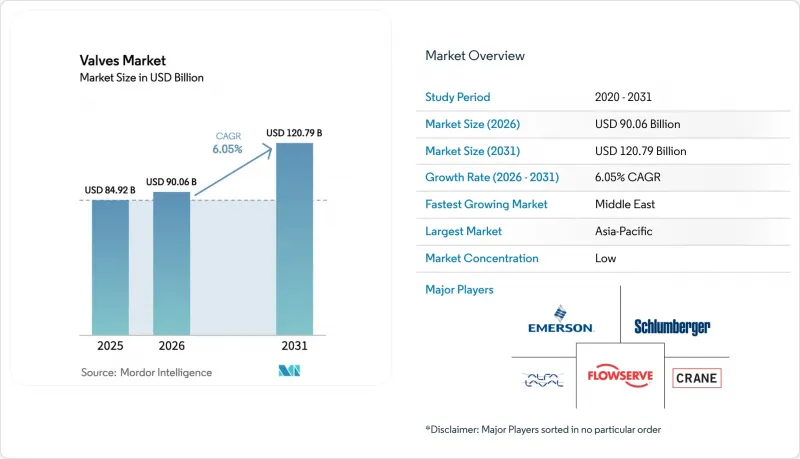
根據 Mordor Intelligence 預測,閥門市場規模將從 2025 年的 849.2 億美元成長到 2026 年的 900.6 億美元,然後在 2031 年達到 1,207.9 億美元,2026 年至 2031 年的複合年成長率為 6.05%。
本報告按閥門類型(球閥、蝶閥、閘閥、截止閥、止回閥、塞閥、控制閥等)、材質(不銹鋼、碳鋼、合金鋼、低溫材料等)、操作方式(手動、電動、氣壓、液壓等)、終端用戶行業(石油天然氣、發電、化學、用水和污水、採礦等)和地區進行細分。市場預測以美元(USD)計價。
全球閥門市場趨勢及洞察
基礎建設相關發展增加
對供水管網、公路和區域供熱系統的維修和擴建投入了大量資金,這加快了確保可靠關閉、控制氣蝕和延長使用壽命的閥門的採購進度。光是賓州美國水務公司就制定了2024-2026年耗資5.86億美元的維修計劃,安大略省也批准了9.7億加元(約7.19億美元)的預算用於加固都市區管道。印度的「飲用水生命線計畫」(Jal Jeevan Mission)和沙烏地阿拉伯的國家水戰略也投入了類似的巨額預算,使原始設備製造商(OEM)能夠實現組裝本地化,並擴大其不銹鋼和球墨鑄鐵鑄造能力。此外,為提高城市韌性,相關規範也不斷擴展,納入了抗水錘蝶閥和可與區域SCADA平台無縫整合的智慧減壓閥。
石油和天然氣領域能源項目的擴張
上游和中游業者正將資金集中投入到複雜的高壓資產上,在這些資產中,遵守洩漏和排放法規以及使用數位化性能儀錶板至關重要。阿布達比國家石油公司 (ADNOC) 決定委託福斯公司為其年處理量 150 萬噸的碳捕集設施提供乾氣密封系統,這清楚地表明了可靠性和先進密封技術的重要性。隨著海上生產向更深水域轉移,全金屬密封件和狀態監測感測器正成為額定壓力超過 15,000 psi 的球閥和海底閘閥的標準配置。同時,北美頁岩油生產商正在對現有設施進行改造,加裝低洩漏氣動控制器,從而推動了售後市場對改裝套件和自我診斷執行器的需求。
原物料價格波動
2024年全年,不銹鋼和合金鋼的價格指數波動劇烈,給那些合約中包含多年交貨期和價格漲幅上限條款的原始設備製造商(OEM)帶來了巨大挑戰。製造商採取的應對措施包括供應商多元化、購買期貨鋼坯以及使用性能相近的合金替代,但這些措施增加了營運資金需求,並延長了認證前置作業時間。價格波動對入門級蝶閥和閘閥的影響最為嚴重。這是因為終端用戶抵制價格上漲,迫使製造商在現貨市場穩定之前承受利潤率下降的局面。
細分市場分析
球閥憑藉其低扭矩操作和多端口通用性的優勢,在2025年仍保持閥門市場佔有率37.10%的領先地位。控制閥預計將以6.65%的複合年成長率成長,這主要得益於連續製程工業中數位定位器在實現更精確迴路控制方面的應用日益廣泛。這一趨勢正在擴大化工廠和發電廠中先進球閥、V型球閥和旋塞閥的市場佔有率。將自我診斷功能整合到控制閥組件中,有助於操作人員減少非計劃性停機時間,從而顯著提高生產效率。
各類閥門均有產品創新。蝶閥採用三偏心設計,增強雙向零洩漏密封性能;海底閘閥則採用非侵入式致動器,簡化維護。福斯公司(Flowserve)的高溫填料歐洲專利表明,研發工作正不斷拓展安全工作溫度範圍,使其超過1200°F(654°C)。同時,止回閥製造商正在重新設計閥瓣形狀,以降低壓力損失,從而滿足管道輸送的能源效率目標。
預計到2025年,不銹鋼的市佔率將達到45.05%,這鞏固了其作為煉油廠、海水淡化廠和食品加工廠等通用應用領域首選合金的地位。然而,液化天然氣出口終端和液氫先導工廠的建設正推動9%鎳合金和奧氏體不銹鋼等低溫合金的複合年成長率達到7.24%,從而擴大了特種鍛造閥門的市場規模。在環境水和非腐蝕性氣體管道領域,碳鋼仍然具有競爭力,因為預算限制會影響採購決策。
積層製造技術正逐漸在對運作條件要求苛刻的特定應用領域獲得認可,而Samson公司已成為首家獲得歐盟認證,其壓力設備採用粉末層熔融(PBF)技術製造的公司。這項突破性技術能夠設計出複雜的流道,從而減少球閥閥體內的湍流和侵蝕。塑膠閥門先前因溫度限制而應用受限,但隨著新型氟聚合物混合物的應用,其耐溫能力提升至120 度C,應用範圍也隨之擴展,例如在氯鹼和半導體濕式製程台等應用領域。
區域分析
亞太地區預計在2025年仍將佔據閥門市場37.75%的主導地位,這主要得益於中國和印度的基礎建設蓬勃發展,包括水上地鐵系統、大型煉油廠和半導體製造廠等。區域各國政府正為高速鐵路走廊和防洪庫建設撥出多年預算,這些項目都對截止閥和控制設備產生了顯著的採購需求。此外,日本運作重啟計畫推動了ASME BPVC認證的1級安全閥需求的復甦,而韓國的智慧工廠計畫則促進了數位執行器的應用。澳洲的液化天然氣補充計畫和印尼的鎳加工廠也進一步支撐了該地區的銷售量。
預計到2031年,中東地區將以7.19%的複合年成長率實現最高增速,這主要得益於沙烏地阿拉伯「2030願景」下的經濟多元化、卡達北田液化天然氣項目的擴建以及阿拉伯聯合大公國對可再生能源海水淡化技術的投資。艾默生決定在沙烏地阿拉伯建立製造地,表明該地區正從依賴進口轉向滿足國內採購比例要求的在地化採購。包括阿布達比國家在地採購(ADNOC)年處理量150萬噸的碳捕獲項目在內的碳捕獲計劃,均指定使用低排放量閥門組件,這為福斯(Flowserve)和威蘭(Veran)等公司的工程解決方案帶來了高價值的商機。
在北美,成熟的現有基礎設施和技術升級週期共同推動了無排氣氣動控制器的維修,尤其是在頁岩氣收集網路中,以降低甲烷排放強度。美國兩黨基礎設施法案提供的聯邦基礎設施津貼正在加速市政供水管道的現代化改造,從而帶動了對蝶閥和排氣產品的強勁需求。歐洲的脫碳藍圖正在投資建造氫能走廊和碳捕獲與封存(CCS)叢集,這推動了對低溫和高合金產品需求的成長。在東歐市場,隨著區域供熱網路的重組,具有熱循環耐受性的三偏心蝶閥的應用正在逐步擴大。
其他好處:
- Excel格式的市場預測(ME)表
- 3個月的分析師支持
目錄
第1章:引言
- 研究假設和市場定義
- 調查範圍
第2章:調查方法
第3章執行摘要
第4章 市場狀況
- 市場概覽
- 市場促進因素
- 基礎建設相關發展增加
- 石油和天然氣領域能源項目的擴張
- 對用水和污水處理的投資
- 工業自動化和智慧閥門
- 氫能經濟的發展
- 模組化核子反應爐
- 市場限制因素
- 原物料價格波動
- 缺乏全球統一的認證體系
- 智慧閥門的網路安全風險
- 密封材料供應鏈的集中化
- 產業價值鏈分析
- 監理情勢
- 技術展望
- 宏觀經濟因素的影響
- 波特五力分析
- 投資分析
第5章 市場規模與成長預測
- 按閥門類型
- 球閥
- 蝶閥
- 閘閥
- 球閥
- 單向閥
- 塞閥
- 控制閥
- 其他閥門類型
- 材料
- 不銹鋼
- 碳鋼
- 合金鋼
- 極低溫度
- 塑膠
- 其他材料
- 驅動類型
- 手動的
- 電的
- 氣壓
- 油壓
- 智慧(電動液壓式)
- 其他操作方法
- 按最終用戶行業分類
- 石油和天然氣
- 發電
- 化學品
- 水和污水處理
- 礦業
- 其他終端用戶產業
- 按地區
- 北美洲
- 美國
- 加拿大
- 墨西哥
- 南美洲
- 巴西
- 阿根廷
- 其他南美國家
- 歐洲
- 德國
- 英國
- 法國
- 義大利
- 西班牙
- 俄羅斯
- 其他歐洲國家
- 亞太地區
- 中國
- 日本
- 印度
- 韓國
- 澳洲和紐西蘭
- 其他亞太國家
- 中東
- 沙烏地阿拉伯
- 阿拉伯聯合大公國
- 土耳其
- 其他中東國家
- 非洲
- 南非
- 奈及利亞
- 埃及
- 其他非洲國家
- 北美洲
第6章 競爭情勢
- 市場集中度
- 策略趨勢
- 市佔率分析
- 公司簡介
- Emerson Electric Co.
- Flowserve Corporation
- Schlumberger NV
- Alfa Laval AB
- Crane Company
- Rotork plc
- IMI plc
- SAMSON AKTIENGESELLSCHAFT
- KITZ Corporation
- Spirax-Sarco Engineering plc
- AVK Holding A/S
- Velan Inc.
- Metso Oyj
- Baker Hughes Company
- Parker Hannifin Corporation
- The Weir Group PLC
- OMB Valves SpA
- Cla-Val Co.
- CIRCOR International Inc.
- Curtiss-Wright Corporation
- Neway Valve(Suzhou)Co., Ltd.
第7章 市場機會與未來展望
According to Mordor Intelligence, the valves market size is expected to grow from USD 84.92 billion in 2025 to USD 90.06 billion in 2026 and is forecast to reach USD 120.79 billion by 2031 at 6.05% CAGR over 2026-2031.
This report is Segmented by Valve Type (Ball, Butterfly, Gate, Globe, Check, Plug, Control, and More), Material (Stainless Steel, Carbon Steel, Alloy Steel, Cryogenic, and More), Actuation Type (Manual, Electric, Pneumatic, Hydraulic, and More), End-User Vertical (Oil and Gas, Power Generation, Chemical, Water and Wastewater, Mining, and More), and Geography. The Market Forecasts are Provided in Terms of Value (USD).
Global Valves Market Trends and Insights
Rise in Infrastructure-Related Developments
Capital committed to repairing and expanding water networks, expressways, and district energy systems is pulling forward purchasing schedules for valves that deliver tight shut-off, cavitation control, and long service life. Pennsylvania American Water alone programmed USD 586 million in upgrades for 2024-2026, while Ontario approved CAD 970 million (USD 719 million) to reinforce municipal pipelines. Similar headline allocations are appearing in India's Jal Jeevan Mission and Saudi Arabia's National Water Strategy, prompting OEMs to localize assembly lines and raise stainless and ductile-iron casting capacities. Urban resilience mandates are also broadening specification sheets to include surge-proof butterfly valves and smart pressure-reducing valves that integrate seamlessly with district SCADA platforms.
Growing Energy Projects in Oil and Gas Sector
Upstream and midstream operators are concentrating capital on complex, high-pressure assets where fugitive-emission compliance and digital performance dashboards are non-negotiable. ADNOC's decision to entrust Flowserve with dry-gas-seal systems for a 1.5 million ton-per-year carbon-capture installation underscores the premium placed on reliability and engineered sealing. As offshore production migrates toward deeper waters, ball and subsea gate valves rated above 15 000 psi are standardizing on all-metal seals and condition-monitoring sensors. Simultaneously, North American shale producers are retrofitting existing sites with low-bleed pneumatic controllers, propelling aftermarket demand for conversion kits and self-diagnosing actuators.
Volatility in Raw-Material Prices
Stainless and alloy-steel indices vacillated sharply throughout 2024, challenging OEMs whose contracts feature multi-year delivery windows and capped escalation clauses. Producers responded by widening supplier pools, forward-buying billet, and substituting near-equivalent alloys, but these tactics inflate working-capital needs and introduce qualification lead times. Pricing turbulence hits entry-level butterfly and gate valves hardest because end-users resist pass-throughs, forcing manufacturers to absorb margin erosion until spot markets stabilize.
Other drivers and restraints analyzed in the detailed report include:
- Investments in Water and Wastewater Treatment
- Industrial Automation and Smart Valves
- Lack of Standardized Global Certification
For complete list of drivers and restraints, kindly check the Table Of Contents.
Segment Analysis
Ball valves retained the highest 37.10% valves market share in 2025 on the strength of their low-torque operation and multi-port versatility. Control valves are projected to lead growth at a 6.65% CAGR because continuous process industries increasingly specify digital positioners for tighter loop control. This preference lifts the valves market size allocation for advanced globe, V-port ball, and rotary plug designs in chemical and power plants. The integration of self-diagnostics into control-valve assemblies is helping operators cut unscheduled downtime, translating into measurable productivity gains.
Product innovation is visible across all major styles: butterfly valves are adopting triple-offset geometries to enhance zero-leak bi-directional sealing, while gate valves destined for subsea positions feature non-intrusive actuators to simplify maintenance. Flowserve's European patent covering high-temperature packing materials demonstrates how R and D continues to push safe operating envelopes beyond 1 200°F. Meanwhile, check-valve makers are re-engineering disc profiles for lower pressure drop, responding to energy-efficiency targets in pipeline transport.
Stainless steel's 45.05% presence in 2025 underlines its status as the default alloy for general service across refineries, desalination, and food processing installations. However, LNG export terminals and liquid hydrogen pilot plants are propelling a 7.24% CAGR in cryogenic alloys such as 9% nickel and austenitic-stainless variants, expanding the Valves market size for specialty forgings. Carbon-steel grades continue to compete in room-temperature water and non-corrosive gas lines where budget discipline dominates procurement decisions.
Additive manufacturing is gradually penetrating niche severe-service applications, with SAMSON earning the first EU certificate for pressure equipment produced via powder-bed fusion. This breakthrough allows intricate flow paths that reduce turbulence and erosion inside globe-valve bodies. Plastic valves, traditionally capped by temperature limits, are also progressing via new fluoropolymer blends that tolerate up to 120 °C, widening their remit in chlor-alkali and semiconductor wet benches.
Complete Report Scope:
- By Valve Type
- Ball Valve
- Butterfly Valve
- Gate Valve
- Globe Valve
- Check Valve
- Plug Valve
- Control Valve
- Other Valve Types
- By Material
- Stainless Steel
- Carbon Steel
- Alloy Steel
- Cryogenic
- Plastic
- Other Materials
- By Actuation Type
- Manual
- Electric
- Pneumatic
- Hydraulic
- Smart (Electro-hydraulic)
- Other Actuation Types
- By End-User Vertical
- Oil and Gas
- Power Generation
- Chemical
- Water and Wastewater
- Mining
- Other End-User Verticals
- By Geography
- North America
- United States
- Canada
- Mexico
- South America
- Brazil
- Argentina
- Rest of South America
- Europe
- Germany
- United Kingdom
- France
- Italy
- Spain
- Russia
- Rest of Europe
- Asia Pacific
- China
- Japan
- India
- South Korea
- Australia and New Zealand
- Rest of Asia Pacific
- Middle East
- Saudi Arabia
- United Arab Emirates
- Turkey
- Rest of Middle East
- Africa
- South Africa
- Nigeria
- Egypt
- Rest of Africa
- North America
Geography Analysis
Asia Pacific maintained a commanding 37.75% Valves market share in 2025 on the back of aggressive infrastructure expansion in China and India, including water metros, mega-refineries, and semiconductor fabs. Regional governments allocate multi-year budgets to high-speed rail corridors and flood-control reservoirs, each generating high-volume requisitions for isolation and control devices. Japan's nuclear restart program is also refreshing demand for Class-1 safety valves certified under the ASME BPVC, whereas South Korea's smart-factory agenda boosts uptake of digitally native actuators. Australia's LNG backfill projects and Indonesia's nickel-processing plants further underpin regional volume.
The Middle East is projected to record the fastest 7.19% CAGR through 2031, energized by Saudi Arabia's Vision 2030 diversification, Qatar's LNG North Field expansion, and the United Arab Emirates' renewable desalination investments. Emerson's decision to establish a Saudi manufacturing hub signals the region's pivot from import reliance toward localized supply that meets in-kingdom content quotas. Carbon-capture initiatives such as ADNOC's 1.5 million tonnes per year project are specifying ultra-low-emission valve assemblies, opening premium opportunities for engineered packages from Flowserve and Velan.
North America combines mature installed bases with technology refresh cycles, particularly in shale gas gathering networks where ventless pneumatic controllers are retrofitted to curb methane intensity. Federal infrastructure grants under the U.S. Bipartisan Infrastructure Law accelerate municipal water replacement, keeping butterfly-valve and air-release product lines buoyant. Europe's decarbonization roadmap channels funds to hydrogen corridors and CCS clusters, pushing cryogenic and high-alloy inquiries. Eastern European markets, rebuilding district heating grids, create incremental adoption of triple-eccentric butterfly valves with thermal-cycling durability.
- Emerson Electric Co.
- Flowserve Corporation
- Schlumberger N.V.
- Alfa Laval AB
- Crane Company
- Rotork plc
- IMI plc
- SAMSON AKTIENGESELLSCHAFT
- KITZ Corporation
- Spirax-Sarco Engineering plc
- AVK Holding A/S
- Velan Inc.
- Metso Oyj
- Baker Hughes Company
- Parker Hannifin Corporation
- The Weir Group PLC
- OMB Valves S.p.A.
- Cla-Val Co.
- CIRCOR International Inc.
- Curtiss-Wright Corporation
- Neway Valve (Suzhou) Co., Ltd.
Additional Benefits:
- The market estimate (ME) sheet in Excel format
- 3 months of analyst support
TABLE OF CONTENTS
1 INTRODUCTION
- 1.1 Study Assumptions and Market Definition
- 1.2 Scope of the Study
2 RESEARCH METHODOLOGY
3 EXECUTIVE SUMMARY
4 MARKET LANDSCAPE
- 4.1 Market Overview
- 4.2 Market Drivers
- 4.2.1 Rise in infrastructure-related developments
- 4.2.2 Growing energy projects in oil and gas sector
- 4.2.3 Investments in water and wastewater treatment
- 4.2.4 Industrial automation and smart valves
- 4.2.5 Hydrogen economy build-out
- 4.2.6 Modular nuclear reactors
- 4.3 Market Restraints
- 4.3.1 Volatility in raw-material prices
- 4.3.2 Lack of standardized global certification
- 4.3.3 Cyber-security risks in intelligent valves
- 4.3.4 Seal material supply-chain concentration
- 4.4 Industry Value Chain Analysis
- 4.5 Regulatory Landscape
- 4.6 Technological Outlook
- 4.7 Impact of Macroeconomic Factors
- 4.8 Porter's Five Forces Analysis
- 4.8.1 Bargaining Power of Suppliers
- 4.8.2 Bargaining Power of Buyers
- 4.8.3 Threat of New Entrants
- 4.8.4 Threat of Substitutes
- 4.8.5 Intensity of Competitive Rivalry
- 4.9 Investment Analysis
5 MARKET SIZE AND GROWTH FORECASTS (VALUE)
- 5.1 By Valve Type
- 5.1.1 Ball Valve
- 5.1.2 Butterfly Valve
- 5.1.3 Gate Valve
- 5.1.4 Globe Valve
- 5.1.5 Check Valve
- 5.1.6 Plug Valve
- 5.1.7 Control Valve
- 5.1.8 Other Valve Types
- 5.2 By Material
- 5.2.1 Stainless Steel
- 5.2.2 Carbon Steel
- 5.2.3 Alloy Steel
- 5.2.4 Cryogenic
- 5.2.5 Plastic
- 5.2.6 Other Materials
- 5.3 By Actuation Type
- 5.3.1 Manual
- 5.3.2 Electric
- 5.3.3 Pneumatic
- 5.3.4 Hydraulic
- 5.3.5 Smart (Electro-hydraulic)
- 5.3.6 Other Actuation Types
- 5.4 By End-User Vertical
- 5.4.1 Oil and Gas
- 5.4.2 Power Generation
- 5.4.3 Chemical
- 5.4.4 Water and Wastewater
- 5.4.5 Mining
- 5.4.6 Other End-User Verticals
- 5.5 By Geography
- 5.5.1 North America
- 5.5.1.1 United States
- 5.5.1.2 Canada
- 5.5.1.3 Mexico
- 5.5.2 South America
- 5.5.2.1 Brazil
- 5.5.2.2 Argentina
- 5.5.2.3 Rest of South America
- 5.5.3 Europe
- 5.5.3.1 Germany
- 5.5.3.2 United Kingdom
- 5.5.3.3 France
- 5.5.3.4 Italy
- 5.5.3.5 Spain
- 5.5.3.6 Russia
- 5.5.3.7 Rest of Europe
- 5.5.4 Asia Pacific
- 5.5.4.1 China
- 5.5.4.2 Japan
- 5.5.4.3 India
- 5.5.4.4 South Korea
- 5.5.4.5 Australia and New Zealand
- 5.5.4.6 Rest of Asia Pacific
- 5.5.5 Middle East
- 5.5.5.1 Saudi Arabia
- 5.5.5.2 United Arab Emirates
- 5.5.5.3 Turkey
- 5.5.5.4 Rest of Middle East
- 5.5.6 Africa
- 5.5.6.1 South Africa
- 5.5.6.2 Nigeria
- 5.5.6.3 Egypt
- 5.5.6.4 Rest of Africa
- 5.5.1 North America
6 COMPETITIVE LANDSCAPE
- 6.1 Market Concentration
- 6.2 Strategic Moves
- 6.3 Market Share Analysis
- 6.4 Company Profiles (includes Global level Overview, Market level overview, Core Segments, Financials as available, Strategic Information, Market Rank/Share for key companies, Products and Services, and Recent Developments)
- 6.4.1 Emerson Electric Co.
- 6.4.2 Flowserve Corporation
- 6.4.3 Schlumberger N.V.
- 6.4.4 Alfa Laval AB
- 6.4.5 Crane Company
- 6.4.6 Rotork plc
- 6.4.7 IMI plc
- 6.4.8 SAMSON AKTIENGESELLSCHAFT
- 6.4.9 KITZ Corporation
- 6.4.10 Spirax-Sarco Engineering plc
- 6.4.11 AVK Holding A/S
- 6.4.12 Velan Inc.
- 6.4.13 Metso Oyj
- 6.4.14 Baker Hughes Company
- 6.4.15 Parker Hannifin Corporation
- 6.4.16 The Weir Group PLC
- 6.4.17 OMB Valves S.p.A.
- 6.4.18 Cla-Val Co.
- 6.4.19 CIRCOR International Inc.
- 6.4.20 Curtiss-Wright Corporation
- 6.4.21 Neway Valve (Suzhou) Co., Ltd.
7 MARKET OPPORTUNITIES AND FUTURE OUTLOOK
- 7.1 White-space and unmet-need assessment

 美國閥門:市場佔有率分析、行業趨勢和統計數據、成長預測(2026-2031)
 氣動閥門彈簧市場規模、佔有率和成長分析:按產品類型、材質、應用、分銷管道、最終用戶和地區分類-2026-2033年產業預測
 蓄壓器充壓閥市場分析及預測(至2035年):類型、產品、技術、組件、應用、製程、最終用戶、功能、安裝類型
 鋼製混合閥市場規模、佔有率和成長分析:按閥門類型、材質等級、應用、最終用戶、連接方式和地區分類-2026-2033年產業預測
 閥襯市場:全球市場預測,2026-2032年分流閥市場:全球市場預測,2026-2032年旋轉閥市場:全球市場預測,2026-2032年
 2026年全球高壓閥門市場報告2026年全球牛心包瓣膜市場報告
 2026-2030年全球閥門市場