


 |
市場調查報告書
商品編碼
2125368
遠端監控與控制:市場佔有率分析、產業趨勢與統計、成長預測(2026-2031)Remote Monitoring And Control - Market Share Analysis, Industry Trends & Statistics, Growth Forecasts (2026 - 2031) |
||||||

※ 本網頁內容可能與最新版本有所差異。詳細情況請與我們聯繫。
根據 Mordor Intelligence 預測,遠端監控市場規模將從 2025 年的 271.3 億美元成長到 2026 年的 285.5 億美元,到 2031 年將達到 368.5 億美元,2026 年至 2031 年的複合年成長率為 5.24%。
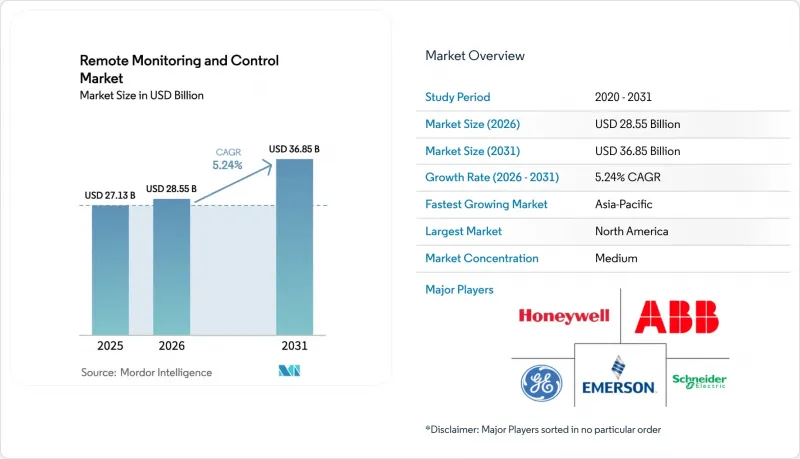
本報告按組件(解決方案和現場設備)、部署方式(本地部署和雲端部署)、連接技術(有線和無線)、最終用戶產業(石油和天然氣、發電和公用事業、化學和石化等)以及地區進行細分。市場預測以美元計價。
全球遠端監控市場趨勢及洞察
工業自動化需求日益成長
製造商將自動化視為彌補勞動力短缺和提高生產效率的主要手段。由羅克韋爾自動化和諾基亞共同建置的專用 5G 網路利用公民寬頻無線電服務 (CBRS)頻寬支援即時控制,從而實現離散製造和流程製造工廠的自主運作。協作機器人、人工智慧視覺和預測分析技術如今在統一平台上並行運作,使操作人員能夠以最小的停機時間重新配置生產線。這不僅降低了單位成本,也創造了更安全的工作環境。採礦和石化設施也受益匪淺,無線感測器能夠在故障變得嚴重之前向技術人員發出警報。那些延遲採用自動化技術的公司將面臨失去競爭力的風險,因為競爭對手已經享受了縮短生產週期和降低缺陷率的好處。
利用工業物聯網擴展預測性維護計劃
FactoryTalk Analytics Guardian AI 利用資產層的機器學習模型,及早發現異常情況,從而延長設備使用壽命並減少備件庫存。邊緣運算支援在本地處理振動和溫度數據,減少雲端頻寬,並為維護團隊提供即時回饋。在嚴苛的採礦環境中,無線閘道器可傳輸運輸卡車動力傳動系統的狀態指標,實現即時維護,最大限度地延長車輛正常運轉率。同樣,在製造業中,它可以追蹤CNC工具機主軸的磨損情況,避免代價高昂的意外停機。這些方案在各行業都能持續提升設備整體效率 (OEE),並在單一預算週期內帶來可衡量的投資報酬率 (ROI)。
高昂的初始資本支出以及與現有設施整合的複雜性。
將現代感測器改造到使用了幾十年的水泵、驅動器和閥門上通常需要客製化閘道器和協議轉換器。工程團隊必須謹慎地分階段進行升級,以確保工廠的正常運作,這會導致專案工期延長和預算超支。供水事業升級到先進的SCADA系統還面臨額外的負擔:在滿足監管報告要求的同時,也要映射數千個I/O點。這些因素會延誤決策,尤其對於資源有限的市政當局和小型企業而言,即使長期成本節約顯而易見。
細分市場分析
到2025年,解決方案將佔據遠端監控市場59.70%的佔有率,鞏固向以軟體為中心的架構轉型。雲端儀錶板、分析引擎和網路安全模組構成了連接各種現場設備的數位骨幹。供應商將許可、更新和支援捆綁到訂閱計劃中,從而降低前期成本並最佳化現金流。現場設備雖然市佔率較小,但卻是成長最快的細分市場,複合年成長率高達7.86%。智慧感測器整合了可執行本地診斷的微控制器,從而減少網路流量並確保在通訊線路故障時具備容錯能力。早期採用者報告稱,現場訪問次數減少,異常檢測速度加快,進一步提高了效率。
現場儀表的興起也標誌著向邊緣智慧的更廣泛轉變。過去在集中式伺服器上運行的演算法現在在設備端進行處理,而預傳輸壓縮則降低了通訊成本。隨著企業將低成本節點連接到現有的泵浦、馬達和輸送機,這種發展正在擴大遠端監控市場。同時,軟體供應商透過在其平台上添加拖放式配置功能,幫助非專業用戶部署新的感測器元件。智慧硬體和敏捷軟體的強強聯合正在推動遠端監控行業在各種工廠和公用設施中穩步擴張。
到2025年,本地部署系統仍將佔據遠端監控市場58.05%的佔有率。這反映了迄今為止的大量投資以及關於資料儲存位置的監管規定。在管理具有亞秒控制迴路的安全關鍵型流程時,本地部署系統仍然至關重要。然而,隨著企業優先考慮可擴展性和降低維護成本,雲端採用率正以9.12%的複合年成長率成長。艾默生DeltaV SaaS SCADA解決方案透過提供安全的瀏覽器存取和用於分析的彈性計算,體現了這一轉變。
目前,混合拓撲結構將邊緣伺服器與雲層結合,用於處理對延遲敏感的任務,並實現長期最佳化。這種設計使營運商能夠在不丟棄已成為沉沒成本的資產的情況下進行現代化改造,從而加速遠端監控市場的規模化發展。標準化的API簡化了資料匯出到企業資源計劃(ERP)套件的過程,並將工廠指標轉化為財務儀錶板。隨著5G覆蓋範圍的擴大,頻寬限制得到緩解,即使在高速生產線上也能實現完全的雲端控制。
區域分析
預計到2025年,北美將引領遠端監控市場,佔據33.85%的市場。這主要得益於美國嚴格的排放法規和工業物聯網(IIoT)的廣泛成熟。聯邦基礎設施建設資金正在加速用水和污水處理設施的設備升級,而頁岩氣營運商正在部署甲烷檢測陣列,以符合美國環保署(EPA)2025年的相關規定。在加拿大,碳定價機制鼓勵即時能源分析,從而推動了市場需求的成長。在墨西哥的汽車產業叢集,組裝的數位化正在推進,以保持出口競爭力,從而為解決方案供應商確保來自該地區的穩定訂單來源。
亞太地區預計將以7.95%的複合年成長率成長,受益於中國的智慧製造補貼和印度的生產連結獎勵計畫計畫。台灣和韓國的半導體工廠正在部署私有5G網路來控制移動機器人,而澳洲的礦業公司正在偏遠沙漠地區實現運輸作業的自動化。東南亞國協正在投資建構智慧城市供水網路,利用雲端SCADA系統最大限度地減少漏水。這些多元化的項目正在擴大開發中國家的遠端監控市場。
在歐洲,隨著企業努力實現「綠色新政」目標並抵消不斷飆升的能源成本,預測性維護正日益普及。德國汽車製造商正在為現有生產線加裝邊緣閘道器,而英國公用事業公司則在預算有限的情況下,採用基於SaaS的SCADA系統來改造擁有百年歷史的網路。在中東,石油收入正被用於天然氣加工廠的數位化;在南非,智慧電網的遠端監控系統正在礦業城市進行試點。這些舉措凸顯了全球廣泛且因用途而異的需求曲線。
其他好處:
- Excel格式的市場預測(ME)表
- 3個月的分析師支持
目錄
第1章:引言
- 研究假設和市場定義
- 調查範圍
第2章:調查方法
第3章執行摘要
第4章 市場狀況
- 市場概覽
- 市場促進因素
- 工業自動化需求日益成長
- 工業移動性和遠端系統管理應用的擴展
- 利用工業物聯網擴展預測性維護計劃
- 在危險區域採用邊緣人工智慧控制器
- 更嚴格的碳排放追蹤法規要求提供即時數據
- 一種新型的專用 5G 網路,可實現超高可靠性和低延遲通訊。
- 市場限制因素
- 初始資本支出 (CAPEX) 較高,且難以整合到現有設施中。
- OT與IT融合中的網路安全漏洞
- 多供應商平台缺乏熟練人員
- 傳統協定鎖定限制了互通性
- 產業價值鏈分析
- 監理情勢
- 技術展望
- 產業吸引力—五力分析
- 新進入者的威脅
- 供應商的議價能力
- 買方的議價能力
- 替代品的威脅
- 競爭公司之間的競爭
- 宏觀經濟因素對市場的影響
第5章 市場規模與成長預測
- 按組件
- 解決方案
- 現場儀器
- 部署模式
- 現場
- 雲
- 連接技術
- 有線
- 無線的
- 按最終用戶行業分類
- 石油和天然氣
- 發電和公用事業
- 化工/石油化工
- 金屬和採礦
- 水和污水處理
- 食品/飲料
- 製藥和生命科學
- 紙漿和造紙
- 半導體和電子學
- 其他終端用戶產業
- 按地區
- 北美洲
- 美國
- 加拿大
- 墨西哥
- 南美洲
- 巴西
- 阿根廷
- 智利
- 其他南美國家
- 歐洲
- 德國
- 英國
- 法國
- 義大利
- 西班牙
- 俄羅斯
- 其他歐洲國家
- 亞太地區
- 中國
- 印度
- 日本
- 韓國
- 馬來西亞
- 新加坡
- 澳洲
- 其他亞太國家
- 中東和非洲
- 中東
- 阿拉伯聯合大公國
- 沙烏地阿拉伯
- 土耳其
- 其他中東國家
- 非洲
- 南非
- 奈及利亞
- 其他非洲國家
- 中東
- 北美洲
第6章 競爭情勢
- 市場集中度
- 策略趨勢
- 市佔率分析
- 公司簡介
- ABB Ltd.
- Emerson Electric Co.
- Honeywell International Inc.
- Schneider Electric SE
- General Electric Co.
- Rockwell Automation Inc.
- Yokogawa Electric Corp.
- Endress+Hauser AG
- Siemens AG
- Mitsubishi Electric Corp.
- Omron Corp.
- Advantech Co. Ltd.
- Moxa Inc.
- Red Lion Controls Inc.
- ProSoft Technology Inc.
- Inductive Automation LLC
- ICONICS Inc.
- Opto 22
- AVEVA Group plc(Wonderware)
- Kepware Technologies
- HMS Networks AB
- B-Scada Inc.
- Pepperl+Fuchs SE
- Banner Engineering Corp.
- Schneider Citect(AVEVA Plant SCADA)
- Softing AG
第7章 市場機會與未來趨勢
- 評估市場閒置頻段和未滿足的需求
According to Mordor Intelligence, the remote monitoring and control market size is expected to grow from USD 27.13 billion in 2025 to USD 28.55 billion in 2026 and is forecast to reach USD 36.85 billion by 2031 at 5.24% CAGR over 2026-2031.
This report is Segmented by Component (Solution and Field Instruments), Deployment Mode (On-Premise and Cloud), Connectivity Technology (Wired and Wireless), End-User Industry (Oil and Gas, Power Generation and Utilities, Chemicals and Petrochemicals, and More) and Geography. The Market Forecasts are Provided in Terms of Value (USD).
Global Remote Monitoring And Control Market Trends and Insights
Rising demand for industrial automation
Manufacturers view automation as a primary lever for offsetting labor shortages and boosting throughput. Private 5G networks built by Rockwell Automation and Nokia support real-time control over Citizens Broadband Radio Service spectrum, enabling autonomous operations in discrete and process plants. Collaborative robots, AI vision, and predictive analytics now run side-by-side on unified platforms, letting operators re-configure production lines with minimal downtime. The result is lower cost per unit and safer work environments. Similar benefits appear in mining and petrochemical facilities where wireless sensors alert technicians before a fault escalates. Companies that delay adoption risk competitive erosion as peers capture savings from faster cycle times and reduced scrap.
Expanding IIoT-enabled predictive maintenance programs
FactoryTalk Analytics Guardian AI uses machine-learning models at the asset layer to catch anomalies early, extending equipment life and shrinking spare-parts inventories. Edge computing allows vibration and temperature data to be processed locally, cutting cloud bandwidth and providing instant feedback for maintenance crews. In harsh mining locations, wireless gateways stream health metrics from haul-truck drivetrains, enabling just-in-time service that maximizes fleet availability. Manufacturers similarly track spindle wear on CNC machines, avoiding costly unplanned shutdowns. Across industries, these programs translate into consistent OEE improvements and measurable ROI within one budget cycle.
High initial CAPEX and complex brown-field integration
Retrofitting decades-old pumps, drives, and valves with modern sensors often requires custom gateways and protocol converters. Engineering teams must stage upgrades carefully to keep plants running, lengthening project timelines and inflating budgets. Water utilities upgrading to advanced SCADA face the added burden of mapping thousands of I/O points while maintaining regulatory reporting. These factors delay decision-makers, particularly in resource-constrained municipalities and SMEs, despite clear long-term savings.
Other drivers and restraints analyzed in the detailed report include:
- Proliferation of edge-AI controllers in hazardous sites
- Stricter carbon-tracking regulations needing real-time data
- Cyber-security vulnerabilities in OT-IT convergence
For complete list of drivers and restraints, kindly check the Table Of Contents.
Segment Analysis
Solutions accounted for 59.70% of remote monitoring and control market share in 2025, affirming the shift toward software-centric architectures. Cloud dashboards, analytics engines, and cybersecurity modules form the digital backbone that binds diverse field devices. Vendors bundle licensing, updates, and support into subscription plans that trim upfront costs and smooth cash flow. Field instruments, while holding a smaller slice, represent the fastest-growing sub-segment at an 7.86% CAGR. Smart sensors embed microcontrollers that run local diagnostics, easing network traffic and ensuring resilience during link outages. Early adopters report fewer site visits and quicker anomaly detection, which feeds back into efficiency gains.
Field instruments' rise also signals a broader move to edge intelligence. Devices now host algorithms that once lived on centralized servers, compressing data before transfer and cutting cellular fees. This evolution widens the remote monitoring and control market as firms attach low-cost nodes to legacy pumps, motors, and conveyors. Software publishers, in turn, enhance their platforms with drag-and-drop configuration, helping non-specialists deploy new sensor packs. The combined momentum of smarter hardware and agile software underpins steady expansion of the remote monitoring and control industry across diverse plants and utilities.
On-premise systems kept 58.05% share of the remote monitoring and control market in 2025, reflecting entrenched investment and regulatory data-residency rules. They remain vital where sub-second control loops govern safety-critical processes. Yet cloud deployments are rising at a 9.12% CAGR as firms favor scalability and lower maintenance overhead. Emerson's DeltaV SaaS SCADA exemplifies this swing by delivering secure browser access and elastic compute for analytics.
Hybrid topologies now blend edge servers for latency-sensitive tasks with cloud layers for long-term optimization. Such designs let operators modernize without discarding sunk-cost assets, accelerating the remote monitoring and control market size expansion. Standardized APIs streamline data export into enterprise resource-planning suites, turning plant metrics into financial dashboards. As 5G coverage broadens, bandwidth constraints ease, making full-cloud control viable even for high-speed production lines.
Complete Report Scope:
- By Component
- Solutions
- Field Instruments
- By Deployment Mode
- On-premise
- Cloud
- By Connectivity Technology
- Wired
- Wireless
- By End-user Industry
- Oil and Gas
- Power Generation and Utilities
- Chemicals and Petrochemicals
- Metals and Mining
- Water and Wastewater
- Food and Beverages
- Pharmaceuticals and Life Sciences
- Pulp and Paper
- Semiconductor and Electronics
- Other End-user Industries
- By Geography
- North America
- United States
- Canada
- Mexico
- South America
- Brazil
- Argentina
- Chile
- Rest of South America
- Europe
- Germany
- United Kingdom
- France
- Italy
- Spain
- Russia
- Rest of Europe
- Asia-Pacific
- China
- India
- Japan
- South Korea
- Malaysia
- Singapore
- Australia
- Rest of Asia-Pacific
- Middle East and Africa
- Middle East
- United Arab Emirates
- Saudi Arabia
- Turkey
- Rest of Middle East
- Africa
- South Africa
- Nigeria
- Rest of Africa
- Middle East
- North America
Geography Analysis
North America led the remote monitoring and control market with 33.85% share in 2025, anchored by the United States' stringent emissions legislation and broad IIoT maturity. Federal infrastructure funds stimulate upgrades in water and wastewater utilities, while shale operators fit methane-detection arrays to comply with the 2025 EPA rule. Canada augments demand through carbon price mechanisms that reward real-time energy analytics. Mexico's automotive clusters digitalize assembly lines to maintain export competitiveness, ensuring steady regional inflows for solution providers.
Asia-Pacific, projected to rise at an 7.95% CAGR, benefits from China's smart-manufacturing subsidies and India's production-linked incentive schemes. Semiconductor fabs in Taiwan and South Korea deploy private 5G to orchestrate mobile robots, while Australian miners automate haulage in remote deserts. ASEAN nations invest in smart-city water grids that rely on cloud SCADA to minimize leakage. This diverse set of projects expands the remote monitoring and control market footprint across developing and advanced economies alike.
Europe records consistent uptake as companies chase Green Deal targets and adopt predictive maintenance to offset high energy costs. German automotive OEMs retrofit legacy lines with edge gateways, whereas UK utilities adopt SaaS SCADA to modernize century-old networks under tight budgets. The Middle East leverages oil revenue to digitize gas processing trains, and South Africa pilots smart-grid telemetry in mining towns. Together, these efforts highlight a global demand curve that is both geographically widespread and use-case specific.
- ABB Ltd.
- Emerson Electric Co.
- Honeywell International Inc.
- Schneider Electric SE
- General Electric Co.
- Rockwell Automation Inc.
- Yokogawa Electric Corp.
- Endress+Hauser AG
- Siemens AG
- Mitsubishi Electric Corp.
- Omron Corp.
- Advantech Co. Ltd.
- Moxa Inc.
- Red Lion Controls Inc.
- ProSoft Technology Inc.
- Inductive Automation LLC
- ICONICS Inc.
- Opto 22
- AVEVA Group plc (Wonderware)
- Kepware Technologies
- HMS Networks AB
- B-Scada Inc.
- Pepperl+Fuchs SE
- Banner Engineering Corp.
- Schneider Citect (AVEVA Plant SCADA)
- Softing AG
Additional Benefits:
- The market estimate (ME) sheet in Excel format
- 3 months of analyst support
TABLE OF CONTENTS
1 INTRODUCTION
- 1.1 Study Assumptions and Market Definition
- 1.2 Scope of the Study
2 RESEARCH METHODOLOGY
3 EXECUTIVE SUMMARY
4 MARKET LANDSCAPE
- 4.1 Market Overview
- 4.2 Market Drivers
- 4.2.1 Rising demand for industrial automation
- 4.2.2 Increasing use of industrial mobility and remote management
- 4.2.3 Expanding IIoT-enabled predictive maintenance programs
- 4.2.4 Proliferation of edge-AI controllers in hazardous sites
- 4.2.5 Stricter carbon-tracking regulations needing real-time data
- 4.2.6 Emerging private-5G networks for ultra-reliable low-latency links
- 4.3 Market Restraints
- 4.3.1 High initial CAPEX and complex brown-field integration
- 4.3.2 Cyber-security vulnerabilities in OT-IT convergence
- 4.3.3 Skilled workforce shortage for multi-vendor platforms
- 4.3.4 Legacy protocol lock-in limiting interoperability
- 4.4 Industry Value Chain Analysis
- 4.5 Regulatory Landscape
- 4.6 Technological Outlook
- 4.7 Industry Attractiveness - Porter's Five Forces Analysis
- 4.7.1 Threat of New Entrants
- 4.7.2 Bargaining Power of Suppliers
- 4.7.3 Bargaining Power of Buyers
- 4.7.4 Threat of Substitutes
- 4.7.5 Intensity of Competitive Rivalry
- 4.8 Impact of Macroeconomic Factors on the Market
5 MARKET SIZE AND GROWTH FORECASTS (VALUES)
- 5.1 By Component
- 5.1.1 Solutions
- 5.1.2 Field Instruments
- 5.2 By Deployment Mode
- 5.2.1 On-premise
- 5.2.2 Cloud
- 5.3 By Connectivity Technology
- 5.3.1 Wired
- 5.3.2 Wireless
- 5.4 By End-user Industry
- 5.4.1 Oil and Gas
- 5.4.2 Power Generation and Utilities
- 5.4.3 Chemicals and Petrochemicals
- 5.4.4 Metals and Mining
- 5.4.5 Water and Wastewater
- 5.4.6 Food and Beverages
- 5.4.7 Pharmaceuticals and Life Sciences
- 5.4.8 Pulp and Paper
- 5.4.9 Semiconductor and Electronics
- 5.4.10 Other End-user Industries
- 5.5 By Geography
- 5.5.1 North America
- 5.5.1.1 United States
- 5.5.1.2 Canada
- 5.5.1.3 Mexico
- 5.5.2 South America
- 5.5.2.1 Brazil
- 5.5.2.2 Argentina
- 5.5.2.3 Chile
- 5.5.2.4 Rest of South America
- 5.5.3 Europe
- 5.5.3.1 Germany
- 5.5.3.2 United Kingdom
- 5.5.3.3 France
- 5.5.3.4 Italy
- 5.5.3.5 Spain
- 5.5.3.6 Russia
- 5.5.3.7 Rest of Europe
- 5.5.4 Asia-Pacific
- 5.5.4.1 China
- 5.5.4.2 India
- 5.5.4.3 Japan
- 5.5.4.4 South Korea
- 5.5.4.5 Malaysia
- 5.5.4.6 Singapore
- 5.5.4.7 Australia
- 5.5.4.8 Rest of Asia-Pacific
- 5.5.5 Middle East and Africa
- 5.5.5.1 Middle East
- 5.5.5.1.1 United Arab Emirates
- 5.5.5.1.2 Saudi Arabia
- 5.5.5.1.3 Turkey
- 5.5.5.1.4 Rest of Middle East
- 5.5.5.2 Africa
- 5.5.5.2.1 South Africa
- 5.5.5.2.2 Nigeria
- 5.5.5.2.3 Rest of Africa
- 5.5.5.1 Middle East
- 5.5.1 North America
6 COMPETITIVE LANDSCAPE
- 6.1 Market Concentration
- 6.2 Strategic Moves
- 6.3 Market Share Analysis
- 6.4 Company Profiles (includes Global level Overview, Market level overview, Core Segments, Financials as available, Strategic Information, Market Rank/Share for key companies, Products and Services, and Recent Developments)
- 6.4.1 ABB Ltd.
- 6.4.2 Emerson Electric Co.
- 6.4.3 Honeywell International Inc.
- 6.4.4 Schneider Electric SE
- 6.4.5 General Electric Co.
- 6.4.6 Rockwell Automation Inc.
- 6.4.7 Yokogawa Electric Corp.
- 6.4.8 Endress+Hauser AG
- 6.4.9 Siemens AG
- 6.4.10 Mitsubishi Electric Corp.
- 6.4.11 Omron Corp.
- 6.4.12 Advantech Co. Ltd.
- 6.4.13 Moxa Inc.
- 6.4.14 Red Lion Controls Inc.
- 6.4.15 ProSoft Technology Inc.
- 6.4.16 Inductive Automation LLC
- 6.4.17 ICONICS Inc.
- 6.4.18 Opto 22
- 6.4.19 AVEVA Group plc (Wonderware)
- 6.4.20 Kepware Technologies
- 6.4.21 HMS Networks AB
- 6.4.22 B-Scada Inc.
- 6.4.23 Pepperl+Fuchs SE
- 6.4.24 Banner Engineering Corp.
- 6.4.25 Schneider Citect (AVEVA Plant SCADA)
- 6.4.26 Softing AG
7 MARKET OPPORTUNITIES AND FUTURE TRENDS
- 7.1 White-Space and Unmet-Need Assessment

 全球遠端監控市場規模、佔有率、趨勢及成長分析報告(2026-2034)
 遠端監控市場:全球市場預測,2026-2032年
 遠端監控市場機會、成長要素、產業趨勢分析及2026-2035年預測。遠端儲罐液位監測市場:按組件、技術、通訊方式、部署模式、儲槽類型、應用、產業分類,全球預測(2026-2032年)遠端儲罐監控市場按產品類型、儲罐類型、監控類型、部署方式和最終用戶分類,全球預測(2026-2032年)
 2026年全球遠端監控市場報告
 遠端監控市場-全球產業規模、佔有率、趨勢、機會和預測:按行為、類型、最終用戶、地區和競爭格局分類,2021-2031年油氣遠端監控市場-全球產業規模、佔有率、趨勢、機會和預測,按類型、產業、地區和競爭格局分類,2021-2031年預測
 遠端監控市場規模、佔有率及成長分析(按組件、最終用戶產業及地區分類)-2026-2033年產業預測
 全球遠端儲罐監控市場報告 - 第八版