


 |
市場調查報告書
商品編碼
2125356
加密軟體:市場佔有率分析、產業趨勢與統計、成長預測(2026-2031)Encryption Software - Market Share Analysis, Industry Trends & Statistics, Growth Forecasts (2026 - 2031) |
||||||

※ 本網頁內容可能與最新版本有所差異。詳細情況請與我們聯繫。
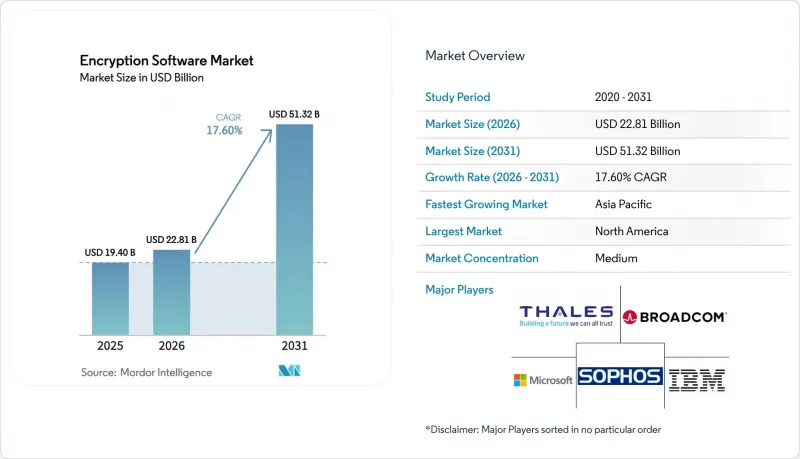
據 Mordor Intelligence 稱,2025 年加密軟體市場價值 194 億美元,預計到 2031 年將達到 513.2 億美元,而 2026 年為 228.1 億美元,預測期(2026-2031 年)複合年成長率為 17.6%。
本報告按元件(軟體、服務)、部署模式(本地部署、雲端部署)、企業規模(大型企業、中小企業)、功能(磁碟加密、通訊加密、文件/資料夾加密等)、產業(IT與電信、銀行、金融服務和保險等)以及地區對產業進行分類。市場預測以美元計價。
全球加密軟體市場趨勢與洞察
嚴格的資料保護條例
目前,全球監管機構正積極推行加密強制措施,要求將安全性融入數位基礎設施,而不僅僅將其視為形式。英國資訊專員辦公室 (ICO) 於 2025 年 5 月更新了其指南,強制要求根據直接影響採購決策的演算法強度進行監管。在美國,網路安全成熟度模型認證 (CMMC) 2.0 強制要求承包商對傳輸和靜態儲存的受管非機密資訊 (CUI) 進行加密,從而擴大了聯邦供應商對加密軟體的潛在市場。此外,司法部的民事詐騙舉措提高了對違規的處罰力度,使加密成為一項關鍵的風險管理要求。管理 23 兆美元資產的金融機構面臨許多重疊的監管要求,例如 GLBA、SOX 和 PCI-DSS,這些法規都強制執行加密要求,從而加強了前台、中台和後勤部門系統的多層實施。這些法規的共同作用將使預計複合年成長率 (CAGR) 提高 4.2%。
針對雲端工作負載的網路攻擊日益增加且手段日益複雜
攻擊手段正從機會主義的資料竊取轉向系統性的「先收集後解密」宣傳活動旨在累積加密資料集,為未來的量子解密做好準備。加拿大2025-2026年國家網路威脅評估報告指出,國家支持的攻擊者正在升級針對關鍵基礎設施的人工智慧攻擊。為了因應這些攻擊,企業正在採用「多層防禦」策略,結合多種加密協定和統一的金鑰層級結構。隨著勒索軟體演變為雙重和三重勒索攻擊,保護多租戶工作負載的緊迫性日益凸顯,這體現在雲端加密27.6%的複合年成長率。因此,當邊界防禦被突破時,加密作為最後一道防線的重要性日益凸顯,從而推動了對跨混合環境的整合解決方案的需求。
企業級全碟加密的總擁有成本高昂
總擁有成本 (TCO) 不僅包括授權費,還包括硬體升級、效能開銷以及聘請專家的費用。後量子演算法會產生 10-30% 的處理開銷,從而加快基礎設施更新周期。金鑰管理需要對硬體安全模組和隔離網路進行進一步的資本投資。企業的年度金鑰管理預算可能在 50 萬美元到 200 萬美元之間,超過了軟體成本。在對延遲敏感的環境中,例如高頻交易,即使是微秒級的延遲也會導致收入損失,因此部署昂貴的硬體加速至關重要。因此,預算有限的中小型企業正在推遲或縮減廣泛部署加密技術的規模,導致年複合成長率 (CAGR) 下降了 2.8%。
細分市場分析
目前,服務業務的發展速度落後於軟體業務,但隨著企業面臨2035年PQC合規期限的臨近,服務業務的成長速度最為迅猛。受加密資產監控、演算法遷移藍圖和金鑰生命週期管理等需求的推動,加密軟體市場中由服務業務主導的部分預計將以20.6%的複合年成長率成長。聯邦機構已撥款約70億美元用於PQC遷移服務,顯示諮詢領域蘊藏著巨大的商機。儘管軟體產業繼續透過訂閱模式獲得經常性收入,但日益成長的複雜性正促使人們傾向於選擇承包託管服務,尤其是在醫療保健和金融等對認證專業知識和持續合規性要求極高的行業。
同時,軟體供應商正在整合自動化遷移工具,這促使他們將諮詢服務打包出售,以提供差異化價值。這種「授權+服務」的雙重收入模式強化了供應商鎖定,尤其是在平台整合能夠最大限度減少營運摩擦的情況下。到2025年,超過60%的新交易(已明確範圍)將軟體許可與涵蓋狀態評估、糾正措施和符合PQC標準的架構檢驗的專業服務包相結合。因此,軟體供應商與全球系統整合商之間的合作關係正在激增,這有助於雙方從加密軟體市場的巨變中獲利。
到2025年,本地部署將佔加密軟體市場的61.28%,但雲端加密將成為成長最快的領域,複合年成長率將達到24.07%,這主要得益於混合架構和聯邦政府的「雲端優先」政策。實施零信任框架的政府機構需要在公共雲端、私有雲端和多重雲端環境中實現可擴展的金鑰管理。中小企業更傾向於雲端訂閱模式,因為它可以避免資本投資,並按需獲得企業級安全保障。 82%的受訪中小企業表示,雲端訂閱可以提高營運效率,這與他們的這項訴求相符。
在資料主權和超低延遲至關重要的領域,例如受監管的銀行業務和高頻交易平台,對本地部署解決方案的需求仍然強勁。然而,雲端服務供應商現在提供硬體安全模組即服務 (HSM-as-a-Service) 和機密運算環境,緩解了人們對外部部署金鑰管理的傳統擔憂。雲端原生加密能夠跨容器和無伺服器函數快速應用策略,而這在傳統的磁碟加密中難以實現。因此,儘管加密軟體市場正經歷著向靈活的 SaaS 模式的長期轉變,但混合部署仍然保留了本地部署工具的重要性,儘管其成長速度正在放緩。
區域分析
北美以 42.60% 的市佔率佔據榜首,這得益於其對零信任技術的早期應用以及強大的供應商生態系統。該地區受益於國家量子戰略,該戰略撥款 3.6 億加元(約 2.67 億美元)用於後量子密碼學的研究和開發,旨在建立安全的量子通訊網路。各省議會同樣積極,僅在 2024 年就通過了 75 項與網路安全相關的法案,從而推動了公共部門對加密解決方案的採購。
亞太地區正以19.78%的複合年成長率成長,這反映了製造業、金融業和醫療保健產業的快速數字化轉型,以及日本、韓國和新加坡法規結構的加速發展。該地區在半導體行業的領先地位推動了硬體信任根(RoT)的出貨量,但也暴露了供應鏈的脆弱性,促使人們更加關注純軟體加密以緩解組件短缺問題。在歐洲,隨著英國新指南強調GDPR合規性和以演算法強度為中心的管治,強化了加密在數位主權中的作用。綜上所述,這些趨勢揭示了區域格局的演變:政策、供應鍊和雲端採用的領先地位決定著各地區在加密軟體市場的發展動能。
歐洲的發展趨勢與資料本地化和隱私保護的優先事項一致。人們對同構加密的興趣正在復甦,這使得跨境分析能夠在不違反GDPR的情況下進行。成員國正在協調先導計畫,並加快採購支援PQC的電子郵件閘道器和VPN。由於英國脫歐導致資料傳輸變得更加複雜,加密已成為英國與歐盟之間貿易的必要手段。監管環境的碎片化為能夠適應不同保留期限和揭露規則的策略感知型金鑰管理供應商提供了機會。
其他好處:
- Excel格式的市場預測(ME)表
- 3個月的分析師支持
目錄
第1章:引言
- 研究假設和市場定義
- 調查範圍
第2章:調查方法
第3章執行摘要
第4章 市場狀況
- 市場概覽
- 市場促進因素
- 嚴格的資料保護條例
- 針對雲端工作負載的網路攻擊數量和複雜程度都在增加。
- 遠端辦公和混合辦公的普及推動了對終端級加密的需求。
- 隱私保護分析中同態密碼學的引入
- 關鍵基礎設施中抗量子密碼技術的試點項目
- 嵌入式硬體「信任根」晶片正在推動物聯網加密產品的銷售。
- 市場限制因素
- 企業級全碟加密的總擁有成本很高
- 開放原始碼和盜版加密工具的氾濫
- 某些國家/地區的法律限制了對強加密技術的存取。
- 5G/邊緣應用中的延遲開銷
- 監理情勢
- 技術展望
- 波特五力分析
- 投資分析
第5章 市場規模與成長預測
- 按組件
- 軟體
- 服務
- 按部署模式
- 現場
- 雲
- 按公司規模
- 大公司
- 小型企業
- 按功能
- 磁碟加密
- 通訊加密
- 文件/資料夾加密
- 雲端加密
- 資料庫加密
- 按行業分類
- IT/通訊
- BFSI
- 衛生保健
- 政府
- 零售
- 教育
- 其他
- 按地區
- 北美洲
- 美國
- 加拿大
- 墨西哥
- 南美洲
- 巴西
- 阿根廷
- 其他南美國家
- 歐洲
- 英國
- 德國
- 法國
- 義大利
- 西班牙
- 其他歐洲國家
- 亞太地區
- 中國
- 日本
- 印度
- 韓國
- 澳洲
- 其他亞太國家
- 中東
- 沙烏地阿拉伯
- 阿拉伯聯合大公國
- 土耳其
- 其他中東國家
- 非洲
- 南非
- 奈及利亞
- 埃及
- 其他非洲國家
- 北美洲
第6章 競爭情勢
- 市場集中度
- 策略趨勢
- 市佔率分析
- 公司簡介
- IBM
- Microsoft
- Broadcom Inc.(Symantec)
- Sophos Ltd.
- Thales
- McAfee LLC
- Trend Micro Incorporated
- Dell Inc.
- Check Point Software Technologies Ltd.
- Micro Focus International plc
- Cisco Systems, Inc.
- Proofpoint Inc.
- WinMagic Inc.
- ESET spol. s ro
- F-Secure Corporation
- Amazon Web Services Inc.
- VMware Inc.
- Fortinet Inc.
- Oracle Corporation
- Google LLC
第7章 市場機會與未來展望
According to Mordor Intelligence, the encryption software market size was valued at USD 19.4 billion in 2025 and estimated to grow from USD 22.81 billion in 2026 to reach USD 51.32 billion by 2031, at a CAGR of 17.6% during the forecast period (2026-2031).
This report Segments the Industry Into by Component (Software, Service), Deployment Model (On-Premise, Cloud), by Enterprise Size (Large Enterprises, Small and Medium Enterprises), Function (Disk Encryption, Communication Encryption, File/Folder Encryption, and More), Industry Vertical (IT & Telecommunication, BFSI, and More), and Geography. The Market Forecasts are Provided in Terms of Value (USD).
Global Encryption Software Market Trends and Insights
Stringent Data-Protection Regulations
Global watchdogs now require proactive encryption mandates that embed security into digital infrastructure rather than treat it as a check-box exercise. The U.K. Information Commissioner's Office updated guidance in May 2025, mandating algorithm-strength oversight that directly steers procurement choices. In the United States, Cybersecurity Maturity Model Certification 2.0 compels contractors to encrypt Controlled Unclassified Information in transit and at rest, widening the addressable encryption software market among federal suppliers. The Department of Justice's Civil Cyber-Fraud Initiative raises financial penalties for non-compliance, turning encryption into a material risk-management imperative. Financial institutions supervising USD 23 trillion in assets face overlapping GLBA, SOX, and PCI-DSS mandates, each specifying encryption requirements, reinforcing multi-layered adoption across front-, middle-, and back-office systems. Together, these statutes contribute a 4.2% uplift to the forecast CAGR.
Rising Volume & Sophistication of Cyber-Attacks on Cloud Workloads
Attacks have shifted from opportunistic data theft to systematic "harvest-now-decrypt-later" campaigns that bank encrypted datasets for future quantum decryption. Canada's National Cyber Threat Assessment 2025-2026 flags state-sponsored actors escalating AI-assisted campaigns targeting critical infrastructure. Enterprises answer with defense-in-depth strategies layering multiple encryption protocols and unified key hierarchies. Cloud encryption's 27.6% CAGR reflects the urgency to protect multi-tenant workloads as ransomware evolves into double and triple-extortion assaults. Consequently, encryption becomes the final shield once perimeter defenses fall, fuelling integrated solution demand across hybrid environments.
High TCO of Full-Disk Encryption at Enterprise Scale
Total cost of ownership encompasses not just licensing but hardware upgrades, performance overhead, and specialist staffing. Post-quantum algorithms can impose 10-30% processing overhead, forcing infrastructure refresh cycles. Key management introduces further capital outlays for hardware security modules and segregated networks. Annual enterprise key-management budgets can range from USD 500,000 to USD 2 million, outstripping software fees. In latency-sensitive environments such as high-frequency trading, even microsecond delays translate into lost revenue, compelling expensive hardware acceleration. SMEs with limited budgets therefore delay or scale down broad encryption roll-outs, shaving 2.8% from the CAGR.
Other drivers and restraints analyzed in the detailed report include:
- Remote & Hybrid Workforce Fueling Endpoint-Level Encryption Demand
- Homomorphic Encryption Adoption in Privacy-Preserving Analytics
For complete list of drivers and restraints, kindly check the Table Of Contents.
Segment Analysis
Services currently trail software yet register the steepest ascent as enterprises confront the 2035 PQC compliance horizon. The encryption software market size attributed to services will climb on a 20.6% CAGR, driven by demand for cryptographic asset inventories, algorithm migration roadmaps, and managed key-lifecycle oversight. Federal agencies earmark an estimated USD 7 billion for PQC transition services-an indicator of the consulting windfall in play. Software still secures recurrent revenue through subscriptions, but rising complexity favors turnkey managed offerings, especially within healthcare and finance where certified expertise and continuous compliance are mandatory.
At the same time, software vendors embed automated migration tooling, prompting vendors to bundle advisory services for differentiated value. This dual revenue track-license plus services-strengthens vendor lock-in, particularly where platform integration minimises operational friction. Over 60% of new deals scoped in 2025 combine software licenses with professional-service packages that cover discovery, remediation, and PQC-ready architecture validation. Consequently, partnerships between software publishers and global systems integrators are proliferating, helping both sides monetise the quantum shift inside the encryption software market.
Despite on-premise deployments commanding 61.28% of encryption software market size in 2025, cloud encryption climbs fastest at a 24.07% CAGR on the back of hybrid architectures and federal cloud-first mandates. Government agencies implementing zero-trust frameworks require scalable key management that spans public-, private-, and multi-cloud estates gsa. Small and mid-sized enterprises favour cloud subscriptions to sidestep capital outlays and access enterprise-grade security on demand, aligning with operational efficiency gains noted in 82% of SME studies businesses.
On-premise solutions retain appeal where data sovereignty or ultra-low latency demands prevail, such as regulated banking workloads and high-frequency trading platforms. Yet cloud providers now offer Hardware Security Module-as-a-Service and confidential-computing enclaves, eroding legacy objections to off-premise key custody. Cloud-native encryption enables rapid policy propagation across containers and serverless functions otherwise hard to cover with traditional disk encryption. As a result, the encryption software market witnesses a secular tilt towards flexible SaaS models while hybrid adoption ensures on-premise tools remain relevant, albeit at a slower growth pace.
Complete Report Scope:
- By Component
- Software
- Service
- By Deployment Model
- On-premise
- Cloud
- By Enterprise Size
- Large Enterprises
- Small and Medium Enterprises
- By Function
- Disk Encryption
- Communication Encryption
- File/Folder Encryption
- Cloud Encryption
- Database Encryption
- By Industry Vertical
- IT and Telecommunication
- BFSI
- Healthcare
- Government
- Retail
- Education
- Others
- By Geography
- North America
- United States
- Canada
- Mexico
- South America
- Brazil
- Argentina
- Rest of South America
- Europe
- United Kingdom
- Germany
- France
- Italy
- Spain
- Rest of Europe
- Asia-Pacific
- China
- Japan
- India
- South Korea
- Australia
- Rest of Asia-Pacific
- Middle East
- Saudi Arabia
- United Arab Emirates
- Turkey
- Rest of Middle East
- Africa
- South Africa
- Nigeria
- Egypt
- Rest of Africa
- North America
Geography Analysis
North America leads at 42.60% market share, fortified by early zero-trust adoption and a robust vendor ecosystem. The region benefits from the National Quantum Strategy, which allocates CAD 360 million (USD 267 million) to post-quantum cryptography R&D and aims to deliver a secure quantum communication network. State legislatures are equally active, with 75 cybersecurity bills enacted in 2024 alone, driving encryption procurement within the public sector.
APAC, climbing at 19.78% CAGR, reflects rapid digitisation in manufacturing, finance, and healthcare plus accelerating regulatory frameworks in Japan, South Korea, and Singapore. The region's semiconductor dominance advances hardware-root-of-trust shipments yet also reveals supply-chain fragility, spurring interest in software-only encryption that mitigates component shortages. Europe grows at a steady clip under GDPR compliance and new U.K. guidance that stresses algorithm-strength governance, reinforcing encryption's role in digital sovereignty. Collectively, these trends map a geographic landscape where leadership in policy, supply chains, and cloud adoption determines regional momentum within the encryption software market.
Europe's trajectory aligns to data localization and privacy priorities. Renewed focus on homomorphic encryption facilitates cross-border analytics without breaching GDPR. Member states coordinate quantum-safe pilot projects to protect critical infrastructure, driving procurement of PQC-enabled email gateways and VPNs. Brexit imposes data-transfer complexity, making encryption essential for U.K.-EU commerce. Fragmented national regulations create opportunity for vendors offering policy-aware key management capable of adapting to differing retention and disclosure rules.
- IBM
- Microsoft
- Broadcom Inc. (Symantec)
- Sophos Ltd.
- Thales
- McAfee LLC
- Trend Micro Incorporated
- Dell Inc.
- Check Point Software Technologies Ltd.
- Micro Focus International plc
- Cisco Systems, Inc.
- Proofpoint Inc.
- WinMagic Inc.
- ESET spol. s r.o.
- F-Secure Corporation
- Amazon Web Services Inc.
- VMware Inc.
- Fortinet Inc.
- Oracle Corporation
- Google LLC
Additional Benefits:
- The market estimate (ME) sheet in Excel format
- 3 months of analyst support
TABLE OF CONTENTS
1 INTRODUCTION
- 1.1 Study Assumptions and Market Definition
- 1.2 Scope of the Study
2 RESEARCH METHODOLOGY
3 EXECUTIVE SUMMARY
4 MARKET LANDSCAPE
- 4.1 Market Overview
- 4.2 Market Drivers
- 4.2.1 Stringent data-protection regulations
- 4.2.2 Rising volume and sophistication of cyber-attacks on cloud workloads
- 4.2.3 Remote and hybrid workforce fuelling endpoint?level encryption demand
- 4.2.4 Homomorphic encryption adoption in privacy-preserving analytics
- 4.2.5 Quantum-resistant cryptography pilots in critical infrastructure
- 4.2.6 Embedded hardware root-of-trust chips boosting IoT encryption sales
- 4.3 Market Restraints
- 4.3.1 High TCO of full-disk encryption at enterprise scale
- 4.3.2 Proliferation of open-source and pirated encryption tools
- 4.3.3 Lawful-access regulations restricting strong encryption in select nations
- 4.3.4 Latency overhead in 5G/edge applications
- 4.4 Regulatory Landscape
- 4.5 Technological Outlook
- 4.6 Porter's Five Forces Analysis
- 4.6.1 Bargaining Power of Suppliers
- 4.6.2 Bargaining Power of Buyers/Consumers
- 4.6.3 Threat of New Entrants
- 4.6.4 Threat of Substitute Products
- 4.6.5 Intensity of Competitive Rivalry
- 4.7 Investment Analysis
5 MARKET SIZE AND GROWTH FORECASTS (VALUE)
- 5.1 By Component
- 5.1.1 Software
- 5.1.2 Service
- 5.2 By Deployment Model
- 5.2.1 On-premise
- 5.2.2 Cloud
- 5.3 By Enterprise Size
- 5.3.1 Large Enterprises
- 5.3.2 Small and Medium Enterprises
- 5.4 By Function
- 5.4.1 Disk Encryption
- 5.4.2 Communication Encryption
- 5.4.3 File/Folder Encryption
- 5.4.4 Cloud Encryption
- 5.4.5 Database Encryption
- 5.5 By Industry Vertical
- 5.5.1 IT and Telecommunication
- 5.5.2 BFSI
- 5.5.3 Healthcare
- 5.5.4 Government
- 5.5.5 Retail
- 5.5.6 Education
- 5.5.7 Others
- 5.6 By Geography
- 5.6.1 North America
- 5.6.1.1 United States
- 5.6.1.2 Canada
- 5.6.1.3 Mexico
- 5.6.2 South America
- 5.6.2.1 Brazil
- 5.6.2.2 Argentina
- 5.6.2.3 Rest of South America
- 5.6.3 Europe
- 5.6.3.1 United Kingdom
- 5.6.3.2 Germany
- 5.6.3.3 France
- 5.6.3.4 Italy
- 5.6.3.5 Spain
- 5.6.3.6 Rest of Europe
- 5.6.4 Asia-Pacific
- 5.6.4.1 China
- 5.6.4.2 Japan
- 5.6.4.3 India
- 5.6.4.4 South Korea
- 5.6.4.5 Australia
- 5.6.4.6 Rest of Asia-Pacific
- 5.6.5 Middle East
- 5.6.5.1 Saudi Arabia
- 5.6.5.2 United Arab Emirates
- 5.6.5.3 Turkey
- 5.6.5.4 Rest of Middle East
- 5.6.6 Africa
- 5.6.6.1 South Africa
- 5.6.6.2 Nigeria
- 5.6.6.3 Egypt
- 5.6.6.4 Rest of Africa
- 5.6.1 North America
6 COMPETITIVE LANDSCAPE
- 6.1 Market Concentration
- 6.2 Strategic Moves
- 6.3 Market Share Analysis
- 6.4 Company Profiles (includes Global level Overview, Market level overview, Core Segments, Financials as available, Strategic Information, Market Rank/Share for key companies, Products and Services, and Recent Developments)
- 6.4.1 IBM
- 6.4.2 Microsoft
- 6.4.3 Broadcom Inc. (Symantec)
- 6.4.4 Sophos Ltd.
- 6.4.5 Thales
- 6.4.6 McAfee LLC
- 6.4.7 Trend Micro Incorporated
- 6.4.8 Dell Inc.
- 6.4.9 Check Point Software Technologies Ltd.
- 6.4.10 Micro Focus International plc
- 6.4.11 Cisco Systems, Inc.
- 6.4.12 Proofpoint Inc.
- 6.4.13 WinMagic Inc.
- 6.4.14 ESET spol. s r.o.
- 6.4.15 F-Secure Corporation
- 6.4.16 Amazon Web Services Inc.
- 6.4.17 VMware Inc.
- 6.4.18 Fortinet Inc.
- 6.4.19 Oracle Corporation
- 6.4.20 Google LLC
7 MARKET OPPORTUNITIES AND FUTURE OUTLOOK
- 7.1 White-space and Unmet-Need Assessment

 2026-2030年全球加密軟體市場
 AES加密軟體市場規模、佔有率和成長分析:按部署類型、組件、應用、企業規模、最終用戶和地區分類-2026-2033年產業預測
 自主客戶管理加密軟體:市佔率分析、產業趨勢與統計及成長預測(2026-2031 年)
 加密軟體市場:2026-2032年全球市場預測(依加密方法、產品類型、用例、授權模式、部署類型、組織規模和最終用戶分類)
 加密軟體市場規模、佔有率、趨勢和預測:按組件、部署模式、組織規模、功能、行業和地區分類,2026-2034 年
 加密軟體市場規模、佔有率和成長分析:按部署類型、組件、應用、最終用途和地區分類-2026-2033年產業預測
 2026年全球加密軟體市場報告
 加密軟體市場分析及預測(至2035年):類型、產品類型、服務、技術、組件、應用、部署類型、最終用戶、功能
 全球加密軟體市場規模、佔有率、趨勢和成長分析報告(2026-2034)
 電子郵件加密軟體市場按元件、加密類型、部署類型、最終用戶和地區分類