


 |
市場調查報告書
商品編碼
2118187
自主客戶管理加密軟體:市佔率分析、產業趨勢與統計及成長預測(2026-2031 年)Sovereign Customer Managed Encryption Software - Market Share Analysis, Industry Trends & Statistics, Growth Forecasts (2026 - 2031) |
||||||

※ 本網頁內容可能與最新版本有所差異。詳細情況請與我們聯繫。
根據 Mordor Intelligence 預測,主權客戶管理的加密軟體市場規模預計將從 2025 年的 67.4 億美元成長到 2031 年的 203.4 億美元,2026 年至 2031 年的複合年成長率為 20.88%。
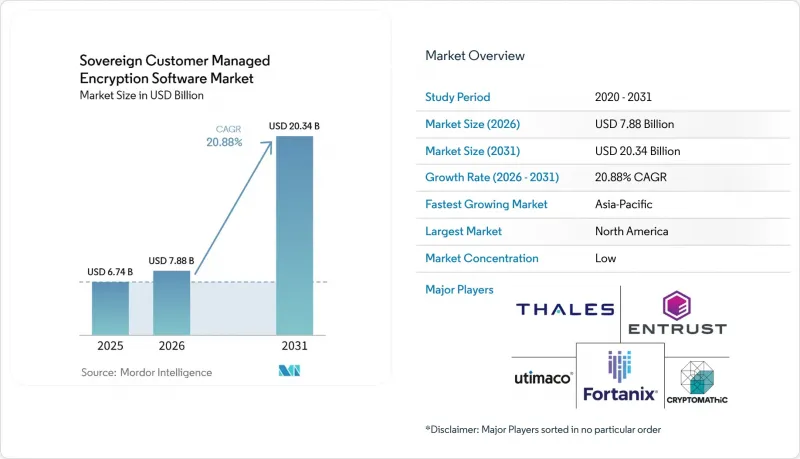
本報告按組件(軟體和服務)、部署模式(雲端、混合、本地部署)、應用程式(雲端儲存和物件儲存加密、資料庫加密等)、最終用戶(IT和電信、銀行、金融服務和保險、汽車和運輸等)以及地區進行細分。市場預測以價值(美元)表示。
全球主權客戶管理加密軟體市場趨勢與洞察
加強資料主權和隱私監管
隱私法規日益關注的不僅是資料儲存地點,還有加密金鑰的管理者。 「雲端法案」可能要求美國供應商揭露儲存在美國境外的資料。客戶擁有金鑰可能會限制供應商解密受保護資訊的能力。 2026年,法國的公共採購政策將數位主權置於技術採購的更高優先事項。該政策尤其將獨立的加密金鑰管理置於評估標準的首位。這些趨勢進一步提升了由客戶自主管理的加密軟體市場對於公共機構和受監管企業的重要性,這些機構和企業需要對敏感資料擁有可證明的控制權。類似的法規也可能影響供應商的選擇、合約設計以及外包處理的監管。
雲端資料外洩和勒索軟體攻擊事件日益增多
勒索軟體攻擊的成功率從2025年的50%上升到2026年的56%。每次事件的平均恢復成本達到170萬美元,比上一年成長了11%。根據Sophos的一份報告,到2026年,66%的組織將使用備份來還原加密資料。攻擊者擴大將目標對準備份儲存庫,這凸顯了在復原計畫中密鑰保護的重要性。當組織將加密的備份資料置於客戶管理的金鑰之下時,客戶自主管理的加密軟體市場將從中受益。這使得資料暴露權限與儲存備份副本的系統權限分離。如果提供者帳號遭到入侵,這種方法可以降低生產資料和復原副本同時外洩的風險。
主權金鑰基礎設施整體擁有成本高昂
實施「自主金鑰管理」可能需要硬體安全模組、冗餘金鑰儲存、專業人員以及獨立審計。這些要求對小規模的組織和新興市場買家而言構成最大的成本負擔。隨著金鑰環境擴展到公共雲端、私有系統和邊緣位置,成本也會隨之增加。有限的技術預算可能會延遲對專用主權金鑰基礎設施的投資。託管服務可以將支出從資本支出轉移到持續營運成本,但這並不能消除管治要求。客戶自主管理的加密軟體市場開始提供基於使用量的服務,降低了沒有大規模保全行動營運的組織的進入門檻。買家仍然需要評估金鑰的儲存位置、誰有權存取金鑰以及如何維護服務連續性。
細分市場分析
至2025年,軟體將佔據自主客戶管理加密軟體市場71.24%的佔有率。受監管機構往往更傾向於在受控安全環境下運作的軟體。這一趨勢反映了對加密控制進行直接監督的既定需求。金融服務機構、政府機構和其他受監管的買家也需要了解金鑰的產生和使用方式。軟體平台可以支援對內部系統進行這種程度的監督。自主客戶管理加密軟體市場也為買家提供了一種在各個業務部門標準化這些控制措施的方法。對於那些擁有完善加密營運團隊的機構而言,這個細分市場仍然十分重要。
預計到2031年,服務市場將以22.74%的複合年成長率成長。這一成長反映了缺乏內部資源處理金鑰管理營運的組織的需求。零售、醫療產業和中型金融公司可以利用託管服務來實現控制功能,而無需建立完整的內部基礎設施。此外,當將關鍵系統連接到雲端、資料庫和儲存環境時,他們也需要部署支援。以SaaS形式交付的平台允許客戶在提供基於使用量的存取權限的同時,保持對關鍵材料的控制。因此,這些組件的組合既體現了直接軟體所有權,也體現了外部支援的營運模式。隨著營運需求的變化,客戶自主管理的加密軟體市場可以適應這兩種方法。
到 2025 年,雲端部署將佔據 68.41% 的市場。然而,雲端的主導地位並不一定意味著企業會將密鑰管理權拱手讓給服務提供者。將自主雲端服務與獨立的金鑰管理系統結合,既能實現雲端運算,又能兼顧客戶自主管理的加密。微軟於 2026 年 5 月正式發布了 Azure 整合 HSM,用於保護硬體中的敏感工作負載。這項服務體現了服務提供者為滿足受監管雲端用戶的需求所做的努力。對於那些既需要可擴展性又需要維持既定金鑰管理實務的企業而言,雲端部署仍然是合適的選擇。自主客戶管理的加密軟體市場透過提供獨立的金鑰管理選項,支援這種平衡。
預計到2031年,混合部署將以21.63%的複合年成長率成長。企業通常將高度敏感的密鑰材料儲存在本地或私人環境中。這使得他們能夠在公共雲端上運行加密應用程式。客戶系統透過託管連線授權解密過程。混合環境也能夠滿足從舊有系統到雲端服務的長期遷移需求。因此,對於那些需要在改變技術基礎架構的同時保持業務連續性的公司而言,自主管理的客戶加密軟體市場至關重要,並且允許分階段遷移,而無需突然替換所有現有的加密控制措施。
區域分析
2025年,北美佔據了主權客戶管理加密軟體市場34.62%的佔有率。聯邦政府的加密要求、龐大的企業技術預算以及成熟的供應商基礎支撐了該地區的地位。 2026年6月發布的一項美國總統令加快了聯邦政府向抗量子加密技術過渡的準備工作,目標是在2030年前完成。各機構需要識別加密資產並確定系統遷移的優先順序。加拿大和墨西哥也透過雲端採購活動和受監管行業的數位轉型來支援區域需求。
預計到2031年,亞太地區將以22.84%的複合年成長率成長。印度於2025年11月頒布了《數位個人資料保護條例》,其中關於資料控制者同意的條款將於2026年11月生效。越南的《個人資料保護法》於2026年1月生效。中國也於2026年1月基於《個人資料保護法》建立了跨境傳輸認證架構。韓國的《個人資訊保護法》持續推動資料安全領域的投資。儘管印度、中國、日本和韓國佔據了大部分需求,但東南亞和澳洲也看到了進一步的成長機會。
歐洲憑藉其法規結構發揮至關重要的作用,該框架融合了GDPR、NIS2、DORA和歐盟資料法。使用美國雲端基礎架構的歐洲組織可能需要對加密金鑰保持獨立控制,以符合國家主權政策。在法國,中央政府行政運作和高度敏感的公共工作負載必須使用經SecNumCloud認證的提供者。在中東和非洲地區,沙烏地阿拉伯、阿拉伯聯合大公國和南非的資料管治措施正在推動市場發展。在南美洲,巴西LGPD的實施以及對資料保護措施的廣泛需求正在推動成長。這些因素正在擴大具有不同法律規範的全部區域的需求。
其他好處:
- Excel格式的市場預測(ME)表
- 3個月的分析師支持
目錄
第1章:引言
- 研究假設和市場定義
- 調查範圍
第2章:調查方法
第3章執行摘要
第4章 市場狀況
- 市場概覽
- 市場促進因素
- 加強對資料主權和隱私方面的監管
- 雲端資料外洩和勒索軟體攻擊事件增多
- 擴展多重雲端和SaaS工作負載
- 擴大「自備鑰匙」和「持有鑰匙」架構的採用範圍。
- 客戶可自行管理的加密終止開關,以應對監管和提款風險。
- 人工智慧和敏感運算工作負載的主權金鑰管理
- 市場限制因素
- 主權金鑰基礎設施整體擁有成本高昂
- 生命週期管理中的主要複雜性和技能差距
- 碎片化的雲端和加密互通性標準
- 國家對跨境災害復原的限制
- 宏觀經濟因素對市場的影響
- 產業價值鏈分析
- 科技趨勢
- 監理情勢
- 波特五力分析
第5章 市場規模與成長預測
- 按組件
- 軟體
- 服務
- 按部署模式
- 雲
- 混合
- 現場
- 透過使用
- 雲端儲存和物件儲存的加密
- 資料庫加密
- 檔案系統加密
- 磁碟和磁碟區加密
- 應用層和字段級加密
- 通訊和傳輸中的資料加密
- 其他用途
- 最終用戶
- 資訊科技/通訊
- BFSI
- 汽車和運輸業
- 醫療保健和生命科學
- 零售與電子商務
- 工業製造
- 其他最終用戶
- 按地區
- 北美洲
- 美國
- 加拿大
- 墨西哥
- 南美洲
- 巴西
- 阿根廷
- 其他南美國家
- 歐洲
- 德國
- 英國
- 法國
- 俄羅斯
- 西班牙
- 其他歐洲國家
- 亞太地區
- 中國
- 日本
- 印度
- 韓國
- 東南亞
- 其他亞太國家
- 中東和非洲
- 中東
- 沙烏地阿拉伯
- 阿拉伯聯合大公國
- 其他中東國家
- 非洲
- 南非
- 奈及利亞
- 其他非洲國家
- 中東
- 北美洲
第6章 競爭情勢
- 市場集中度
- 策略趨勢
- 市佔率分析
- 公司簡介
- Thales SA
- Entrust Corporation
- Fortanix, Inc.
- Utimaco GmbH
- Cryptomathic A/S
- Securosys SA
- Futurex, LP
- Keyfactor, Inc.
- WinMagic Inc.
- Virtru Corporation
- PKWARE, Inc.
- Protegrity USA, Inc.
- Baffle, Inc.
- Skyflow, Inc.
- Echoworx Corporation
- Stormshield SAS
- DuoKey SA
- SSH Communications Security Corporation
- QNu Labs Private Limited
- Eviden SAS
- Kryptus Seguranca da Informacao SA
- OpenKCM
第7章 市場機會與未來展望
According to Mordor Intelligence, the sovereign customer managed encryption software market size is projected to expand from USD 6.74 billion in 2025 to USD 20.34 billion by 2031, registering a CAGR of 20.88% between 2026 and 2031.
This report is Segmented by Component (Software, and Services), Deployment Model (Cloud, Hybrid, and On-Premises), Application (Cloud Storage and Object Storage Encryption, Database Encryption, and More), End User (IT and Telecommunication, BFSI, Automotive and Transportation, and More), and Geography. The Market Forecasts are Provided in Terms of Value (USD).
Global Sovereign Customer Managed Encryption Software Market Trends and Insights
Tightening Data Sovereignty and Privacy Regulations
Privacy rules increasingly focus on who controls encryption keys, not just where data is stored. The CLOUD Act can require U.S.-headquartered providers to disclose data held outside the United States. Customer-held keys can limit a provider's ability to decrypt protected information. In 2026, French public procurement policy gave digital sovereignty a higher priority in technology purchases. The policy specifically placed independent encryption key management near the top of the evaluation criteria. These developments make the Sovereign customer managed encryption software market more relevant to public bodies and regulated enterprises that require demonstrable control over sensitive data. The same rules can influence supplier selection, contract design, and oversight of outsourced processing.
Escalating Cloud Data Breaches and Ransomware Exposure
Ransomware success rates reached 56% in 2026, compared with 50% in 2025. Average recovery costs reached USD 1.7 million per incident, which was 11% higher than the prior year. Sophos reported that 66% of organizations used backups to recover encrypted data in 2026. Attackers increasingly target backup repositories, underscoring the importance of key protection for recovery planning. The Sovereign customer managed encryption software market benefits when organizations place encrypted backup data under customer-controlled keys. This separates the authority to release data from the systems that store backup copies. This approach can reduce the risk that a compromised provider account exposes both production data and recovery copies.
High Total Cost of Ownership for Sovereign Key Infrastructure
Hold Your Own Key deployments can require hardware security modules, redundant key storage, skilled staff, and independent audits. These requirements place the highest cost burden on smaller organizations and emerging market buyers. Costs increase as key environments expand across public cloud, private systems, and edge locations. Tight technology budgets can delay investment in dedicated sovereign key infrastructure. Managed services can shift spending from capital purchases to recurring operating costs, but they do not remove the governance requirement. The Sovereign customer managed encryption software market is responding with consumption-based offerings that can lower the entry barrier for organizations without large security operations. Buyers still need to assess where keys reside, who can access them, and how service continuity is maintained.
Other drivers and restraints analyzed in the detailed report include:
- Rising Adoption of Bring Your Own Key and Hold Your Own Key Architectures
- Expansion of Multi-Cloud and SaaS Workloads
- Key Lifecycle Management Complexity and Skills Shortages
For complete list of drivers and restraints, kindly check the Table Of Contents.
Segment Analysis
Software held 71.24% of the Sovereign customer managed encryption software market in 2025. Regulated organizations often prefer software that operates within a controlled security environment. This preference reflects established requirements for direct oversight of encryption controls. Financial services, government, and other regulated buyers also need evidence of how keys are created and used. Software platforms can support that level of oversight across their internal systems. The Sovereign customer managed encryption software market also gives buyers a way to standardize those controls across business units. The segment remains important where organizations maintain established cryptographic operations teams.
Services are projected to expand at a 22.74% CAGR through 2031. This growth reflects demand from organizations that lack internal resources for key management operations. Retail, healthcare, and mid-sized financial firms can use managed services to deploy controls without building a full internal infrastructure. Implementation support is also needed when teams connect key systems to clouds, databases, and storage environments. SaaS-delivered platforms can provide consumption-based access while enabling customers to retain control over key materials. The component mix, therefore, reflects both direct software ownership and externally supported operational models. The Sovereign customer managed encryption software market can accommodate both approaches as operational requirements change.
Cloud deployment held 68.41% share in 2025. Cloud leadership does not necessarily mean that organizations have given control of keys to a provider. Sovereign cloud services and independent key systems can combine cloud computing with customer-managed encryption. Microsoft made Azure Integrated HSM generally available in May 2026 for hardware-backed protection of sensitive workloads. The offering reflects provider efforts to meet requirements from regulated cloud users. Cloud deployments remain suitable for organizations that need scalability while maintaining defined key custody practices. The Sovereign customer managed encryption software market supports this balance through independent key control options.
Hybrid deployment is projected to expand at a 21.63% CAGR through 2031. Organizations often keep sensitive key material on-premises or in private environments. They can then run encrypted applications in the public cloud. The customer system authorizes decryption activity through controlled connections. Hybrid environments also support long migration periods from legacy systems to cloud services. This makes the Sovereign customer managed encryption software market relevant to enterprises that need operational continuity while changing their technology estate. It enables staged migration without requiring a sudden replacement of every existing encryption control.
Complete Report Scope:
- By Component
- Software
- Services
- By Deployment Model
- Cloud
- Hybrid
- On-Premises
- By Application
- Cloud Storage and Object Storage Encryption
- Database Encryption
- File System Encryption
- Disk and Volume Encryption
- Application and Field-Level Encryption
- Communication and Data-in-Transit Encryption
- Other Applications
- By End User
- IT and Telecommunication
- BFSI
- Automotive and Transportation
- Healthcare and Life Sciences
- Retail and E-Commerce
- Industrial Manufacturing
- Other End Users
- By Geography
- North America
- United States
- Canada
- Mexico
- South America
- Brazil
- Argentina
- Rest of South America
- Europe
- Germany
- United Kingdom
- France
- Russia
- Spain
- Rest of Europe
- Asia-Pacific
- China
- Japan
- India
- South Korea
- Southeast Asia
- Rest of Asia-Pacific
- Middle East and Africa
- Middle East
- Saudi Arabia
- United Arab Emirates
- Rest of Middle East
- Africa
- South Africa
- Nigeria
- Rest of Africa
- Middle East
- North America
Geography Analysis
North America held 34.62% of the Sovereign customer managed encryption software market share in 2025. Federal encryption requirements, large enterprise technology budgets, and a mature supplier base supported the region's position. The U.S. executive order issued in June 2026 accelerated federal preparation for a transition to quantum-safe cryptography by 2030. Agencies must identify cryptographic assets and prioritize which systems to migrate. Canada and Mexico also support regional demand through cloud procurement activity and digitization in regulated sectors.
Asia-Pacific is projected to expand at a 22.84% CAGR through 2031. India notified its Digital Personal Data Protection Rules in November 2025, with consent manager provisions taking effect in November 2026. Vietnam's Personal Data Protection Law took effect in January 2026. China also completed its cross-border transfer certification framework under PIPL in January 2026. South Korea's Personal Information Protection Act continues to support investment in data security. India, China, Japan, and South Korea account for a large share of demand, while Southeast Asia and Australia offer further growth opportunities.
Europe has a major role because its regulatory framework combines GDPR, NIS2, DORA, and the EU Data Act. European organizations using U.S. cloud infrastructure may need to retain independent control over encryption keys to comply with internal sovereignty policies. France requires SecNumCloud-certified providers for central government administration and sensitive public workloads. The Middle East and Africa are developing through data governance measures in Saudi Arabia, the UAE, and South Africa. South America is supported by Brazil's LGPD enforcement and broader demand for data protection controls. These conditions extend demand across regions with different regulatory structures.
- Thales SA
- Entrust Corporation
- Fortanix, Inc.
- Utimaco GmbH
- Cryptomathic A/S
- Securosys SA
- Futurex, L.P.
- Keyfactor, Inc.
- WinMagic Inc.
- Virtru Corporation
- PKWARE, Inc.
- Protegrity USA, Inc.
- Baffle, Inc.
- Skyflow, Inc.
- Echoworx Corporation
- Stormshield SAS
- DuoKey SA
- SSH Communications Security Corporation
- QNu Labs Private Limited
- Eviden SAS
- Kryptus Seguranca da Informacao S.A.
- OpenKCM
Additional Benefits:
- The market estimate (ME) sheet in Excel format
- 3 months of analyst support
TABLE OF CONTENTS
1 INTRODUCTION
- 1.1 Study Assumptions and Market Definition
- 1.2 Scope of the Study
2 RESEARCH METHODOLOGY
3 EXECUTIVE SUMMARY
4 MARKET LANDSCAPE
- 4.1 Market Overview
- 4.2 Market Drivers
- 4.2.1 Tightening Data Sovereignty and Privacy Regulations
- 4.2.2 Escalating Cloud Data Breaches and Ransomware Exposure
- 4.2.3 Expansion of Multi-Cloud and SaaS Workloads
- 4.2.4 Rising Adoption of Bring Your Own Key and Hold Your Own Key Architectures
- 4.2.5 Customer-Controlled Cryptographic Kill Switches for Regulatory and Exit Risk
- 4.2.6 Sovereign Key Management for Artificial Intelligence and Confidential Computing Workloads
- 4.3 Market Restraints
- 4.3.1 High Total Cost of Ownership for Sovereign Key Infrastructure
- 4.3.2 Key Lifecycle Management Complexity and Skills Shortages
- 4.3.3 Fragmented Cloud and Cryptographic Interoperability Standards
- 4.3.4 Sovereignty-Induced Restrictions on Cross-Border Disaster Recovery
- 4.4 Impact of Macroeconomic Factors on the Market
- 4.5 Industry Value-Chain Analysis
- 4.6 Technology Outlook
- 4.7 Regulatory Landscape
- 4.8 Porter's Five Forces Analysis
- 4.8.1 Threat of New Entrants
- 4.8.2 Bargaining Power of Suppliers
- 4.8.3 Bargaining Power of Buyers
- 4.8.4 Threat of Substitutes
- 4.8.5 Intensity of Competitive Rivalry
5 MARKET SIZE AND GROWTH FORECASTS (VALUE)
- 5.1 By Component
- 5.1.1 Software
- 5.1.2 Services
- 5.2 By Deployment Model
- 5.2.1 Cloud
- 5.2.2 Hybrid
- 5.2.3 On-Premises
- 5.3 By Application
- 5.3.1 Cloud Storage and Object Storage Encryption
- 5.3.2 Database Encryption
- 5.3.3 File System Encryption
- 5.3.4 Disk and Volume Encryption
- 5.3.5 Application and Field-Level Encryption
- 5.3.6 Communication and Data-in-Transit Encryption
- 5.3.7 Other Applications
- 5.4 By End User
- 5.4.1 IT and Telecommunication
- 5.4.2 BFSI
- 5.4.3 Automotive and Transportation
- 5.4.4 Healthcare and Life Sciences
- 5.4.5 Retail and E-Commerce
- 5.4.6 Industrial Manufacturing
- 5.4.7 Other End Users
- 5.5 By Geography
- 5.5.1 North America
- 5.5.1.1 United States
- 5.5.1.2 Canada
- 5.5.1.3 Mexico
- 5.5.2 South America
- 5.5.2.1 Brazil
- 5.5.2.2 Argentina
- 5.5.2.3 Rest of South America
- 5.5.3 Europe
- 5.5.3.1 Germany
- 5.5.3.2 United Kingdom
- 5.5.3.3 France
- 5.5.3.4 Russia
- 5.5.3.5 Spain
- 5.5.3.6 Rest of Europe
- 5.5.4 Asia-Pacific
- 5.5.4.1 China
- 5.5.4.2 Japan
- 5.5.4.3 India
- 5.5.4.4 South Korea
- 5.5.4.5 Southeast Asia
- 5.5.4.6 Rest of Asia-Pacific
- 5.5.5 Middle East and Africa
- 5.5.5.1 Middle East
- 5.5.5.1.1 Saudi Arabia
- 5.5.5.1.2 United Arab Emirates
- 5.5.5.1.3 Rest of Middle East
- 5.5.5.2 Africa
- 5.5.5.2.1 South Africa
- 5.5.5.2.2 Nigeria
- 5.5.5.2.3 Rest of Africa
- 5.5.5.1 Middle East
- 5.5.1 North America
6 COMPETITIVE LANDSCAPE
- 6.1 Market Concentration
- 6.2 Strategic Moves
- 6.3 Market Share Analysis
- 6.4 Company Profiles (includes Global Level Overview, Market Level Overview, Core Segments, Financials as available, Strategic Information, Market Rank/Share, Products and Services, Recent Developments)
- 6.4.1 Thales SA
- 6.4.2 Entrust Corporation
- 6.4.3 Fortanix, Inc.
- 6.4.4 Utimaco GmbH
- 6.4.5 Cryptomathic A/S
- 6.4.6 Securosys SA
- 6.4.7 Futurex, L.P.
- 6.4.8 Keyfactor, Inc.
- 6.4.9 WinMagic Inc.
- 6.4.10 Virtru Corporation
- 6.4.11 PKWARE, Inc.
- 6.4.12 Protegrity USA, Inc.
- 6.4.13 Baffle, Inc.
- 6.4.14 Skyflow, Inc.
- 6.4.15 Echoworx Corporation
- 6.4.16 Stormshield SAS
- 6.4.17 DuoKey SA
- 6.4.18 SSH Communications Security Corporation
- 6.4.19 QNu Labs Private Limited
- 6.4.20 Eviden SAS
- 6.4.21 Kryptus Seguranca da Informacao S.A.
- 6.4.22 OpenKCM
7 MARKET OPPORTUNITIES AND FUTURE OUTLOOK
- 7.1 White-Space and Unmet-Need Assessment

 2026-2030年全球加密軟體市場
 加密軟體:市場佔有率分析、產業趨勢與統計、成長預測(2026-2031)
 AES加密軟體市場規模、佔有率和成長分析:按部署類型、組件、應用、企業規模、最終用戶和地區分類-2026-2033年產業預測
 加密軟體市場:2026-2032年全球市場預測(依加密方法、產品類型、用例、授權模式、部署類型、組織規模和最終用戶分類)
 加密軟體市場規模、佔有率、趨勢和預測:按組件、部署模式、組織規模、功能、行業和地區分類,2026-2034 年
 加密軟體市場規模、佔有率和成長分析:按部署類型、組件、應用、最終用途和地區分類-2026-2033年產業預測
 2026年全球加密軟體市場報告
 加密軟體市場分析及預測(至2035年):類型、產品類型、服務、技術、組件、應用、部署類型、最終用戶、功能
 全球加密軟體市場規模、佔有率、趨勢和成長分析報告(2026-2034)
 電子郵件加密軟體市場按元件、加密類型、部署類型、最終用戶和地區分類