


 |
市場調查報告書
商品編碼
2125355
金屬粉末:市場佔有率分析、產業趨勢與統計、成長預測(2026-2031)Metal Powder - Market Share Analysis, Industry Trends & Statistics, Growth Forecasts (2026 - 2031) |
||||||

※ 本網頁內容可能與最新版本有所差異。詳細情況請與我們聯繫。
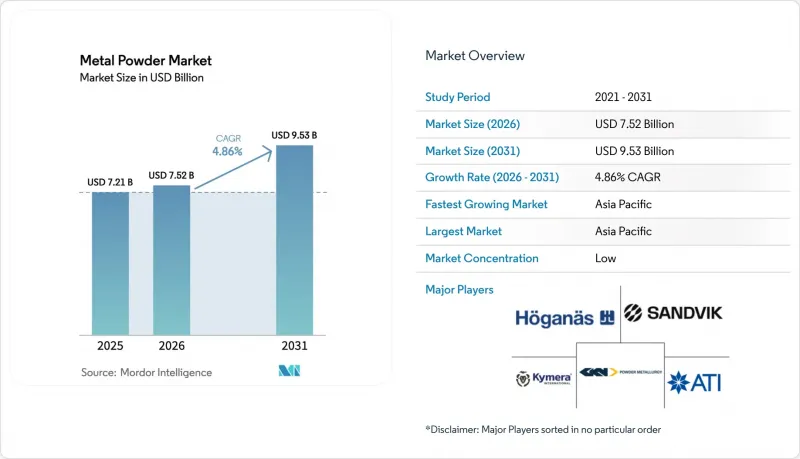
根據 Mordor Intelligence 預測,金屬粉末市場規模將從 2025 年的 72.1 億美元和 2026 年的 75.2 億美元成長到 2031 年的 95.3 億美元,2026 年至 2031 年的年複合成長率(CAGR)為 4.86%。
本報告按類型(鐵、青銅、其他)、製程(霧化、化合物還原、電解、其他)、製造方法(壓制/燒結、金屬射出成型、其他)、終端用戶產業(交通運輸、電氣/電子、醫療、其他)和地區(亞太、北美、其他)進行細分。市場預測以美元計價。
全球金屬粉末市場趨勢及洞察
汽車和航太領域的輕量化計畫激增。
汽車和航太製造商正擴大採用粉末冶金技術製造齒輪、連桿、支架和液壓歧管等零件。這種轉變不僅減輕了車輛和飛機的重量,而且在其整個生命週期中顯著降低了排放和油耗。例如,通用汽車(GM)在其Ultium電動車平台上使用了壓制燒結齒輪,在減輕重量的同時,保持了超過20萬次的疲勞壽命。同樣,空中巴士在其A320neo飛機中使用了鋁矽粉末支架,實現了減重並顯著縮短了前置作業時間。這些成就促成了多年的粉末供應契約,同時也給粉末加工產能帶來了壓力。因此,預計到2025年,航太鋁粉的價格將會上漲。在CAFE和歐7排放標準等監管壓力推動輕量化的背景下,擁有航太認證的粉末供應商預計將獲得通用鐵粉供應商無法企及的利潤溢價。
黏著劑噴塗積層製造技術的快速產業化
Desktop Metal 的 P-50 系統推動了黏著劑噴塗技術從原型原型製作邁向大規模量產。這項進步使汽車零件供應商能夠在單件生產中實現與金屬射出成型相當的成本效益,從而具備了價格競爭力。通用電氣航空航太公司在其 RISE 引擎專案中批准使用黏著劑噴塗生產的鈦合金,並指出其燒結密度優於鍛造材料,這為該技術提供了關鍵支援。目前,市場對高球形度鈦原料的需求日益成長,但也造成了瓶頸:高溫真空爐的短缺導致前置作業時間延長至一年。這種情況有利於那些同時具備粉末製造和燒結能力的垂直整合型企業。
奈米級生產中的呼吸道與爆炸風險
2025年1月,美國職業安全與健康管理局(OSHA)強制規定,在密封環境下處理粒徑小於10微米的粉末,並需進行即時顆粒監測。這項要求顯著增加了每條生產線的合規成本。同時,歐洲防爆指令(ATEX)的實施使得防爆電氣系統和惰性氣體防護裝置的維修成本高昂,迫使小規模生產商放棄奈米粉末生產線。 2024年發生的一系列粉塵爆炸事故導致保險費上漲。這種激增使得供應鏈集中在能夠將安全投資負擔分散到更廣泛的業務組合中。
細分市場分析
預計到2025年,鐵的市佔率將達到44.08%。這反映了鐵在齒輪、軸承和結構件等大規模生產零件中的重要作用,儘管商品化趨勢持續對利潤率構成壓力。 「其他類型」類別預計將以每年5.85%的速度成長,主要受整形外科和牙科植入、高超音速系統以及半導體溫度控管組件等行業對超高純度粉末需求不斷成長的推動。鐵基粉末供應商正透過滿足電動車電池托盤等電氣化需求來規避利潤率風險,而高附加價值合金生產商則透過與醫療和國防行業的客戶簽訂長期照付不議合約來規避價格波動風險。
預計到2025年,霧化製程將佔據金屬粉末市場69.79%的佔有率。這得歸功於數十年來對低成本鐵鋁粉壓制燒結生產系統的投資。 「其他製程」預計到2031年將以5.38%的複合年成長率成長。這是因為流體化床電解和氫還原法能夠顯著降低能耗,並可處理低品位礦石,從而縮小與傳統霧化製程的成本差距。現有霧化工藝企業利用規模經濟、自身廢料儲備以及與一級汽車製造商的代工協議,同時也在投資升級設備,採用等離子體和氫等離子體工藝,以維持其市場佔有率。電化學領域的新興企業專注於電子和航太領域的鈦、銅和鎳粉,這些粉末的價格取決於純度和晶體形態,因此它們在小批量生產成本趨於一致之前,避免直接參與大規模競爭。因此,競爭的激烈程度不僅取決於加工能力,還取決於能源經濟性和原料柔軟性。
區域分析
預計到2025年,亞太地區將佔據金屬粉末市場44.26%的佔有率,並將在2031年以5.48%的最高複合年成長率成長。這一成長主要得益於中國和印度的各項舉措,特別是氫直接還原鐵(DRI)生產和電動車平台的擴張。中國產業領導者寶武集團透過無縫整合上游工程海綿鐵和水噴法工藝,在成本方面比西方競爭對手更具優勢。同時,印度的生產連結獎勵計畫計畫(PLI)促使印度在2025年大幅提升了壓制和燒結產能。日本和韓國則專注於為多層陶瓷電容器提供超細銅粉和銀粉,鞏固了其在美洲和歐洲的出口主導地位。
預計到2025年,北美將佔據相當大的市場佔有率,這主要得益於航太、國防和電動車(EV)產業的強勁需求。美國國內的鈦粉生產線已受惠於第3章津貼。同時,《通貨膨脹控制法案》下的先進製造業稅額扣抵正在刺激電動車馬達和風力發電機機齒輪箱等關鍵綠色粉末的生產。憑藉其水力發電優勢,魁北克的工業叢集已將力拓金屬粉末公司和泰克納公司等主要企業打造成為美國和歐洲重要的低碳供應商。
歐洲預計將在2025年佔據較大的市場佔有率,但由於微型車產量成長緩慢,該地區曾面臨成長瓶頸。然而,由於有利於低二氧化碳粉末的第三類脫碳獎勵,該地區正重拾成長動能。隨著碳邊境調節機制(CBAM)徵收的關稅導致進口價格上漲,Höganhas和Metallisys等公司正在加速開發氫等離子體和電解技術,以期佔據市場主導。同時,德國和義大利的中小型霧化器公司正透過專注於航太領域和高階工具用粉末,策略性地確保利潤率。南美、中東和非洲的市場佔有率總合雖然較小,但成長潛力巨大,尤其是在巴西對汽車產業的熱情以及沙烏地阿拉伯大力推動可再生能源和氫直接還原鐵(DRI)策略的推動下。
其他好處:
- Excel格式的市場預測(ME)表
- 3個月的分析師支持
目錄
第1章:引言
- 研究假設和市場定義
- 調查範圍
第2章:調查方法
第3章執行摘要
第4章 市場狀況
- 市場概覽
- 市場促進因素
- 汽車和航太領域的輕量化計畫激增。
- 黏著劑噴塗積層製造技術的快速產業化
- 電子設備的日益普及推動了對超細粉末的需求。
- 氫基直接還原鐵(DRI)製程的興起,可生產高純度鐵粉。
- 用於高超音速系統的國防耐火合金
- 市場限制因素
- 奈米級生產中的呼吸道與爆炸風險
- 回收原料品質的差異
- 高能耗霧化技術對永續性指標產生影響
- 價值鏈分析
- 波特五力模型
第5章 市場規模與成長預測
- 類型
- 鐵
- 青銅
- 鋁
- 矽
- 鎳
- 其他(鈦等)
- 過程
- 原子化
- 化合物的減少
- 電解
- 其他方法(例如濕式冶金)
- 製造方法
- 壓制燒結(傳統粉末冶金)
- 金屬射出成型
- 積層製造/3D列印
- 其他(例如,高溫等靜壓成型)
- 終端用戶產業
- 運輸
- 電氣和電子設備
- 醫療保健
- 化學/冶金
- 防禦
- 建造
- 其他(積層製造服務提供者等)
- 地區
- 亞太地區
- 中國
- 印度
- 日本
- 韓國
- 泰國
- 印尼
- 越南
- 馬來西亞
- 菲律賓
- 其他亞太國家
- 北美洲
- 美國
- 加拿大
- 墨西哥
- 歐洲
- 德國
- 英國
- 法國
- 義大利
- 西班牙
- 俄羅斯
- 北歐國家
- 土耳其
- 其他歐洲國家
- 南美洲
- 巴西
- 阿根廷
- 哥倫比亞
- 其他南美國家
- 中東和非洲
- 沙烏地阿拉伯
- 阿拉伯聯合大公國
- 卡達
- 南非
- 奈及利亞
- 埃及
- 其他中東和非洲國家
- 亞太地區
第6章 競爭情勢
- 市場集中度
- 策略趨勢
- 市佔率和排名分析
- 公司簡介
- Advanced Technology & Materials Co., Ltd.
- Alcoa Corporation
- ATI
- Aubert & Duval
- BASF
- CNPC Powder
- CRS Holdings, LLC.
- Erasteel
- GKN Powder Metallurgy
- HC Starck Tungsten GmbH
- Hitachi High-Tech India Private Limited
- Hoganas AB
- JFE Steel Corporation
- Kymera International
- Linde Plc
- Metalysis Ltd.
- Outokumpu
- Polema
- Rio Tinto Metal Powders
- Sandvik AB
- Seiko Epson Corporation
- Tekna
- Valimet
第7章 市場機會與未來展望
According to Mordor Intelligence, the metal powder market size is projected to expand from USD 7.21 billion in 2025 and USD 7.52 billion in 2026 to USD 9.53 billion by 2031, registering a CAGR of 4.86% between 2026 to 2031.
This report is Segmented by Type (Iron, Bronze, and More), Process (Atomization, Reduction of Compounds, Electrolysis, and Other Processes), Manufacturing Method (Press and Sinter, Metal Injection Molding, and More), End-User Industry (Transportation, Electrical and Electronics, Medical, and More), and Geography (Asia-Pacific, North America, and More). The Market Forecasts are Provided in Terms of Value (USD).
Global Metal Powder Market Trends and Insights
Surge in Automotive and Aerospace Lightweighting Programs
Automotive and aerospace manufacturers are increasingly turning to powder metallurgy for components like gears, connecting rods, brackets, and hydraulic manifolds. This shift not only reduces the mass of vehicles and aircraft but also leads to significant cuts in lifecycle emissions and fuel consumption. For instance, General Motors has integrated press-and-sinter gears into its Ultium electric-vehicle platform, achieving a reduction in component mass while retaining fatigue life over 200,000 cycles. Similarly, Airbus has adopted aluminum-silicon powder brackets for its A320neo, resulting in a weight reduction and a significant reduction in lead times. These achievements have paved the way for multi-year powder supply contracts, tightening atomization capacity. Consequently, prices for aerospace-grade aluminum powder are projected to rise in 2025. With regulatory pressures from CAFE and Euro 7 pushing for lightweighting, powder suppliers holding aerospace certifications stand to gain margin premiums, a privilege not extended to commodity iron-powder vendors.
Rapid Industrialization of Binder-Jet Additive Manufacturing
Desktop Metal's P-50 system has propelled binder-jet technology from mere prototyping to full-scale serial production. This advancement allows automotive suppliers to competitively price their offerings, matching the cost-efficiency of metal-injection molding for unit batches. In a significant endorsement, GE Aerospace has approved binder-jet titanium for its RISE engine program, noting a sintered density surpassing wrought materials. While the demand for powder is increasingly leaning towards a highly spherical titanium feedstock, a bottleneck emerges: a scarcity of high-temperature vacuum furnaces is extending lead times to a year. This situation is advantageous for vertically integrated firms that possess both powder and sintering capabilities.
Respiratory and Explosion Hazards in Nano-Scale Production
In January 2025, OSHA mandated enclosed handling and live particulate monitoring for powders smaller than 10 µm. This requirement has raised compliance costs significantly for each production line. Meanwhile, European ATEX regulations are pushing smaller producers away from nano-powder lines due to the high costs of retrofitting for explosion-proof electrics and inert-gas blanketing. Following a series of dust explosions in 2024, insurance premiums have increased. This spike has led to a concentration of supply among integrated players, who can spread the burden of safety investments across their broader portfolios.
Other drivers and restraints analyzed in the detailed report include:
- Electronics Densification Driving Ultra-Fine Powder Demand
- Rise of Hydrogen-Based DRI Routes Creating High-Purity Fe Powders
- Energy-Intensive Atomization Undermining Sustainability Metrics
For complete list of drivers and restraints, kindly check the Table Of Contents.
Segment Analysis
Iron accounted for a 44.08% share in 2025, reflecting its role in high-volume gears, bearings, and structural components, but commoditization continues to suppress margins. "Other Types" are forecast to grow 5.85% annually as orthopedic and dental implants, hypersonic systems, and semiconductor thermal-management parts demand ultra-clean powders. Iron suppliers hedge margin risk by capturing vehicular electrification volumes in EV battery trays, while premium-alloy producers secure long-term take-or-pay contracts with medical and defense customers that insulate pricing.
Atomization delivered 69.79% of the metal powder market share in 2025 because decades of investment locked in low-cost production for press-and-sinter iron and aluminum powders. "Other Processes" will expand at a 5.38% CAGR through 2031 as fluidized-bed electrolysis and hydrogen reduction slash energy use and accept lower-grade ores, tightening the metal powder market size cost gap versus traditional atomization. Atomization incumbents leverage scale, captive scrap, and tolling deals with automotive tier-ones, yet they invest in plasma and hydrogen-plasma upgrades to defend share. Electrochemical challengers focus on titanium, copper, and nickel powders for electronics and aerospace, where purity and morphology command premiums, avoiding head-on volume battles until cost parity approaches at smaller batch sizes. Competitive intensity, therefore, pivots on energy economics and feedstock flexibility rather than throughput alone.
Complete Report Scope:
- Type
- Iron
- Bronze
- Aluminum
- Silicon
- Nickel
- Other Types (Titanium, etc.)
- Process
- Atomization
- Reduction of Compounds
- Electrolysis
- Other Processes (Hydrometallurgical Routes, etc.)
- Manufacturing Method
- Press and Sinter (Conventional PM)
- Metal Injection Molding
- Additive Manufacturing/3D Printing
- Other Methods (Hot Isostatic Pressing, etc.)
- End-User Industry
- Transportation
- Electrical and Electronics
- Medical
- Chemical and Metallurgical
- Defense
- Construction
- Other End-User Industries (Additive Manufacturing Service Bureaus, etc.)
- Geography
- Asia-Pacific
- China
- India
- Japan
- South Korea
- Thailand
- Indonesia
- Vietnam
- Malaysia
- Philippines
- Rest of Asia-Pacific
- North America
- United States
- Canada
- Mexico
- Europe
- Germany
- United Kingdom
- France
- Italy
- Spain
- Russia
- NORDIC Countries
- Turkey
- Rest of Europe
- South America
- Brazil
- Argentina
- Colombia
- Rest of South America
- Middle-East and Africa
- Saudi Arabia
- United Arab Emirates
- Qatar
- South Africa
- Nigeria
- Egypt
- Rest of Middle-East and Africa
- Asia-Pacific
Geography Analysis
Asia-Pacific held 44.26% of the metal powder market share in 2025 and is projected to post the fastest 5.48% CAGR to 2031. This growth is largely fueled by initiatives in China and India, notably in hydrogen-DRI production and the expansion of electric vehicle platforms. Chinese industry leader Baowu is reaping significant cost advantages over Western counterparts by seamlessly integrating upstream sponge iron with water-atomization. Meanwhile, India's Production-Linked Incentive (PLI) scheme unveiled a significant boost in press-and-sinter capacity in 2025. Both Japan and South Korea have carved a niche, specializing in ultra-fine copper and silver powders tailored for multilayer ceramic capacitors, solidifying their export dominance in the Americas and Europe.
North America accounted for a substantial portion of the 2025 market volume, propelled by robust demand from the aerospace, defense, and electric vehicle sectors. Domestic titanium-powder production lines received a boost from Title III grants, while the Inflation Reduction Act's advanced-manufacturing credit is driving green-powder production, essential for EV motors and wind turbine gearboxes. Leveraging its hydropower advantage, Quebec's cluster is positioning giants like Rio Tinto Metal Powders and Tekna as prime low-carbon suppliers to both the U.S. and Europe.
Europe, holding a significant share of the market in 2025, faced growth constraints due to stagnant light-vehicle output. However, the region found momentum in scope-3 decarbonization incentives, which favor low-CO2 powders. Companies like Hoganas and Metalysis are racing ahead, fast-tracking hydrogen-plasma and electrolysis technologies, eyeing market leadership as CBAM tariffs push import prices higher. Meanwhile, smaller atomizers in Germany and Italy are honing in on aerospace and luxury tooling powders, strategically safeguarding their profit margins. Though South America and the Middle-East and Africa collectively account for a smaller portion of the market, there's potential for growth, especially with Brazil's automotive ambitions and Saudi Arabia's push towards renewables and hydrogen-DRI strategies.
- Advanced Technology & Materials Co., Ltd.
- Alcoa Corporation
- ATI
- Aubert & Duval
- BASF
- CNPC Powder
- CRS Holdings, LLC.
- Erasteel
- GKN Powder Metallurgy
- H.C. Starck Tungsten GmbH
- Hitachi High-Tech India Private Limited
- Hoganas AB
- JFE Steel Corporation
- Kymera International
- Linde Plc
- Metalysis Ltd.
- Outokumpu
- Polema
- Rio Tinto Metal Powders
- Sandvik AB
- Seiko Epson Corporation
- Tekna
- Valimet
Additional Benefits:
- The market estimate (ME) sheet in Excel format
- 3 months of analyst support
TABLE OF CONTENTS
1 Introduction
- 1.1 Study Assumptions and Market Definition
- 1.2 Scope of the Study
2 Research Methodology
3 Executive Summary
4 Market Landscape
- 4.1 Market Overview
- 4.2 Market Drivers
- 4.2.1 Surge in automotive and aerospace light-weighting programs
- 4.2.2 Rapid industrialisation of binder-jet additive manufacturing
- 4.2.3 Electronics densification driving ultra-fine powder demand
- 4.2.4 Rise of hydrogen-based DRI routes creating high-purity Fe powders
- 4.2.5 Defense-grade refractory alloys for hypersonic systems
- 4.3 Market Restraints
- 4.3.1 Respiratory and explosion hazards in nano-scale production
- 4.3.2 Quality drift in recycled feedstock streams
- 4.3.3 Energy-intensive atomisation impacting sustainability metrics
- 4.4 Value Chain Analysis
- 4.5 Porter's Five Forces
- 4.5.1 Bargaining Power of Suppliers
- 4.5.2 Bargaining Power of Buyers
- 4.5.3 Threat of New Entrants
- 4.5.4 Threat of Substitutes
- 4.5.5 Degree of Competition
5 Market Size and Growth Forecasts (Value)
- 5.1 Type
- 5.1.1 Iron
- 5.1.2 Bronze
- 5.1.3 Aluminum
- 5.1.4 Silicon
- 5.1.5 Nickel
- 5.1.6 Other Types (Titanium, etc.)
- 5.2 Process
- 5.2.1 Atomization
- 5.2.2 Reduction of Compounds
- 5.2.3 Electrolysis
- 5.2.4 Other Processes (Hydrometallurgical Routes, etc.)
- 5.3 Manufacturing Method
- 5.3.1 Press and Sinter (Conventional PM)
- 5.3.2 Metal Injection Molding
- 5.3.3 Additive Manufacturing/3D Printing
- 5.3.4 Other Methods (Hot Isostatic Pressing, etc.)
- 5.4 End-User Industry
- 5.4.1 Transportation
- 5.4.2 Electrical and Electronics
- 5.4.3 Medical
- 5.4.4 Chemical and Metallurgical
- 5.4.5 Defense
- 5.4.6 Construction
- 5.4.7 Other End-User Industries (Additive Manufacturing Service Bureaus, etc.)
- 5.5 Geography
- 5.5.1 Asia-Pacific
- 5.5.1.1 China
- 5.5.1.2 India
- 5.5.1.3 Japan
- 5.5.1.4 South Korea
- 5.5.1.5 Thailand
- 5.5.1.6 Indonesia
- 5.5.1.7 Vietnam
- 5.5.1.8 Malaysia
- 5.5.1.9 Philippines
- 5.5.1.10 Rest of Asia-Pacific
- 5.5.2 North America
- 5.5.2.1 United States
- 5.5.2.2 Canada
- 5.5.2.3 Mexico
- 5.5.3 Europe
- 5.5.3.1 Germany
- 5.5.3.2 United Kingdom
- 5.5.3.3 France
- 5.5.3.4 Italy
- 5.5.3.5 Spain
- 5.5.3.6 Russia
- 5.5.3.7 NORDIC Countries
- 5.5.3.8 Turkey
- 5.5.3.9 Rest of Europe
- 5.5.4 South America
- 5.5.4.1 Brazil
- 5.5.4.2 Argentina
- 5.5.4.3 Colombia
- 5.5.4.4 Rest of South America
- 5.5.5 Middle-East and Africa
- 5.5.5.1 Saudi Arabia
- 5.5.5.2 United Arab Emirates
- 5.5.5.3 Qatar
- 5.5.5.4 South Africa
- 5.5.5.5 Nigeria
- 5.5.5.6 Egypt
- 5.5.5.7 Rest of Middle-East and Africa
- 5.5.1 Asia-Pacific
6 Competitive Landscape
- 6.1 Market Concentration
- 6.2 Strategic Moves
- 6.3 Market Share(%)/Ranking Analysis
- 6.4 Company Profiles (includes Global level Overview, Market level overview, Core Segments, Financials as available, Strategic Information, Products and Services, Recent Developments)
- 6.4.1 Advanced Technology & Materials Co., Ltd.
- 6.4.2 Alcoa Corporation
- 6.4.3 ATI
- 6.4.4 Aubert & Duval
- 6.4.5 BASF
- 6.4.6 CNPC Powder
- 6.4.7 CRS Holdings, LLC.
- 6.4.8 Erasteel
- 6.4.9 GKN Powder Metallurgy
- 6.4.10 H.C. Starck Tungsten GmbH
- 6.4.11 Hitachi High-Tech India Private Limited
- 6.4.12 Hoganas AB
- 6.4.13 JFE Steel Corporation
- 6.4.14 Kymera International
- 6.4.15 Linde Plc
- 6.4.16 Metalysis Ltd.
- 6.4.17 Outokumpu
- 6.4.18 Polema
- 6.4.19 Rio Tinto Metal Powders
- 6.4.20 Sandvik AB
- 6.4.21 Seiko Epson Corporation
- 6.4.22 Tekna
- 6.4.23 Valimet
7 Market Opportunities and Future Outlook
- 7.1 White-space and Unmet-Need Assessment
- 7.2 Increasing Developments in Healthcare Industries

 球形鐵粉市場報告:趨勢、預測及競爭分析(至2035年)
 2026-2030年全球金屬粉末層熔煉市場
 先進粉末材料市場預測(2034 年)—按產品類型、製造方法、性能、應用、產業和地區分類的全球分析金屬粉末市場預測至2034年-按材料類型、製造方法、形態、應用、產業和地區分類的全球分析
 2026-2030年全球金屬粉末市場
 鈦金屬粉末市場規模、佔有率和趨勢分析報告:按產品、最終用途、地區和細分市場分類(2026-2033 年)
 霧化金屬粉末:市場佔有率分析、產業趨勢與統計、成長預測(2026-2031)
 金屬粉末市場:2026年至2032年全球預測(按金屬類型、粒度、製造方法、純度、應用、最終用途和通路)鈦金屬粉末市場按產品類型、製程類型、粒度、最終用途產業和應用分類-全球預測,2026-2032年
 全球金屬粉末市場規模、佔有率、趨勢和成長分析報告(2026-2034年)