


 |
市場調查報告書
商品編碼
2062101
霧化金屬粉末:市場佔有率分析、產業趨勢與統計、成長預測(2026-2031)Atomizing Metal Powder - Market Share Analysis, Industry Trends & Statistics, Growth Forecasts (2026 - 2031) |
||||||

※ 本網頁內容可能與最新版本有所差異。詳細情況請與我們聯繫。
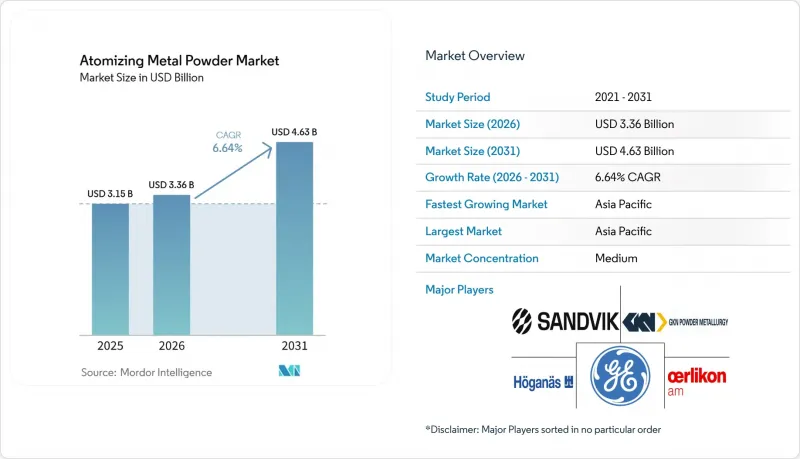
根據 Mordor Intelligence 預測,霧化金屬粉末市場規模將從 2025 年的 31.5 億美元和 2026 年的 33.6 億美元成長到 2031 年的 46.3 億美元,2026 年至 2031 年的年複合成長率(CAGR)為 6.64%。
本報告按霧化製程(例如,氣體霧化)、金屬類型(例如,不鏽鋼粉末)、應用領域(例如,積層製造)、終端用戶產業(例如,能源、汽車和電動車製造)以及地區(亞太地區、北美地區、歐洲地區、南美地區、中東和非洲)進行細分。市場預測以美元計價。
全球霧化金屬粉末市場趨勢及洞察
航太和電動車領域對高性能粉末冶金組件的需求不斷成長。
民航機製造商在其GE9X渦輪扇引擎中使用了超過300種積層製造零件,從而減輕了引擎重量並降低了10%的燃油消耗。美國燃氣渦輪製造商正在檢驗氫含量高達75%的氫混合燃料,這導致符合氧含量低於300ppm標準的鎳基高溫合金粉末的需求量增加。電動車(EV)平台正在用燒結鋼和鋁製零件取代鑄造支架,以降低每千瓦時的質量,這一轉變反映在2024年北美鋁粉出貨量激增22.6%。醫療設備製造商正在推動積層製造的發展,僅在2026年第一季就獲得了五種鈦合金脊椎和顎顏面植入的批准。這些因素共同促成了霧化金屬粉末市場成長預期成長約2個百分點。
對先進鈦、鎳和高熵合金粉末的需求激增
美國聯邦航空管理局 (FAA) 對快速等離子沉積 (RPD) 鈦結構的批准,以及空中巴士與通用電氣簽訂的 1000 噸鈦原料供應契約,都凸顯了高品質合金在工業領域的廣泛認可。到 2025 年,三家專業供應商將在其產品目錄中列出商用級高熵合金粉末,從而擴展高超音速飛機和低溫泵的合金產品線。山特維克已在英國和瑞典擴大了產能,並獲得了 AS9100D 認證,供應氧控鎳和鈦合金。到 2025 年底,TEKNA 的等離子霧化鈦產量將超過 1000 噸,證實了該技術的成熟。對這些合金的需求正推動金屬粉末霧化市場成長率提高 1.5 個百分點。
對顆粒尺寸分佈、形態和流動性進行嚴格的品管。
ISO 52907 和新的 ASTM 粉末分析標準要求所有批次產品均需透過雷射衍射、全流動測試和 CT 成像,這使得品管成本每噸增加高達 1500 美元。衛星顆粒會使流動性降低高達 30%,需要額外的篩分工序,將成品率從 85% 降低至 65%,並導致策略性產能限制。 Hoganas 公司 2024 年的產量為 41.2 萬噸,而其額定產能為 50 萬噸,這便是一個例證。同年,由於目的地設備製造商 (OEM) 推遲訂單,直到供應商證明其產品可重複性提高,北美地區的原料出貨量下降了 10%。這些要求導致預計複合年成長率 (CAGR) 下降了 0.7 個百分點。
細分市場分析
由於成本優勢,氣體霧化在2025年仍將佔總產量的57.12%。同時,水霧化滿足了對價格敏感的鐵粉和工具鋼粉的需求。等離子霧化預計將以6.88%的複合年成長率成長,高於金屬粉末霧化市場的整體平均水平,因為航太和醫療行業的買家需要氧濃度低於300 ppm的產品。
PyroGenesis公司憑藉其等離子法製備的Ti-6Al-4V原料(粒徑範圍為45至106 µm)獲得了波音公司的認證,充分展現了等離子體法在非標準粒徑調節方面的柔軟性。雖然氣體霧化對於不銹鋼和鋁合金的加工仍然至關重要,但隨著品質規範的日益嚴格和氦氣價格的趨於穩定,其在金屬粉末霧化市場的主導地位將逐漸下降。
2025年,不鏽鋼粉末的銷售額佔比為30.11%,而鈦和鎳基高溫合金的市佔率預計將以7.03%的複合年成長率成長至2031年。由於GE Additive與空中巴士簽訂了多年契約,每年供應1000噸鈦粉,預計僅鈦行業就將顯著推動噴塗金屬粉末市場的規模成長。
由於6K與西門子的合作,鎳基粉末的碳排放減少了91%,預計到2031年將達到兩位數的市場佔有率。不銹鋼在汽車燒結零件領域仍佔有一席之地,其中316L和17-4PH牌號滿足成本和耐腐蝕性要求,儘管其在霧化金屬粉末市場的佔有率在預測期內可能會下降。高熵合金仍處於小眾市場,但其價格居高不下,即使銷售量較低也能保證收入。
區域分析
預計到2025年,亞太地區將佔據霧化金屬粉末市場39.56%的佔有率,並將在2031年之前以7.12%的複合年成長率快速成長。中油粉、Avimetal和Epson Atmix計劃在2026年底新增產能總合超過1萬噸。儘管由於各國對關鍵礦產的出口限制,該地區正在大力建造自己的回收工廠,但在氦氣採購和氫氣相容品質標準方面仍面臨挑戰。
在北美,受電動車需求的推動,鋁粉出貨量激增22.6%;同時,由於國防領域的機械加工需求,碳化鎢的需求也隨之成長。 Velta公司在美國投資6,000萬美元興建鈦合金製造廠,並獲得烏克蘭的直接投資支持,這體現了美國為降低地緣政治供應風險而進行的戰略性生產回流。 6K Additive公司根據《國防生產法》第三部分獲得了2340萬美元的津貼,使其年產量從200噸提高到1000噸,這凸顯了聯邦政府對國內鎳合金和鈦粉產能的重視。
Höganass 2025 年的歐洲市佔率得益於其在 15 個生產基地年產能達 50 萬噸的規模。公司計劃在 2026 年通過基礎設施投資,以生物炭取代 20% 的化石煤,並於同年完成從中國遷出生產基地的工作。此外,隨著山特維克在英國尼斯新增兩座氣體霧化塔,並在瑞典桑德維肯新建一座通過 AS9100D 認證的鈦鎳合金工廠,歐洲現在更有運作為航太和醫療設備製造商 (OEM) 提供服務。
雖然南美洲和中東/非洲加起來的市場佔有率相對較小,但汽車和石化行業的需求高於平均水平,這表明隨著區域回收供應鏈的成熟,市場有快速成長的潛力。
其他好處:
- Excel格式的市場預測(ME)表
- 3個月的分析師支持
目錄
第1章:引言
- 研究假設和市場定義
- 調查範圍
第2章:調查方法
第3章執行摘要
第4章 市場狀況
- 市場概覽
- 市場促進因素
- 對高性能粉末冶金組件的需求增加(航太、電動車)
- 對先進合金(鈦合金、鎳基合金、高熵合金)的需求激增
- 按需供應的去中心化微霧化
- 用於氫氣渦輪機和能源應用的超低氧粉末
- 用於鋰離子電池和固態固態電池的電池級球形銅鋁粉
- 市場限制因素
- 對PSD、形狀和流動性進行嚴格的品管。
- 等離子體/氣體霧化法中氦氣供應價格的波動
- 活性/臨界粉末閉合迴路回收的局限性
- 價值鏈分析
- 波特五力模型
第5章 市場規模與成長預測
- 透過噴塗工藝
- 氣體霧化
- 電漿霧化
- 水噴淋法
- 離心噴霧
- 其他方法(例如,超音波)
- 按金屬類型
- 不銹鋼粉末
- 鈦和高溫合金粉末
- 鋁粉
- 銅及銅合金粉末
- 鎳基合金
- 其他金屬和合金
- 透過使用
- 積層製造(AM/3DP)
- 粉末冶金零件
- 切削刀具和磨損部件
- 塗層和熱噴塗材料
- 其他工業用途
- 按最終用戶行業分類
- 航太/國防
- 汽車和電動汽車製造
- 醫療和牙科設備
- 工業機械和工具
- 能源(渦輪機、石油和天然氣)
- 其他終端用戶產業
- 按地區
- 亞太地區
- 中國
- 印度
- 日本
- 韓國
- 東南亞國協
- 其他亞太國家
- 北美洲
- 美國
- 加拿大
- 墨西哥
- 歐洲
- 德國
- 英國
- 法國
- 義大利
- 西班牙
- 俄羅斯
- 北歐國家
- 其他歐洲國家
- 南美洲
- 巴西
- 阿根廷
- 其他南美國家
- 中東和非洲
- 沙烏地阿拉伯
- 阿拉伯聯合大公國
- 南非
- 其他中東和非洲國家
- 亞太地區
第6章 競爭情勢
- 市場集中度
- 策略趨勢
- 市佔率和排名分析
- 公司簡介
- 6K Inc.
- AMETEK Specialty Metal Powders
- Aubert & Duval
- CRS Holdings, LLC
- EOS GmbH
- Eramet-MATI Shanghai
- ERASTEEL
- Forged Solutions Group
- General Electric Company
- GKN Powder Metallurgy
- Hoganas
- Metalysis
- Oerlikon Management AG
- PyroGenesis Additive
- Rio Tinto
- Sandvik AB
- TEKNA
- Xi'an Sailong Metal
第7章 市場機會與未來展望
According to Mordor Intelligence, the atomizing metal powder market size is projected to expand from USD 3.15 billion in 2025 and USD 3.36 billion in 2026 to USD 4.63 billion by 2031, registering a CAGR of 6.64% between 2026 and 2031.
This report is Segmented by Atomization Process (Gas Atomization, and More), Metal Type (Stainless Steel Powders, and More), Application (Additive Manufacturing, and More), End-User Industry (Energy, Automotive and EV Manufacturing, and More), and Geography (Asia-Pacific, North America, Europe, South America, and the Middle-East and Africa). The Market Forecasts are Provided in Terms of Value (USD).
Global Atomizing Metal Powder Market Trends and Insights
Expanding Demand for High-Performance PM Parts in Aerospace and EVs
Commercial airframe builders deploy more than 300 additive-manufactured components in the GE9X turbofan, cutting engine weight and lowering fuel burn by 10%. United States gas-turbine makers validate hydrogen blends up to 75%, raising consumption of nickel-based superalloy powders qualified to sub-300 ppm oxygen limits. Electric-vehicle platforms replace cast brackets with sintered steel and aluminum parts to trim mass per kilowatt-hour, a change mirrored in the 22.6% jump in North American aluminum powder shipments during 2024. Medical suppliers received five titanium spinal and maxillofacial implant clearances in Q1 2026 alone, reinforcing additive-manufacturing traction. These combined pulls add almost two percentage-points to the Atomizing metal powder market growth outlook.
Surging Need for Advanced Titanium, Nickel, and HEA Powders
FAA (Federal Aviation Administration) clearance of rapid-plasma-deposited titanium structures and Airbus-GE supply deals for 1,000 tons of titanium feedstock confirm industrial acceptance of premium alloys. Commercial volumes of high-entropy alloy powders entered the catalogs of three specialty suppliers in 2025, widening alloy menus for hypersonic vehicles and cryogenic pumps. Sandvik expanded capacity in the United Kingdom and Sweden, under AS9100D certification, to deliver oxygen-controlled nickel and titanium grades. Plasma-atomized titanium production exceeded 1,000 tons cumulative at TEKNA by late 2025, underscoring maturity. Demand for these alloys lifts the Atomizing metal powder market trajectory by 1.5 percentage-points.
Stringent QC on Particle-Size Distribution, Morphology, and Flowability
ISO 52907 and new ASTM powder-analysis standards require every batch to pass laser diffraction, Hall flow, and CT imaging, raising quality-control overhead by up to USD 1,500 per tonne. Satellite particles reduce flowability by up to 30%, forcing extra sieving that cuts yield from 85% to 65% and drives strategic throttling of capacity, as seen when Hoganas produced 412,000 tons against 500,000 tons nameplate in 2024. North American feedstock shipments fell 10% the same year because OEMs (original equipment manufacturers) delayed orders until suppliers proved tighter reproducibility. These requirements shave 0.7 percentage-points off forecast CAGR.
Other drivers and restraints analyzed in the detailed report include:
- Decentralized Micro-Atomization for On-Demand Supply
- Ultra-Low-Oxygen Powders for Hydrogen Turbines and Energy Systems
- Helium Price Volatility for Plasma and Gas Atomization
For complete list of drivers and restraints, kindly check the Table Of Contents.
Segment Analysis
Gas atomization retained 57.12% of 2025 volume owing to cost advantages, while water atomization served price-sensitive iron and tool-steel powders. Plasma atomization is projected to rise at a 6.88% CAGR, outstripping the Atomizing Metal Powder market average because aerospace and medical buyers demand oxygen below 300 ppm.
Plasma's non-standard cut flexibility was proven when PyroGenesis won Boeing qualification for 45-106 µm Ti-6Al-4V feedstock. Gas atomization remains critical for stainless steel and aluminum grades, but its dominance in the Atomizing metal powder market will gradually erode as quality specifications tighten and helium pricing stabilizes.
Stainless steel powders commanded 30.11% of 2025 sales, yet titanium and nickel superalloys will capture incremental share at a 7.03% CAGR through 2031. The titanium category alone is set to climb substantially in the Atomizing Metal Powder market size as GE Additive supplies 1,000 tons of titanium powder to Airbus under a multi-year deal.
Nickel-based powders benefit from the 6K-Siemens alliance, delivering 91% carbon cuts and will likely reach double-digit share before 2031. Stainless steel keeps a foothold in automotive sintered parts where 316L and 17-4PH grades meet cost and corrosion targets, but its Atomizing metal powder market share may dip below over the forecast horizon. High-entropy alloys remain niche but command premium pricing that bolsters revenue even at low tonnage.
Geography Analysis
Asia-Pacific dominated 39.56% of the Atomizing Metal Powder market in 2025 and is racing ahead at a 7.12% CAGR to 2031 as CNPC Powder, Avimetal, and Epson Atmix together add more than 10,000 tons of new capacity by end-2026. Local export controls on critical minerals push the region to build in-house recycling plants, yet helium sourcing and hydrogen-ready quality standards remain open challenges.
In North America, aluminum powder volumes surged 22.6% on electric-vehicle demand, and tungsten carbide climbed on defense machining requirements. Velta's USD 60 million investment in a United States titanium manufacturing facility, backed by Ukrainian foreign direct investment, reflects strategic reshoring to reduce geopolitical supply risk. 6K Additive's USD 23.4 million Defense Production Act Title III grant to scale from 200 metric tons per year to 1,000 metric tonnes per year underscores federal prioritization of domestic nickel-alloy and titanium powder capacity.
Europe's market share in 2025 is anchored by Hoganas' 500,000 tons per year capacity across 15 production sites, with biochar infrastructure investment to replace 20% of fossil coal by 2026 and China relocation completion in 2026. Sandvik's commissioning of two additional gas-atomization towers at Neath, United Kingdom, and a new plant in Sandviken, Sweden, for titanium and nickel alloys under AS9100D certification positions Europe to serve aerospace and medical-device OEMs.
South America and the Middle East-Africa together account for a relatively small market share yet display above-average automotive and petrochemical demand, suggesting a potential fast-follower pattern once regional recycling supply chains mature.
- 6K Inc.
- AMETEK Specialty Metal Powders
- Aubert & Duval
- CRS Holdings, LLC
- EOS GmbH
- Eramet-MATI Shanghai
- ERASTEEL
- Forged Solutions Group
- General Electric Company
- GKN Powder Metallurgy
- Hoganas
- Metalysis
- Oerlikon Management AG
- PyroGenesis Additive
- Rio Tinto
- Sandvik AB
- TEKNA
- Xi'an Sailong Metal
Additional Benefits:
- The market estimate (ME) sheet in Excel format
- 3 months of analyst support
TABLE OF CONTENTS
1 Introduction
- 1.1 Study Assumptions and Market Definition
- 1.2 Scope of the Study
2 Research Methodology
3 Executive Summary
4 Market Landscape
- 4.1 Market Overview
- 4.2 Market Drivers
- 4.2.1 Expanding demand for high-performance PM parts (aerospace, EV)
- 4.2.2 Surging need for advanced alloys (Ti, Ni-based, HEA)
- 4.2.3 Decentralized micro-atomization for on-demand supply
- 4.2.4 Ultra-low-oxygen powders for hydrogen turbines and energy
- 4.2.5 Battery-grade spherical Cu and AI powders for Li-ion and solid-state cells
- 4.3 Market Restraints
- 4.3.1 Stringent QC on PSD, morphology and flowability
- 4.3.2 Helium supply price volatility for plasma/gas atomization
- 4.3.3 Limited closed-loop recycling for reactive/critical powders
- 4.4 Value Chain Analysis
- 4.5 Porter's Five Forces
- 4.5.1 Bargaining Power of Suppliers
- 4.5.2 Bargaining Power of Buyers
- 4.5.3 Threat of New Entrants
- 4.5.4 Threat of Substitutes
- 4.5.5 Degree of Competition
5 Market Size and Growth Forecasts (Value)
- 5.1 By Atomization Process
- 5.1.1 Gas Atomization
- 5.1.2 Plasma Atomization
- 5.1.3 Water Atomization
- 5.1.4 Centrifugal Atomization
- 5.1.5 Other Methods (e.g., ultrasonic)
- 5.2 By Metal Type
- 5.2.1 Stainless Steel Powders
- 5.2.2 Titanium and Superalloy Powders
- 5.2.3 Aluminum Powders
- 5.2.4 Copper and Copper-Alloy Powders
- 5.2.5 Nickel-based Alloys
- 5.2.6 Other Metals and Alloys
- 5.3 By Application
- 5.3.1 Additive Manufacturing (AM/3DP)
- 5.3.2 Powder-Metallurgy Components/Parts
- 5.3.3 Cutting Tools and Wear Parts
- 5.3.4 Coatings and Thermal-Spray Materials
- 5.3.5 Other Industrial Applications
- 5.4 By End-user Industry
- 5.4.1 Aerospace and Defense
- 5.4.2 Automotive and EV Manufacturing
- 5.4.3 Medical and Dental Devices
- 5.4.4 Industrial Machinery and Tooling
- 5.4.5 Energy (turbines, oil and gas)
- 5.4.6 Other End-user Industries
- 5.5 By Geography
- 5.5.1 Asia-Pacific
- 5.5.1.1 China
- 5.5.1.2 India
- 5.5.1.3 Japan
- 5.5.1.4 South Korea
- 5.5.1.5 ASEAN Countries
- 5.5.1.6 Rest of Asia-Pacific
- 5.5.2 North America
- 5.5.2.1 United States
- 5.5.2.2 Canada
- 5.5.2.3 Mexico
- 5.5.3 Europe
- 5.5.3.1 Germany
- 5.5.3.2 United Kingdom
- 5.5.3.3 France
- 5.5.3.4 Italy
- 5.5.3.5 Spain
- 5.5.3.6 Russia
- 5.5.3.7 NORDIC Countries
- 5.5.3.8 Rest of Europe
- 5.5.4 South America
- 5.5.4.1 Brazil
- 5.5.4.2 Argentina
- 5.5.4.3 Rest of South America
- 5.5.5 Middle-East and Africa
- 5.5.5.1 Saudi Arabia
- 5.5.5.2 United Arab Emirates
- 5.5.5.3 South Africa
- 5.5.5.4 Rest of Middle-East and Africa
- 5.5.1 Asia-Pacific
6 Competitive Landscape
- 6.1 Market Concentration
- 6.2 Strategic Moves
- 6.3 Market Share(%)/Ranking Analysis
- 6.4 Company Profiles (includes Global Overview, Market Overview, Core Segments, Financials, Strategic Information, Products and Services, Recent Developments)
- 6.4.1 6K Inc.
- 6.4.2 AMETEK Specialty Metal Powders
- 6.4.3 Aubert & Duval
- 6.4.4 CRS Holdings, LLC
- 6.4.5 EOS GmbH
- 6.4.6 Eramet-MATI Shanghai
- 6.4.7 ERASTEEL
- 6.4.8 Forged Solutions Group
- 6.4.9 General Electric Company
- 6.4.10 GKN Powder Metallurgy
- 6.4.11 Hoganas
- 6.4.12 Metalysis
- 6.4.13 Oerlikon Management AG
- 6.4.14 PyroGenesis Additive
- 6.4.15 Rio Tinto
- 6.4.16 Sandvik AB
- 6.4.17 TEKNA
- 6.4.18 Xi'an Sailong Metal
7 Market Opportunities and Future Outlook
- 7.1 White-space and Unmet-need Assessment

 球形鐵粉市場報告:趨勢、預測及競爭分析(至2035年)
 2026-2030年全球金屬粉末層熔煉市場
 金屬粉末:市場佔有率分析、產業趨勢與統計、成長預測(2026-2031)
 先進粉末材料市場預測(2034 年)—按產品類型、製造方法、性能、應用、產業和地區分類的全球分析金屬粉末市場預測至2034年-按材料類型、製造方法、形態、應用、產業和地區分類的全球分析
 2026-2030年全球金屬粉末市場
 鈦金屬粉末市場規模、佔有率和趨勢分析報告:按產品、最終用途、地區和細分市場分類(2026-2033 年)
 金屬粉末市場:2026年至2032年全球預測(按金屬類型、粒度、製造方法、純度、應用、最終用途和通路)鈦金屬粉末市場按產品類型、製程類型、粒度、最終用途產業和應用分類-全球預測,2026-2032年
 全球金屬粉末市場規模、佔有率、趨勢和成長分析報告(2026-2034年)