


 |
市場調查報告書
商品編碼
2125333
工業潛水泵:市場佔有率分析、產業趨勢與統計、成長預測(2026-2031)Industrial Submersible Pumps - Market Share Analysis, Industry Trends & Statistics, Growth Forecasts (2026 - 2031) |
||||||

※ 本網頁內容可能與最新版本有所差異。詳細情況請與我們聯繫。
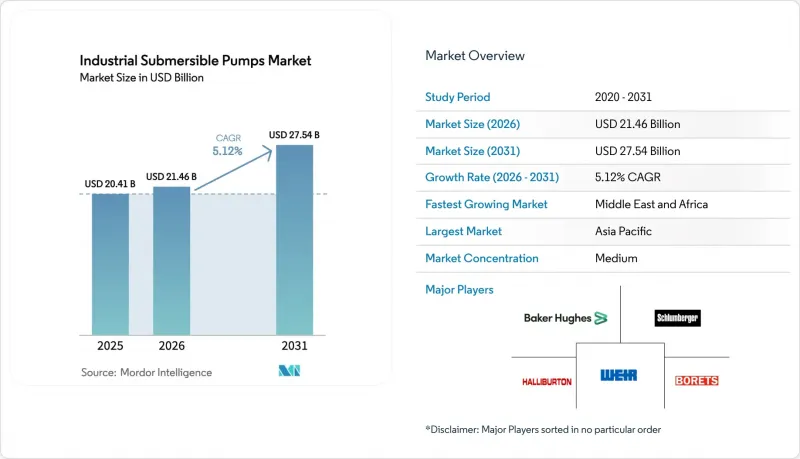
據 Mordor Intelligence 稱,2025 年工業潛水泵市場價值為 204.1 億美元,預計到 2031 年將達到 275.4 億美元,而 2026 年為 214.6 億美元,預測期(2026-2031 年)的複合年成長率為 5.12%。
本報告按驅動系統(電動、液壓等)、泵類型(深井泵、淺井泵、污水泵等)、終端用戶行業(用水和污水、採礦和建築等)、額定功率(低功率(小於15kW)、中功率(15-100kW等)、揚程深度(小於50m、50-100m)進行分類(DUSD。
全球工業潛水泵市場趨勢與洞察
全球供水和污水處理基礎設施的擴建
世界各地的地方政府正在維修泵站,以堵住洩漏並滿足新的處理能力標準。德克薩斯州已撥款4.81億美元用於水質淨化項目,其中包括潛水泵的維修。波多黎各耗資42億美元的重組項目涵蓋1267個泵站,這清楚地顯示了氣候脆弱地區的需求規模。在人口稠密的城市,小規模分散式水處理設施的數量正在增加,與傳統的集中式設施相比,這些設施每兆升處理能力需要更多的泵浦。供水事業也尋求IE5級馬達以降低電力成本,電力成本可能佔泵浦全生命週期成本的80%以上。能夠證明其能源效率的供應商目前正在爭取多年框架契約,這使他們能夠保護其收入免受商品價格波動的影響。
全球範圍內,都市化和建設項目正在快速推進。
亞洲正經歷規模空前的新城市發展浪潮,亞洲開發銀行(亞銀)預計,到2030年,亞洲基礎設施的年需求將達到1.7兆美元。由於地面安裝式排水系統會產生噪音且佔用場地空間有限,因此緊湊型水下排水系統是地鐵隧道、地下室和輸電隧道等深基坑開挖工程的首選。 2024年,東協的外國直接投資達2,300億美元,其中大部分投資於可再生能源園區,這些園區需要耐腐蝕泵浦來循環製程用水。建築資訊模型(BIM)軟體能夠更精確地選擇泵浦的容量,從而減少過度設計,並增加對高精度液壓裝置的需求。即使整體工業資本投資放緩,這些趨勢也使得專案主導訂單的訂購進度保持穩定。
整個生命週期內維護和拆除成本高昂
深井和海上泵浦的回收通常需要數天的停機時間,導致高昂的維修成本。電氣故障佔電潛泵(ESP)故障的61%,隨著油井老化,平均故障間隔時間(MTBF)縮短,增加了現場作業者的營運預算。諸如單罐雙泵陣列之類的技術創新可以減少停機時間,但會增加資本投資成本,這種權衡使得對成本敏感的製造商難以採用這些技術。當地面安裝的泵組能夠滿足揚程要求時,資產所有者可能會選擇升級為潛水泵,這阻礙了市場成長。供應商正在推出模組化電潛泵來應對這一問題,這種泵允許在無需完全回收的情況下更換馬達和密封件,但這些設計的價格仍然很高,並非所有買家都能負擔得起。
細分市場分析
至2025年,電動潛水泵將佔工業潛水泵市場的33.45%。這主要得益於市政當局和接入電網的工業設施,它們優先考慮穩定的電力供應。 IE5永磁馬達的廣泛應用進一步鞏固了電動潛水泵的市場主導地位,使營運商無需重新設計管道即可降低電力成本。變頻驅動裝置現已作為標準配置出貨,使工廠能夠根據即時需求調節流量,避免因節流造成的損失。儘管液壓驅動系統市場規模較小,但預計到2031年將以5.43%的複合年成長率成長,這主要得益於深井鑽探和海上鑽機在極端壓力下對精確速度控制的需求。緊湊型動力單元和新型流體調節迴路減少了洩漏,使得液壓驅動即使在難以進行電氣隔離的場所也實用化。氣動和柴油驅動幫浦在災害應變和電網無法覆蓋的偏遠建築工地等特定領域仍保持著一定的市場需求。數位介面以各種形式實現了遠端監控的標準化,使操作人員能夠管理不同類型的泵,而不會影響對其狀態資料的可見性。
在工業潛水泵市場,能夠根據每種應用的風險狀況量身定做驅動系統的供應商仍然具有優勢。雖然在供水事業,電動系統在生命週期成本方面更具優勢,但在面臨高磨蝕性礦漿的高揚程礦場中,液壓系統則能提供更高的利潤率。在易受洪水侵襲的城市,由於需要具備自持式容錯能力,柴油機組仍能獲得緊急合約。隨著世界各國政府陸續徵收碳排放稅,一些礦場正在考慮引入由現場太陽能電池陣列供電的混合動力(電動和液壓)機組,這表明驅動系統的選擇不再僅僅是一個技術決策,而是一個能源戰略決策。擁有涵蓋多種驅動系統的產品線的供應商,透過將資料流整合到單一控制面板中,既能夠響應不斷變化的市場需求,又能確保售後服務業務收益。
到2025年,鑽井泵將佔據工業潛水泵市場40.15%的佔有率,以滿足農業和城市深井中等流量和高揚程的需求。多級離心式幫浦浦設計現已採用耐腐蝕葉輪,即使在微鹹含水層中也能延長維護週期。防堵塞污水泵用於污水處理廠,因為開放式井式裝置容易因異物污染而堵塞,而防堵塞污水泵的渦流葉輪可減少維護時間。受銅、鋰和鐵礦石項目(這些項目需要處理高密度尾礦)擴張的推動,預計到2031年,泥漿泵和脫水泵的複合年成長率將達到6.18%。耐磨塗層和可調式耐磨環可延長泵浦的使用壽命,並減少偏遠礦區的停機時間。
隨著營運商擴大採用感測器來記錄固態負荷和運作週期,泵浦的選擇也越來越依賴數據驅動。這種轉變有利於那些擁有應用工程團隊的供應商,這些團隊能夠模擬磨損模式並推薦合適尺寸的型號,從而降低資本支出 (CAPEX) 和備件庫存。工業潛水泵市場也出現了跨界設備,例如用於市政項目的混合井泵和漿泵,這些項目既要應對含沙量,又要應對流量波動。在食品加工廠,由於衛生標準禁止使用塗漆表面,不銹鋼衛生幫浦越來越受歡迎。對於能夠證明其產品符合特定產業標準(從 NSF 到 ATEX)的製造商而言,每個細分市場都能帶來更高的利潤率。
區域分析
亞太地區仍是市場中心,預計到2025年將佔工業潛水泵市場價值的44.05%,與整體市場5.12%的複合年成長率保持一致。中國老舊城市供水系統的更新、印度的「飲用水生命線計畫」(Jal Jeevan Mission)以及製造業東南亞國協的湧入,都支撐了強勁的訂單儲備,同時,國內供應商正在擴大生產規模以滿足對價格敏感的農村需求。日本和韓國企業正在推出物聯網先導計畫,以突破效率極限,這些項目隨後將在全部區域推廣。
儘管中東和非洲地區的規模較小,但預計到2031年,隨著海水淡化、區域供冷和大型基礎設施項目的蓬勃發展,該地區的年複合成長率將達到6.03%。沙烏地阿拉伯已授予一項價值2.93億美元的廢水處理和管道建設契約,合約將於2025年生效;摩洛哥還獲得了國際金融公司(IFC)1億歐元的貸款,用於建設一條219公里長的海水淡化管道(ifc.org)。 NEOM的淨零排放供水網路展現了該地區向太陽能驅動、數位控制的泵站平台邁出的一大步。
在北美和歐洲,隨著公共產業對其戰後資產進行現代化改造並遵守更嚴格的能源效率要求,市場正日趨成熟並穩步成長。美國能源局) 的標準將於 2025 年 5 月生效,要求工業園區提交水泵能源效率報告,並鼓勵採購符合 IE4 和 IE5 標準的系統。德克薩斯州水資源委員會提供的 4.81 億美元資金以及波多黎各的氣候適應型重組計畫表明,已開發國家的潛水泵供應商仍然擁有巨大的潛在市場。在南美洲,智利的新型鋰離子海水淡化計畫以及巴西塞拉多地區太陽能灌溉系統的實施預計將帶來成長機會並擴大全球銷售基礎。
其他好處:
- Excel格式的市場預測(ME)表
- 3個月的分析師支持
目錄
第1章:引言
- 研究假設和市場定義
- 調查範圍
第2章:調查方法
第3章執行摘要
第4章 市場狀況
- 市場概覽
- 市場促進因素
- 全球用水和污水基礎設施的擴建
- 全球快速都市化和持續不斷的建設項目
- 上游油氣鑽井作業的恢復(引入電潛泵)
- 政府促進產業部門維修能源效率
- 用於農業的太陽能潛水泵補貼正在大幅增加。
- 快速數位化:利用物聯網進行幫浦的狀態監測
- 市場限制因素
- 整個生命週期內維護和報廢成本高昂
- 不銹鋼和稀土元素材料的價格波動
- 缺乏強制性的 IE3 能源效率標準導致採購週期延誤。
- 馬達故障會對關鍵基礎設施部門造成營運瓶頸。
- 產業生態系分析
- 技術展望
- 波特五力分析
第5章 市場規模與成長預測
- 透過驅動系統
- 電的
- 油壓
- 氣動和柴油動力
- 泵浦類型
- 對於深井
- 對於淺井
- 用於廢棄物和污水
- 用於泥漿和排水
- 按最終用戶行業分類
- 用水和污水
- 石油和天然氣
- 採礦和建築
- 發電
- 食品/飲料
- 農業和灌溉
- 額定功率
- 低功率(小於15kW)
- 中功率(15-100kW)
- 高功率(100kW 或以上)
- 不同的頭部深度
- 不到50米
- 50~100m
- 超過100米
- 按地區
- 北美洲
- 美國
- 加拿大
- 墨西哥
- 南美洲
- 巴西
- 阿根廷
- 其他南美國家
- 歐洲
- 德國
- 英國
- 法國
- 義大利
- 西班牙
- 俄羅斯
- 其他歐洲國家
- 亞太地區
- 中國
- 印度
- 日本
- 韓國
- 澳洲
- 其他亞太國家
- 中東和非洲
- 波灣合作理事會(GCC)成員國
- 土耳其
- 南非
- 其他中東和非洲國家
- 北美洲
第6章 競爭情勢
- 市場集中度
- 策略舉措和夥伴關係
- 市佔率分析
- 公司簡介
- Grundfos Group
- Xylem Inc.
- Sulzer Ltd
- KSB SE and Co. KGaA
- Weir Group PLC
- Franklin Electric Co. Inc.
- Baker Hughes Co.
- Schlumberger Ltd
- Halliburton Co.
- Atlas Copco AB
- Ebara Corporation
- Tsurumi Manufacturing
- Flowserve Corporation
- Wilo SE
- Kirloskar Brothers Ltd
- Pentair PLC
- Gorman-Rupp Company
- Borets International
- Shakti Pumps(India)Ltd
- WEG Industries
第7章 市場機會與未來展望
According to Mordor Intelligence, the industrial submersible pumps market size was valued at USD 20.41 billion in 2025 and estimated to grow from USD 21.46 billion in 2026 to reach USD 27.54 billion by 2031, at a CAGR of 5.12% during the forecast period (2026-2031).
This report is Segmented by Drive Type (Electric, Hydraulic, and More), Pump Type (Borewell, Open-Well, Non-Clog Sewage, and More), End-User Industry (Water and Wastewater, Mining and Construction, and More), Power Rating (Low (Less Than15 KW), Medium (15-100 KW), and More), Head Depth (Below 50 M, 50 - 100 M), and Geography. The Market Forecasts are Provided in Terms of Value (USD).
Global Industrial Submersible Pumps Market Trends and Insights
Expanding Global Water and Wastewater Infrastructure
Municipal utilities worldwide upgrade pump stations to stem leakage and meet new capacity standards. Texas allocated USD 481 million in 2025 for clean-water schemes that include submersible pump retrofits. Puerto Rico's USD 4.2 billion rebuild covers 1,267 pumping assets, illustrating the scale of demand in climate-exposed regions. Smaller, distributed treatment plants proliferate in dense cities, requiring more pumps per megaliter of capacity than legacy centralized plants. Utilities also seek IE5-class motors to curb electricity bills, a cost line that can exceed 80% of lifetime pump spending. Suppliers able to certify energy savings now win multi-year framework contracts that insulate revenues from commodity-price swings.
Rapid Urbanization and Construction Projects Across the Globe
Asia hosts the biggest wave of new urban developments, with the Asian Development Bank estimating USD 1.7 trillion in yearly infrastructure needs to 2030. Deep excavation for metro tunnels, basements, and power tunnels favors compact submersible dewatering sets because surface-mounted alternatives cause noise and block limited site space. Foreign direct investment into ASEAN hit USD 230 billion in 2024, much of it channeled to renewable-energy parks that rely on corrosion-resistant pumps for process water circulation. Building-information-modeling software now sizes pumps accurately, trimming overspecification and reinforcing demand for high-precision hydraulic units. These trends sustain a steady call-off schedule for project-driven pump orders even when general industrial capex softens.
High Lifecycle Maintenance and Pull-Out Costs
Deep-well and offshore pumps often require costly workovers because each retrieval can halt production for days. Electrical faults account for 61% of ESP failures, and mean time between failures shortens as wells age, inflating operating budgets for field operators. Innovations such as single-tank dual-pump arrays reduce downtime yet push capital costs higher, creating a trade-off that slows adoption for cost-sensitive producers. Where surface-mounted sets can meet head requirements, asset owners sometimes shelve submersible upgrades, holding back market volume growth. Suppliers respond with modular ESPs that allow motor or seal section swaps without full pull-out, but these designs still command a premium that not all buyers can absorb.
Other drivers and restraints analyzed in the detailed report include:
- Recovery in Upstream Oil and Gas Drilling (ESP Adoption)
- Government Push for Industrial Energy-Efficiency Retrofits
- Volatility in Stainless-Steel and Rare-Earth Motor Materials
For complete list of drivers and restraints, kindly check the Table Of Contents.
Segment Analysis
The electric segment accounted for 33.45% of industrial submersible pumps market share in 2025, supported by grid-connected municipal and industrial sites that prize predictable power supply. Widespread availability of IE5 permanent-magnet motors lets operators trim electricity bills without redesigning piping, reinforcing electric leadership. Variable-frequency drives now ship as standard, letting plants match flow to real-time demand and avoiding throttling losses. Hydraulic drive systems, though a smaller base, are slated for a 5.43% CAGR through 2031 as deep-well mining and offshore rigs need precise speed control under extreme pressure. Compact power packs and new fluid-conditioning circuits reduce leakage, making hydraulics viable where electric insulation is difficult. Air and diesel sets keep niche relevance for disaster response and remote construction where grid power is absent. Across all formats, digital interfaces standardize telemetry, letting operators mix fleets without losing visibility into condition data.
The industrial submersible pumps market continues to reward suppliers that tailor drive offerings to application risk profiles. Electric systems win on life-cycle cost in water utilities, but hydraulics attract premium margins in high-head mines that face abrasive slurries. Diesel packages still secure emergency contracts from flood-prone cities wanting standalone resilience. As governments add carbon taxes, some mineshafts consider hybrid electric-hydraulic sets powered by onsite solar arrays, underscoring how drive choice is becoming an energy-strategy decision rather than a pure engineering call. Suppliers that maintain multi-drive catalogs hedge demand shifts and capture back-end service revenue by unifying data streams onto single dashboards.
Borewell pumps captured 40.15% share of the industrial submersible pumps market in 2025 by catering to deep agricultural and municipal wells that demand high head at modest flow. Multistage centrifugal designs now feature corrosion-resistant impellers that stretch service intervals even in brackish aquifers. Non-clog sewage pumps occupy wastewater plants where ragging can choke open-well units; their vortex impellers lower maintenance hours. Slurry and dewatering pumps will deliver a 6.18% CAGR into 2031 thanks to expanded copper, lithium, and iron-ore projects that handle dense tailings. Abrasion-resistant coatings and adjustable wear rings extend life, reducing downtime in remote pits.
Pump-type selection is increasingly data-driven as operators deploy sensors to log solids loading and duty cycles. This shift favors vendors with application engineering teams that can simulate wear patterns and recommend right-sized models, reducing both capex and spares inventory. The industrial submersible pumps market also sees crossover equipment such as hybrid borewell-slurry designs for municipal projects that face both sand ingress and variable flow. In food factories, stainless sanitary pumps gain traction where hygiene codes ban painted surfaces. Each niche offers margin uplift for manufacturers that can certify compliance with sector-specific standards, from NSF to ATEX.
Complete Report Scope:
- By Drive Type
- Electric
- Hydraulic
- Air- and Diesel-Driven
- By Pump Type
- Borewell
- Open-well
- Non-clog Sewage
- Slurry and Dewatering
- By End-user Industry
- Water and Wastewater
- Oil and Gas
- Mining and Construction
- Power Generation
- Food and Beverage
- Agriculture and Irrigation
- By Power Rating
- Low (Less than 15 kW)
- Medium (15-100 kW)
- High (Higher than 100 kW)
- By Head Depth
- Below 50 m
- 50 - 100 m
- Above 100 m
- By Geography
- North America
- United States
- Canada
- Mexico
- South America
- Brazil
- Argentina
- Rest of South America
- Europe
- Germany
- United Kingdom
- France
- Italy
- Spain
- Russia
- Rest of Europe
- Asia-Pacific
- China
- India
- Japan
- South Korea
- Australia
- Rest of Asia-Pacific
- Middle East and Africa
- Gulf Cooperation Council Countries
- Turkey
- South Africa
- Rest of Middle East and Africa
- North America
Geography Analysis
Asia-Pacific remained the epicenter, holding 44.05% of industrial submersible pumps market value in 2025, and is forecast to track the overall 5.12% CAGR. China's replacement of aging city mains, India's Jal Jeevan Mission, and ASEAN manufacturing inflows underpin steady order books, while domestic suppliers scale up to meet price-sensitive rural demand. Japanese and South Korean firms push efficiency frontiers, seeding IoT pilot projects that later diffuse across the region.
The Middle East and Africa, although smaller, is expected to log a 6.03% CAGR through 2031 as desalination, district cooling, and mega-infrastructure projects proliferate. Saudi Arabia launched USD 293 million of sewage and pipeline contracts in 2025, and Morocco secured a EUR 100 million IFC loan for a 219 km desalinated-water pipeline ifc.org. NEOM's net-zero water network illustrates how the region leapfrogs to solar-powered, digitally orchestrated pumping platforms.
North America and Europe show mature yet resilient growth as utilities replace post-war assets and comply with tighter efficiency mandates. The U.S. DOE standard effective May 2025 forces industrial campuses to file pump-efficiency reports, steering purchases toward IE4 and IE5 systems. Texas water-board funding of USD 481 million and Puerto Rico's climate-proof rebuild confirm that even developed markets still offer sizeable addressable pockets for submersible suppliers. South America contributes opportunistic upside via new lithium brine projects in Chile and solar-irrigation rollouts in Brazil's cerrado, broadening the global revenue footprint.
- Grundfos Group
- Xylem Inc.
- Sulzer Ltd
- KSB SE and Co. KGaA
- Weir Group PLC
- Franklin Electric Co. Inc.
- Baker Hughes Co.
- Schlumberger Ltd
- Halliburton Co.
- Atlas Copco AB
- Ebara Corporation
- Tsurumi Manufacturing
- Flowserve Corporation
- Wilo SE
- Kirloskar Brothers Ltd
- Pentair PLC
- Gorman-Rupp Company
- Borets International
- Shakti Pumps (India) Ltd
- WEG Industries
Additional Benefits:
- The market estimate (ME) sheet in Excel format
- 3 months of analyst support
TABLE OF CONTENTS
1 INTRODUCTION
- 1.1 Study Assumptions and Market Definition
- 1.2 Scope of the Study
2 RESEARCH METHODOLOGY
3 EXECUTIVE SUMMARY
4 MARKET LANDSCAPE
- 4.1 Market Overview
- 4.2 Market Drivers
- 4.2.1 Expanding global water and wastewater infrastructure
- 4.2.2 Rapid urbanization and ongoing construction projects across the globe
- 4.2.3 Recovery in upstream oil and gas drilling (ESP adoption)
- 4.2.4 Government push for industrial energy efficiency retrofits
- 4.2.5 Surge in solar-powered submersible pump subsidies for agriculture
- 4.2.6 Rapid digitalisation: IoT-enabled condition-monitoring pumps
- 4.3 Market Restraints
- 4.3.1 High lifecycle maintenance and pull-out costs
- 4.3.2 Volatility in stainless-steel and rare-earth motor materials
- 4.3.3 Absence of IE3 efficiency mandates delays procurement cycles
- 4.3.4 Motor Failure results in operations bottleneck in critocal infrastructure sector
- 4.4 Industry Ecosystem Analysis
- 4.5 Technological Outlook
- 4.6 Porter's Five Forces Analysis
- 4.6.1 Bargaining Power of Buyers
- 4.6.2 Bargaining Power of Suppliers
- 4.6.3 Threat of New Entrants
- 4.6.4 Threat of Substitutes
- 4.6.5 Intensity of Competitive Rivalry
5 MARKET SIZE AND GROWTH FORECASTS (VALUES)
- 5.1 By Drive Type
- 5.1.1 Electric
- 5.1.2 Hydraulic
- 5.1.3 Air- and Diesel-Driven
- 5.2 By Pump Type
- 5.2.1 Borewell
- 5.2.2 Open-well
- 5.2.3 Non-clog Sewage
- 5.2.4 Slurry and Dewatering
- 5.3 By End-user Industry
- 5.3.1 Water and Wastewater
- 5.3.2 Oil and Gas
- 5.3.3 Mining and Construction
- 5.3.4 Power Generation
- 5.3.5 Food and Beverage
- 5.3.6 Agriculture and Irrigation
- 5.4 By Power Rating
- 5.4.1 Low (Less than 15 kW)
- 5.4.2 Medium (15-100 kW)
- 5.4.3 High (Higher than 100 kW)
- 5.5 By Head Depth
- 5.5.1 Below 50 m
- 5.5.2 50 - 100 m
- 5.5.3 Above 100 m
- 5.6 By Geography
- 5.6.1 North America
- 5.6.1.1 United States
- 5.6.1.2 Canada
- 5.6.1.3 Mexico
- 5.6.2 South America
- 5.6.2.1 Brazil
- 5.6.2.2 Argentina
- 5.6.2.3 Rest of South America
- 5.6.3 Europe
- 5.6.3.1 Germany
- 5.6.3.2 United Kingdom
- 5.6.3.3 France
- 5.6.3.4 Italy
- 5.6.3.5 Spain
- 5.6.3.6 Russia
- 5.6.3.7 Rest of Europe
- 5.6.4 Asia-Pacific
- 5.6.4.1 China
- 5.6.4.2 India
- 5.6.4.3 Japan
- 5.6.4.4 South Korea
- 5.6.4.5 Australia
- 5.6.4.6 Rest of Asia-Pacific
- 5.6.5 Middle East and Africa
- 5.6.5.1 Gulf Cooperation Council Countries
- 5.6.5.2 Turkey
- 5.6.5.3 South Africa
- 5.6.5.4 Rest of Middle East and Africa
- 5.6.1 North America
6 COMPETITIVE LANDSCAPE
- 6.1 Market Concentration
- 6.2 Strategic Moves and Partnerships
- 6.3 Market Share Analysis
- 6.4 Company Profiles (includes Global level Overview, Market level overview, Core Segments, Financials as available, Strategic Information, Market Rank/Share for key companies, Products and Services, and Recent Developments)
- 6.4.1 Grundfos Group
- 6.4.2 Xylem Inc.
- 6.4.3 Sulzer Ltd
- 6.4.4 KSB SE and Co. KGaA
- 6.4.5 Weir Group PLC
- 6.4.6 Franklin Electric Co. Inc.
- 6.4.7 Baker Hughes Co.
- 6.4.8 Schlumberger Ltd
- 6.4.9 Halliburton Co.
- 6.4.10 Atlas Copco AB
- 6.4.11 Ebara Corporation
- 6.4.12 Tsurumi Manufacturing
- 6.4.13 Flowserve Corporation
- 6.4.14 Wilo SE
- 6.4.15 Kirloskar Brothers Ltd
- 6.4.16 Pentair PLC
- 6.4.17 Gorman-Rupp Company
- 6.4.18 Borets International
- 6.4.19 Shakti Pumps (India) Ltd
- 6.4.20 WEG Industries
7 MARKET OPPORTUNITIES AND FUTURE OUTLOOK
- 7.1 White-space and Unmet-need Assessment

 2026-2034年全球多級潛水電動幫浦市場規模、佔有率、趨勢與成長分析報告
 潛水泵電容器市場規模、佔有率和成長分析:按電容器類型、介電材料、額定電壓、終端用戶產業和地區分類-2026-2033年產業預測
 潛水泵:市場佔有率分析、產業趨勢與統計、成長預測(2026-2031)
 2026 年至 2035 年多級電動潛水幫浦的市場機會、成長要素、產業趨勢分析與預測。
 潛水泵浦市場:2026-2032年全球市場預測(依產品類型、驅動系統、運轉類型、額定輸出功率、材質、安裝類型及應用分類)
 液壓潛水泵市場-全球產業規模、佔有率、趨勢、機會和預測:按應用、類型、材質、最終用戶、地區和競爭格局分類,2021-2031年
 潛水泵浦市場報告:按類型、運作方式、額定功率、應用和地區分類(2026-2034 年)全球潛水泵市場規模、佔有率、趨勢和成長分析報告(2026-2034)
 潛水泵浦市場規模、佔有率和趨勢分析報告:按產品、驅動系統、最終用途、地區和細分市場分類,預測期為2026-2033年
 潛水泵浦市場:依產品類型、揚程類型、終端使用者產業及地區分類