


 |
市場調查報告書
商品編碼
2113431
潛水泵:市場佔有率分析、產業趨勢與統計、成長預測(2026-2031)Submersible Pumps - Market Share Analysis, Industry Trends & Statistics, Growth Forecasts (2026 - 2031) |
||||||

※ 本網頁內容可能與最新版本有所差異。詳細情況請與我們聯繫。
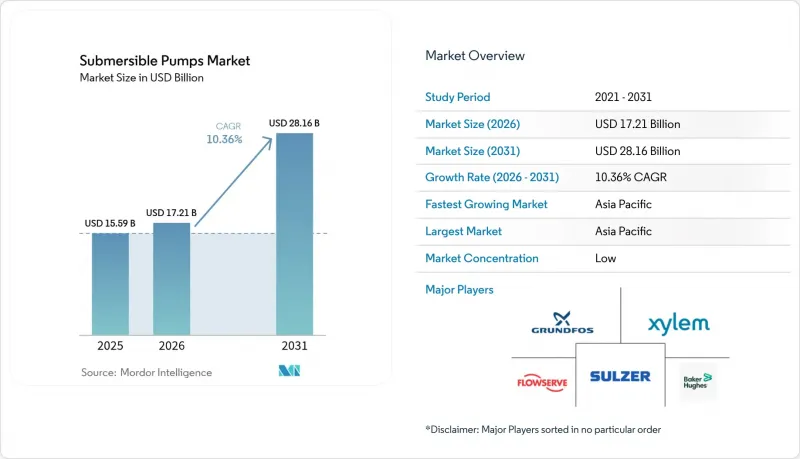
據 Mordor Intelligence 稱,2025 年潛水泵市場價值為 155.9 億美元,預計到 2031 年將達到 281.6 億美元,而 2026 年為 172.1 億美元,預測期(2026-2031 年)的複合年成長率為 10.36%。
本報告按泵類型(波爾井潛水泵、開式井潛水泵、防堵塞/污水潛水泵等)、驅動系統(電動、液壓、太陽能)、揚程(小於 50 米、50-100 米、大於 100 米)、最終用戶(用水和污水處理廠、石油和北美、歐洲、南美地區(北美、歐洲、亞太地區)、石油和北美地區進行分類。
全球潛水泵市場趨勢及洞察
石油和天然氣行業現有採礦項目的復甦
隨著營運商將資金重新分配到需要高揚程電潛泵(ESP)系統的成熟油井,棕地最佳化正在重塑人工抽油作業的經濟格局。一份為阿塞拜疆國家石油公司(SOCAR)提供超過150套ESP系統的多年期合約表明,傳統油藏如何依賴現代ESP技術來抵消壓力下降和水分增加。 SLB緊湊型、寬範圍的ESP系列產品也追求類似的目標,能夠在最大限度減少已完成工程安裝面積的同時,實現對更深儲存層的開採。諸如BP卡斯基達油田等項目的海底增壓合約進一步凸顯了ESP的重要性,即使產業鑽井預算趨於穩定,因為最大化現有資產的回報可以保障現金流並降低探勘風險。
全球建築熱潮與排水需求
基礎設施、隧道和地下交通項目的加速推進,推動了對能夠在高磨損環境下連續運行的可靠現場排水泵的需求。例如,耗資11億美元的紐約Kenshiko-Eastview連接隧道就需要大容量排水系統來保持挖掘現場乾燥。像蘇爾壽這樣的製造商正在擴展其產品線,從可攜式現場排水裝置到重型隧道泵,將堅固耐用的葉輪材料與智慧感測器相結合,以防止意外運作。亞太地區的土木工程、管道和礦產探勘也進一步推動了這項需求。
全生命週期高能耗:與地面幫浦的比較
對於能耗較高的用戶而言,在揚程較淺且能以更少的千瓦時電量實現同等水力性能的情況下,他們往往更傾向於選擇陸基替代方案。擁有成本對比研究表明,只有當潛水泵與高性能馬達和變頻驅動器(例如富蘭克林電氣公司的“SubDrive”系列)結合使用時,其效率才能顯著提高。儘管製造商不斷改進葉輪和絕緣等級,但在某些淺水環境中,冷卻造成的固有損耗會降低能源效率,這仍然是一個挑戰。
細分市場分析
預計到2025年,鑽井設備將佔總銷售額的64.18%,並維持10.58%的複合年成長率,主要得益於印度、中國和非洲部分地區電力或太陽能灌溉應用範圍的擴大。隨著政府補貼初始硬體成本並鼓勵農民從柴油發電機轉向更高效的電力驅動裝置,用於鑽井的潛水泵面積預計將迅速成長。深井電潛泵系統佔據高階市場,可支援日產超過15萬桶的油田在高達250 度C的高溫環境下作業。隨著都市化的加快,對具有防堵塞功能的污水泵的需求日益成長,而在含水層較淺、安裝較為簡便的地區,開放式水泵仍然是一種可行的選擇。
成長動能取決於與太陽能的整合,例如印度的PM-KUSUM等國家級項目推動了太陽能水泵套件的大量訂單,這些套件能夠降低電費並緩解電網尖峰負載。採用耐腐蝕金屬材料並結合最大功率點追蹤(MPPT)控制器的供應商預計將透過葉輪更換和電子升級來增強其持續的收入來源。同時,大量廉價進口產品湧入對價格敏感的農業市場,給國內製造商的利潤率帶來了壓力。
預計到2025年,電動裝置將佔據77.65%的市場佔有率,並隨著新興經濟體電網升級改善電壓穩定性,以10.89%的複合年成長率持續成長。太陽能逆變器正日益成為標準配置,使得同一台馬達白天可運作太陽能系統供電,夜間則可使用市電。液壓驅動裝置仍應用於集中式發電不可行的海上和偏遠地區採礦項目,但由於需要輔助設備,其生命週期成本仍然較高。
永磁馬達、主動冷卻套和碳化矽功率模組的技術創新提高了整體效率,並緩解了潛水泵浦市場面臨的主要阻礙因素之一。短期風險在於稀土元素價格波動,這會影響磁鐵的供應。因此,目前正在研發鐵氧體和同步磁阻等替代技術。能夠提供符合低諧波失真要求的產品的供應商,在依賴波形不穩定的發電機組的礦場也正在贏得市場佔有率。
區域分析
預計到2025年,亞太地區將佔全球銷售額的39.62%,並在2031年之前以11.44%的複合年成長率成長。受中國農村供水現代化、印度對灌溉電氣化補貼以及印尼城市軌道交通網路擴張等因素的推動,競標數量依然居高不下。 Shakti Pumps和Kirloskar Brothers等區域供應商利用其具有成本競爭力的鑄造能力和本地品質保證網路,而跨國公司則從區域契約製造採購控制電子元件以縮短前置作業時間。
北美仍然是緻密油盆地用高功率電潛泵組的主要需求中心,但由於合格的電纜連接和牽引技術人員人手不足,安裝速度正在放緩。根據《基礎設施投資和就業法案》,市政招標規範中大規模增加了水利基礎設施預算,這促使市政競標規範更加重視高效評估和預測性維護。在加拿大偏遠的礦區,正在實施太陽能和柴油混合發電的微電網,並採用變速潛水泵來平滑發電廠的負載曲線。
在歐洲,應對氣候變遷的能力是重中之重,公共採購中強制要求嚴格的能源效率標示。英國耗資26.5億英鎊的防洪計畫正在增加大規模雨水處理設施計畫。在德國、法國和比荷盧經濟聯盟地區,變速井泵正被引入區域供熱和地下水熱泵迴路,耐腐蝕不銹鋼合金在該細分市場備受青睞。在斯堪地那維亞,循環經濟的概念促使人們優先考慮維修合約而非完全更換,模組化泵浦設計也更受歡迎。
中東地區海水淡化投資正穩步推進,當地潛水式渦輪泵正承受著海水的侵蝕。在台灣,一座價值5.08億歐元的海水淡化廠已訂購,其設備來自蘇伊士集團,包括耐腐蝕的濕水場工段。非洲各國政府正在擴大太陽能灌溉規模,以減少柴油進口;而南美洲的鹽層下油田則採用海底增壓系統,該系統配備長臂式靜電除塵器模組,能夠承受富含二氧化碳流體的化學腐蝕。
其他好處:
- Excel格式的市場預測(ME)表
- 3個月的分析師支持
目錄
第1章:引言
- 研究假設和市場定義
- 調查範圍
第2章:調查方法
第3章執行摘要
第4章 市場狀況
- 市場概覽
- 市場促進因素
- 石油和天然氣行業現有項目的恢復
- 全球建築熱潮與排水需求
- 針對氣候變遷的防洪措施投資
- 地方政府增加供水和污水處理系統的資本支出
- 利用太陽能水泵實現非洲灌溉電氣化
- 透過人工智慧驅動的預測性維護降低營運成本。
- 市場限制因素
- 與地面泵浦相比,其整個生命週期的能源成本更高。
- 熟練的地下作業人員短缺
- 稀土元素價格波動影響PM馬達的物料清單(BOM)。
- 偏遠地區電網的電能品質問題正在導致故障。
- 供應鏈分析
- 監理情勢
- 技術展望
- 波特五力模型
第5章 市場規模與成長預測
- 泵浦類型
- 水井用潛水泵
- 用於明井的潛水泵
- 適用於低水位供水的防堵塞潛水泵
- 深井用電動潛水幫浦(ESP)
- 潛水式渦輪泵
- 透過驅動系統
- 電的
- 油壓
- 太陽能供電
- 按提升高度等級
- 不到50米
- 50~100 m
- 100公尺或以上
- 最終用戶
- 用水和污水業務
- 石油和天然氣(人工抽水)
- 採礦和建築業的廢水處理
- 農業和灌溉
- 地方政府防洪措施
- 地區
- 北美洲
- 美國
- 加拿大
- 墨西哥
- 歐洲
- 英國
- 德國
- 法國
- 西班牙
- 北歐國家
- 俄羅斯
- 其他歐洲國家
- 亞太地區
- 中國
- 印度
- 日本
- 韓國
- 東南亞國協
- 其他亞太國家
- 南美洲
- 巴西
- 阿根廷
- 哥倫比亞
- 其他南美國家
- 中東和非洲
- 阿拉伯聯合大公國
- 沙烏地阿拉伯
- 南非
- 埃及
- 其他中東和非洲國家
- 北美洲
第6章 競爭情勢
- 市場集中度
- 策略趨勢(併購、聯盟、購電協議)
- 市場佔有率分析(主要公司的市場排名和市場佔有率)
- 公司簡介
- Baker Hughes Co.
- Schlumberger Ltd.
- Halliburton Co.
- Weir Group PLC
- Sulzer AG
- Grundfos Holding A/S
- Flowserve Corporation
- Xylem Inc.
- Atlas Copco AB
- Ebara Corporation
- Franklin Electric Co. Inc.
- KSB SE & Co. KGaA
- Wilo SE
- Kirloskar Brothers Ltd.
- CRI Pumps Pvt. Ltd.
- Shakti Pumps India Ltd.
- Pentair PLC
- Gorman-Rupp Company
- Borets International Ltd.
- ITT Goulds Pumps
第7章 市場機會與未來展望
According to Mordor Intelligence, the submersible pumps market size was valued at USD 15.59 billion in 2025 and estimated to grow from USD 17.21 billion in 2026 to reach USD 28.16 billion by 2031, at a CAGR of 10.36% during the forecast period (2026-2031).
This report is Segmented by Pump Type (Borewell Submersible Pumps, Openwell Submersible Pumps, Non-Clog/Sewage Submersible Pumps, and More), Drive Type (Electric, Hydraulic and Solar-Powered), Head Rating (Below 50 M, 50 To 100 M, and Above 100 M), End User (Water and Wastewater Utilities, Oil and Gas, and More), and Geography (North America, Europe, Asia-Pacific, South America, and Middle East and Africa).
Global Submersible Pumps Market Trends and Insights
Recovery in oil & gas brown-field projects
Brownfield optimization reshapes artificial-lift economics as operators redeploy capital toward mature wells requiring high-lift electric submersible pump (ESP) systems . A multi-year agreement to supply more than 150 ESP strings to Azerbaijan's SOCAR illustrates how legacy reservoirs now depend on modern ESP technology to offset declining pressures and rising water cuts. SLB's compact wide-range ESP series pursues similar goals, enabling deeper production zones while minimizing completion footprints. Subsea boosting contracts for projects such as BP's Kaskida field further confirm that ESPs remain essential even when industry drilling budgets flatten, because maximizing recovery from existing assets protects cash flow and reduces exploration risk.
Global Construction Boom & Dewatering Needs
Accelerated infrastructure, tunneling, and underground transit programs boost demand for reliable site-dewatering pumps running continuously in abrasive conditions. The USD 1.1 billion Kensico-Eastview Connection Tunnel in New York requires high-capacity drainage systems to keep excavation dry. Manufacturers like Sulzer have expanded ranges, including portable site-drainage units and heavy-duty tunnel pumps, pairing rugged impeller materials with smart sensors to prevent unexpected downtime. Asia-Pacific civil works, pipelines, and mining exploration add additional momentum.
High life-cycle energy costs vs. surface pumps
Energy-intensive users often favor surface alternatives when shallow lift depths allow similar hydraulic performance at lower kilowatt-hours. Comparative ownership studies show submersible pump efficiency improves markedly only when paired with premium motors and variable-frequency drives such as Franklin Electric's SubDrive series . Manufacturers continue to refine impellers and insulation classes, yet inherent cooling losses impose an energy penalty in certain shallow settings.
Other drivers and restraints analyzed in the detailed report include:
- Climate-driven Flood-control Investments
- Rising Municipal Water & Wastewater CAPEX
- Shortage of skilled down-hole service labor
For complete list of drivers and restraints, kindly check the Table Of Contents.
Segment Analysis
Borewell units delivered 64.18% of 2025 revenue and are projected to log a 10.58% CAGR as acreage under electric or solar-assisted irrigation rises in India, China, and parts of Africa. The submersible pump market size for borewell applications is forecast to widen sharply because governments are issuing subsidies that defray initial hardware costs and incentivize farmers to swap diesel sets for efficient electric drives. Deep-well ESP systems occupy the premium tier, serving production rates above 150,000 barrels per day in oilfields with temperatures up to 250 °C. Urban growth supports non-clog sewage models, while open-well pumps remain viable where shallow aquifers enable simplified installations.
Growth momentum hinges on solar integration, with national schemes such as India's PM-KUSUM awarding bulk orders for photovoltaic pump kits that cut electricity bills and reduce grid peak loads. Suppliers that combine corrosion-resistant metallurgy with maximum power-point tracking controllers stand to reinforce recurring revenue through replacement impellers and electronics upgrades. Conversely, inexpensive imports into price-sensitive farm markets heighten margin pressure for domestic fabricators.
Electric drives secured 77.65% market share in 2025 and are expanding at 10.89% CAGR as transmission upgrades improve voltage stability across emerging economies. Solar-ready inverters increasingly ship as standard, allowing the same motor to run on daytime photovoltaic arrays and night-time utility supply. Hydraulic drives persist in offshore and remote mineral projects where central power generation is impractical, but their lifecycle costs remain higher due to auxiliary equipment.
Innovations in permanent-magnet motors, active cooling jackets, and silicon-carbide power modules lift overall efficiency, mitigating one of the key restraints facing the submersible pump market. Short-term risks arise from rare-earth price swings that disrupt magnet supply; this is directing R&D toward ferrite or synchronous reluctance alternatives. Suppliers certifying products for low harmonic distortion also capture share in mining camps reliant on generator sets that exhibit uneven waveforms.
Complete Report Scope:
- By Pump Type
- Borewell Submersible Pumps
- Openwell Submersible Pumps
- Non-clog/Sewage Submersible Pumps
- Deep-well Electric Submersible Pumps (ESPs)
- Submersible Turbine Pumps
- By Drive Type
- Electric
- Hydraulic
- Solar-powered
- By Head Rating
- Below 50 m
- 50 to 100 m
- Above 100 m
- By End User
- Water and Wastewater Utilities
- Oil and Gas (Artificial-Lift)
- Mining and Construction Dewatering
- Agriculture and Irrigation
- Municipal Flood Control
- Geography
- North America
- United States
- Canada
- Mexico
- Europe
- United Kingdom
- Germany
- France
- Spain
- Nordic Countries
- Russia
- Rest of Europe
- Asia-Pacific
- China
- India
- Japan
- South Korea
- ASEAN Countries
- Rest of Asia-Pacific
- South America
- Brazil
- Argentina
- Colombia
- Rest of South America
- Middle East and Africa
- United Arab Emirates
- Saudi Arabia
- South Africa
- Egypt
- Rest of Middle East and Africa
- North America
Geography Analysis
Asia-Pacific contributed 39.62% of 2025 revenue and is tracking an 11.44% CAGR through 2031. China's push to modernize rural water supply and India's subsidy-backed irrigation electrification combine with Indonesia's metro-rail expansion to keep tender volumes high. Regional suppliers such as Shakti Pumps and Kirloskar Brothers leverage cost-competitive casting capacity and local warranty networks, while multinationals source control electronics from regional contract manufacturers to reduce lead times.
North America remains a volume hub for high-horsepower ESP strings used in tight-oil basins, though a labor shortage of certified cable-splice and pull-crew technicians tempers installation pace. Substantial water infrastructure appropriations under the Infrastructure Investment and Jobs Act steer municipal bid specifications toward premium efficiency ratings and predictive-maintenance gateways. Canada's remote mining districts adopt hybrid solar-diesel microgrids where variable-speed submersible pumps smooth station load profiles.
Europe prioritizes climate resilience and puts strict energy-efficiency labels on public procurement. The United Kingdom's GBP 2.65 billion flood program adds a sizable project pipeline for high-capacity stormwater stations. Germany, France, and the Benelux region deploy variable-speed borehole pumps in district heating and groundwater source-heat-pump loops, a market niche that values corrosion-resistant stainless alloys. Scandinavia's focus on circularity drives refurbishment contracts over full replacements, favoring modular pump designs.
The Middle East invests in seawater desalination, where submersible turbine pumps withstand brine abrasion; a EUR 508 million plant in Taiwan secured SUEZ equipment orders that include corrosion-proof wet ends . African governments scale solar irrigation to curb diesel imports, while South America's pre-salt fields award subsea boost systems that rely on long-step-out ESP modules rated for chemical exposure to CO2-rich fluids.
- Baker Hughes Co.
- Schlumberger Ltd.
- Halliburton Co.
- Weir Group PLC
- Sulzer AG
- Grundfos Holding A/S
- Flowserve Corporation
- Xylem Inc.
- Atlas Copco AB
- Ebara Corporation
- Franklin Electric Co. Inc.
- KSB SE & Co. KGaA
- Wilo SE
- Kirloskar Brothers Ltd.
- CRI Pumps Pvt. Ltd.
- Shakti Pumps India Ltd.
- Pentair PLC
- Gorman-Rupp Company
- Borets International Ltd.
- ITT Goulds Pumps
Additional Benefits:
- The market estimate (ME) sheet in Excel format
- 3 months of analyst support
TABLE OF CONTENTS
1 Introduction
- 1.1 Study Assumptions & Market Definition
- 1.2 Scope of the Study
2 Research Methodology
3 Executive Summary
4 Market Landscape
- 4.1 Market Overview
- 4.2 Market Drivers
- 4.2.1 Recovery in oil & gas brown-field projects
- 4.2.2 Global construction boom & dewatering needs
- 4.2.3 Climate-driven flood-control investments
- 4.2.4 Rising municipal water-&-wastewater CAPEX
- 4.2.5 Electrification of African irrigation via solar pumps
- 4.2.6 AI-enabled predictive maintenance lowering OPEX
- 4.3 Market Restraints
- 4.3.1 High life-cycle energy costs vs. surface pumps
- 4.3.2 Shortage of skilled down-hole service labor
- 4.3.3 Volatile rare-earth prices hitting PM motor BOM
- 4.3.4 Remote-area grid power-quality issues causing failures
- 4.4 Supply-Chain Analysis
- 4.5 Regulatory Landscape
- 4.6 Technological Outlook
- 4.7 Porter's Five Forces
- 4.7.1 Bargaining Power of Suppliers
- 4.7.2 Bargaining Power of Buyers
- 4.7.3 Threat of New Entrants
- 4.7.4 Threat of Substitutes
- 4.7.5 Competitive Rivalry
5 Market Size & Growth Forecasts
- 5.1 By Pump Type
- 5.1.1 Borewell Submersible Pumps
- 5.1.2 Openwell Submersible Pumps
- 5.1.3 Non-clog/Sewage Submersible Pumps
- 5.1.4 Deep-well Electric Submersible Pumps (ESPs)
- 5.1.5 Submersible Turbine Pumps
- 5.2 By Drive Type
- 5.2.1 Electric
- 5.2.2 Hydraulic
- 5.2.3 Solar-powered
- 5.3 By Head Rating
- 5.3.1 Below 50 m
- 5.3.2 50 to 100 m
- 5.3.3 Above 100 m
- 5.4 By End User
- 5.4.1 Water and Wastewater Utilities
- 5.4.2 Oil and Gas (Artificial-Lift)
- 5.4.3 Mining and Construction Dewatering
- 5.4.4 Agriculture and Irrigation
- 5.4.5 Municipal Flood Control
- 5.5 Geography
- 5.5.1 North America
- 5.5.1.1 United States
- 5.5.1.2 Canada
- 5.5.1.3 Mexico
- 5.5.2 Europe
- 5.5.2.1 United Kingdom
- 5.5.2.2 Germany
- 5.5.2.3 France
- 5.5.2.4 Spain
- 5.5.2.5 Nordic Countries
- 5.5.2.6 Russia
- 5.5.2.7 Rest of Europe
- 5.5.3 Asia-Pacific
- 5.5.3.1 China
- 5.5.3.2 India
- 5.5.3.3 Japan
- 5.5.3.4 South Korea
- 5.5.3.5 ASEAN Countries
- 5.5.3.6 Rest of Asia-Pacific
- 5.5.4 South America
- 5.5.4.1 Brazil
- 5.5.4.2 Argentina
- 5.5.4.3 Colombia
- 5.5.4.4 Rest of South America
- 5.5.5 Middle East and Africa
- 5.5.5.1 United Arab Emirates
- 5.5.5.2 Saudi Arabia
- 5.5.5.3 South Africa
- 5.5.5.4 Egypt
- 5.5.5.5 Rest of Middle East and Africa
- 5.5.1 North America
6 Competitive Landscape
- 6.1 Market Concentration
- 6.2 Strategic Moves (M&A, Partnerships, PPAs)
- 6.3 Market Share Analysis (Market Rank/Share for key companies)
- 6.4 Company Profiles (includes Global level Overview, Market level overview, Core Segments, Financials as available, Strategic Information, Products & Services, and Recent Developments)
- 6.4.1 Baker Hughes Co.
- 6.4.2 Schlumberger Ltd.
- 6.4.3 Halliburton Co.
- 6.4.4 Weir Group PLC
- 6.4.5 Sulzer AG
- 6.4.6 Grundfos Holding A/S
- 6.4.7 Flowserve Corporation
- 6.4.8 Xylem Inc.
- 6.4.9 Atlas Copco AB
- 6.4.10 Ebara Corporation
- 6.4.11 Franklin Electric Co. Inc.
- 6.4.12 KSB SE & Co. KGaA
- 6.4.13 Wilo SE
- 6.4.14 Kirloskar Brothers Ltd.
- 6.4.15 CRI Pumps Pvt. Ltd.
- 6.4.16 Shakti Pumps India Ltd.
- 6.4.17 Pentair PLC
- 6.4.18 Gorman-Rupp Company
- 6.4.19 Borets International Ltd.
- 6.4.20 ITT Goulds Pumps
7 Market Opportunities & Future Outlook
- 7.1 White-space & Unmet-Need Assessment

 2026-2034年全球多級潛水電動幫浦市場規模、佔有率、趨勢與成長分析報告
 工業潛水泵:市場佔有率分析、產業趨勢與統計、成長預測(2026-2031)
 潛水泵電容器市場規模、佔有率和成長分析:按電容器類型、介電材料、額定電壓、終端用戶產業和地區分類-2026-2033年產業預測
 2026 年至 2035 年多級電動潛水幫浦的市場機會、成長要素、產業趨勢分析與預測。
 潛水泵浦市場:2026-2032年全球市場預測(依產品類型、驅動系統、運轉類型、額定輸出功率、材質、安裝類型及應用分類)
 液壓潛水泵市場-全球產業規模、佔有率、趨勢、機會和預測:按應用、類型、材質、最終用戶、地區和競爭格局分類,2021-2031年
 潛水泵浦市場報告:按類型、運作方式、額定功率、應用和地區分類(2026-2034 年)全球潛水泵市場規模、佔有率、趨勢和成長分析報告(2026-2034)
 潛水泵浦市場規模、佔有率和趨勢分析報告:按產品、驅動系統、最終用途、地區和細分市場分類,預測期為2026-2033年
 潛水泵浦市場:依產品類型、揚程類型、終端使用者產業及地區分類