


 |
市場調查報告書
商品編碼
2125325
非洲LED照明:市場佔有率分析、產業趨勢與統計及成長預測(2026-2031年)Africa LED Lighting - Market Share Analysis, Industry Trends & Statistics, Growth Forecasts (2026 - 2031) |
||||||

※ 本網頁內容可能與最新版本有所差異。詳細情況請與我們聯繫。
根據 Mordor Intelligence 預測,非洲 LED 照明市場規模將從 2025 年的 27.7 億美元成長到 2026 年的 29.7 億美元,然後在 2031 年達到 42.4 億美元,2026 年至 2031 年的複合年成長率為 7.34%。
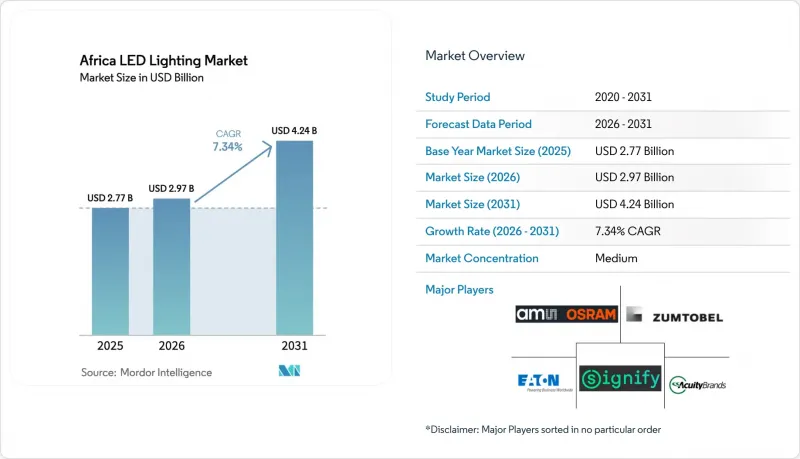
本報告按產品類型(燈具、照明設備)、分銷管道(直銷、批發/零售、電子商務)、應用領域(商業辦公室等)、安裝類型(新安裝、維修安裝)、最終用戶(室內、室外、汽車)和國家/地區(南非、奈及利亞等)進行細分。市場預測以美元計價。
非洲LED照明市場趨勢與洞察
政府能源效率法規與逐步淘汰義務
南非的最低能源性能標準(MEPS)將於2024年1月生效,該標準強制要求所有政府設施使用LED照明。同時,加納的2025年政策架構指南公共採購中採用經認證的高效節能燈具。奈及利亞的標準化機構目前正在強制執行基於IEC 62560標準的進口合規性,這將淘汰低品質燈具,並提高對認證品牌的需求。這些指南確保了多年採購週期,因為每個機構都必須完成既定的維修目標。經認證的供應商可以獲得可預測的大批量訂單,而本地分銷商則可以受益於儲備數量有限但利潤豐厚的產品系列,這些產品能夠順利通過海關文件檢查。監管帶來的動力也正在蔓延到零售、商業和工業領域,因為私人建築公司經常會效仿公共部門的規範。
LED組件成本更低,價格更實惠
由於全球供應過剩,預計到2024年LED晶片價格將下降15-20%,而驅動電子元件也透過平台標準化實現了類似的成本降低。總部位於烏干達的Pearlight公司正順應這一元件成本下降的趨勢,將其產品定價比同類進口產品低10-15%,從而加速了中等收入住宅因成本主導的照明設備更換浪潮。在奈及利亞,批發商強調投資回收期不到18個月即可達到損益平衡點,即使在電價補貼地區,這一說法也引起了廣泛共鳴。元件價格的下降也加速了市政路燈照明項目中燈具的更換,因為每次採購都可以在預算範圍內購買更多燈柱,從而能夠更有效地將有限的資金分配到廣闊的郊區。
價格敏感型市場中照明設備的初始成本較高
對許多農村家庭來說,一盞煤油燈的價格不到5美元,仍然難以負擔;而一盞燈具的價格在15到25美元之間,更是遙不可及。在電力補貼降低每月電費的地區,這種價格差距更為顯著,節能帶來的實際效益也因此被掩蓋。雖然小額貸款和社區大量訂購相結合的項目正在努力降低這一門檻,但推廣效果仍然參差不齊。製造商們正在嘗試推出簡化的光學組件,以滿足入門級流明要求,同時推遲整合感測器等高階功能的推出,直到用戶收入足以進行升級為止。
細分市場分析
2025年,照明燈具佔銷售額的59.83%。這主要歸功於設施管理人員傾向於選擇整合式燈具,以簡化大規模園區內的維修審核流程。這一主導地位反映了非洲LED照明市場對承包解決方案的偏好,尤其是在競標文件中明確規定了光束角、防塵防水等級和保固期等條件的情況下。燈泡雖然市佔率較小,但成長速度最快,複合年成長率達7.96%。對於注重成本的家庭而言,燈泡是首次嘗試LED照明的理想選擇,因為A60燈泡無需重新佈線即可插入現有插座。 Genesis One Lighting公司在約翰尼斯堡一家購物中心安裝了2400盞高棚燈,展示了其節能優勢。最終,電力消耗降低了65%,進一步提升了對物業管理人員的價值提案。
產品組合的變化會影響採購週期。照明燈具通常需要事先進行可行性研究並配備安裝人員,因此其採購往往集中在財政年度預算範圍內。相較之下,燈泡則透過零售和電商通路持續分銷,從而平抑了批發商銷售的季節性波動。展望未來,非洲LED照明市場預計將迎來升級,轉向配備智慧晶片、可透過Zigbee和藍牙通訊的燈泡,這一趨勢可能會促使部分照明燈具的需求轉向現有插座。
到2025年,住宅市佔率將達到53.02%,這主要得益於約翰尼斯堡大都會圈、拉各斯和內羅畢等地家庭數量的快速成長。節能意識強的消費者正在用9瓦的LED燈泡替換60瓦的白熾燈泡,此舉在保持亮度的同時,顯著降低了每月的用電量。商業空間正成為成長最快的領域,這主要得益於企業對碳排放的承諾以及照明維修對環境、社會和治理(ESG)評分的直接影響。零售連鎖店正在利用高顯色指數(CRI)的照明設備來提升產品吸引力並延長顧客停留時間,而辦公大樓業主則正在安裝可調光白光燈以提高租戶的工作效率,最終使得商業照明領域的年複合成長率達到9.14%。
儘管工業領域的應用略顯滯後,但工廠的照明需求正穩定成長,因為高棚照明燈具即使在環境溫度超過 40 度C的情況下也能保持穩定的流明水準。在專業園藝領域的試點應用也正在加速推進;Florensis Kenya 公司報告稱,透過使用飛利浦 GreenPower 模組,實現了 93% 的節能效果並提高了作物質量,這表明農業可能成為推動小眾市場需求成長的主要動力。目前,非洲 LED 照明市場的這一細分領域規模仍然較小,但隨著農業技術資金籌措計劃的建立,預計該領域將迅速發展。
其他好處:
- Excel格式的市場預測(ME)表
- 3個月的分析師支持
目錄
第1章:引言
- 研究假設和市場定義
- 調查範圍
第2章:調查方法
第3章執行摘要
第4章 市場狀況
- 市場概覽
- 市場促進因素
- 政府能源效率法規與逐步淘汰義務
- LED元件的成本正在下降,變得越來越實惠。
- 城市基礎設施擴建和智慧城市項目
- 按需付費的太陽能LED燈具正在刺激農村地區的需求。
- 電子商務的普及使得D2C(直接面對消費者)LED分銷成為可能。
- 自由區製造業激勵措施正在提高區域生產力。
- 市場限制因素
- 價格敏感型產業的高初始資本投資成本
- 農村地區消費者意識較低
- 電壓不穩定會導致驅動器過早失效。
- 電子廢棄物和回收管理架構不完善,導致合規成本不斷上升。
- 產業價值鏈分析
- 宏觀經濟因素的影響
- 監理情勢
- 技術展望
- 波特五力分析
第5章 市場規模與成長預測
- 依產品類型
- 燈
- 照明燈具/設備
- 透過分銷管道
- 直銷
- 批發和零售
- 電子商務
- 透過使用
- 商業辦公
- 零售店
- 飯店業
- 產業
- 高速公路/普通道路
- 大樓
- 公共場所
- 醫院
- 園藝和花園
- 住宅
- 車
- 其他(化工、石油天然氣、農業)
- 按安裝類型
- 新安裝
- 維修和安裝
- 最終用戶
- 室內的
- 戶外的
- 車
- 國家
- 南非
- 奈及利亞
- 其他非洲國家
第6章 競爭情勢
- 市場集中度
- 策略趨勢
- 市佔率分析
- 公司簡介
- Signify NV
- ams-OSRAM AG
- Acuity Brands, Inc.
- Eaton Corporation plc
- Zumtobel Group AG
- Schreder SA
- Foshan Electrical and Lighting Co., Ltd.(FSL Group)
- Opple Lighting Co., Ltd.
- Nichia Corporation
- CreeLED, Inc.
- LG Innotek Co., Ltd.
- Panasonic Holdings Corporation
- BEKA(Pty)Ltd trading as BEKA Schreder
- LED Lighting SA(Pty)Ltd
- Sunfor Technologies(Pty)Ltd
- Afrison LED(Pty)Ltd
- D.light Design Inc.
- BBOXX Limited
- Heliospectra AB
第7章 市場機會與未來展望
According to Mordor Intelligence, the Africa LED lighting market size is expected to grow from USD 2.77 billion in 2025 to USD 2.97 billion in 2026 and is forecast to reach USD 4.24 billion by 2031 at 7.34% CAGR over 2026-2031.
This report is Segmented by Product Type (Lamps, and Luminaires/Fixtures), Distribution Channel (Direct Sales, Wholesale Retail, and E-Commerce), Application (Commercial Offices, and More), Installation Type (New Installation, and Retrofit Installation), End User (Indoor, Outdoor, and Automotive), and Country (South Africa, Nigeria, and More). The Market Forecasts are Provided in Terms of Value (USD).
Africa LED Lighting Market Trends and Insights
Government Energy-Efficiency Regulations and Phase-Out Mandates
South Africa's Minimum Energy Performance Standards, effective January 2024, require the use of LED lighting in all government facilities, while Ghana's 2025 policy framework directs public procurement toward certified high-efficiency lamps. Nigeria's Standards Organization now enforces IEC 62560 import compliance that excludes low-grade lamps and elevates demand for certified brands. These directives ensure multi-year purchasing cycles, as agencies must meet schedule-driven retrofit targets. Certified suppliers gain predictable volume orders, and local distributors benefit from stocking a narrower yet higher-margin product mix that satisfies documentation checks at customs channels. Private builders often mirror public specifications, so regulatory momentum cascades into demand for retail, commercial, and industrial sectors as well.
Declining LED Component Costs and Rising Affordability
Global oversupply enabled LED chip prices to decline by 15-20% in 2024, while driver electronics achieved similar savings through platform standardization. Uganda-based Pearlight converts the lower bill of materials into price tags that sit 10-15% below imported equivalents, catalyzing a cost-led switching wave among mid-income homeowners. In Nigeria, wholesalers spotlight breakeven payback periods of less than 18 months, an argument that resonates even where grid tariffs are subsidized. Component deflation also accelerates fixture replacement in municipal streetlight programs because budgets buy more poles per tranche, stretching limited capital across sprawling suburbs.
High Upfront Fixture Cost in Price-Sensitive Segments
Many rural homes still view USD 15-25 per fixture as unattainable when kerosene lamps cost under USD 5. The price gap is more pronounced where electricity subsidies lower monthly bills, thereby reducing the visible benefit of efficiency. Programs that blend microloans with community-level bulk orders are easing the hurdle, yet adoption remains episodic. Manufacturers are experimenting with stripped-down optical packages that meet entry-level lumen needs while deferring premium features-such as integrated sensors-until incomes permit upgrades.
Other drivers and restraints analyzed in the detailed report include:
- Urban Infrastructure Expansion and Smart-City Projects
- Pay-As-You-Go Solar LED Models Unlocking Rural Demand
- Voltage Instability Causing Premature Driver Failures
For complete list of drivers and restraints, kindly check the Table Of Contents.
Segment Analysis
Luminaires contributed 59.83% of 2025 sales as facility managers preferred integrated housings that simplify retrofit audits across large campuses. This leadership reflects how the Africa LED Lighting market favors turnkey solutions when tender documents stipulate specific beam angles, ingress protection ratings, and warranty duration. Lamps, although a smaller slice, are the fastest growing at an 7.96% CAGR. Cost-sensitive households can slot an A60 bulb into an existing socket without rewiring, making the category the entry point for first-time adopters. Genesis One Lighting validated the energy-saving promise by installing 2,400 high-bay luminaires in a Johannesburg mall, resulting in a 65% reduction in electricity use and reinforcing the value proposition for property managers.
The shift in mix influences procurement cycles. Luminaires often require upfront feasibility studies and installation crews, so purchases cluster around fiscal-year budgets. Lamps, by contrast, flow continuously through retail and e-commerce channels, smoothing revenue seasonality for wholesalers. Over time, the Africa LED Lighting market is likely to witness lamp upgrades incorporating smart chips that communicate via Zigbee or Bluetooth, a development that may redirect some luminaire demand into sockets already in place.
The residential segment held a 53.02% share in 2025, driven by rapid household formation in greater Johannesburg, Lagos, and Nairobi. Energy-aware consumers are swapping 60-W incandescent bulbs for 9-W LEDs, a move that slashes monthly usage while preserving brightness. Commercial spaces are emerging as the fastest climber, buoyed by corporate carbon pledges that make lighting retrofits a quick win within ESG scorecards. Retail chains utilize high CRI fixtures to enhance product appeal and extend dwell time, while office landlords incorporate tunable white lamps to support occupant productivity, driving a 9.14% CAGR in commercial adoption.
Industrial uptake lags slightly yet grows steadily as factories discover that high-bay luminaires sustain lumen maintenance despite ambient temperatures above 40 °C. Specialized horticulture trials are also gaining traction: Florensis Kenya reported 93% energy savings and improvements in crop quality with Philips GreenPower modules, signaling how agriculture can become a niche volume driver. The Africa LED Lighting market size for niche verticals remains small today, but stands to expand once agritech financing packages normalize.
Complete Report Scope:
- By Product Type
- Lamps
- Luminaires / Fixtures
- By Distribution Channel
- Direct Sales
- Wholesale Retail
- E-commerce
- By Application
- Commercial Offices
- Retail Stores
- Hospitality
- Industrial
- Highway and Roadway
- Architectural
- Public Places
- Hospitals
- Horticulture Gardens
- Residential
- Automotive
- Others (Chemicals, Oil and Gas, Agriculture)
- By Installation Type
- New Installation
- Retrofit Installation
- By End User
- Indoor
- Outdoor
- Automotive
- By Country
- South Africa
- Nigeria
- Rest of Africa
List of Companies Covered in this Report:
- Signify N.V.
- ams-OSRAM AG
- Acuity Brands, Inc.
- Eaton Corporation plc
- Zumtobel Group AG
- Schreder SA
- Foshan Electrical and Lighting Co., Ltd. (FSL Group)
- Opple Lighting Co., Ltd.
- Nichia Corporation
- CreeLED, Inc.
- LG Innotek Co., Ltd.
- Panasonic Holdings Corporation
- BEKA (Pty) Ltd trading as BEKA Schreder
- LED Lighting SA (Pty) Ltd
- Sunfor Technologies (Pty) Ltd
- Afrison LED (Pty) Ltd
- D.light Design Inc.
- BBOXX Limited
- Heliospectra AB
Additional Benefits:
- The market estimate (ME) sheet in Excel format
- 3 months of analyst support
TABLE OF CONTENTS
1 INTRODUCTION
- 1.1 Study Assumptions and Market Definition
- 1.2 Scope of the Study
2 RESEARCH METHODOLOGY
3 EXECUTIVE SUMMARY
4 MARKET LANDSCAPE
- 4.1 Market Overview
- 4.2 Market Drivers
- 4.2.1 Government energy-efficiency regulations and phase-out mandates
- 4.2.2 Declining LED component costs and rising affordability
- 4.2.3 Urban infrastructure expansion and smart-city projects
- 4.2.4 Pay-as-you-go solar LED models unlocking rural demand
- 4.2.5 E-commerce penetration enabling D2C LED distribution
- 4.2.6 Free-zone manufacturing incentives boosting local output
- 4.3 Market Restraints
- 4.3.1 High upfront fixture cost in price-sensitive segments
- 4.3.2 Limited consumer awareness in rural communities
- 4.3.3 Voltage instability causing premature driver failures
- 4.3.4 Weak e-waste and recycling framework raising compliance cost
- 4.4 Industry Value Chain Analysis
- 4.5 Impact of Macroeconomic Factors
- 4.6 Regulatory Landscape
- 4.7 Technological Outlook
- 4.8 Porter's Five Forces Analysis
- 4.8.1 Threat of New Entrants
- 4.8.2 Bargaining Power of Suppliers
- 4.8.3 Bargaining Power of Buyers
- 4.8.4 Threat of Substitutes
- 4.8.5 Intensity of Competitive Rivalry
5 MARKET SIZE AND GROWTH FORECASTS (VALUE)
- 5.1 By Product Type
- 5.1.1 Lamps
- 5.1.2 Luminaires / Fixtures
- 5.2 By Distribution Channel
- 5.2.1 Direct Sales
- 5.2.2 Wholesale Retail
- 5.2.3 E-commerce
- 5.3 By Application
- 5.3.1 Commercial Offices
- 5.3.2 Retail Stores
- 5.3.3 Hospitality
- 5.3.4 Industrial
- 5.3.5 Highway and Roadway
- 5.3.6 Architectural
- 5.3.7 Public Places
- 5.3.8 Hospitals
- 5.3.9 Horticulture Gardens
- 5.3.10 Residential
- 5.3.11 Automotive
- 5.3.12 Others (Chemicals, Oil and Gas, Agriculture)
- 5.4 By Installation Type
- 5.4.1 New Installation
- 5.4.2 Retrofit Installation
- 5.5 By End User
- 5.5.1 Indoor
- 5.5.2 Outdoor
- 5.5.3 Automotive
- 5.6 By Country
- 5.6.1 South Africa
- 5.6.2 Nigeria
- 5.6.3 Rest of Africa
6 COMPETITIVE LANDSCAPE
- 6.1 Market Concentration
- 6.2 Strategic Moves
- 6.3 Market Share Analysis
- 6.4 Company Profiles (includes Global level Overview, Market level overview, Core Segments, Financials as available, Strategic Information, Market Rank/Share for key companies, Products and Services, and Recent Developments)
- 6.4.1 Signify N.V.
- 6.4.2 ams-OSRAM AG
- 6.4.3 Acuity Brands, Inc.
- 6.4.4 Eaton Corporation plc
- 6.4.5 Zumtobel Group AG
- 6.4.6 Schreder SA
- 6.4.7 Foshan Electrical and Lighting Co., Ltd. (FSL Group)
- 6.4.8 Opple Lighting Co., Ltd.
- 6.4.9 Nichia Corporation
- 6.4.10 CreeLED, Inc.
- 6.4.11 LG Innotek Co., Ltd.
- 6.4.12 Panasonic Holdings Corporation
- 6.4.13 BEKA (Pty) Ltd trading as BEKA Schreder
- 6.4.14 LED Lighting SA (Pty) Ltd
- 6.4.15 Sunfor Technologies (Pty) Ltd
- 6.4.16 Afrison LED (Pty) Ltd
- 6.4.17 D.light Design Inc.
- 6.4.18 BBOXX Limited
- 6.4.19 Heliospectra AB
7 MARKET OPPORTUNITIES AND FUTURE OUTLOOK
- 7.1 White-space and Unmet-need Assessment

 2026年全球LED櫥櫃下照明市場報告
 美國和歐洲LED照明:市場佔有率分析、行業趨勢和統計數據以及成長預測(2026-2031年)
 LED 照明和 OLED 照明:市場分析和製造趨勢
 LED照明市場-2026-2032年全球市場預測印度LED照明:市場佔有率分析、產業趨勢與統計及成長預測(2026-2031年)亞太地區LED照明:市佔率分析、產業趨勢與統計及成長預測(2026-2031年)
 LED霓虹燈市場規模、佔有率和成長分析:按產品類型、安裝類型、電壓類型、應用、顏色類型、分銷管道、最終用戶和地區分類-2026-2033年產業預測
 LED面板燈市場報告:按應用和地區分類(2026-2034)歐洲LED照明:市場佔有率分析、產業趨勢與統計及成長預測(2026-2031年)
 LED照明市場規模、佔有率和成長分析:按產品類型、安裝類型、流明、應用、銷售管道和地區分類-2026-2033年產業預測