


 |
市場調查報告書
商品編碼
2125300
同步馬達:市場佔有率分析、產業趨勢與統計、成長預測(2026-2031)Synchronous Motor - Market Share Analysis, Industry Trends & Statistics, Growth Forecasts (2026 - 2031) |
||||||

※ 本網頁內容可能與最新版本有所差異。詳細情況請與我們聯繫。
根據 Mordor Intelligence 預測,同步馬達市場規模預計在 2026 年達到 258.2 億美元,到 2031 年達到 310.6 億美元,在整個預測期內複合年成長率為 3.76%。
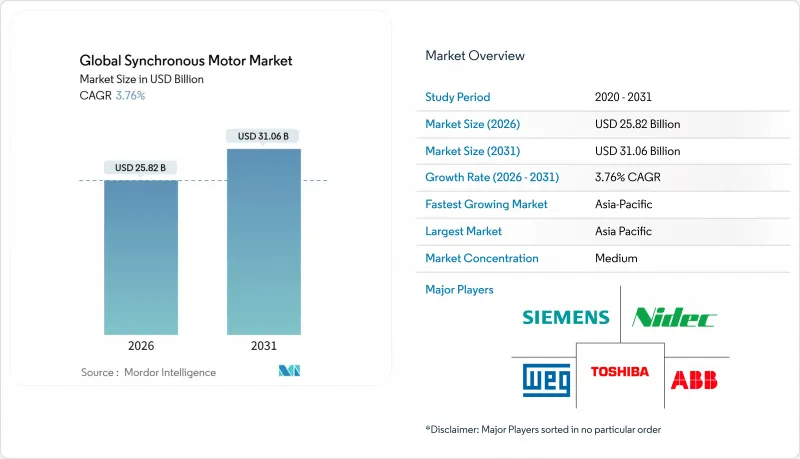
本報告依轉子結構(直流勵磁、永磁等)、額定輸出功率(1兆瓦以下、1-10兆瓦、10兆瓦以上)、終端用戶產業(石油天然氣、化工及石化、發電等)、應用領域(泵浦、壓縮機、風扇及鼓風機、輸送機及起吊裝置等)及地區進行細分。市場預測以美元計價。
全球同步馬達市場趨勢與洞察
嚴格的IE3/IE4能效標準
IEC 60034-30-1標準中規定的能效法規,以及歐盟2019/1781號生態設計法規,收緊了採購規範,促使買家轉向同步馬達技術,因為這種技術無需複雜的銅轉子即可輕鬆達到IE4和IE5能效等級。中國也在GB 18613-2020標準下推動類似的能源效率提升,該標準將於2025年生效,鼓勵本土OEM廠商擴大產能,加速老舊感應電動機的更新換代。能源支出佔總營運成本40%以上的公共產業和工業營運商現在意識到,透過旨在符合法規要求的維修,可以在不到三年的時間內收回投資,這推動了供水事業和石化廠的持續升級。在整個市場範圍內,這些法規透過擴大高效能產品的基準銷售和價格範圍,正在重振同步馬達市場。
暖通空調和工業自動化的擴展
隨著諸如ASHRAE 90.1-2022標準等建築規範的修訂,功率超過10馬力的馬達現在必須配備變速控制,這使得同步馬達成為屋頂空調和冷卻器的理想選擇,因為這些設備一年中的大部分時間都在部分負載下運作。丹佛斯和特靈在2025年推出的設備將同步磁阻轉子與智慧駕駛整合在一起,現場測試顯示可節省15%至25%的能耗。在工廠自動化領域,伺服級同步馬達,例如西門子Synamics S210,透過邊緣連接驅動器實現快速加速、再生煞車和預測性維護分析,也帶來了許多優勢。暖通空調和自動化之間的這種協同作用正在擴大同步馬達在商業建築和離散製造業的市場佔有率。
永磁轉子初始成本高
永磁同步馬達的價格比感應馬達高出20%至40%。在資本預算緊張、投資回收期預計不到三年的新興市場,這種溢價現象更為顯著。釹镨氧化物的現貨價格波動劇烈,預計到2025年將達到每噸4.8萬美元至6.8萬美元,相當於每公斤燒結磁鐵8美元至12美元,這將推高所有高階馬達的零件成本。因此,儘管永磁同步馬達具有長期節能的潛力,但地方政府公共產業和中小製造商仍在推遲更換,這導致同步馬達市場短期銷售成長放緩。
細分市場分析
預計到2025年,永磁轉子將維持47.80%的市場佔有率,成為高扭力和牽引應用的基礎,其高密度使其成本物有所值。然而,在ABB的IE5和即將推出的IE6產品線,以及計劃於2025年發布並融合了Regal Rexnord知識產權的WEG W50平台的推動下,感應電機設計預計將以11.80%的複合年成長率成長。歐洲對IE5法規日益嚴格的要求,加上稀土元素的供不應求,正在推動泵浦、風扇和壓縮機領域對無磁性或鐵氧體輔助馬達的需求。直流勵磁機由於其勵磁繞組的柔軟性,能夠穩定無功功率和電壓,因此在水力發電和船舶推進領域繼續發揮至關重要的作用。磁滯轉子仍然是一個小眾市場,主要用於對扭矩極其平穩性要求極高的精密實驗室設備和計時裝置。
磁阻馬達在亞太地區和歐洲的應用尤其強勁,這些地區的原始設備製造商 (OEM) 表示,與同等永磁產品相比,磁阻馬達的前置作業時間更短,單位成本降低超過 20%。 IEEE 在 2024 年進行的一項研究證實,鐵氧體輔助同步磁阻馬達的效率可超過 94%,縮小了與釹磁電機設計的實際差距,並將材料成本降低了約三分之一。隨著牽引車輛、暖通空調 (HVAC) OEM 和食品加工商對這些系統的檢驗,到 2031 年,每種轉子類型的市場佔有率平衡將被重新評估,從而在同步馬達市場中催生新的競爭和技術藍圖。
2025年,1-10兆瓦功率範圍的馬達裝置量將佔總裝置量的38.50%,成為市場主導領域。這與離心式壓縮機、冷卻器驅動裝置以及中型工業自動化專案的需求相吻合。同時,受分散式製造、模組化水處理和食品加工設備升級的推動,預計1兆瓦以下功率範圍的電機裝機量將以10.40%的複合年成長率成長。在這些領域,馬達最佳化可以有效減少能源浪費。Schneider Electric將於2024年推出的「Altivar Process」驅動器,結合0.75-500千瓦的同步馬達,提供基於雲端的預測分析功能,幫助工廠管理人員大幅減少停機時間。
參與美國「更佳建築計劃」(Better Building Initiative)的工業用戶透過用最佳化的同步馬達替換過大的感應電動機,實現了15%至30%的節能效果,並且由於一項舉措計劃,投資回收期不到兩年。雖然10兆瓦以上的馬達仍然廣泛應用於風力發電機和大型水力發電裝置,但兆瓦以下功率馬達的不斷成長表明,低功率領域的創新將支撐同步馬達市場的未來成長。
區域分析
預計到2025年,亞太地區將佔全球銷售額的34.80%,並在2031年之前以12.10%的複合年成長率成長,這主要得益於中國、印度和東南亞國家提高最低能源效率標準和擴大工廠自動化規模。中國製造商如臥龍電氣於2025年在浙江省投資5億元人民幣(約7,000萬美元)新建廠,以擴大IE3以上能源效率等級產品的產能。同時,在印度生產連結獎勵計畫計畫(PLI)的支持下,基洛斯卡電氣在馬哈拉斯特拉邦新建了一家工廠,年產能可達5萬台高效率馬達。日本NIDEK在2024會計年度同步馬達銷量成長18%,這主要得益於中國和歐洲強勁的牽引馬達設計訂單。
預計到2025年,北美和歐洲合計將佔全球市場價值的約45%。在美國,根據工業評估中心(IAC)的一項調查,馬達系統更換佔建議節能項目的22%,其中超過三分之一的更換項目指定使用同步馬達。歐洲的「綠色新政」工業計畫撥款30億歐元(約33億美元)用於支持國內潔淨科技製造業,資助波蘭和西班牙新建馬達生產線。在中東,對用於海水淡化的大型同步幫浦馬達的需求正在成長,但該地區的市佔率仍低於5%。
南美洲以巴西為中心,WEG位於巴西的Jagua do Sul工廠預計2024年將生產超過200萬台同步馬達,由於能源成本上漲,同步馬達在南美洲的佔比正在不斷提高。非洲的需求主要集中在南非和銅纜礦業叢集,ABB和西門子等公司的高功率解決方案被用於破碎機和通風設備。從區域來看,同步馬達市場呈現兩極化的趨勢。成熟經濟體正致力於提升效率的維修,而新興市場則隨著新工業化的推進,直接轉向高階同步馬達。
其他好處:
- Excel格式的市場預測(ME)表
- 3個月的分析師支持
目錄
第1章:引言
- 研究假設和市場定義
- 調查範圍
第2章:調查方法
第3章執行摘要
第4章 市場狀況
- 市場概覽
- 市場促進因素
- 嚴格的IE3/IE4能效標準
- 暖通空調和工業自動化的擴展
- 電動車和牽引馬達需求激增
- 電網級可再生能源專案、抽水蓄能水力發電廠
- 不含稀土元素的同步磁阻馬達越來越受歡迎。
- 高速磁軸承微型渦輪機
- 市場限制因素
- 永磁轉子初始成本高
- 稀土元素供應的波動
- 高功率密度下溫度控管的局限性
- 感應馬達和變頻器效率面臨的競爭壓力
- 產業價值鏈分析
- 監理情勢
- 技術展望
- 宏觀經濟因素的影響
- 波特五力分析
第5章 市場規模與成長預測
- 按類型分類的轉子結構
- 直流勵磁型
- 永久磁鐵
- 鬆弛
- 滯後現象
- 額定功率
- 1兆瓦或以下
- 1~10 MW
- 超過10兆瓦
- 按最終用戶行業分類
- 石油和天然氣
- 化工/石油化工
- 發電
- 水和污水處理
- 金屬和採礦
- 食品/飲料
- 離散製造
- 暖通空調/冷氣
- 透過使用
- 泵浦
- 壓縮機
- 風扇鼓風機
- 輸送機起吊裝置
- 牽引/推進
- 其他用途
- 按地區
- 北美洲
- 美國
- 加拿大
- 墨西哥
- 歐洲
- 德國
- 英國
- 法國
- 義大利
- 西班牙
- 俄羅斯
- 其他歐洲國家
- 亞太地區
- 中國
- 日本
- 印度
- 韓國
- 澳洲
- 其他亞太國家
- 中東
- 沙烏地阿拉伯
- 阿拉伯聯合大公國
- 土耳其
- 其他中東國家
- 非洲
- 南非
- 奈及利亞
- 其他非洲國家
- 南美洲
- 巴西
- 阿根廷
- 其他南美國家
- 北美洲
第6章 競爭情勢
- 市場集中度
- 策略趨勢
- 市佔率分析
- 公司簡介
- ABB Ltd.
- Siemens AG
- WEG SA
- Nidec Corporation
- Toshiba Corporation
- Mitsubishi Electric Corporation
- Regal Rexnord Corporation
- Schneider Electric SE
- General Electric Company
- TECO-Westinghouse Motor Company
- Johnson Electric Holdings Limited
- Franklin Electric Co., Inc.
- Kirloskar Electric Company Ltd.
- SEVA-tec GmbH
- Dunkermotoren GmbH
- BEN Buchele Elektromotorenwerke GmbH
- Hyosung Heavy Industries Corporation
- CG Power and Industrial Solutions Ltd.
- Hitachi Ltd.
- Motion Drivetronics Pvt. Ltd.
第7章 市場機會與未來展望
According to Mordor Intelligence, the synchronous motor market size stood at USD 25.82 billion in 2026 and is projected to reach USD 31.06 billion by 2031, reflecting a 3.76% CAGR across the forecast horizon.
This report is Segmented by Rotor Construction (DC-Excited, Permanent Magnet, and More), Power Rating (<=1 MW, 1-10 MW, and >10 MW), End-User Industry (Oil and Gas, Chemicals and Petrochemicals, Power Generation, and More), Application (Pumps, Compressors, Fans and Blowers, Conveyors and Hoists, and More), and Geography. The Market Forecasts are Provided in Terms of Value (USD).
Global Synchronous Motor Market Trends and Insights
Stringent IE3/IE4 Energy-Efficiency Mandates
Efficiency regulations anchored in IEC 60034-30-1 and codified into European Union Ecodesign Regulation 2019/1781 have tightened procurement specifications, pushing buyers toward synchronous technologies that readily achieve IE4 and IE5 grades without copper-rotor complexity. China enacted a parallel leap under GB 18613-2020 during 2025, spurring local OEM capacity expansions and accelerating the replacement of legacy induction stock. Utility and industrial operators with energy expenditures above 40% of total operating cost now see compliance-driven retrofits delivering sub-three-year paybacks, fueling recurrent upgrade cycles across water utilities and petrochemical plants. Market-wide, these mandates lift the synchronous motor market by expanding both baseline volumes and premium-efficiency price points.
Expansion of HVAC and Industrial Automation
Building-code revisions such as ASHRAE Standard 90.1-2022 compel variable-speed control on motors above 10 horsepower, positioning synchronous motors as the preferred choice for rooftop units and chillers that run at part-load most of the year. Equipment launched by Danfoss and Trane in 2025 integrates synchronous reluctance rotors with intelligent drives, documenting 15%-25% electricity savings in field pilots. Parallel gains in factory automation emerge through servo-grade synchronous motors that enable rapid acceleration, regenerative braking, and predictive health analytics via edge-connected drives like Siemens Sinamics S210. These combined HVAC and automation pull-through effects widen the synchronous motor market footprint in both commercial buildings and discrete manufacturing.
High Up-Front Cost of Permanent-Magnet Rotors
Permanent-magnet synchronous units carry a 20%-40% price premium over induction counterparts, magnified in emerging markets where capital budgets are tight, and payback expectations hover under three years. Volatile spot prices for neodymium-praseodymium oxide, ranging from USD 48,000-68,000 per metric ton in 2025, translate into USD 8-12 per kilogram of sintered magnet and elevate bill-of-materials costs for every high-end motor. Municipal utilities and small manufacturers therefore defer replacements despite long-run energy savings, slowing near-term volume expansion in the synchronous motor market.
Other drivers and restraints analyzed in the detailed report include:
- Surge in Electric Vehicle and Traction Motor Demand
- Rare-Earth-Free Synchronous Reluctance Motor Momentum
- Rare-Earth Supply Volatility
For complete list of drivers and restraints, kindly check the Table Of Contents.
Segment Analysis
Permanent-magnet rotors retained 47.80% share of 2025 revenue, anchoring high-torque and traction roles where their density justifies cost. However, reluctance designs are forecast to grow at an 11.80% CAGR, driven by ABB's IE5 and forthcoming IE6 lines and WEG's 2025-launched W50 platform, which incorporates Regal Rexnord intellectual property. Europe's regulatory push toward IE5, combined with the scarcity of rare earths, is driving demand for magnet-free or ferrite-assisted options in pumps, fans, and compressors. DC-excited machines remain relevant in hydro-pumped storage and marine propulsion because their field-winding flexibility provides reactive power and voltage support. Hysteresis rotors remain niche, serving precision lab equipment and timing devices where ultra-smooth torque is prized.
Reluctance adoption momentum is especially sharp in Asia-Pacific and Europe, where OEMs report reduced lead times and 20%-plus unit-cost savings versus permanent-magnet equivalents. IEEE research during 2024 confirmed ferrite-assisted synchronous reluctance efficiencies topping 94%, narrowing any practical gulf with neodymium designs and slicing material costs by about one-third. As traction vehicles, HVAC OEMs, and food processors validate these systems, rotor-type balances will realign by 2031, driving fresh competition and technical road-maps inside the synchronous motor market.
The 1-10 megawatt band dominated with 38.50% of 2025 installations, aligning with centrifugal compressors, chiller drives, and mid-scale industrial automation projects. Yet the sub-1 megawatt class is projected to post a 10.40% CAGR, fueled by distributed manufacturing, modular water treatment, and food processing upgrades, where right-sizing motors trims energy waste. Schneider Electric's 2024 Altivar Process drive, coupled with 0.75-500 kilowatt synchronous motors, brings cloud-based predictive analytics that help plant managers slash downtime.
Industrial users participating in the United States Better Buildings Initiative logged 15%-30% power savings when oversized induction units were swapped for optimized synchronous machines, with rebate programs pulling payback under two years. While motors exceeding 10 megawatts stay entrenched in wind turbines and large hydro units, the swelling sub-megawatt base indicates that small-horsepower innovation will underpin the next leg of expansion for the synchronous motor market size.
Complete Report Scope:
- By Rotor Construction
- DC-Excited
- Permanent Magnet
- Reluctance
- Hysteresis
- By Power Rating
- <=1 MW
- 1-10 MW
- >10 MW
- By End-User Industry
- Oil and Gas
- Chemicals and Petrochemicals
- Power Generation
- Water and Wastewater
- Metals and Mining
- Food and Beverage
- Discrete Manufacturing
- HVAC and Refrigeration
- By Application
- Pumps
- Compressors
- Fans and Blowers
- Conveyors and Hoists
- Traction/Propulsion
- Other Applications
- By Geography
- North America
- United States
- Canada
- Mexico
- Europe
- Germany
- United Kingdom
- France
- Italy
- Spain
- Russia
- Rest of Europe
- Asia-Pacific
- China
- Japan
- India
- South Korea
- Australia
- Rest of Asia-Pacific
- Middle East
- Saudi Arabia
- United Arab Emirates
- Turkey
- Rest of Middle East
- Africa
- South Africa
- Nigeria
- Rest of Africa
- South America
- Brazil
- Argentina
- Rest of South America
- North America
Geography Analysis
Asia-Pacific, holding 34.80% of 2025 revenue, is on track for a 12.10% CAGR through 2031 as China, India, and Southeast Asian nations raise minimum efficiency thresholds and expand factory automation. Chinese producers such as Wolong Electric funneled CNY 500 million (USD 70 million) into Zhejiang facilities in 2025 to scale IE3 and above units, while India's Production-Linked Incentive scheme spurred Kirloskar Electric's new Maharashtra plant capable of 50,000 high-efficiency motors annually. Japan's Nidec posted 18% synchronous revenue growth in fiscal 2024, benefitting from traction-motor design wins in China and Europe.
North America and Europe combined to capture about 45% of 2025 value. In the United States, Industrial Assessment Centers documented that motor-system upgrades accounted for 22% of recommended efficiency projects, with synchronous equipment specified in more than one-third of replacements. Europe's Green Deal Industrial Plan earmarked EUR 3 billion (USD 3.3 billion) to back domestic clean-tech manufacturing, financing new motor lines in Poland and Spain. The Middle East pursues large synchronous pump motors for desalination, yet regional share stays below 5%.
South America centers on Brazil, where WEG's Jaragua do Sul complex produced more than two million units in 2024, increasingly synchronous as energy costs bite. African demand skews toward mining clusters in South Africa and the Copperbelt, leveraging ABB and Siemens high-horsepower solutions for grinding mills and ventilation. Across regions, the synchronous motor market tracks a two-tier pattern: mature economies retrofit for higher efficiency, while developing markets leapfrog directly to premium-grade synchronous options amid new industrialization.
- ABB Ltd.
- Siemens AG
- WEG S.A.
- Nidec Corporation
- Toshiba Corporation
- Mitsubishi Electric Corporation
- Regal Rexnord Corporation
- Schneider Electric SE
- General Electric Company
- TECO-Westinghouse Motor Company
- Johnson Electric Holdings Limited
- Franklin Electric Co., Inc.
- Kirloskar Electric Company Ltd.
- SEVA-tec GmbH
- Dunkermotoren GmbH
- BEN Buchele Elektromotorenwerke GmbH
- Hyosung Heavy Industries Corporation
- CG Power and Industrial Solutions Ltd.
- Hitachi Ltd.
- Motion Drivetronics Pvt. Ltd.
Additional Benefits:
- The market estimate (ME) sheet in Excel format
- 3 months of analyst support
TABLE OF CONTENTS
1 INTRODUCTION
- 1.1 Study Assumptions and Market Definition
- 1.2 Scope of the Study
2 RESEARCH METHODOLOGY
3 EXECUTIVE SUMMARY
4 MARKET LANDSCAPE
- 4.1 Market Overview
- 4.2 Market Drivers
- 4.2.1 Stringent IE3/IE4 Energy-Efficiency Mandates
- 4.2.2 Expansion of HVAC and Industrial Automation
- 4.2.3 Surge in Electric Vehicle and Traction Motor Demand
- 4.2.4 Grid-Scale Renewable Projects, Hydro-Pumped Storage
- 4.2.5 Rare-Earth-Free Synchronous Reluctance Motor Adoption Momentum
- 4.2.6 High-Speed Magnetic Bearing Micro-Turbines
- 4.3 Market Restraints
- 4.3.1 High Up-Front Cost of Permanent-Magnet Rotors
- 4.3.2 Rare-Earth Supply Volatility
- 4.3.3 Thermal-Management Limits at High Power Density
- 4.3.4 Induction-VFD Efficiency Parity Pressure
- 4.4 Industry Value Chain Analysis
- 4.5 Regulatory Landscape
- 4.6 Technological Outlook
- 4.7 Impact of Macroeconomic Factors
- 4.8 Porter's Five Forces Analysis
- 4.8.1 Threat of New Entrants
- 4.8.2 Bargaining Power of Suppliers
- 4.8.3 Bargaining Power of Buyers
- 4.8.4 Threat of Substitutes
- 4.8.5 Competitive Rivalry
5 MARKET SIZE AND GROWTH FORECASTS (VALUE)
- 5.1 By Rotor Construction
- 5.1.1 DC-Excited
- 5.1.2 Permanent Magnet
- 5.1.3 Reluctance
- 5.1.4 Hysteresis
- 5.2 By Power Rating
- 5.2.1 <=1 MW
- 5.2.2 1-10 MW
- 5.2.3 >10 MW
- 5.3 By End-User Industry
- 5.3.1 Oil and Gas
- 5.3.2 Chemicals and Petrochemicals
- 5.3.3 Power Generation
- 5.3.4 Water and Wastewater
- 5.3.5 Metals and Mining
- 5.3.6 Food and Beverage
- 5.3.7 Discrete Manufacturing
- 5.3.8 HVAC and Refrigeration
- 5.4 By Application
- 5.4.1 Pumps
- 5.4.2 Compressors
- 5.4.3 Fans and Blowers
- 5.4.4 Conveyors and Hoists
- 5.4.5 Traction/Propulsion
- 5.4.6 Other Applications
- 5.5 By Geography
- 5.5.1 North America
- 5.5.1.1 United States
- 5.5.1.2 Canada
- 5.5.1.3 Mexico
- 5.5.2 Europe
- 5.5.2.1 Germany
- 5.5.2.2 United Kingdom
- 5.5.2.3 France
- 5.5.2.4 Italy
- 5.5.2.5 Spain
- 5.5.2.6 Russia
- 5.5.2.7 Rest of Europe
- 5.5.3 Asia-Pacific
- 5.5.3.1 China
- 5.5.3.2 Japan
- 5.5.3.3 India
- 5.5.3.4 South Korea
- 5.5.3.5 Australia
- 5.5.3.6 Rest of Asia-Pacific
- 5.5.4 Middle East
- 5.5.4.1 Saudi Arabia
- 5.5.4.2 United Arab Emirates
- 5.5.4.3 Turkey
- 5.5.4.4 Rest of Middle East
- 5.5.5 Africa
- 5.5.5.1 South Africa
- 5.5.5.2 Nigeria
- 5.5.5.3 Rest of Africa
- 5.5.6 South America
- 5.5.6.1 Brazil
- 5.5.6.2 Argentina
- 5.5.6.3 Rest of South America
- 5.5.1 North America
6 COMPETITIVE LANDSCAPE
- 6.1 Market Concentration
- 6.2 Strategic Moves
- 6.3 Market Share Analysis
- 6.4 Company Profiles (includes Global level Overview, Market level overview, Core Segments, Financials as available, Strategic Information, Market Rank/Share for key companies, Products and Services, and Recent Developments)
- 6.4.1 ABB Ltd.
- 6.4.2 Siemens AG
- 6.4.3 WEG S.A.
- 6.4.4 Nidec Corporation
- 6.4.5 Toshiba Corporation
- 6.4.6 Mitsubishi Electric Corporation
- 6.4.7 Regal Rexnord Corporation
- 6.4.8 Schneider Electric SE
- 6.4.9 General Electric Company
- 6.4.10 TECO-Westinghouse Motor Company
- 6.4.11 Johnson Electric Holdings Limited
- 6.4.12 Franklin Electric Co., Inc.
- 6.4.13 Kirloskar Electric Company Ltd.
- 6.4.14 SEVA-tec GmbH
- 6.4.15 Dunkermotoren GmbH
- 6.4.16 BEN Buchele Elektromotorenwerke GmbH
- 6.4.17 Hyosung Heavy Industries Corporation
- 6.4.18 CG Power and Industrial Solutions Ltd.
- 6.4.19 Hitachi Ltd.
- 6.4.20 Motion Drivetronics Pvt. Ltd.
7 MARKET OPPORTUNITIES AND FUTURE OUTLOOK
- 7.1 White-Space and Unmet-Need Assessment

 永磁體市場-2026-2032年全球市場預測
 永久磁鐵:市場佔有率分析、產業趨勢與統計、成長預測(2026-2031)
 2026-2030年全球永久磁鐵市場同步馬達市場:依產品類型、安裝方式、組件、電壓等級、冷卻方式、轉速、應用、最終用途和銷售管道,全球預測,2026-2032年永磁聚光燈市場:按材料、應用、類型、配置和額定功率分類,全球預測(2026-2032年)
 全球永久磁鐵市場:市場規模、佔有率和趨勢分析(按材料、應用和地區分類),細分市場預測(2026-2033 年)
 永久磁鐵市場分析及預測(至2035年):依類型、產品、應用、材料類型、技術、最終用戶、功能、安裝類型、解決方案分類
 2026年全球永久磁鐵市場報告高溫永磁體市場依材質、產品類型、溫度等級、終端用戶產業及通路分類-2026-2032年全球預測
 同步馬達市場-2026-2031年預測