


 |
市場調查報告書
商品編碼
2097175
永久磁鐵:市場佔有率分析、產業趨勢與統計、成長預測(2026-2031)Permanent Magnet - Market Share Analysis, Industry Trends & Statistics, Growth Forecasts (2026 - 2031) |
||||||

※ 本網頁內容可能與最新版本有所差異。詳細情況請與我們聯繫。
根據 Mordor Intelligence 預測,永磁體市場規模將從 2025 年的 518 億美元成長到 2026 年的 549.1 億美元,到 2031 年將達到 741.1 億美元,2026 年至 2031 年的複合年成長率為 6.18%。
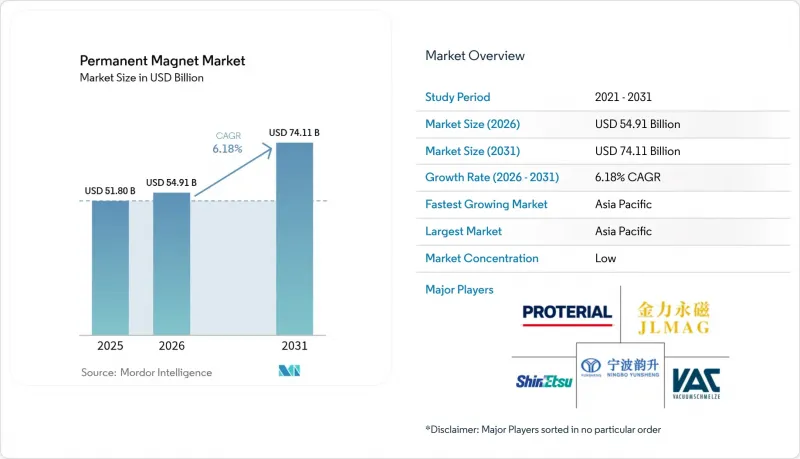
本報告按材料類型(釹鐵硼、鐵氧體、釤鈷、鋁鎳鈷)、終端用戶產業(汽車、電子、工業、發電及其他終端用戶產業)和地區(亞太、北美、歐洲、南美以及中東和非洲)進行細分。市場預測以美元計價。
全球永磁體市場趨勢與洞察
乘用車和商用電動車車隊的電氣化
預計到2025年,電池式電動車產量將達1,400萬輛,每輛乘用車平均使用2公斤燒結釹鐵硼磁體,重型卡車則高達8公斤。比亞迪的e平台3.0採用了耐溫180 度C的釹鐵硼轉子,戴姆勒卡車和沃爾沃則在其雙馬達驅動系統中將磁鐵用量增加了一倍。將於2025年7月生效的歐7排放標準將強制要求新型城市公車使用永磁同步馬達,這將為永久磁鐵市場帶來長期需求,其更換週期約為4萬台。
直驅風力發電機的快速普及
預計到2025年,離岸風力發電將增加22吉瓦,其中68%為直驅式發電機,每台機組需要600-1200公斤釹鐵硼磁鐵。中國計劃建設的42吉瓦項目以及美國近期租賃的區塊也採用了類似的配置,導致高等級稀土元素磁鐵的供需關係緊張。
稀土元素價格波動與出口限制
緬甸停止重稀土元素生產以及中國對重稀土徵收15%的出口關稅,導致2025年氧化釹價格上漲42%,給中國以外的精煉商帶來壓力,並將Linus公司的利潤率壓低至22%。镨釹合金的現貨價格預計平均為每公斤68美元,將使2公斤重的電動車馬達零件成本增加32美元,從而對整個永久磁鐵市場帶來成本壓力。
細分市場分析
由於電動車和風力發電設計人員對能量密度超過35 MGOe的產品需求旺盛,釹鐵硼(NdFeB)磁體預計將以7.18%的複合年成長率(CAGR)在2031年之前超越整體永久磁鐵市場的成長速度。鐵氧體磁鐵因其在智慧型手機、揚聲器和低速馬達等應用中具有低成本優勢,在2025年佔了46.76%的銷售額,但隨著牽引馬達普遍採用燒結釹鐵硼磁體,其市場佔有率正在萎縮。釤鈷磁鐵由於能夠在超過250 度C的溫度下保持穩定性,在航太和石油天然氣設備等細分市場仍佔有一席之地,但鋁鎳鈷磁體的市場佔有率已降至5%以下,因為它在感測器和精密儀器領域已被稀土元素磁體所取代。信越化學 2025 會計年度燒結釹鐵硼的出貨量年增 14%,這表明該公司正在大幅減少對黏結磁鐵的依賴。
黏結釹鐵硼磁體的應用範圍僅限於超薄微型喇叭環和智慧型手錶中的觸覺回饋應用,在這些應用中,近淨成形製程的優勢超過了其能耗限制。因此,預計到2031年,釹鐵硼永磁體市場將佔絕對成長的一半以上,而鐵氧體永久磁鐵的成長趨勢預計將與全球GDP的成長趨勢大致一致。
區域分析
亞太地區正以7.25%的複合年成長率快速成長,預計到2025年將佔全球市場的53.72%,鞏固主導地位。光是中國就提煉了全球85%的稀土元素氧化物,並生產了18.7萬噸釹鐵硼磁體。這得歸功於低廉的電力成本以及從礦山開採到磁鐵製造的叢集體系。日本維持技術領先地位,但由於國內原料有限,產量僅3.1萬噸。印度的永久磁鐵產量在其生產連結獎勵計畫計劃(PLI)的推動下成長了18%,該計劃可報銷新建工廠高達20%的資本投資。
到2025年,北美和歐洲將成為主要收入來源。 MP Materials位於加州的第二期精煉廠生產氧化釹镨,鞏固了美國永久磁鐵市場,因為它實現了自2015年以來美國首個整合磁鐵生產的上游工程。德國VACUUMSCHMELZE公司將位於哈瑙工廠的燒結產能提高了30%,並根據多年期照付不議合約向歐洲電動車工廠供貨。
南美洲、中東和非洲對永久磁鐵的需求正在成長。巴西離岸風力發電的擴張推動了當地對磁鐵組件的需求;南非礦山正在引入永久磁鐵輸送機驅動裝置,以降低25%的能耗。韓國在2025年出口了1.8萬噸磁體,供應越南和泰國的供應鏈。在歐洲,2025年生效的擴展版生態設計指令將提高工業馬達的能源效率標準,從而有效促進額定功率超過7.5千瓦的永磁同步馬達的發展。
其他好處:
- Excel格式的市場預測(ME)表
- 3個月的分析師支持
目錄
第1章:引言
- 研究假設和市場定義
- 調查範圍
第2章:調查方法
第3章執行摘要
第4章 市場狀況
- 市場概覽
- 市場促進因素
- 乘用車和商用電動車車隊的電氣化
- 直驅式風力發電機的安裝數量正在迅速增加。
- 高精度家用電子電器的微型化
- 對工業自動化和人形機器人的投資
- 利用3D列印技術實現近淨成形磁體的商業化
- 市場限制因素
- 稀土元素價格波動與出口限制
- 鐵氧體/軟磁複合材料作為替代品的興起
- 高等級釹鐵硼技術的專利限制
- 價值鏈分析
- 波特五力模型
第5章 市場規模與成長預測
- 材料類型
- 釹、鐵、硼
- 鐵氧體
- 釤鈷
- 阿爾尼科
- 按最終用戶行業分類
- 車
- 電子設備
- 產業
- 發電
- 其他終端用戶產業(醫療保健)
- 按地區
- 亞太地區
- 中國
- 日本
- 印度
- 韓國
- 其他亞太國家
- 北美洲
- 美國
- 加拿大
- 墨西哥
- 歐洲
- 德國
- 英國
- 法國
- 義大利
- 其他歐洲國家
- 南美洲
- 巴西
- 阿根廷
- 其他南美國家
- 中東和非洲
- 沙烏地阿拉伯
- 南非
- 其他中東和非洲國家
- 亞太地區
第6章 競爭情勢
- 市場集中度
- 策略趨勢
- 市佔率和排名分析
- 公司簡介
- Arnold Magnetic Technologies
- Daido Steel Co., Ltd.
- Dmegc.de
- Galaxymagnets
- Hitachi Metals, Ltd.
- JL MAG Rare-Earth Co., Ltd.
- Lynas Rare Earths Ltd.
- NEO
- NINGBO YUNSHENG co., Ltd
- Powder Metallurgy
- Shin-Etsu Chemical Co., Ltd.
- TDK Corporation
- VACUUMSCHMELZE GmbH & Co. KG
- Yantai Zhenghai Magnetic Material Co.,Ltd.
- Zhongke Sanhuan
第7章 市場機會與未來展望
According to Mordor Intelligence, the permanent magnet market size is projected to grow from USD 51.80 billion in 2025 to USD 54.91 billion in 2026, and reach USD 74.11 billion by 2031, growing at a CAGR of 6.18% from 2026 to 2031.
This report is Segmented by Material Type (Neodymium-Iron-Boron, Ferrite, Samarium-Cobalt, and Alnico), End-User Industry (Automotive, Electronics, Industrial, Power Generation, and Other End-User Industries), and Geography (Asia-Pacific, North America, Europe, South America, and Middle East and Africa). The Market Forecasts are Provided in Terms of Value (USD).
Global Permanent Magnet Market Trends and Insights
Electrification of Passenger and Commercial EV Fleets
Battery-electric vehicle output hit 14 million units in 2025, with each passenger car averaging 2 kg of sintered NdFeB and heavy trucks using up to 8 kg. BYD's e-platform 3.0 specified 180 °C-rated NdFeB rotors, while Daimler Truck and Volvo doubled magnet content in dual-motor drivetrains. The Euro 7 tailpipe rule, effective July 2025, locks in permanent-magnet synchronous machines for new urban buses, embedding long-run demand across a 40,000-unit replacement cycle in the permanent magnet market.
Surging Direct-Drive Wind-Turbine Installations
Offshore wind added 22 GW in 2025, and 68% used direct-drive generators that require 600-1,200 kg of NdFeB per turbine. China's 42 GW pipeline and recent US lease areas specify the same topology, tightening the supply-demand balance for high-grade rare-earth magnets.
Rare-Earth Price Volatility and Export Controls
Neodymium oxide spiked 42% in 2025 after Myanmar halted heavy-rare-earth output and China imposed a 15% export tariff, squeezing non-Chinese refiners and trimming Lynas margins to 22%. Spot prices of praseodymium-neodymium alloy averaged USD 68/kg, adding USD 32 to a 2 kg EV motor bill-of-materials, creating cost pressures across the permanent magnet market.
Other drivers and restraints analyzed in the detailed report include:
- Miniaturization in High-Precision Consumer Electronics
- Industrial Automation and Humanoid-Robot Investments
- Rise of Ferrite/Soft-Magnetic Composite Substitutes
For complete list of drivers and restraints, kindly check the Table Of Contents.
Segment Analysis
Neodymium-Iron-Boron (NdFeB) magnets outpace the permanent magnet market at 7.18% CAGR through 2031 as electric-mobility and wind-power designers demand energy products above 35 MGOe. Ferrite retained 46.76% of 2025 revenue because smartphones, loudspeakers, and low-speed motors value low cost per kilogram, yet its share erodes as traction motors standardize on sintered NdFeB. Samarium-cobalt remains a niche for aerospace and oil-and-gas tools thanks to stability beyond 250 °C, while alnico slips under 5% after rare-earth options displaced it in sensors and precision instruments. Shin-Etsu shipped 14% more sintered NdFeB in fiscal 2025, underscoring the shift from bonded forms.
Bonded NdFeB is relegated to thin micro-speaker rings and smartwatch haptics where net-shape molding outweighs energy limits. The permanent magnet market size for NdFeB is therefore projected to capture an outsized share of absolute value gains through 2031 while ferrite largely tracks global GDP.
Complete Report Scope:
- By Material Type
- Neodymium-Iron-Boron
- Ferrite
- Samarium-Cobalt
- Alnico
- By End-user Industry
- Automotive
- Electronics
- Industrial
- Power Generation
- Other End-user Industries (Medical and Healthcare)
- By Geography
- Asia-Pacific
- China
- Japan
- India
- South Korea
- Rest of Asia-Pacific
- North America
- United States
- Canada
- Mexico
- Europe
- Germany
- United Kingdom
- France
- Italy
- Rest of Europe
- South America
- Brazil
- Argentina
- Rest of South America
- Middle East and Africa
- Saudi Arabia
- South Africa
- Rest of Middle East and Africa
- Asia-Pacific
Geography Analysis
Asia-Pacific generated 53.72% of global value in 2025 and is rising at a 7.25% CAGR, reinforcing its leadership in the permanent magnet market. China alone refined 85% of global rare-earth oxides and produced 187,000 tons of NdFeB magnets, bolstered by low electricity costs and integrated mine-to-magnet clusters. Japan maintains technology leadership, but limited domestic raw materials capped output at 31,000 tons. India's production grew 18% under Production-Linked Incentives that reimburse up to 20% of capital outlay for new plants.
North America plus Europe accounted for significant revenue in 2025. MP Materials' Stage II refinery produced neodymium-praseodymium oxide in California, marking the first US upstream step toward integrated magnets since 2015, strengthening the US permanent magnet market. Germany's VACUUMSCHMELZE lifted Hanau's sintering capacity 30% to supply European EV plants under multiyear take-or-pay contracts.
South America and the Middle East and Africa are witnessing a rising demand for permanent magnets. Brazil's offshore wind build-out supports local magnet assemblies, and South African mines install permanent-magnet conveyor drives to save 25% energy. South Korea exported 18,000 tons of magnets in 2025, feeding Vietnamese and Thai supply chains. Across Europe, the extended Ecodesign Directive, effective 2025, pushes industrial motor efficiency thresholds that effectively favor permanent-magnet synchronous machines in ratings above 7.5 kW.
- Arnold Magnetic Technologies
- Daido Steel Co., Ltd.
- Dmegc.de
- Galaxymagnets
- Hitachi Metals, Ltd.
- JL MAG Rare-Earth Co., Ltd.
- Lynas Rare Earths Ltd.
- NEO
- NINGBO YUNSHENG co., Ltd
- Powder Metallurgy
- Shin-Etsu Chemical Co., Ltd.
- TDK Corporation
- VACUUMSCHMELZE GmbH & Co. KG
- Yantai Zhenghai Magnetic Material Co.,Ltd.
- Zhongke Sanhuan
Additional Benefits:
- The market estimate (ME) sheet in Excel format
- 3 months of analyst support
TABLE OF CONTENTS
1 Introduction
- 1.1 Study Assumptions and Market Definition
- 1.2 Scope of the Study
2 Research Methodology
3 Executive Summary
4 Market Landscape
- 4.1 Market Overview
- 4.2 Market Drivers
- 4.2.1 Electrification of passenger and commercial EV fleets
- 4.2.2 Surging direct-drive wind-turbine installations
- 4.2.3 Miniaturisation in high-precision consumer electronics
- 4.2.4 Industrial automation and humanoid-robot investments
- 4.2.5 Commercialisation of 3-D-printed net-shape magnets
- 4.3 Market Restraints
- 4.3.1 Rare-earth price volatility and export controls
- 4.3.2 Rise of ferrite/soft-magnetic composite substitutes
- 4.3.3 Patent restrictions on high-grade NdFeB technology
- 4.4 Value Chain Analysis
- 4.5 Porter's Five Forces
- 4.5.1 Bargaining Power of Suppliers
- 4.5.2 Bargaining Power of Buyers
- 4.5.3 Threat of New Entrants
- 4.5.4 Threat of Substitutes
- 4.5.5 Degree of Competition
5 Market Size and Growth Forecasts (Value)
- 5.1 By Material Type
- 5.1.1 Neodymium-Iron-Boron
- 5.1.2 Ferrite
- 5.1.3 Samarium-Cobalt
- 5.1.4 Alnico
- 5.2 By End-user Industry
- 5.2.1 Automotive
- 5.2.2 Electronics
- 5.2.3 Industrial
- 5.2.4 Power Generation
- 5.2.5 Other End-user Industries (Medical and Healthcare)
- 5.3 By Geography
- 5.3.1 Asia-Pacific
- 5.3.1.1 China
- 5.3.1.2 Japan
- 5.3.1.3 India
- 5.3.1.4 South Korea
- 5.3.1.5 Rest of Asia-Pacific
- 5.3.2 North America
- 5.3.2.1 United States
- 5.3.2.2 Canada
- 5.3.2.3 Mexico
- 5.3.3 Europe
- 5.3.3.1 Germany
- 5.3.3.2 United Kingdom
- 5.3.3.3 France
- 5.3.3.4 Italy
- 5.3.3.5 Rest of Europe
- 5.3.4 South America
- 5.3.4.1 Brazil
- 5.3.4.2 Argentina
- 5.3.4.3 Rest of South America
- 5.3.5 Middle East and Africa
- 5.3.5.1 Saudi Arabia
- 5.3.5.2 South Africa
- 5.3.5.3 Rest of Middle East and Africa
- 5.3.1 Asia-Pacific
6 Competitive Landscape
- 6.1 Market Concentration
- 6.2 Strategic Moves
- 6.3 Market Share(%)/Ranking Analysis
- 6.4 Company Profiles (includes Global level Overview, Market level overview, Core Segments, Financials as available, Strategic Information, Products and Services, Recent Developments)
- 6.4.1 Arnold Magnetic Technologies
- 6.4.2 Daido Steel Co., Ltd.
- 6.4.3 Dmegc.de
- 6.4.4 Galaxymagnets
- 6.4.5 Hitachi Metals, Ltd.
- 6.4.6 JL MAG Rare-Earth Co., Ltd.
- 6.4.7 Lynas Rare Earths Ltd.
- 6.4.8 NEO
- 6.4.9 NINGBO YUNSHENG co., Ltd
- 6.4.10 Powder Metallurgy
- 6.4.11 Shin-Etsu Chemical Co., Ltd.
- 6.4.12 TDK Corporation
- 6.4.13 VACUUMSCHMELZE GmbH & Co. KG
- 6.4.14 Yantai Zhenghai Magnetic Material Co.,Ltd.
- 6.4.15 Zhongke Sanhuan
7 Market Opportunities and Future Outlook
- 7.1 White-space and Unmet-need Assessment

 同步馬達:市場佔有率分析、產業趨勢與統計、成長預測(2026-2031)
 永磁體市場-2026-2032年全球市場預測
 2026-2030年全球永久磁鐵市場同步馬達市場:依產品類型、安裝方式、組件、電壓等級、冷卻方式、轉速、應用、最終用途和銷售管道,全球預測,2026-2032年永磁聚光燈市場:按材料、應用、類型、配置和額定功率分類,全球預測(2026-2032年)
 全球永久磁鐵市場:市場規模、佔有率和趨勢分析(按材料、應用和地區分類),細分市場預測(2026-2033 年)
 永久磁鐵市場分析及預測(至2035年):依類型、產品、應用、材料類型、技術、最終用戶、功能、安裝類型、解決方案分類
 2026年全球永久磁鐵市場報告高溫永磁體市場依材質、產品類型、溫度等級、終端用戶產業及通路分類-2026-2032年全球預測
 同步馬達市場-2026-2031年預測