


 |
市場調查報告書
商品編碼
2125299
歐洲食品契約製造和包裝:市場佔有率分析、行業趨勢和統計數據以及成長預測(2026-2031 年)Europe Food Contract Manufacturing And Packaging - Market Share Analysis, Industry Trends & Statistics, Growth Forecasts (2026 - 2031) |
||||||

※ 本網頁內容可能與最新版本有所差異。詳細情況請與我們聯繫。
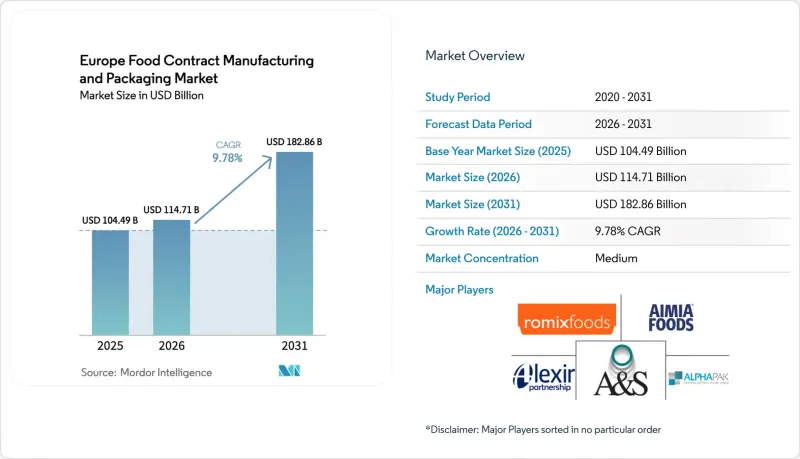
據 Mordor Intelligence 稱,2025 年歐洲食品契約製造和包裝市場價值為 1044.9 億美元,預計到 2031 年將達到 1828.6 億美元,而 2026 年為 1147.1 億美元,預測期(2026-2031 年)的複合年成長率為 9.78%。
本報告按服務類型(加工製造、包裝、倉儲履約、客製化加工和研發)、終端用戶行業(烘焙和糖果甜點、乳製品、簡便食品和調理食品、其他)、包裝類型(軟包裝、硬包裝)以及國家/地區進行細分。市場預測以美元計價。
歐洲食品契約製造和包裝市場的趨勢和洞察。
契約製造製造商投資於無過敏原和植物來源產品線。
為了因應各國食品安全監管機構日益嚴格的監管,專門生產無過敏原和植物來源產品的工廠正在歐洲各地擴張。 2024年,瑪氏公司投資1.404億美元對其在法國的八家工廠進行現代化改造,安裝了獨立的空調和儲存系統,以消除交叉污染的風險。一些領先正與缺乏資金進行專業設備維修的品牌簽訂多年合約。維修週期為18至24個月,在此期間,外包產能會暫時緊張,但升級完成後,整體加工能力最終將會提升。推動這項需求的因素包括素食產品上市數量的激增,以及公共衛生機構將文明病與動物性蛋白質攝取過量聯繫起來。對於契約製造生產商而言,植物性蛋白組織化生產線可提供更高的利潤,足以抵消與過敏原管理相關的高昂營運成本和認證費用。因此,這一趨勢正在提高歐洲食品契約製造和包裝市場的利潤密度和議價能力。
尋求靈活生產能力的零售商正在擴大其自有品牌規模。
歐洲食品零售商目前正利用自有品牌的高利潤率來保護消費者免受通膨衝擊,因為通膨導致生產計劃出現前所未有的波動。新公主集團(New Princess)計劃於2025年以10億美元收購家樂福義大利,凸顯了能夠處理多溫區產品系列的內部和合約製造能力的戰略價值。零售商擴大採用季度競標週期而非年度招標競標,更傾向於選擇能夠在24小時內完成生產切換的承包商。靈活的生產能力合約(通常為12至18個月)現在包含可變數量條款,將庫存風險轉移回製造商。能夠透過數位孿生調度和快速衛生規程來攤銷頻繁生產推出成本的公司,正在歐洲食品契約製造和包裝市場佔據主導地位。
品牌所有者價格利潤率的降低將對承包商產生影響。
預計到2025年,英國食品通膨率將達到5.1%的峰值,這將促使零售商限制商店,並向供應商施壓,要求承擔原物料成本的急劇上漲。與2020年的基準值相比,電力和天然氣價格已加倍,侵蝕了高耗能烹飪和乾燥生產線的利潤率。大型承包商正在協商價格轉嫁條款並對沖能源成本,而中型企業則面臨利潤率壓力,這抑制了它們的資本投資。現金流緊張導致自動化升級延遲,進一步擴大了歐洲契約製造和包裝市場的績效差距。
細分市場分析
至2025年,加工製造領域將佔歐洲食品契約製造和包裝市場46.88%的佔有率,凸顯其作為大眾市場自有品牌消費食品基礎的地位。合約製造商利用規模經濟,透過批量採購原料和採用連續流生產設備,為品牌製造商和零售商維持具有競爭力的價格。同時,客製化製造和研發領域預計到2031年將以10.18%的複合年成長率成長,這表明品牌所有者迫切需要在不自建中先導工廠的情況下,將差異化理念商業化。因此,隨著經臨床驗證的膳食補充劑和潔淨標示乳化產品僅需一個季度即可從實驗室走向商店,歐洲食品契約製造和包裝市場中客製化製造服務的市場規模預計將會擴大。
微批次膠囊化技術的進步,例如ACG的個人化膠囊平台,展現了合約製造商如何透過溢價收費系統將配方智慧財產權(IP)貨幣化。倉儲和履約服務受益於日益成長的直接面對消費者(D2C)趨勢,但定價仍基於銷量,因此即時庫存可見度成為最佳化空間利用的策略重點。由於歐盟可回收性要求推動的持續重新設計和監管檢驗,包裝服務的利潤率不斷提高,而這一過程的複雜性也促使許多品牌所有者傾向於外包。總體而言,歐洲食品契約製造和包裝市場正持續向能夠提供配方開發、加工和符合法規要求的包裝等承包解決方案的承包商轉變。
其他好處
- Excel格式的市場預測(ME)表
- 3個月的分析師支持
目錄
第1章:引言
- 研究假設和市場定義
- 調查範圍
第2章:調查方法
第3章執行摘要
第4章 市場狀況
- 市場概覽
- 市場促進因素
- 契約製造製造商投資於無過敏原和植物來源產品線。
- 尋求靈活生產能力的零售商正在擴大其自有品牌規模。
- 數位化和雲端連接工廠提高了生產線換線速度。
- 電子商務食材自煮包的蓬勃發展帶動了對履約型包裝的需求成長。
- 歐盟綠色交易為低碳包裝企業提供獎勵
- 將升級再造的原料商業化,進而創造新的價值
- 市場限制因素
- 品牌所有者價格利潤率的降低將對承包商產生影響。
- 由於歐盟對一次性塑膠和 PPWR(電力購買塑膠)的規定更加嚴格,合規成本增加。
- 由於李斯特菌和過敏原引起的召回事件,食品安全責任日益增加。
- 能源價格和物流成本波動導致生產計畫中斷。
- 產業價值鏈分析
- 波特五力分析
- 宏觀經濟因素對市場的影響
- 監理情勢
- 技術展望
第5章 市場規模與成長預測
- 按服務類型
- 加工/製造
- 包裝
- 倉儲存儲和履約
- 客製化製造流程及研發
- 按最終用途行業分類
- 麵包糖果甜點
- 乳製品
- 簡便食品/調理食品
- 功能性營養補充品
- 其他終端用戶產業
- 按包裝類型
- 柔軟的
- 包裝袋和小袋
- 包包
- 其他軟包裝
- 難的
- 瓶子和罐子
- 能
- 調色盤
- 紙盒
- 其他硬質包裝
- 柔軟的
- 國家
- 英國
- 德國
- 法國
- 義大利
- 西班牙
- 其他歐洲國家
第6章 競爭情勢
- 市場集中度
- 策略趨勢
- 市佔率分析
- 公司簡介
- Romix Foods Limited
- Aimia Foods Ltd
- Norvik Foods Limited
- A and S Packing Company Limited
- Alexir Co-Packers Limited
- Alphapak International Ltd
- Agilery GmbH
- SternMaid GmbH and Co. KG
- Hearthside Food Solutions Europe BV
- STOCKMEIER Food GmbH and Co. KG
- Budelpack Poortvliet BV
- Complete Co-Packing Services Ltd
- Marvinpac SA
- Marsden Packaging Ltd
- HACO Holding AG
- ID Logistics SE
- PacMoore Europe BV
- Thrive Foods Europe Ltd
- Kilfera Food Manufacturers Limited
- Prima Foods UK Ltd
第7章 市場機會與未來展望
According to Mordor Intelligence, the Europe food contract manufacturing and packaging market size was valued at USD 104.49 billion in 2025 and estimated to grow from USD 114.71 billion in 2026 to reach USD 182.86 billion by 2031, at a CAGR of 9.78% during the forecast period (2026-2031).
This report is Segmented by Service Type (Processing and Manufacturing, Packaging, Warehousing and Fulfilment, Custom Formulation and R&D), End-Use Industry (Bakery and Confectionery, Dairy Products, Convenience and Ready Meals, and More), Packaging Format (Flexible, Rigid), and Country. The Market Forecasts are Provided in Terms of Value (USD).
Europe Food Contract Manufacturing And Packaging Market Trends and Insights
Contract-Manufacturers Investing in Allergen-Free and Plant-Based Lines
Facilities dedicated to allergen-free and plant-based production are scaling across Europe in response to stricter oversight from national food safety agencies. Mars allocated USD 140.4 million to modernize eight French sites in 2024, installing segregated air-handling and storage systems that eliminate cross-contact risk. Early movers secure multi-year contracts from brands that lack capital for specialized retrofits. The conversion cycle spans 18-24 months, temporarily tightening outsourced capacity but ultimately lifting overall throughput once finished. Demand is buoyed by a surge in vegan product launches and by public health authorities linking lifestyle diseases to overconsumption of animal proteins. For contract manufacturers, plant-protein texturization lines offer premium fees that offset the higher utility and certification expenses associated with allergen management. As a result, this trend lifts both revenue density and bargaining power within the Europe food contract manufacturing and packaging market.
Retail Private-Label Expansion Seeking Flexible Capacity
European grocers now use private-label margins to shield consumers from inflation shocks, driving unprecedented volatility in production schedules. NewPrinces' USD 1 billion acquisition of Carrefour Italia in 2025 affirms the strategic value of in-house and contracted capacity that can handle multi-temperature portfolios. Retailers increasingly issue quarterly bid cycles rather than annual tenders, rewarding contractors that demonstrate sub-24-hour changeover. Flexible capacity contracts, typically 12-18 months in length, now include variable-volume clauses that shift inventory risk back to manufacturers. Those able to amortize frequent start-ups through digital twin scheduling and rapid sanitization protocols capture disproportionate wallet share in the Europe food contract manufacturing and packaging market.
Compression of Brand Owner Price Margins Passed to Contractors
Food inflation peaked at 5.1% in the United Kingdom during 2025, prompting retailers to cap shelf prices and force suppliers to absorb input spikes. Electricity and gas tariffs doubled versus 2020 baselines, eroding contribution margins on energy-intensive cooking and drying lines. While tier-one contractors negotiate pass-through clauses or hedge energy, mid-sized firms face a margin squeeze that dampens capital spending. Constrained cash flow slows automation upgrades, widening performance gaps inside the Europe food contract manufacturing and packaging market.
Other drivers and restraints analyzed in the detailed report include:
- Digitalization and Cloud-Connected Factories Improving Line-Changeover Speeds
- E-Commerce Meal-Kit Boom Demanding Fulfillment-Ready Packaging
- Tightening EU Single-Use Plastics and PPWR Rules Raising Compliance Costs
For complete list of drivers and restraints, kindly check the Table Of Contents.
Segment Analysis
Processing and manufacturing held 46.88% of the Europe food contract manufacturing and packaging market share in 2025, underscoring its role as the volume backbone for private-label staples. Its scale benefits allow contractors to leverage bulk ingredient procurement and continuous-flow machinery, keeping unit costs competitive for branded and retailer customers. Simultaneously, the custom formulation and R&D segment is forecast to grow at a 10.18% CAGR through 2031, signaling brand owner urgency to commercialize differentiated concepts without building in-house pilot plants. The Europe food contract manufacturing and packaging market size for custom formulation services is thus expected to swell as clinical-substantiated nutraceuticals and clean-label emulsions move from lab to shelf within a single quarterly cycle.
Advances in micro-batch encapsulation, such as ACG's personalized capsule platform, illustrate how contractors monetize formulation IP through premium fee structures. Warehousing and fulfillment services benefit from rising direct-to-consumer flows, but pricing remains volume-linked, placing a strategic emphasis on real-time inventory visibility to optimize cube utilization. Packaging services face margin uplift as EU recyclability mandates require continuous redesign and regulatory validation, a complexity most brand owners prefer to outsource. Overall, the Europea food contract manufacturing and packaging market continues to tilt toward contractors capable of bundling formulation, processing, and compliant packaging into a single turnkey proposition..
Complete Report Scope:
- By Service Type
- Processing and Manufacturing
- Packaging
- Warehousing and Fulfilment
- Custom Formulation and R&D
- By End-Use Industry
- Bakery and Confectionery
- Dairy Products
- Convenience and Ready Meals
- Functional and Nutraceutical Products
- Other End-Use Industries
- By Packaging Format
- Flexible
- Pouches and Sachets
- Bags
- Other Flexible Packaging
- Rigid
- Bottles and Jars
- Cans
- Pallets
- Cartons
- Other Rigid Packaging
- Flexible
- By Country
- United Kingdom
- Germany
- France
- Italy
- Spain
- Rest of Europe
List of Companies Covered in this Report:
- Romix Foods Limited
- Aimia Foods Ltd
- Norvik Foods Limited
- A and S Packing Company Limited
- Alexir Co-Packers Limited
- Alphapak International Ltd
- Agilery GmbH
- SternMaid GmbH and Co. KG
- Hearthside Food Solutions Europe B.V.
- STOCKMEIER Food GmbH and Co. KG
- Budelpack Poortvliet B.V.
- Complete Co-Packing Services Ltd
- Marvinpac SA
- Marsden Packaging Ltd
- HACO Holding AG
- ID Logistics SE
- PacMoore Europe B.V.
- Thrive Foods Europe Ltd
- Kilfera Food Manufacturers Limited
- Prima Foods UK Ltd
Additional Benefits:
- The market estimate (ME) sheet in Excel format
- 3 months of analyst support
TABLE OF CONTENTS
1 INTRODUCTION
- 1.1 Study Assumptions and Market Definition
- 1.2 Scope of the Study
2 RESEARCH METHODOLOGY
3 EXECUTIVE SUMMARY
4 MARKET LANDSCAPE
- 4.1 Market Overview
- 4.2 Market Drivers
- 4.2.1 Contract-manufacturers investing in allergen-free and plant-based lines
- 4.2.2 Retail private-label expansion seeking flexible capacity
- 4.2.3 Digitalisation and cloud-connected factories improving line-changeover speeds
- 4.2.4 E-commerce meal-kit boom demanding fulfilment-ready packaging
- 4.2.5 EU Green Deal incentives for low-carbon packaging operations
- 4.2.6 Commercialisation of upcycled ingredients supplying new value streams
- 4.3 Market Restraints
- 4.3.1 Compression of brand owner price margins passed to contractors
- 4.3.2 Tightening EU Single-Use Plastics and PPWR rules raising compliance costs
- 4.3.3 Heightened food-safety liability driven by Listeria/Allergen recalls
- 4.3.4 Volatile energy and logistics prices disrupting production planning
- 4.4 Industry Value Chain Analysis
- 4.5 Porter's Five Forces Analysis
- 4.5.1 Bargaining Power of Suppliers
- 4.5.2 Bargaining Power of Buyers/Consumers
- 4.5.3 Threat of New Entrants
- 4.5.4 Threat of Substitute Products
- 4.5.5 Intensity of Competitive Rivalry
- 4.6 Impact of Macroeconomic Factors on the Market
- 4.7 Regulatory Landscape
- 4.8 Technological Outlook
5 MARKET SIZE AND GROWTH FORECASTS (VALUE)
- 5.1 By Service Type
- 5.1.1 Processing and Manufacturing
- 5.1.2 Packaging
- 5.1.3 Warehousing and Fulfilment
- 5.1.4 Custom Formulation and R&D
- 5.2 By End-Use Industry
- 5.2.1 Bakery and Confectionery
- 5.2.2 Dairy Products
- 5.2.3 Convenience and Ready Meals
- 5.2.4 Functional and Nutraceutical Products
- 5.2.5 Other End-Use Industries
- 5.3 By Packaging Format
- 5.3.1 Flexible
- 5.3.1.1 Pouches and Sachets
- 5.3.1.2 Bags
- 5.3.1.3 Other Flexible Packaging
- 5.3.2 Rigid
- 5.3.2.1 Bottles and Jars
- 5.3.2.2 Cans
- 5.3.2.3 Pallets
- 5.3.2.4 Cartons
- 5.3.2.5 Other Rigid Packaging
- 5.3.1 Flexible
- 5.4 By Country
- 5.4.1 United Kingdom
- 5.4.2 Germany
- 5.4.3 France
- 5.4.4 Italy
- 5.4.5 Spain
- 5.4.6 Rest of Europe
6 COMPETITIVE LANDSCAPE
- 6.1 Market Concentration
- 6.2 Strategic Moves
- 6.3 Market Share Analysis
- 6.4 Company Profiles (includes Global level Overview, Market level overview, Core Segments, Financials as available, Strategic Information, Market Rank/Share for key companies, Products and Services, and Recent Developments)
- 6.4.1 Romix Foods Limited
- 6.4.2 Aimia Foods Ltd
- 6.4.3 Norvik Foods Limited
- 6.4.4 A and S Packing Company Limited
- 6.4.5 Alexir Co-Packers Limited
- 6.4.6 Alphapak International Ltd
- 6.4.7 Agilery GmbH
- 6.4.8 SternMaid GmbH and Co. KG
- 6.4.9 Hearthside Food Solutions Europe B.V.
- 6.4.10 STOCKMEIER Food GmbH and Co. KG
- 6.4.11 Budelpack Poortvliet B.V.
- 6.4.12 Complete Co-Packing Services Ltd
- 6.4.13 Marvinpac SA
- 6.4.14 Marsden Packaging Ltd
- 6.4.15 HACO Holding AG
- 6.4.16 ID Logistics SE
- 6.4.17 PacMoore Europe B.V.
- 6.4.18 Thrive Foods Europe Ltd
- 6.4.19 Kilfera Food Manufacturers Limited
- 6.4.20 Prima Foods UK Ltd
7 MARKET OPPORTUNITIES and FUTURE OUTLOOK
- 7.1 White-space and Unmet-Need Assessment


