


 |
市場調查報告書
商品編碼
2125291
印度智慧型穿戴裝置:市場佔有率分析、產業趨勢與統計及成長預測(2026-2031)India Smart Wearable - Market Share Analysis, Industry Trends & Statistics, Growth Forecasts (2026 - 2031) |
||||||

※ 本網頁內容可能與最新版本有所差異。詳細情況請與我們聯繫。
據 Mordor Intelligence 稱,2025 年印度智慧型穿戴裝置市值為 29.4 億美元,預計到 2031 年將從 2026 年的 36.2 億美元成長至 102.6 億美元,預測期(2026-2031 年)的複合年成長率為 23.17%。
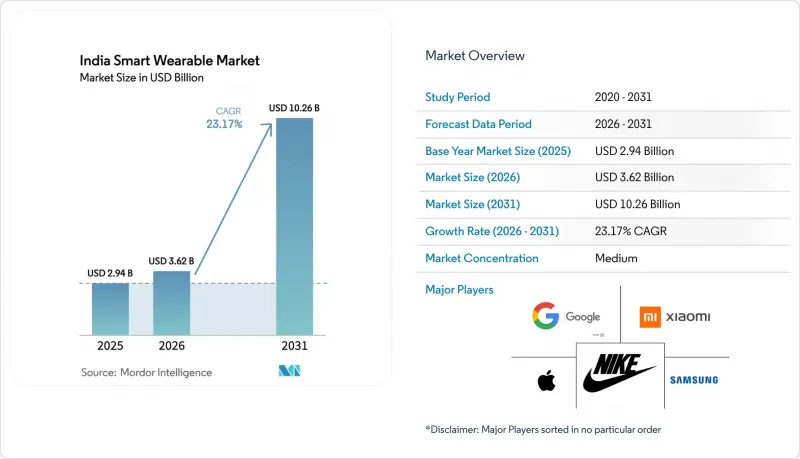
本報告按產品類型(智慧型手錶、健身手環、智慧戒指、智慧眼鏡及其他產品類型)、連接技術(僅藍牙、藍牙+LTE/eSIM、支援NFC)和最終用途(健康和健身追蹤、慢性病遠端監測、支付和門禁控制等)進行分類。市場預測以美元(USD)計價。
印度智慧型穿戴設備市場的趨勢與洞察
越來越注重健康的中產階級
如今,印度都市區中產階級已將智慧感測器視為管理慢性疾病的實用工具。預計到2025年中期,印度將有172,148家健康健康中心提供25.9億次健康諮詢服務,將催生對自動化生命徵象監測的日常需求。同時,將有6500萬公民開設「阿尤斯曼·巴拉特健康帳戶」(ABHA),能夠採集智慧型手錶和智慧戒指數據的電子病歷也日益普及。這些平行發展正在將印度的智慧穿戴裝置市場從可有可無的消費性電子產品類別,轉變為基層醫療網路不可或缺的補充組成部分。
由於國內競爭,平均售價(ASP)大幅下降。
根據電子元件製造計劃 (ECMS) 營運的本地組裝製造商可獲得資本投資和銷售補貼,這使得元件成本降低了高達 12%。因此,2025 年第一季出貨的智慧型手錶中,十分之九的售價低於 5,000 印度盧比,加速了二線城市的普及。雖然平均售價 (ASP) 的下降對毛利率造成了壓力,但銷量激增增加了運作中部署量,從而創造了訂閱軟體、配件和替換錶帶等相關業務機會,抵消了硬體盈利能力面臨的壓力。
平均售價的下降給整車製造商的利潤率帶來了壓力。
自2023年以來,價格競爭已使智慧型手錶的平均售價下降了42%,給二線品牌的毛利率帶來了壓力。除非企業透過雲端分析來獲利或拓展相關音訊配件業務,否則現金流緊張將迫使產業整合,並可能導致目前佔市場佔有率38%的「長尾」競爭對手被淘汰。 2026年至2027年,SKU數量的減少可能導致功能創新放緩,進而可能減緩印度智慧穿戴裝置市場的成長速度。
細分市場分析
到2025年,智慧型手錶將佔印度智慧穿戴裝置市場規模的62.78%。這主要得益於多感測器陣列的普及,它們將健身、通訊和UPI支付等功能整合到一個腕戴式介面中。相較之下,智慧戒指目前仍屬於小眾產品,但其時尚的珠寶設計吸引了注重風格的千禧世代,使其複合年成長率達到了24.4%。
智慧型手錶憑藉其功能的快速擴展,例如LTE模組、2GB內存以及完整的安卓作業系統,持續保持主導地位,這些功能使其能夠替代智慧型手機。同時,智慧戒指的平均單價高達204美元,足以涵蓋其高階鈦金屬錶殼和醫用級光學容積描記法(PPG)感測器的成本。在預測期內,智慧手錶預計將繼續佔據大眾市場,而智慧戒指則有望在心臟代謝監測這一細分市場佔據一席之地。預計這兩類產品將在印度智慧穿戴裝置市場共存,互不蠶食。
其他好處:
- Excel格式的市場預測(ME)表
- 3個月的分析師支持
目錄
第1章:引言
- 研究假設和市場定義
- 調查範圍
第2章:調查方法
第3章執行摘要
第4章 市場狀況
- 市場概覽
- 市場促進因素
- 中產階級越來越注重健康和健身。
- 由於國內競爭激烈,平均售價大幅下降。
- 政府對生產責任保險和數位健康的獎勵
- 基於穿戴裝置數據的健康保險折扣
- 智慧戒指的設計理念是方便佩戴,可以作為珠寶。
- 使用支援UPI的穿戴式設備進行非接觸式支付。
- 市場限制因素
- 平均售價(服務量)的下降給原始設備製造商(OEM)的利潤率帶來了壓力。
- 資料隱私和網路安全問題
- 最初的購買熱潮過後,更換週期已經延長。
- 印度中央藥品標準控制組織(CDSCO)對醫療穿戴裝置的立場含糊不清
- 監理情勢
- 技術展望
- 波特五力分析
第5章 市場規模與成長預測
- 依產品類型
- 智慧型手錶
- 健身手環
- 智慧戒指
- 智慧眼鏡
- 其他產品類型
- 透過連接技術
- 限藍牙
- Bluetooth+LTE/eSIM
- 相容NFC
- 按最終用途
- 健康與健身追蹤
- 慢性病遠端監測
- 支付和存取控制
- 工業和現場工人
- 其他最終用途
第6章 競爭情勢
- 市場集中度
- 策略趨勢
- 市佔率分析
- 公司簡介
- Nexxbase Marketing Private Limited(Noise)
- Fire-Boltt Innovations Private Limited
- Imagine Marketing Limited(boAt)
- Samsung Electronics Co., Ltd.
- Apple Inc.
- Garmin Ltd.
- Xiaomi Corporation
- Huawei Technologies Co., Ltd.
- Fitbit LLC(Alphabet Inc. subsidiary)
- Titan Company Limited
- GOQii Technologies Pvt. Ltd.
- Nike, Inc.
- Realme Mobile Telecommunications(India)Pvt. Ltd.
- OnePlus Technology(Shenzhen)Co., Ltd.
- Oppo Mobile Telecommunications Corp., Ltd.
- Zepp Health Corporation(Amazfit)
- Lenovo Group Limited
- Zebronics India Pvt. Ltd.
- Portronics Digital Pvt. Ltd.
- Fastrack(Division of Titan Company Limited)
- Sony Group Corporation
- Google LLC(Pixel Watch)
第7章 市場機會與未來展望
According to Mordor Intelligence, the India smart wearable market size was valued at USD 2.94 billion in 2025 and estimated to grow from USD 3.62 billion in 2026 to reach USD 10.26 billion by 2031, at a CAGR of 23.17% during the forecast period (2026-2031).
This report is Segmented by Product Type (Smartwatches, Fitness Bands, Smart Rings, Smart Glasses, and Other Product Types), Connectivity Technology (Bluetooth-Only, Bluetooth + LTE/ESIM, and NFC-Enabled), End-Use Application (Health and Fitness Tracking, Chronic-Disease Remote Monitoring, Payments and Access Control, and More). The Market Forecasts are Provided in Terms of Value (USD).
India Smart Wearable Market Trends and Insights
Rising Health-Focused Middle Class
India's urban and peri-urban middle class now views connected sensors as practical tools for managing chronic ailments. An estimated 172,148 Health and Wellness Centers had delivered 2.59 billion wellness sessions by mid-2025, creating day-to-day demand for automated vitals capture.Simultaneously, 65 crore citizens have generated Ayushman Bharat Health Accounts (ABHA), normalizing digital medical records that can ingest smartwatch or smart-ring data. These parallel developments position the India smart wearable market as an indispensable adjunct to the primary-care network rather than an optional consumer gadget category.
Rapid ASP Decline from Domestic Competition
Local assemblers operating under the Electronics Component Manufacturing Scheme receive cap-ex and turnover subsidies that reduce bill-of-materials costs by up to 12%. As a result, nine out of every ten smartwatches shipped in Q1 2025 retailed below INR 5,000, accelerating device diffusion in Tier 2 geographies. While ASP contraction squeezes gross margins, the volume surge enlarges the active installed base, creating follow-on opportunities for subscription software, accessories, and replacement straps that offset hardware compression.
ASP Erosion Squeezing OEM Margins
Price wars have already reduced smartwatch ASPs by 42% since 2023, eroding gross margins for second-tier brands. Unless firms monetize cloud analytics or expand into adjacent audio accessories, cash-flow stress could force consolidation, trimming the long-tail of competitors that now accounts for 38% of shipments. Over 2026-2027, fewer SKUs may translate into slower feature innovation, introducing softness in the India smart wearable market growth curve.
Other drivers and restraints analyzed in the detailed report include:
- Government PLI and Digital-Health Schemes
- Insurance Discounts for Wellness Data
- Data-Privacy and Cybersecurity Concerns
For complete list of drivers and restraints, kindly check the Table Of Contents.
Segment Analysis
Smartwatches generated 62.78% of the India smart wearable market size in 2025, buoyed by multi-sensor arrays that bundle fitness, communication, and UPI payments in a single wrist-top interface. In contrast, smart rings, while still niche, are tracking a 24.4% CAGR as jewelry-friendly aesthetics appeal to style-conscious millennials.
Continued smartwatch leadership is underwritten by rapid feature creep, such as LTE modules, 2 GB RAM, and a full Android OS that converts the device into a phone substitute. Yet rings enjoy a higher average revenue per unit, USD 204, subsidizing premium titanium builds and medical-grade photoplethysmography sensors. Over the forecast horizon, rings could capture cardiometabolic-monitoring niches even while watches retain mass-market status, ensuring both categories coexist rather than cannibalize within the India smart wearable market.
Complete Report Scope:
- By Product Type (Value)
- Smartwatches
- Fitness Bands
- Smart Rings
- Smart Glasses
- Other Product Types
- By Connectivity Technology (Value)
- Bluetooth-only
- Bluetooth + LTE/eSIM
- NFC-enabled
- By End-Use Application (Value)
- Health and Fitness Tracking
- Chronic-disease Remote Monitoring
- Payments and Access Control
- Industrial and Field Workforce
- Other End-Use Applications
List of Companies Covered in this Report:
- Nexxbase Marketing Private Limited (Noise)
- Fire-Boltt Innovations Private Limited
- Imagine Marketing Limited (boAt)
- Samsung Electronics Co., Ltd.
- Apple Inc.
- Garmin Ltd.
- Xiaomi Corporation
- Huawei Technologies Co., Ltd.
- Fitbit LLC (Alphabet Inc. subsidiary)
- Titan Company Limited
- GOQii Technologies Pvt. Ltd.
- Nike, Inc.
- Realme Mobile Telecommunications (India) Pvt. Ltd.
- OnePlus Technology (Shenzhen) Co., Ltd.
- Oppo Mobile Telecommunications Corp., Ltd.
- Zepp Health Corporation (Amazfit)
- Lenovo Group Limited
- Zebronics India Pvt. Ltd.
- Portronics Digital Pvt. Ltd.
- Fastrack (Division of Titan Company Limited)
- Sony Group Corporation
- Google LLC (Pixel Watch)
Additional Benefits:
- The market estimate (ME) sheet in Excel format
- 3 months of analyst support
TABLE OF CONTENTS
1 INTRODUCTION
- 1.1 Study Assumptions and Market Definition
- 1.2 Scope of the Study
2 RESEARCH METHODOLOGY
3 EXECUTIVE SUMMARY
4 MARKET LANDSCAPE
- 4.1 Market Overview
- 4.2 Market Drivers
- 4.2.1 Rising health- and fitness-conscious middle class
- 4.2.2 Rapid ASP decline from intense domestic competition
- 4.2.3 Government PLI and Digital Health incentives
- 4.2.4 Health-insurance discounts for wearables data
- 4.2.5 Emergence of smart rings as jewellery-friendly form factor
- 4.2.6 UPI-enabled contactless payments via wearables
- 4.3 Market Restraints
- 4.3.1 ASP erosion squeezing OEM margins
- 4.3.2 Data-privacy and cybersecurity concerns
- 4.3.3 Lengthening replacement cycles after first-time buyer boom
- 4.3.4 CDSCO ambiguity on medical-grade wearables
- 4.4 Regulatory Landscape
- 4.5 Technological Outlook
- 4.6 Porter's Five Forces Analysis
- 4.6.1 Threat of New Entrants
- 4.6.2 Bargaining Power of Suppliers
- 4.6.3 Bargaining Power of Buyers
- 4.6.4 Threat of Substitutes
- 4.6.5 Competitive Rivalry
5 MARKET SIZE AND GROWTH FORECASTS (VALUE)
- 5.1 By Product Type (Value)
- 5.1.1 Smartwatches
- 5.1.2 Fitness Bands
- 5.1.3 Smart Rings
- 5.1.4 Smart Glasses
- 5.1.5 Other Product Types
- 5.2 By Connectivity Technology (Value)
- 5.2.1 Bluetooth-only
- 5.2.2 Bluetooth + LTE/eSIM
- 5.2.3 NFC-enabled
- 5.3 By End-Use Application (Value)
- 5.3.1 Health and Fitness Tracking
- 5.3.2 Chronic-disease Remote Monitoring
- 5.3.3 Payments and Access Control
- 5.3.4 Industrial and Field Workforce
- 5.3.5 Other End-Use Applications
6 COMPETITIVE LANDSCAPE
- 6.1 Market Concentration
- 6.2 Strategic Moves
- 6.3 Market Share Analysis
- 6.4 Company Profiles (includes Global level Overview, Market level overview, Core Segments, Financials as available, Strategic Information, Market Rank/Share for key companies, Products and Services, and Recent Developments)
- 6.4.1 Nexxbase Marketing Private Limited (Noise)
- 6.4.2 Fire-Boltt Innovations Private Limited
- 6.4.3 Imagine Marketing Limited (boAt)
- 6.4.4 Samsung Electronics Co., Ltd.
- 6.4.5 Apple Inc.
- 6.4.6 Garmin Ltd.
- 6.4.7 Xiaomi Corporation
- 6.4.8 Huawei Technologies Co., Ltd.
- 6.4.9 Fitbit LLC (Alphabet Inc. subsidiary)
- 6.4.10 Titan Company Limited
- 6.4.11 GOQii Technologies Pvt. Ltd.
- 6.4.12 Nike, Inc.
- 6.4.13 Realme Mobile Telecommunications (India) Pvt. Ltd.
- 6.4.14 OnePlus Technology (Shenzhen) Co., Ltd.
- 6.4.15 Oppo Mobile Telecommunications Corp., Ltd.
- 6.4.16 Zepp Health Corporation (Amazfit)
- 6.4.17 Lenovo Group Limited
- 6.4.18 Zebronics India Pvt. Ltd.
- 6.4.19 Portronics Digital Pvt. Ltd.
- 6.4.20 Fastrack (Division of Titan Company Limited)
- 6.4.21 Sony Group Corporation
- 6.4.22 Google LLC (Pixel Watch)
7 MARKET OPPORTUNITIES AND FUTURE OUTLOOK
- 7.1 White-space and Unmet-need Assessment

 智慧型穿戴裝置:市場佔有率分析、產業趨勢與統計及成長預測(2026-2031)
 智慧型穿戴裝置市場:按組件、產品類型、連接方式、應用和銷售管道分類-2026-2032年全球市場預測
 智慧型穿戴式打鼾偵測器市場規模、佔有率和成長分析:按產品類型、技術、價格範圍、最終用戶、銷售管道、地區和產業預測,2026-2033年
 2026年全球智慧型穿戴式打鼾檢測器市場報告
 智慧型穿戴裝置市場分析及預測(至2035年):按類型、產品類型、服務、技術、組件、應用、形狀、材質、最終用戶和功能分類智慧生物識別穿戴裝置市場分析及預測(至2035年):按類型、產品類型、服務、技術、組件、應用、形式、最終用戶和功能分類智慧襪市場分析及預測(至2035年):依類型、產品類型、技術、組件、應用、材料類型、最終用戶、功能、安裝類型及解決方案分類2026年全球智慧穿戴裝置市場報告
 智慧型穿戴裝置市場-全球產業規模、佔有率、趨勢、機會及預測(依設備、產品類型、應用、地區及競爭格局分類,2021-2031年)智慧健康襪市場按產品類型、技術、應用、分銷管道和最終用戶分類-2026年至2032年全球預測