


 |
市場調查報告書
商品編碼
2121601
智慧型穿戴裝置:市場佔有率分析、產業趨勢與統計及成長預測(2026-2031)Smart Wearable - Market Share Analysis, Industry Trends & Statistics, Growth Forecasts (2026 - 2031) |
||||||

※ 本網頁內容可能與最新版本有所差異。詳細情況請與我們聯繫。
根據 Mordor Intelligence 預測,智慧型穿戴裝置市場規模將從 2025 年的 993.6 億美元成長到 2026 年的 1,188.9 億美元,然後在 2031 年達到 2,543.1 億美元,2026 年至 2031 年的複合年成長率為 16.42%。
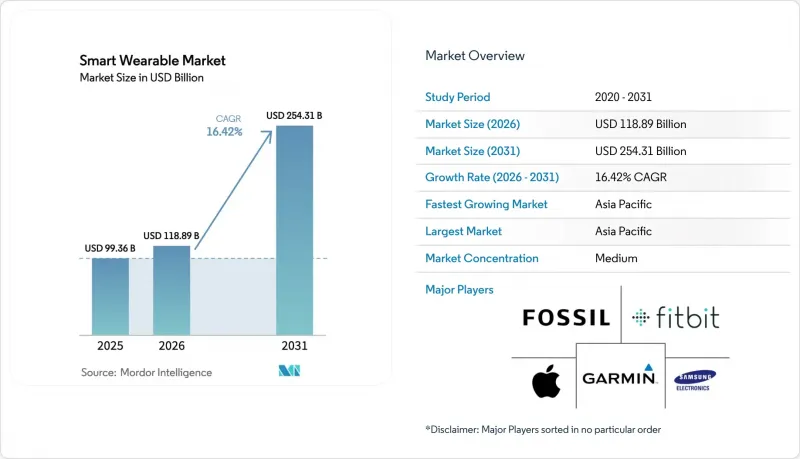
本報告按產品類型(智慧型手錶、穿戴式耳機、健身追蹤器、頭戴式顯示器、智慧穿戴裝置、人體攝影機、智慧戒指等)、組件(硬體、軟體、服務)、連接方式(藍牙、蜂窩網路等)、最終用途(消費、醫療保健等)、分銷管道(線上、線下)和地區進行細分。市場預測以美元計價。
全球智慧穿戴設備市場趨勢及洞察
消費者對健康和健身的意識日益增強
每日步數、心率變異性和睡眠階段評分已成為日常健康指標,穿戴式裝置正在轉型為自我管理的得力助手。根據蘋果預測,2025 年,70% 的 Apple Watch Series 9 購買者會將健康管理工具作為購買的主要原因,比 2022 年增加了 12 個百分點。 Garmin 的跑步和騎行產品線在 2025 年同比成長 18%,這主要得益於與 Strava 和 Training Peaks 的整合,這些整合正在將休閒慢跑者轉變為數據驅動型運動員。三星在 Galaxy Watch 6 中加入了身體組成分析功能,提供了以往只有醫用秤才能提供的肌肉量和體脂百分比等數據。這些整合在遊戲化軟體中的醫用級感測器,即使在智慧型手機更換週期延長的情況下,仍然保持著兩位數的銷售成長。
保險涵蓋的穿戴式設備,用於遠端心臟監測
美國醫療保險和醫療補助服務中心 (CMS) 於 2024 年開始向臨床醫生報銷每位患者每月 50 至 65 美元的費用,用於審查從穿戴式裝置取得的心電圖資料。OMRON的 HeartGuide 手錶是首款獲得 FDA 批准的示波法血壓監測穿戴式設備,於 2025 年被納入 UnitedHealthcare 和 Anthem 的醫療保險範圍,將用戶的費用從 499 美元降至 100 美元以下。 Withings 的 ScanWatch 2 獲得了 FDA 批准用於檢測心房顫動,到 2025 年年中,已有超過 40 家責任醫療組織 (ACO) 將其數據整合到 Epic 和 Cerner 醫療記錄系統中。因此,隨著保險報銷機制的完善,穿戴式裝置正從單純的輔助健康工具轉變為可計費的診斷工具。
歐洲資料居住要求限制了雲端配套應用程式
在「Schrems II」裁決之後,歐盟監管機構於2025年加強了執法力度,要求供應商必須在歐洲境內託管健康資料。據估計,蘋果花費了2億美元將iCloud Health工作負載遷移到德國和愛爾蘭的伺服器。 Fitbit因未經用戶同意透過美國伺服器傳輸用戶資料而被罰款800萬歐元,凸顯了違規帶來的財務風險。缺乏財力建構本地基礎設施的小規模品牌要么被迫退出市場,要么由於與本地雲端服務提供商合作而面臨利潤率下降和獲客成本上升的困境。
細分市場分析
預計到2025年,智慧型手錶將佔智慧穿戴裝置總銷量的60.39%,成為此品類的核心。這主要歸功於蘋果、三星和佳明憑藉其生態系統鎖定效應和多運動模式的GPS定位精度,維持了其市場佔有率。助聽器佔總出貨量的18%,這主要得益於蘋果AirPods Pro 2獲準作為商用助聽器上市,為3,000萬輕度聽力損失的美國人提供服務。同時,隨著消費者轉向整合支付、行動電話通話和健康儀錶板等功能的全功能智慧型手錶,健身手環的市場佔有率萎縮至12%。
市場趨勢正轉向更隱密的外形規格。智慧戒指市場在Oura 5億美元的年訂閱收入和三星Galaxy Ring的推動下,正以17.05%的複合年成長率成長,成為智慧穿戴裝置市場所有產品線中成長最快的。頭戴式顯示器目前僅佔5%的市場佔有率,但Meta公司Quest 3S的降價預示著未來銷量將有所成長。智慧穿戴、醫療貼片和動力外骨骼等細分領域合計僅佔5%的市場佔有率,但它們作為尚未開發的市場蘊藏著巨大的潛力。 Ekso Bionics公司在2025會計年度向美國陸軍交付120套EVO外骨骼便是明證。
預計到2025年,硬體營收將佔蘋果總營收的71.22%,但服務業務正以16.94%的複合年成長率持續成長至2031年,構成比智慧穿戴裝置市場的營收結構。蘋果服務部門預計2025會計年度營收將超過960億美元,其中約8%與Fitness+和iCloud健康儲存相關。 WHOOP無需上傳硬體的模式已吸引了120萬用戶,每月收費30美元,展現出透過持續現金流提升企業價值的潛力。
軟體和配套應用佔據了8%的市場佔有率,它們支撐著硬體的便利性和開放的開發者生態系統。 Garmin的Connect IQ在2025年的下載量預計將超過5000萬次,而小米在2025年3月開放原始碼其穿戴式設備專用HyperOS SDK後,短短六個月內第三方提交的應用數量就成長了150%。因此,目前智慧型穿戴裝置產業中採用訂閱模式的廠商的市盈率在8到12倍之間,而僅提供硬體的競爭對手的本益比僅為2到4倍。
區域分析
預計到2025年,亞太地區將佔全球銷售額的34.91%,成為最大的市場,並在2031年之前維持17.31%的複合年成長率,成為所有地區中成長最快的地區。中國監管機構在2025年批准了47款兩用智慧型手錶,比2024年成長了56%。每台最高500元人民幣(約71.40美元)的補貼也促進了華為、小米和OPPO等品牌的銷售。在印度,智慧手錶出貨量成長了68%,本土品牌Noise、Fire-Boltt和boAt憑藉著低於50美元的定價和本地化應用程式,獲得了超過60%的市場佔有率。在日本,2025年4月,穿戴式裝置血壓數據的保險覆蓋範圍擴大,促使OMRON「HeartGuide」的出貨量在一個季度內成長了34%。
在北美,醫療保險代碼和企業健康預算貢獻了2025年32%的銷售額。 2024年9月發表的Apple Watch Series 10,憑藉其獲得FDA批准的睡眠呼吸中止症偵測功能,構成比50歲以上用戶銷售額的18%。在加拿大,25,000塊輔助智慧型手錶被分發到各省,用於針對慢性病的試點計畫;而墨西哥市場儘管對中國製造的設備提高了關稅,但進口產品仍實現了41%的成長。
歐洲市場佔總銷售額的22%,但合規負擔也最為沉重。德國聯邦資訊安全辦公室現要求跨境傳輸生物辨識資料必須獲得明確許可,這導致產品上市計畫最多延遲三個月。在英國,穿戴式裝置數據將於2025年整合到NHS應用程式中,屆時將有1,200萬名公民能夠與醫生共用測量數據。南美洲和中東及非洲市場各佔總銷售額的6%,其中巴西銷量領先,但由於平均每用戶收入(ARPU)較低,成長有限;而阿拉伯聯合大公國則推動了對高階智慧型手錶的需求。
其他好處:
- Excel格式的市場預測(ME)表
- 3個月的分析師支持
目錄
第1章:引言
- 研究假設和市場定義
- 調查範圍
第2章:調查方法
第3章執行摘要
第4章 市場狀況
- 市場概覽
- 市場促進因素
- 消費者對健康和健身的意識日益增強
- 企業數位化健康計畫正在增加設備補貼。
- 北美地區醫療保險涵蓋的用於遠端心臟監測的穿戴式設備
- 中國透過「健康中國2030」計畫對兩用(消費+醫療)智慧型手錶提供補貼
- 配備人工智慧晶片的穿戴式設備的興起,將使無需針頭即永續監測血糖值成為可能。
- 根據美國「士兵作戰能力增強計畫」購買防禦性外骨骼裝置
- 市場限制因素
- 資料居住要求限制了雲端相關應用程式在歐洲的使用。
- 超薄智慧型手錶高密度電池熱失控的擔憂
- 與手勢控制智慧戒指相關的專利許可訴訟費用
- 南美洲較低的ARPU值限制了5G獨立組網穿戴式裝置的部署。
- 產業價值鏈分析
- 監理情勢
- 技術展望
- 宏觀經濟因素對市場的影響
- 波特五力分析
- 投資和資金籌措分析
第5章 市場規模與成長預測
- 依產品
- 智慧型手錶
- 穿戴式音訊設備(耳戴式智慧耳機)
- 健身活動追蹤器
- 頭戴式顯示器(AR、VR、MR)
- 智慧服飾和紡織品
- 執法記錄儀
- 智慧戒指和珠寶
- 醫用穿戴貼片和生物感測器
- 動力外骨骼
- 按組件
- 硬體
- 軟體和應用程式
- 服務和訂閱
- 透過連接技術
- 藍牙、低功耗藍牙
- 蜂窩網路(3G、4G、LTE-M)
- 5G獨立組網
- 近場通訊 (NFC)、無線射頻識別 (RFID)
- Wi-Fi、無線區域網
- 其他連接技術(UWB、ANT+)
- 按最終用途
- 家居電子產品和生活方式
- 醫療保健
- 健身和運動
- 工業和企業安全
- 軍事/國防
- 透過分銷管道
- 線上(品牌官方網路商店、市場)
- 線下(量販店、專賣店、診所)
- 按地區
- 北美洲
- 美國
- 加拿大
- 墨西哥
- 歐洲
- 德國
- 英國
- 法國
- 義大利
- 西班牙
- 其他歐洲國家
- 亞太地區
- 中國
- 日本
- 韓國
- 印度
- 東南亞
- 其他亞太國家
- 南美洲
- 巴西
- 其他南美國家
- 中東
- 阿拉伯聯合大公國
- 沙烏地阿拉伯
- 其他中東國家
- 非洲
- 南非
- 其他非洲國家
- 北美洲
第6章 競爭情勢
- 市場集中度
- 策略趨勢
- 市佔率分析
- 公司簡介
- Apple Inc.
- Samsung Electronics Co. Ltd.
- Alphabet Inc.(Fitbit, Google Pixel)
- Garmin Ltd.
- Huawei Technologies Co. Ltd.
- Xiaomi Corporation
- Meta Platforms Inc.(Oculus)
- Sony Group Corporation
- Microsoft Corp.
- Withings SA
- Huami Corp.(Zepp Health)
- GoPro Inc.
- Fossil Group Inc.
- Omron Healthcare Inc.
- Ekso Bionics Holdings Inc.
- Cyberdyne Inc.
- Nuheara Ltd.
- Bragi GmbH
- Sensoria Inc.
- AIQ Smart Clothing Inc.
- Polar Electro Oy
- Coros Wearables Inc.
- Oura Health Ltd.
- WHOOP Inc.
第7章 市場機會與未來展望
According to Mordor Intelligence, the smart wearable market size is expected to grow from USD 99.36 billion in 2025 to USD 118.89 billion in 2026 and is forecast to reach USD 254.31 billion by 2031 at 16.42% CAGR over 2026-2031.
This report is Segmented by Product (Smartwatches, Hearables, Fitness Trackers, Head-Mounted Displays, Smart Clothing, Body-Worn Cameras, Smart Rings, and More), Component (Hardware, Software, and Services), Connectivity (Bluetooth, Cellular, and More), Application (Consumer, Healthcare, and More), Distribution (Online, and Offline), and Geography. Market Forecasts are Provided in Terms of Value (USD).
Global Smart Wearable Market Trends and Insights
Rising Health and Fitness Consciousness Among Consumers
Daily step counts, heart-rate variability, and sleep-stage scores have become routine metrics, transforming wearables into accountability companions. Apple disclosed that 70% of 2025 Watch Series 9 buyers ranked health tools as the main reason for purchase, up 12 percentage points from 2022. Garmin's running and cycling portfolio expanded 18% year over year in 2025, boosted by links to Strava and Training Peaks that turn casual joggers into data-driven athletes. Samsung added body-composition analysis to Galaxy Watch 6, offering muscle and body-fat insights previously confined to clinic scales. These medical-grade sensors wrapped in gamified software are sustaining double-digit unit growth even as smartphone replacement cycles lengthen.
Insurance-Approved Wearables for Cardiac Remote Monitoring
Centers for Medicare and Medicaid Services began reimbursing clinician review of wearable-derived electrocardiogram data in 2024, paying USD 50-USD 65 per patient each month. Omron's HeartGuide watch, the first FDA-cleared oscillometric blood-pressure wearable, gained coverage from UnitedHealthcare and Anthem in 2025, lowering member costs from USD 499 to under USD 100. Withings' ScanWatch 2 earned FDA clearance for atrial-fibrillation detection, and more than 40 accountable-care organizations embedded its data into Epic and Cerner records by mid-2025. Reimbursement is therefore repositioning wearables from wellness extras to billable diagnostic endpoints.
Data-Residency Mandates Limiting Cloud Companion Apps in Europe
Following the Schrems II judgment, EU regulators intensified enforcement in 2025, forcing vendors to host health data within European borders. Apple spent an estimated USD 200 million migrating iCloud Health workloads to German and Irish facilities. Fitbit was fined EUR 8 million for routing user data through U.S. servers without consent, highlighting the financial risk of non-compliance. Smaller brands lacking capital for localized infrastructure face exit decisions or margin-eroding partnerships with regional clouds, raising customer acquisition costs.
Other drivers and restraints analyzed in the detailed report include:
- China's Dual-Use Smartwatch Subsidies Under Healthy China 2030
- AI-On-Chip Wearables Enable Needle-Free Glucose Monitoring
- High-Density Battery Thermal Runaway Concerns
For complete list of drivers and restraints, kindly check the Table Of Contents.
Segment Analysis
Smartwatches delivered 60.39% of 2025 revenue, placing the category at the center of the smart wearable market size, as Apple, Samsung, and Garmin leveraged ecosystem lock-ins and multisport GPS accuracy to defend share. Hearables supplied 18% of shipments, riding Apple AirPods Pro 2's over-the-counter hearing-aid approval to serve 30 million Americans with mild hearing loss. Fitness bands tapered to 12% as consumers gravitated toward full-stack watches that fuse payments, cellular calls, and health dashboards.
Momentum is shifting toward discreet form factors. Smart rings, led by Oura's USD 500 million annual subscription run rate and Samsung's Galaxy Ring, are rising at a 17.05% CAGR, the fastest of any product line in the smart wearable market. Head-mounted displays held 5% share, but Meta's Quest 3S price drop hints at future volume plays. Niche frontiers in smart clothing, medical patches, and powered exoskeletons contributed a combined 5% yet hold white-space potential, evidenced by Ekso Bionics shipping 120 EVO exoskeletons to the U.S. Army in fiscal 2025.
Hardware retained 71.22% of 2025 revenue, but the services layer is expanding at a 16.94% CAGR to 2031, repositioning revenue streams inside the smart wearable market. Apple's services unit topped USD 96 billion in fiscal 2025, with roughly 8% linked to Fitness Plus and iCloud Health storage. WHOOP's no-upfront-hardware model achieved 1.2 million subscribers at USD 30 monthly, illustrating the valuation upside in annuity cash flows.
Software and companion apps, representing 8% share, underpin hardware utility and open developer ecosystems. Garmin processed more than 50 million Connect IQ downloads in 2025, while Xiaomi's decision to open-source its HyperOS wearable SDK in March 2025 boosted third-party submissions 150% within six months. Consequently, subscription-centric vendors in the smart wearable industry now trade at 8-12X revenue multiples, compared with 2-4X for hardware-only peers.
Complete Report Scope:
- By Product
- Smartwatches
- Hearables (Ear-Worn, Smart Earbuds)
- Fitness and Activity Trackers
- Head-Mounted Displays (AR, VR, MR)
- Smart Clothing and Textiles
- Body-Worn Cameras
- Smart Rings and Jewelry
- Medical Wearable Patches and Biosensors
- Powered Exoskeletons
- By Component
- Hardware
- Software and Apps
- Services and Subscriptions
- By Connectivity Technology
- Bluetooth, BLE
- Cellular (3G, 4G, LTE-M)
- 5G Stand-Alone
- NFC, RFID
- Wi-Fi, WLAN
- Others Connectivity Technology (UWB, ANT+)
- By End-Use
- Consumer Electronics and Lifestyle
- Healthcare and Medical
- Fitness and Sports
- Industrial and Enterprise Safety
- Military and Defense
- By Distribution Channel
- Online (Brand E-Store, Marketplaces)
- Offline (Consumer Electronics Stores, Specialty, Clinics)
- By Geography
- North America
- United States
- Canada
- Mexico
- Europe
- Germany
- United Kingdom
- France
- Italy
- Spain
- Rest of Europe
- Asia Pacific
- China
- Japan
- South Korea
- India
- South-East Asia
- Rest of Asia Pacific
- South America
- Brazil
- Rest of South America
- Middle East
- United Arab Emirates
- Saudi Arabia
- Rest of Middle East
- Africa
- South Africa
- Rest of Africa
- North America
Geography Analysis
Asia Pacific led with 34.91% revenue in 2025 and is projected to register a 17.31% CAGR to 2031, the quickest regional pace. China's regulator cleared 47 dual-use smartwatch models in 2025, a 56% jump from 2024, and subsidies of up to CNY 500 (USD 71.4) per unit fostered a volume surge for Huawei, Xiaomi, and Oppo. India's unit shipments climbed 68%, allowing domestic brands Noise, Fire-Boltt, and boAt to command over 60% share via sub-USD 50 pricing and vernacular apps. Japan expanded reimbursement for wearable-sourced blood-pressure data in April 2025, lifting Omron's HeartGuide volumes 34% in a single quarter.
North America generated 32% revenue in 2025, anchored by Medicare codes and enterprise wellness budgets. Apple Watch Series 10, released in September 2024 with FDA-cleared sleep-apnea detection, drew an 18% sales mix from users over 50. Provinces in Canada distributed 25,000 subsidized smartwatches for chronic-disease pilots, while Mexico's market grew 41% on imported stock despite higher tariffs on Chinese devices.
Europe supplied 22% revenue but faces the heaviest compliance drag. Germany's Federal Office for Information Security now demands explicit consent for any cross-border transfer of biometric information, adding as much as three months to launch timelines. The United Kingdom integrated wearable data into the NHS App in 2025, enabling 12 million citizens to share metrics with doctors. South America and Middle East and Africa each represented 6% revenue, with Brazil driving volume yet limited by low ARPU and the United Arab Emirates propelling luxury smartwatch demand.
- Apple Inc.
- Samsung Electronics Co. Ltd.
- Alphabet Inc. (Fitbit, Google Pixel)
- Garmin Ltd.
- Huawei Technologies Co. Ltd.
- Xiaomi Corporation
- Meta Platforms Inc. (Oculus)
- Sony Group Corporation
- Microsoft Corp.
- Withings SA
- Huami Corp. (Zepp Health)
- GoPro Inc.
- Fossil Group Inc.
- Omron Healthcare Inc.
- Ekso Bionics Holdings Inc.
- Cyberdyne Inc.
- Nuheara Ltd.
- Bragi GmbH
- Sensoria Inc.
- AIQ Smart Clothing Inc.
- Polar Electro Oy
- Coros Wearables Inc.
- Oura Health Ltd.
- WHOOP Inc.
Additional Benefits:
- The market estimate (ME) sheet in Excel format
- 3 months of analyst support
TABLE OF CONTENTS
1 INTRODUCTION
- 1.1 Study Assumptions and Market Definition
- 1.2 Scope of the Study
2 RESEARCH METHODOLOGY
3 EXECUTIVE SUMMARY
4 MARKET LANDSCAPE
- 4.1 Market Overview
- 4.2 Market Drivers
- 4.2.1 Rising Health-and-Fitness Consciousness Among Consumers
- 4.2.2 Enterprise Digital-Wellness Programs Boosting Device Subsidies
- 4.2.3 Insurance-Approved Wearables for Cardiac Remote Monitoring in North America
- 4.2.4 China's Dual-Use (Consumer + Medical) Smartwatch Subsidies Through Healthy China 2030
- 4.2.5 Rise of AI-on-Chip Wearables Enabling Continuous Glucose Monitoring Without Needles
- 4.2.6 Defense Exoskeleton Procurements Under United States Soldier Lethality Program
- 4.3 Market Restraints
- 4.3.1 Data-Residency Mandates Limiting Cloud Companion Apps in Europe
- 4.3.2 High-Density Battery Thermal Runaway Concerns in Ultra-Slim Smartwatches
- 4.3.3 Patent-Licensing Litigation Costs for Gesture-Based Smart Rings
- 4.3.4 Low ARPU in South America Limiting 5G Stand-Alone Wearable Roll-outs
- 4.4 Industry Value-Chain Analysis
- 4.5 Regulatory Landscape
- 4.6 Technological Outlook
- 4.7 Impact of Macroeconomic Factors on the Market
- 4.8 Porter's Five Forces Analysis
- 4.8.1 Bargaining Power of Suppliers
- 4.8.2 Bargaining Power of Buyers
- 4.8.3 Threat of New Entrants
- 4.8.4 Threat of Substitute Products
- 4.8.5 Intensity of Competitive Rivalry
- 4.9 Investment and Funding Analysis
5 MARKET SIZE AND GROWTH FORECASTS (VALUES)
- 5.1 By Product
- 5.1.1 Smartwatches
- 5.1.2 Hearables (Ear-Worn, Smart Earbuds)
- 5.1.3 Fitness and Activity Trackers
- 5.1.4 Head-Mounted Displays (AR, VR, MR)
- 5.1.5 Smart Clothing and Textiles
- 5.1.6 Body-Worn Cameras
- 5.1.7 Smart Rings and Jewelry
- 5.1.8 Medical Wearable Patches and Biosensors
- 5.1.9 Powered Exoskeletons
- 5.2 By Component
- 5.2.1 Hardware
- 5.2.2 Software and Apps
- 5.2.3 Services and Subscriptions
- 5.3 By Connectivity Technology
- 5.3.1 Bluetooth, BLE
- 5.3.2 Cellular (3G, 4G, LTE-M)
- 5.3.3 5G Stand-Alone
- 5.3.4 NFC, RFID
- 5.3.5 Wi-Fi, WLAN
- 5.3.6 Others Connectivity Technology (UWB, ANT+)
- 5.4 By End-Use
- 5.4.1 Consumer Electronics and Lifestyle
- 5.4.2 Healthcare and Medical
- 5.4.3 Fitness and Sports
- 5.4.4 Industrial and Enterprise Safety
- 5.4.5 Military and Defense
- 5.5 By Distribution Channel
- 5.5.1 Online (Brand E-Store, Marketplaces)
- 5.5.2 Offline (Consumer Electronics Stores, Specialty, Clinics)
- 5.6 By Geography
- 5.6.1 North America
- 5.6.1.1 United States
- 5.6.1.2 Canada
- 5.6.1.3 Mexico
- 5.6.2 Europe
- 5.6.2.1 Germany
- 5.6.2.2 United Kingdom
- 5.6.2.3 France
- 5.6.2.4 Italy
- 5.6.2.5 Spain
- 5.6.2.6 Rest of Europe
- 5.6.3 Asia Pacific
- 5.6.3.1 China
- 5.6.3.2 Japan
- 5.6.3.3 South Korea
- 5.6.3.4 India
- 5.6.3.5 South-East Asia
- 5.6.3.6 Rest of Asia Pacific
- 5.6.4 South America
- 5.6.4.1 Brazil
- 5.6.4.2 Rest of South America
- 5.6.5 Middle East
- 5.6.5.1 United Arab Emirates
- 5.6.5.2 Saudi Arabia
- 5.6.5.3 Rest of Middle East
- 5.6.6 Africa
- 5.6.6.1 South Africa
- 5.6.6.2 Rest of Africa
- 5.6.1 North America
6 COMPETITIVE LANDSCAPE
- 6.1 Market Concentration
- 6.2 Strategic Moves
- 6.3 Market Share Analysis
- 6.4 Company Profiles (includes Global Level Overview, Market Level Overview, Core Segments, Financials as Available, Strategic Information, Market Rank/Share for Key Companies, Products and Services, and Recent Developments)
- 6.4.1 Apple Inc.
- 6.4.2 Samsung Electronics Co. Ltd.
- 6.4.3 Alphabet Inc. (Fitbit, Google Pixel)
- 6.4.4 Garmin Ltd.
- 6.4.5 Huawei Technologies Co. Ltd.
- 6.4.6 Xiaomi Corporation
- 6.4.7 Meta Platforms Inc. (Oculus)
- 6.4.8 Sony Group Corporation
- 6.4.9 Microsoft Corp.
- 6.4.10 Withings SA
- 6.4.11 Huami Corp. (Zepp Health)
- 6.4.12 GoPro Inc.
- 6.4.13 Fossil Group Inc.
- 6.4.14 Omron Healthcare Inc.
- 6.4.15 Ekso Bionics Holdings Inc.
- 6.4.16 Cyberdyne Inc.
- 6.4.17 Nuheara Ltd.
- 6.4.18 Bragi GmbH
- 6.4.19 Sensoria Inc.
- 6.4.20 AIQ Smart Clothing Inc.
- 6.4.21 Polar Electro Oy
- 6.4.22 Coros Wearables Inc.
- 6.4.23 Oura Health Ltd.
- 6.4.24 WHOOP Inc.
7 MARKET OPPORTUNITIES AND FUTURE OUTLOOK
- 7.1 White-Space and Unmet-Need Assessment

 印度智慧型穿戴裝置:市場佔有率分析、產業趨勢與統計及成長預測(2026-2031)
 智慧型穿戴裝置市場:按組件、產品類型、連接方式、應用和銷售管道分類-2026-2032年全球市場預測
 智慧型穿戴式打鼾偵測器市場規模、佔有率和成長分析:按產品類型、技術、價格範圍、最終用戶、銷售管道、地區和產業預測,2026-2033年
 2026年全球智慧型穿戴式打鼾檢測器市場報告
 智慧型穿戴裝置市場分析及預測(至2035年):按類型、產品類型、服務、技術、組件、應用、形狀、材質、最終用戶和功能分類智慧生物識別穿戴裝置市場分析及預測(至2035年):按類型、產品類型、服務、技術、組件、應用、形式、最終用戶和功能分類智慧襪市場分析及預測(至2035年):依類型、產品類型、技術、組件、應用、材料類型、最終用戶、功能、安裝類型及解決方案分類2026年全球智慧穿戴裝置市場報告
 智慧型穿戴裝置市場-全球產業規模、佔有率、趨勢、機會及預測(依設備、產品類型、應用、地區及競爭格局分類,2021-2031年)智慧健康襪市場按產品類型、技術、應用、分銷管道和最終用戶分類-2026年至2032年全球預測