


 |
市場調查報告書
商品編碼
2125266
亞太地區通訊平台即服務 (CPaaS):市場佔有率分析、產業趨勢與統計及成長預測 (2026-2031)Asia-Pacific Communication Platform-as-a-Service - Market Share Analysis, Industry Trends & Statistics, Growth Forecasts (2026 - 2031) |
||||||

※ 本網頁內容可能與最新版本有所差異。詳細情況請與我們聯繫。
據 Mordor Intelligence 稱,亞太地區 CPaaS(通訊平台即服務)市場預計到 2026 年價值 128.7 億美元,高於 2025 年的 88.8 億美元,預計到 2031 年將達到 821.9 億美元。
預計 2026 年至 2031 年的複合年成長率將達到 44.90%。
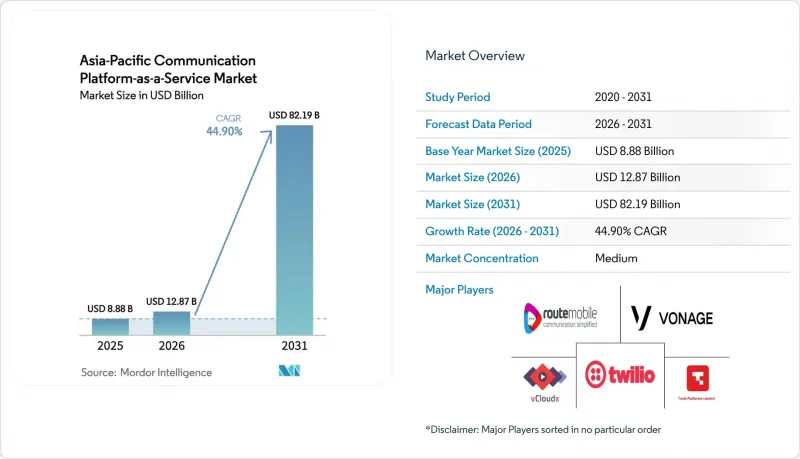
本報告按組織規模(中小企業、大型企業)、終端用戶產業(IT和電信、銀行、金融服務和保險、零售和消費品、其他)、通訊管道(簡訊和RCS、語音、影片、其他)、組件/服務類型(通訊API、語音API、其他)以及地區進行細分。市場預測以美元(USD)為單位。
亞太地區通訊平台即服務 (CPaaS) 市場趨勢與洞察
從中小企業到大型企業,雲端運算正在推動快速的數位轉型。
到2025年,企業將把85%的應用程式遷移到雲端平台,雲端工作負載的激增直接推動了對可與SaaS後端整合的靈活通訊API的需求。預計到2025年,中國雲端支出將成長15%,其中阿里雲、華為雲和騰訊雲佔據國內71%的市場佔有率,它們都將CPaaS附加元件整合到各自的市場產品組合中。中小企業現在不再將通訊視為基礎設施,而是將其視為“代碼”,利用計量收費的API來發送警報、驗證用戶身份並協調客服中心運營。這種低門檻的方法正在推動企業級通訊的廣泛應用,消除了先前限制其普及的資本支出障礙。這種結構性轉變正在使API通訊不再只是輔助功能,而是成為數位體驗架構的核心支柱。
行動優先用戶數量的增加以及 5G 部署帶來的 A2P 流量加速成長。
預計到2025年,亞太地區的智慧型手機普及率將超過78%,而東南亞和大洋洲的5G用戶數量預計到2027年將超過5.7億,這將進一步鞏固「行動優先」的用戶互動習慣。儘管由於身份驗證方式的多樣化,國際動態密碼(OTP)流量正在下降,但營運商正透過進階通訊服務(RCS)和高級通訊格式的商業化來應對這一趨勢。 Sinch和新加坡電信於2024年在新加坡推出首個RCS企業通訊服務,顯示富媒體正在彌補純文字的衰落。隨著頻寬的增加,企業正從靜態簡訊轉向影片片段、對話式商務和應用程式內聊天,這為通訊平台即服務(CPaaS)供應商創造了新的收入來源。
整合和遷移舊有系統的複雜性
三分之二的電信服務供應商表示,與舊有系統的糾纏是採用現代API的最大障礙,到2024年,技術債將佔其IT預算的56%。日本和韓國的企業由於幾十年來累積了專有系統,在運作CPaaS模組之前,面臨複雜的資料映射和安全管治挑戰。在新加坡,81%的企業正在尋找能夠管理多重雲端遷移並與舊有系統共存的供應商。因此,企業越來越傾向於選擇包含預先建置連接器、安全邊緣節點和諮詢服務的端到端平台。
細分市場分析
到2025年,大型企業憑藉其複雜的整合、強大的安全層和跨國企業發展,將佔據亞太地區CPaaS市場61.30%的佔有率。同時,預計到2031年,中小企業(SME)的複合年成長率將達到45.10%,從而縮小採用率差距。可口可樂歐洲太平洋合作夥伴印尼公司在其Klik Toko應用程式中採用8x8簡訊API,清楚表明即使是頂級品牌也在依靠CPaaS來簡化其B2B分銷流程。可程式通訊成本的降低和低程式碼建構器的普及,使得即使是小規模零售商也能在幾天內(而不是幾個月)實現聊天機器人、支付通知和點擊視訊功能。供應商現在提供分級套餐,可以從入門套件擴展到企業叢集,確保入門級客戶不會隨著使用量的增加而流失。這種民主化擴大了潛在基本客群,但也加劇了與價格敏感型中小企業之間的合約競爭。
至2025年,銀行、金融服務和保險(BFSI)產業將佔亞太地區CPaaS市場規模的25.10%,反映出動態密碼(OTP)、交易通知和監管通知的廣泛應用。同時,隨著超級應用整合自動化互動結帳、訂單追蹤和退貨處理等功能,電子商務和物流領域預計將在2031年之前以44.80%的複合年成長率加速成長。金融機構優先考慮可信度和合規性,推動了號碼檢驗API和互動式通訊傳遞的普及。相較之下,線上市場需要個人化和快速實驗,因此更青睞具備A/B測試功能和人工智慧聊天創建功能的平台。這種差異迫使CPaaS供應商調整其藍圖:為受監管行業提供高度安全且可審計的模組,為數位商務提供敏捷的客戶體驗工具包。
物流公司正在利用視訊聊天為駕駛者提供支援並解決倉庫問題,而保險公司則在試點語音生物識別以加快理賠處理速度。在醫療保健領域,符合病患資料法規的視訊SDK正被用於將CPaaS擴展到遠距醫療和處方箋提醒等領域。這些多樣化的應用案例凸顯出,產業專屬範本而非通用API,如今已成為供應商的關鍵差異化優勢。能夠提供PCI-DSS、HIPAA合規性以及本地電子簽章功能等監管合規工具的供應商,隨著各行業向全通路互動模式的整合,正在獲得更穩定的收入。
其他好處
- Excel格式的市場預測(ME)表
- 3個月的分析師支持
目錄
第1章:引言
- 研究假設和市場定義
- 調查範圍
第2章:調查方法
第3章執行摘要
第4章 市場狀況
- 市場概覽
- 市場促進因素
- 從中小企業到大型企業,雲端運算正在推動快速的數位轉型。
- 行動優先用戶數量的增加以及 5G 部署帶來的 A2P 流量加速成長。
- 全通路客戶體驗的擴展趨勢以及基於CPaaS的客戶體驗現代化。
- 電信業者支援的開放式閘道器 API 可實現網路可程式性。
- 嵌入式金融的融合正在推動金融科技和超級應用中CPaaS的普及。
- 透過整合生成式人工智慧的 API 擴展 CPaaS 服務陣容和 ARPU。
- 市場限制因素
- 整合和遷移舊有系統的複雜性
- 資料隱私和跨境合規框架的碎片化
- 簡訊電信費用的區域差異和電信業者的合併
- 因簡訊詐騙而增加AIT/推廣主動流量過濾
- 供應鏈分析
- 監理情勢
- 技術展望
- 波特五力分析
第5章 市場規模與成長預測
- 按組織規模
- 中小企業
- 大公司
- 按最終用戶行業分類
- 資訊科技/通訊
- BFSI
- 零售和消費品
- 醫療保健和生命科學
- 電子商務與物流
- 其他
- 透過通訊管道
- 簡訊和RCS
- 聲音的
- 影片
- 電子郵件和推播通知
- 應用程式內/OTT聊天
- 按組件/服務類型
- 通訊API
- 語音 API
- 影片API 和 SDK
- 多通路與工作流程編配平台
- 專業服務及託管服務
- 按地區
- 中國
- 印度
- 日本
- 韓國
- 東南亞
- 澳洲和紐西蘭
- 亞太其他地區
第6章 競爭情勢
- 市場集中度
- 策略舉措和趨勢
- 市佔率分析
- 公司簡介
- Twilio Inc.
- Vonage Holdings Corp.(愛立信子公司)
- Tanla Platforms Ltd.
- Route Mobile Ltd.
- Sinch AB
- Infobip Ltd.
- Kaleyra SpA(Tata Communications)
- VCloudX Pte Ltd.(EnableX)
- 8x8 Inc.
- MNF Group Ltd.
- MessageBird BV
- Plivo Inc.
- Telnyx LLC
- Bandwidth Inc.
- ACL Mobile(Sinch)
- Alibaba Cloud
- Tencent Cloud
- Huawei Cloud
- AsiaInfo Technologies Ltd.
第7章 市場機會與未來展望
According to Mordor Intelligence, the Asia-Pacific cPaaS market size in 2026 is estimated at USD 12.87 billion, growing from 2025 value of USD 8.88 billion with 2031 projections showing USD 82.19 billion, growing at 44.90% CAGR over 2026-2031.
This report is Segmented by Organization Size (SMEs, Large Enterprises), End-User Industry (IT & Telecom, BFSI, Retail and Consumer Goods, and More), Communication Channel (SMS and RCS, Voice, Video, and More), Component (Messaging APIs, Voice APIs, and More), and Geography. The Market Forecasts are Provided in Terms of Value (USD).
Asia-Pacific Communication Platform-as-a-Service Market Trends and Insights
Rapid Cloud-Led Digital Transformation Across SMEs and Large Enterprises
Enterprises have migrated 85% of applications to cloud platforms by 2025, and this lift in cloud workloads directly fuels demand for flexible communication APIs that plug into SaaS back-ends. China's cloud spending is rising 15% in 2025, with Alibaba Cloud, Huawei Cloud, and Tencent Cloud jointly delivering 71% domestic share, each embedding CPaaS add-ons into their marketplace portfolios. SMEs now regard communications as code rather than infrastructure, using pay-as-you-go APIs to send alerts, authenticate users, and orchestrate contact-center tasks. These low-barrier entry points democratize enterprise-grade communications, erasing the CapEx hurdle that historically limited adoption. The structural shift positions API communications as a core pillar of digital-experience architecture, not an auxiliary bolt-on.
Mobile-First Population and 5G Rollout Accelerating A2P Traffic
Asia-Pacific's smartphone penetration surpasses 78% in 2025, and 5G subscriptions in Southeast Asia and Oceania are on course to exceed 570 million by 2027, reinforcing mobile-first engagement habits. Although international one-time-password traffic is set to decline as authentication alternatives emerge, operators counter by commercializing Rich Communication Services and advanced messaging formats. Sinch and Singtel's 2024 launch of Singapore's first RCS Business Messaging service showcases how richer media will offset plain-text erosion. As bandwidth improves, enterprises pivot from static SMS to video snippets, conversational commerce, and in-app chat, unlocking new monetization streams for CPaaS vendors.
Legacy Integration and Migration Complexity
Two-thirds of communication-service providers cite legacy system entanglement as a top barrier to rolling out modern APIs, and technology debt reached 56% of IT budgets in 2024. Japanese and Korean enterprises that accrued proprietary systems over decades face complex data-mapping and security-governance tasks before activating CPaaS modules. In Singapore, 81% of companies seek vendors capable of managing multi-cloud migration and legacy coexistence The resulting preference is for end-to-end platforms that bundle pre-built connectors, secure edge nodes, and consulting services.
Other drivers and restraints analyzed in the detailed report include:
- Growing Omnichannel CX and CPaaS-Based CX Modernization Wave
- Telco-Backed Open-Gateway APIs Unlocking Network Programmability
- Fragmented Data-Privacy and Cross-Border Compliance Landscape
For complete list of drivers and restraints, kindly check the Table Of Contents.
Segment Analysis
Large enterprises captured 61.30% of Asia-Pacific CPaaS market share in 2025, leveraging complex integrations, heavy security layers, and multi-country footprints. SMEs, however, are growing at a 45.10% CAGR to 2031, narrowing the historical adoption gap. Coca-Cola Europacific Partners Indonesia's use of 8x8 SMS APIs within its Klik Toko app underscores how even blue-chip brands rely on CPaaS to streamline B2B distribution. The falling cost of programmable communications and the availability of low-code builders let smaller retailers embed chatbots, payment alerts, and click-to-video support in days rather than months. Providers now launch tiered packages that scale from starter kits to enterprise clusters, ensuring that entry-level customers do not churn as usage expands. This democratization both enlarges the total addressable base and intensifies competition for price-sensitive SME contracts.
BFSI held 25.10% of the Asia-Pacific CPaaS market size in 2025, reflecting widespread use of OTP, transaction alerts, and regulatory notices. Yet e-commerce and logistics is forecast to accelerate at a 44.80% CAGR through 2031 as super-apps embed conversational checkout, order tracking, and returns automation. Financial institutions prioritize reliability and compliance, driving uptake of number-verification APIs and encrypted messaging. In contrast, online marketplaces demand personalization and rapid experimentation, favoring platforms that expose A/B testing hooks and AI-powered chat composition. This divergence compels CPaaS vendors to segment roadmaps: highly secure, audit-ready modules for regulated sectors and agile CX toolkits for digital commerce.
Logistics operators adopt video chat for driver support and warehouse troubleshooting, while insurers test voice-biometric authentication to speed claims processing. Healthcare extends CPaaS into tele-consultation and prescription reminders, leveraging video SDKs compliant with patient-data laws. These diversified use cases emphasize that verticalized templates, not generic APIs, now determine vendor differentiation. Providers able to package regulatory accelerators-PCI-DSS, HIPAA equivalence, local e-signature-capture stickier revenue as industries converge on omnichannel engagement norms
Complete Report Scope:
- By Organization Size
- Small and Medium-sized Enterprises (SMEs)
- Large Enterprises
- By End-User Industry
- IT and Telecom
- BFSI
- Retail and Consumer Goods
- Healthcare and Life Sciences
- E-commerce and Logistics
- Others
- By Communication Channel
- SMS and RCS
- Voice
- Video
- Email and Push
- In-app / OTT Chat
- By Component / Service Type
- Messaging APIs
- Voice APIs
- Video APIs and SDKs
- Multi-channel and Workflow Orchestration Platforms
- Professional and Managed Services
- By Geography
- China
- India
- Japan
- South Korea
- Southeast Asia
- Australia and New Zealand
- Rest of Asia-Pacific
List of Companies Covered in this Report:
- Twilio Inc.
- Vonage Holdings Corp. (an Ericsson company)
- Tanla Platforms Ltd.
- Route Mobile Ltd.
- Sinch AB
- Infobip Ltd.
- Kaleyra S.p.A. (Tata Communications)
- VCloudX Pte Ltd. (EnableX)
- 8x8 Inc.
- MNF Group Ltd.
- MessageBird B.V.
- Plivo Inc.
- Telnyx LLC
- Bandwidth Inc.
- ACL Mobile (Sinch)
- Alibaba Cloud
- Tencent Cloud
- Huawei Cloud
- AsiaInfo Technologies Ltd.
Additional Benefits:
- The market estimate (ME) sheet in Excel format
- 3 months of analyst support
TABLE OF CONTENTS
1 INTRODUCTION
- 1.1 Study Assumptions and Market Definition
- 1.2 Scope of the Study
2 RESEARCH METHODOLOGY
3 EXECUTIVE SUMMARY
4 MARKET LANDSCAPE
- 4.1 Market Overview
- 4.2 Market Drivers
- 4.2.1 Rapid cloud-led digital transformation across SMEs and large enterprises
- 4.2.2 Mobile-first population and 5G rollout accelerating A2P traffic
- 4.2.3 Growing omnichannel CX and CPaaS-based CX modernization wave
- 4.2.4 Telco-backed Open-Gateway APIs unlocking network programmability
- 4.2.5 Embedded-finance integrations driving CPaaS uptake in fintech and super-apps
- 4.2.6 Generative-AI infused APIs expanding CPaaS service mix and ARPU
- 4.3 Market Restraints
- 4.3.1 Legacy integration and migration complexity
- 4.3.2 Fragmented data-privacy and cross-border compliance landscape
- 4.3.3 Volatile regional SMS termination pricing and carrier consolidation
- 4.3.4 Rising AIT/SMS-fraud prompting aggressive traffic filtering
- 4.4 Supply-Chain Analysis
- 4.5 Regulatory Landscape
- 4.6 Technological Outlook
- 4.7 Porter's Five Forces Analysis
- 4.7.1 Bargaining Power of Suppliers
- 4.7.2 Bargaining Power of Buyers
- 4.7.3 Threat of New Entrants
- 4.7.4 Threat of Substitutes
- 4.7.5 Intensity of Competitive Rivalry
5 MARKET SIZE AND GROWTH FORECASTS (VALUE)
- 5.1 By Organization Size
- 5.1.1 Small and Medium-sized Enterprises (SMEs)
- 5.1.2 Large Enterprises
- 5.2 By End-User Industry
- 5.2.1 IT and Telecom
- 5.2.2 BFSI
- 5.2.3 Retail and Consumer Goods
- 5.2.4 Healthcare and Life Sciences
- 5.2.5 E-commerce and Logistics
- 5.2.6 Others
- 5.3 By Communication Channel
- 5.3.1 SMS and RCS
- 5.3.2 Voice
- 5.3.3 Video
- 5.3.4 Email and Push
- 5.3.5 In-app / OTT Chat
- 5.4 By Component / Service Type
- 5.4.1 Messaging APIs
- 5.4.2 Voice APIs
- 5.4.3 Video APIs and SDKs
- 5.4.4 Multi-channel and Workflow Orchestration Platforms
- 5.4.5 Professional and Managed Services
- 5.5 By Geography
- 5.5.1 China
- 5.5.2 India
- 5.5.3 Japan
- 5.5.4 South Korea
- 5.5.5 Southeast Asia
- 5.5.6 Australia and New Zealand
- 5.5.7 Rest of Asia-Pacific
6 COMPETITIVE LANDSCAPE
- 6.1 Market Concentration
- 6.2 Strategic Moves and Developments
- 6.3 Market Share Analysis
- 6.4 Company Profiles (includes Global level Overview, Market level overview, Core Segments, Financials as available, Strategic Information, Market Rank/Share for key companies, Products and Services, and Recent Developments)
- 6.4.1 Twilio Inc.
- 6.4.2 Vonage Holdings Corp. (an Ericsson company)
- 6.4.3 Tanla Platforms Ltd.
- 6.4.4 Route Mobile Ltd.
- 6.4.5 Sinch AB
- 6.4.6 Infobip Ltd.
- 6.4.7 Kaleyra S.p.A. (Tata Communications)
- 6.4.8 VCloudX Pte Ltd. (EnableX)
- 6.4.9 8x8 Inc.
- 6.4.10 MNF Group Ltd.
- 6.4.11 MessageBird B.V.
- 6.4.12 Plivo Inc.
- 6.4.13 Telnyx LLC
- 6.4.14 Bandwidth Inc.
- 6.4.15 ACL Mobile (Sinch)
- 6.4.16 Alibaba Cloud
- 6.4.17 Tencent Cloud
- 6.4.18 Huawei Cloud
- 6.4.19 AsiaInfo Technologies Ltd.
7 MARKET OPPORTUNITIES AND FUTURE OUTLOOK
- 7.1 White-space and Unmet-need Assessment

 CPaaS(通訊平台即服務):市場佔有率分析、產業趨勢與統計資料、成長預測(2026-2031 年)
 通訊平台即服務 (CPaaS) 市場:全球市場預測,2026-2032 年
 通訊平台即服務 (CPaaS) 市場規模、佔有率和成長分析:按服務類型、企業規模、應用領域、最終用戶產業、銷售管道和地區分類-2026-2033 年產業預測
 通訊平台即服務 (CPaaS) 市場:按最終用戶產業和地區分類
 2026年全球通訊平台(MaaP)市場報告
 通訊平台即服務 (CPaaS) 市場預測至 2034 年—按組件、通訊管道、部署模式、企業規模、應用程式、最終用戶和地區分類的全球分析電信平台即服務 (TPaaS) 市場預測至 2034 年—按組件、部署模式、平台類型、企業用例、最終用戶和區域分類的全球分析
 通訊平台即服務 (CPaaS) 市場規模、佔有率、趨勢和預測:按組件、企業規模、行業和地區分類,2026-2034 年2026年全球通訊平台即服務(CPaaS)市場報告印度通訊平台即服務 (CPaaS) 市場佔有率分析、行業趨勢、統計數據和成長預測 (2026-2031)