


 |
市場調查報告書
商品編碼
2125256
亞太地區專業視聽系統:市場佔有率分析、產業趨勢與統計及成長預測(2026-2031)Asia-Pacific Professional Audio-Visual Systems - Market Share Analysis, Industry Trends & Statistics, Growth Forecasts (2026 - 2031) |
||||||

※ 本網頁內容可能與最新版本有所差異。詳細情況請與我們聯繫。
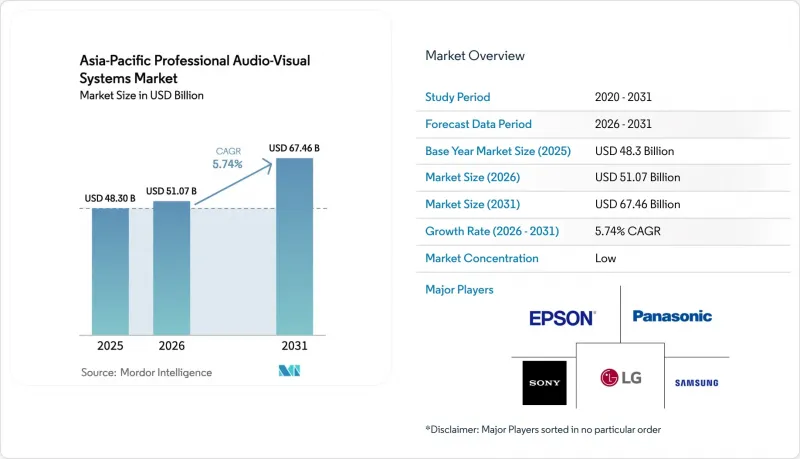
根據 Mordor Intelligence 預測,亞太地區專業視聽系統市場規模將從 2025 年的 483 億美元成長到 2026 年的 510.7 億美元,然後在 2031 年達到 674.6 億美元,2026 年至 2031 年的複合年成長率為 5.74%。
本報告按類型(拍攝及製作設備、其他)、組件(音訊設備、顯示器及投影系統、其他)、終端用戶產業(企業、場館及活動、零售、教育、其他)及地區(中國、日本、印度、韓國、東南亞及其他亞太地區)進行細分。市場預測以美元計價。
亞太地區專業視聽系統市場趨勢與洞察。
混合辦公環境中對雲端原生統一通訊與協作套件的需求
亞太地區專業影音系統市場的企業正逐步採用微軟Teams Rooms及類似平台,迫使整合商提供包含攝影機、麥克風、互動式顯示器和人工智慧音訊處理功能的承包解決方案。空間音訊功能和自動取景功能使遠距員工更輕鬆地參與會議,這對於在中國和日本管理跨境團隊的跨國公司而言至關重要。整合的音訊視訊和IT網路還能簡化管理服務,降低設施管理人員的現場回應成本,並透過電力消耗設備調度幫助企業實現內部碳減排目標。
體驗式零售中數位電子看板網路的擴展
互動式LED幕牆和8K電視牆正在改變旗艦店的面貌,區域零售商正利用大型顯示器將店內購物與社交電商互動連接起來。亞太地區的專業視聽系統市場受益於更低的像素間距價格以及高效能微型LED模組的出現,這些模組在滿足永續性法規的同時,亮度也毫不遜色。疫情後的安全訊息正在加速顯示器的普及,內容管理軟體現在整合了人體感應器,可以觸發即時視覺引導——新加坡和首爾的零售商正在實施這項功能,以符合當地的衛生法規。
複雜的自動駕駛專案會帶來高昂的營運和合規成本。
整合解決方案融合了影像、音訊、控制和網路安全措施,導致設計工作量和專業人員的人事費用增加,尤其是在主要都市區以外的地區。人才培養體系無法滿足需求。亞太地區擁有高級軟體開發視訊工程師 (SDVoE) 認證的工程師不足 3000 人,迫使企業依賴自由工作者,而這些自由工作者可能無法在整個保固期內留任。雖然「影音即服務 (AVaaS)」合約將資本支出 (Capex) 轉為營運支出 (OpEx),但其中包含與運轉率和資料保護審計掛鉤的服務等級協定 (SLA) 違約罰款,這使得中小型整合商採取謹慎的財務策略。
細分市場分析
串流媒體、儲存和分發佔據亞太地區專業視聽系統市場35.15%的佔有率,凸顯了其作為遠端協作和直接面對消費者娛樂的基礎地位。 5G專用網路在工廠的普及進一步加速了雲端閘道器的採用,這些閘道器能夠在不到一秒的時間內捕獲、轉碼和傳輸4K內容,從而無需現場人員即可進行遠端品質保證審核。 「拍攝與製作設備」細分市場預計將以6.62%的複合年成長率成長,市場蓬勃發展主要得益於網紅經濟的興起以及價格親民的無反相機與人工智慧自動追蹤三腳架的普及。傳統視訊投影機在演講廳和飯店宴會廳仍然發揮著至關重要的作用,這些場所需要亮度高、無需燈泡且能夠全天候運作且維護量極低的設備。
第二代邊緣編碼器能以一半的位元率壓縮HEVC視訊串流,進而降低遠端教育供應商的頻寬成本。託管服務供應商正將這些編碼器與內容傳遞網路(CDN)訂閱服務捆綁銷售,推動亞太地區專業視聽系統市場從硬體銷售模式轉向持續收入模式。實驗性全像顯示器已出現在手術規劃室中,但大多數公司仍在研發預算範圍內進行試點項目,而非進行大規模推廣。
其他好處
- Excel格式的市場預測(ME)表
- 3個月的分析師支持
目錄
第1章:引言
- 研究假設和市場定義
- 調查範圍
第2章:調查方法
第3章執行摘要
第4章 市場狀況
- 市場概覽
- 市場促進因素
- 混合辦公環境中對雲端原生統一通訊與協作套件的需求
- 體驗式零售中數位電子看板網路的擴展
- 新興亞洲國家政府主導的「智慧教室」投資
- 實況活動的復甦正在加速舞台租賃搭建成本的增加。
- 利用5G實現遠端製作和AVoIP工作流程
- 對節能型影像設備履行碳中和採購義務。
- 市場限制因素
- 複雜的自動駕駛專案會帶來高昂的營運和合規成本。
- 晶片組和光學元件持續面臨供應瓶頸
- 亞洲二線城市合格影音技術人員短缺
- 碳邊境關稅會增加出口產品的物料清單成本。
- 宏觀經濟因素的影響
- 產業價值鏈分析
- 監理情勢
- 技術展望
- 波特五力分析
第5章 市場規模與成長預測
- 按類型
- 拍攝和製作設備
- 視訊投影
- 串流媒體、儲存和分發
- 服務
- 其他
- 按組件
- 音訊設備(麥克風、混音器、擴大器)
- 顯示器和投影系統
- 控制與處理
- 儲存和分發硬體
- 按最終用戶行業分類
- 公司
- 場地和活動
- 零售
- 媒體與娛樂
- 教育
- 政府
- 衛生保健
- 其他終端用戶產業
- 國家
- 中國
- 日本
- 印度
- 韓國
- 東南亞
- 亞太其他地區
第6章 競爭情勢
- 市場集中度
- 策略趨勢
- 市佔率分析
- 公司簡介
- Sony Corporation
- Samsung Electronics
- Panasonic Corporation
- LG Electronics
- Epson
- Barco NV
- Alpine Electronics Inc.
- Kramer Electronics
- Crestron Electronics
- Bose Professional
- Shure Incorporated
- Extron Electronics
- Planar Systems Inc.
- Vega Global
- Elmo
- Guangzhou Baolun Electronic Co.
- Guangzhou DSPPA Audio Co.
- Sennheiser Electronic
第7章 市場機會與未來展望
According to Mordor Intelligence, the Asia-Pacific professional audio-visual system market size is expected to grow from USD 48.3 billion in 2025 to USD 51.07 billion in 2026 and is forecast to reach USD 67.46 billion by 2031 at 5.74% CAGR over 2026-2031.
This report is Segmented by Type (Capture and Production Equipment, and More), Component (Audio Equipment, Display and Projection Systems, and More), End-User Vertical (Corporate, Venues and Events, Retail, Education, and More), and Geography (China, Japan, India, South Korea, South-East Asia, Rest of Asia-Pacific). The Market Forecasts are Provided in Terms of Value (USD).
Asia-Pacific Professional Audio-Visual Systems Market Trends and Insights
Hybrid-workplace demand for cloud-native UC suites
Enterprises across the Asia-Pacific professional audio-visual system market are standardizing on Microsoft Teams Rooms and similar platforms, prompting integrators to deliver turnkey packages that blend cameras, microphones, interactive displays, and AI-driven sound processing. Spatial audio functions and automated framing make meetings more inclusive for distributed employees, a priority for Chinese and Japanese multinationals managing cross-border teams. Converged AV-IT networks also streamline managed services, cutting truck-roll costs for facility managers and helping corporations meet internal carbon-reduction goals through power-optimized device scheduling.
Expansion of digital signage in experiential retail
Interactive LED facades and 8K videowalls are transforming flagship stores, with regional retailers using large-format displays to bridge physical shopping and social-commerce engagement. The Asia-Pacific professional audio-visual system market benefits from falling pixel-pitch pricing and higher-efficiency micro-LED modules that meet sustainability regulations without sacrificing brightness. Post-pandemic safety messaging hastened display roll-outs, and content management software now integrates occupancy sensors to trigger real-time visual prompts, a feature retailers in Singapore and Seoul deploy to comply with local health codes.
High operating and compliance costs of complex AV projects
Integrated solutions now blend video, audio, control, and cybersecurity safeguards, raising design hours and specialist wages, particularly outside primary metro areas. Training pipelines lag demand: fewer than 3,000 Asia-Pacific engineers hold advanced SDVoE certification, prompting firms to rely on freelancers who may not stay through warranty periods. AV-as-a-Service contracts transfer capex to opex but include SLA penalties tied to uptime and data-protection audits, making smaller integrators financially cautious.
Other drivers and restraints analyzed in the detailed report include:
- Government-led "smart classroom" capex
- Live-event rebound lifts rental and staging
- Carbon-border tariffs inflate export BOM costs
For complete list of drivers and restraints, kindly check the Table Of Contents.
Segment Analysis
Streaming Media, Storage, and Distribution holds a 35.15% share of the Asia-Pacific professional audio-visual system market, underlining its role as the backbone for distance collaboration and direct-to-consumer entertainment. The wave of 5G private networks across factories further entrenches cloud gateways that ingest, transcode, and forward 4K content in under a second, unlocking remote quality-assurance reviews without on-site staff. Capture and Production Equipment, projected to clock a 6.62% CAGR, thrives on influencer-economy growth and affordable mirrorless cameras paired with AI auto-tracking tripods. Legacy video projection remains relevant for lecture halls and hotel ballrooms craving bright, lamp-free units able to run 24/7 with minimal maintenance.
Second-generation edge encoders compress HEVC streams at half the bit-rate, shrinking bandwidth fees for distance-learning providers. Managed-service vendors bundle them with content-delivery-network subscriptions, shifting the Asia-Pacific professional audio-visual system market from hardware sales toward recurring revenue models. Experimental holographic displays surface in surgical-planning labs, yet most enterprises still pilot them under research and development budgets rather than mainstream roll-outs.
Complete Report Scope:
- By Type
- Capture and Production Equipment
- Video Projection
- Streaming Media, Storage and Distribution
- Services
- Other Types
- By Component
- Audio Equipment (mics, mixers, amps)
- Display and Projection Systems
- Control and Processing
- Storage and Distribution Hardware
- By End-user Vertical
- Corporate
- Venues and Events
- Retail
- Media and Entertainment
- Education
- Government
- Healthcare
- Other End-user Vertical
- By Country
- China
- Japan
- India
- South Korea
- South-East Asia
- Rest of Asia-Pacific
List of Companies Covered in this Report:
- Sony Corporation
- Samsung Electronics
- Panasonic Corporation
- LG Electronics
- Epson
- Barco NV
- Alpine Electronics Inc.
- Kramer Electronics
- Crestron Electronics
- Bose Professional
- Shure Incorporated
- Extron Electronics
- Planar Systems Inc.
- Vega Global
- Elmo
- Guangzhou Baolun Electronic Co.
- Guangzhou DSPPA Audio Co.
- Sennheiser Electronic
Additional Benefits:
- The market estimate (ME) sheet in Excel format
- 3 months of analyst support
TABLE OF CONTENTS
1 INTRODUCTION
- 1.1 Study Assumptions and Market Definition
- 1.2 Scope of the Study
2 RESEARCH METHODOLOGY
3 EXECUTIVE SUMMARY
4 MARKET LANDSCAPE
- 4.1 Market Overview
- 4.2 Market Drivers
- 4.2.1 Hybrid-Workplace Demand for Cloud-Native UC and C Suites
- 4.2.2 Expansion of Digital Signage Networks in Experiential Retail
- 4.2.3 Government-Led "Smart Classroom" Capex Across Emerging Asia
- 4.2.4 Live-Event Rebound Accelerating Rental and Staging Spend
- 4.2.5 5G-Enabled Remote Production and AVoIP Workflows
- 4.2.6 Carbon-Neutral Procurement Mandates for Energy-Efficient AV
- 4.3 Market Restraints
- 4.3.1 High Operating and Compliance Costs of Complex AV Projects
- 4.3.2 Persistent Chipset and Optical-Component Supply Bottlenecks
- 4.3.3 Shortage of Certified AV Technicians in Tier-2 Asian Cities
- 4.3.4 Carbon-Border Tariffs Inflating Export BOM Costs
- 4.4 Impact of Macroeconomic Factors
- 4.5 Industry Value Chain Analysis
- 4.6 Regulatory Landscape
- 4.7 Technological Outlook
- 4.8 Porter's Five Forces Analysis
- 4.8.1 Threat of New Entrants
- 4.8.2 Bargaining Power of Buyers/Consumers
- 4.8.3 Bargaining Power of Suppliers
- 4.8.4 Threat of Substitute Products
- 4.8.5 Intensity of Competitive Rivalry
5 MARKET SIZE AND GROWTH FORECASTS (VALUE)
- 5.1 By Type
- 5.1.1 Capture and Production Equipment
- 5.1.2 Video Projection
- 5.1.3 Streaming Media, Storage and Distribution
- 5.1.4 Services
- 5.1.5 Other Types
- 5.2 By Component
- 5.2.1 Audio Equipment (mics, mixers, amps)
- 5.2.2 Display and Projection Systems
- 5.2.3 Control and Processing
- 5.2.4 Storage and Distribution Hardware
- 5.3 By End-user Vertical
- 5.3.1 Corporate
- 5.3.2 Venues and Events
- 5.3.3 Retail
- 5.3.4 Media and Entertainment
- 5.3.5 Education
- 5.3.6 Government
- 5.3.7 Healthcare
- 5.3.8 Other End-user Vertical
- 5.4 By Country
- 5.4.1 China
- 5.4.2 Japan
- 5.4.3 India
- 5.4.4 South Korea
- 5.4.5 South-East Asia
- 5.4.6 Rest of Asia-Pacific
6 COMPETITIVE LANDSCAPE
- 6.1 Market Concentration
- 6.2 Strategic Moves
- 6.3 Market Share Analysis
- 6.4 Company Profiles (includes Global-level Overview, Market-level Overview, Core Segments, Financials as available, Strategic Information, Market Rank/Share for key companies, Products and Services, and Recent Developments)
- 6.4.1 Sony Corporation
- 6.4.2 Samsung Electronics
- 6.4.3 Panasonic Corporation
- 6.4.4 LG Electronics
- 6.4.5 Epson
- 6.4.6 Barco NV
- 6.4.7 Alpine Electronics Inc.
- 6.4.8 Kramer Electronics
- 6.4.9 Crestron Electronics
- 6.4.10 Bose Professional
- 6.4.11 Shure Incorporated
- 6.4.12 Extron Electronics
- 6.4.13 Planar Systems Inc.
- 6.4.14 Vega Global
- 6.4.15 Elmo
- 6.4.16 Guangzhou Baolun Electronic Co.
- 6.4.17 Guangzhou DSPPA Audio Co.
- 6.4.18 Sennheiser Electronic
7 MARKET OPPORTUNITIES AND FUTURE OUTLOOK
- 7.1 White-Space and Unmet-Need Assessment

 專業音訊:市場佔有率分析、產業趨勢與統計、成長預測(2026-2031)專業視聽系統:市場佔有率分析、產業趨勢與統計、成長預測(2026-2031)
 2026-2030 年全球專業視音頻市場
 2026年網際網路協定媒體體驗(IPMX)專業影音(AV)串流媒體全球市場報告
 全球專業影音市場規模、佔有率、趨勢和成長分析報告(2026-2034)
 專業音影片解決方案市場規模、佔有率和成長分析:按產品類型、技術、應用、最終用戶、分銷管道和地區分類-2026-2033年產業預測
 KVM 和專業影音市場:按類型、最終用戶和地區分類2026 年專業影像(Pro AV) 全球市場報告2026年高等教育專業視聽(Pro AV)全球市場報告2026年全球專業影像(AV)系統市場報告