


 |
市場調查報告書
商品編碼
2123749
專業視聽系統:市場佔有率分析、產業趨勢與統計、成長預測(2026-2031)Professional Audio Visual Systems - Market Share Analysis, Industry Trends & Statistics, Growth Forecasts (2026 - 2031) |
||||||

※ 本網頁內容可能與最新版本有所差異。詳細情況請與我們聯繫。
2025 年專業視聽系統市場價值為 2951.8 億美元,預計到 2031 年將達到 3827.4 億美元,而 2026 年為 3082.3 億美元,預測期(2026-2031 年)複合年成長率為 4.42%。
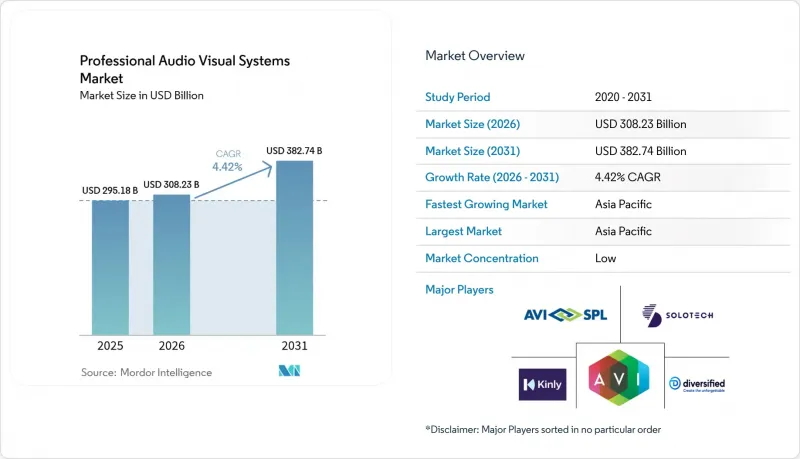
本報告按類型(拍攝和製作設備、視訊投影等)、組件(音訊設備、顯示和投影系統、控制和處理等)、最終用戶行業(企業、場館和活動、零售等)以及地區(北美、南美、歐洲、亞太等)進行細分。市場預測以美元計價。
全球專業影音系統市場趨勢與洞察
混合式辦公室和混合式學習模式的興起
企業支出已從升級單一會議室轉向建構全公司範圍的生態系統,旨在為現場和遠端員工提供統一的體驗。如今的投資包括可與主流協作平台整合的空間音訊陣列、多攝影機追蹤和自動內容取景。教育產業也呈現類似的趨勢,需要講座錄製、校園直播和設備管理來支持混合式學習。隨著企業傾向於選擇可整合到現有IT策略中的認證、完全託管的解決方案,專業影音系統市場正從中受益。員工體驗的基準測試正在推動快速的更新週期,並促成多年採購藍圖的發展。因此,平台和雲端控制面板之間的互通性正成為供應商之間的關鍵差異化因素。
在體驗式零售和公共設施中安裝LED設備
零售連鎖店正將門市改造為身臨其境型媒體空間,利用小間距LED顯示器講述品牌故事、指引方向並投放即時促銷訊息。 Scheels斥資1100萬美元在全美範圍內部署指示牌,清晰地展現了這一趨勢的資本密集度和規模。類似的顯示器也被應用於公共場所和交通樞紐,用於管理客流和傳遞安全訊息。集中式內容管理系統使營運商能夠跨區域同步宣傳活動,並根據當地語言和優惠資訊進行客製化。隨著顯示器硬體整合分析功能,能夠將資料傳輸到零售商的客戶關係管理(CRM)工具中,專業視聽系統市場也因此蓬勃發展。儘管零售支出有週期性波動,但由於人們對客流量成長的預期不斷提高,LED顯示器的需求依然強勁。
高昂的總擁有成本和合規成本
關於無障礙、網路安全和能源的法規從根本上改變了採購成本的計算方式。美國聯邦通訊委員會 (FCC) 的規定將於 2027 年 1 月生效,強制要求視訊會議平台提供字幕、手語支援和無障礙使用者介面。同時,能源標準要求製造商使用更有效率的組件重新設計機殼和電源。合規性要求進行測試、認證和頻繁的軟體更新,這使得複雜部署的生命週期成本翻倍。各組織低估了持續培訓、監控和審計文件的負擔,導致預算超支,並阻礙了商用視聽系統市場的短期訂單。
細分市場分析
在專業視聽系統市場中,「錄製和製作設備」預計到2025年將佔據30.25%的市場佔有率,這凸顯了市場對高品質來源內容的日益重視。隨著企業和教育機構的工作室複製廣播工作流程,攝影系統、雲台控制器和製作切換台等產品正向價格較低的市場拓展。包含硬體、軟體和遠端支援的訂閱模式正在提升供應商的年度經常性收入。成長最快的細分市場「串流媒體、儲存和分發」的複合年成長率(CAGR)為5.33%,反映了市場對可擴展雲端編碼器和隨選節目庫的需求。邊緣快取正在降低全球分散式用戶的延遲,使媒體伺服器成為討論專業視聽系統市場規模的關鍵節點。
傳統視訊投影在禮堂和教堂等場所仍然十分重要,但在高亮度環境下,其市場佔有率正被直視式LED投影機蠶食。隨著客戶將生命週期管理外包,設計、監控和故障維修等服務合約的需求日益成長。全像顯示和空間運算等新興技術雖然仍處於小眾領域,但正吸引高階設施的創新預算。在所有細分領域,價值創造正從孤立的硬體轉向能夠實現分析和內容工作流程貨幣化的整合生態系統。
區域分析
亞太地區以29.55%的市佔率佔最大佔有率,並以5.78%的複合年成長率領先業界,主要得益於交通運輸、旅館和智慧城市等領域的大型企劃。中國、印度和印尼等國的數位化政策正在推動校園網路和身臨其境型教室的投資。本地製造群正在縮短前置作業時間並降低成本,加速下一代LED和人工智慧處理技術的應用。日本和韓國正透過微型LED構裝和語音人工智慧領域的研發突破來提升產能,並增強出口競爭力。成熟的系統整合商正在建立合資企業,以應對區域採購和語言多樣性問題,這項策略正在提升其在專業視聽系統市場的佔有率。
在北美,受無障礙法規和混合辦公模式的推動,設備升級正在穩步推進。美國聯邦通訊委員會(FCC)的字幕規則導致人工智慧轉錄引擎和自適應使用者介面元素的需求激增。各公司正在重新審視其3-5年的設備升級週期,以平衡辦公室辦公和遠距辦公體驗。在加拿大,對廣播工作室和遠端教育基礎設施的投資正在推動市場成長。在墨西哥,基於IP的影音技術正被用於協調加工出口區的跨境供應鏈,該地區在專業影音系統市場繼續佔據至關重要的地位。
在歐洲,由於永續性法規強制要求降低能耗和採用循環經濟設計,市場正在不斷擴張。在德國和法國,被動式冷卻機殼和可自動切換至低功耗模式的韌體正被優先考慮。在英國,人工智慧分析技術在交通樞紐客流密度管理的應用正在加速。在東歐國家,重建資金正被用於升級社區劇院和當地大學的設施。泛歐資料隱私立法使得安全的雲端管理成為供應商之間的關鍵競爭優勢,並影響整個專業視聽系統市場的採購政策。
其他好處:
- Excel格式的市場預測(ME)表
- 3個月的分析師支持
目錄
第1章:引言
- 研究假設和市場定義
- 調查範圍
第2章:調查方法
第3章執行摘要
第4章 市場狀況
- 市場概覽
- 宏觀經濟因素的影響
- 市場促進因素
- 混合型工作方式和學習方法正在迅速增加。
- 在體驗式零售和公共設施中引入LED技術。
- 疫情過後,線下活動和線上線下混合活動都呈現復甦跡象。
- 向基於IP的音影片架構過渡
- 人工智慧驅動的即時無障礙解決方案
- 強制對節能型影音設備進行脫碳改造
- 市場限制因素
- 高昂的總擁有成本和合規成本
- 半導體和顯示器供應鏈的波動性
- 連網音影音設備的網路保險費
- 技術純熟勞工短缺和工資上漲
- 產業供應鏈分析
- 監理情勢
- 技術展望
- 宏觀經濟因素對市場的影響
- 波特五力分析
第5章 市場規模與成長預測
- 按類型
- 收集和生產設備
- 視訊投影
- 串流媒體、儲存和分發
- 服務
- 其他類型
- 按組件
- 音訊設備(麥克風、混音器、擴大機)
- 顯示和投影系統
- 控制與處理
- 儲存和分發硬體
- 按最終用戶行業分類
- 公司
- 場地和活動
- 零售
- 媒體與娛樂
- 教育
- 政府
- 衛生保健
- 其他終端用戶產業
- 按地區
- 北美洲
- 美國
- 加拿大
- 墨西哥
- 南美洲
- 巴西
- 阿根廷
- 其他南美國家
- 歐洲
- 德國
- 英國
- 法國
- 其他歐洲國家
- 亞太地區
- 中國
- 日本
- 印度
- 韓國
- 東南亞
- 其他亞太國家
- 中東和非洲
- 中東
- 沙烏地阿拉伯
- 阿拉伯聯合大公國
- 其他中東國家
- 非洲
- 南非
- 埃及
- 其他非洲國家
- 中東
- 北美洲
第6章 競爭情勢
- 市場集中度
- 策略趨勢
- 市佔率分析
- 公司簡介
- AVI-SPL Inc.
- Diversified
- AVI Systems Inc.
- Ford Audio-Video LLC
- CCS Presentation Systems Inc.
- Solutionz Inc.
- Electrosonic Group
- Solotech Inc.
- Conference Technologies Inc.
- Vistacom Inc.
- Kinly BV
- Vega Global
- IDNS Ltd.
- Ricoh USA Inc.
- Midwich Group plc
- Wesco Anixter Inc.
- Audinate Group Ltd.
- NMK Electronics Enterprises
- Qvest Group
- ACTLD SA
- Almo Professional A/V(Exertis Almo)
- ClearOne Inc.
- Kramer Electronics Ltd.
第7章 市場機會與未來展望
According to Mordor Intelligence, the professional audio visual system market size was valued at USD 295.18 billion in 2025 and estimated to grow from USD 308.23 billion in 2026 to reach USD 382.74 billion by 2031, at a CAGR of 4.42% during the forecast period (2026-2031).
This report is Segmented by Type (Capture and Production Equipment, Video Projection, and More), Component (Audio Equipment, Display and Projection Systems, Control and Processing, and More), End-User Vertical (Corporate, Venues and Events, Retail, and More), and Geography (North America, South America, Europe, Asia-Pacific, and More). The Market Forecasts are Provided in Terms of Value (USD).
Global Professional Audio Visual Systems Market Trends and Insights
Hybrid Work and Learning Surge
Corporate spending shifted from isolated conference-room upgrades to enterprise-wide ecosystems that deliver equitable experiences for on-site and remote staff. Investments span spatial audio arrays, multi-camera tracking, and automated content framing that integrate with leading collaboration platforms. Education is mirroring this demand with lecture capture, campus streaming, and device management that support blended classrooms. The professional audio visual system market benefits because enterprises prefer certified, fully managed solutions that plug into existing IT policies. Rapid refresh cycles are fueled by employee experience benchmarks, leading to multiyear procurement roadmaps. As a result, platform interoperability and cloud dashboards have emerged as critical vendor differentiators.
Experiential Retail and Public-Venue LED Rollouts
Retail chains are turning stores into immersive media venues where fine-pitch LEDs deliver branded storytelling, wayfinding, and real-time promotions. Scheels' USD 11 million national signage rollout underscores capital intensity and scale. Public buildings and transport hubs are installing similar displays to manage passenger flow and safety messaging. Central content management lets operators synchronize campaigns across regions while tailoring local language and offers. The professional audio visual system market is bolstered because display hardware now ships with embedded analytics that feed retailers' CRM tools. Rising foot-traffic expectations keep LED demand elevated despite cyclical retail spending.
High TCO and Compliance Costs
Accessibility, cybersecurity, and energy mandates have transformed procurement math. The FCC rules, effective January 2027, require captioning, sign-language support, and accessible user interfaces within video-conferencing platforms. Parallel energy standards push manufacturers to redesign enclosures and power supplies with higher-efficiency components. Compliance adds testing, certification, and frequent software updates, doubling lifecycle spending for complex deployments. Organizations underestimate ongoing training, monitoring, and audit documentation, leading to budget overruns that temper near-term orders in the professional audio visual system market.
Other drivers and restraints analyzed in the detailed report include:
- Live and Hybrid Events Rebound Post-Pandemic
- Migration to AV-over-IP Architectures
- Skilled-Labor Shortages and Wage Inflation
For complete list of drivers and restraints, kindly check the Table Of Contents.
Segment Analysis
The professional audio visual system market recorded Capture and Production Equipment at a leading 30.25% share in 2025, underscoring the premium placed on high-quality source content. Camera systems, PTZ controllers, and production switchers move down-market as corporate and educational studios replicate broadcast workflows. Bundled subscription models that wrap hardware, software, and remote support increase annual recurring revenue for vendors. Streaming Media, Storage, and Distribution, the fastest-growing slice at a 5.33% CAGR, reflects demand for scalable cloud encoders and on-demand content libraries. Edge caching reduces latency for globally dispersed viewers, turning media servers into strategic nodes in the professional audio visual system market size discussions.
Traditional Video Projection retains relevance for auditoriums and houses of worship but yields share to direct-view LED in high-brightness settings. Services, including design, monitoring, and break-fix contracts, climb as customers outsource lifecycle management. Emerging types such as holographic displays and spatial computing remain niche yet capture innovation budgets for premium venues. Every sub-segment illustrates a shift where value creation migrates from isolated hardware to integrated ecosystems that monetize analytics and content workflows.
Complete Report Scope:
- By Type
- Capture and Production Equipment
- Video Projection
- Streaming Media, Storage and Distribution
- Services
- Other Types
- By Component
- Audio Equipment (mics, mixers, amps)
- Display and Projection Systems
- Control and Processing
- Storage and Distribution Hardware
- By End-user Vertical
- Corporate
- Venues and Events
- Retail
- Media and Entertainment
- Education
- Government
- Healthcare
- Other End-user Verticals
- By Geography
- North America
- United States
- Canada
- Mexico
- South America
- Brazil
- Argentina
- Rest of South America
- Europe
- Germany
- United Kingdom
- France
- Rest of Europe
- Asia-Pacific
- China
- Japan
- India
- South Korea
- South-East Asia
- Rest of Asia-Pacific
- Middle East and Africa
- Middle East
- Saudi Arabia
- United Arab Emirates
- Rest of Middle East
- Africa
- South Africa
- Egypt
- Rest of Africa
- Middle East
- North America
Geography Analysis
Asia-Pacific holds the largest 29.55% share and a leading 5.78% CAGR, propelled by mega-projects in transportation, hospitality, and smart cities. National digitization policies funnel funds into campus networks and immersive classrooms in China, India, and Indonesia. Local manufacturing clusters compress lead times and cost structures, allowing rapid adoption of next-generation LED and AI processing. Japan and South Korea supplement volume with research and development breakthroughs in micro-LED packaging and voice AI, enhancing export competitiveness. Mature integrators forge joint ventures to navigate regional procurement and language diversity, a tactic that expands the professional audio visual system market footprint.
North America posts steady upgrades anchored by accessibility mandates and hybrid work normalization. The FCC captioning rule multiplies demand for AI transcription engines and adaptive UI elements. Enterprises revisit refresh cycles every three to five years to maintain parity between in-office and remote experiences. Canada boosts market momentum through investments in broadcast studios and distance-learning infrastructure across dispersed territories. Mexico's maquiladora centers adopt AV-over-IP to coordinate cross-border supply chains, keeping the region integral to the professional audio visual system market.
Europe advances on the back of sustainability legislation requiring lower energy consumption and circular-economy design. Germany and France prioritize passive cooling enclosures and firmware that schedules low-power modes. The United Kingdom accelerates the adoption of AI analytics in transport hubs to manage passenger density. Eastern European countries allocate recovery funds to upgrade civic theatres and regional universities. Pan-European data-privacy laws elevate secure cloud control as a competitive edge among vendors, shaping procurement policies across the professional audio visual system market.
- AVI-SPL Inc.
- Diversified
- AVI Systems Inc.
- Ford Audio-Video LLC
- CCS Presentation Systems Inc.
- Solutionz Inc.
- Electrosonic Group
- Solotech Inc.
- Conference Technologies Inc.
- Vistacom Inc.
- Kinly BV
- Vega Global
- IDNS Ltd.
- Ricoh USA Inc.
- Midwich Group plc
- Wesco Anixter Inc.
- Audinate Group Ltd.
- NMK Electronics Enterprises
- Qvest Group
- ACTLD SA
- Almo Professional A/V (Exertis Almo)
- ClearOne Inc.
- Kramer Electronics Ltd.
Additional Benefits:
- The market estimate (ME) sheet in Excel format
- 3 months of analyst support
TABLE OF CONTENTS
1 INTRODUCTION
- 1.1 Study Assumptions and Market Definition
- 1.2 Scope of the Study
2 RESEARCH METHODOLOGY
3 EXECUTIVE SUMMARY
4 MARKET LANDSCAPE
- 4.1 Market Overview
- 4.2 Impact of Macroeconomic Factors
- 4.3 Market Drivers
- 4.3.1 Hybrid work and learning surge
- 4.3.2 Experiential retail and public-venue LED roll-outs
- 4.3.3 Live and hybrid events rebound post-pandemic
- 4.3.4 Migration to AV-over-IP architectures
- 4.3.5 AI-driven real-time accessibility solutions
- 4.3.6 Decarbonization mandates for energy-efficient AV
- 4.4 Market Restraints
- 4.4.1 High TCO and compliance costs
- 4.4.2 Semiconductor and display supply-chain volatility
- 4.4.3 Cyber-insurance premiums on networked AV
- 4.4.4 Skilled-labor shortages and wage inflation
- 4.5 Industry Supply Chain Analysis
- 4.6 Regulatory Landscape
- 4.7 Technological Outlook
- 4.8 Impact of Macroeconomic Factors on the Market
- 4.9 Porter's Five Forces Analysis
- 4.9.1 Bargaining Power of Suppliers
- 4.9.2 Bargaining Power of Consumers
- 4.9.3 Threat of New Entrants
- 4.9.4 Intensity of Competitive Rivalry
- 4.9.5 Threat of Substitute Products
5 MARKET SIZE AND GROWTH FORECASTS (VALUE)
- 5.1 By Type
- 5.1.1 Capture and Production Equipment
- 5.1.2 Video Projection
- 5.1.3 Streaming Media, Storage and Distribution
- 5.1.4 Services
- 5.1.5 Other Types
- 5.2 By Component
- 5.2.1 Audio Equipment (mics, mixers, amps)
- 5.2.2 Display and Projection Systems
- 5.2.3 Control and Processing
- 5.2.4 Storage and Distribution Hardware
- 5.3 By End-user Vertical
- 5.3.1 Corporate
- 5.3.2 Venues and Events
- 5.3.3 Retail
- 5.3.4 Media and Entertainment
- 5.3.5 Education
- 5.3.6 Government
- 5.3.7 Healthcare
- 5.3.8 Other End-user Verticals
- 5.4 By Geography
- 5.4.1 North America
- 5.4.1.1 United States
- 5.4.1.2 Canada
- 5.4.1.3 Mexico
- 5.4.2 South America
- 5.4.2.1 Brazil
- 5.4.2.2 Argentina
- 5.4.2.3 Rest of South America
- 5.4.3 Europe
- 5.4.3.1 Germany
- 5.4.3.2 United Kingdom
- 5.4.3.3 France
- 5.4.3.4 Rest of Europe
- 5.4.4 Asia-Pacific
- 5.4.4.1 China
- 5.4.4.2 Japan
- 5.4.4.3 India
- 5.4.4.4 South Korea
- 5.4.4.5 South-East Asia
- 5.4.4.6 Rest of Asia-Pacific
- 5.4.5 Middle East and Africa
- 5.4.5.1 Middle East
- 5.4.5.1.1 Saudi Arabia
- 5.4.5.1.2 United Arab Emirates
- 5.4.5.1.3 Rest of Middle East
- 5.4.5.2 Africa
- 5.4.5.2.1 South Africa
- 5.4.5.2.2 Egypt
- 5.4.5.2.3 Rest of Africa
- 5.4.5.1 Middle East
- 5.4.1 North America
6 COMPETITIVE LANDSCAPE
- 6.1 Market Concentration
- 6.2 Strategic Moves
- 6.3 Market Share Analysis
- 6.4 Company Profiles (includes Global level Overview, Market level overview, Core Segments, Financials as available, Strategic Information, Market Rank/Share for key companies, Products and Services, and Recent Developments)
- 6.4.1 AVI-SPL Inc.
- 6.4.2 Diversified
- 6.4.3 AVI Systems Inc.
- 6.4.4 Ford Audio-Video LLC
- 6.4.5 CCS Presentation Systems Inc.
- 6.4.6 Solutionz Inc.
- 6.4.7 Electrosonic Group
- 6.4.8 Solotech Inc.
- 6.4.9 Conference Technologies Inc.
- 6.4.10 Vistacom Inc.
- 6.4.11 Kinly BV
- 6.4.12 Vega Global
- 6.4.13 IDNS Ltd.
- 6.4.14 Ricoh USA Inc.
- 6.4.15 Midwich Group plc
- 6.4.16 Wesco Anixter Inc.
- 6.4.17 Audinate Group Ltd.
- 6.4.18 NMK Electronics Enterprises
- 6.4.19 Qvest Group
- 6.4.20 ACTLD SA
- 6.4.21 Almo Professional A/V (Exertis Almo)
- 6.4.22 ClearOne Inc.
- 6.4.23 Kramer Electronics Ltd.
7 MARKET OPPORTUNITIES AND FUTURE OUTLOOK
- 7.1 White-space and Unmet-Need Assessment

 亞太地區專業視聽系統:市場佔有率分析、產業趨勢與統計及成長預測(2026-2031)專業音訊:市場佔有率分析、產業趨勢與統計、成長預測(2026-2031)
 2026-2030 年全球專業視音頻市場
 2026年網際網路協定媒體體驗(IPMX)專業影音(AV)串流媒體全球市場報告
 全球專業影音市場規模、佔有率、趨勢和成長分析報告(2026-2034)
 專業音影片解決方案市場規模、佔有率和成長分析:按產品類型、技術、應用、最終用戶、分銷管道和地區分類-2026-2033年產業預測
 KVM 和專業影音市場:按類型、最終用戶和地區分類2026 年專業影像(Pro AV) 全球市場報告2026年高等教育專業視聽(Pro AV)全球市場報告2026年全球專業影像(AV)系統市場報告