


 |
市場調查報告書
商品編碼
2124950
歐洲路燈照明:市場佔有率分析、產業趨勢與統計及成長預測(2026-2031 年)Europe Street Lighting - Market Share Analysis, Industry Trends & Statistics, Growth Forecasts (2026 - 2031) |
||||||

※ 本網頁內容可能與最新版本有所差異。詳細情況請與我們聯繫。
根據 Mordor Intelligence 預測,歐洲路燈市場規模預計在 2025 年達到 33.3 億美元,2026 年達到 35.9 億美元,到 2031 年達到 50.9 億美元,2026 年至 2031 年的複合年成長率為 7.23%。
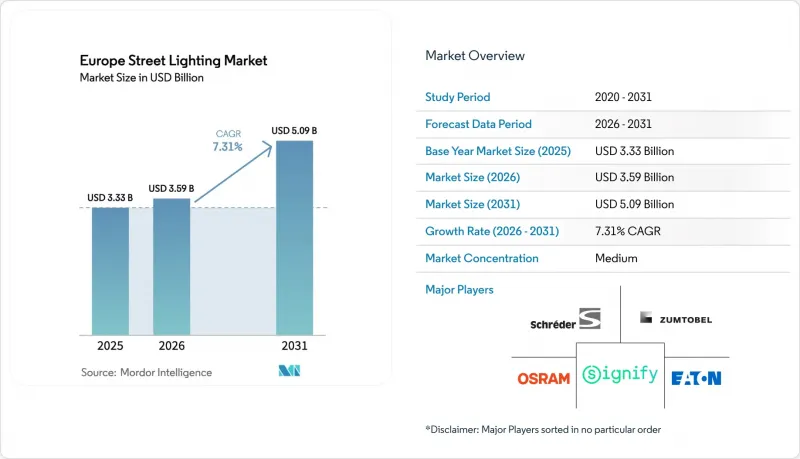
本報告依照明類型(傳統照明、智慧照明)、光源(LED、螢光、HID燈)、產品/服務(硬體、軟體、服務)、連接技術(有線、無線)、安裝類型(新安裝、維修)以及國家(德國、英國、法國、其他國家)進行細分。市場預測以美元計價。
歐洲路燈市場趨勢與洞察
歐盟禁止使用螢光並收緊生態設計目標
歐盟委員會的汞排放法規(2024/1849)強制要求在2025年12月前逐步淘汰緊湊型螢光,並在2026年12月前淘汰線性螢光,從而堵住了含汞光源方面的最後一個漏洞。隨著合規期限的臨近,各市政當局正在加快更換老舊設備,並對工人進行LED診斷方面的再培訓,導致競標數量激增。在法國,政府提供15億歐元(約16.1億美元)的市政津貼以支持合規工作,加速了小規模城鎮的LED照明系統普及。雖然強制折舊和回收安定器會在短期內給預算帶來壓力,但它也將創造對符合最新生態設計能源效率標準的聯網LED照明系統多年的需求。
智慧城市建設勢頭強勁,試點計畫不斷擴展
2024年,歐盟「地平線歐洲」計畫指定103個城市為氣候中和示範城市,並撥款4,100萬歐元(約4,390萬美元)用於將照明打造為數位化基礎設施的綜合試點計畫。德國100億歐元(約107億美元)的氣候基金為維修計畫提供高達50%的補貼,前提是計畫必須整合交通感測器和空氣品質監測節點,促進中型城市的採用。 RESONANCE計畫基於LoRaWAN架構,在冰島已被證實可降低35%的能耗和42%的現場回應頻率。憑藉穩定的資金籌措和已發布的最佳實踐指南,決策週期不斷縮短,推動歐洲路燈市場轉型為平台模式。
小規模市政智慧維修專案需要較高的初始資本支出(CAPEX)。
連網LED燈具的價格在300至500歐元之間,而獨立式LED燈具的價格僅150歐元。這對於年預算低於500萬歐元(約593萬美元)的城鎮來說是一大障礙。儘管自2009年以來,ELENA基金已籌集了11億歐元(約13.1億美元)用於技術支持,但南歐和東歐地區的津貼覆蓋範圍仍然不均衡。法國的「法國2030」計畫將照明納入更廣泛的基礎設施升級改造,實際上排除了融資拮据的市政當局獨立競標的可能性。撥款申請週期的周期性進一步延緩了照明設施的普及,並限制了歐洲路燈市場的初期需求成長。
細分市場分析
預計到2025年,智慧平台將佔銷售額的52.67%,顯示歐洲路燈市場正穩步從簡單地替換普通燈具轉向網路化智慧照明。遠距離診斷和自適應調光功能降低了生命週期成本,而安裝在燈桿上的無線設備則支援交通分析和環境監測等增值服務。與市政當局簽訂的小型基地台捆綁協議正在創造額外的租賃收入,並增強平台的經濟效益。雖然傳統路燈在債務能力有限的農村地區仍然很重要,但由於零件價格下降和津貼增加,預計到2030年,其目標市場規模將會縮小。
由於「地平線歐洲」計畫的持續支持,以及諸如冰島LORIOT計畫6000節點部署等試點計畫的成功,節能和維護成本的節約已得到證實,投資回收期也縮短至不到四年。隨著城市發布利用其照明網路的開放資料儀表板,公眾對感測器整合的興趣日益濃厚,未來的採購規範也越來越傾向於大力支持智慧基礎設施。
到2025年,LED將佔據86.58%的市場佔有率,預計到2031年,歐洲路燈市場將以8.33%的複合年成長率持續成長,並全面過渡到固態光源。雖然根據2024/1849號汞排放法規,螢光的購買將從2026年起被禁止,但由於高壓鈉燈調光相容性差,其淘汰速度較為緩慢。早期型號LED燈的二次更換進一步促進了LED燈的銷售,而無需安裝新的燈桿。
晶片級封裝和碳化矽 (SiC) 驅動器的技術進步延長了燈具在高溫環境下的使用壽命,並直接消除了一個主要的限制因素:驅動器的熱失效。隨著安定器庫存和老式燈具維修技術人員的減少,預計從 2026 年起,競標將全部採用 LED 解決方案,從而鞏固該技術的近乎絕對的主導地位。
其他好處
- Excel格式的市場預測(ME)表
- 3個月的分析師支持
目錄
第1章:引言
- 研究假設和市場定義
- 調查範圍
第2章:調查方法
第3章執行摘要
第4章 市場狀況
- 市場概覽
- 市場促進因素
- 歐盟禁止使用螢光並收緊生態設計目標
- 智慧城市建設勢頭強勁,試點計畫不斷擴展
- 降低 LED 的總擁有成本 (TCO) 和連接性。
- 歐盟復甦與韌性基金(REF)電動交通走廊
- 第一代LED二次替換需求浪潮(2024-2030年)
- 利用邊緣物聯網技術將路燈桿貨幣化為「房地產」。
- 市場限制因素
- 小規模市政當局智慧維修的初始資本支出(CAPEX)較高
- LED驅動器的可靠性及熱劣化所導致的故障
- 網路安全與GDPR合規負擔
- 半導體元件供應的波動
- 產業價值、供應鏈分析
- 監理情勢
- 技術展望
- 波特五力分析
- 宏觀經濟因素對市場的影響
第5章 市場規模與成長預測
- 依照明類型
- 傳統照明
- 智慧照明
- 透過光源
- LED
- 螢光
- HID燈
- 透過提供
- 硬體
- 燈具和燈泡
- 照明設備
- 控制系統
- 軟體服務
- 硬體
- 透過連接技術
- 有線連接(PLC、DALI、乙太網路)
- 無線(Zigbee、LoRa-WAN、NB-IoT、5G)
- 按安裝類型
- 新推出
- 維修和安裝,二次更換
- 國家
- 德國
- 英國
- 法國
- 義大利
- 其他歐洲國家
第6章 競爭情勢
- 市場集中度
- 策略趨勢
- 市佔率分析
- 公司簡介
- Signify NV
- Zumtobel Group AG
- Schreder SA
- Eaton Corporation plc
- OSRAM GmbH
- Acuity Brands Inc.
- Cree Lighting(IDEAL Industries)
- Itron Inc.
- Telensa Ltd.
- Sensus(Xylem)
- Flashnet SRL(InteliLIGHT)
- Lucy Zodion Ltd.
- Fagerhult Group
- Thorn Lighting Ltd.
- Le-Tehnika doo(Luxtella)
- Hubbell Incorporated
- Urban Control Ltd.
- AEC Illuminazione Srl
- Fagerhults Belysning AB
- Cisco Systems-Smart Lighting
第7章 市場機會與未來展望
According to Mordor Intelligence, the Europe street lighting market size is projected to be USD 3.33 billion in 2025, USD 3.59 billion in 2026 and reach USD 5.09 billion by 2031, growing at a CAGR of 7.23% from 2026 to 2031.
This report is Segmented by Lighting Type (Conventional Lighting, and Smart Lighting), Light Source (LEDs, Fluorescent Lamps, and HID Lamps), Offering (Hardware, and Software, and Services), Connectivity Technology (Wired, and Wireless), Installation Type (New Installation, and Retrofit), and Country (Germany, United Kingdom, France, and More). The Market Forecasts are Provided in Terms of Value (USD).
Europe Street Lighting Market Trends and Insights
EU Ban on Fluorescent Lamps and Stricter Ecodesign Targets
The European Commission's Mercury Regulation 2024/1849 mandates a complete phase-out of compact fluorescent lamps by December 2025 and linear fluorescent lamps by December 2026, closing the final loophole for mercury-containing sources. Compliance deadlines have triggered a surge in tender releases as municipalities rush to replace obsolete inventories and retrain crews on LED diagnostics. France has tied EUR 1.5 billion (USD 1.61 billion) of municipal grants to adherence, accelerating take-up in smaller towns. Obsolete ballast write-offs and mandatory recycling add near-term budget pressure, yet they open multiyear demand for connected LED systems that meet updated Ecodesign efficacy thresholds.
Smart-City Stimulus and Pilot Replication Momentum
Horizon Europe labeled 103 cities as climate-neutral demonstrators in 2024 and allocated EUR 41 million (USD 43.9 million) for integrated pilots where lighting forms the digital backbone. Germany's EUR 10 billion (USD 10.7 billion) climate fund reimburses up to 50% of retrofit costs when projects embed traffic sensing and air-quality nodes, spurring replication in mid-sized municipalities. The RESONANCE project is scaling LoRaWAN-based architectures proven to cut energy use 35% and truck-rolls 42% in Iceland. Funding consistency and published best-practice playbooks continue to shrink decision cycles, propelling the Europe street lighting market toward platform models.
High Up-Front CAPEX for Smart Retrofits in Small Municipalities
A networked LED unit costs EUR 300-500 versus EUR 150 for a non-connected replacement, a hurdle for towns with annual budgets under EUR 5 million (USD 5.93 million). While the ELENA facility has mobilized EUR 1.1 billion (USD 1.31 billion) for technical assistance since 2009, coverage remains uneven in Southern and Eastern Europe. France's France 2030 plan bundles lighting with broader infrastructure upgrades, effectively sidelining stand-alone bids from cash-strapped communes. Cyclic grant windows further delay adoption, constraining early volume in the Europe street lighting market.
Other drivers and restraints analyzed in the detailed report include:
- Declining Total Cost of Ownership for LED and Connectivity
- EU Recovery and Resilience Facility E-Mobility Corridors
- LED Driver Reliability and Thermal Ageing Failures
For complete list of drivers and restraints, kindly check the Table Of Contents.
Segment Analysis
Smart platforms accounted for 52.67% of 2025 revenue, demonstrating that the Europe street lighting market is steadily migrating from commodity lamp replacement to network intelligence. Remote diagnostics and adaptive dimming lower lifecycle costs, while pole-mounted radios support add-on services such as traffic analytics and environmental monitoring. Municipal bundling with 5G small cells opens incremental lease income, reinforcing platform economics. Conventional lighting retains relevance in rural zones where debt capacity is limited, yet declining component prices and widening grant access are set to narrow its addressable pocket by 2030.
Continued stimulus from Horizon Europe and evidence from pilots such as LORIOT's 6,000-node Iceland deployment have validated energy and maintenance savings, shortening payback periods below four years. As cities publish open-data dashboards powered by lighting networks, civic appetite for sensor integration is rising, anchoring future procurement specifications firmly in favor of smart infrastructure.
LEDs commanded an 86.58% share in 2025 and are advancing at an 8.33% CAGR to 2031 as the Europe street lighting market size shifts wholesale toward solid-state sources. Mercury Regulation 2024/1849 makes the purchase of fluorescent lamps illegal after 2026, while high-pressure sodium remains in slow retirement due to poor dimming compatibility. Secondary replacement of early LED vintages further lifts unit volumes without adding new poles.
Advances in chip-scale packaging and silicon-carbide drivers are extending usable life under high-ambient conditions, directly addressing the primary restraint of thermal driver failures. As ballast inventories and technician skill sets for legacy lamps vanish, post-2026 tenders are expected to specify LED-only solutions, cementing the technology's near-total dominance.
Complete Report Scope:
- By Lighting Type
- Conventional Lighting
- Smart Lighting
- By Light Source
- LEDs
- Fluorescent Lamps
- HID Lamps
- By Offering
- Hardware
- Lights and Bulbs
- Luminaires
- Control Systems
- Software and Services
- Hardware
- By Connectivity Technology
- Wired (PLC, DALI, Ethernet)
- Wireless (Zigbee, LoRa-WAN, NB-IoT, 5G)
- By Installation Type
- New Installation
- Retrofit, Secondary Replacement
- By Country
- Germany
- United Kingdom
- France
- Italy
- Rest of Europe
List of Companies Covered in this Report:
- Signify N.V.
- Zumtobel Group AG
- Schreder SA
- Eaton Corporation plc
- OSRAM GmbH
- Acuity Brands Inc.
- Cree Lighting (IDEAL Industries)
- Itron Inc.
- Telensa Ltd.
- Sensus (Xylem)
- Flashnet SRL (InteliLIGHT)
- Lucy Zodion Ltd.
- Fagerhult Group
- Thorn Lighting Ltd.
- Le-Tehnika d.o.o. (Luxtella)
- Hubbell Incorporated
- Urban Control Ltd.
- AEC Illuminazione Srl
- Fagerhults Belysning AB
- Cisco Systems - Smart Lighting
Additional Benefits:
- The market estimate (ME) sheet in Excel format
- 3 months of analyst support
TABLE OF CONTENTS
1 INTRODUCTION
- 1.1 Study Assumptions and Market Definition
- 1.2 Scope of the Study
2 RESEARCH METHODOLOGY
3 EXECUTIVE SUMMARY
4 MARKET LANDSCAPE
- 4.1 Market Overview
- 4.2 Market Drivers
- 4.2.1 EU Ban on Fluorescent Lamps and Stricter Ecodesign Targets
- 4.2.2 Smart-City Stimulus and Pilot Replication Momentum
- 4.2.3 Declining Total Cost of Ownership for LED and Connectivity
- 4.2.4 EU Recovery and Resilience Facility E-Mobility Corridors
- 4.2.5 Secondary-Replacement Wave for First-Gen LEDs (2024-2030)
- 4.2.6 Street-Light Poles Monetised as Edge-IoT Real-Estate
- 4.3 Market Restraints
- 4.3.1 High Up-Front CAPEX for Smart Retrofits in Small Municipalities
- 4.3.2 LED Driver Reliability and Thermal Ageing Failures
- 4.3.3 Cyber-Security and GDPR Compliance Burden
- 4.3.4 Semiconductor-Component Supply Volatility
- 4.4 Industry Value, Supply-Chain Analysis
- 4.5 Regulatory Landscape
- 4.6 Technological Outlook
- 4.7 Porter's Five Forces Analysis
- 4.7.1 Bargaining Power of Suppliers
- 4.7.2 Bargaining Power of Consumers
- 4.7.3 Threat of New Entrants
- 4.7.4 Threat of Substitutes
- 4.7.5 Intensity of Competitive Rivalry
- 4.8 Impact of Macroeconomic Factors on the Market
5 MARKET SIZE AND GROWTH FORECASTS (VALUE)
- 5.1 By Lighting Type
- 5.1.1 Conventional Lighting
- 5.1.2 Smart Lighting
- 5.2 By Light Source
- 5.2.1 LEDs
- 5.2.2 Fluorescent Lamps
- 5.2.3 HID Lamps
- 5.3 By Offering
- 5.3.1 Hardware
- 5.3.1.1 Lights and Bulbs
- 5.3.1.2 Luminaires
- 5.3.1.3 Control Systems
- 5.3.2 Software and Services
- 5.3.1 Hardware
- 5.4 By Connectivity Technology
- 5.4.1 Wired (PLC, DALI, Ethernet)
- 5.4.2 Wireless (Zigbee, LoRa-WAN, NB-IoT, 5G)
- 5.5 By Installation Type
- 5.5.1 New Installation
- 5.5.2 Retrofit, Secondary Replacement
- 5.6 By Country
- 5.6.1 Germany
- 5.6.2 United Kingdom
- 5.6.3 France
- 5.6.4 Italy
- 5.6.5 Rest of Europe
6 COMPETITIVE LANDSCAPE
- 6.1 Market Concentration
- 6.2 Strategic Moves
- 6.3 Market Share Analysis
- 6.4 Company Profiles (Includes Global Level Overview, Market Level Overview, Core Segments, Financials as Available, Strategic Information, Market Rank/Share for Key Companies, Products and Services, and Recent Developments)
- 6.4.1 Signify N.V.
- 6.4.2 Zumtobel Group AG
- 6.4.3 Schreder SA
- 6.4.4 Eaton Corporation plc
- 6.4.5 OSRAM GmbH
- 6.4.6 Acuity Brands Inc.
- 6.4.7 Cree Lighting (IDEAL Industries)
- 6.4.8 Itron Inc.
- 6.4.9 Telensa Ltd.
- 6.4.10 Sensus (Xylem)
- 6.4.11 Flashnet SRL (InteliLIGHT)
- 6.4.12 Lucy Zodion Ltd.
- 6.4.13 Fagerhult Group
- 6.4.14 Thorn Lighting Ltd.
- 6.4.15 Le-Tehnika d.o.o. (Luxtella)
- 6.4.16 Hubbell Incorporated
- 6.4.17 Urban Control Ltd.
- 6.4.18 AEC Illuminazione Srl
- 6.4.19 Fagerhults Belysning AB
- 6.4.20 Cisco Systems - Smart Lighting
7 MARKET OPPORTUNITIES AND FUTURE OUTLOOK
- 7.1 White-Space and Unmet-Need Assessment

 路燈:市場佔有率分析、行業趨勢和統計數據、成長預測(2026-2031 年)
 LED路燈市場報告:按應用和地區分類(2026-2034)
 路燈燈具市場:按燈具類型、燈具類型、安裝類型、配電類型、應用、最終用戶分類,全球預測(2026-2032年)
 全球隧道照明市場規模、佔有率、趨勢和成長分析報告(2026-2034年)
 2026年全球LED路燈市場報告2026年全球街道與道路照明市場報告
 街道和道路照明市場規模、佔有率和成長分析(按照明類型、安裝類型、電源、控制類型、最終用戶和地區分類)—2026-2033年產業預測北美街道照明:市場佔有率分析、行業趨勢和統計、成長預測(2025-2030 年)路燈及道路照明的全球市場規模:照明各類型,各來源,各瓦特數類型,各提供,各終端用戶產業,各地區,範圍及預測