


 |
市場調查報告書
商品編碼
2124919
遠端儲槽監控系統:市場佔有率分析、產業趨勢與統計、成長預測(2026-2031)Remote Tank Monitoring System - Market Share Analysis, Industry Trends & Statistics, Growth Forecasts (2026 - 2031) |
||||||

※ 本網頁內容可能與最新版本有所差異。詳細情況請與我們聯繫。
根據 Mordor Intelligence 預測,遠端儲槽監控系統的市場規模預計將從 2025 年的 27.3 億美元和 2026 年的 32.1 億美元成長到 2031 年的 91.6 億美元,2026 年至 2031 年的年複合成長率(CAGR)為 23.33%。
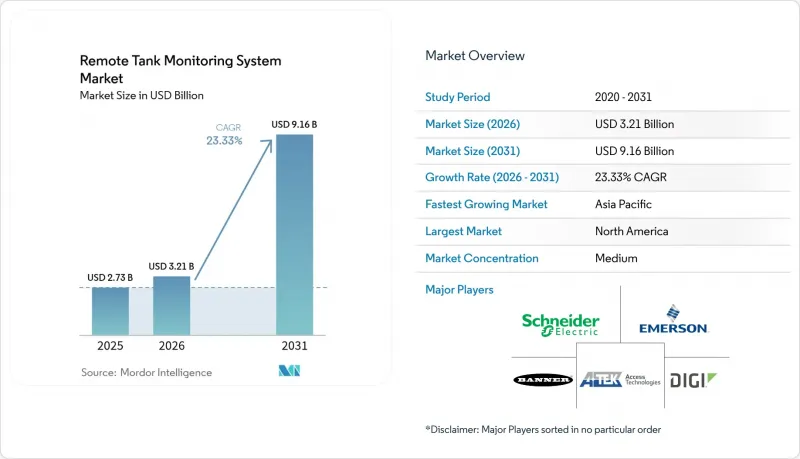
本報告依監測類型(點位監測、連續液位監測)、技術(接觸式感測器、非接觸式感測器)、連接方式(蜂窩網路、低功耗廣域網路、其他)、儲槽類型(地面式、固定頂式、其他)、終端用戶產業(石油天然氣、化學和石化、其他)以及地區進行細分。市場預測以美元計價。
全球遠端儲罐監控系統市場趨勢與洞察
擴大石油、天然氣和化學產品的儲存基礎設施
到2025年,全球將運作約1.8億桶地上儲油能力,其中42%將位於美國。營運商在建造過程中採用了雷達和磁致伸縮探頭,以滿足美國石油學會(API)653標準,從而降低了維修成本,並確保了運作時的合規性。沙烏地阿美公司的傑夫拉冷凝油計畫為所有新建儲槽配備了無線感測器,可將數據傳輸到數位孿生模型,從而減少了85%的人工計量和30%的意外停機時間。在中國Delta地區,12,000個發送器將於2025年投入運作,以滿足危險化學品法規對即時警報的要求。持續的遠端監控已將庫存核對的頻率從每週一次降低到每小時一次,從而使綜合石化中心的營運資金減少了高達20%。
基於雲端的物聯網平台的普及
截至2025年12月,微軟Azure IoT營運平台每天處理45億個感測器訊息,其中儲罐液位資料處理量排名第三。 [2] 本地閘道器的邊緣分析技術將蜂窩網路流量減少了60%,即使在通訊故障期間也能維持亞秒級的警報啟動。艾默生Plantweb Optics在2025年新增了2,300個終端,並將儲槽清洗造成的停機時間減少了25%。分析技術的普及使中型丙烷經銷商能夠根據天氣情況制定補給計劃,從而減少了卡車運輸次數。隨著遠端儲槽監控系統市場進一步滲透到中型企業市場,安裝50個儲槽的總成本從2024年的8.5萬美元降至2026年的6.2萬美元。
高昂的初始硬體和整合成本
除了功能齊全的無線雷達節點外,太陽能發電系統和閘道器的平均成本在 2200 美元到 3800 美元之間,另需 800 美元到 1500 美元繪製歷史數據和員工培訓。一套包含 500 個丙烷罐的車隊成本為 110 萬美元,相當於許多小規模經銷商兩年的淨利潤。國際水資源管理實驗室 (IWMI) 2025 年的一項調查發現,印度和巴西 78% 的合作社表示,他們需要優惠融資才能在五年內實現收支平衡。硬體即服務 (HaaS) 可以減輕這種負擔,但在價格敏感型行業,其應用仍然有限,這限制了遠端儲罐監控系統在小規模企業中的市場滲透率。
細分市場分析
預計到 2025 年,該細分市場將佔據遠端儲罐監控系統市場最大的佔有率,達到 58.82%。 SPCC 法規和歐洲工業排放指令中的監管語言明確要求不間斷地追蹤液位,這鞏固了市場需求。
此外,連續測量系統可將資料輸入機器學習模型,從而檢測微小洩漏並最佳化補貨物流,這使其價格高出 60-80%。點位探頭對於預算是採購決策主要因素的低價值或非危險液體仍然有用,但隨著標準向即時可視性轉變,其市場佔有率正在逐漸萎縮。
預計到2025年,接觸式探頭將佔據遠端儲槽監測系統市場36.77%的佔有率。這主要得益於磁致伸縮式和浮標式探頭的應用,這些探頭已在成品油終端應用數十年。它們±1毫米的精度仍然是交付計量合約的標準,從而支撐了替換需求。
非接觸式雷達接收器正在縮小其在腐蝕性、發泡或高溫環境應用方面的差距,VEGAPULS 6X 的 80GHz 波束正在取代波導雷達,用於受阻儲槽。然而,許多業者仍然傾向於使用成熟的濕式探頭,直到設備退役週期迫使他們做出投資決策,這使得接觸式技術的成長保持著 23.77% 的穩定複合年成長率。
區域分析
到2025年,北美將佔全球銷售額的32.74%,這主要得益於SPCC(溢油預防、控制和緩解)合規性的維修以及美國和加拿大丙烷氣市場的擴張。這歸功於SPCC的嚴格執行、廣泛的油氣基礎設施以及工業IoT的早期應用。聯邦政府對遍遠地區寬頻發展的津貼正在擴大低功耗廣域網路(LPWAN)的覆蓋範圍,進一步推動農業省份遠端儲槽監控系統的應用。加拿大戰略石油儲備的重組正在推動跨境業務發展,營運商正在整合資產管理平台。
亞太地區遠端儲槽監控系統市場成長最快,複合年成長率達 24.13%。中國的石化產業叢集,對蒸氣封蓋和連續位准計的需求量很大,而印度的「Jal Jeevan Mission」計畫則在投資 LoRaWAN 節點用於地下水監測。
在歐洲,受工業排放法規和ESG報告義務的推動,該產業佔全球整體收入的24%。在中東,根據OGMP 2.0標準,甲烷監測感測器正在部署;澳洲礦業公司則利用衛星回程傳輸將卡車運輸量減少了55%。
其他好處
- Excel格式的市場預測(ME)表
- 3個月的分析師支持
目錄
第1章:引言
- 研究假設和市場定義
- 調查範圍
第2章:調查方法
第3章執行摘要
第4章 市場狀況
- 市場概覽
- 市場促進因素
- 擴大石油、天然氣和化學產品的儲存基礎設施
- 基於雲端的物聯網平台的普及
- 加強全球監管,防止洩漏和控制庫存
- 衛星物聯網為極偏遠地區的儲存槽提供覆蓋
- 透過HaaS訂閱模式降低資本支出進入門檻
- 散裝液體供應鏈中範圍 3 ESG 報告面臨壓力
- 市場限制因素
- 高昂的初始硬體和整合成本
- 網路安全和資料所有權問題
- 與電池廢棄物相關的永續性責任
- 由於鋼鐵和鋁關稅,設備材料清單(BOM) 成本增加。
- 價值鏈分析
- 監理情勢
- 波特五力模型
- 宏觀經濟因素對市場的影響
第5章 市場規模與成長預測
- 透過監測類型
- 點級監測
- 連續液位監測
- 透過技術
- 接觸式感應器
- 浮子和捲尺
- 磁致伸縮型
- 靜水壓力
- 非接觸式感測器
- 超音波
- 雷達 FMCW
- 光學和雷射
- 接觸式感應器
- 連結性別
- 蜂窩網路(4G LTE、5G、NB-IoT、Cat-M)
- LPWAN(LoRaWAN、Sigfox)
- 衛星(低地球軌道/地球同步軌道)
- 短距離射頻/Wi-Fi/藍牙低功耗
- 坦克型
- 地面安裝式,固定屋頂型
- 地面安裝式浮動頂
- 地下/UST
- 按最終用戶行業分類
- 石油和天然氣
- 化工/石油化工
- 水和污水處理
- 飲食
- 農業與灌溉
- 發電
- 採礦和金屬
- 藥品和醫療保健
- 按服務模式
- 獨立硬體的銷售
- 硬體即服務 (HaaS) 訂閱
- 全託管承包平台
- 按地區
- 北美洲
- 美國
- 加拿大
- 墨西哥
- 南美洲
- 巴西
- 阿根廷
- 南美洲其他地區
- 歐洲
- 英國
- 德國
- 法國
- 義大利
- 西班牙
- 俄羅斯
- 其他歐洲國家
- 亞太地區
- 中國
- 日本
- 印度
- 韓國
- 澳洲和紐西蘭
- 東南亞
- 亞太其他地區
- 中東
- 沙烏地阿拉伯
- 阿拉伯聯合大公國
- 土耳其
- 其他中東國家
- 非洲
- 南非
- 奈及利亞
- 肯亞
- 其他非洲地區
- 北美洲
第6章 競爭情勢
- 市場集中度
- 策略趨勢
- 市佔率分析
- 公司簡介
- Schneider Electric SE
- Emerson Electric Co.
- Banner Engineering Corp.
- ATEK Access Technologies LLC(TankScan)
- Anova(DataOnline Corp.)
- Digi International Inc.
- Otodata Wireless Network Inc.
- SkyBitz Inc.
- Powelectrics Ltd.
- Dunraven Systems Limited
- Endress+Hauser Group
- Honeywell International Inc.
- Vega Grieshaber KG
- RemoteTank(Alpha Wireless Automation Inc.)
- Rugged Telemetry
- Tekelek Group
- Tank Utility Inc.(Generac Power Systems Inc.)
- Cavagna Group
- Mistras Group Inc.
- Sensile Technologies SA
- WIKA Alexander Wiegand SE and Co KG
第7章 市場機會與未來展望
According to Mordor Intelligence, the remote tank monitoring system market size is projected to expand from USD 2.73 billion in 2025 and USD 3.21 billion in 2026 to USD 9.16 billion by 2031, registering a CAGR of 23.33% between 2026 to 2031.
This report is Segmented by Monitoring Type (Point-Level, and Continuous-Level), Technology (Contact Sensors, and Non-Contact Sensors), Connectivity (Cellular, LPWAN, and More), Tank Type (Above-Ground Fixed-Roof, and More), End-User Industry (Oil and Gas, Chemicals, and More), and Geography. The Market Forecasts are Provided in Terms of Value (USD).
Global Remote Tank Monitoring System Market Trends and Insights
Expansion of Oil and Gas and Chemical Storage Infrastructure
Roughly 180 million barrels of new above-ground capacity were commissioned worldwide in 2025, 42% of which arose in the United States. Operators embedded radar and magnetostrictive probes during construction to satisfy American Petroleum Institute Standard 653, cutting retrofit expense and ensuring compliance at start-up. Saudi Aramco's Jafurah condensate program equipped every new tank with wireless sensors feeding a digital twin, reducing manual gauging by 85% and unexpected shutdowns by 30%. In China's Yangtze River Delta, 12,000 transmitters went live during 2025 to meet hazardous-chemical rules that require real-time alarms. Continuous telemetry shortens inventory reconciliation from weekly to hourly intervals, lowering working capital by up to 20% for integrated petrochemical hubs.
Proliferation of Cloud-Based IoT Platforms
Microsoft Azure IoT Operations processed 4.5 billion daily sensor messages by December 2025, with tank-level data ranking third largest.[2] Edge analytics on local gateways cut cellular traffic by 60% and maintained sub-second alarms during outages. Emerson Plantweb Optics added 2,300 endpoints in 2025, trimming tank-cleaning downtime by 25%. Democratized analytics now let mid-sized propane dealers run weather-driven refill schedules, reducing truck rolls. Total cost for a 50-tank installation has fallen from USD 85,000 in 2024 to USD 62,000 in 2026, pushing the Remote Tank Monitoring System market deeper into the mid-market.
High Upfront Hardware and Integration Costs
A fully featured wireless radar node plus solar power and gateway averages USD 2,200-3,800, with another USD 800-1,500 for historian mapping and staff training. A 500-tank propane fleet costs USD 1.1 million, nearly two years of net income for many small distributors. Seventy-eight percent of Indian and Brazilian cooperatives in a 2025 International Water Management Institute survey said concessional loans would be required for breakeven within five years. HaaS eases the burden, but price-sensitive sectors still postpone adoption, limiting Remote Tank Monitoring System market penetration among micro-operators.
Other drivers and restraints analyzed in the detailed report include:
- Stricter Global Spill-Prevention and Inventory Regulations
- Satellite-IoT Coverage for Ultra-Remote Tanks
- Cyber-Security and Data-Ownership Concerns
For complete list of drivers and restraints, kindly check the Table Of Contents.
Segment Analysis
The segment generated the largest share of Remote Tank Monitoring System market size in 2025 at 58.82%. Regulatory language in both the SPCC rule and Europe's Industrial Emissions Directive explicitly calls for uninterrupted level tracking, locking in demand.
Continuous systems also feed machine-learning models that detect micro-leaks and optimize refill logistics, justifying their 60-80% price premium. Point-level probes remain relevant for low-value or non-hazardous liquids where budgets dominate purchase decisions, but their footprint is slowly eroding as standards migrate toward real-time visibility.
Contact probes held 36.77% Remote Tank Monitoring System market share in 2025, buoyed by decades of installed magnetostrictive and float-and-tape devices in refined-product terminals. Their +-1 mm accuracy still defines custody-transfer contracts, sustaining replacement demand.
Non-contact radar receivers are closing the gap for corrosive, foaming, or high-temperature duties, and the VEGAPULS 6X's 80 GHz beam is displacing guided-wave radar in obstructed tanks. Yet many operators prefer proven wetted probes until decommissioning cycles force capex decisions, keeping contact technology expansion at a healthy 23.77% CAGR.
Complete Report Scope:
- By Monitoring Type
- Point-Level Monitoring
- Continuous-Level Monitoring
- By Technology
- Contact Sensors
- Float and Tape Gauge
- Magnetostrictive
- Hydrostatic Pressure
- Non-Contact Sensors
- Ultrasonic
- Radar / FMCW
- Optical / Laser
- Contact Sensors
- By Connectivity
- Cellular (4G LTE, 5G, NB-IoT, Cat-M)
- LPWAN (LoRaWAN, Sigfox)
- Satellite (LEO / GEO)
- Short-Range RF / Wi-Fi / BLE
- By Tank Type
- Above-Ground Fixed-Roof
- Above-Ground Floating-Roof
- Underground / UST
- By End-User Industry
- Oil and Gas
- Chemicals and Petrochemicals
- Water and Wastewater
- Food and Beverage
- Agriculture and Irrigation
- Power Generation
- Mining and Metals
- Pharmaceuticals and Healthcare
- By Service Model
- Stand-alone Hardware Sales
- Hardware-as-a-Service (HaaS) Subscription
- Fully Managed Turnkey Platforms
- By Geography
- North America
- United States
- Canada
- Mexico
- South America
- Brazil
- Argentina
- Rest of South America
- Europe
- United Kingdom
- Germany
- France
- Italy
- Spain
- Russia
- Rest of Europe
- Asia-Pacific
- China
- Japan
- India
- South Korea
- Australia and New Zealand
- Southeast Asia
- Rest of Asia-Pacific
- Middle East
- Saudi Arabia
- United Arab Emirates
- Turkey
- Rest of Middle East
- Africa
- South Africa
- Nigeria
- Kenya
- Rest of Africa
- North America
Geography Analysis
North America commanded 32.74% of 2025 sales, driven by SPCC retrofits and strong propane adoption in the United States and Canada, driven by SPCC enforcement, extensive oil and gas infrastructure, and early industrial IoT adoption. Federal grants for rural broadband enhance LPWAN coverage, further propelling the deployment of remote tank monitoring systems in agricultural states. Canada's renewed strategic petroleum reserve buildout adds cross-border momentum as operators harmonize asset management platforms.
Asia-Pacific increases the Remote Tank Monitoring System market size fastest at 24.13% CAGR. Chinese petrochemical clusters in Zhejiang and Jiangsu require vapor caps and continuous gauges, while India's Jal Jeevan Mission funds LoRaWAN nodes for groundwater oversight.
Europe delivers 24% of global revenue on the back of Industrial Emissions enforcement and ESG reporting mandates. The Middle East deploys sensors for OGMP 2.0 methane tracking, and Australia's miners use satellite backhaul to slash truck visits by 55%.
- Schneider Electric SE
- Emerson Electric Co.
- Banner Engineering Corp.
- ATEK Access Technologies LLC (TankScan)
- Anova (DataOnline Corp.)
- Digi International Inc.
- Otodata Wireless Network Inc.
- SkyBitz Inc.
- Powelectrics Ltd.
- Dunraven Systems Limited
- Endress+Hauser Group
- Honeywell International Inc.
- Vega Grieshaber KG
- RemoteTank (Alpha Wireless Automation Inc.)
- Rugged Telemetry
- Tekelek Group
- Tank Utility Inc. (Generac Power Systems Inc.)
- Cavagna Group
- Mistras Group Inc.
- Sensile Technologies SA
- WIKA Alexander Wiegand SE and Co KG
Additional Benefits:
- The market estimate (ME) sheet in Excel format
- 3 months of analyst support
TABLE OF CONTENTS
1 INTRODUCTION
- 1.1 Study Assumptions and Market Definition
- 1.2 Scope of the Study
2 RESEARCH METHODOLOGY
3 EXECUTIVE SUMMARY
4 MARKET LANDSCAPE
- 4.1 Market Overview
- 4.2 Market Drivers
- 4.2.1 Expansion Of Oil And Gas And Chemical Storage Infrastructure
- 4.2.2 Proliferation Of Cloud-Based IoT Platforms
- 4.2.3 Stricter Global Spill-Prevention And Inventory Regulations
- 4.2.4 Satellite-IoT Coverage For Ultra-Remote Tanks
- 4.2.5 HaaS Subscription Models Lowering CAPEX Barriers
- 4.2.6 Scope-3 ESG Reporting Pressure On Bulk-Liquid Supply Chains
- 4.3 Market Restraints
- 4.3.1 High Upfront Hardware And Integration Costs
- 4.3.2 Cyber-Security And Data-Ownership Concerns
- 4.3.3 Battery-Waste Sustainability Liabilities
- 4.3.4 Steel/Aluminum Tariffs Inflating Device BOM
- 4.4 Value Chain Analysis
- 4.5 Regulatory Landscape
- 4.6 Porter's Five Forces
- 4.6.1 Bargaining Power of Suppliers
- 4.6.2 Bargaining Power of Buyers
- 4.6.3 Threat of New Entrants
- 4.6.4 Threat of Substitutes
- 4.6.5 Intensity of Competitive Rivalry
- 4.7 Impact of Macroeconomic Factors on the Market
5 MARKET SIZE AND GROWTH FORECASTS (VALUE)
- 5.1 By Monitoring Type
- 5.1.1 Point-Level Monitoring
- 5.1.2 Continuous-Level Monitoring
- 5.2 By Technology
- 5.2.1 Contact Sensors
- 5.2.1.1 Float and Tape Gauge
- 5.2.1.2 Magnetostrictive
- 5.2.1.3 Hydrostatic Pressure
- 5.2.2 Non-Contact Sensors
- 5.2.2.1 Ultrasonic
- 5.2.2.2 Radar / FMCW
- 5.2.2.3 Optical / Laser
- 5.2.1 Contact Sensors
- 5.3 By Connectivity
- 5.3.1 Cellular (4G LTE, 5G, NB-IoT, Cat-M)
- 5.3.2 LPWAN (LoRaWAN, Sigfox)
- 5.3.3 Satellite (LEO / GEO)
- 5.3.4 Short-Range RF / Wi-Fi / BLE
- 5.4 By Tank Type
- 5.4.1 Above-Ground Fixed-Roof
- 5.4.2 Above-Ground Floating-Roof
- 5.4.3 Underground / UST
- 5.5 By End-User Industry
- 5.5.1 Oil and Gas
- 5.5.2 Chemicals and Petrochemicals
- 5.5.3 Water and Wastewater
- 5.5.4 Food and Beverage
- 5.5.5 Agriculture and Irrigation
- 5.5.6 Power Generation
- 5.5.7 Mining and Metals
- 5.5.8 Pharmaceuticals and Healthcare
- 5.6 By Service Model
- 5.6.1 Stand-alone Hardware Sales
- 5.6.2 Hardware-as-a-Service (HaaS) Subscription
- 5.6.3 Fully Managed Turnkey Platforms
- 5.7 By Geography
- 5.7.1 North America
- 5.7.1.1 United States
- 5.7.1.2 Canada
- 5.7.1.3 Mexico
- 5.7.2 South America
- 5.7.2.1 Brazil
- 5.7.2.2 Argentina
- 5.7.2.3 Rest of South America
- 5.7.3 Europe
- 5.7.3.1 United Kingdom
- 5.7.3.2 Germany
- 5.7.3.3 France
- 5.7.3.4 Italy
- 5.7.3.5 Spain
- 5.7.3.6 Russia
- 5.7.3.7 Rest of Europe
- 5.7.4 Asia-Pacific
- 5.7.4.1 China
- 5.7.4.2 Japan
- 5.7.4.3 India
- 5.7.4.4 South Korea
- 5.7.4.5 Australia and New Zealand
- 5.7.4.6 Southeast Asia
- 5.7.4.7 Rest of Asia-Pacific
- 5.7.5 Middle East
- 5.7.5.1 Saudi Arabia
- 5.7.5.2 United Arab Emirates
- 5.7.5.3 Turkey
- 5.7.5.4 Rest of Middle East
- 5.7.6 Africa
- 5.7.6.1 South Africa
- 5.7.6.2 Nigeria
- 5.7.6.3 Kenya
- 5.7.6.4 Rest of Africa
- 5.7.1 North America
6 COMPETITIVE LANDSCAPE
- 6.1 Market Concentration
- 6.2 Strategic Moves
- 6.3 Market Share Analysis
- 6.4 Company Profiles (includes Global level Overview, Market level overview, Core Segments, Financials as available, Strategic Information, Market Rank / Share for key companies, Products and Services, and Recent Developments)
- 6.4.1 Schneider Electric SE
- 6.4.2 Emerson Electric Co.
- 6.4.3 Banner Engineering Corp.
- 6.4.4 ATEK Access Technologies LLC (TankScan)
- 6.4.5 Anova (DataOnline Corp.)
- 6.4.6 Digi International Inc.
- 6.4.7 Otodata Wireless Network Inc.
- 6.4.8 SkyBitz Inc.
- 6.4.9 Powelectrics Ltd.
- 6.4.10 Dunraven Systems Limited
- 6.4.11 Endress+Hauser Group
- 6.4.12 Honeywell International Inc.
- 6.4.13 Vega Grieshaber KG
- 6.4.14 RemoteTank (Alpha Wireless Automation Inc.)
- 6.4.15 Rugged Telemetry
- 6.4.16 Tekelek Group
- 6.4.17 Tank Utility Inc. (Generac Power Systems Inc.)
- 6.4.18 Cavagna Group
- 6.4.19 Mistras Group Inc.
- 6.4.20 Sensile Technologies SA
- 6.4.21 WIKA Alexander Wiegand SE and Co KG
7 MARKET OPPORTUNITIES AND FUTURE OUTLOOK
- 7.1 White-space and Unmet-Need Assessment

 2026年全球汽車塑膠燃料箱市場報告
 自增壓液態氮冷卻罐市場:全球市場預測,2026-2032年遠端水質監測與品管設備市場:全球市場預測,2026-2032年2026年全球油罐車市場報告2026年全球折疊式燃料箱市場報告2026年全球罐車市場報告
 全球國防外掛油箱市場:2026-2036LNG駁船加註系統市場按組件、安裝類型、推進類型、駁船類型、應用和最終用戶分類,全球預測(2026-2032年)
 自供電水質監測系統市場分析及預測(至2035年):依類型、產品類型、服務、技術、組件、應用、部署類型、最終用戶及功能分類卡車加油系統市場按組件、燃料類型、技術、支付方式、最終用途和車輛類型分類-全球預測(2026-2032 年)