


 |
市場調查報告書
商品編碼
2124773
住宅通風系統:市場佔有率分析、產業趨勢與統計、成長預測(2026-2031)Home Ventilation System - Market Share Analysis, Industry Trends & Statistics, Growth Forecasts (2026 - 2031) |
||||||

※ 本網頁內容可能與最新版本有所差異。詳細情況請與我們聯繫。
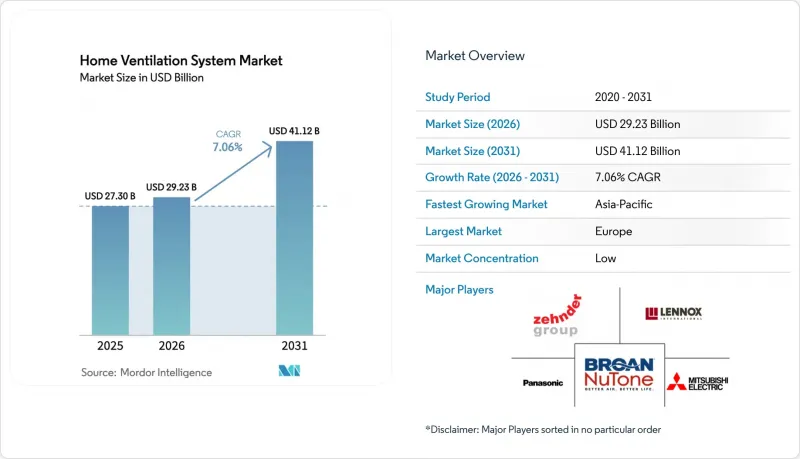
根據 Mordor Intelligence 預測,住宅通風系統市場規模將從 2025 年的 273 億美元和 2026 年的 292.3 億美元成長到 2031 年的 411.2 億美元,2026 年至 2031 年的年複合成長率(CAGR)為 7.06%。
本報告按系統類型(全住宅/集中式通風、局部/僅排氣通風、其他)、產品類型(整合式暖通空調機組、獨立式通風系統和風扇、其他)、安裝類型(新建、維修/改造)以及地區(北美、南美、歐洲、亞太、中東和非洲)進行細分。市場預測以美元(USD)計價。
全球住宅通風系統市場趨勢與洞察
室內空氣品質是住宅中最重要的健康問題。
自2024年以來,隨著人們對空氣污染物的認知不斷提高,室內空氣品質已從一項可選升級轉變為住宅項目和中期維修的常規要求。最低通風率已被納入各種建築規範和標準,執法措施要求達到可測量的持續氣流標準,從而為大多數新建住宅設定了基於最低合規性的通風能力標準。在歐盟,修訂後的《2024年環境規劃指令》(EPBD 2024)要求成員國在2026年5月29日之前製定國家室內空氣品質措施,並將監測納入所有新建非住宅零排放建築。這表明,隨著零排放建築成為標準,住宅領域的預期發展方向正在改變。以健康為導向的項目,例如美國能源局(DOE) 的「零能耗住宅」計畫及其相關標籤方案,正將通風系統納入更廣泛的性能指標體系,引導建築商從現在到 2030 年在住宅中採用具有適當過濾水平的平衡式通風系統。隨著建築規範和自願性標籤方案的整合,增強型通風設備 (ERV) 的普及得益於相關證據,這些證據表明,平衡式通風系統無需依賴意外的室外空氣流入即可確保穩定的氣流。這意味著住宅通風系統市場將明顯受益於以健康為導向的住宅設計理念的轉變。
與智慧家庭的融合正在加速對智慧通風的需求。
自 2024 年以來,住宅暖通空調平台整合了更多軟體功能,通風功能擴大被整合到控制系統中,作為能源最佳化的一部分。製造商的公告強調了對預測性維護、開放式連接和人工智慧控制的重視,這些功能不僅應用於供暖和製冷,還應用於通風調度和需求控制。擁有建築自動化產品系列的公司顯然正在將重點轉向軟體驅動的差異化,推動通風模組基於測量的室內環境而非固定設定運作。將恆溫器、室內空氣品質 (IAQ) 感測器和通風設備整合到單一應用程式中的產品生態系統正受到承包商和住宅的青睞,縮短試運行時間,並提供除簡單空氣交換之外的附加價值。隨著智慧功能在中端產品中日益普及,住宅通風系統市場正在湧現出更多應用場景,例如按需控制通風、遠距離診斷和效能檢驗,以滿足建築規範合規性和公共產業項目要求。這些特性增強了通風作為住宅整體性能系統中可測量和可控要素的作用,並提高了智慧設備普及已成為主流的地區中聯網 ERV 和 HRV 系統的價值創造。
該系統和安裝成本高昂,阻礙了其在大眾市場的廣泛應用。
全住宅系統若具備熱回收或能源回收功能並能達到均衡氣流,則涉及設備及人事費用。對於未預先規劃管道系統的住宅而言,這可能是一筆不小的負擔。當現有暖通空調系統和管道無法共用,或獨立通風設備需要額外穿孔和佈線時,安裝的複雜性會增加。這不僅會增加維修專案的預算,還會延長投資回收期。價格趨勢受組件變化的影響,例如轉向低全球暖化潛值(GWP)冷媒、供應鏈狀況以及反映市場向互聯連網型設備轉變的控制組件升級,所有這些因素都導致了多家製造商報告的平均售價上漲。儘管許多項目透過獎勵降低了實際成本,但價格敏感地區的住宅仍在權衡前期成本與其他維修方案,這可能導致他們更傾向於分階段的解決方案,並推遲集中式管道解決方案的採用。在新房屋建設中,成本可以輕鬆計入房屋抵押貸款,這有助於整合系統在住宅通風系統市場中保持持續的佔有率。在這個市場中,建商通常會將平衡通風系統作為綜合暖通空調方案的一部分進行指定。
細分市場分析
至2025年,全住宅/集中式通風系統將佔總量的46.81%。這反映出建築商普遍傾向於採用集中式風管解決方案,將新鮮空氣輸送到高氣密性住宅的多個區域。由於風管和控制系統在新房的粗裝修階段就已經協調完成,因此該類別受益於成熟的安裝流程以及與強制通風基礎設施的兼容性。能源回收通風系統(ERV)是成長最快的細分市場,到2031年複合年成長率將達到7.72%。這是因為住宅和建築商優先考慮顯熱和潛熱的轉移,這有助於穩定室內環境,不受季節影響。這項特性推動了ERV在混合氣候地區和冷凍需求占主導地位地區的普及。除了更高的效率外,平衡系統還符合建築規範,這些規範要求滿足特定氣密性要求的住宅必須安裝機械通風系統,從而推動了ERV和HRV在能源效率和舒適度優勢最為顯著的氣候地區的普及。這些選擇為住宅通風系統市場帶來了重大變化,整合式能量回收解決方案在能源回收住宅、需要隔間的多用戶住宅項目以及需要達到舒適性目標(包括夏季濕度控制)的場所越來越受歡迎。
在更廣泛的系統類型比較中,由於初始成本較低且易於安裝,局部通風和僅排氣通風在易受潮房間中仍然保持著一定的市場需求。熱回收通風系統(HRV)具有顯熱回收功能,可減少通風造成的熱量損失,因此在寒冷氣候地區繼續得到應用,並在冬季供暖負荷占主導地位的地區提供顯著的附加價值。在新建築中,隨著基於性能的合規要求和氣密性懲罰機制的提高,平衡式通風系統正逐漸成為主流,因為僅排氣系統難以滿足氣密性要求。在此背景下,能量回收通風系統(ERV)在住宅通風系統產業的成長正在加速。原始設備製造商(OEM)的產品藍圖強化了這一趨勢,建築規範相關資源、標籤檢視計劃和建築商培訓也為此提供了支持,使得平衡式通風成為追求高能源效率和健康居住環境的首選。因此,預計在預測期內,ERV 和 HRV 將在系統規格中佔據更大的佔有率,其中 ERV 將主要針對那些室內濕度控制和冷卻是主要考慮因素的住宅通風系統市場區域。
區域分析
歐洲的主導地位預計到2025年將達到31.73%,這主要得益於相關法規,這些法規實際上將機械通風作為新建建築和大型維修的強制性要求。建築能源性能指令(EPBD)的修訂正在推動零排放建築標準,並強製成員國採取室內空氣品質措施,這進一步強化了在日益氣密性建築中對通風的需求。各國的維修策略都著重於維修低效率的現有建築,而通風系統的升級自然與隔熱和暖氣的改善密切相關。德國和法國是主要的需求中心,而北歐國家則在適用於寒冷氣候的熱回收和平衡通風技術的創新方面處於領先地位。在英國,建築法規的修訂和過熱緩解措施鞏固了具有熱回收功能的機械通風作為新住宅推薦合規解決方案的地位。
儘管亞太地區目前市佔率較小,但預計到2031年將以6.71%的複合年成長率實現最快成長,這主要得益於都市區密度的增加以及新建建築對機械空調日益成長的依賴。該地區的新建住宅越來越依賴機械系統來管理室內空氣品質和熱舒適度。製造商正在擴大本地生產規模,並客製化整合通風和空調解決方案,以滿足高密度住宅的需求。隨著建築氣密性提高和氣流檢驗的普及,平衡通風系統正被廣泛接受,並通常輔以聯網控制系統和空氣品質監測。在一些國家,節能改造計畫和國家建築規範的修訂正逐步將通風系統從住宅項目的可選配置轉變為標準配置。
北美在全球需求中佔據重要佔有率,並在建築規範和能源計畫的推動下保持穩定成長。隨著住宅氣密性提高,修訂後的能源標準建議採用機械通風系統,並將其有效地應用於新建住宅。區域法規,尤其是在多用戶住宅領域,正在推廣採用平衡式系統,例如熱回收和能源回收通風系統。修訂後的建築規範的廣泛應用及其與聯邦能源效率舉措的銜接,正在推動機械通風系統在不同氣候帶的普及。從長遠來看,持續的執法、對建築商的培訓以及區域獎勵計劃將增強市場需求,尤其是在寒冷地區和聯排住宅中,機械通風對於房屋性能和法規遵從至關重要。
其他好處:
- Excel格式的市場預測(ME)表
- 3個月的分析師支持
目錄
第1章:引言
- 研究假設和市場定義
- 調查範圍
第2章:調查方法
第3章執行摘要
第4章 市場狀況
- 市場概覽
- 市場促進因素
- 室內空氣品質正成為住宅中最重要的健康議題。
- 與智慧家庭的融合正在加速對智慧通風的需求。
- 節能建築標準中的強制通風要求
- 需求主導源自於老舊住宅存量和通風不良導致的翻新改造。
- 都市區高度密封的住宅正在推動機械通風系統的普及。
- 提高熱回收和高效系統的採用率
- 市場限制因素
- 該系統和安裝成本高昂,阻礙了其在大眾市場的廣泛應用。
- 老住宅維修中的結構限制
- 各國法規及建築標準有差異
- 維護的複雜性以及對長期成本的擔憂已被人們所認知。
- 產業價值鏈分析
- 監理情勢
- 波特五力模型
- 洞察最新市場趨勢與創新
- 近期市場趨勢分析(新產品發布、策略性舉措、投資、合作、合資、業務擴張、併購等)
第5章 市場規模與成長預測
- 依系統類型
- 全樓/集中式通風
- 局部/僅排氣通風
- 能源回收通風系統(ERV)
- 熱回收通風系統(HRV)
- 依產品類型
- HVAC整合單元
- 獨立式通風系統和風扇
- 管道風扇及配件
- 按安裝類型
- 新建工程
- 維修/改造
- 按地區
- 北美洲
- 加拿大
- 美國
- 墨西哥
- 南美洲
- 巴西
- 秘魯
- 智利
- 阿根廷
- 其他南美國家
- 歐洲
- 英國
- 德國
- 法國
- 西班牙
- 義大利
- 比荷盧經濟聯盟(比利時、荷蘭、盧森堡)
- 北歐國家(丹麥、芬蘭、冰島、挪威、瑞典)
- 其他歐洲國家
- 亞太地區
- 印度
- 中國
- 日本
- 澳洲
- 韓國
- 東南亞(新加坡、馬來西亞、泰國、印尼、越南、菲律賓)
- 其他亞太國家
- 中東和非洲
- 阿拉伯聯合大公國
- 沙烏地阿拉伯
- 南非
- 奈及利亞
- 其他中東和非洲國家
- 北美洲
第6章 競爭情勢
- 市場集中度
- 策略趨勢
- 市佔率分析
- 公司簡介
- Zehnder Group
- Lennox International
- Panasonic Corporation
- Broan-NuTone LLC
- Mitsubishi Electric
- Daikin Industries
- Honeywell International
- Johnson Controls
- Trane Technologies
- Aldes Group
- Systemair AB
- Greenheck Fan Corporation
- Soler & Palau Ventilation(S&P)
- Blauberg Ventilatoren
- Vent-Axia
- Nuaire
- EnviroVent
- Fantech(Systemair)
- Lunos Luftungstechnik
- TwinFresh
第7章 市場機會與未來展望
According to Mordor Intelligence, the home ventilation system market size is projected to expand from USD 27.30 billion in 2025 and USD 29.23 billion in 2026 to USD 41.12 billion by 2031, registering a CAGR of 7.06% between 2026 to 2031.
This report is Segmented by System Type (Whole-Home/Central Ventilation, Spot/Exhaust-Only Ventilation, Others), Product Type (HVAC-Integrated Units, Standalone Ventilators & Fans, Others), Installation Type (New Construction, Retrofit/Renovation), and Geography (North America, South America, Europe, Asia-Pacific, Middle East and Africa). The Market Forecasts are Provided in Terms of Value (USD).
Global Home Ventilation System Market Trends and Insights
Indoor Air Quality Becoming a Core Residential Health Priority
Indoor air quality has moved from an optional upgrade to a routine requirement in residential projects and mid-cycle retrofits, as awareness of airborne contaminants has persisted since 2024. Minimum ventilation rates are embedded across codes and standards with enforcement pathways that tie compliance to measurable continuous airflow, creating a compliance-driven floor for ventilation capacity in most new homes. In the European Union, the EPBD 2024 recast requires member states to establish national indoor air quality measures by May 29, 2026, and embeds monitoring in all new non-residential zero-emission buildings, which sets a tone for residential expectations as zero-emission buildings become the norm. Health-focused programs such as DOE Zero Energy Ready Home and associated labeling frameworks integrate ventilation as part of a broader performance package, which steers builders toward balanced systems with right-sized filtration in new construction now and through the 2030 horizon. As codes and voluntary labels converge, ERV adoption benefits from evidence that balanced ventilation can deliver steady airflow rates without relying on incidental infiltration, which makes the home ventilation system market a clear beneficiary of the shift toward health-centered residential design.
Smart Home Integration Accelerating Demand for Intelligent Ventilation
Residential HVAC platforms have integrated more software features since 2024, and ventilation is increasingly included in the control stack as part of energy optimization. Manufacturer disclosures underscore a focus on predictive maintenance, open connectivity, and AI-assisted control, and these features are being applied to ventilation scheduling and demand control alongside heating and cooling. Companies with building automation portfolios show a clear pivot to software-enabled differentiation, and this supports ventilation modules that respond to measured indoor conditions rather than static setpoints. Product ecosystems that consolidate thermostats, IAQ sensors, and ventilation boxes under a single app are gaining traction with installers and homeowners, which shortens commissioning and supports value propositions beyond air exchange alone. As intelligent features spread across mid-market price points, the home ventilation system market sees expanding use cases for demand-controlled ventilation, remote diagnostics, and performance verification that align with code compliance checks and utility program requirements. These capabilities reinforce ventilation's role as a measurable, controllable element in a whole-home performance stack, improving the value capture for connected ERV and HRV systems across regions where smart device adoption is already mainstream.
High System & Installation Costs Limiting Mass-Market Adoption
Whole-house systems that deliver balanced airflow with heat or energy recovery involve both equipment and labor, which can be significant in homes without pre-planned duct runs. Installation complexity increases when existing HVAC systems cannot share ductwork or when additional penetrations and wiring are needed for a stand-alone ventilator, which adds to project budgets and lengthens payback periods in retrofit scenarios. Price trends have been influenced by component transitions such as low-GWP refrigerants, supply chain conditions, and upgraded control packages that reflect the market's shift toward connected devices, all of which contribute to higher average selling prices reported by several manufacturers. While incentives reduce net costs in many programs, homeowners in price-sensitive regions still weigh upfront outlays against alternative upgrades, which can delay adoption of centrally ducted solutions in favor of incremental measures. In new construction, costs are more easily amortized into mortgages, and this helps sustain share for integrated systems in the home ventilation system market, where builders specify balanced ventilation as part of a comprehensive HVAC package.
Other drivers and restraints analyzed in the detailed report include:
- Mandatory Ventilation Requirements in Energy-Efficient Building Codes
- Renovation-Led Demand from Aging and Poorly Ventilated Housing Stock
- Structural Constraints in Retrofitting Older Residential Buildings
For complete list of drivers and restraints, kindly check the Table Of Contents.
Segment Analysis
Whole-home or central ventilation systems accounted for 46.81% in 2025, reflecting builder preferences for centralized ducted solutions that distribute fresh air across multiple zones as a standard practice in tighter envelopes. The category benefits from established installation workflows and compatibility with forced-air infrastructure in new construction, where ductwork and controls are coordinated at rough-in stages. Energy recovery ventilators are the fastest-growing segment at a 7.72% CAGR through 2031, as owners and builders value both sensible and latent energy transfer, which stabilizes indoor conditions across seasons; this differential supports adoption in mixed and cooling-dominant regions. Alongside efficiency gains, balanced systems align with codes that require mechanical ventilation for homes meeting prescriptive air-sealing, reinforcing ERV and HRV penetration in climates where the energy and comfort payoffs are most visible. These choices create a noticeable shift in the home ventilation system market where total energy recovery solutions are favored when envelopes are tight, multifamily projects require compartmentalization, and comfort goals include humidity control in summer conditions.
In the broader comparison of system types, spot or exhaust-only ventilation retains a base in moisture-prone rooms due to lower upfront costs and ease of installation. HRVs continue to serve cold climates with sensible heat recovery that reduces ventilation heat loss, adding measurable value where winter heating loads dominate. Embedded trends favor balanced systems across new construction because performance-based compliance and airtightness credits push projects toward lower leakage targets, which are harder to maintain with exhaust-only approaches; this context amplifies ERV growth in the home ventilation system industry. These patterns are reinforced by OEM product roadmaps and supported by code resources, labeling programs, and builder training that make balanced ventilation the default selection when targeting higher energy performance and healthy home credentials. As a result, ERVs and HRVs are positioned to capture a larger portion of system specifications over the forecast period, with ERVs addressed to regions where indoor humidity control and cooling are central considerations in the home ventilation system market.
Complete Report Scope:
- By System Type
- Whole-Home / Central Ventilation
- Spot / Exhaust-Only Ventilation
- Energy Recovery Ventilators (ERV)
- Heat Recovery Ventilators (HRV)
- By Product Type
- HVAC-Integrated Units
- Standalone Ventilators & Fans
- Inline Duct Fans & Accessories
- By Installation Type
- New Construction
- Retrofit / Renovation
- By Geography
- North America
- Canada
- United States
- Mexico
- South America
- Brazil
- Peru
- Chile
- Argentina
- Rest of South America
- Europe
- United Kingdom
- Germany
- France
- Spain
- Italy
- BENELUX (Belgium, Netherlands, and Luxembourg)
- NORDICS (Denmark, Finland, Iceland, Norway, and Sweden)
- Rest of Europe
- Asia-Pacific
- India
- China
- Japan
- Australia
- South Korea
- South East Asia (Singapore, Malaysia, Thailand, Indonesia, Vietnam, and Philippines)
- Rest of Asia-Pacific
- Middle East And Africa
- United Arab Emirates
- Saudi Arabia
- South Africa
- Nigeria
- Rest of Middle East And Africa
- North America
Geography Analysis
Europe's leadership at 31.73% in 2025 rests on regulations that make mechanical ventilation a practical necessity for new builds and major renovations. The recast Energy Performance of Buildings Directive pushes zero-emission building standards and requires member states to implement indoor air quality measures, reinforcing the need for ventilation in increasingly airtight buildings. National renovation strategies focus on upgrading inefficient building stock, naturally linking ventilation upgrades with insulation and heating improvements. Germany and France serve as major demand hubs, while Northern European countries lead innovation in heat recovery and balanced ventilation suited to colder climates. In the United Kingdom, updated building regulations and overheating mitigation measures strongly position mechanical ventilation with heat recovery as a preferred compliance solution in new homes.
Asia-Pacific is smaller in its current share but grows the fastest at a 6.71% CAGR through 2031, shaped by urban density and greater reliance on mechanical conditioning in new construction. New construction in the region relies heavily on mechanical systems to manage indoor air quality and thermal comfort. Manufacturers are expanding local production and tailoring integrated ventilation and conditioning solutions to meet the needs of high-density housing. As building envelopes tighten and airflow verification becomes more common, balanced ventilation systems gain wider acceptance, often supported by connected controls and air quality monitoring. Energy efficiency programs and evolving national codes in select countries are steadily shifting ventilation from an optional feature to a standard requirement in residential projects.
North America represents a substantial portion of global demand and shows steady growth supported by evolving building codes and energy programs. Updated energy codes encourage mechanical ventilation as homes become more airtight, effectively embedding ventilation into new residential construction. Regional regulations, particularly in multifamily housing, promote the use of balanced systems such as heat and energy recovery ventilators. Wider adoption of updated codes and alignment with federal efficiency initiatives are expanding the installed base across diverse climate zones. Over time, consistent enforcement, builder education, and localized incentive programs are strengthening demand, especially in colder regions and attached housing, where mechanical ventilation is critical for performance and compliance.
List of Companies Covered in this Report:
- Zehnder Group
- Lennox International
- Panasonic Corporation
- Broan-NuTone LLC
- Mitsubishi Electric
- Daikin Industries
- Honeywell International
- Johnson Controls
- Trane Technologies
- Aldes Group
- Systemair AB
- Greenheck Fan Corporation
- Soler & Palau Ventilation (S&P)
- Blauberg Ventilatoren
- Vent-Axia
- Nuaire
- EnviroVent
- Fantech (Systemair)
- Lunos Luftungstechnik
- TwinFresh
Additional Benefits:
- The market estimate (ME) sheet in Excel format
- 3 months of analyst support
TABLE OF CONTENTS
1 Introduction
- 1.1 Study Assumptions & Market Definition
- 1.2 Scope of the Study
2 Research Methodology
3 Executive Summary
4 Market Landscape
- 4.1 Market Overview
- 4.2 Market Drivers
- 4.2.1 Indoor Air Quality Becoming a Core Residential Health Priority
- 4.2.2 Smart Home Integration Accelerating Demand for Intelligent Ventilation
- 4.2.3 Mandatory Ventilation Requirements in Energy-Efficient Building Codes
- 4.2.4 Renovation-Led Demand from Aging and Poorly Ventilated Housing Stock
- 4.2.5 Airtight Urban Housing Driving Mechanical Ventilation Adoption
- 4.2.6 Rising Penetration of Heat-Recovery & Energy-Efficient Systems
- 4.3 Market Restraints
- 4.3.1 High System & Installation Costs Limiting Mass-Market Adoption
- 4.3.2 Structural Constraints in Retrofitting Older Residential Buildings
- 4.3.3 Fragmented Regulations Across Countries and Building Standards
- 4.3.4 Perceived Maintenance Complexity and Long-Term Cost Concerns
- 4.4 Industry Value Chain Analysis
- 4.5 Regulatory Landscape
- 4.6 Porter's Five Forces
- 4.6.1 Threat of New Entrants
- 4.6.2 Bargaining Power of Buyers
- 4.6.3 Bargaining Power of Suppliers
- 4.6.4 Threat of Substitutes
- 4.6.5 Competitive Rivalry
- 4.7 Insights into the Latest Trends and Innovations in the Market
- 4.8 Insights into Recent Developments (New Product Launches, Strategic Initiatives, Investments, Partnerships, JVs, Expansion, M&As, etc.) in the Market
5 Market Size & Growth Forecasts
- 5.1 By System Type
- 5.1.1 Whole-Home / Central Ventilation
- 5.1.2 Spot / Exhaust-Only Ventilation
- 5.1.3 Energy Recovery Ventilators (ERV)
- 5.1.4 Heat Recovery Ventilators (HRV)
- 5.2 By Product Type
- 5.2.1 HVAC-Integrated Units
- 5.2.2 Standalone Ventilators & Fans
- 5.2.3 Inline Duct Fans & Accessories
- 5.3 By Installation Type
- 5.3.1 New Construction
- 5.3.2 Retrofit / Renovation
- 5.4 By Geography
- 5.4.1 North America
- 5.4.1.1 Canada
- 5.4.1.2 United States
- 5.4.1.3 Mexico
- 5.4.2 South America
- 5.4.2.1 Brazil
- 5.4.2.2 Peru
- 5.4.2.3 Chile
- 5.4.2.4 Argentina
- 5.4.2.5 Rest of South America
- 5.4.3 Europe
- 5.4.3.1 United Kingdom
- 5.4.3.2 Germany
- 5.4.3.3 France
- 5.4.3.4 Spain
- 5.4.3.5 Italy
- 5.4.3.6 BENELUX (Belgium, Netherlands, and Luxembourg)
- 5.4.3.7 NORDICS (Denmark, Finland, Iceland, Norway, and Sweden)
- 5.4.3.8 Rest of Europe
- 5.4.4 Asia-Pacific
- 5.4.4.1 India
- 5.4.4.2 China
- 5.4.4.3 Japan
- 5.4.4.4 Australia
- 5.4.4.5 South Korea
- 5.4.4.6 South East Asia (Singapore, Malaysia, Thailand, Indonesia, Vietnam, and Philippines)
- 5.4.4.7 Rest of Asia-Pacific
- 5.4.5 Middle East And Africa
- 5.4.5.1 United Arab Emirates
- 5.4.5.2 Saudi Arabia
- 5.4.5.3 South Africa
- 5.4.5.4 Nigeria
- 5.4.5.5 Rest of Middle East And Africa
- 5.4.1 North America
6 Competitive Landscape
- 6.1 Market Concentration
- 6.2 Strategic Moves
- 6.3 Market Share Analysis
- 6.4 Company Profiles (includes Global level Overview, Market level overview, Core Segments, Financials as available, Strategic Information, Market Rank/Share for key companies, Products & Services, and Recent Developments)
- 6.4.1 Zehnder Group
- 6.4.2 Lennox International
- 6.4.3 Panasonic Corporation
- 6.4.4 Broan-NuTone LLC
- 6.4.5 Mitsubishi Electric
- 6.4.6 Daikin Industries
- 6.4.7 Honeywell International
- 6.4.8 Johnson Controls
- 6.4.9 Trane Technologies
- 6.4.10 Aldes Group
- 6.4.11 Systemair AB
- 6.4.12 Greenheck Fan Corporation
- 6.4.13 Soler & Palau Ventilation (S&P)
- 6.4.14 Blauberg Ventilatoren
- 6.4.15 Vent-Axia
- 6.4.16 Nuaire
- 6.4.17 EnviroVent
- 6.4.18 Fantech (Systemair)
- 6.4.19 Lunos Luftungstechnik
- 6.4.20 TwinFresh
7 Market Opportunities & Future Outlook
- 7.1 Modular/Decentralized HRV Units for Multifamily Stock
- 7.2 Smart, Sensor-Driven DCV Retrofit Packages

 美國通風市場(2026 年)
 歐洲通風設備:市場佔有率分析、產業趨勢與統計、成長預測(2026-2031 年)
 智慧通風系統市場分析及預測(至2035年):類型、產品、技術、組件、應用、最終用戶、功能、安裝類型、解決方案印度通風設備市場:2026 年
 全球通風系統市場:機會與策略展望(至2035年)
 不銹鋼通風過濾器市場預測至2034年-按產品類型、過濾器等級、最終用戶和地區分類的全球分析2026年全球美髮沙龍通風系統市場報告
 防霧霾新風通風扇市場:依產品類型、安裝方式、過濾技術、應用領域、最終用戶分類,全球預測(2026-2032年)全球屋頂上吹式通風扇市場(按通風扇類型、最終用途產業、驅動類型、材料、安裝類型和風量分類)預測(2026-2032年)商用噴射擴散器市場按類型、材料、應用、分銷管道和最終用戶分類,全球預測(2026-2032)