


 |
市場調查報告書
商品編碼
2119621
歐洲通風設備:市場佔有率分析、產業趨勢與統計、成長預測(2026-2031 年)Europe Ventilation Equipment - Market Share Analysis, Industry Trends & Statistics, Growth Forecasts (2026 - 2031) |
||||||

※ 本網頁內容可能與最新版本有所差異。詳細情況請與我們聯繫。
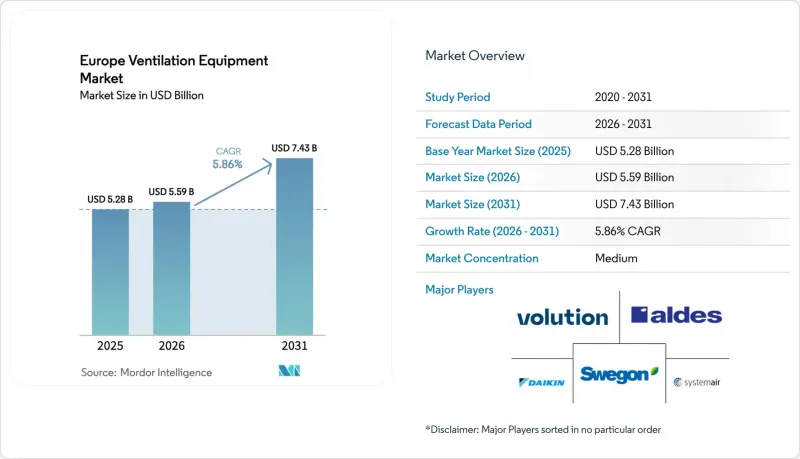
根據 Mordor Intelligence 預測,歐洲通風設備市場規模將從 2025 年的 52.8 億美元成長到 2026 年的 55.9 億美元,到 2031 年將達到 74.3 億美元,2026 年至 2031 年的複合年成長率為 5.86%。
本報告按設備類型(送風和排風系統、平衡式熱回收/能量回收裝置等)、通風方式(集中式風管系統等)、技術(熱回收、能量回收等)、終端用戶行業(住宅等)、應用領域(客廳/臥室、潮濕區域(廚房、浴室等))和國家/地區進行細分。市場預測以美元計價。
歐洲通風設備市場趨勢與洞察
能源效能指令 (EPBD) 強制執行更嚴格的能源效率標準。
修訂後的《能源性能指令》(EPBD)規定,自2030年起,建築能耗必須接近零能耗,並要求設計人員指定熱回收效率達到75%或以上的機械通風系統。德國正在積極執行這項規定,一些聯邦州已強制要求在超過四套單元的多用戶住宅項目中安裝熱回收系統。為實現每年3%的性能提升,相關法規推動了維修熱潮,促使人們傾向於選擇無需對管道系統進行大規模維修的分散式機械通風熱回收(MVHR)裝置。符合EN 15251和ISO 16814標準也促進了平衡式熱回收通風/能量回收通風(HRV/ERV)設備的普及,這些設備能夠證明其節能效果,從而滿足監管報告的要求。因此,歐洲通風設備市場,無論是住宅或商業領域,都在轉型為高效節能型設備。
後疫情時代,人們越來越關注職場的室內空氣品質。
歐洲疾病預防控制中心 (ECDC) 的最新指南將每人最低通風量提高至 10 公升/秒,要求現有辦公室提升通風能力。 SAP 和西門子等德國領導者正在部署與人體感應器連動的可變風量系統,優先考慮即時空氣品質數據而非單純的能耗指標。能夠報告顆粒物、二氧化碳和濕度水平的物聯網整合通風系統不再是奢侈品,而是正在成為標準配置。提供分析儀錶板的供應商更受青睞,這進一步加速了整個歐洲通風設備市場的數位化。
合格安裝技師和試運行技師短缺
該領域合格技術人員短缺約4萬人,導致工程工期平均延長8週,安裝成本增加25%至30%。德國的短缺情況最為嚴重,但整個北歐地區也有類似問題。複雜熱交換器(HRV)的平衡和數位化試運行需要專業技能,但目前的培訓項目無法滿足這項需求。製造商正透過即插即用設備和遠端試運行應用程式來解決這個問題,但這些限制仍然阻礙著歐洲通風設備市場的成長。
細分市場分析
至2025年,平衡式熱回收通風/能量回收通風設備將佔歐洲通風設備市場46.25%的佔有率。這主要得益於能源性能指令(EPBD)的實施,該指令促進了此類設備在新建築和維修項目中的應用。預計抽油煙機/爐具油煙機的複合年成長率將達到7.22%,主要受廚房整修和飯店餐飲業業務擴張的推動。
在強而有力的政策支持下,熱回收通風/能量回收通風系統(HRV/ERV)仍然是大金產品組合的核心組成部分。 2024年大金收購Robert Heath將進一步增強其產品組合的技術實力。單向風扇對於資料中心的定向氣流仍然至關重要,而送風和排風系統也繼續滿足工業領域的需求。這些趨勢正在推動歐洲通風設備市場轉型為能源回收技術。
至2025年,集中式風管系統將佔歐洲通風設備市場55.15%的佔有率,主要用於新建商業設施。混合模式通風預計將以6.88%的複合年成長率成長,這主要得益於建築管理軟體根據EN 16798標準最佳化自然通風和機械通風模式。
營運商優先考慮柔軟性,混合解決方案可在氣候溫和的季節降低能耗,同時在高峰時段保持室內空氣品質 (IAQ)。分散式空調機組在歷史建築和公共住宅的維修項目中越來越受歡迎,因為在這些項目中安裝管道系統並不現實。這些趨勢共同推動了銷售管道的多元化,並支撐了歐洲通風設備市場的持續成長。
其他好處:
- Excel格式的市場預測(ME)表
- 3個月的分析師支持
目錄
第1章:引言
- 研究假設和市場定義
- 調查範圍
第2章:調查方法
第3章執行摘要
第4章 市場狀況
- 市場概覽
- 市場促進因素
- 能源效能指令 (EPBD) 強制執行更嚴格的能源效率標準。
- 為解決公共住宅黴菌問題,一場快速的翻維修正在展開。
- 新冠疫情後,人們對職場室內空氣品質(IAQ)的關注度有所提高。
- 隨著電氣化進程的推進,對熱回收通風系統的需求也不斷成長。
- 維修工程中向分散式機械通風熱回收系統的過渡
- 隨著資料中心冷卻負荷的增加,需要精確的通風。
- 市場限制因素
- 合格安裝人員和試運行技術人員短缺
- 原物料價格波動推高了風扇和馬達的成本。
- 限制風管位置的建築消防安全法規
- 混合式自然-機械設計中橫排氣式的風險
- 產業價值鏈分析
- 監理情勢
- 技術展望
- 波特五力分析
- 分銷通路分析
- 宏觀經濟趨勢對市場的影響
第5章 市場規模與成長預測
- 依設備類型
- 空氣供應和排氣通風系統
- 平衡式 HRV/ERV 裝置
- 單向風扇(軸流式、離心式、屋頂式)
- 爐灶/炊具食品
- 通風方法
- 集中式風管系統
- 分散式室內機
- 混合(混合模式)解決方案
- 透過技術
- 熱回收通風(HRV)
- 能源回收通風(ERV)
- 正壓通氣(PIV)
- 機械排氣通風(MEV)
- 按最終用戶行業分類
- 住宅
- 商業和公共設施
- 工業設施
- 農業和受控環境
- 透過使用
- 客廳和臥室
- 濕式房間(廚房、浴室)
- 工藝/無塵室和資料中心
- 溫室和牲畜棚
- 國家
- 德國
- 英國
- 法國
- 義大利
- 西班牙
- 荷蘭
- 比利時
- 其他歐洲國家
第6章 競爭情勢
- 市場集中度
- 策略趨勢
- 市佔率分析
- 公司簡介
- Systemair AB
- Volution Group plc
- Aldes Aeraulique SA
- Daikin Industries Ltd.
- Swegon AB
- FlaktGroup Holding GmbH
- TROX GmbH
- Helios Ventilatoren GmbH+Co KG
- Zehnder Group AG
- Lindab International AB
- Soler and Palau Sistemas de Ventilacion SLU
- Rosenberg Ventilatoren GmbH
- Blauberg Ventilatoren GmbH
- Nuaire Ltd.
- Dantherm Group A/S
- Brink Climate Systems BV
- Vostermans Ventilation BV
- KCVENTS Industrial Ventilation Co., Ltd.
- Vent-Axia Ltd.
- VENTS Joint-Stock Company
- Airbox Lufttechnik GmbH
- EXHAUSTO A/S
第7章 市場機會與未來展望
According to Mordor Intelligence, the Europe ventilation equipment market size is expected to grow from USD 5.28 billion in 2025 to USD 5.59 billion in 2026 and is forecast to reach USD 7.43 billion by 2031 at 5.86% CAGR over 2026-2031.
This report is Segmented by Equipment Type (Supply/Exhaust Ventilation Systems, Balanced HRV/ERV Units, and More), Ventilation Mechanism (Centralised Ducted Systems, and More), Technology (HRV, ERV, and More), End-User Industry (Residential Buildings, and More), Application Area (Living and Sleeping Spaces, Wet Rooms, and More), and Country. The Market Forecasts are Provided in Terms of Value (USD).
Europe Ventilation Equipment Market Trends and Insights
Tightening EPBD-Mandated Energy-Efficiency Standards
The revised EPBD requires nearly zero-energy buildings from 2030, obliging designers to specify mechanical ventilation with heat-recovery efficiencies >=75%. Germany enforces the rule aggressively, with federal states mandating heat-recovery systems in multifamily projects exceeding four units. Renovation-wave provisions that target a 3% annual performance gain favor decentralized MVHR units, which avoid intrusive ductwork modifications. Compliance with EN 15251 and ISO 16814 supports uptake of balanced HRV/ERV equipment capable of documenting energy savings for regulatory reporting. As a result, the European ventilation equipment market is pivoting toward high-efficiency units across both residential and commercial segments.
Post-COVID Focus on Indoor Air Quality in Workplaces
Updated ECDC guidance raises minimum ventilation rates to 10 L/s-person, prompting capacity upgrades in existing offices. Large German employers such as SAP and Siemens have added variable-air-volume systems connected to occupancy sensors, valuing real-time air-quality data over pure energy metrics. IoT-integrated ventilation that reports particulate, CO2, and humidity levels is becoming standard rather than premium. Suppliers that bundle analytics dashboards with equipment gain preference, reinforcing digitization across the European ventilation equipment market.
Shortage of Certified Installers and Commissioning Engineers
The sector lacks roughly 40,000 qualified technicians, extending project schedules by eight weeks on average and raising installed costs by 25-30%. Germany experiences the deepest gap, but shortages are visible across Northern Europe. Complex HRV balancing and digital commissioning require specialist skills that current training pipelines cannot supply. Manufacturers respond with plug-and-play units and remote-commissioning apps, yet the constraint continues to moderate growth in the European ventilation equipment market.
Other drivers and restraints analyzed in the detailed report include:
- Electrification Driving Heat-Recovery Ventilation Demand
- Rapid Retrofit Wave for Mould Mitigation in Social Housing
- Volatile Raw-Material Prices Inflating Fan/Motor Costs
For complete list of drivers and restraints, kindly check the Table Of Contents.
Segment Analysis
Balanced HRV/ERV units accounted for 46.25% of the European ventilation equipment market size in 2025 as EPBD compliance drove adoption across construction and retrofit. Range/cooker hoods are projected to grow at a 7.22% CAGR, spurred by kitchen upgrades and expanding hospitality footprints.
Strong policy alignment means HRV/ERV will continue to anchor product mixes, with Daikin's 2024 purchase of Robert Heath adding technical depth to its portfolio. Unidirectional fans remain indispensable for directional airflow in data centers, while supply/exhaust systems sustain industrial demand. These trends reinforce value migration toward energy-recovery technologies within the European ventilation equipment market.
Centralized ducted systems captured a 55.15% share of the European ventilation equipment market size in 2025, mainly in new commercial builds. Hybrid mixed-mode ventilation is set to expand at a 6.88% CAGR as building-management software optimizes between natural and mechanical modes under EN 16798 guidelines.
Operators prioritize flexibility; hybrid solutions cut energy use in mild seasons yet uphold IAQ during high occupancy. Decentralized units thrive in historic or social-housing retrofits where ducts are impractical. Together, these patterns diversify channel demand and support the sustained expansion of the European ventilation equipment market.
Complete Report Scope:
- By Equipment Type
- Supply/Exhaust Ventilation Systems
- Balanced HRV/ERV Units
- Unidirectional Fans (Axial, Centrifugal, Roof)
- Range/Cooker Hoods
- By Ventilation Mechanism
- Centralised Ducted Systems
- Decentralised Room Units
- Hybrid (Mixed-Mode) Solutions
- By Technology
- Heat-Recovery Ventilation (HRV)
- Energy-Recovery Ventilation (ERV)
- Positive-Input Ventilation (PIV)
- Mechanical Extract Ventilation (MEV)
- By End-User Industry
- Residential Buildings
- Commercial and Institutional Buildings
- Industrial Facilities
- Agriculture and Controlled-Environment
- By Application Area
- Living and Sleeping Spaces
- Wet Rooms (Kitchens, Bathrooms)
- Process/Clean-Room and Data Centres
- Greenhouses and Livestock Housing
- By Country
- Germany
- United Kingdom
- France
- Italy
- Spain
- Netherlands
- Belgium
- Rest of Europe
List of Companies Covered in this Report:
- Systemair AB
- Volution Group plc
- Aldes Aeraulique S.A.
- Daikin Industries Ltd.
- Swegon AB
- FlaktGroup Holding GmbH
- TROX GmbH
- Helios Ventilatoren GmbH + Co KG
- Zehnder Group AG
- Lindab International AB
- Soler and Palau Sistemas de Ventilacion S.L.U.
- Rosenberg Ventilatoren GmbH
- Blauberg Ventilatoren GmbH
- Nuaire Ltd.
- Dantherm Group A/S
- Brink Climate Systems B.V.
- Vostermans Ventilation B.V.
- KCVENTS Industrial Ventilation Co., Ltd.
- Vent-Axia Ltd.
- VENTS Joint-Stock Company
- Airbox Lufttechnik GmbH
- EXHAUSTO A/S
Additional Benefits:
- The market estimate (ME) sheet in Excel format
- 3 months of analyst support
TABLE OF CONTENTS
1 INTRODUCTION
- 1.1 Study Assumptions and Market Definition
- 1.2 Scope of the Study
2 RESEARCH METHODOLOGY
3 EXECUTIVE SUMMARY
4 MARKET LANDSCAPE
- 4.1 Market Overview
- 4.2 Market Drivers
- 4.2.1 Tightening EPBD-mandated energy-efficiency standards
- 4.2.2 Rapid retrofit wave for mould-mitigation in social housing
- 4.2.3 Post-COVID focus on indoor air quality (IAQ) in workplaces
- 4.2.4 Electrification driving heat-recovery ventilation demand
- 4.2.5 Shift to decentralised MVHR in renovation projects
- 4.2.6 Growing data-centre cooling loads requiring precision ventilation
- 4.3 Market Restraints
- 4.3.1 Shortage of certified installers and commissioning engineers
- 4.3.2 Volatile raw-material prices inflating fan/motor costs
- 4.3.3 Building-fabric fire-safety rules limiting duct layouts
- 4.3.4 Cross-draft risks in hybrid natural-mechanical designs
- 4.4 Industry Value Chain Analysis
- 4.5 Regulatory Landscape
- 4.6 Technological Outlook
- 4.7 Porter's Five Forces Analysis
- 4.7.1 Bargaining Power of Suppliers
- 4.7.2 Bargaining Power of Consumers
- 4.7.3 Threat of New Entrants
- 4.7.4 Threat of Substitutes
- 4.7.5 Intensity of Competitive Rivalry
- 4.8 Distribution Channel Analysis
- 4.9 Impact of Macroeconomic Trends on the Market
5 MARKET SIZE AND GROWTH FORECASTS (VALUES)
- 5.1 By Equipment Type
- 5.1.1 Supply/Exhaust Ventilation Systems
- 5.1.2 Balanced HRV/ERV Units
- 5.1.3 Unidirectional Fans (Axial, Centrifugal, Roof)
- 5.1.4 Range/Cooker Hoods
- 5.2 By Ventilation Mechanism
- 5.2.1 Centralised Ducted Systems
- 5.2.2 Decentralised Room Units
- 5.2.3 Hybrid (Mixed-Mode) Solutions
- 5.3 By Technology
- 5.3.1 Heat-Recovery Ventilation (HRV)
- 5.3.2 Energy-Recovery Ventilation (ERV)
- 5.3.3 Positive-Input Ventilation (PIV)
- 5.3.4 Mechanical Extract Ventilation (MEV)
- 5.4 By End-User Industry
- 5.4.1 Residential Buildings
- 5.4.2 Commercial and Institutional Buildings
- 5.4.3 Industrial Facilities
- 5.4.4 Agriculture and Controlled-Environment
- 5.5 By Application Area
- 5.5.1 Living and Sleeping Spaces
- 5.5.2 Wet Rooms (Kitchens, Bathrooms)
- 5.5.3 Process/Clean-Room and Data Centres
- 5.5.4 Greenhouses and Livestock Housing
- 5.6 By Country
- 5.6.1 Germany
- 5.6.2 United Kingdom
- 5.6.3 France
- 5.6.4 Italy
- 5.6.5 Spain
- 5.6.6 Netherlands
- 5.6.7 Belgium
- 5.6.8 Rest of Europe
6 COMPETITIVE LANDSCAPE
- 6.1 Market Concentration
- 6.2 Strategic Moves
- 6.3 Market Share Analysis
- 6.4 Company Profiles (includes Global level Overview, Market level Overview, Core Segments, Financials as available, Strategic Information, Market Rank/Share, Products and Services, Recent Developments)
- 6.4.1 Systemair AB
- 6.4.2 Volution Group plc
- 6.4.3 Aldes Aeraulique S.A.
- 6.4.4 Daikin Industries Ltd.
- 6.4.5 Swegon AB
- 6.4.6 FlaktGroup Holding GmbH
- 6.4.7 TROX GmbH
- 6.4.8 Helios Ventilatoren GmbH + Co KG
- 6.4.9 Zehnder Group AG
- 6.4.10 Lindab International AB
- 6.4.11 Soler and Palau Sistemas de Ventilacion S.L.U.
- 6.4.12 Rosenberg Ventilatoren GmbH
- 6.4.13 Blauberg Ventilatoren GmbH
- 6.4.14 Nuaire Ltd.
- 6.4.15 Dantherm Group A/S
- 6.4.16 Brink Climate Systems B.V.
- 6.4.17 Vostermans Ventilation B.V.
- 6.4.18 KCVENTS Industrial Ventilation Co., Ltd.
- 6.4.19 Vent-Axia Ltd.
- 6.4.20 VENTS Joint-Stock Company
- 6.4.21 Airbox Lufttechnik GmbH
- 6.4.22 EXHAUSTO A/S
7 MARKET OPPORTUNITIES AND FUTURE OUTLOOK
- 7.1 White-space and Unmet-Need Assessment

 附篩網通風帽市場-2026年至2032年全球市場預測
 美國通風市場(2026 年)
 住宅通風系統:市場佔有率分析、產業趨勢與統計、成長預測(2026-2031)
 智慧通風系統市場分析及預測(至2035年):類型、產品、技術、組件、應用、最終用戶、功能、安裝類型、解決方案印度通風設備市場:2026 年
 不銹鋼通風過濾器市場預測至2034年-按產品類型、過濾器等級、最終用戶和地區分類的全球分析
 2026年全球美髮沙龍通風系統市場報告防霧霾新風通風扇市場:依產品類型、安裝方式、過濾技術、應用領域、最終用戶分類,全球預測(2026-2032年)全球屋頂上吹式通風扇市場(按通風扇類型、最終用途產業、驅動類型、材料、安裝類型和風量分類)預測(2026-2032年)商用噴射擴散器市場按類型、材料、應用、分銷管道和最終用戶分類,全球預測(2026-2032)