

 |
市場調查報告書
商品編碼
2124737
歐洲數位交易管理(DTM):市場佔有率分析、行業趨勢和統計數據以及成長預測(2026-2031 年)Europe Digital Transaction Management (DTM) - Market Share Analysis, Industry Trends & Statistics, Growth Forecasts (2026 - 2031) |
||||||

※ 本網頁內容可能與最新版本有所差異。詳細情況請與我們聯繫。
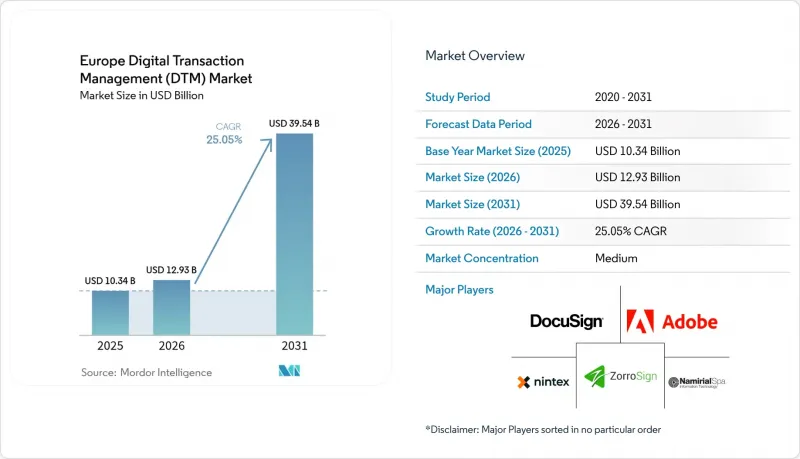
據 Mordor Intelligence 稱,歐洲數位交易管理市場預計到 2026 年價值將達到 129.3 億美元,高於 2025 年的 103.4 億美元,預計到 2031 年將達到 395.4 億美元。
預計 2026 年至 2031 年的複合年成長率為 25.05%。
本報告按組件(解決方案、服務)、部署模式(雲端、本地部署、其他)、組織規模(中小企業、大型企業)、最終用戶行業(銀行、金融服務和保險、醫療保健和生命科學、零售和電子商務、其他)以及國家/地區進行細分。市場預測以美元 (USD) 為單位。
歐洲數位交易管理 (DTM) 市場的趨勢和洞察
電子簽章和雲端採用率的提高
歐洲立法機構預測,電子簽章服務收入將維持25%的年穩定成長,這將進一步推動雲端模式的發展。目前,雲端模式已佔交易總量的77.70%,預計到2030年將成為複合年成長率最高的領域。北歐各國政府正大力推動公共服務的無紙化,丹麥已取消了與公民互動的大部分紙本選項,瑞典也正朝著無現金經濟邁進。 eIDAS 2.0透過批准在歐盟認證的信任服務下簽發的遠端簽名,消除了跨境壁壘。銀行、金融和保險(BFSI)產業的相關人員也依賴雲端的可擴展性,在規定的10秒內驗證即時支付,雲端架構正成為泛歐信任服務的實際基礎。
推動中小企業實現端到端工作流程自動化
中小企業佔歐洲企業總數的99%以上,但數位化合規的負擔卻高達530億歐元。歐盟「數位歐洲基金」的定向支持正在部分抵消這些成本,並以26.50%的複合年成長率推動中小企業採用數位化技術。像Visma這樣的綜合性公司正在透過收購將KYC、發票和簽章功能打包承包解決方案的利基平台來應對這一趨勢。如今,72%的中小企業依賴數據驅動的決策工具,對基於訂閱的無程式碼自動化的需求正從單純的便利轉變為生存的必需品。
人們持續擔憂資料隱私和網路風險
即時支付要求在 10 秒內完成交易處理,但在許多情況下,它們還必須遵守 GDPR 的資料最小化規則,該規則要求資料儲存在國內。隨著 NIS2 指令擴大了資料外洩通知義務並提高了處罰力度,許多銀行正在部署基於人工智慧的異常檢測系統,以便在不違反隱私限制的情況下應對日益增多的詐欺試驗。中小企業尤其難以聘請專業的安全人員,凸顯了將供應商提供的合規功能整合到平台中的必要性。
細分市場分析
到2025年,解決方案將佔據歐洲數位交易管理市場70.85%的佔有率。這主要得益於將簽章、身分驗證、工作流程和稽核功能整合到單一授權中的平台。儘管服務領域的市佔率較小,但其複合年成長率高達23.15%,這主要歸功於企業將複雜營運外包給託管服務供應商的趨勢日益成長,而這又受到eIDAS錢包整合和即時結算強制實施的推動。供應商正在將人工智慧應用於自動化文件分類、身份驗證和警報觸發,從而減輕員工負擔,並確保解決方案收入在總支出中保持主導地位,即使服務業務快速擴張。
監管實施後,諮詢需求達到高峰,之後平台使用費成為永續的收入來源。在歐洲健康數據空間框架下資助的醫療保健項目會獲得專項預算撥款,用於整合經認證的信任服務,從而確保簽訂多年期平台合約。因此,歐洲領先的軟體公司正在收購利基服務提供商,以確保獲得實施人才並保持其在平台上的主導地位。
2025年,雲端解決方案將佔歐洲市場規模的78.15%,複合年成長率達27.95%,推動企業從本地部署架構遷移到雲端。雲端服務供應商提供即時合規性更新、地理圍欄資料中心和延遲保證,這些功能在本地環境中難以實現,成本高昂。監管機構要求全天候即時結算運作,進一步加速了向彈性雲端資源的遷移,這些資源能夠在處理量激增時自動擴展。
對於希望將核心帳本資料保留在本地,同時將面向客戶的營運業務遷移到雲端的金融機構而言,混合環境仍然是一條可行的遷移路徑。然而,即便如此,稽核追蹤和簽章檢驗通常仍然依賴託管環境。北歐國家完全基於雲端建構的政府入口網站已經證明,在保持強大的隱私保護的同時,可以大規模地經營全國性的數位服務。其他一些先前落後的國家現在也正在推行類似的舉措。
其他好處:
- Excel格式的市場預測(ME)表
- 3個月的分析師支持
目錄
第1章:引言
- 研究假設和市場定義
- 調查範圍
第2章:調查方法
第3章執行摘要
第4章 市場狀況
- 市場概覽
- 市場促進因素
- 電子簽章和雲端採用率的提高
- 中小企業為端到端工作流程自動化所做的努力
- 歐盟的 eIDAS 2.0 和 PSD3 正在加速可信任服務的發展。
- 新冠疫情後向數位化工作流程的永久過渡
- 歐盟範圍內強制實施企業對企業電子帳單
- 即時支付網路正在推動對即時桌面音樂 (DTM) 的需求。
- 市場限制因素
- 人們對資料隱私和網路風險的擔憂依然存在。
- 高昂的整合成本和變更管理成本
- 不同國家電子識別系統碎片化阻礙了互通性。
- 中小企業貸款的收緊正在減緩技術更新換代的週期。
- 價值鏈分析
- 監理情勢
- 技術展望
- 波特五力分析
- 宏觀經濟因素的影響
第5章 市場規模與成長預測
- 按組件
- 解決方案
- 服務
- 按實現類型
- 雲
- 現場
- 混合
- 按組織規模
- 小型企業
- 大公司
- 按最終用戶行業分類
- BFSI
- 醫療保健和生命科學
- 零售與電子商務
- IT/通訊
- 政府/公共部門
- 房地產和建築
- 汽車與出行
- 國家
- 英國
- 德國
- 法國
- 西班牙
- 義大利
- 其他歐洲國家
第6章 競爭情勢
- 市場集中度
- 策略趨勢
- 市佔率分析
- 公司簡介
- Adobe Inc.
- DocuSign Inc.
- Namirial SpA
- InfoCert SpA(Tinexta SpA)
- Signicat AS
- Scrive AB
- PandaDoc Inc.
- Dropbox Sign(HelloSign)
- airSlate Inc.(SignNow)
- Nintex UK Ltd
- Mitratech Holdings Inc.
- AssureSign LLC(Equifax)
- Topaz Systems Inc.
- ZorroSign Inc.
- OneSpan Inc.
- Entrust Corporation
- eMudhra Ltd.
- Universign SAS
- Kofax Inc.
- Nitro Software Ltd.
第7章 市場機會與未來展望
According to Mordor Intelligence, Europe digital transaction management market size in 2026 is estimated at USD 12.93 billion, growing from 2025 value of USD 10.34 billion with 2031 projections showing USD 39.54 billion, growing at 25.05% CAGR over 2026-2031.
This report is Segmented by Component (Solutions, Services), Deployment Mode (Cloud, On-Premise, and More), Organisation Size (Small and Medium Enterprises, Large Enterprises), End-User Industry (BFSI, Healthcare and Life Sciences, Retail and E-Commerce, and More), and Country. The Market Forecasts are Provided in Terms of Value (USD).
Europe Digital Transaction Management (DTM) Market Trends and Insights
Rise in e-signatures and cloud adoption
European legislators project stable 25% yearly revenue gains for e-signature services, propelling cloud models that already hold 77.70% of transactions and register the fastest CAGR through 2030. Nordic governments showcase near-paperless public services, with Denmark eliminating hard-copy options for most citizen interactions and Sweden nearing a cash-free economy. eIDAS 2.0 removes cross-border friction by recognising remote signatures issued under any qualified EU trust service. BFSI stakeholders also depend on cloud scalability to authenticate instant payments within the mandated 10 seconds, cementing cloud architecture as the de facto backbone of pan-European trust services.
SME push for end-to-end workflow automation
SMEs account for over 99% of European businesses yet carry a EUR 53 billion digital-compliance burden. Targeted EU Digital Europe funds partially offset those costs and are catalysing 26.50% CAGR uptake among smaller firms. Consolidators such as Visma have responded by acquiring niche platforms that package KYC, invoicing and signing features into turnkey bundles. As 72% of SMEs now rely on data-driven decision tools, the demand for subscription-based, no-code automation has evolved from a convenience to a survival requirement .
Persistent data-privacy and cyber-risk concerns
Real-time payments demand 10-second clearing and yet must honour GDPR data-minimisation rules that often require data residency within national borders. The NIS2 directive widens breach-notification duties and raises fines, leading many banks to deploy AI-based anomaly detection that can handle rising fraud attempts without infringing privacy constraints. Smaller firms particularly struggle to finance specialist security skills, underscoring the need for vendor-provided compliance capabilities baked into platforms.
Other drivers and restraints analyzed in the detailed report include:
- EU eIDAS 2.0 and PSD3 accelerating trust services
- Post-COVID permanent shift to digital workflows
- High integration and change-management costs
For complete list of drivers and restraints, kindly check the Table Of Contents.
Segment Analysis
Solutions accounted for 70.85% of the Europe Digital Transaction Management market share in 2025 on the back of platforms that bundle signing, identity, workflow and audit functions under one licence. The services slice is smaller but rising at 23.15% CAGR as organisations outsource complexity to managed providers, especially for eIDAS wallet integration and instant-payment obligations. Vendors embed AI to auto-classify documents, verify identities and trigger alerts, reducing staff overheads and ensuring that solutions revenue continues to dominate absolute spend even while services expand faster.
Demand for consulting peaks during regulation roll-outs, after which recurring platform fees drive sustained revenue. Healthcare projects funded under the European Health Data Space allocate budget specifically to qualified trust-service integration, thereby locking in multi-year platform contracts. European software majors are consequently acquiring niche service firms to secure implementation talent and defend platform primacy.
Cloud solutions held 78.15% of the Europe Digital Transaction Management market size in 2025 and are growing at 27.95% CAGR, reinforcing the architectural pivot away from on-premise. Providers offer real-time compliance updates, geo-fenced data centres and latency guarantees that on-premise installs find costly to replicate. Regulatory requirements for 24/7 instant-payment uptime further tilt adoption toward elastic cloud resources that can auto-scale during volume spikes.
Hybrid remains a transition path for financial institutions that wish to retain core-ledger data locally while routing customer-facing activity to the cloud. Nevertheless, even in these cases audit trails and signature verification often reside in managed environments. Nordic government portals, built completely in the cloud, supply proof points that nationwide digital services can run at scale with strong privacy safeguards, causing lagging countries to follow suit.
Complete Report Scope:
- By Component
- Solutions
- Services
- By Deployment Mode
- Cloud
- On-premise
- Hybrid
- By Organisation Size
- Small and Medium Enterprises
- Large Enterprises
- By End-user Industry
- BFSI
- Healthcare and Life Sciences
- Retail and E-commerce
- IT and Telecommunication
- Government and Public Sector
- Real-Estate and Construction
- Automotive and Mobility
- By Country
- United Kingdom
- Germany
- France
- Spain
- Italy
- Rest of Europe
List of Companies Covered in this Report:
- Adobe Inc.
- DocuSign Inc.
- Namirial SpA
- InfoCert SpA (Tinexta SpA)
- Signicat AS
- Scrive AB
- PandaDoc Inc.
- Dropbox Sign (HelloSign)
- airSlate Inc. (SignNow)
- Nintex UK Ltd
- Mitratech Holdings Inc.
- AssureSign LLC (Equifax)
- Topaz Systems Inc.
- ZorroSign Inc.
- OneSpan Inc.
- Entrust Corporation
- eMudhra Ltd.
- Universign SAS
- Kofax Inc.
- Nitro Software Ltd.
Additional Benefits:
- The market estimate (ME) sheet in Excel format
- 3 months of analyst support
TABLE OF CONTENTS
1 INTRODUCTION
- 1.1 Study Assumptions and Market Definition
- 1.2 Scope of the Study
2 RESEARCH METHODOLOGY
3 EXECUTIVE SUMMARY
4 MARKET LANDSCAPE
- 4.1 Market Overview
- 4.2 Market Drivers
- 4.2.1 Rise in e-signatures and cloud adoption
- 4.2.2 SME push for end-to-end workflow automation
- 4.2.3 EU eIDAS 2.0 and PSD3 accelerating trust services
- 4.2.4 Post-COVID permanent shift to digital workflows
- 4.2.5 Mandatory B2B e-invoicing roll-outs across EU
- 4.2.6 Instant-payment rails driving real-time DTM demand
- 4.3 Market Restraints
- 4.3.1 Persistent data-privacy and cyber-risk concerns
- 4.3.2 High integration and change-management costs
- 4.3.3 Fragmented national eID schemes hinder interoperability
- 4.3.4 Tight SME financing slows tech refresh cycles
- 4.4 Value Chain Analysis
- 4.5 Regulatory Landscape
- 4.6 Technological Outlook
- 4.7 Porter's Five Forces Analysis
- 4.7.1 Threat of New Entrants
- 4.7.2 Bargaining Power of Buyers
- 4.7.3 Bargaining Power of Suppliers
- 4.7.4 Threat of Substitutes
- 4.7.5 Intensity of Competitive Rivalry
- 4.8 Impact of Macroeconomic Factors
5 MARKET SIZE AND GROWTH FORECASTS (VALUE)
- 5.1 By Component
- 5.1.1 Solutions
- 5.1.2 Services
- 5.2 By Deployment Mode
- 5.2.1 Cloud
- 5.2.2 On-premise
- 5.2.3 Hybrid
- 5.3 By Organisation Size
- 5.3.1 Small and Medium Enterprises
- 5.3.2 Large Enterprises
- 5.4 By End-user Industry
- 5.4.1 BFSI
- 5.4.2 Healthcare and Life Sciences
- 5.4.3 Retail and E-commerce
- 5.4.4 IT and Telecommunication
- 5.4.5 Government and Public Sector
- 5.4.6 Real-Estate and Construction
- 5.4.7 Automotive and Mobility
- 5.5 By Country
- 5.5.1 United Kingdom
- 5.5.2 Germany
- 5.5.3 France
- 5.5.4 Spain
- 5.5.5 Italy
- 5.5.6 Rest of Europe
6 COMPETITIVE LANDSCAPE
- 6.1 Market Concentration
- 6.2 Strategic Moves
- 6.3 Market Share Analysis
- 6.4 Company Profiles (includes Global level Overview, Market level overview, Core Segments, Financials as available, Strategic Information, Market Rank/Share, Products and Services, Recent Developments)
- 6.4.1 Adobe Inc.
- 6.4.2 DocuSign Inc.
- 6.4.3 Namirial SpA
- 6.4.4 InfoCert SpA (Tinexta SpA)
- 6.4.5 Signicat AS
- 6.4.6 Scrive AB
- 6.4.7 PandaDoc Inc.
- 6.4.8 Dropbox Sign (HelloSign)
- 6.4.9 airSlate Inc. (SignNow)
- 6.4.10 Nintex UK Ltd
- 6.4.11 Mitratech Holdings Inc.
- 6.4.12 AssureSign LLC (Equifax)
- 6.4.13 Topaz Systems Inc.
- 6.4.14 ZorroSign Inc.
- 6.4.15 OneSpan Inc.
- 6.4.16 Entrust Corporation
- 6.4.17 eMudhra Ltd.
- 6.4.18 Universign SAS
- 6.4.19 Kofax Inc.
- 6.4.20 Nitro Software Ltd.
7 MARKET OPPORTUNITIES AND FUTURE OUTLOOK
- 7.1 White-space and Unmet-need Assessment

 數位交易管理(DTM):市場佔有率分析、行業趨勢和統計數據、成長預測(2026-2031)
 數位交易管理市場:依部署模式、組件、產業及企業規模分類-2026-2032年全球市場預測
 數位交易管理市場:按組件和地區分類
 全球數位交易管理市場規模、佔有率、趨勢和成長分析報告(2026-2034)
 數位交易管理市場-全球產業規模、佔有率、趨勢、機會、預測:按解決方案、組件、最終用戶、地區和競爭對手分類,2021-2031年
 數位交易管理市場規模、佔有率和成長分析(按組件、解決方案、部署模式、最終用戶、垂直產業和地區分類)-2026-2033年產業預測
 2025年數位交易管理全球市場報告
 全球數位交易管理市場數位交易管理市場,2026-2032:按組件、部署模型、垂直產業和地區分類
 數位交易管理市場規模、佔有率、趨勢分析報告:按組件、按解決方案、按最終用戶、按行業、按地區、細分市場預測,2025-2030 年