


 |
市場調查報告書
商品編碼
2123271
數位交易管理(DTM):市場佔有率分析、行業趨勢和統計數據、成長預測(2026-2031)Digital Transaction Management (DTM) - Market Share Analysis, Industry Trends & Statistics, Growth Forecasts (2026 - 2031) |
||||||

※ 本網頁內容可能與最新版本有所差異。詳細情況請與我們聯繫。
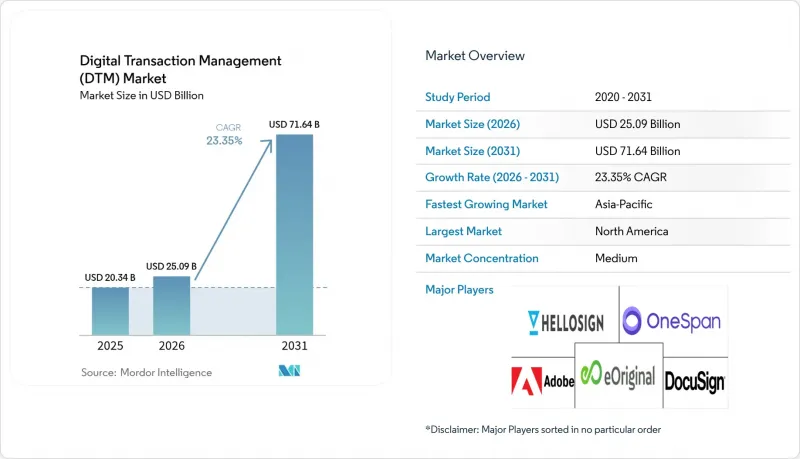
據 Mordor Intelligence 稱,2025 年數位交易管理市場價值為 203.4 億美元,預計將從 2026 年的 250.9 億美元成長到 2031 年的 716.4 億美元。
預測期(2026-2031 年)的複合年成長率預計為 23.35%。
本報告按組件(解決方案、服務)、部署模式(雲端、本地部署)、組織規模(中小企業、大型企業)、最終用戶行業(銀行、金融服務和保險、醫療保健和生命科學等)以及地區進行細分。市場預測以價值(美元)表示。
全球數位交易管理 (DTM) 市場趨勢與洞察
加快受監管產業採用電子簽章
目前,美國已有43個州根據選舉規則認可電子簽章,運輸部正在最終敲定一項擬議修正案,以在法律上認可藥物檢測記錄中的電子認證。這些先例消除了人們對法律公開性的疑慮,並表明企業可以在確保合規的前提下,將文件處理週期縮短75%。例如,大規模醫療機構正在使用合格的電子簽章來同步跨州的知情同意書,避免了郵寄延誤,從而提高了患者滿意度並減輕了行政負擔。
銀行、金融服務和保險機構以及政府機構向合約生命週期端到端自動化轉型
銀行同時處理超過2萬份有效契約,若缺乏有效監管,可能面臨高達9%的收入損失。基於區塊鏈的「花旗代幣服務」的推出,展現了即時支付如何降低營運風險,並為負責人帶來營運資金效益。政府機構也紛紛效仿,將採購文件集中到一個搜尋的儲存庫中,以實現近乎即時的政策審計並減少詐欺行為。這些發展凸顯了為何超越簡單電子簽章的全面自動化正成為資訊長預算中的必要措施。
關於複雜跨境加密簽名的法規
儘管eIDAS認可「合格電子簽章」具有最高的證據效力,但在歐盟以外的地區,相互認可仍然不均衡(helpx.adobe.com)。此外,諸如GDPR之類的資料主權法規與美國《雲端法案》規定的域外應用要求存在衝突(isaca.org)。這種分散的局面增加了法律諮詢成本,延緩了旨在支持跨國工作流程的供應商的上市計劃,並最終減緩了數位交易管理市場的短期成長。
細分市場分析
2025年,解決方案業務佔總營收的69.25%,但預計到2031年,服務業務的複合年成長率將達到27.62%,成為數位交易管理市場中成長最快的領域。金融機構在升級舊有系統時往往缺乏內部監管方面的專業知識,這推動了對整合、合規和託管支援的需求。在2024年的一項案例研究中,一個顧問團隊將電子簽章工作流程與核心銀行帳簿整合,從而減少了處理錯誤和營運成本。
解決方案領域並未停滯不前。區塊鏈模組整合了防篡改的審計追蹤功能,而人工智慧驅動的分類功能則實現了資料收集的自動化。供應商正在發布行業專屬模板,這些模板能夠立即滿足 HIPAA 和 SOC 2 合規性要求,從而加快醫療保健和金融行業客戶的價值實現速度。然而,關鍵任務工作流程的複雜性使得企業仍需要依賴外部專家,這也推動了業務收益的成長。
到2025年,雲端平台將佔據75.40%的市場。考慮到當年25.6%的複合年成長率,雲端採用的數位交易管理市場規模在2031年之前就可能翻倍。企業正在優先考慮基於訂閱的收費系統、快速部署以及通過ISO 27001和FedRAMP認證的資料中心。多重雲端架構透過將敏感資料路由到本地主權雲,同時在公共基礎架構上保持突發容量,從而在敏捷性和合規性之間取得平衡。
儘管在國防、關鍵基礎設施和部分金融機構中仍能看到本地部署,但即使是這些用戶也開始採用混合控制平面,在防火牆後複製雲端功能。隨著加密金鑰管理、敏感運算和零信任框架的日趨成熟,對全面雲端遷移的阻力將會降低,雲端採用率的上升趨勢也將持續下去。
區域分析
到2025年,北美將佔數位交易管理市場收入的29.85%。電子記錄相關法律法規的明確性正在推動私營和聯邦部門的電子記錄應用。美國運輸部提出的電子藥物檢測表格規則表明,數位信任監管正在不斷加強(federalregister.gov)。同樣,美國醫療保健合規藍圖也在加速電子記錄的普及,醫療服務提供者正利用符合HIPAA標準的電子簽章系統來簡化計費流程(iclg.com)。總部位於該地區的技術供應商正在不斷部署人工智慧技術,以提升服務品質並使其更高的授權費用更具合理性。
亞太地區是成長最快的市場,年複合成長率高達27.8%。全球超過一半的數位支付都在該地區完成,預計到2027年,B2C電子商務規模將超過4兆歐元(4.3兆美元)(tmcnet.com)。印度的統一支付介面(UPI)目標是每年處理超過2000億筆交易,這將推動對高度擴充性的簽名引擎的需求。飯店、物流和政府部門也擴大採用數位契約,以適應行動優先的消費者需求。儘管監管方面仍存在一些不一致之處,但像印尼這樣的國家只要滿足基本同意原則,就承認數位合約(mondaq.com),這表明監管正在逐步趨於統一。
在歐洲,統一的eIDAS系統確保經認證的電子簽章與手寫簽章具有同等效力(helpx.adobe.com)。即將推出的eDAS 2.0法規和歐盟數位身分錢包將實現無縫的跨境簽名,並進一步增強市場信心。拉丁美洲、中東和非洲的基準較小,但成長率很高。巴西和海灣國家的政府數位化項目,以及不斷擴大的寬頻接入,正在為這些地區的數位交易管理行業創造有利環境。
其他好處:
- Excel格式的市場預測(ME)表
- 3個月的分析師支持
目錄
第1章:引言
- 研究假設和市場定義
- 調查範圍
第2章:調查方法
第3章執行摘要
第4章 市場狀況
- 市場概覽
- 市場促進因素
- 在受監管行業中,電子簽章的應用正在加速。
- 銀行、金融服務和保險機構以及政府機構向合約生命週期端到端自動化轉型
- 強制遠距辦公正在推動基於雲端的數位音樂製作 (DTM) 軟體的普及。
- 生成式人工智慧助理可縮短文件處理時間
- 透過「ClickWrap」服務條款協議提升亞洲電子商務轉換率
- 數位身分框架(eIDAS 2.0、Aadhaar、NID)正在推動其廣泛應用。
- 市場限制因素
- 關於複雜跨境電子簽章的法規
- 新興市場合格遠距身分驗證高成本
- 碎片化、傳統的銀行核心工作流程阻礙了全面自動化。
- 5G部署有限/農村地區邊緣基礎設施發展落後阻礙了行動DTM的使用擴展。
- 價值鏈分析
- 技術展望
- 波特五力分析
- 宏觀經濟趨勢影響評估
- 投資分析
第5章 市場規模與成長預測
- 按組件
- 解決方案
- 服務
- 部署模式
- 雲
- 現場
- 按組織規模
- 小型企業
- 大公司
- 按最終用戶行業分類
- 銀行業、金融服務業及保險業
- 醫療保健和生命科學
- 零售與電子商務
- 政府/公共部門
- 資訊科技/通訊
- 教育
- 其他終端用戶產業
- 按地區
- 北美洲
- 美國
- 加拿大
- 墨西哥
- 歐洲
- 英國
- 德國
- 法國
- 義大利
- 其他歐洲國家
- 亞太地區
- 中國
- 日本
- 印度
- 韓國
- 其他亞太國家
- 南美洲
- 巴西
- 阿根廷
- 其他南美國家
- 中東
- 阿拉伯聯合大公國
- 沙烏地阿拉伯
- 其他中東國家
- 非洲
- 南非
- 其他非洲國家
- 北美洲
第6章 競爭情勢
- 市場集中度
- 策略趨勢
- 市佔率分析
- 公司簡介
- Adobe Inc.
- DocuSign, Inc.
- Dropbox, Inc.
- Nintex Global Ltd.
- Namirial SpA
- OneSpan Inc.
- Wolters Kluwer NV
- Entrust Corporation
- SignEasy Inc.
- Mitratech Holdings Inc.
- Sertifi, Inc.
- Thales Group(Gemalto NV)
- Nitro Software Ltd.
- airSlate Inc.
- PandaDoc Inc.
- Conga(Apttus Corporation)
- Zoho Corporation Pvt. Ltd.
- ZorroSign, Inc.
- Topaz Systems Inc.
- InfoCert SpA
- AssureSign LLC
- eOriginal, Inc.
第7章 市場機會與未來展望
According to Mordor Intelligence, the digital transaction management market size was valued at USD 20.34 billion in 2025 and estimated to grow from USD 25.09 billion in 2026 to reach USD 71.64 billion by 2031, at a CAGR of 23.35% during the forecast period (2026-2031).
This report is Segmented by Component (Solutions, Services), Deployment Mode (Cloud, On-Premise), Organization Size (Small and Medium Enterprises, Large Enterprises), End-User Industry (Banking, Financial Services and Insurance, Healthcare and Life Sciences, and More), and Geography. The Market Forecasts are Provided in Terms of Value (USD).
Global Digital Transaction Management (DTM) Market Trends and Insights
Accelerating E-Signature Adoption Across Regulated Industries
U.S. election rules now allow e-signatures in 43 states, and the Department of Transportation is finalizing amendments that treat electronic attestations as legally valid for drug-testing records. These precedents demonstrate how statutory openness removes residual skepticism, letting enterprises shorten document cycles by 75% while maintaining compliance. Large health providers, for example, rely on qualified electronic signatures to synchronize cross-state consent forms without postal delays, thereby elevating patient satisfaction and trimming administrative overhead.
Shift Toward End-to-End Contract Lifecycle Automation in BFSI and Government
Banks process more than 20,000 active contracts simultaneously, exposing them to revenue leakage of up to 9% when oversight is weak. The rollout of blockchain-backed Citi Token Services shows how real-time settlement can shrink operational risk and unlock working-capital benefits for treasurers. Government agencies follow suit by centralizing procurement documents into searchable repositories, enabling near-instant policy audits and mitigating fraud. Together, these moves underscore why holistic automation-beyond simple e-signatures-is becoming mandatory budgeting line-item for CIOs.
Complex Cross-Border Crypto-Signature Regulations
eIDAS assigns top evidentiary weight to Qualified Electronic Signatures, yet mutual recognition outside the EU remains uneven (helpx.adobe.com). Additionally, data sovereignty mandates such as GDPR conflict with extraterritorial requests under the US CLOUD Act (isaca.org). This patchwork raises legal counsel costs and elongates go-to-market plans for providers trying to support multinational workflows, therefore tempering the digital transaction management market's near-term acceleration.
Other drivers and restraints analyzed in the detailed report include:
- Generative-AI Assistants Reducing Document Turn-Around Times
- Digital Identity Frameworks Catalyzing Adoption
- Limited 5G / Edge Infrastructure in Rural Areas Slowing Mobile DTM Usage
For complete list of drivers and restraints, kindly check the Table Of Contents.
Segment Analysis
Solutions generated 69.25% of 2025 revenue, but services are forecast to expand at a 27.62% compound rate to 2031, the highest within the digital transaction management market. Financial institutions upgrading legacy stacks often lack in-house regulatory expertise, fueling demand for integration, compliance, and managed support. Example engagements in 2024 reduced processing errors and operating expense when consultancy teams unified e-signature workflows with core banking ledgers.
The solutions category is not stagnant; blockchain modules embed immutable audit trails while AI classification automates data capture. Vendors release vertical-specific templates that satisfy HIPAA and SOC 2 out-of-the-box, shortening time-to-value for healthcare and finance clients. Nevertheless, the intricate nature of mission-critical workflows implies ongoing reliance on external specialists, which sustains the services revenue curve.
Cloud platforms held 75.40% share in 2025, and their 25.6% CAGR means the digital transaction management market size for cloud deployments could double well before 2031. Enterprises value subscription pricing, rapid provisioning, and certified data centers that pass ISO 27001 and FedRAMP audits. Multi-cloud architectures now route sensitive data to local sovereign clouds while reserving burst capacity on public infrastructure, balancing agility with compliance.
On-premise installations still exist for defense, critical infrastructure, and select financial institutions, yet even these buyers adopt hybrid control planes that mirror cloud features behind the firewall. As encryption key management, confidential computing, and zero-trust frameworks mature, resistance to full cloud conversion will erode, maintaining the upward bias in cloud uptake.
Complete Report Scope:
- By Component
- Solutions
- Services
- By Deployment Mode
- Cloud
- On-premise
- By Organization Size
- Small and Medium Enterprises
- Large Enterprises
- By End-user Industry
- Banking, Financial Services and Insurance
- Healthcare and Life Sciences
- Retail and E-commerce
- Government and Public Sector
- IT and Telecommunications
- Education
- Other End-user Industries
- By Geography
- North America
- United States
- Canada
- Mexico
- Europe
- United Kingdom
- Germany
- France
- Italy
- Rest of Europe
- Asia-Pacific
- China
- Japan
- India
- South Korea
- Rest of Asia-Pacific
- South America
- Brazil
- Argentina
- Rest of South America
- Middle East
- United Arab Emirates
- Saudi Arabia
- Rest of Middle East
- Africa
- South Africa
- Rest of Africa
- North America
Geography Analysis
North America generated 29.85% of digital transaction management market revenue in 2025. Mature legal clarity around electronic records encourages both private-sector and federal adoption. The U.S. Department of Transportation's pending rule on electronic drug-testing forms demonstrates continuous regulatory reinforcement of digital trust (federalregister.gov). Healthcare compliance roadmaps in the United States similarly accelerate usage, as providers exploit HIPAA-compatible e-signature stacks to streamline claims (iclg.com). Technology vendors headquartered in the region continue to roll out AI features that differentiate service quality and justify premium licensing.
Asia-Pacific is the fastest-growing arena with a 27.8% CAGR. The region processes more than half of the world's digital payments, and B2C e-commerce is projected to exceed EUR 4 trillion (USD 4.3 trillion) by 2027 (tmcnet.com). India's Unified Payments Interface aims beyond 200 billion annual transactions, intensifying demand for scalable signature engines. Hospitality, logistics, and public administration segments likewise embrace digital contracts to keep pace with a mobile-first consumer base. Regulatory heterogeneity remains, yet countries such as Indonesia recognize digital contracts provided core consent principles are satisfied (mondaq.com), signaling gradual convergence.
Europe benefits from the harmonized eIDAS regime, where qualified electronic signatures hold equivalence with handwritten ones (helpx.adobe.com). The forthcoming eIDAS 2.0 provisions and the EU Digital Identity Wallet promise seamless cross-border signing, reinforcing market confidence. Latin America and the Middle East and Africa record smaller baselines but high growth rates. Government digitization programs in Brazil and Gulf economies, coupled with expanding broadband access, create favorable conditions for the digital transaction management industry in those territories.
- Adobe Inc.
- DocuSign, Inc.
- Dropbox, Inc.
- Nintex Global Ltd.
- Namirial S.p.A.
- OneSpan Inc.
- Wolters Kluwer N.V.
- Entrust Corporation
- SignEasy Inc.
- Mitratech Holdings Inc.
- Sertifi, Inc.
- Thales Group (Gemalto N.V.)
- Nitro Software Ltd.
- airSlate Inc.
- PandaDoc Inc.
- Conga (Apttus Corporation)
- Zoho Corporation Pvt. Ltd.
- ZorroSign, Inc.
- Topaz Systems Inc.
- InfoCert S.p.A.
- AssureSign LLC
- eOriginal, Inc.
Additional Benefits:
- The market estimate (ME) sheet in Excel format
- 3 months of analyst support
TABLE OF CONTENTS
1 INTRODUCTION
- 1.1 Study Assumptions and Market Definition
- 1.2 Scope of the Study
2 RESEARCH METHODOLOGY
3 EXECUTIVE SUMMARY
4 MARKET LANDSCAPE
- 4.1 Market Overview
- 4.2 Market Drivers
- 4.2.1 Accelerating E-Signature Adoption Across Regulated Industries
- 4.2.2 Shift Toward End-to-End Contract Lifecycle Automation in BFSI and Government
- 4.2.3 Mandatory Remote-Work Compliance Spurring Cloud-Based DTM Uptake
- 4.2.4 Generative-AI Assistants Reducing Document Turn-Around Times
- 4.2.5 Click-Wrap Acceptance Driving E-Commerce Conversion in Asia
- 4.2.6 Digital Identity Frameworks (eIDAS 2.0, Aadhaar, NID) Catalyzing Adoption
- 4.3 Market Restraints
- 4.3.1 Complex Cross-Border Crypto-Signature Regulations
- 4.3.2 High Cost of Qualified Remote ID Assurance in Emerging Markets
- 4.3.3 Fragmented Legacy Core-Banking Workflows Hindering Full Automation
- 4.3.4 Limited 5G / Edge Infrastructure in Rural Areas Slowing Mobile DTM Usage
- 4.4 Value Chain Analysis
- 4.5 Technological Outlook
- 4.6 Porter's Five Forces Analysis
- 4.6.1 Bargaining Power of Suppliers
- 4.6.2 Bargaining Power of Buyers
- 4.6.3 Threat of New Entrants
- 4.6.4 Threat of Substitutes
- 4.6.5 Intensity of Competitive Rivalry
- 4.7 Macroeconomic Trend Impact Assessment
- 4.8 Investment Analysis
5 MARKET SIZE AND GROWTH FORECASTS (VALUE)
- 5.1 By Component
- 5.1.1 Solutions
- 5.1.2 Services
- 5.2 By Deployment Mode
- 5.2.1 Cloud
- 5.2.2 On-premise
- 5.3 By Organization Size
- 5.3.1 Small and Medium Enterprises
- 5.3.2 Large Enterprises
- 5.4 By End-user Industry
- 5.4.1 Banking, Financial Services and Insurance
- 5.4.2 Healthcare and Life Sciences
- 5.4.3 Retail and E-commerce
- 5.4.4 Government and Public Sector
- 5.4.5 IT and Telecommunications
- 5.4.6 Education
- 5.4.7 Other End-user Industries
- 5.5 By Geography
- 5.5.1 North America
- 5.5.1.1 United States
- 5.5.1.2 Canada
- 5.5.1.3 Mexico
- 5.5.2 Europe
- 5.5.2.1 United Kingdom
- 5.5.2.2 Germany
- 5.5.2.3 France
- 5.5.2.4 Italy
- 5.5.2.5 Rest of Europe
- 5.5.3 Asia-Pacific
- 5.5.3.1 China
- 5.5.3.2 Japan
- 5.5.3.3 India
- 5.5.3.4 South Korea
- 5.5.3.5 Rest of Asia-Pacific
- 5.5.4 South America
- 5.5.4.1 Brazil
- 5.5.4.2 Argentina
- 5.5.4.3 Rest of South America
- 5.5.5 Middle East
- 5.5.5.1 United Arab Emirates
- 5.5.5.2 Saudi Arabia
- 5.5.5.3 Rest of Middle East
- 5.5.6 Africa
- 5.5.6.1 South Africa
- 5.5.6.2 Rest of Africa
- 5.5.1 North America
6 COMPETITIVE LANDSCAPE
- 6.1 Market Concentration
- 6.2 Strategic Moves
- 6.3 Market Share Analysis
- 6.4 Company Profiles (includes Global Level Overview, Market Level Overview, Core Segments, Financials as Available, Strategic Information, Market Rank/Share for Key Companies, Products and Services, and Recent Developments)
- 6.4.1 Adobe Inc.
- 6.4.2 DocuSign, Inc.
- 6.4.3 Dropbox, Inc.
- 6.4.4 Nintex Global Ltd.
- 6.4.5 Namirial S.p.A.
- 6.4.6 OneSpan Inc.
- 6.4.7 Wolters Kluwer N.V.
- 6.4.8 Entrust Corporation
- 6.4.9 SignEasy Inc.
- 6.4.10 Mitratech Holdings Inc.
- 6.4.11 Sertifi, Inc.
- 6.4.12 Thales Group (Gemalto N.V.)
- 6.4.13 Nitro Software Ltd.
- 6.4.14 airSlate Inc.
- 6.4.15 PandaDoc Inc.
- 6.4.16 Conga (Apttus Corporation)
- 6.4.17 Zoho Corporation Pvt. Ltd.
- 6.4.18 ZorroSign, Inc.
- 6.4.19 Topaz Systems Inc.
- 6.4.20 InfoCert S.p.A.
- 6.4.21 AssureSign LLC
- 6.4.22 eOriginal, Inc.
7 MARKET OPPORTUNITIES AND FUTURE OUTLOOK
- 7.1 White-Space and Unmet-Need Assessment

 歐洲數位交易管理(DTM):市場佔有率分析、行業趨勢和統計數據以及成長預測(2026-2031 年)
 數位交易管理市場:依部署模式、組件、產業及企業規模分類-2026-2032年全球市場預測
 數位交易管理市場:按組件和地區分類
 全球數位交易管理市場規模、佔有率、趨勢和成長分析報告(2026-2034)
 數位交易管理市場-全球產業規模、佔有率、趨勢、機會、預測:按解決方案、組件、最終用戶、地區和競爭對手分類,2021-2031年
 數位交易管理市場規模、佔有率和成長分析(按組件、解決方案、部署模式、最終用戶、垂直產業和地區分類)-2026-2033年產業預測
 2025年數位交易管理全球市場報告
 全球數位交易管理市場數位交易管理市場,2026-2032:按組件、部署模型、垂直產業和地區分類
 數位交易管理市場規模、佔有率、趨勢分析報告:按組件、按解決方案、按最終用戶、按行業、按地區、細分市場預測,2025-2030 年