


 |
市場調查報告書
商品編碼
2124721
非公路用車輛資訊處理:市場佔有率分析、行業趨勢和統計數據以及成長預測(2026-2031 年)Off-Highway Vehicle Telematics - Market Share Analysis, Industry Trends & Statistics, Growth Forecasts (2026 - 2031) |
||||||

※ 本網頁內容可能與最新版本有所差異。詳細情況請與我們聯繫。
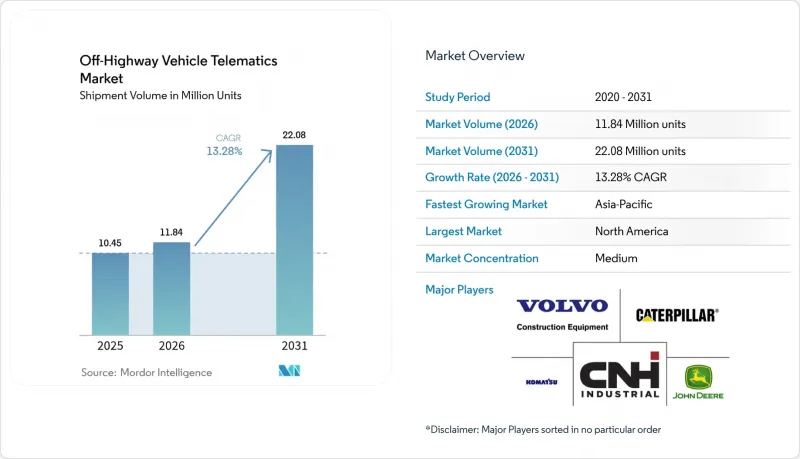
據 Mordor Intelligence 稱,2025 年非公路用車輛遠端資訊處理市場價值為 1,045 萬台,預計到 2031 年將從 2026 年的 1,184 萬台成長至 2,208 萬台,預測期(2026-2031 年)的複合年成長率為 13.28%。
本報告按組件(硬體、軟體、服務)、連接方式(蜂窩網路、衛星網路等)、解決方案類型(OEM嵌入式、售後安裝)、車輛類型(施工機械、農業機械、礦山機械等)、最終用戶行業(建築、農業、採礦等)和地區進行細分。市場預測以銷售量(單位)為基礎。
全球非公路用車輛遠端資訊處理市場趨勢及洞察
法規要求重型機械必須安裝原廠車載資訊系統。
加州提案的第五階段排放法規要求,到2029年,功率在56至560千瓦之間的引擎氮氧化物排放量必須減少90%,並強制要求持續上傳排放氣體數據以進行合規性審計。這使得遠端資訊處理技術在北美地區成為事實上的標準配置,而非可選配置。歐洲的第五階段排放標準也反映了這一趨勢,強制要求對柴油顆粒過濾器進行即時監測。原始設備製造商(OEM)正在積極回應,將遠端資訊處理功能作為車輛出廠時的標準配置,從而降低額外成本,並加速其在建築、農業和採礦等行業的車隊中的應用。類似的法規也為未來強制要求在敏感區域實施操作員疲勞預警和地理圍欄技術提供了可能,這將推動非公路用車輛遠端資訊處理市場朝著符合所有安全標準的方向發展。
低地球軌道衛星星系的快速成長使得通訊覆蓋範圍不再存在盲點。
像星鏈這樣的低地球軌道網路正在消除先前限制遠端資訊處理技術在農村農業和露天礦山應用的通訊中斷問題。約翰迪爾公司在堪薩斯州進行的實地測試,在方圓70英里的農田範圍內保持了持續的數據流,從而實現了即時農業調整和預測性維護,最終節省了燃料並減少了意外維修。礦業公司受益更多,因為不間斷的資料流可以將高價值採礦設備的昂貴停機時間減少高達20%。雖然衛星服務的月費仍然在每顆衛星50美元到200美元之間,但由於車隊的快速部署,批量折扣正在出現,非公路用車輛資訊處理市場的長期成長提供了支持。
終端使用者對改變傳統維修流程的抵觸情緒。
許多家族式承包商和農場仍然依賴目視檢查和技工的直覺,而不是分析儀錶板,理由是數據過載和工作流程被打亂。當技術人員缺乏數據分析技能時,這種抵觸情緒會更加嚴重,導致紙本日誌的平行生成,削弱了數位化帶來的優勢。最成功的分階段實施方案,從簡單的位置追蹤開始,逐步過渡到預測演算法,顯示非公路用車輛遠端資訊處理市場普及的關鍵障礙並非技術,而是文化轉變。
細分市場分析
即使到了2025年,硬體預計仍將維持53.65%的市場佔有率。這是因為任何部署仍將以遠端資訊處理控制單元、感測器和天線為基礎。然而,軟體15.72%的複合年成長率表明,非公路用車輛遠端資訊處理市場正從基礎追蹤向高級數據分析發展。預計在預測期內,與雲端平台、人工智慧引擎和視覺化工具相關的非公路用車輛遠端資訊處理市場規模將超過硬體支出,這反映出市場對洞察而非原始數據的需求日益成長。
此外,隨著車隊營運商依賴專家進行安裝、API整合和持續最佳化,業務收益也同步成長。Caterpillar的生成式人工智慧服務引擎可從150萬個聯網資產中提取數據,充分展現了軟體與服務的結合如何提升客戶的運作和滿意度。隨著用戶群的擴大,針對設備類型、車隊規模和合規性要求量身定做的訂閱計畫將進一步推動該軟體在多品牌環境中的應用。
到2025年,4G和5G蜂窩通訊將佔據58.55%的市場佔有率,並將繼續成為日常數據流量的基礎。然而,設備遷移到營運商服務區域之外(例如露天礦、大型農場和偏遠森林地區)需要無縫容錯移轉。雙模蜂窩和衛星系統以15.12%的複合年成長率成長,無需人工干預即可確保業務連續性,並維護分析流程和監管相關日誌。
約翰迪爾公司對星鏈天線的整合,展現了原始設備製造商 (OEM) 如何將衛星功能標準化應用於高階曳引機,從而將田間作業轉變為完全可追蹤的作業環境,消除容易導致停機的盲區。同時,結合了 Wi-Fi、藍牙或超寬頻 (UWB) 技術的本地網狀網路連接相鄰的機器,共用碰撞預警和韌體更新資訊。這些混合拓撲結構共同推動著非公路用車輛遠端資訊處理市場的下一階段發展。
區域分析
2025年,北美將引領非公路用車輛遠端資訊處理市場,佔36.35%的市場。這得益於成熟的經銷商網路、嚴格的排放氣體和安全法規以及數據驅動的車輛管理文化。較高的可支配收入和大型承包商大規模的車隊規模確保了穩定的硬體更新周期和訂閱服務的快速普及。 OEM廠商與經銷商之間的夥伴關係進一步簡化了部署流程,使即使是中型車主也能在無需承擔高昂IT成本的情況下存取分析儀表板。
在第五階段排放氣體法規和全部區域碳減排指令的推動下,歐洲正逐步效仿,這些指令要求設備所有者持續記錄顆粒物和氮氧化物數據。德國和斯堪地那維亞國家正在實施獎勵計劃,獎勵那些整合了基於遠端資訊處理技術的碳排放計算系統的車隊,從而進一步加速了合規和ESG報告平台的普及。此外,歐盟的《一般資料保護規則》(GDPR)要求供應商建構以隱私為核心的解決方案,增強了歐洲客戶對擴大遠端資訊處理技術應用範圍的信心。
亞太地區是成長的主要驅動力,預計到2031年將以15.78%的複合年成長率成長。中國的「一帶一路」舉措和印度的國家基礎設施建設計劃總合推動了對數百萬台新設備的需求,其中大部分將標配用於性能追蹤的遠端資訊處理功能。在地化生產降低了設備成本,加速了對成本敏感的買家對此類設備的接受度。此外,各國政府正在推出精密農業津貼,幫助農民購買連網設備,這必將推動非公路用車輛遠端資訊處理市場從大都會圈擴展到農村地區。雖然東南亞部分地區仍面臨技術人員短缺的嚴峻問題,但原始設備製造商(OEM)正在迅速開設培訓學院和遠距離診斷中心,以彌補這一缺口。
其他好處:
- Excel格式的市場預測(ME)表
- 3個月的分析師支持
目錄
第1章:引言
- 研究假設和市場定義
- 調查範圍
第2章:調查方法
第3章執行摘要
第4章 市場狀況
- 市場概覽
- 市場促進因素
- 法規強制要求重型機械安裝原廠車載資訊系統
- 低地球軌道衛星星系的快速成長實現了無通訊盲區的覆蓋。
- 堅固耐用的TCU和感測器的單價降低
- 整合基於遠端資訊處理的排碳權貨幣化平台
- 採用獨立於 OEM 的 AEMP 2.0 資料標準,可對混合車輛車隊進行分析。
- 一個面向租賃車輛的全新人工智慧驅動型預測性維護市場。
- 市場限制因素
- 最終使用者不願改變他們傳統的維護工作流程。
- 農村地區缺乏合格的遠距資訊處理技術人員
- 跨境營運車隊的資料主權與網路安全合規成本
- 衛星通訊收費系統分散,阻礙了小規模隊的部署。
- 產業價值鏈分析
- 監理情勢
- 技術展望
- 產業吸引力—五力分析
- 供應商的議價能力
- 買方的議價能力
- 新進入者的威脅
- 替代品的威脅
- 競爭公司之間的競爭
- 宏觀經濟因素對市場的影響
第5章 市場規模及成長預測(數量)
- 按組件
- 硬體
- 軟體
- 服務
- 透過連接方式
- 細胞
- 衛星
- 雙模(行動電話+衛星)
- 短程通訊(Wi-Fi/BLE/UWB)
- 按解決方案類型
- OEM嵌入式
- 售後安裝類型
- 車輛類型
- 施工機械
- 土木工程機具
- 升降機
- 道路建設
- 農業機械
- 聯結機
- 收割機
- 農業設備
- 採礦機械
- 地面用途
- 用於地下
- 林業機械
- 費勒‧邦徹
- 貨運代理
- 物料運輸及其他
- 起重機
- 堆高機
- ATV
- 施工機械
- 按最終用戶行業分類
- 建造
- 農業
- 礦業
- 林業
- 租賃車輛
- 按地區
- 北美洲
- 美國
- 加拿大
- 墨西哥
- 南美洲
- 巴西
- 阿根廷
- 智利
- 其他南美國家
- 歐洲
- 德國
- 英國
- 法國
- 義大利
- 西班牙
- 俄羅斯
- 其他歐洲國家
- 亞太地區
- 中國
- 印度
- 日本
- 韓國
- 新加坡
- 馬來西亞
- 澳洲
- 其他亞太國家
- 中東和非洲
- 中東
- 阿拉伯聯合大公國
- 沙烏地阿拉伯
- 土耳其
- 其他中東國家
- 非洲
- 南非
- 奈及利亞
- 埃及
- 其他非洲國家
- 中東
- 北美洲
第6章 競爭情勢
- 市場集中度
- 策略趨勢
- 市佔率分析
- 公司簡介
- Caterpillar Inc.
- Komatsu Ltd.
- Deere & Company
- CNH Industrial NV
- Volvo Construction Equipment AB
- Hitachi Construction Machinery Co. Ltd.
- Liebherr-International AG
- Doosan Bobcat Inc.
- SANY Heavy Industry Co. Ltd.
- JCB Ltd.
- Trimble Inc.
- ORBCOMM Inc.
- Geotab Inc.
- Samsara Inc.
- Trackunit A/S
- Proemion GmbH
- Teltonika Telematics UAB
- Topcon Positioning Systems Inc.
- Hexagon AB(Leica Geosystems)
- ACTIA Group
- Danfoss Power Solutions(PLUS+1 Connect)
- Quake Global Inc.
- HED Inc.(CANect)
- Zonar Systems Inc.
- Skylo Technologies
- CalAmp Corp.
第7章 市場機會與未來趨勢
- 評估閒置頻段和未滿足的需求
According to Mordor Intelligence, the off-Highway vehicle telematics market size was valued at 10.45 million units in 2025 and estimated to grow from 11.84 million units in 2026 to reach 22.08 million units by 2031, at a CAGR of 13.28% during the forecast period (2026-2031).
This report is Segmented by Component (Hardware, Software, and Services), Connectivity (Cellular, Satellite, and More), Solution Type (OEM-Embedded and Aftermarket-Installed), Vehicle Type (Construction Equipment, Agricultural Machinery, Mining Equipment, and More), End-User Industry (Construction, Agriculture, Mining, and More), and Geography. The Market Forecasts are Provided in Terms of Volume (Units).
Global Off-Highway Vehicle Telematics Market Trends and Insights
Regulations mandating OEM-installed telematics on heavy equipment
California's proposed Tier 5 rules demand 90% NOx reduction for 56-560 kW engines by 2029 and require continuous emissions data uploads for compliance auditing, effectively making telematics standard rather than optional throughout North America. European Stage V requirements echo this stance by obligating real-time monitoring of diesel particulate filters. OEMs respond by bundling telematics at the factory, lowering incremental costs and accelerating adoption curves across construction, agriculture, and mining fleets. The same provisions open the door for future mandates on operator-fatigue alerts and geofencing in sensitive zones, pushing the off-highway vehicle telematics market toward full-spectrum safety compliance.
Surge in low-orbit satellite constellations enabling "black-spot-free" coverage
Low-Earth-orbit networks such as Starlink now bridge connectivity gaps that historically limited telematics in rural agriculture and open-pit mines. John Deere's Kansas field trials maintained continuous data flow across a 70-mile farming radius, enabling real-time agronomic tweaks and predictive maintenance that saved fuel and reduced unexpected repairs. Mining firms gain even more, as uninterrupted data streams cut costly downtime by up to 20% on high-value extraction machinery. While satellite subscriptions still range USD 50-200 per unit each month, volume pricing is trending downward alongside rapid fleet uptake, underpinning long-term growth for the off-highway vehicle telematics market.
End-user reluctance to alter legacy maintenance workflows
Many family-owned contractors and farms rely on visual inspections and mechanic intuition rather than dashboards rich in analytics, citing "data overload" and workflow disruption. Resistance is heightened where technicians lack data-analysis skills, leading to parallel paper logs that undercut digital gains. Gradual rollouts that begin with simple location tracking before moving to predictive algorithms have proven most successful, indicating cultural change-not technology-is the critical adoption hurdle for the off-highway vehicle telematics market.
Other drivers and restraints analyzed in the detailed report include:
- Falling unit cost of ruggedized TCUs and sensors
- Emerging AI-based predictive-maintenance marketplaces for rental fleets
- Shortage of certified telematics technicians in rural regions
For complete list of drivers and restraints, kindly check the Table Of Contents.
Segment Analysis
Hardware retained a 53.65% share in 2025 because every deployment still begins with a telematics control unit, sensors, and antennas. Yet software's 15.72% CAGR illustrates how the off-highway vehicle telematics market is evolving from basic tracking to advanced data analytics. The off-highway vehicle telematics market size associated with cloud platforms, AI engines, and visualization tools will outpace hardware outlays over the forecast period, reflecting demand for insight rather than raw data.
Service revenue grows in parallel as fleets lean on experts for installation, API integration, and ongoing optimization. Caterpillar's generative-AI service engine, which mines data from 1.5 million connected assets, demonstrates how software and services combine to lift customer uptime and satisfaction. As the user base expands, subscription tiers tailored to equipment class, fleet size, and compliance needs will deepen software penetration across mixed-brand environments.
With a 58.55% share in 2025, 4G and 5G cellular remain the baseline for day-to-day data traffic. However, equipment that roams outside carrier footprints-open-pit mines, large farms, remote forestry tracts-demands seamless fail-over. Dual-mode cellular-satellite systems growing at 15.12% CAGR guarantee continuity without manual intervention, sustaining analytics pipelines and regulatory logs.
John Deere's integration of Starlink antennas shows how OEMs package satellite as standard on premium tractors, turning downtime black spots into fully traceable acreage. Meanwhile, local mesh networks that combine Wi-Fi, Bluetooth, or ultra-wideband link neighboring machines to share collision warnings and firmware updates. Together, these hybrid topologies underpin the next phase of the off-highway vehicle telematics market.
Complete Report Scope:
- By Component
- Hardware
- Software
- Services
- By Connectivity
- Cellular
- Satellite
- Dual-Mode (Cell + Satellite)
- Short-Range (Wi-Fi / BLE / UWB)
- By Solution Type
- OEM-Embedded
- Aftermarket-Installed
- By Vehicle Type
- Construction Equipment
- Earth-moving
- Lifting
- Road-building
- Agricultural Machinery
- Tractors
- Harvesters
- Implements
- Mining Equipment
- Surface
- Underground
- Forestry Machinery
- Feller-bunchers
- Forwarders
- Material-Handling and Others
- Cranes
- Forklifts
- ATVs
- Construction Equipment
- By End-user Industry
- Construction
- Agriculture
- Mining
- Forestry
- Rental and Leasing Fleets
- By Geography
- North America
- United States
- Canada
- Mexico
- South America
- Brazil
- Argentina
- Chile
- Rest of South America
- Europe
- Germany
- United Kingdom
- France
- Italy
- Spain
- Russia
- Rest of Europe
- Asia-Pacific
- China
- India
- Japan
- South Korea
- Singapore
- Malaysia
- Australia
- Rest of Asia-Pacific
- Middle East and Africa
- Middle East
- United Arab Emirates
- Saudi Arabia
- Turkey
- Rest of Middle East
- Africa
- South Africa
- Nigeria
- Egypt
- Rest of Africa
- Middle East
- North America
Geography Analysis
North America led the off-highway vehicle telematics market in 2025 with a 36.35% share, aided by well-established dealer networks, robust enforcement of emissions and safety rules, and a culture of data-driven fleet management. High disposable incomes and large contractor fleets translate into steady hardware refresh cycles and rapid uptake of subscription services. OEM-dealer partnerships further simplify onboarding, ensuring that even mid-tier owners gain access to analytics dashboards without heavy IT overhead.
Europe follows closely, propelled by Stage V emissions controls and region-wide carbon-reduction mandates that oblige equipment owners to document particulate and NOx data continually. Incentive programs in Germany and Scandinavia reward fleets that integrate telematics-based carbon accounting, driving stronger platform adoption for compliance and ESG reporting. Additionally, the EU's General Data Protection Regulation forces vendors to engineer privacy-by-design solutions, giving European customers confidence to expand telematics footprints.
Asia-Pacific represents the growth engine, projected at a 15.78% CAGR through 2031. China's Belt and Road Initiative and India's National Infrastructure Pipeline collectively require millions of new machines, most factory-equipped with telematics for performance tracking. Local manufacturing keeps device costs low, accelerating penetration among cost-sensitive buyers. National governments also deploy precision-farming subsidies that reimburse farmers for connected equipment, ensuring that the off-highway vehicle telematics market spreads beyond megacities into rural provinces. While technician shortages remain acute in parts of Southeast Asia, OEMs are rapidly opening training academies and remote diagnostic centers to bridge the gap.
- Caterpillar Inc.
- Komatsu Ltd.
- Deere & Company
- CNH Industrial N.V.
- Volvo Construction Equipment AB
- Hitachi Construction Machinery Co. Ltd.
- Liebherr-International AG
- Doosan Bobcat Inc.
- SANY Heavy Industry Co. Ltd.
- JCB Ltd.
- Trimble Inc.
- ORBCOMM Inc.
- Geotab Inc.
- Samsara Inc.
- Trackunit A/S
- Proemion GmbH
- Teltonika Telematics UAB
- Topcon Positioning Systems Inc.
- Hexagon AB (Leica Geosystems)
- ACTIA Group
- Danfoss Power Solutions (PLUS+1 Connect)
- Quake Global Inc.
- HED Inc. (CANect)
- Zonar Systems Inc.
- Skylo Technologies
- CalAmp Corp.
Additional Benefits:
- The market estimate (ME) sheet in Excel format
- 3 months of analyst support
TABLE OF CONTENTS
1 INTRODUCTION
- 1.1 Study Assumptions and Market Definition
- 1.2 Scope of the Study
2 RESEARCH METHODOLOGY
3 EXECUTIVE SUMMARY
4 MARKET LANDSCAPE
- 4.1 Market Overview
- 4.2 Market Drivers
- 4.2.1 Regulations mandating OEM-installed telematics on heavy equipment
- 4.2.2 Surge in low-orbit satellite constellations enabling "black-spot-free" coverage
- 4.2.3 Falling unit cost of ruggedized TCUs and sensors
- 4.2.4 Integration of telematics-driven carbon-credit monetisation platforms
- 4.2.5 OEM-agnostic AEMP 2.0 data-standard adoption unlocking mixed-fleet analytics
- 4.2.6 Emerging AI-based predictive-maintenance marketplaces for rental fleets
- 4.3 Market Restraints
- 4.3.1 End-user reluctance to alter legacy maintenance workflows
- 4.3.2 Shortage of certified telematics technicians in rural regions
- 4.3.3 Data-sovereignty and cybersecurity compliance costs for cross-border fleets
- 4.3.4 Fragmented satellite subscription pricing models inhibiting small-fleet uptake
- 4.4 Industry Value Chain Analysis
- 4.5 Regulatory Landscape
- 4.6 Technological Outlook
- 4.7 Industry Attractiveness - Porter's Five Forces Analysis
- 4.7.1 Bargaining Power of Suppliers
- 4.7.2 Bargaining Power of Buyers
- 4.7.3 Threat of New Entrants
- 4.7.4 Threat of Substitutes
- 4.7.5 Intensity of Competitive Rivalry
- 4.8 Impact of Macroeconomic Factors on the Market
5 MARKET SIZE AND GROWTH FORECASTS (VOLUMES)
- 5.1 By Component
- 5.1.1 Hardware
- 5.1.2 Software
- 5.1.3 Services
- 5.2 By Connectivity
- 5.2.1 Cellular
- 5.2.2 Satellite
- 5.2.3 Dual-Mode (Cell + Satellite)
- 5.2.4 Short-Range (Wi-Fi / BLE / UWB)
- 5.3 By Solution Type
- 5.3.1 OEM-Embedded
- 5.3.2 Aftermarket-Installed
- 5.4 By Vehicle Type
- 5.4.1 Construction Equipment
- 5.4.1.1 Earth-moving
- 5.4.1.2 Lifting
- 5.4.1.3 Road-building
- 5.4.2 Agricultural Machinery
- 5.4.2.1 Tractors
- 5.4.2.2 Harvesters
- 5.4.2.3 Implements
- 5.4.3 Mining Equipment
- 5.4.3.1 Surface
- 5.4.3.2 Underground
- 5.4.4 Forestry Machinery
- 5.4.4.1 Feller-bunchers
- 5.4.4.2 Forwarders
- 5.4.5 Material-Handling and Others
- 5.4.5.1 Cranes
- 5.4.5.2 Forklifts
- 5.4.5.3 ATVs
- 5.4.1 Construction Equipment
- 5.5 By End-user Industry
- 5.5.1 Construction
- 5.5.2 Agriculture
- 5.5.3 Mining
- 5.5.4 Forestry
- 5.5.5 Rental and Leasing Fleets
- 5.6 By Geography
- 5.6.1 North America
- 5.6.1.1 United States
- 5.6.1.2 Canada
- 5.6.1.3 Mexico
- 5.6.2 South America
- 5.6.2.1 Brazil
- 5.6.2.2 Argentina
- 5.6.2.3 Chile
- 5.6.2.4 Rest of South America
- 5.6.3 Europe
- 5.6.3.1 Germany
- 5.6.3.2 United Kingdom
- 5.6.3.3 France
- 5.6.3.4 Italy
- 5.6.3.5 Spain
- 5.6.3.6 Russia
- 5.6.3.7 Rest of Europe
- 5.6.4 Asia-Pacific
- 5.6.4.1 China
- 5.6.4.2 India
- 5.6.4.3 Japan
- 5.6.4.4 South Korea
- 5.6.4.5 Singapore
- 5.6.4.6 Malaysia
- 5.6.4.7 Australia
- 5.6.4.8 Rest of Asia-Pacific
- 5.6.5 Middle East and Africa
- 5.6.5.1 Middle East
- 5.6.5.1.1 United Arab Emirates
- 5.6.5.1.2 Saudi Arabia
- 5.6.5.1.3 Turkey
- 5.6.5.1.4 Rest of Middle East
- 5.6.5.2 Africa
- 5.6.5.2.1 South Africa
- 5.6.5.2.2 Nigeria
- 5.6.5.2.3 Egypt
- 5.6.5.2.4 Rest of Africa
- 5.6.5.1 Middle East
- 5.6.1 North America
6 COMPETITIVE LANDSCAPE
- 6.1 Market Concentration
- 6.2 Strategic Moves
- 6.3 Market Share Analysis
- 6.4 Company Profiles (includes Global level Overview, Market level overview, Core Segments, Financials as available, Strategic Information, Market Rank/Share for key companies, Products and Services, and Recent Developments)
- 6.4.1 Caterpillar Inc.
- 6.4.2 Komatsu Ltd.
- 6.4.3 Deere & Company
- 6.4.4 CNH Industrial N.V.
- 6.4.5 Volvo Construction Equipment AB
- 6.4.6 Hitachi Construction Machinery Co. Ltd.
- 6.4.7 Liebherr-International AG
- 6.4.8 Doosan Bobcat Inc.
- 6.4.9 SANY Heavy Industry Co. Ltd.
- 6.4.10 JCB Ltd.
- 6.4.11 Trimble Inc.
- 6.4.12 ORBCOMM Inc.
- 6.4.13 Geotab Inc.
- 6.4.14 Samsara Inc.
- 6.4.15 Trackunit A/S
- 6.4.16 Proemion GmbH
- 6.4.17 Teltonika Telematics UAB
- 6.4.18 Topcon Positioning Systems Inc.
- 6.4.19 Hexagon AB (Leica Geosystems)
- 6.4.20 ACTIA Group
- 6.4.21 Danfoss Power Solutions (PLUS+1 Connect)
- 6.4.22 Quake Global Inc.
- 6.4.23 HED Inc. (CANect)
- 6.4.24 Zonar Systems Inc.
- 6.4.25 Skylo Technologies
- 6.4.26 CalAmp Corp.
7 MARKET OPPORTUNITIES AND FUTURE TRENDS
- 7.1 White-Space and Unmet-Need Assessment

 非公路用車輛(OHV)遠端資訊處理市場分析及至2035年預測:類型、產品、服務、技術、組件、應用、部署、最終用戶、功能、安裝類型
 非公路用車輛(OHV)遠端資訊處理市場:按最終用途、技術、銷售管道和地區分類
 2026年全球非道路車輛遠端資訊處理市場報告
 全球非公路用車輛(OHV)遠端資訊處理市場規模、佔有率、趨勢和成長分析報告(2026-2034年)
 全球非公路用車遠端資訊處理市場:按車輛類型、組件、連接類型、解決方案類型、最終用戶、國家和地區分類-產業分析、市場規模、佔有率和預測(2025-2032)
 全球非公路車輛遠端資訊處理市場 - 第七版
 非公路車輛遠端資訊處理市場機會、成長動力、產業趨勢分析及 2025 - 2034 年預測
 非公路用車輛遠端資訊處理市場規模、佔有率和趨勢分析報告:按技術、解決方案、銷售管道、最終用途、地區和細分市場進行預測,2025 年至 2033 年
 全球非公路用車輛遠端資訊處理市場