


 |
市場調查報告書
商品編碼
2124702
印度工業泵:市場佔有率分析、產業趨勢與統計及成長預測(2026-2031)India Industrial Pump - Market Share Analysis, Industry Trends & Statistics, Growth Forecasts (2026 - 2031) |
||||||

※ 本網頁內容可能與最新版本有所差異。詳細情況請與我們聯繫。
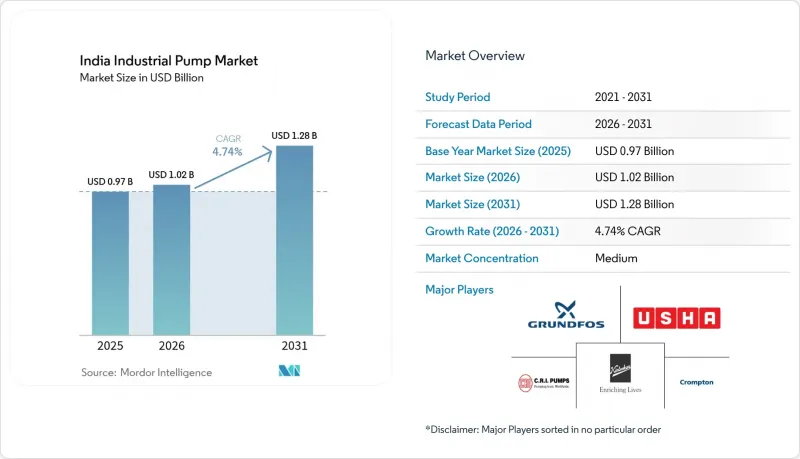
據 Mordor Intelligence 稱,2025 年印度工業泵浦市值為 9.7 億美元,預計到 2031 年將從 2026 年的 10.2 億美元成長到 12.8 億美元,預測期(2026-2031 年)的複合年成長率為 4.74%。
本報告按泵浦類型(離心泵浦、容積式泵浦)、終端用戶產業(石油天然氣、供水和污水處理、化學和石化、發電、採礦等)、驅動系統(電動、引擎驅動、太陽能)、安裝類型(地上泵浦、潛水泵浦)和地區進行細分。市場預測以美元計價。
印度工業泵浦市場趨勢與分析
政府在國家基礎設施管道(NIP)計劃下的投資正在加速對工業泵的需求。
一項耗資1110億印度盧比的國家基礎設施管道(NIP)項目計劃持續到2025年,該項目透過將數位化性能要求納入所有新建公共產業、煉油廠維修和工業園區,永久地改變了泵浦的採購方式。官民合作關係要求供應商確保運作指標,並強制要求供應商提供工業IoT感測器、符合API 610標準的產品以及長期服務合約。帕拉迪普煉油廠耗資24,000印度盧比的棕地計畫生動地展現了這項新標準,該計畫強制要求在所有泵浦撬上安裝遠距離診斷和預測性維護儀錶板。這種模式有利於那些擁有覆蓋全國的服務網路和雲端控制平台的公司,同時也提高了缺乏數據閘道器和標準化協議的低規格進口產品的市場准入門檻。隨著NIP專案資金的推進,離心式幫浦的維修將轉向基於狀態的更換,即使在資本支出減少的情況下也能維持售後市場收入。
污水處理能力的快速擴張推動了對專用幫浦的需求。
預計到2030年,污水處理覆蓋率將達到70%,高於2024年的37%,這將導致耐腐蝕、固態廢棄物處理幫浦的採購量創歷史新高,這些幫浦的效率需達到75%或更高。光是在孟買大都會圈,就已累計25,000印度盧比用於分散式污水泵送和污泥脫水,需要2,000多台能夠在腐蝕性環境中無人值守運作的精密泵浦。營運商現在強制要求使用變頻驅動裝置(VFD)來應對波動的進水負荷,這為擁有冶金技術和VFD成套設備的製造商創造了一個高價值的利基市場。中央污染控制委員會更嚴格的法規進一步增加了對即時監控和冗餘的需求,使配備無洩漏磁力驅動的離心式幫浦具有競爭優勢。
中國製造的低成本水泵進口激增,對國內市場動態帶來了壓力。
中國製造的產品比同類國產產品便宜30-40%,這確保了通用暖通空調(HVAC)相關產品的訂單,並對毛利率造成了壓力。更短的前置作業時間時間和靈活的信用條款吸引了眾多中小企業,迫使印度製造商自動化生產並降低營運成本。然而,售後服務不足和備件供應困難也為現有製造商提供了採取服務導向應對措施的機會,隨著印度標準局(BIS)加強對ISI認證的執行力度,這一趨勢尤為明顯。
細分市場分析
離心泵能夠在水循環、冷卻和一般製程迴路中高效輸送大流量流體,揚程適中,預計2025年將佔印度工業泵市場銷售額的65.02%。容積式泵浦雖然僅佔出貨量的34.98%,但預計到2031年將達到6.79%的複合年成長率,超過離心泵3.95%的成長率。這是因為特種化學品和製藥業的客戶需要對不同黏度下的流體進行精確計量。供應商正透過在其離心泵產品線中整合磁力驅動裝置和陶瓷軸承來縮小差距,而容積式泵製造商則在推廣高速、緊湊型撬裝式裝置,用於現有設備的維修。物聯網驅動的維修將進一步模糊兩者之間的界限,使操作人員能夠即時評估效率,並根據運作週期分析來切換技術。在整個預測期內,離心式幫浦的出貨量將繼續大幅超過容積式泵,但由於容積式泵採用特殊合金和無縫結構,最大限度地減少洩漏,因此其銷售佔有率預計將會增加。
到2025年,用水和污水處理產業將佔印度工業泵浦市場佔有率的28.86%。這主要得益於「Jal Jeevan」計畫以及超過36億印度盧比的都市區污水處理廠投資。採礦業目前僅佔銷售額的8.40%,但其複合年成長率(CAGR)高達7.18%,成為成長最快的行業之一,這主要得益於印度煤炭公司和主要鋼鐵製造商透過機械化提高產量。耐磨彈性體和雙相不銹鋼在脫水、泥漿和尾礦處理生產線中需求旺盛,推高了平均售價(ASP)。石油和天然氣產業透過煉油廠維修維持了穩定的需求,而化學工業則利用進口替代政策來推廣容積式泵浦的應用。預計恰蒂斯加爾邦的鐵礦石帶和奧裡薩邦的鉻礦等區域叢集將出現兩位數的支出,但在成熟的火力發電廠中,大部分資本投資都用於升級而不是擴建。
其他好處:
- Excel格式的市場預測(ME)表
- 3個月的分析師支持
目錄
第1章:引言
- 研究假設和市場定義 - 研究範圍
第2章:調查方法
第3章執行摘要
第4章 市場狀況
- 市場概覽
- 市場促進因素
- 基於國家基礎設施管道(NIPs)的政府資本支出
- 污水處理能力快速擴張
- 印度煉油廠的棕地擴建
- 工業領域太陽能水泵的採用率不斷提高
- 過渡到符合 API 610/ISO 13709 標準的泵
- 引入利用工業IoT的預測性維護
- 市場限制因素
- 中國製造的低價水泵進口量激增。
- 總擁有成本(能源成本+維護成本)相對較高。
- 鋼鐵和銅價格波動
- 公共部門專案核准流程過長
- 產業價值鏈分析
- 監理情勢
- 技術展望
- 波特五力分析
第5章 市場規模與成長預測
- 泵浦類型
- 離心式
- 正位移
- 按最終用戶行業分類
- 石油和天然氣
- 用水和污水處理
- 化工/石油化工
- 發電
- 礦業
- 其他
- 透過驅動系統
- 電的
- 引擎驅動(柴油/壓縮天然氣)
- 太陽能供電
- 按安裝類型
- 地面安裝式水泵
- 潛水泵
第6章 競爭情勢
- 市場集中度
- 策略趨勢
- 市佔率分析
- 公司簡介
- Kirloskar Brothers Limited
- KSB SE and Co. KGaA(India)
- CRI Pumps Private Limited
- Grundfos Pumps India Private Limited
- Xylem Inc.(India)
- Shakti Pumps(India)Limited
- Crompton Greaves Consumer Electricals Limited
- CNP Pumps India Private Limited
- Falcon Pumps Private Limited
- Chemlin Pumps and Valves Private Limited
- La-Gajjar Machineries Private Limited
- Kishor Pumps Private Limited
- Unnati Pumps Private Limited
- V-Guard Industries Limited
- Flowserve India Controls Private Limited
- Sulzer Pumps India Private Limited
- Wilo Mather and Platt Pumps Private Limited
- Ebara Pumps India Private Limited
- ITT Goulds Pumps India Private Limited
- Roto Pumps Limited
- Netzsch Technologies India Private Limited
- Armstrong Fluid Technology(India)Private Limited
- Alfa Laval India Private Limited
- Peerless Pump India Private Limited
第7章 市場機會與未來展望
According to Mordor Intelligence, the India industrial pump market size was valued at USD 0.97 billion in 2025 and estimated to grow from USD 1.02 billion in 2026 to reach USD 1.28 billion by 2031, at a CAGR of 4.74% during the forecast period (2026-2031).
[1] Ministry of Finance, "Union Budget 2024-25," INDIABUDGET.GOV.IN The solid growth stems from sustained government capex under the National Infrastructure Pipeline, widening wastewater treatment coverage, and the steady shift toward smart, energy-efficient pumping systems. This report is Segmented by Pump Type (Centrifugal, and Positive-Displacement), End-User Industry (Oil and Gas, Water and Wastewater, Chemicals and Petrochemicals, Power Generation, Mining, and More), Driver Type (Electric-Motor Driven, Engine-Driven, and Solar-Powered), Installation (Surface Pumps, and Submersible Pumps), and Geography. The Market Forecasts are Provided in Terms of Value (USD).
India Industrial Pump Market Trends and Insights
Government Capex Under the National Infrastructure Pipeline Accelerates Industrial Pump Demand
The INR 111 lakh crore National Infrastructure Pipeline (NIP) earmarked through 2025 has permanently changed pump procurement behaviour by embedding digital-performance requirements in every new utility, refinery upgrade, and industrial park. Public-private partnerships now expect suppliers to guarantee uptime metrics, pushing vendors to bundle Industrial IoT sensors, API 610 compliance, and long-term service contracts. Paradip refinery's INR 24,000 crore brown-field project illustrates the new norm, specifying remote diagnostics and predictive-maintenance dashboards with every pump skid. The model favours enterprises that maintain nationwide service crews and cloud-ready control platforms while elevating entry barriers for low-spec imports lacking data gateways or standardized protocols. As NIP disbursements progress, centrifugal pump retrofits give way to condition-based replacements, sustaining aftermarket revenue even after capital outlays taper.
Rapid Expansion of Wastewater Treatment Capacity Drives Specialized Pump Requirements
Wastewater coverage is slated to reach 70% by 2030 from 37% in 2024, triggering record procurement of corrosion-resistant, solids-handling pumps rated above 75% efficiency. Mumbai Metropolitan Region alone has budgeted INR 25,000 crore for decentralized sewage lifting and sludge dewatering, demanding more than 2,000 precision pumps able to operate unattended in corrosive environments. Operators now stipulate variable-frequency drives to match fluctuating influent loads, creating premium niches for manufacturers with metallurgy know-how and VFD bundles. Tightened Central Pollution Control Board norms further elevate demand for real-time monitoring and redundancy, placing centrifugal offerings with leak-free magnetic drives at a competitive edge.
Import Surge of Low-Cost Chinese Pumps Pressures Domestic Market Dynamics
Chinese models undercut domestic equivalents by 30-40%, capturing commodity water and HVAC orders and compressing gross margins. Shorter lead times and flexible credit terms lure SMEs, compelling Indian producers to automate fabrication and trim overhead. However, inconsistent after-sales service and spares unavailability offer incumbents a service-oriented counterpunch, especially as the Bureau of Indian Standards tightens ISI enforcement.
Other drivers and restraints analyzed in the detailed report include:
- Brown-field Expansion in Indian Refineries Creates High-Value Pump Opportunities
- Increasing Solar-Powered Pump Installations Transform Industrial Energy Economics
- High Total Cost of Ownership Constrains Market Expansion in Energy-Intensive Applications
For complete list of drivers and restraints, kindly check the Table Of Contents.
Segment Analysis
Centrifugal models commanded 65.02% of 2025 revenue of the India industrial pump market size, because they efficiently move large flows at moderate heads in water, cooling, and general process loops. Positive-displacement pumps, though only 34.98% of shipments, are set for a 6.79% CAGR by 2031, outstripping centrifugal's 3.95% pace as specialty chemical and pharma customers demand precise metering under variable viscosities. Vendors are closing the gap by adding magnetic drives and ceramic bearings to centrifugal lines, while PD makers push higher-speed, compact skids for brown-field retrofits. IoT retrofits blur lines further, letting operators benchmark efficiency in real time and switch technologies based on duty cycle analytics. Over the forecast, centrifugal unit volumes will still dwarf PD counts, yet PD value share will rise on premium pricing for exotic alloys and seamless architectures that curb fugitive emissions.
Water and wastewater accounted for 28.86% of the India industrial pump market share in 2025 on the back of Jal Jeevan and urban STP investments valued above INR 3.6 lakh crore. Mining, though only 8.40% of current sales, leads with a 7.18% CAGR as Coal India and steel majors increase mechanized output. Dewatering, slurry, and tailings lines call for abrasion-resistant elastomers and duplex stainless steels, lifting ASPs. Oil and gas remain a steady buyer through refinery upgrades, while chemicals leverage import-substitution policies to spur PD pump adoption. Regional clusters such as Chhattisgarh iron-ore belts or Odisha chromite pits will show double-digit spends, whereas mature thermal power plants mostly allocate capex for replacements rather than expansions.
Complete Report Scope:
- By Pump Type
- Centrifugal
- Positive-Displacement
- By End-user Industry
- Oil and Gas
- Water and Wastewater
- Chemicals and Petrochemicals
- Power Generation
- Mining
- Other End-User Industry
- By Driver Type
- Electric-motor Driven
- Engine-Driven (Diesel/CNG)
- Solar-Powered
- By Installation
- Surface Pumps
- Submersible Pumps
List of Companies Covered in this Report:
- Kirloskar Brothers Limited
- KSB SE and Co. KGaA (India)
- CRI Pumps Private Limited
- Grundfos Pumps India Private Limited
- Xylem Inc. (India)
- Shakti Pumps (India) Limited
- Crompton Greaves Consumer Electricals Limited
- CNP Pumps India Private Limited
- Falcon Pumps Private Limited
- Chemlin Pumps and Valves Private Limited
- La-Gajjar Machineries Private Limited
- Kishor Pumps Private Limited
- Unnati Pumps Private Limited
- V-Guard Industries Limited
- Flowserve India Controls Private Limited
- Sulzer Pumps India Private Limited
- Wilo Mather and Platt Pumps Private Limited
- Ebara Pumps India Private Limited
- ITT Goulds Pumps India Private Limited
- Roto Pumps Limited
- Netzsch Technologies India Private Limited
- Armstrong Fluid Technology (India) Private Limited
- Alfa Laval India Private Limited
- Peerless Pump India Private Limited
Additional Benefits:
- The market estimate (ME) sheet in Excel format
- 3 months of analyst support
TABLE OF CONTENTS
1 INTRODUCTION
- 1.1 Study Assumptions and Market Definition - Scope of the Study
2 RESEARCH METHODOLOGY
3 EXECUTIVE SUMMARY
4 MARKET LANDSCAPE
- 4.1 Market Overview
- 4.2 Market Drivers
- 4.2.1 Government cap-ex under National Infrastructure Pipeline (NIP)
- 4.2.2 Rapid expansion of wastewater treatment capacity
- 4.2.3 Brown-field expansion in Indian refineries
- 4.2.4 Increasing solar-powered pump installations in industries
- 4.2.5 Shift toward API 610/ISO 13709-compliant pumps
- 4.2.6 Industrial IoT-enabled predictive-maintenance adoption
- 4.3 Market Restraints
- 4.3.1 Import surge of low-cost Chinese pumps
- 4.3.2 High total cost of ownership (energy + maintenance)
- 4.3.3 Volatility in steel and copper prices
- 4.3.4 Lengthy approval cycles in public sector projects
- 4.4 Industry Value-Chain Analysis
- 4.5 Regulatory Landscape
- 4.6 Technological Outlook
- 4.7 Porter's Five Forces Analysis
5 MARKET SIZE AND GROWTH FORECASTS (VALUE)
- 5.1 By Pump Type
- 5.1.1 Centrifugal
- 5.1.2 Positive-Displacement
- 5.2 By End-user Industry
- 5.2.1 Oil and Gas
- 5.2.2 Water and Wastewater
- 5.2.3 Chemicals and Petrochemicals
- 5.2.4 Power Generation
- 5.2.5 Mining
- 5.2.6 Other End-User Industry
- 5.3 By Driver Type
- 5.3.1 Electric-motor Driven
- 5.3.2 Engine-Driven (Diesel/CNG)
- 5.3.3 Solar-Powered
- 5.4 By Installation
- 5.4.1 Surface Pumps
- 5.4.2 Submersible Pumps
6 COMPETITIVE LANDSCAPE
- 6.1 Market Concentration
- 6.2 Strategic Moves
- 6.3 Market Share Analysis
- 6.4 Company Profiles {(includes Global level Overview, Market level overview, Core Segments, Financials as available, Strategic Information, Market Rank/Share for key companies, Products and Services, and Recent Developments)}
- 6.4.1 Kirloskar Brothers Limited
- 6.4.2 KSB SE and Co. KGaA (India)
- 6.4.3 CRI Pumps Private Limited
- 6.4.4 Grundfos Pumps India Private Limited
- 6.4.5 Xylem Inc. (India)
- 6.4.6 Shakti Pumps (India) Limited
- 6.4.7 Crompton Greaves Consumer Electricals Limited
- 6.4.8 CNP Pumps India Private Limited
- 6.4.9 Falcon Pumps Private Limited
- 6.4.10 Chemlin Pumps and Valves Private Limited
- 6.4.11 La-Gajjar Machineries Private Limited
- 6.4.12 Kishor Pumps Private Limited
- 6.4.13 Unnati Pumps Private Limited
- 6.4.14 V-Guard Industries Limited
- 6.4.15 Flowserve India Controls Private Limited
- 6.4.16 Sulzer Pumps India Private Limited
- 6.4.17 Wilo Mather and Platt Pumps Private Limited
- 6.4.18 Ebara Pumps India Private Limited
- 6.4.19 ITT Goulds Pumps India Private Limited
- 6.4.20 Roto Pumps Limited
- 6.4.21 Netzsch Technologies India Private Limited
- 6.4.22 Armstrong Fluid Technology (India) Private Limited
- 6.4.23 Alfa Laval India Private Limited
- 6.4.24 Peerless Pump India Private Limited
7 MARKET OPPORTUNITIES AND FUTURE OUTLOOK
- 7.1 White-space and Unmet-Need Assessment

 全球工業泵浦控制面板市場規模、佔有率、趨勢和成長分析報告(2026-2034年)
 2026-2030年全球瀝青泵市場
 活塞幫浦市場分析與預測(至2035年):類型、產品、技術、組件、應用、材質、最終用戶、功能、安裝配置、解決方案液壓軸向活塞泵市場分析及預測(至2035年):類型、產品、技術、組件、應用、最終用戶、功能、安裝類型、設備、解決方案工業泵浦市場規模、佔有率、成長、全球產業分析、區域趨勢及2026-2034年預測。
 工業幫浦:市場佔有率分析、產業趨勢與統計、成長預測(2026-2031)
 工業泵浦市場-2026-2032年全球市場預測
 2026年全球工程幫浦市場報告
 2026-2030年全球工業幫浦租賃市場
 商用幫浦市場 - 全球產業規模、佔有率、趨勢、機會、預測:按類型、應用、地區和競爭格局分類,2021-2031年