


 |
市場調查報告書
商品編碼
2124675
基板:市場佔有率分析、產業趨勢與統計、成長預測(2026-2031 年)Substrate - Market Share Analysis, Industry Trends & Statistics, Growth Forecasts (2026 - 2031) |
||||||

※ 本網頁內容可能與最新版本有所差異。詳細情況請與我們聯繫。
據 Mordor Intelligence 稱,2025 年基板市場價值為 43.3 億美元,預計到 2031 年將從 2026 年的 45.4 億美元成長至 57.5 億美元,預測期(2026-2031 年)複合年成長率為 4.83%。
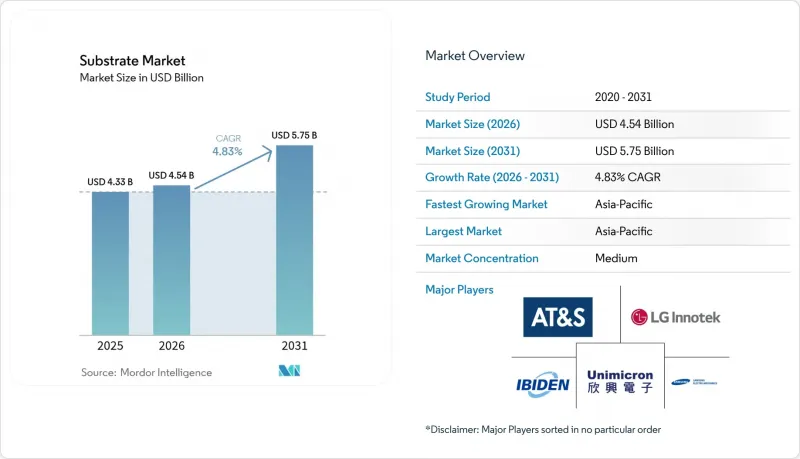
本報告依基板類型(剛性FR-4、軟性、軟硬複合等)、材料(環氧玻璃FR-4、聚醯亞胺、BT樹脂等)、製造製程(PCB蝕刻/層壓、薄膜沉積等)、終端用戶產業(電腦與資料儲存、家用電子電器等)以及地區進行細分。市場預測以美元(USD)為單位。
全球基板市場趨勢與洞察
人工智慧加速器中異質整合的普及
異質整合允許多個專用晶片在單一封裝內協同工作,這提高了對基板複雜性的要求。英特爾的目標是透過使用玻璃基板,實現比有機層壓板高 10 倍的互連密度,從而實現邏輯、記憶體和加速器晶片的共存,同時不影響訊號完整性。有機 FR-4 基板無法處理如此精細的佈線,因此設計師正在轉向玻璃、先進有機材料和陶瓷。目前的封裝架構將高速介面和敏感的類比電源軌緊密排列,使得介電損耗、熱膨脹係數和過孔可靠性成為關鍵的選擇標準。製造商正在投資高解析度微影術和雷射鑽孔技術,以滿足 10µm 以下的線寬/間距要求。隨著人工智慧工作負載的擴展,封裝帶來的效能提升與前端節點的微型化同樣重要,而前端節點的微型化也支撐著先進基板的高昂價格。
行動和穿戴式裝置對小型化的需求
隨著智慧型手機基板尺寸的縮小,元件數量卻不斷增加,迫使供應商提供更薄、密度更高、柔軟性更強的基板結構。採用聚醯亞胺芯材的軟硬複合設計有助於防止高速匯流排在折疊處佈線時出現裂痕。穿戴式裝置對層壓結構的壓縮要求更高,因此需要將被動元件嵌入芯層中。中國、韓國和越南的製造商在2024年後的設計週期中,軟性層壓板的訂單量加倍,從而提高了軟式電路板工廠的運轉率。由於元件間距縮小導致熱量增加,採用鋁背襯的金屬芯產品正進入高階手機市場。這些趨勢意味著,即使行動電話產量保持不變,每塊基板的附加價值也逐漸提高,基板市場也將持續擴張。
高玻璃化轉變溫度樹脂供應鏈的波動
由於極少有化學製造商能夠提供玻璃化轉變溫度 (Tg) 高於 170°C 的樹脂,供應中斷導致現貨市場供應緊張,價格飆升。環氧樹脂前驅物的貿易限制已將前置作業時間延長至 2024 年的 24 週,迫使基板供應商維持更大的安全庫存。庫存成本給利潤率帶來壓力,尤其是對中小型製造商而言。汽車和航太客戶要求在引擎室應用和航空電子設備組件中使用高 Tg基板,因此標準的 FR-4 替代品並不實用。供應商雖然簽訂了長期契約,但仍容易受到東亞主要樹脂製造地周邊地緣政治動盪的影響。
細分市場分析
2025年,剛性FR-4基板在基板市場維持了54.98%的市佔率。這反映了其成熟的基礎設施和較低的單位成本。該細分市場主要面向主流筆記型電腦、電視和消費性電子產品,這些產品更注重每平方英吋的成本而非尖端效能。相較之下,玻璃基板的複合年成長率(CAGR)為5.54%,是所有類型中成長最快的。這主要是由於人工智慧加速器和開關ASIC的藍圖對佈線密度提出了高達10倍的要求。這項需求推動了對能夠適應更嚴格的尺寸公差和更低熱膨脹係數(CTE)不匹配的玻璃中介層的需求。陶瓷基板在高功率密度電路中佔據穩定的細分市場,而金屬芯基板在LED照明和中功率設計領域的需求正在成長。軟性基板和剛柔結合基板在折疊式智慧型手機和汽車資訊娛樂面板中保持市場佔有率,它們在彎曲半徑方面優於剛性基板。隨著良率學習曲線的提高,每層成本降低,預計到 2031 年,玻璃基板市場規模將超過 10.7 億美元。供應商正在高強度玻璃基板和成本最佳化的 FR-4基板之間分配產能,以對沖經濟波動風險。
越來越多的晶片供應商開始採用玻璃作為光罩尺寸的中介層材料,這提振了專業面板製造廠的訂單前景,並促進了與設備製造商的合作。 2025年的試生產中,缺陷密度低於50ppm,推動了2026年及以後的大規模生產。儘管如此,剛性FR-4在價格敏感的家用電子電器領域仍發揮著至關重要的作用,其廣泛的供應基礎也為OEM廠商提供了談判優勢。採用FR-4外殼包裹玻璃芯的混合層壓結構正逐漸成為一種過渡技術,幫助客戶在無需徹底重新設計系統的情況下實現轉型。整體而言,在未來五年內,基板配置將主要以共存形式存在,而不是完全被取代。
FR-4環氧玻璃兼具機械強度、阻燃性和低成本等優點,預計2025年將佔據41.88%的市場。同時,玻璃材料預計在2031年前實現5.42%的複合年成長率,這得益於其能夠實現更精細的線間距並減少大尺寸基板的翹曲。 BT樹脂具有低介電常數,適用於高速串列鏈路,預計將佔據高階網卡市場。聚醯亞胺層可承受高達260 度C的連續使用溫度,滿足FR-4無法滿足的航太及地下鑽探電子應用需求。氮化鋁和氧化鋁陶瓷板的熱導率超過150 W/mK,使其成為基於碳化矽的電動車逆變器的關鍵材料。金屬芯層壓板結合了銅或鋁背襯和預浸料,為LED驅動器提供了成本和性能平衡的中間導熱方案。
材料創新者正在最佳化填料的化學成分,以降低毫米波頻段的損耗角正切,這對於5G前端模組至關重要。永續發展措施推動了對符合RoHS和REACH標準的無鹵替代材料的需求成長,促使樹脂供應商推出一系列新產品。隨著異質整合導致線寬變窄,基板和矽之間的熱膨脹係數匹配至關重要,而隨著層數的增加,玻璃基板的性能更勝一籌。所有這些因素綜合起來意味著,沒有單一的材料能夠同時滿足所有性能和成本目標,導致基板市場持續細分為不同的材料系列。
區域分析
預計亞太地區在2025年將維持37.92%的營收佔有率,並在2031年之前以5.29%的複合年成長率持續成長,這主要得益於台灣、韓國和中國大陸供應鏈的規模經濟效益。韓國的三星馬達和LG Innotek正在升級其面板級扇出型晶片生產線,部分資金來自國家創新津貼。台灣的振鼎科技和宇能光科技正根據其主要的GPU和網路ASIC產品藍圖進行擴張,並已獲得多年訂單。中國當地的廠商正在努力實現玻璃基板的自給自足,以降低出口許可證的不確定性,並組織政府支持的聯盟來實現關鍵製造設備的本地化。
在北美,由於《晶片技術創新法案》(CHIPS Act),相關活動再次活躍起來。該法案為先進封裝設備的投資提供25%的投資稅額扣抵,有效降低了資本密集度。德克薩斯州累計津貼億美元用於新建晶圓製造廠和配套的基板製造廠,而奧勒岡州預計到2030年半導體相關支出將達到400億美元。原始設備製造商(OEM)正致力於將生產外包到近岸地區,以確保穩定的供應並縮短工程週期。作為回應,基板製造商正在考慮建造規模較小但利潤較高的國內工廠。
歐洲正強調戰略自主,並調整補貼政策以配合其車輛電氣化藍圖。隨著德國一級供應商將逆變器組裝線轉移至企業內部,陶瓷基板的滲透率正在不斷提高。歐盟提案的生態設計法規正在加強對鹵素基材料的審查,並鼓勵使用FR-4替代材料。政策主導的需求正在催生一個高階市場,該市場有利於符合環保法規的供應商。
在各個地區,外匯波動都會影響採購決策,而由於物流瓶頸,接近性最終組裝地點變得越來越重要。雖然多元化略微降低了亞太地區的市場佔有率,但區域間的競爭正在基板市場催生多個成長中心。
其他好處:
- Excel格式的市場預測(ME)表
- 3個月的分析師支持
目錄
第1章:引言
- 研究假設和市場定義
- 調查範圍
第2章:調查方法
第3章執行摘要
第4章 市場狀況
- 市場概覽
- 市場促進因素
- 人工智慧加速器中異質整合的普及
- 行動和穿戴式裝置對小型化的需求。
- 5G 的部署正在推動對高頻射頻基板的需求增加。
- 電動車電力電子裝置中陶瓷和金屬基板的應用
- 晶片封裝技術現已問世。
- 不同地區半導體補貼的競爭
- 市場限制因素
- 高Tg樹脂的供應鏈波動性
- 先進基板生產線的資本投資強度
- 傳統PCB製造工廠的技術鎖定風險
- 鹵素基層壓板面臨的永續性壓力
- 產業價值鏈分析
- 監理情勢
- 技術展望
- 波特五力分析
第5章 市場規模與成長預測
- 依基材類型
- 剛性(FR-4)
- 彈性
- 軟硬複合
- 陶瓷製品
- 玻璃
- 其他類型
- 材料
- 環氧玻璃(FR-4)
- 聚醯亞胺
- BT樹脂
- 陶瓷(氧化鋁、氮化鋁)
- 玻璃
- 金屬芯(鋁、銅)
- 其他材料
- 透過製造技術
- PCB蝕刻和層壓
- 薄膜沉積
- 積層製造/列印
- 扇出型晶圓級封裝
- 嵌入式晶片
- 其他技術
- 按最終用戶行業分類
- 計算和數據存儲
- 家用電子產品
- 汽車和運輸業
- 工業和醫療用途
- 通訊和基礎設施
- 航太/國防
- 其他終端用戶產業
- 按地區
- 北美洲
- 美國
- 加拿大
- 墨西哥
- 南美洲
- 巴西
- 阿根廷
- 其他南美國家
- 歐洲
- 德國
- 英國
- 法國
- 義大利
- 西班牙
- 俄羅斯
- 其他歐洲國家
- 亞太地區
- 中國
- 日本
- 韓國
- 印度
- 台灣
- ASEAN
- 其他亞太國家
- 中東和非洲
- 中東
- 沙烏地阿拉伯
- UAE
- 土耳其
- 其他中東國家
- 非洲
- 南非
- 奈及利亞
- 其他非洲國家
- 中東
- 北美洲
第6章 競爭情勢
- 市場集中度
- 策略趨勢
- 市佔率分析
- 公司簡介
- Ibiden Co., Ltd.
- Unimicron Technology Corp.
- Samsung Electro-Mechanics Co., Ltd.
- AT&S AG
- Zhen Ding Technology Holding Ltd.
- Shinko Electric Industries Co., Ltd.
- Nan Ya PCB Corp.
- LG Innotek Co., Ltd.
- Compeq Manufacturing Co., Ltd.
- Kyocera Corporation
- Nippon Mektron, Ltd.
- Shenzhen Kinwong Electronic Co., Ltd.
- Fujikura Ltd.
- Young Poong Electronics Co., Ltd.
- Tripod Technology Corporation
- Wus Printed Circuit Co., Ltd.
- NCAB Group AB
- China Fastprint Technology Co., Ltd.
- Eltek Ltd.
- Flexium Interconnect, Inc.
- PCB Technologies Ltd.
- Advanced Semiconductor Engineering, Inc.
- JCET Group Co., Ltd.
第7章 市場機會與未來展望
According to Mordor Intelligence, the substrate market size was valued at USD 4.33 billion in 2025 and estimated to grow from USD 4.54 billion in 2026 to reach USD 5.75 billion by 2031, at a CAGR of 4.83% during the forecast period (2026-2031).
This report is Segmented by Substrate Type (Rigid FR-4, Flex, Rigid-Flex, and More), Material (Epoxy Glass FR-4, Polyimide, BT Resin, and More), Manufacturing Technology (PCB Etching/Lamination, Thin-Film Deposition, and More), End-User Industry (Computing and Data Storage, Consumer Electronics, and More), and Geography. The Market Forecasts are Provided in Terms of Value (USD).
Global Substrate Market Trends and Insights
Proliferation of Heterogeneous Integration in AI Accelerators
Heterogeneous integration allows multiple specialized dies to work together inside a single package, raising substrate complexity requirements. Intel targets 10 X higher interconnect density over organic laminates using glass substrates, enabling logic, memory, and accelerator chiplets to coexist without signal-integrity losses. Organic FR-4 cannot match these routings at fine pitches, which encourages designers to transition toward glass, advanced organic, and ceramic options. Package architectures now mix high-speed interfaces next to sensitive analog rails, so dielectric loss, coefficient of thermal expansion, and via reliability become critical selection criteria. Fabricators invest in higher-resolution lithography and laser drilling to meet line/space rules under 10 µm. As AI workloads continue scaling, packaging-centric performance gains are as important as front-end node shrinks, sustaining premium pricing for advanced substrates.
Miniaturization Demand in Mobile and Wearable Devices
Smartphone boards are shrinking while component counts rise, pressing suppliers to deliver thinner, denser, and more flexible substrate constructions. Rigid-flex designs with polyimide cores help route high-speed buses around fold lines without cracking. Wearables further compress stack-ups, forcing the adoption of embedded passive components inside the core layers. Makers in China, South Korea, and Vietnam doubled orders for flexible laminates after 2024 design cycles, lifting utilization in flex substrate factories. Tighter component clearances heighten heat buildup; hence, metal-core variants with aluminum backing are entering high-end mobile segments. These dynamics keep substrate market revenue expanding even when handset unit volumes plateau because value per board creeps higher.
Supply-Chain Volatility for High-Tg Resins
Only a handful of chemical producers offer resins that survive above 170 °C glass-transition temperatures, so any outage tightens spot supply and spikes pricing. Trade restrictions on epoxy precursors raised lead times to 24 weeks during 2024, forcing substrate vendors to hold larger safety stocks. Inventory carrying costs erode margins, especially for small and mid-size shops. Automotive and aerospace customers mandate high-Tg boards for under-hood and avionics assemblies, so substitution with standard FR-4 is not feasible. Suppliers negotiate long-term contracts yet remain vulnerable to geopolitical disruptions around major resin-manufacturing centers in East Asia.
Other drivers and restraints analyzed in the detailed report include:
- 5G Roll-Outs Boosting High-Frequency RF Substrates
- EV Power-Electronics Adoption of Ceramic and Metal-Core Substrates
- CAPEX Intensity of Advanced Substrate Lines
For complete list of drivers and restraints, kindly check the Table Of Contents.
Segment Analysis
Rigid FR-4 retained a 54.98% slice of the substrate market share in 2025, reflecting entrenched infrastructure and low unit costs. The segment addresses mainstream notebooks, televisions, and home appliances that prize cost per square inch over bleeding-edge performance. In contrast, glass substrates record a 5.54% CAGR, the fastest pace across types, because AI accelerators and switch-ASIC roadmaps now mandate up to 10 X interconnect density. That requirement pulls demand toward glass interposers capable of tighter dimensional tolerances and low CTE mismatch. Ceramic substrates occupy a stable niche in power-dense circuits, while metal-core boards pick up LED lighting and mid-power designs. Flex and rigid-flex constructions hold share in foldable phones and automotive infotainment panels where bend radii beat rigid boards. Looking forward, the substrate market size for glass lines is projected to exceed USD 1.07 billion by 2031 as yield learning curves trim per-layer costs. Suppliers split capacity between high-layer glass and cost-optimized FR-4 to hedge cyclical swings.
A growing list of chip vendors adopt glass for reticle-sized interposers, lifting order visibility for specialty panel fabs and sparking partnerships with equipment makers. Pilot production runs delivered defect densities under 50 ppm in 2025, supporting volume ramps from 2026 onward. Yet rigid FR-4 remains relevant for price-sensitive consumer electronics, and its deep supply base provides negotiating leverage to OEMs. Hybrid stack-ups that laminate glass cores inside FR-4 shells emerge as a bridge technology, helping customers transition without wholesale redesigns. Overall, coexistence rather than outright replacement defines the next five-year substrate mix.
FR-4 epoxy glass held a 41.88% revenue share in 2025 thanks to its balanced mechanical strength, flame retardancy, and low price. Glass materials, however, chart the leading 5.42% CAGR through 2031 by enabling finer line/space and reducing warpage in large substrates. BT resin provides lower dielectric constants suited to high-speed serial links, capturing advanced networking cards. Polyimide layers withstand continuous service up to 260 °C, supporting aerospace and down-hole drilling electronics where FR-4 fails. Ceramic plates of aluminum nitride or alumina reach thermal conductivities above 150 W/mK, making them indispensable in SiC-based EV inverters. Metal-core laminates combine copper or aluminum backers with prepreg, offering an intermediate thermal step that balances cost and performance for LED drivers.
Material innovators tailor filler chemistry to lower loss tangent at mmWave bands, an attribute critical for 5G front-end modules. Sustainability drives demand for halogen-free alternatives compliant with RoHS and REACH, spurring incremental product launches from resin suppliers. As heterogeneous integration tightens line widths, coefficient of thermal expansion convergence between substrate and silicon becomes essential, giving glass an edge at high layer counts. Taken together, the substrate market continues fragmenting by material family as no single option satisfies every performance and cost target.
Complete Report Scope:
- By Substrate Type
- Rigid (FR-4)
- Flex
- Rigid-Flex
- Ceramic
- Glass
- Other Types
- By Material
- Epoxy Glass (FR-4)
- Polyimide
- BT Resin
- Ceramic (Alumina, AlN)
- Glass
- Metal-Core (Al, Cu)
- Other Materials
- By Manufacturing Technology
- PCB Etching and Lamination
- Thin-Film Deposition
- Additive Manufacturing / Printing
- Fan-Out Wafer-Level Packaging
- Embedded Die
- Other Technologies
- By End-User Industry
- Computing and Data Storage
- Consumer Electronics
- Automotive and Transportation
- Industrial and Medical
- Telecom and Infrastructure
- Aerospace and Defense
- Other End-User Industries
- By Geography
- North America
- United States
- Canada
- Mexico
- South America
- Brazil
- Argentina
- Rest of South America
- Europe
- Germany
- United Kingdom
- France
- Italy
- Spain
- Russia
- Rest of Europe
- Asia Pacific
- China
- Japan
- South Korea
- India
- Taiwan
- ASEAN
- Rest of Asia Pacific
- Middle East and Africa
- Middle East
- Saudi Arabia
- UAE
- Turkey
- Rest of Middle East
- Africa
- South Africa
- Nigeria
- Rest of Africa
- Middle East
- North America
Geography Analysis
Asia Pacific maintained a 37.92% revenue share in 2025 and advances at a 5.29% CAGR through 2031 thanks to scale economies across Taiwanese, South Korean, and Chinese supply chains. Korea's Samsung Electro-Mechanics and LG Innotek are upgrading to panel-level fan-out lines, funded partly by national innovation grants. Taiwan's Zhen Ding Technology and Unimicron synchronize expansions with leading GPU and networking ASIC roadmaps to secure multiyear loadings. Mainland Chinese vendors pursue glass substrate independence to mitigate export-license uncertainties, organizing government-backed consortia to localize key tooling.
North America witnesses resurging activity as the CHIPS Act provides a 25% investment tax credit for advanced-packaging equipment, reducing effective capital intensity. Texas earmarked USD 1.4 billion in grants for substrate fabs co-located with new wafer facilities, and Oregon projects USD 40 billion semiconductor spending by 2030. OEMs value near-shoring for secure supply and faster engineering turns, prompting substrate makers to weigh smaller but higher-margin domestic plants.
Europe focuses on strategic autonomy, aligning subsidies with its automotive electrification roadmap. Ceramic substrates see higher penetration because German Tier-1 suppliers shift inverter assembly lines in-house. The European Union's proposed Eco-Design regulation elevates scrutiny on halogenated materials, favoring FR-4 alternatives. Policy-driven demand shapes a premium market segment that rewards environmentally compliant suppliers.
Across regions, currency fluctuations influence sourcing decisions, and logistics bottlenecks incentivize closer proximity to final assembly. Diversification dilutes Asia Pacific's share only modestly, yet regional competition yields multiple growth nodes for the substrate market.
- Ibiden Co., Ltd.
- Unimicron Technology Corp.
- Samsung Electro-Mechanics Co., Ltd.
- AT&S AG
- Zhen Ding Technology Holding Ltd.
- Shinko Electric Industries Co., Ltd.
- Nan Ya PCB Corp.
- LG Innotek Co., Ltd.
- Compeq Manufacturing Co., Ltd.
- Kyocera Corporation
- Nippon Mektron, Ltd.
- Shenzhen Kinwong Electronic Co., Ltd.
- Fujikura Ltd.
- Young Poong Electronics Co., Ltd.
- Tripod Technology Corporation
- Wus Printed Circuit Co., Ltd.
- NCAB Group AB
- China Fastprint Technology Co., Ltd.
- Eltek Ltd.
- Flexium Interconnect, Inc.
- PCB Technologies Ltd.
- Advanced Semiconductor Engineering, Inc.
- JCET Group Co., Ltd.
Additional Benefits:
- The market estimate (ME) sheet in Excel format
- 3 months of analyst support
TABLE OF CONTENTS
1 INTRODUCTION
- 1.1 Study Assumptions and Market Definition
- 1.2 Scope of the Study
2 RESEARCH METHODOLOGY
3 EXECUTIVE SUMMARY
4 MARKET LANDSCAPE
- 4.1 Market Overview
- 4.2 Market Drivers
- 4.2.1 Proliferation of heterogeneous integration in AI accelerators
- 4.2.2 Miniaturization demand in mobile and wearable devices
- 4.2.3 5G roll-outs boosting high-frequency RF substrates
- 4.2.4 EV power-electronics adoption of ceramic and metal-core substrates
- 4.2.5 Emergence of chiplet-based packages
- 4.2.6 Regional semiconductor subsidy races
- 4.3 Market Restraints
- 4.3.1 Supply-chain volatility for high-Tg resins
- 4.3.2 CAPEX intensity of advanced substrate lines
- 4.3.3 Technological lock-in risk for legacy PCB fabs
- 4.3.4 Sustainability pressure on halogenated laminates
- 4.4 Industry Value Chain Analysis
- 4.5 Regulatory Landscape
- 4.6 Technological Outlook
- 4.7 Porter's Five Forces Analysis
- 4.7.1 Threat of New Entrants
- 4.7.2 Bargaining Power of Suppliers
- 4.7.3 Bargaining Power of Buyers
- 4.7.4 Threat of Substitutes
- 4.7.5 Competitive Rivalry
5 MARKET SIZE AND GROWTH FORECASTS (VALUE)
- 5.1 By Substrate Type
- 5.1.1 Rigid (FR-4)
- 5.1.2 Flex
- 5.1.3 Rigid-Flex
- 5.1.4 Ceramic
- 5.1.5 Glass
- 5.1.6 Other Types
- 5.2 By Material
- 5.2.1 Epoxy Glass (FR-4)
- 5.2.2 Polyimide
- 5.2.3 BT Resin
- 5.2.4 Ceramic (Alumina, AlN)
- 5.2.5 Glass
- 5.2.6 Metal-Core (Al, Cu)
- 5.2.7 Other Materials
- 5.3 By Manufacturing Technology
- 5.3.1 PCB Etching and Lamination
- 5.3.2 Thin-Film Deposition
- 5.3.3 Additive Manufacturing / Printing
- 5.3.4 Fan-Out Wafer-Level Packaging
- 5.3.5 Embedded Die
- 5.3.6 Other Technologies
- 5.4 By End-User Industry
- 5.4.1 Computing and Data Storage
- 5.4.2 Consumer Electronics
- 5.4.3 Automotive and Transportation
- 5.4.4 Industrial and Medical
- 5.4.5 Telecom and Infrastructure
- 5.4.6 Aerospace and Defense
- 5.4.7 Other End-User Industries
- 5.5 By Geography
- 5.5.1 North America
- 5.5.1.1 United States
- 5.5.1.2 Canada
- 5.5.1.3 Mexico
- 5.5.2 South America
- 5.5.2.1 Brazil
- 5.5.2.2 Argentina
- 5.5.2.3 Rest of South America
- 5.5.3 Europe
- 5.5.3.1 Germany
- 5.5.3.2 United Kingdom
- 5.5.3.3 France
- 5.5.3.4 Italy
- 5.5.3.5 Spain
- 5.5.3.6 Russia
- 5.5.3.7 Rest of Europe
- 5.5.4 Asia Pacific
- 5.5.4.1 China
- 5.5.4.2 Japan
- 5.5.4.3 South Korea
- 5.5.4.4 India
- 5.5.4.5 Taiwan
- 5.5.4.6 ASEAN
- 5.5.4.7 Rest of Asia Pacific
- 5.5.5 Middle East and Africa
- 5.5.5.1 Middle East
- 5.5.5.1.1 Saudi Arabia
- 5.5.5.1.2 UAE
- 5.5.5.1.3 Turkey
- 5.5.5.1.4 Rest of Middle East
- 5.5.5.2 Africa
- 5.5.5.2.1 South Africa
- 5.5.5.2.2 Nigeria
- 5.5.5.2.3 Rest of Africa
- 5.5.5.1 Middle East
- 5.5.1 North America
6 COMPETITIVE LANDSCAPE
- 6.1 Market Concentration
- 6.2 Strategic Moves
- 6.3 Market Share Analysis
- 6.4 Company Profiles (includes Global level Overview, Market level overview, Core Segments, Financials as available, Strategic Information, Market Rank/Share, Products and Services, Recent Developments)
- 6.4.1 Ibiden Co., Ltd.
- 6.4.2 Unimicron Technology Corp.
- 6.4.3 Samsung Electro-Mechanics Co., Ltd.
- 6.4.4 AT&S AG
- 6.4.5 Zhen Ding Technology Holding Ltd.
- 6.4.6 Shinko Electric Industries Co., Ltd.
- 6.4.7 Nan Ya PCB Corp.
- 6.4.8 LG Innotek Co., Ltd.
- 6.4.9 Compeq Manufacturing Co., Ltd.
- 6.4.10 Kyocera Corporation
- 6.4.11 Nippon Mektron, Ltd.
- 6.4.12 Shenzhen Kinwong Electronic Co., Ltd.
- 6.4.13 Fujikura Ltd.
- 6.4.14 Young Poong Electronics Co., Ltd.
- 6.4.15 Tripod Technology Corporation
- 6.4.16 Wus Printed Circuit Co., Ltd.
- 6.4.17 NCAB Group AB
- 6.4.18 China Fastprint Technology Co., Ltd.
- 6.4.19 Eltek Ltd.
- 6.4.20 Flexium Interconnect, Inc.
- 6.4.21 PCB Technologies Ltd.
- 6.4.22 Advanced Semiconductor Engineering, Inc.
- 6.4.23 JCET Group Co., Ltd.
7 MARKET OPPORTUNITIES AND FUTURE OUTLOOK
- 7.1 White-space and Unmet-Need Assessment

 全球半絕緣碳化矽晶片市場展望、詳細分析及至2032年預測
 味之素積層製造膜(ABF)基板:市場佔有率分析、產業趨勢與統計、成長預測(2026-2031)
 2026年全球碳化矽(SiC)單晶基板市場報告
 味之素積層製造膜全球市場:按應用和地區分類 - 預測至 2032 年
 《全球氮化鋁單晶基板銷售市場報告:競爭分析與區域機會(2026-2032)》
 先進基板材料市場預測至2034年—按材料類型、基板類型、平台、技術、應用、最終用戶和地區分類的全球分析2026年全球氧化鎂板市場報告
 5G基板材料市場:依產品類型、材料類型、應用和最終用戶產業分類-2026-2032年全球市場預測半導體晶圓回收:市場佔有率分析、產業趨勢與統計、成長預測(2026-2031)鑽石基板市場:按類型、尺寸、沉積技術、純度等級、應用和最終用戶分類-2026年至2032年全球預測