


 |
市場調查報告書
商品編碼
2124656
美國鋁製飲料罐:市場佔有率分析、行業趨勢和統計數據以及成長預測(2026-2031 年)United States Aluminum Beverage Cans - Market Share Analysis, Industry Trends & Statistics, Growth Forecasts (2026 - 2031) |
||||||

※ 本網頁內容可能與最新版本有所差異。詳細情況請與我們聯繫。
據 Mordor Intelligence 稱,美國鋁製飲料罐市場預計到 2026 年價值 289 億美元,高於 2025 年的 281 億美元,預計到 2031 年將達到 332.6 億美元。
預計 2026 年至 2031 年的複合年成長率為 2.85%。
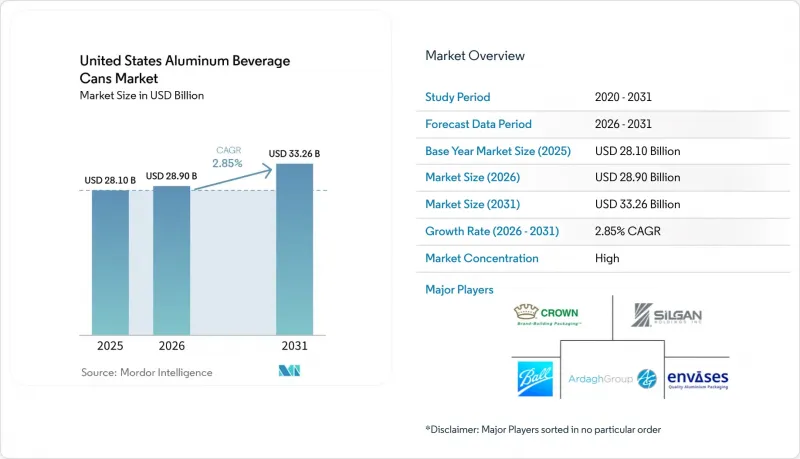
本報告按罐體類型(兩片式拉拔鐵罐、三片式焊接罐)、飲料類型(碳酸飲料、啤酒、風味酒精飲料/硬蘇打水、能量飲料等)、罐體容量(12盎司以下、12-16盎司、16-24盎司、24盎司以上)和配銷通路(直銷和間接銷售)進行細分。市場預測以美元計價。
美國鋁製飲料罐市場趨勢與洞察
來自非酒精飲料製造商的需求增加
能量飲料和即飲咖啡品牌傾向於使用鋁製容器來延長保存期限並打造品牌差異化。紅牛位於鳳凰城的工廠採用了一種「貫穿式」系統,將罐體製造和飲料填充整合在一起,在降低物流成本的同時,也確保了公司獨特的250毫升標準容量。根據全國零售商反映,鋁製容器可使貨架價格上漲6%至8%,使機能飲料生產商即使在激烈的市場競爭中也能維持利潤率。同樣,即飲茶生產商也利用鋁的遮光特性,與PET相比,將冷鏈成本降低了25%。這些容器的優勢促成了穩固的採購承諾,其中包括一份到2027年的軋延板合約。隨著市場需求從能量飲料擴展到運動營養飲料,小規模填充廠預計罐產量每年將進一步成長5%。
精釀啤酒和硬蘇打水的新產品上市數量激增。
2024年,精緻的12盎司硬蘇打水包裝成為標準包裝,多個品牌在風味酒精飲料市場取得了兩位數的佔有率。曾經依賴瓶裝的精釀啤酒廠,隨著像Ball這樣的大型加工商開始提供小批量印刷和薄壁材料,也紛紛轉向罐裝。然而,由於2024年所有合約數量都已分配完畢,現貨買家面臨高達60%的附加費,迫使許多小規模啤酒廠維持經銷商管理的庫存緩衝。雖然隨著產能的提高,價格差距正在縮小,但精緻的16盎司包裝仍然是新產品上市的主流選擇,因為消費者傾向於將罐裝與「新鮮」和「可回收」聯繫起來。隨著含酒精氣泡茶和烈酒基即飲飲料效仿硬蘇打水的行銷策略,預計這一趨勢還將持續。
輕質PET材質,符合繫繩瓶蓋法規
到2024年, 寶特瓶供應商的單位樹脂用量最多可減少10%,從而縮小了與易拉罐的交付差距。歐洲強制使用繫繩式瓶蓋促進了通用瓶蓋系統的發展,這種系統可供全球跨國飲料公司在區域範圍內採用,如果消費者接受度提高,可能會對易拉罐的銷量構成威脅。雖然各州的延伸生產者責任制(EPR)法規將增加所有包裝材料的合規成本,但鋁平均30天的回收週期仍具有優勢。為了應對PET瓶的崛起,易拉罐製造商正在測試更薄的瓶壁,並探索可印刷壓紋技術,以在不增加重量的情況下保持品牌在商店上的影響力。
細分市場分析
到2025年,兩片式拉拔鐵罐(D&I罐)將佔據美國鋁製飲料罐市場88.35%的佔有率,隨著性能的提升,預計到2031年,該細分市場將以3.58%的複合年成長率成長。波爾公司的「STARcan」系列罐體相比傳統的D&I罐體設計,重量已減輕高達8%,在金屬價格上漲的背景下,有助於提高利潤率。透過底部壓縮和合金改進逐步減輕重量,在保持高速填充所需的頂部承載強度的同時,降低了材料消耗。目前,整合視覺系統可偵測每個模製罐體,將缺陷率控制在百萬分之五十以下,最大限度地減少了廢品。
三片式焊接罐目前仍是特色飲料的小眾市場,尤其受到那些偏好獨特造型的消費者的青睞。但隨著FDA逐步淘汰PFAS,塗層重新設計勢在必行,三片式焊接罐的市場萎縮可能會加速。焊接罐的生產週期仍然比高速沖壓成型生產線慢約30%,這使得大規模生產的飲料製造商難以採用這種罐型。儘管如此,一些精釀飲料製造商仍然選擇三片式焊接罐,以營造復古的品牌形象。此外,正在研發的航太級塗層可望延長酸性果汁混合物的保存期限。然而,沖壓成型壓機所需的高昂資本投入仍然是小規模灌裝企業面臨的一大障礙,也限制了焊接罐的需求。
以硬蘇打水系列擴張為主導的風味酒精飲料預計將以3.95%的複合年成長率成長,並預計在2031年之前繼續銷售量啤酒這一旗艦產品。精緻的12盎司包裝在零售店中提供了強大的視覺差異化優勢,同時也滿足了注重卡路里攝取、偏好小份量的消費者的需求。碳酸飲料擁有廣泛的消費群體,但其成長速度落後於機能飲料品類,後者宣稱具有能量補充、增強免疫力和補水等功效。
即飲咖啡和茶利用鋁材阻隔氧氣和光線的阻隔性,使得以往需要昂貴冷藏運輸的產品能夠常溫運輸。隨著氮氣咖啡的興起,加壓鋁罐能夠產生穩定的咖啡油脂,促進了獨立烘焙商和本地罐頭生產商之間的合作。能量飲料在16盎司規格中保持銷售量成長,霧面飾面和紋理飾面進一步鞏固了鋁材在品牌塑造方面的重要作用。罐體內襯化學技術的創新使得添加低pH值的柑橘混合物成為可能,從而拓展了罐裝果汁雞尾酒的可能性。
其他好處:
- Excel格式的市場預測(ME)表
- 3個月的分析師支持
目錄
第1章:引言
- 研究假設和市場定義
- 調查範圍
第2章:調查方法
第3章執行摘要
第4章 市場狀況
- 市場促進因素
- 金屬包裝回收率高
- 罐頭食品的便利性和較長的保存期限
- 精釀啤酒和即飲飲料的蓬勃發展,帶動了罐頭食品的需求成長。
- 監理促進永續單一材料包裝
- 減重技術的創新降低了單位製造成本。
- 品牌所有者對循環包裝的承諾正在確保罐裝產品的出貨量。
- 市場限制因素
- 替代包裝形式(PET、軟包裝袋)的普及
- 鋁和鋼的投入價格波動
- 人們對雙酚A替代品遷移的擔憂正在影響消費者信心。
- 國內製罐用鋼板產能受限,構成供應風險。
- 產業價值鏈分析
- 波特五力分析
- 宏觀經濟因素對市場的影響
- 監理情勢
- 技術展望
第5章 市場規模與成長預測
- 材料類型
- 鋁
- 鋼
- 可結構
- 兩件套
- 三件式西裝
- 單體氣霧劑
- 按生產能力/規模
- 12盎司或更少
- 250~500 ml
- 500~1,000 ml
- 超過1000毫升
- 透過製造程序
- 熨燙(DandI)
- 繪製與重繪 (DRD)
- 衝擊擠壓
- 按最終用戶行業分類
- 食物
- 飲料
- 個人護理化妝品
- 製藥
- 油漆和工業化學品
- 汽車用液體和潤滑劑
- 其他終端用戶產業
第6章 競爭情勢
- 市場集中度
- 策略趨勢
- 市佔率分析
- 公司簡介
- Crown Holdings, Inc.
- Ball Corporation
- Silgan Holdings Inc.
- Mauser Packaging Solutions Holding Company
- Ardagh Metal Packaging SA
- DS Containers, LLC
- CCL Industries Inc.(CCL Container division)
- Independent Can Company
- Tecnocap SpA
- CAN-PACK SA
- Allstate Can Corporation
- Envases Universales Group
- Trivium Packaging BV
- Greif, Inc.
- Toyo Seikan Group Holdings, Ltd.
- Montebello Packaging Inc.
- Berlin Packaging LLC
- TricorBraun Inc.
- Crown Cork and Seal USA, Inc.
- Metal Container Corporation
第7章 市場機會與未來展望
According to Mordor Intelligence, the United States aluminum beverage cans market size in 2026 is estimated at USD 28.9 billion, growing from 2025 value of USD 28.10 billion with 2031 projections showing USD 33.26 billion, growing at 2.85% CAGR over 2026-2031.
This report is Segmented by Type (Two-Piece Draw-And-Iron D and I, and Three-Piece Welded), Beverage Types (Carbonated Soft Drinks, Beer, Flavoured Alcoholic Drinks/Hard Seltzer, Energy Drinks, and More), Can Size (<=12 Oz, 12-16 Oz, 16-24 Oz, >24 Oz), Distribution Channel (Direct Sales, and Indirect Sales). The Market Forecasts are Provided in Terms of Value (USD).
United States Aluminum Beverage Cans Market Trends and Insights
Growing Demand from Non-Alcoholic Beverage Producers
Energy drink and ready-to-drink coffee brands favor aluminum formats to boost shelf life and brand differentiation. Red Bull's Phoenix complex runs a through-the-wall setup that merges can making with beverage filling, trimming logistics costs, and protecting its proprietary 250 ml format. National retailers report that aluminum containers lift premium shelf pricing by 6-8%, allowing functional beverage makers to maintain margins despite stiff competition. RTD tea producers similarly leverage aluminum's light barrier to save 25% in cold-chain expenses compared with PET. These format advantages are translating into firm purchase commitments that lock in rolled sheet contracts through 2027. As demand widens beyond energy drinks into sports nutrition beverages, small fillers expect can volumes to rise another 5% annually.
Surge in Craft Beer and Hard Seltzer Launches
Hard seltzer's sleek 12 oz profile became a packaging standard after multiple brands captured double-digit share in flavored alcohol sales during 2024. Craft breweries that once relied on bottles migrated to cans as large converters like Ball offered short-run graphics and lighter gauge material. However, spot buyers paid up to 60% premiums in 2024 when contract volumes were fully allocated, forcing many small breweries to secure distributor-managed inventory buffers. With capacity additions coming online, price gaps are narrowing, yet sleek and 16 oz formats continue to dominate new product launches as consumers associate cans with freshness and recyclability. The trend is likely to persist as alcoholic sparkling teas and spirit-based RTDs replicate hard seltzer's marketing playbook.
PET Lightweighting and Tethered-Cap Compliance
Competing PET bottle suppliers trimmed resin by up to 10% per unit in 2024, narrowing the delivered-cost gap with cans. European tethered-cap mandates inspired a pipeline of universal lid systems that global beverage multinationals could adopt across regions, threatening can volumes if consumer acceptance grows. State-level extended producer responsibility legislation will add further compliance costs to all packaging materials, though aluminum's 30-day average recycling loop remains an advantage. To counter PET's advances, can makers are testing even thinner gauges and exploring printable embossing to maintain brand shelf impact without extra weight.
Other drivers and restraints analyzed in the detailed report include:
- Corporate ESG Targets Favoring Infinitely Recyclable Packaging
- Aluminum Smelter Capacity Expansions in North America
- Domestic Aluminum Price Volatility from Section 232 Tariffs
For complete list of drivers and restraints, kindly check the Table Of Contents.
Segment Analysis
Two-piece draw-and-iron cans accounted for 88.35% of the United States aluminum beverage cans market share in 2025, and performance gains should lift this segment at a 3.58% CAGR to 2031. Ball's STARcan family already delivers up to 8% weight savings versus legacy D and I designs, reinforcing margins as metal premiums rise. Incremental lightweighting through base compression and alloy refinements reduces material consumption while preserving the top-load strength required for high-speed filling. Embedded vision systems now inspect every formed shell, cutting defect rates below 50 parts per million and minimizing scrap.
Three-piece welded cans remain a niche for specialty beverages that favor distinctive shapes, yet the FDA's PFAS phase-out will drive coating redesign and could accelerate their decline. Production cycle times for welded formats remain roughly 30% slower than high-speed D and I lines, discouraging volume beverages from adopting them. Nonetheless, select craft producers opt for three-piece to create retro branding cues, and aerospace-grade coatings under development may extend shelf life for acidic juice blends. Capital requirements for D and I presses, however, still deter small fillers, leaving limited pockets of demand for welded cans.
Flavored alcoholic beverages, led by hard seltzer line extensions, are forecast to post a 3.95% CAGR and will continue outpacing core beer volumes through 2031. Sleek 12-oz formats deliver strong visual differentiation at retail while catering to calorie-conscious consumers who prefer smaller serving sizes. Carbonated soft drinks retain a broad consumption base, but growth trails functional beverage categories that promise energy, immunity, or hydration benefits.
RTD coffee and tea exploit aluminum's barrier to oxygen and light, allowing ambient shipping for products that once required costly refrigeration. As nitro coffee grows, pressurized aluminum containers provide consistent crema, sparking partnerships between independent roasters and regional canners. Energy drinks sustain volume growth in 16 oz sizes, cementing aluminum's role in high-impact branding with matte and textured finishes. Innovations in can lining chemistry now tolerate low-pH citrus mixes, opening potential for canned juice cocktails.
Complete Report Scope:
- By Material Type
- Aluminium
- Steel
- By Can Structure
- Two-Piece
- Three-Piece
- Monobloc Aerosol
- By Capacity / Size
- <=12 oz
- 250-500 ml
- 500-1,000 ml
- >1,000 ml
- By Manufacturing Process
- Drawn and Ironed (DandI)
- Drawn and Redrawn (DRD)
- Impact Extrusion
- By End-User Industry
- Food
- Beverage
- Personal Care and Cosmetics
- Pharmaceuticals
- Paints and Industrial Chemicals
- Automotive Fluids and Lubricants
- Other End-User Industry
List of Companies Covered in this Report:
- Crown Holdings, Inc.
- Ball Corporation
- Silgan Holdings Inc.
- Mauser Packaging Solutions Holding Company
- Ardagh Metal Packaging S.A.
- DS Containers, LLC
- CCL Industries Inc. (CCL Container division)
- Independent Can Company
- Tecnocap S.p.A.
- CAN-PACK S.A.
- Allstate Can Corporation
- Envases Universales Group
- Trivium Packaging B.V.
- Greif, Inc.
- Toyo Seikan Group Holdings, Ltd.
- Montebello Packaging Inc.
- Berlin Packaging LLC
- TricorBraun Inc.
- Crown Cork and Seal USA, Inc.
- Metal Container Corporation
Additional Benefits:
- The market estimate (ME) sheet in Excel format
- 3 months of analyst support
TABLE OF CONTENTS
1 INTRODUCTION
- 1.1 Study Assumptions and Market Definition
- 1.2 Scope of the Study
2 RESEARCH METHODOLOGY
3 EXECUTIVE SUMMARY
4 MARKET LANDSCAPE
- 4.1 Market Drivers
- 4.1.1 High recyclability rates of metal packaging
- 4.1.2 Convenience and extended shelf life offered by canned foods
- 4.1.3 Craft-beer and RTD beverage boom boosting can demand
- 4.1.4 Regulatory push for sustainable, single-material packaging
- 4.1.5 Lightweighting innovations lowering per-unit can cost
- 4.1.6 Brand-owner circular-packaging pledges securing can volumes
- 4.2 Market Restraints
- 4.2.1 Proliferation of alternate packaging formats (PET, pouches)
- 4.2.2 Volatility in aluminum and steel input prices
- 4.2.3 BPA-substitute migration concerns affecting consumer trust
- 4.2.4 Domestic can-sheet capacity constraints creating supply risk
- 4.3 Industry Value Chain Analysis
- 4.4 Porter's Five Forces Analysis
- 4.4.1 Bargaining Power of Suppliers
- 4.4.2 Bargaining Power of Buyers
- 4.4.3 Threat of New Entrants
- 4.4.4 Threat of Substitutes
- 4.4.5 Intensity of Competitive Rivalry
- 4.5 The Impact of Macroeconomic Factors on the Market
- 4.6 Regulatory Landscape
- 4.7 Technological Outlook
5 MARKET SIZE AND GROWTH FORECASTS (VALUE)
- 5.1 By Material Type
- 5.1.1 Aluminium
- 5.1.2 Steel
- 5.2 By Can Structure
- 5.2.1 Two-Piece
- 5.2.2 Three-Piece
- 5.2.3 Monobloc Aerosol
- 5.3 By Capacity / Size
- 5.3.1 <=12 oz
- 5.3.2 250-500 ml
- 5.3.3 500-1,000 ml
- 5.3.4 >1,000 ml
- 5.4 By Manufacturing Process
- 5.4.1 Drawn and Ironed (DandI)
- 5.4.2 Drawn and Redrawn (DRD)
- 5.4.3 Impact Extrusion
- 5.5 By End-User Industry
- 5.5.1 Food
- 5.5.2 Beverage
- 5.5.3 Personal Care and Cosmetics
- 5.5.4 Pharmaceuticals
- 5.5.5 Paints and Industrial Chemicals
- 5.5.6 Automotive Fluids and Lubricants
- 5.5.7 Other End-User Industry
6 COMPETITIVE LANDSCAPE
- 6.1 Market Concentration
- 6.2 Strategic Moves
- 6.3 Market Share Analysis
- 6.4 Company Profiles (includes Global-level Overview, Market-level Overview, Core Segments, Financials as available, Strategic Information, Market Rank/Share, Products and Services, and Recent Developments)
- 6.4.1 Crown Holdings, Inc.
- 6.4.2 Ball Corporation
- 6.4.3 Silgan Holdings Inc.
- 6.4.4 Mauser Packaging Solutions Holding Company
- 6.4.5 Ardagh Metal Packaging S.A.
- 6.4.6 DS Containers, LLC
- 6.4.7 CCL Industries Inc. (CCL Container division)
- 6.4.8 Independent Can Company
- 6.4.9 Tecnocap S.p.A.
- 6.4.10 CAN-PACK S.A.
- 6.4.11 Allstate Can Corporation
- 6.4.12 Envases Universales Group
- 6.4.13 Trivium Packaging B.V.
- 6.4.14 Greif, Inc.
- 6.4.15 Toyo Seikan Group Holdings, Ltd.
- 6.4.16 Montebello Packaging Inc.
- 6.4.17 Berlin Packaging LLC
- 6.4.18 TricorBraun Inc.
- 6.4.19 Crown Cork and Seal USA, Inc.
- 6.4.20 Metal Container Corporation
7 MARKET OPPORTUNITIES AND FUTURE OUTLOOK
- 7.1 White-space and Unmet-need Assessment

 鋁製飲料罐市場規模、佔有率和趨勢分析報告:按罐容量、飲料、地區和細分市場預測(2026-2033 年)
 飲料罐市場規模及預測(2021-2034)、全球及區域佔有率、趨勢及成長機會分析報告:按材料類型、飲料類型、結構、罐體尺寸及地區分類
 飲料罐市場-2026-2032年全球市場預測
 2026-2030年全球飲料罐市場
 飲料罐包裝市場預測至2034年-按材料類型、結構、罐體形狀、容量、飲料類型、最終用戶和地區分類的全球分析
 2026年全球鋁瓶市場報告
 2026 年至 2035 年飲料罐市場的商業機會、成長要素、產業趨勢分析與預測。全球飲料罐市場:市場規模、佔有率和趨勢分析(按材料、應用和地區分類),細分市場預測(2026-2033 年)
 鋁瓶市場規模、佔有率、成長及全球產業分析:按類型、應用和區域分類,預測2026-2034年全球飲料罐市場規模、佔有率、趨勢和成長分析報告(2026-2034)