


 |
市場調查報告書
商品編碼
2124649
熱轉印標籤:市場佔有率分析、產業趨勢與統計、成長預測(2026-2031)Thermal Transfer Label - Market Share Analysis, Industry Trends & Statistics, Growth Forecasts (2026 - 2031) |
||||||

※ 本網頁內容可能與最新版本有所差異。詳細情況請與我們聯繫。
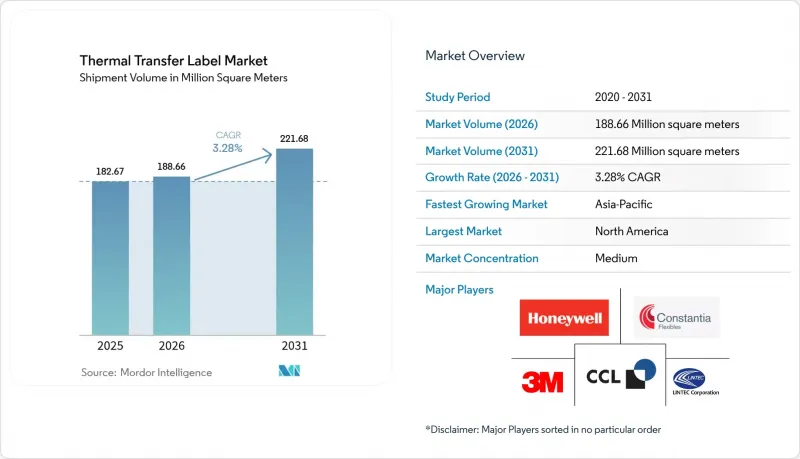
根據 Mordor Intelligence 預測,熱轉印標籤的市場規模預計將從 2025 年的 1.8267 億平方米擴大到 2026 年的 1.8866 億平方米,並將從 2026 年到 2031 年以 3.28% 的複合年成長率成長,到 2016 年達到 2016 億平方米。
本報告按材料(紙本、聚酯(PET)等)、色帶類型(全蠟、蠟樹脂混合、全樹脂)、黏合劑類型(永久性、可剝離式等)、終端用戶產業(食品飲料、醫療製藥、工業產品等)和地區(北美、歐洲等)進行細分。市場預測以體積(百萬平方公尺)為單位。
全球熱轉印標籤市場趨勢及洞察
醫療領域強制單劑量給藥和檢體追蹤
2024年頒布的《藥品供應鏈安全法案》的關鍵要求規定,所有處方藥包裝都必須包含一個在整個分銷和儲存過程中清晰可辨的標準化數位識別碼。因此,製藥廠商正在指定使用能夠承受滅菌和冷鏈溫度偏差的高耐久性熱轉印色帶。像Cardinal Health這樣的合約包裝公司正在其每月處理數百萬個單劑量包裝的工廠中整合序列化模組。實驗室網路也正在採用類似的檢體識別標準,從而將熱轉印標籤市場擴展到診斷試劑管瓶和玻片的追蹤領域。雖然新型數字顯示標籤可以顯示狀態訊息,但在受監管的工作流程中,熱轉印紙本仍然是必不可少的備份。這種轉變正在創造新的基準需求,推動對能夠耐受乙醇和高壓釜的高樹脂含量色帶的需求成長。
高溫電子設備生產線中聚酯標籤的應用
無鉛焊料和細間距元件的採用,使得印刷電路基板的回流焊接溫度接近 260 度C 。耐熱性低至度C的聚酯標籤可在波峰焊接和清洗過程中保護可追溯性數據,而優質聚醯亞胺標籤則能承受航太和汽車行業的高溫環境,最高可達 300 度C 。目前,亞洲的製造工廠正致力於將這些基材與具有類似耐熱性的 RFID嵌體相結合,而色帶的樹脂成分也正轉向矽改質樹脂和陶瓷填充樹脂。 Brady 公司專為嚴苛環境設計的聚酯系列產品還具有抗紫外線和耐溶劑性能,兼具目前市場所需的耐熱性、耐化學性和戶外耐久性。因此,高溫電子市場的成長正推動熱轉印標籤市場以超過平均複合年成長率的速度成長。
特種樹脂價格波動
熱轉印標籤基材成本主要來自聚乙烯和聚丙烯等原料成本。近期供應中斷導致特種樹脂溢價飆漲40%,利潤微薄的加工商不願囤積庫存。由於熱轉印標籤需要均勻的塗層黏度,製造商不能簡單地改用更便宜的替代品,而必須重新認證最終用戶的列印設定檔。北美供應商受益於頁岩氣的價格優勢,而歐洲加工商則面臨能源成本飆升和嚴格的碳排放稅,進一步擠壓了利潤空間。雖然避險和從多個供應商採購等策略可以降低風險,但頻繁的價格談判會阻礙客戶簽訂長期契約,從而減緩熱轉印標籤市場的擴張。
細分市場分析
紙張成本低廉且易於取得,常用作運輸紙箱標籤,預計到2025年將佔據熱轉印標籤市場47.86%的佔有率。儘管隨著小包裹的增加,該領域的出貨量持續成長,但價格敏感度限制了收入成長。預計到2031年,聚丙烯的複合年成長率將達到7.15%,因為化學品桶、油過濾器和管瓶等包裝材料正逐漸轉向使用防潮薄膜。聚乙烯是可壓縮包裝材料的主要材料,但其成長速度相對較慢,僅為個位數中段。聚酯和聚醯亞胺雖然市佔率較小,但盈利豐厚,因為它們是高溫電子產品子部門的基礎材料。西密西根大學的可再製漿矽膠離型紙技術旨在提高紙張的可回收性,從而有望在長期內鞏固其市場主導地位。隨著加工商將自身永續性目標與永續發展目標結合,所有基材的再生材料測試也在不斷推進,這表明在熱轉印標籤市場中,材料選擇的環境性能如今已與經濟因素同等重要。
儘管紙張在成本敏感型物流領域的主導地位可能仍將持續,但監管政策的變化正在重塑高階市場。藥品序列化法規要求基材能夠承受高壓釜和低溫環境,這導致塗層合成薄膜的市場佔有率不斷擴大。電子組裝製造商對能夠耐受助焊劑溶劑的UL認證聚酯材料的需求日益成長。 DNP的V300樹脂色帶已通過認證,可在90%的此類介質上列印,其更佳的兼容性簡化了加工商的庫存管理。因此,材料供應商需要在紙張產能和對高利潤合成材料的投資之間取得平衡,才能在熱轉印標籤市場中獲得價值。
到2025年,全蠟碳帶將佔據熱轉印標籤市場41.85%的佔有率,滿足了運輸和庫存標籤的巨大需求。然而,由於高溫和高溶劑環境的影響,全樹脂碳帶的複合年成長率僅為6.21%。蠟樹脂混合碳帶憑藉其抗刮性和合理的價格填補了這一市場空白,在汽車零件分銷和化學倉庫標籤領域日益普及。 DNP碳帶的結構由五層精心設計的塗層組成:背塗層、薄膜、底塗層、油墨層和麵塗層,每一層都針對散熱和列印頭保護進行了最佳化。 ARMOR-IIMAK的無溶劑塗層製程降低了VOC排放,確保碳帶生產設施符合ISO 14001標準,並強化了DNP對永續性,而這正是買家日益關注的重點。
電子、航太和醫療設備製造業的成長推動了對樹脂需求的增加。波峰焊接生產線要求即使在260 度C下反覆循環後,列印密度仍能保持穩定,而蠟基化學成分無法達到此性能水準。加工商透過異丙醇擦拭測試來證明條碼的長期可讀性,進而提升產品提升銷售。同時,注重價格的物流公司仍在瓦楞紙箱等暴露風險極低的地區指定使用蠟基材料。這種兩極化使得蠟基材料的銷售量居高不下,但熱轉印標籤市場的利潤正逐漸轉向先進的樹脂產品。
區域分析
預計到2025年,北美將佔據熱轉印標籤市場35.10%的佔有率,主要得益於美國食品藥物管理局(FDA)嚴格的序列化法規以及不斷發展的電子商務基礎設施。美國小包裹運輸公司每天列印數億張標籤,可靠的機器可讀性推動了勞動力的減少。加拿大和墨西哥的需求進一步穩定,這主要得益於汽車車輛識別碼(VIN)和跨境合規性。斑馬技術公司(Zebra Technologies)2025年第一季淨銷售額成長11.3%,達13.08億美元。這表明自動化預算正在轉化為對耗材的穩定需求。雖然溫和的GDP成長限制了銷售量的成長,但嚴格的法規也為該地區的熱轉印標籤市場設定了較高的下限。
預計到2031年,亞太地區將達到6.92%的最高複合年成長率,主要得益於中國、韓國和台灣電子產業叢集對耐熱基材的需求旺盛。印度疫苗和學名藥出口的蓬勃發展正在加速序列化系統的應用,而東協電商巨頭則在投資建設全自動化的履約中心。 DNP Imagingcomm Asia正在擴大其本地的色帶塗佈生產線,以縮短前置作業時間並避免外匯波動風險。儘管產能和價格是該地區的關鍵考慮因素,但向聚酯和樹脂產品價值的轉變正推動銷售成長,其成長速度超過了每平方公尺的成長率。
在歐洲,嚴格的包裝廢棄物法規與無底紙標籤的主導應用之間取得了平衡。 CELAB-Europe的目標是到2025年實現75%的離型紙回收率,並鼓勵加工商試行可回收和無底紙標籤。德國和義大利對高耐久性辨識資訊的需求依然強勁,汽車和食品機械的出口也保持旺盛;同時,法國和英國正在加強化妝品和酒類產業的防偽措施。受制裁影響,來自俄羅斯的出口下降,但隨著海灣國家建立醫藥中心,中東的需求正在成長。非洲市場尚處於起步階段,但農產品出口對可追溯冷鏈標籤的需求使其成為一個充滿潛力的市場。在南美洲,以巴西為首的甘蔗乙醇桶標籤和依賴冷藏黏合劑的牛肉出口正在推動市場發展。這些趨勢共同推動了整個熱轉印標籤市場積極進行區域性創新。
其他好處:
- Excel格式的市場預測(ME)表
- 3個月的分析師支持
目錄
第1章:引言
- 研究假設和市場定義
- 調查範圍
第2章:調查方法
第3章執行摘要
第4章 市場狀況
- 市場概覽
- 市場促進因素
- 醫療領域強制單劑量給藥和檢體追蹤
- 高溫環境下電子設備生產線中聚酯標籤的應用現狀
- 電子商務履約自動化(條碼和RFID升級)
- 在速食店引進無底紙TT介質
- 利用區塊鏈技術的「智慧標籤」實現防偽和可追溯性。
- 市場限制因素
- 特種樹脂價格波動
- 小批量包裝印刷向環保溶劑噴墨印刷過渡
- 矽膠處理離型紙回收的瓶頸
- 供應鏈分析
- 監理情勢
- 技術展望
- 波特五力分析
第5章 市場規模與成長預測
- 材料
- 紙
- 聚酯(PET)
- 聚丙烯(PP)
- 聚乙烯(PE)
- 其他材料
- 按絲帶類型
- 全蠟
- 蠟和樹脂
- 全樹脂
- 黏合劑類型
- 永恆的
- 可剝離
- 用於冷凍
- 高黏性/特殊用途
- 按最終用戶行業分類
- 食品/飲料
- 醫療和藥品
- 物流/運輸
- 工業產品
- 半導體和電子學
- 其他終端用戶產業
- 按地區
- 北美洲
- 美國
- 加拿大
- 墨西哥
- 歐洲
- 德國
- 英國
- 法國
- 義大利
- 西班牙
- 俄羅斯
- 其他歐洲國家
- 亞太地區
- 中國
- 印度
- 日本
- 韓國
- 澳洲和紐西蘭
- 其他亞太國家
- 中東和非洲
- 中東
- 阿拉伯聯合大公國
- 沙烏地阿拉伯
- 土耳其
- 其他中東國家
- 非洲
- 南非
- 奈及利亞
- 埃及
- 其他非洲國家
- 中東
- 南美洲
- 巴西
- 阿根廷
- 其他南美國家
- 北美洲
第6章 競爭情勢
- 市場集中度
- 策略趨勢
- 市佔率分析
- 公司簡介
- CCL Industries
- 3M
- Lintec
- Constantia Flexibles
- Honeywell International
- Ricoh
- Zebra Technologies
- SATO Holdings
- Avery Dennison
- Brady Corporation
- Brother Industries
- Seiko Epson
- TSC Auto ID
- BIXOLON
- ARMOR-IIMAK
- DNP Imagingcomm
- ITW Labels
- RRD
- Weber Packaging Solutions
- UPM Raflatac
第7章 市場機會與未來展望
According to Mordor Intelligence, the thermal transfer label market size is expected to grow from 182.67 million m2 in 2025 to 188.66 million m2 in 2026 and is forecast to reach 221.68 million m2 by 2031 at 3.28% CAGR over 2026-2031.
This report is Segmented by Material (Paper, Polyester (PET), and More), Ribbon Type (Full Wax, Wax-Resin, Full Resin), Adhesive Type (Permanent, Removable, and More), End-User Industry (Food and Beverages, Healthcare and Pharmaceuticals, Industrial Goods, and More), and Geography (North America, Europe, and More). The Market Forecasts are Provided in Terms of Volume (Million Square Meters).
Global Thermal Transfer Label Market Trends and Insights
Healthcare Unit-Dose and Specimen-Tracking Mandates
Drug Supply Chain Security Act milestones that took effect in 2024 require every prescription package to carry a standardized numerical identifier that remains legible through distribution and storage. Pharmaceutical lines therefore specify high-durability thermal transfer ribbons whose printed codes withstand sterilization and cold-chain excursions. Contract packagers such as Cardinal Health integrate serialization modules into equipment that processes millions of unit doses each month. Laboratory networks embrace the same standards for specimen identification, extending the thermal transfer label market into diagnostic vials and slide tracking. Emerging digital display labels offer status readouts, yet thermal transfer remains the mandated hard-copy backup inside regulated workflows. The shift locks in new baseline volumes and amplifies demand for resin-rich ribbons able to resist ethanol and autoclave cycles.
Polyester Label Uptake in High-Temperature Electronics Lines
Lead-free solder and finer pitch components expose printed circuit boards to reflow temperatures near 260 °C. Polyester labels rated to 150 °C protect traceability data during wave solder and cleaning, while premium polyimide formats survive 300 °C aerospace and automotive profiles. Asian fabs now combine these substrates with RFID inlays that endure the same heat, pushing ribbon chemistry toward silicone-modified and ceramic-filled resins. Brady Corporation's harsh-environment polyester series further adds UV and solvent resistance, illustrating the blend of thermal, chemical, and outdoor safeguards now expected. Growth in high-temperature electronics therefore lifts the thermal transfer label market above the average CAGR.
Volatility in Specialty Resin Pricing
Polyethylene and polypropylene feedstocks account for most ribbon base film costs. When specialty resin surcharges spiked 40% during recent supply disruptions, converters with thin margins hesitated to hold inventory. Thermal transfer labels require uniform coating viscosity, so producers cannot simply downgrade to cheaper alternatives without requalifying end-user print profiles. North American suppliers enjoy shale-based gas price advantages, but European processors face higher energy bills and aggressive carbon taxes that further compress margins. Hedging and multi-sourcing strategies mitigate risk, yet frequent price renegotiations dampen customer willingness to lock in long-term contracts, tempering expansion of the thermal transfer label market.
Other drivers and restraints analyzed in the detailed report include:
- E-Commerce Fulfilment Automation (Barcode and RFID Upgrades)
- Adoption of Liner-Free TT Media in Quick-Service Restaurants
- Shift to Eco-Solvent Inkjet in Short-Run Packaging
For complete list of drivers and restraints, kindly check the Table Of Contents.
Segment Analysis
Paper accounted for 47.86% of the thermal transfer label market share in 2025, thanks to its low cost and ready availability for shipping carton labels. The segment's volume continues to expand alongside parcel growth, but price sensitivity limits revenue growth. Polypropylene is forecast at a 7.15% CAGR through 2031 as chemical drums, oil filters, and pharmaceutical vials migrate to moisture-resistant films. Polyethylene supports squeezable packaging, albeit at slower mid-single-digit rates. Polyester and polyimide, together, represent a smaller yet lucrative slice, as they anchor the high-temperature electronics sub-sector. Repulpable silicone release liner technology from Western Michigan University aims to boost paper's recyclability credentials, potentially prolonging its dominance. Recycled-content trials advance across all substrates as converters align with corporate sustainability goals, indicating that environmental performance now rivals economics in material selection within the thermal transfer label market.
Paper's primacy in cost-driven logistics will persist, but regulatory change reshapes the premium tiers. Pharmaceutical serialization rules necessitate substrates that handle autoclave and cryogenic conditions, tilting share toward coated synthetic films. Electronics assemblers insist on UL-recognized polyester able to survive flux solvents. DNP's V300 resin ribbon, certified to print on 90% of these media, illustrates cross-compatibility gains that simplify converter inventories. Material suppliers must therefore balance paper capacity with investment in higher-margin synthetics to capture value in the thermal transfer label market.
Full wax ribbons supplied 41.85% of the thermal transfer label market size in 2025, as they cater to the vast shipping and inventory tag base. Yet high-temperature and solvent-rich environments fuel a 6.21% CAGR for full resin grades. Wax-resin hybrids bridge the gap by offering scratch resistance at a moderate premium, making them popular in automotive parts distribution and for chemical warehouse labels. DNP ribbon architecture reveals five engineered layers backcoat, film, primer, ink, overcoat each tuned for heat dispersion and print head protection. Solvent-free coating processes from ARMOR-IIMAK reduce VOC emissions, aligning ribbon plants with ISO 14001 standards and bolstering the sustainability narrative that buyers increasingly demand.
Demand for resin escalates in parallel with the growth of electronics, aerospace, and medical instrument manufacturing. Wave soldering lines require print darkness retention after multiple 260 °C cycles, a capability that surpasses the capabilities of wax-based chemistry. Converters upsell by demonstrating lifetime barcode readability under isopropyl alcohol wipe tests. Meanwhile, price-conscious logistics operators continue to specify wax for cartons where exposure risks are minimal. This bifurcation keeps wax volumes high but shifts profit pools toward advanced resin within the thermal transfer label market.
Complete Report Scope:
- By Material
- Paper
- Polyester (PET)
- Polypropylene (PP)
- Polyethylene (PE)
- Other Materials
- By Ribbon Type
- Full Wax
- Wax-Resin
- Full Resin
- By Adhesive Type
- Permanent
- Removable
- Freezer-grade
- High-Tack / Specialty
- By End-user Industry
- Food and Beverages
- Healthcare and Pharmaceuticals
- Logistics and Transportation
- Industrial Goods
- Semiconductor and Electronics
- Other End-user Industry
- By Geography
- North America
- United States
- Canada
- Mexico
- Europe
- Germany
- United Kingdom
- France
- Italy
- Spain
- Russia
- Rest of Europe
- Asia-Pacific
- China
- India
- Japan
- South Korea
- Australia and New Zealand
- Rest of Asia-Pacific
- Middle East and Africa
- Middle East
- United Arab Emirates
- Saudi Arabia
- Turkey
- Rest of Middle East
- Africa
- South Africa
- Nigeria
- Egypt
- Rest of Africa
- Middle East
- South America
- Brazil
- Argentina
- Rest of South America
- North America
Geography Analysis
North America commanded 35.10% of the thermal transfer label market share in 2025 on the back of strict FDA serialization and expansive e-commerce infrastructure. United States parcel carriers print hundreds of millions of labels daily, driving head-count reductions through reliable machine readability. Canada and Mexico add automotive VIN and cross-border compliance volumes, further stabilizing demand. Zebra Technologies reported 11.3% net sales growth to USD 1,308 million in Q1 2025, demonstrating how automation budgets translate into steady consumable demand. Moderate GDP growth limits unit expansion, yet regulatory rigidity preserves a high floor for the regional thermal transfer label market.
The Asia-Pacific region is projected to deliver the highest 6.92% CAGR to 2031, driven by electronics clusters in China, South Korea, and Taiwan that require heat-resistant substrates. India's vaccine and generic drug export boom accelerates serialization installations, while ASEAN e-commerce giants invest in fully automated fulfillment hubs. DNP Imagingcomm Asia scales local ribbon coating lines to shorten lead times and hedge currency swings. The region prioritizes capacity and price, yet value migration to polyester and resin products elevates revenue faster than square-meter growth.
Europe balances stringent packaging waste rules with leadership in liner-free adoption. CELAB-Europe targets a 75% recycling rate for release liners by 2025, pushing converters to trial recyclable or linerless formats. Germany and Italy sustain automotive and food machinery exports that require durable identification, while France and the United Kingdom enforce counterfeit deterrence in cosmetics and spirits. Russia's volumes contract due to sanctions, but Middle East demand rises as Gulf states build pharmaceutical hubs. Africa's growth is nascent but promising where agriculture exports call for traceable cold-chain labeling. South America, led by Brazil, captures sugarcane ethanol drum labels and beef exports that rely on freezer-grade adhesives. Together these dynamics keep geography-specific innovation active across the thermal transfer label market.
- CCL Industries
- 3M
- Lintec
- Constantia Flexibles
- Honeywell International
- Ricoh
- Zebra Technologies
- SATO Holdings
- Avery Dennison
- Brady Corporation
- Brother Industries
- Seiko Epson
- TSC Auto ID
- BIXOLON
- ARMOR-IIMAK
- DNP Imagingcomm
- ITW Labels
- RRD
- Weber Packaging Solutions
- UPM Raflatac
Additional Benefits:
- The market estimate (ME) sheet in Excel format
- 3 months of analyst support
TABLE OF CONTENTS
1 INTRODUCTION
- 1.1 Study Assumptions and Market Definition
- 1.2 Scope of the Study
2 RESEARCH METHODOLOGY
3 EXECUTIVE SUMMARY
4 MARKET LANDSCAPE
- 4.1 Market Overview
- 4.2 Market Drivers
- 4.2.1 Healthcare unit-dose and specimen-tracking mandates
- 4.2.2 Polyester label uptake in high-temperature electronics lines
- 4.2.3 E-commerce fulfilment automation (barcode and RFID upgrades)
- 4.2.4 Adoption of liner-free TT media in quick-service restaurants
- 4.2.5 Blockchain-ready "smart labels" for anti-counterfeit traceability
- 4.3 Market Restraints
- 4.3.1 Volatility in specialty resin pricing
- 4.3.2 Shift to eco-solvent inkjet in short-run packaging
- 4.3.3 Recycling bottlenecks for siliconised release liners
- 4.4 Supply-Chain Analysis
- 4.5 Regulatory Landscape
- 4.6 Technological Outlook
- 4.7 Porter's Five Forces Analysis
- 4.7.1 Threat of New Entrants
- 4.7.2 Bargaining Power of Buyers
- 4.7.3 Bargaining Power of Suppliers
- 4.7.4 Threat of Substitutes
- 4.7.5 Competitive Rivalry
5 MARKET SIZE AND GROWTH FORECASTS (VOLUME)
- 5.1 By Material
- 5.1.1 Paper
- 5.1.2 Polyester (PET)
- 5.1.3 Polypropylene (PP)
- 5.1.4 Polyethylene (PE)
- 5.1.5 Other Materials
- 5.2 By Ribbon Type
- 5.2.1 Full Wax
- 5.2.2 Wax-Resin
- 5.2.3 Full Resin
- 5.3 By Adhesive Type
- 5.3.1 Permanent
- 5.3.2 Removable
- 5.3.3 Freezer-grade
- 5.3.4 High-Tack / Specialty
- 5.4 By End-user Industry
- 5.4.1 Food and Beverages
- 5.4.2 Healthcare and Pharmaceuticals
- 5.4.3 Logistics and Transportation
- 5.4.4 Industrial Goods
- 5.4.5 Semiconductor and Electronics
- 5.4.6 Other End-user Industry
- 5.5 By Geography
- 5.5.1 North America
- 5.5.1.1 United States
- 5.5.1.2 Canada
- 5.5.1.3 Mexico
- 5.5.2 Europe
- 5.5.2.1 Germany
- 5.5.2.2 United Kingdom
- 5.5.2.3 France
- 5.5.2.4 Italy
- 5.5.2.5 Spain
- 5.5.2.6 Russia
- 5.5.2.7 Rest of Europe
- 5.5.3 Asia-Pacific
- 5.5.3.1 China
- 5.5.3.2 India
- 5.5.3.3 Japan
- 5.5.3.4 South Korea
- 5.5.3.5 Australia and New Zealand
- 5.5.3.6 Rest of Asia-Pacific
- 5.5.4 Middle East and Africa
- 5.5.4.1 Middle East
- 5.5.4.1.1 United Arab Emirates
- 5.5.4.1.2 Saudi Arabia
- 5.5.4.1.3 Turkey
- 5.5.4.1.4 Rest of Middle East
- 5.5.4.2 Africa
- 5.5.4.2.1 South Africa
- 5.5.4.2.2 Nigeria
- 5.5.4.2.3 Egypt
- 5.5.4.2.4 Rest of Africa
- 5.5.4.1 Middle East
- 5.5.5 South America
- 5.5.5.1 Brazil
- 5.5.5.2 Argentina
- 5.5.5.3 Rest of South America
- 5.5.1 North America
6 COMPETITIVE LANDSCAPE
- 6.1 Market Concentration
- 6.2 Strategic Moves
- 6.3 Market Share Analysis
- 6.4 Company Profiles (includes Global overview, Market overview, Core segments, Financials, Strategic info, Market share, Products and Services, Recent Developments)
- 6.4.1 CCL Industries
- 6.4.2 3M
- 6.4.3 Lintec
- 6.4.4 Constantia Flexibles
- 6.4.5 Honeywell International
- 6.4.6 Ricoh
- 6.4.7 Zebra Technologies
- 6.4.8 SATO Holdings
- 6.4.9 Avery Dennison
- 6.4.10 Brady Corporation
- 6.4.11 Brother Industries
- 6.4.12 Seiko Epson
- 6.4.13 TSC Auto ID
- 6.4.14 BIXOLON
- 6.4.15 ARMOR-IIMAK
- 6.4.16 DNP Imagingcomm
- 6.4.17 ITW Labels
- 6.4.18 RRD
- 6.4.19 Weber Packaging Solutions
- 6.4.20 UPM Raflatac
7 MARKET OPPORTUNITIES AND FUTURE OUTLOOK
- 7.1 White-space and Unmet-Need Assessment


